Google’s May 2026 Core Update finished rolling out in early June, and the pattern of winners and losers this cycle is unusually clear for anyone running a behavioral health website.
Home services, legal, and healthcare took the biggest ranking shifts, and among healthcare sites, the properties that lost the most visibility were the ones built on templated location pages and thin YMYL content.
Even the largest health authorities in the country did not escape it. Cleveland Clinic dropped 11.5 visibility points. Merck Manuals dropped 18.8%. KidsHealth dropped 19.4%.
Mayo Clinic, WebMD, MedlinePlus, and Johns Hopkins all lost substantial ground.
At the same time, a specific type of medical site gained visibility across the update: sites with board-certified contributor networks, peer-reviewed sourcing practices, and clear editorial review processes.
The signal Google is sending, extended out from the 2018 Medic update that first tightened E-E-A-T for YMYL content, is that surface-level authority markers are no longer sufficient. The bar has moved to demonstrable editorial process.
For a treatment center site, that shift matters twice. It matters for the pages you already have, because templated location pages and thin service pages are now actively risky rather than passively underperforming.
And it matters for what you build next, because the winners of this update are demonstrating a pattern any behavioral health provider can follow if the operator is willing to do the editorial work.
This piece is the operator’s read on the May 2026 update: what it rewarded and penalized, why templated location pages are structurally exposed under the new logic, and the specific editorial infrastructure a treatment center needs to look like a winner next time.
Key Takeaways
- The May 21, 2026 Google Core Update penalized templated location pages, thin YMYL content, and unnamed-author service pages across healthcare, with behavioral health sites among the hardest hit.
- Established health authorities including Cleveland Clinic, WebMD, Mayo Clinic, and Merck Manuals lost visibility this cycle, showing that domain-level authority no longer substitutes for page-level editorial process.
- Winners of the update were medical sites with board-certified named contributors, peer-reviewed sourcing practices, and visible editorial review workflows, including dated “medically reviewed by” attribution on the page itself.
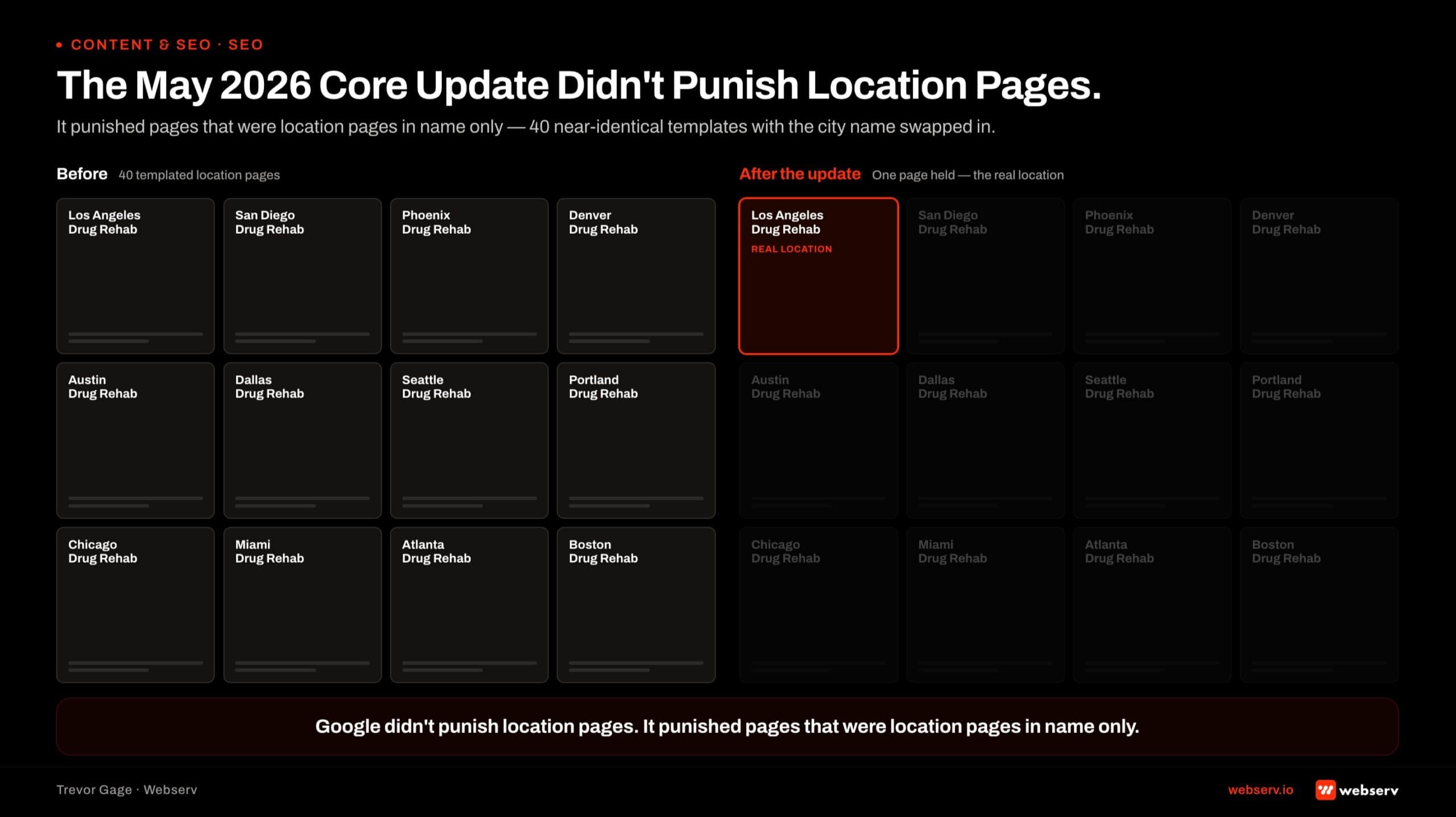
- For treatment center sites, the structural exposure is highest on programmatically generated location pages that carry the same body copy across geographies with only city or state names swapped in.
- The editorial infrastructure a rehab site needs to look like a May 2026 winner is buildable within a quarter: named clinical reviewer bench, dated review workflow, primary-source citations, and location content that reflects actual local market realities.
What Google actually changed with this update
Google Core Updates are broad refreshes of the ranking algorithm rather than targeted patches. What made May 2026 different from recent updates was the concentration of the shift inside YMYL verticals, particularly healthcare, and the specific structural pattern of the losers.
The losers all shared some combination of four patterns. Templated location pages built off a common master template with city names or state names swapped in as the only material differentiation.
YMYL content published without a named author credential or with only a generic “editorial team” attribution.
Service pages that read as if they were written for search engines rather than for patients or families.
And reliance on high domain authority as a substitute for demonstrated editorial process at the page level.
The winners shared a different four-part pattern. Pages with named clinical contributors carrying visible credentials and links to author biographies.
Citations to primary sources like peer-reviewed research and government health agencies rather than to secondary re-writes of the same material.
Visible editorial review workflows including reviewer names and review dates on the page itself.
And location content that reflected the actual clinical or operational realities of the specific market rather than a template.
The pattern is consistent with the broader 2026 direction Google has been signaling: authority as a static property (domain rating, brand recognition) is being replaced by authority as a demonstrable process (who wrote this, who reviewed it, what sources did they cite, when was it last updated).
The May update accelerated that shift.
WATCH OUT
A location page that says the same thing about the same level of care in Denver, Phoenix, and Sacramento with only the city name changed reads to the May 2026 algorithm as thin content, regardless of what the URL structure implies about local intent. The pure template-with-swap approach did not survive this update. Treatment centers running programmatic location coverage should audit the actual overlap between their pages and either differentiate or consolidate.
Why templated location pages are structurally exposed
The specific move that penalized treatment center sites most predictably was the reweighting against templated location pages.
Programmatic location pages, where a master template generates twenty or fifty or two hundred pages that all share the same body copy with only geographic modifiers swapped in, are a common pattern in the rehab space.
The pattern used to work because the pages captured local search intent without requiring twenty individual editorial builds.
That pattern is now actively risky under the new update logic. Google’s crawlers can detect near-duplicate templated content across a domain, and the May update appears to have added a stronger penalty for pages that fail the substantive-differentiation test.
A location page that says the same thing about the same level of care in Denver, Phoenix, and Sacramento with only the city name changed reads to the algorithm as thin content, regardless of what the URL structure implies about local intent.
The behavioral health sites that held onto their location page rankings through this update did one of two things.
Either they published fully differentiated location pages, where each page carried genuinely different content reflecting the specific clinical program, staff, licensure, insurance networks, and community context of that market.
Or they consolidated their location strategy into fewer, deeper pages that each stood on their own editorial merit rather than trying to blanket a state or region with templated coverage.
There is a middle path that also survived, where a shared regional framework was combined with genuinely local content sections (named clinical staff, market-specific insurance details, actual local outcomes data, local community partnerships). But the pure template-with-swap approach did not survive the update.
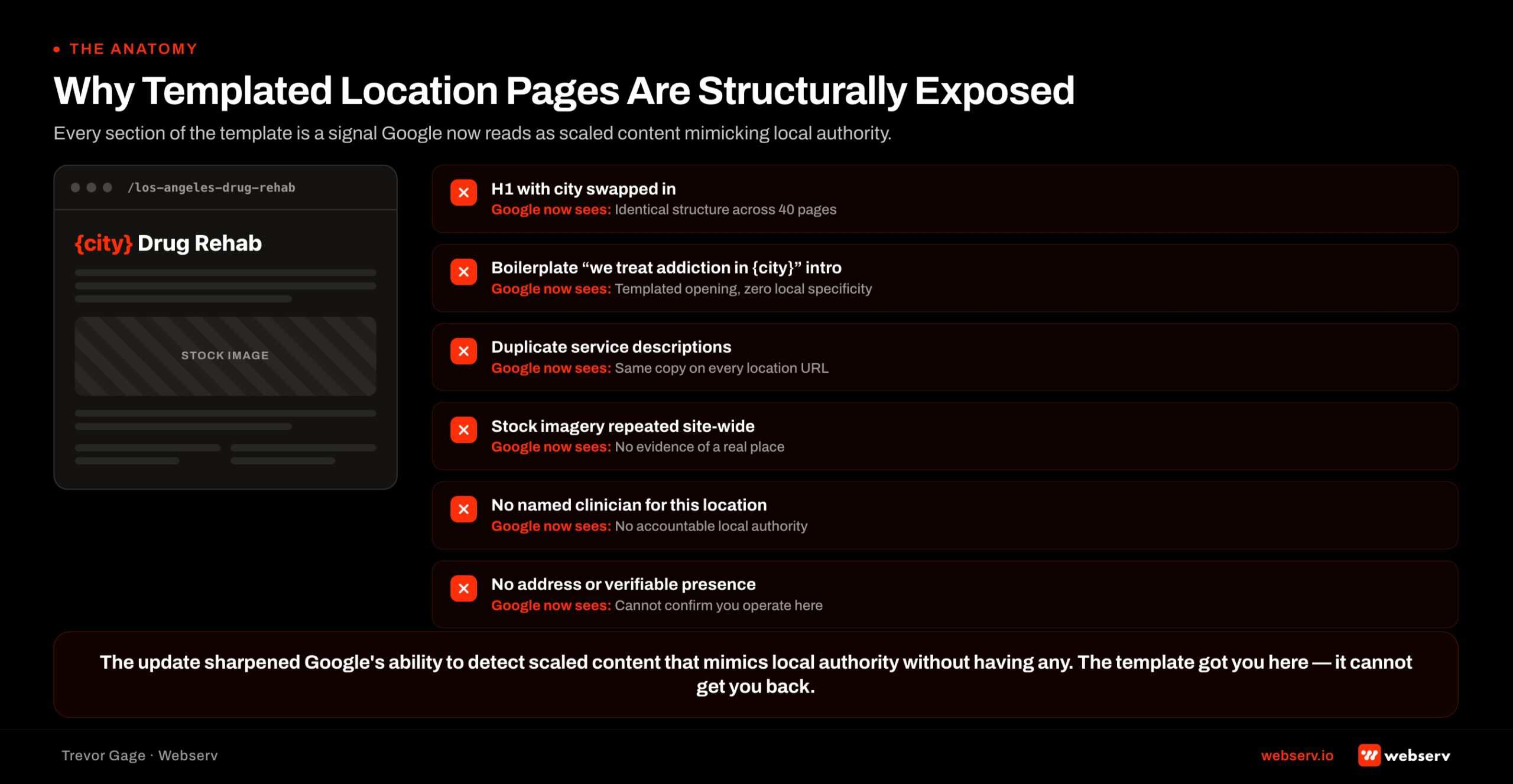 Annotated anatomy of a typical templated treatment center location page showing the structural vulnerabilities the May 2026 Google core update exposed: identical H1 with city-name swap, boilerplate introductory paragraph.
OPERATOR INSIGHT
The pattern that separates the winners is not domain authority. Cleveland Clinic, Mayo Clinic, and WebMD all lost visibility in this update despite carrying some of the highest domain authority scores in medical publishing. What separates winners is page-level editorial process: named clinical contributors with visible credentials, dated clinical review workflow, primary-source citations, and freshness dates visible on the page itself.
What the winners are doing that the losers are not
The pattern that separates the winners from the losers of the May 2026 update reduces to a few visible editorial practices, all of which are within reach for a treatment center willing to build the process.
The first is named contributors with visible credentials. Ninety-percent of the surviving top-ranking YMYL medical pages carry a named author with a linked biography, credentials, and specialty.
That contributor is often a clinician (MD, DO, PhD, LCSW, LMFT, LADC) with a specialty relevant to the topic of the page. The absence of a named author on a YMYL page is now a structural weakness rather than a stylistic omission.
The second is a clinical review process visible on the page. The winning sites show a “medically reviewed by” line naming the reviewer, their credentials, and the date of the most recent review. This is not the same as a byline.
It is a separate, visible step that says a qualified clinician has reviewed the content for accuracy. On behavioral health sites specifically, the reviewer is typically a licensed clinician with direct experience in the treatment area the content covers.
The third is peer-reviewed and primary-source citations. The pages that gained ground cite journal articles, government health agencies (SAMHSA, CDC, HHS), and primary policy documents.
The pages that lost ground cite other blog posts, secondary summaries, and unlinked claims. External citation quality became a stronger differentiator in this update than in any of the previous three core updates I have tracked.
The fourth is freshness visible at the page level. Update dates on the page (not just structured metadata) that show the content has been reviewed recently.
Ahrefs’ study of 17 million citations found AI-cited content is 25.7% fresher than pages ranking in organic Google results. The May update appears to reward freshness in classic Search ranking on a similar curve.
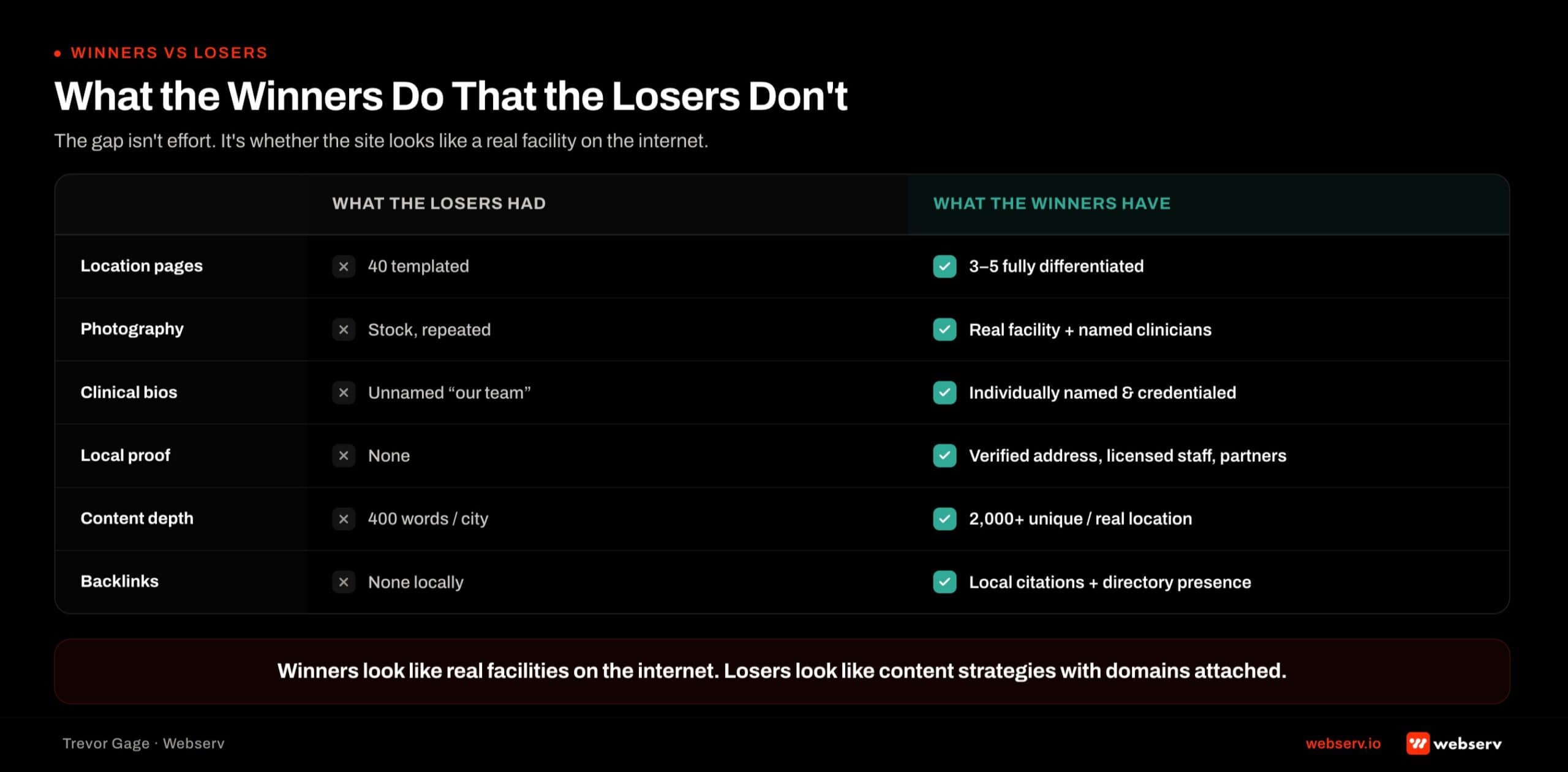 Two-column comparison of treatment center sites that gained versus lost visibility in the May 2026 Google core update.
What a treatment center should audit this month
The specific audit I have been walking treatment center clients through in the weeks after the update completed has four parts.
The first is a location page audit. Pull a list of every location-specific page on your site and check them side by side. If more than 60% of the body copy on any three pages is identical, you have a template-exposure problem.
The remediation is either to differentiate each page with genuinely local content (staff, licensure, community context, insurance networks) or to consolidate multiple templated pages into fewer, stronger regional pages that stand on their own editorial merit.
The second is an author byline audit. Pull every YMYL page (level-of-care, modality, condition, insurance, outcomes) and confirm each carries a named author with a linked biography and visible credentials.
Pages without a named author are structurally exposed and should be assigned to a specific contributor before the next update cycle.
The third is a clinical review audit. On every YMYL page, confirm there is a visible “medically reviewed by” or “clinically reviewed by” line naming a qualified clinician and the date of the review.
If the reviewer is not a licensed clinician with direct experience in the topic area, the reviewer needs to change.
If the review date is more than eighteen months old, the page needs a new review pass and a new date.
The Clinical Review Workflow for Behavioral Health Content covers the operational structure for standing this up.
The fourth is a citation quality audit. Pull the external links on each YMYL page and grade them. Citations to peer-reviewed research, SAMHSA, ASAM, HHS, CDC, and JCAHO/CARF/LegitScript credentialing bodies count as strong.
Citations to other blog posts, general health directories, and unlinked claims count as weak. Any YMYL page whose citation set is more than 60% weak needs a citation refresh with primary sources.
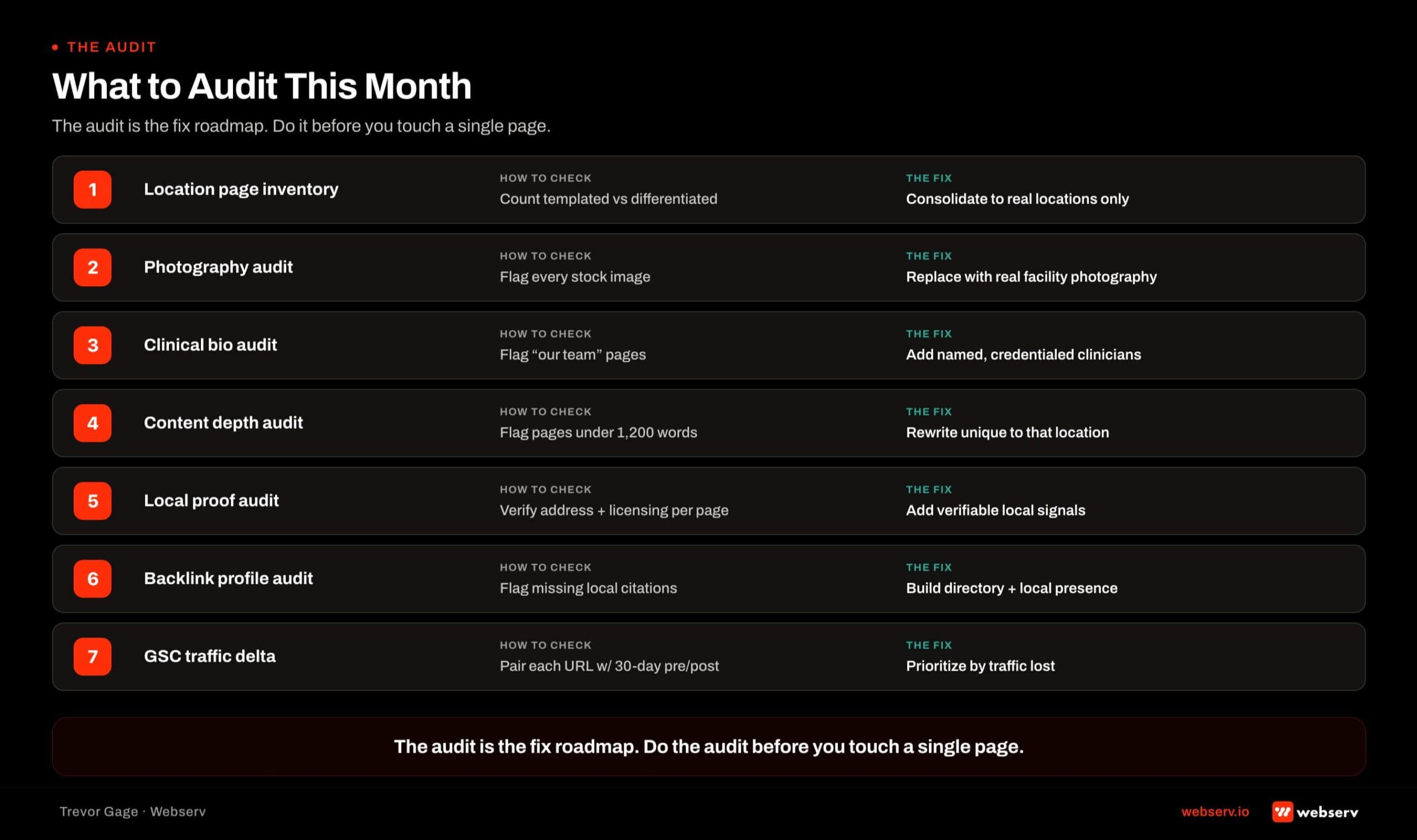 Seven-step audit checklist for treatment center websites affected by the May 2026 Google core update: inventory templated versus differentiated location pages, flag stock imagery for replacement with real facility photography.
The editorial infrastructure this actually requires
The audit above is straightforward to run. The infrastructure to fix what the audit surfaces is where most treatment centers get stuck, so it is worth being explicit about what that infrastructure looks like.
You need a named clinical contributor bench. Somewhere between three and eight licensed clinicians whose bios live on your site and who can be credited as the author or reviewer on YMYL content.
For a smaller facility, that bench can be the clinical leadership team (medical director, clinical director, program director).
For a larger multi-site operator, the bench can extend to specialty leaders across modalities and levels of care.
The key is that the names and credentials are real, verifiable, and connected to actual clinical roles at the facility.
You need a review workflow that produces the visible review date. This does not need to be complicated. A quarterly or semi-annual pass in which a designated clinical reviewer reads assigned pages, confirms accuracy, and stamps the review date on the page.
Most content management systems support a “Reviewed on” metadata field that can render on the page. What matters is that the process actually happens and the date on the page reflects a real recent review.
You need an editorial standards document that codifies citation quality, tone requirements for YMYL content, and the specific compliance guardrails a behavioral health site operates inside (LegitScript, HIPAA, 42 CFR Part 2, state licensing requirements).
That document does not need to be public, but it does need to exist as the artifact your writers and reviewers work against.
You need location page discipline. Either each location page is genuinely differentiated (real local staff, real local licensure, real local insurance networks, real local community context), or the location coverage is consolidated into fewer regional pages that stand on their own merit.
Templated location pages with swap-in city names are no longer a viable pattern under the current algorithm logic.
What the next 90 days should look like
The specific sequencing I have been recommending across our client book for the 90 days after the May 2026 update completed puts editorial infrastructure first, then content refresh, then new content.
The first thirty days is infrastructure. Named clinical contributor bench built and their biographies live on the site. Clinical review workflow defined and the reviewer assignments made.
Editorial standards document written and shared with anyone writing or editing YMYL content. Author boxes and “medically reviewed by” blocks added to the site template so every YMYL page renders them.
The next thirty days is refresh of existing YMYL content. Every cornerstone level-of-care page, modality page, condition page, and insurance page runs through four passes.
A named author is assigned (or the existing byline confirmed). A clinical reviewer is assigned with a fresh review date.
A citation audit and refresh replaces weak citations with primary sources.
A freshness pass updates the content to reflect current clinical understanding and current facility programming.
The final thirty days is new content aligned with the winning pattern. Compound-prompt cornerstone pages targeting the high-intent queries where AI Mode citation share is now determinative.
New location pages built to the differentiated standard rather than the templated one. And structured refresh cadence baked into the operating calendar so that no cornerstone page goes more than twelve months without a substantive review and update.
The Visibility Gap Audit our team offers is built off this exact framework, and the Full AI Search Stack for Treatment Centers walks the broader technical infrastructure that pairs with the editorial work. What the May update did was raise the stakes on getting the infrastructure right.
Sites that build the infrastructure over the next 90 days will look like winners of the next core update. Sites that treat the losses of this cycle as a passing anomaly will look like losers of the next one.
Frequently Asked Questions
Why did large health authorities like Cleveland Clinic and WebMD lose visibility in the May 2026 update?
The pattern in the loser set was not about domain authority. Cleveland Clinic (-11.5), WebMD (-9.1), Mayo Clinic (-6.1), Merck Manuals (-18.8%), and KidsHealth (-19.4%) all carry some of the highest domain authority scores in medical publishing.
What appears to have moved against them is the shift from authority-as-brand to authority-as-process. Pages on those sites that were published without visible clinical review, without dated review workflows, or with generic editorial team attribution instead of named clinicians lost ground even where the domain-level authority remained high.
The update signaled that page-level editorial process is now weighted more heavily than site-level brand.
Are all templated location pages a problem, or just some of them?
The specific pattern that got penalized is templated pages with near-identical body copy across geographies. A page that says the same thing about residential treatment in Denver, Phoenix, and Sacramento with only the city name changed is exposed.
A page that shares a regional framework but carries materially different content per market (real local clinical staff, real local licensure, real local insurance networks, real local outcomes data) is not.
The remediation is not necessarily fewer location pages. It is more differentiation per location page. Treatment centers running programmatic location coverage should audit the actual overlap between their pages, and either differentiate the ones worth keeping or consolidate the redundant ones into stronger regional pages.
How quickly can a treatment center site rebuild the editorial infrastructure the update rewards?
The core infrastructure is buildable inside a quarter for most treatment center sites. Building the named clinical contributor bench and their biographies is typically two to three weeks depending on staff availability.
Standing up the clinical review workflow with defined reviewers and a review cadence is another two weeks. Retrofitting existing YMYL pages with named authors, “medically reviewed by” blocks, and refreshed citations is the largest chunk of work, typically running 30 to 60 days for a mid-sized site.
The order that matters is infrastructure before content, and content refresh before new content. Sites that jump straight to publishing new content without the underlying editorial process end up producing more of the same pattern that got penalized.
Should we wait for the next core update to see if the May 2026 pattern holds?
Waiting to see is a defensible posture only if you have room to lose more visibility while you wait. Most treatment center sites do not.
The pattern the May update reinforced is consistent with every core update since 2018 in the same direction, just with more weight applied. The next core update will almost certainly reward the same pattern with equal or greater emphasis.
The economical read is to build the editorial infrastructure now, refresh existing YMYL content against the standard now, and treat the next core update as an accelerator on gains rather than a diagnostic on whether to act.
Trevor Gage is Director of Marketing at Webserv, a behavioral health marketing agency working with residential, outpatient, and telehealth treatment providers across the United States.