If you or someone you know needs help now, call or text 988 for the 988 Suicide & Crisis Lifeline, or call SAMHSA’s National Helpline at 1-800-662-HELP (4357), a free, confidential, 24/7 treatment referral service.
A family asks ChatGPT where to find addiction treatment nearby. The answer cites its sources. In our testing, those sources were mostly government properties, led by FindTreatment.gov, SAMHSA’s federal treatment locator, and only rarely a treatment center’s own website.
That’s a good thing for families. FindTreatment.gov is a free, legitimate federal resource, and it should be used. It also means your listing there may be the first description of your facility a referred prospect reads.
In March 2025, HHS’s Office of Inspector General published an audit of the directory that found inaccurate information in 66 of 100 sampled listings.
SAMHSA has since implemented every one of the audit’s recommendations. What’s left is the part only the facility controls: the information it submits. This piece covers what the audit found, what changed, and how to make sure the directory is right about you. It’s part of the work inside our AEO program for treatment centers.
This describes a public audit and a public survey process. It isn’t legal or regulatory advice.
Key Takeaways
- In a small internal test of 155 AI answers, 59 of the 113 citations logged for the most-cited sources went to government sites. FindTreatment.gov led with 20. One treatment center appeared among those sources.
- HHS OIG found that, as of April 20, 2023, 66 of 100 sampled FindTreatment.gov facilities had some inaccurate information, and estimated 14,283 of 22,106 facilities did (report A-09-23-01003, March 2025).
- The errors included facility addresses and services information, such as incorrect reporting of the treatment approaches offered.
- SAMHSA concurred with all three recommendations, and all three are closed as implemented, the last in February 2026.
- Being listed didn’t predict being named by AI in our test. The listing matters because it’s the page AI sends prospects to, so check it, fix it, and make sure it matches your website.
Where AI sends people
On October 14, 2026, we asked four AI engines 39 treatment questions about 10 treatment centers and logged the sources cited in 155 answers.
Among the most-cited sources, 59 of 113 logged citations, or 52%, went to government sites: FindTreatment.gov (20), samhsa.gov (16), and state health agency sites. One treatment center appeared among those sources, with 5 citations.
That’s a small, directional test, not a study, and the count covers the most-cited sources rather than every citation. It also found something worth stating plainly: the centers listed on FindTreatment.gov weren’t named by AI more often than the centers that weren’t. Listing isn’t a shortcut to being recommended.
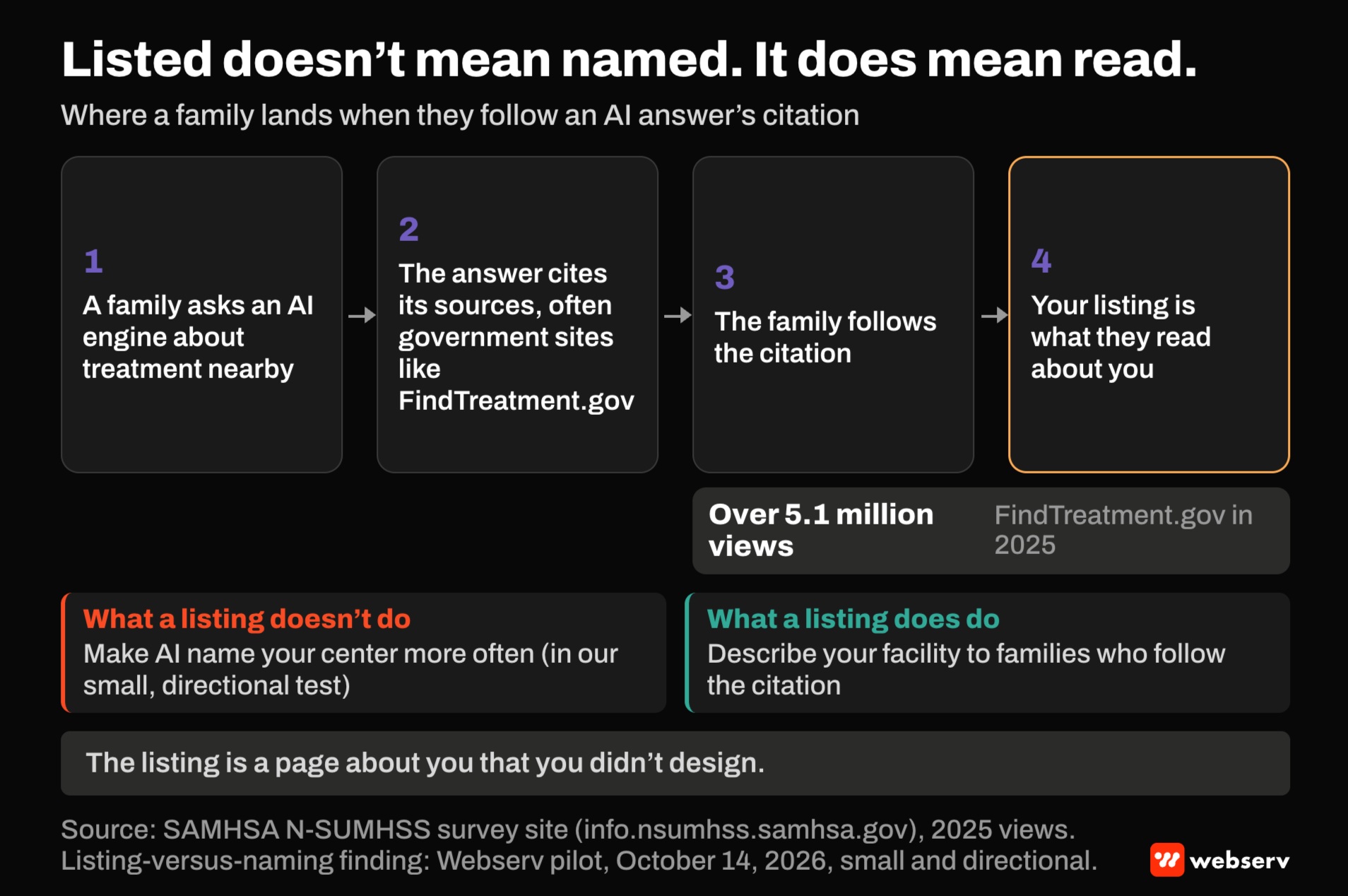
What the test does show is where AI points people. When a family follows the citation, the directory is the page they land on, and your listing is what they read about you. Four of the 10 centers weren’t listed at all, and one was listed under a different name than it uses.
Where AI answers pointed, in our pilot
52%
of logged citations among the most-cited sources went to government sites (59 of 113)
20
citations to FindTreatment.gov, the most of any source
1
treatment center among the most-cited sources
4 of 10
centers in the test weren’t listed on FindTreatment.gov
Source: Webserv pilot, October 14, 2026. 10 treatment centers, 39 questions, 4 AI engines, 155 answers. A small, directional internal test.
SAMHSA’s survey site says FindTreatment.gov had over 5.1 million views in 2025. Whether families arrive from an AI answer or search the directory directly, the listing is a page about you that you didn’t design.
What the audit found
HHS OIG’s audit of FindTreatment.gov looked at a sample of listed facilities as of April 20, 2023.
OIG says it started the audit after a media report that SAMHSA’s locators contained inaccurate and outdated information. KFF Health News had reported in 2022 that SAMHSA’s vetting required only that facilities complete a survey and be licensed in their state.
| Finding | Figure | Source |
|---|---|---|
| Sampled facilities with some inaccurate information | 66 of 100 | HHS OIG, A-09-23-01003, March 2025 |
| Estimated facilities with inaccurate information | 14,283 of 22,106 | Same |
| Facilities that didn’t report some critical information | 11 of 22,106 | Same |
| Data as of | April 20, 2023 | Same |
The inaccuracies included facility addresses and services information, including incorrect reporting of the treatment approaches a facility offers. OIG also found that SAMHSA processed facility and consumer update requests in a timely manner.
The root cause, in OIG’s words, is that SAMHSA relies on facilities to report accurate information when they complete a voluntary annual survey.
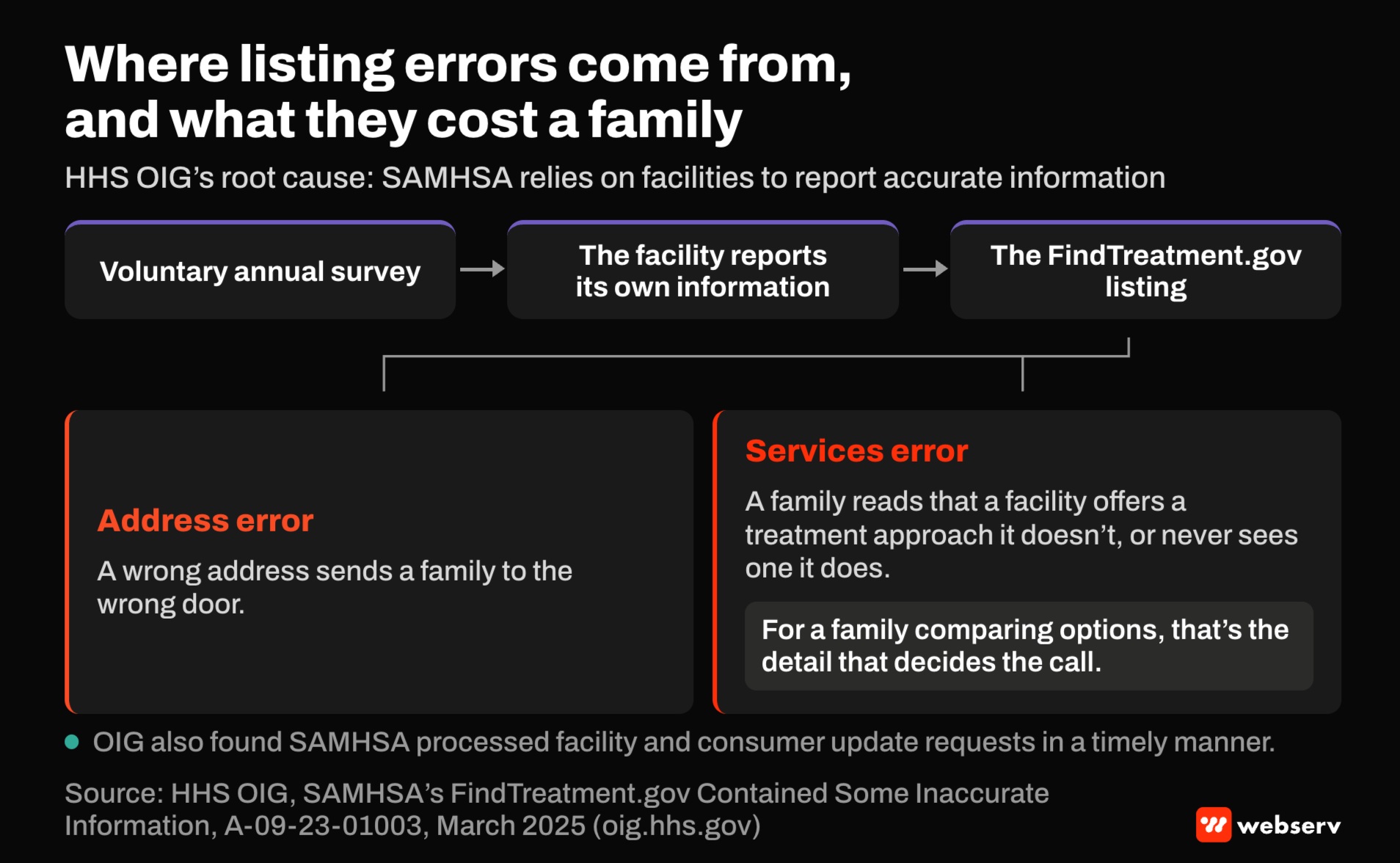
Why services errors matter most. A wrong address sends a family to the wrong door. A wrong services entry means a family reads that a facility offers a treatment approach it doesn’t, or never sees one it does. For a family comparing options, that’s the detail that decides the call.
What changed after the audit
OIG made three recommendations, and SAMHSA concurred with all three:
1. Strengthen procedures for verifying facility information, such as validating a sample of facilities each year.
2. Make the statement about how to report an issue with a listing more prominent on FindTreatment.gov.
3. Add system edits so facilities can’t submit the survey without completing all critical fields.
OIG’s records show all three closed as implemented: two in September 2025 and the last on February 12, 2026.
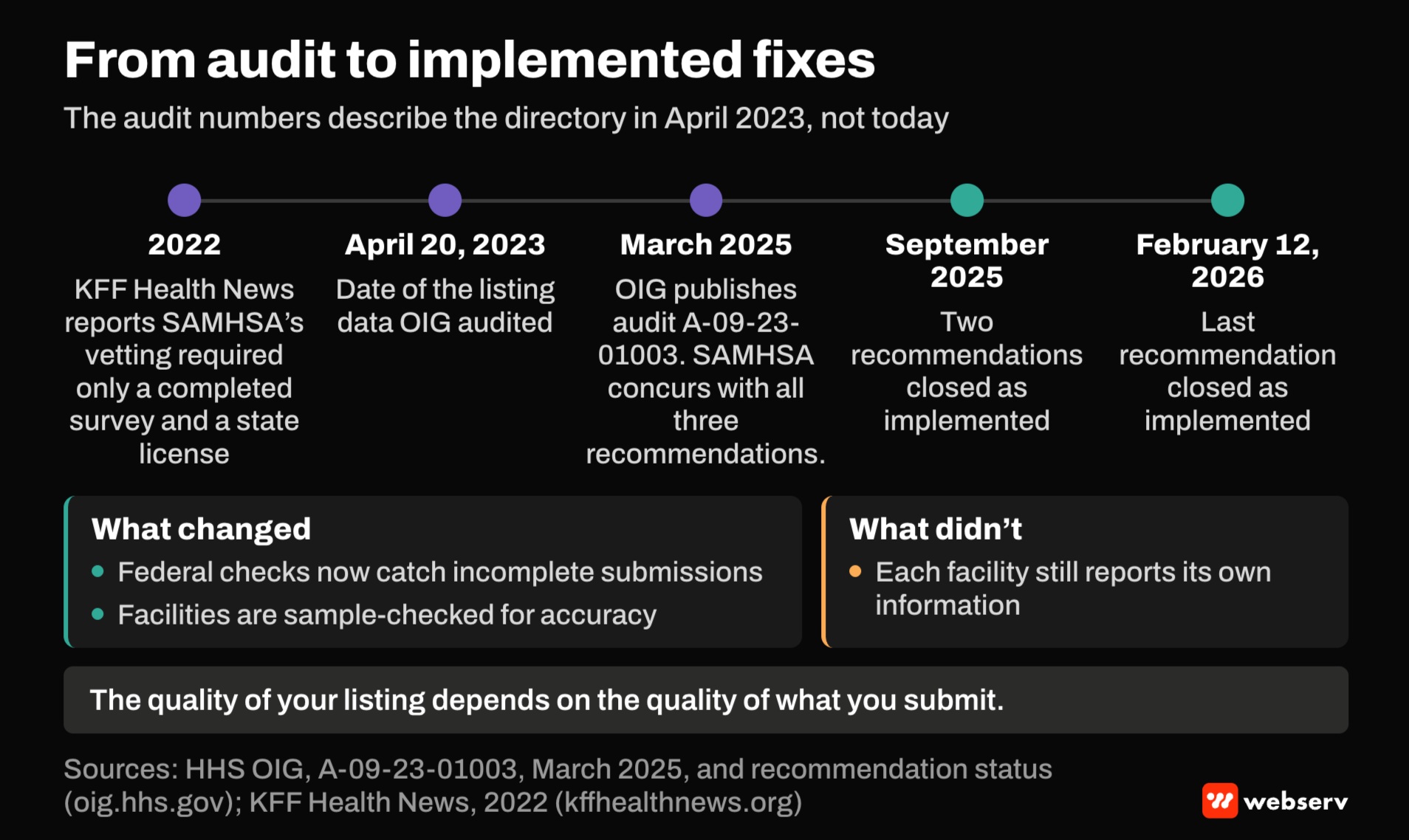
So the audit numbers describe the directory in April 2023, not today. What the fixes didn’t change is the source of the data. Each facility still reports its own information, and the federal checks now catch incomplete submissions and sample-check accuracy. The quality of your listing depends on the quality of what you submit.
COMMON MISTAKE
Treating the survey as paperwork. The annual survey often lands with whoever handles compliance or admissions, gets completed quickly, and isn’t compared against the website.
But that survey is what produces the listing, and the listing is the page an AI answer may send a family to.
What to do this quarter
Five steps, in order.
Confirm you’re listed
Search for your facility on FindTreatment.gov. SAMHSA says only eligible facilities registered in its inventory receive the annual survey invitation. New facilities can register through the facility registration form.
Check every field against reality
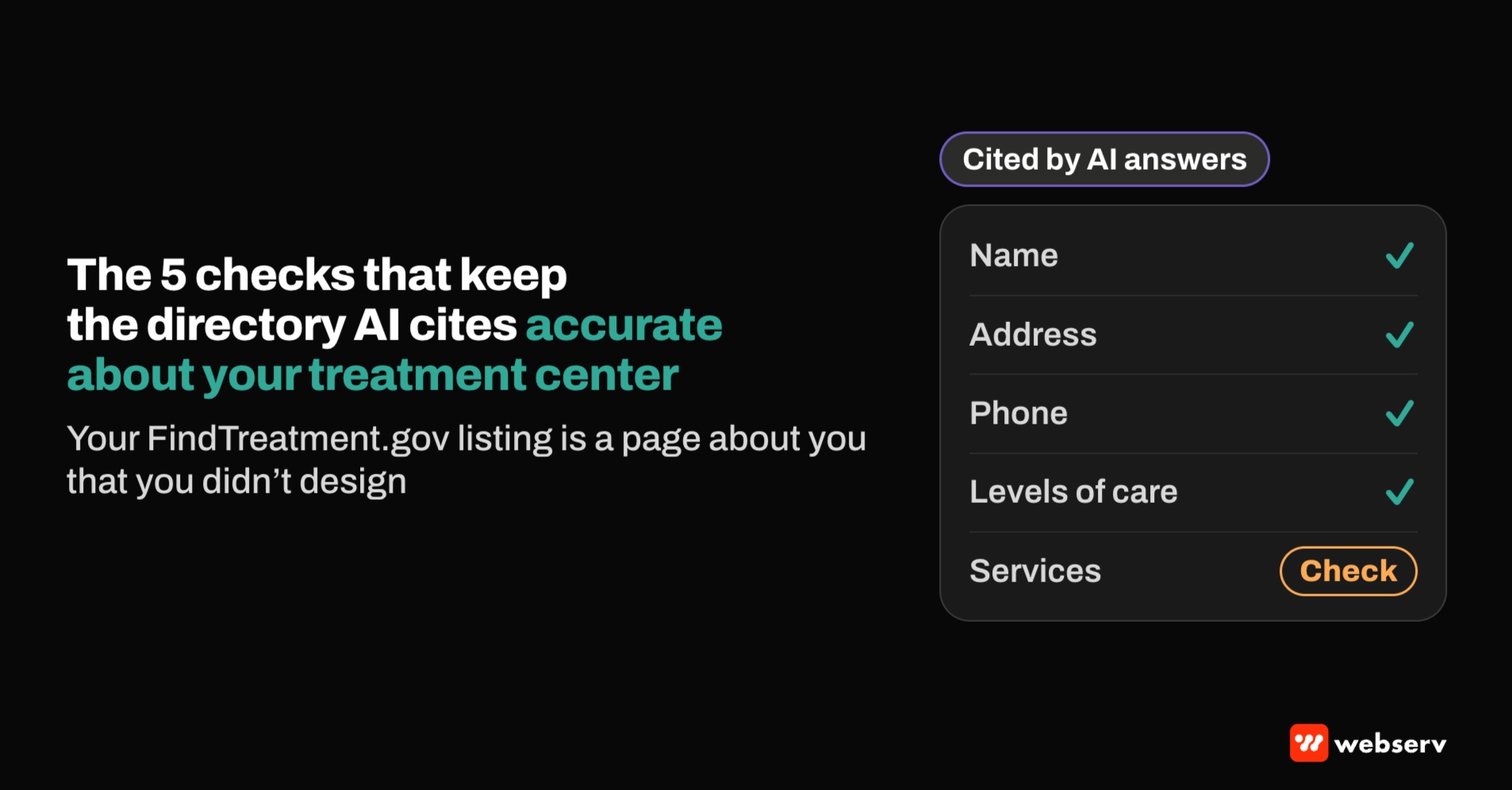
Facility name, address, phone, levels of care, services and treatment approaches, populations served, languages, and payment and insurance accepted. Check the name carefully: one center in our test was listed under a different name than the one it uses. Compare each to what your program actually offers.
Fix errors now, not at the next survey
SAMHSA’s directory materials say facilities can report changes by email at FindTreatment@samhsa.hhs.gov or by calling 1-833-888-1553. OIG reported that contact information updates weekly and monthly, and services information monthly.
Complete the annual survey carefully
SAMHSA’s N-SUMHSS FAQ says a facility must complete the survey every year to keep its listing. Assign it to someone who knows the clinical program, and have a clinical leader review the services section before it’s submitted.
Make your website match
If your website says one thing and the directory says another, a family doesn’t know which to believe, and neither does any system comparing the two. Our guide to the AI information page covers keeping a single, accurate reference on your own site.
Operator insight. Put the listing check on the same calendar as your Google Business Profile review: once a quarter, and whenever a program, location, or service changes.
Treat the listing as marketing infrastructure, not a compliance chore.
Where this fits
An accurate listing is one layer of how a treatment center shows up accurately wherever families look. For the rest, see our guide to getting cited in Google AI Overviews and ChatGPT and the Full AI Search Stack.
For the trust and credentialing side, see our LegitScript glossary entry, our guide to healthcare advertising compliance, and our piece on beating body brokering.
For how AI search fits the rest of your marketing, see the complete guide to behavioral health marketing. If you want a second look at how AI describes your facility, book an intro meeting.
Frequently Asked Questions
Is FindTreatment.gov reliable?
It’s a legitimate, free federal resource, and families should use it. HHS OIG found inaccuracies in a 2023 sample of listings, and SAMHSA has since implemented all three of the audit’s recommendations.
Listings are only as accurate as the information facilities report.
If you run a facility, check and correct your listing so families and AI answers get the right information.
How do we update our FindTreatment.gov listing?
SAMHSA’s directory materials list an email address, FindTreatment@samhsa.hhs.gov, and a phone number, 1-833-888-1553, for reporting changes.
Facilities also update their information through the annual N-SUMHSS survey, which must be completed every year to keep a listing.
OIG reported that contact information updates weekly and monthly, and services information monthly.
How does a facility get listed on FindTreatment.gov?
Eligible facilities registered in SAMHSA’s inventory receive the annual N-SUMHSS survey and can opt to be listed when they complete it.
New facilities can register through the facility registration form on FindTreatment.gov.
The survey excludes some settings, such as individual private practitioners not licensed as a clinic or center.
What did the HHS OIG audit find?
As of April 20, 2023, 66 of 100 sampled facilities had some inaccurate information, and OIG estimated 14,283 of 22,106 facilities did.
The errors included addresses and services information, such as incorrect reporting of treatment approaches.
All three of OIG’s recommendations have since been implemented, the last in February 2026.
Why does a FindTreatment.gov listing matter if AI is answering the question?
In our small pilot, 52% of the citations logged for the most-cited sources went to government sites, led by FindTreatment.gov. AI often points families to the directory.
Being listed didn’t make a center more likely to be named by AI in our test. The listing matters because it’s what families read when they follow the citation.
Keep the listing and your website consistent so both say the same thing.
Trevor Gage is the Director of Marketing at Webserv, a digital marketing agency for treatment centers.