When Anthropic built Claude’s multi-agent research system, its engineers found that early versions of the agents consistently chose SEO-optimized content farms over authoritative sources that ranked lower. They fixed it by giving the system heuristics for source quality.
That detail, from Anthropic’s own engineering write-up, says a lot about how Claude treats sources. Ranking well isn’t enough on its own. Claude is built to weigh whether a source deserves to be cited.
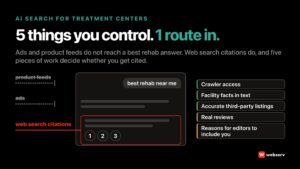
For treatment centers, that’s a useful constraint. This piece covers how Claude finds and cites sources, how its crawlers differ from other assistants’, what citation studies show, what Anthropic says about health conversations, and the content patterns that fit. It’s part of the work we do inside our AEO program for treatment centers.
For the full build across platforms, start with our Full AI Search Stack. This piece focuses on one platform.
Key Takeaways
- Claude searches the web when it helps answer a question, and Anthropic says every web search response includes citations.
- Anthropic runs three crawlers: ClaudeBot for training, Claude-User for user-requested fetches, and Claude-SearchBot for search. Anthropic says all three respect robots.txt, and blocking the last two may reduce search visibility.
- Claude is ad-free. Anthropic says responses won’t be influenced by advertisers, so citation is the only way into an answer.
- Citation studies find Claude cites social platforms less than most assistants: Profound measured a 3.99% social citation rate for Claude, versus 9.1% for ChatGPT and 15.3% for Google AI Overviews.
- None of the Claude-specific studies covers health. Anthropic’s healthcare tools connect Claude to PubMed, the CMS Coverage Database, ICD-10, and the NPI Registry, which points clinical answers toward those sources.
- The patterns that fit: self-contained answer passages, server-rendered pages, current facility facts on your own site, named authors, and citations to primary sources.
How Claude finds and cites sources
Claude’s web search launched in March 2025 for paid US users and was available globally on all plans by May 2025. Anthropic’s help article says Claude searches the web when it helps, and that every response includes citations.
The same article says Claude may use a user’s approximate location, inferred from their IP address, for local results. For “rehab near me” style questions, that makes location pages and consistent address data part of the picture.
Claude’s search results come from an outside index. In March 2025, TechCrunch reported that Anthropic had added Brave Search to its list of subprocessors, and that Claude’s citations matched Brave’s results. Anthropic hasn’t described Brave’s role beyond that listing.
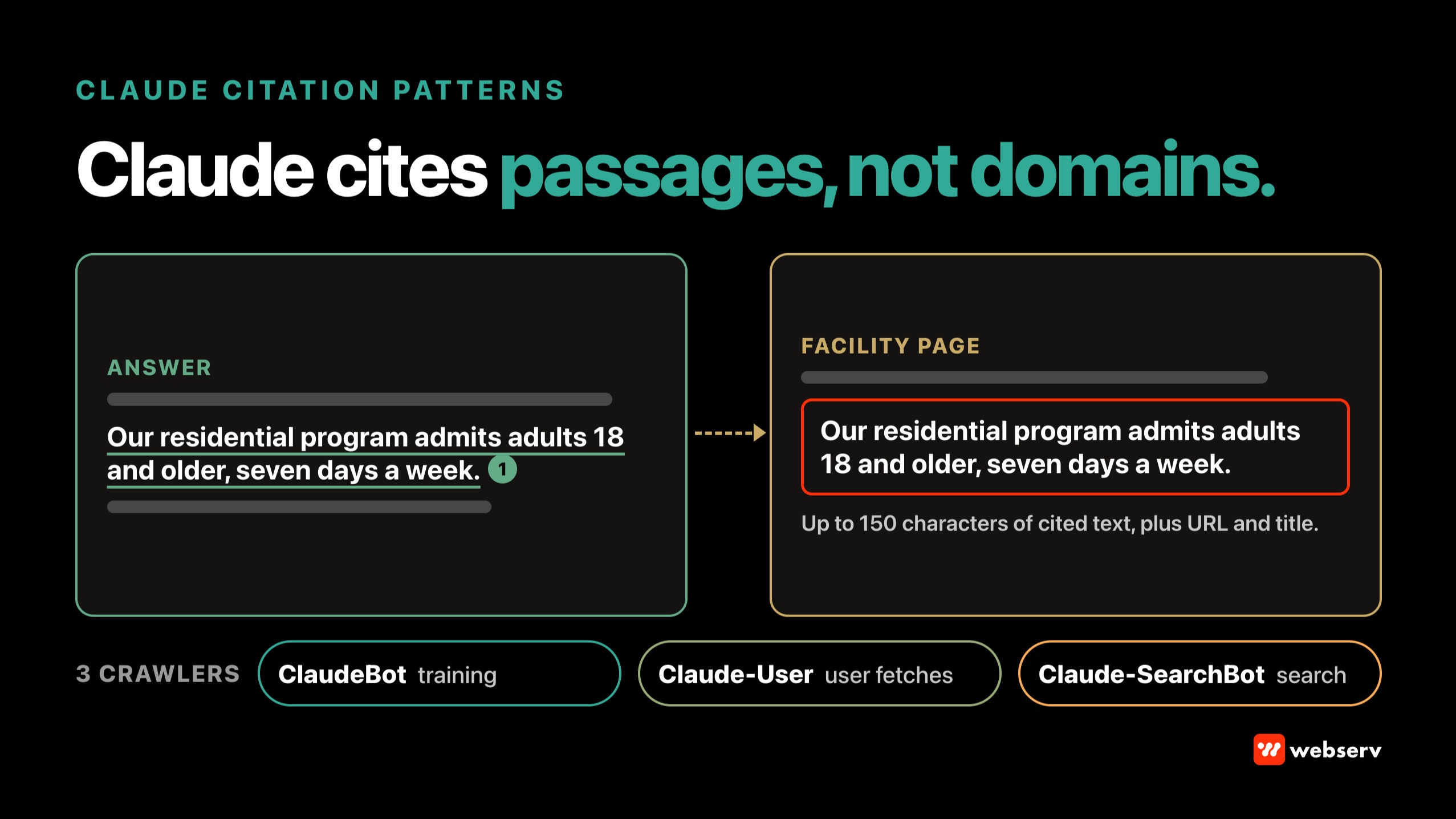
The developer documentation shows how citations work at the passage level. Anthropic’s web search tool docs say citations are always enabled, and each carries up to 150 characters of the cited text along with the URL and page title.
DEFINITION
Claude citation. A source link Claude attaches to a specific statement in its answer, tied to a short passage from the cited page. Because the citation points to a passage, the page has to contain a clear, self-contained sentence that supports the claim, not just a strong domain.
Anthropic’s web fetch tool docs add a technical constraint: the tool doesn’t support websites rendered dynamically with JavaScript. A page whose content only appears after scripts run is harder for Claude to read.
Three crawlers, and all three follow robots.txt
Anthropic’s crawler documentation names three bots with different jobs:
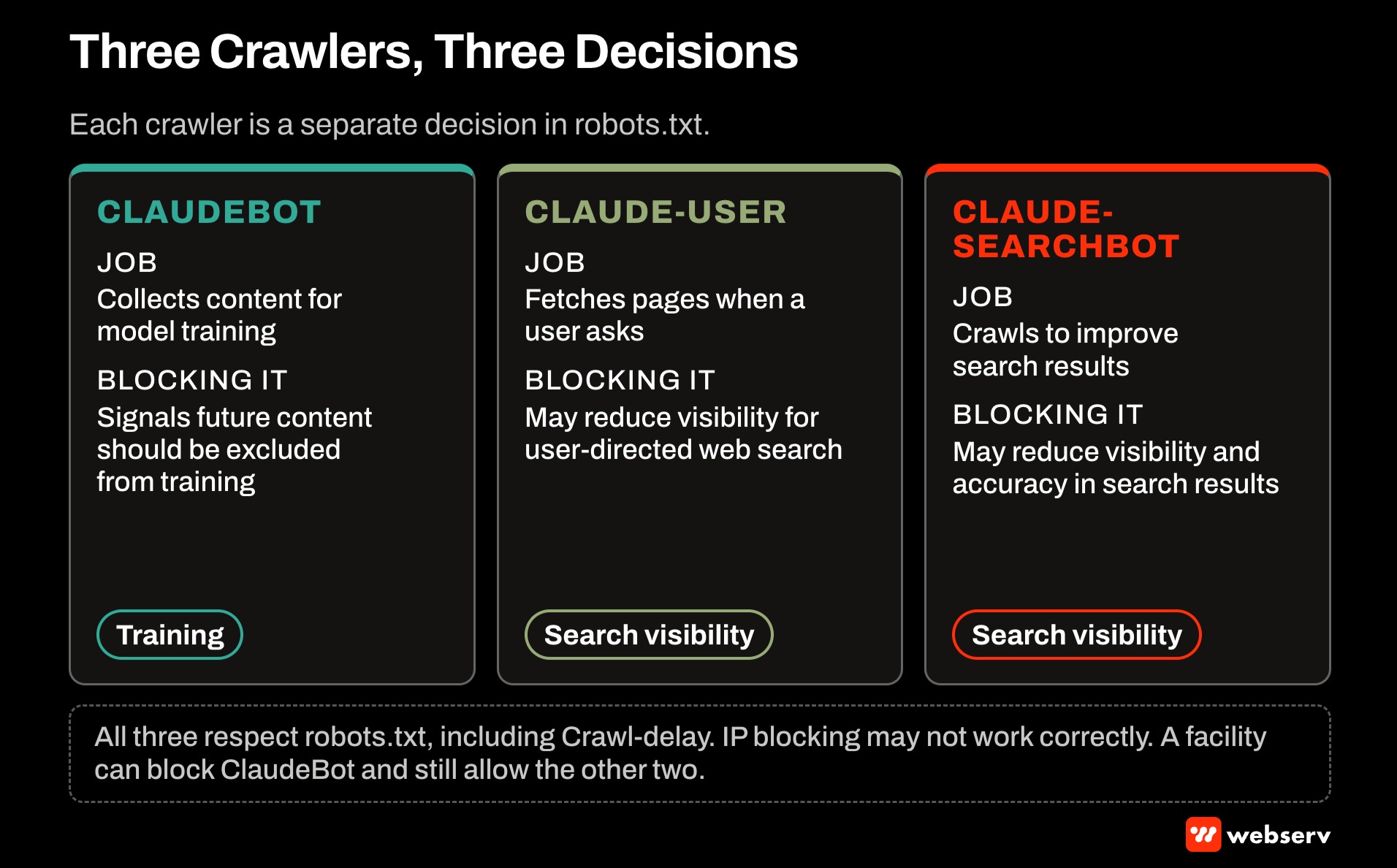
- ClaudeBot collects content for model training. Blocking it signals that a site’s future content should be excluded from training data.
- Claude-User fetches pages when a user asks Claude to. Anthropic says blocking it may reduce a site’s visibility for user-directed web search.
- Claude-SearchBot crawls to improve search results. Anthropic says blocking it may reduce a site’s visibility and accuracy in search results.
Anthropic says its bots respect robots.txt, including the non-standard Crawl-delay directive, and that blocking by IP address may not work correctly. It publishes its crawler IP ranges.
That’s a difference worth knowing. Search Engine Journal noted that OpenAI and Perplexity say their user-initiated fetchers may not follow robots.txt, while Anthropic makes no such exception for Claude-User. A robots.txt rule meant for one bot can quietly remove a site from Claude’s answers.
DO
- Allow Claude-SearchBot and Claude-User if you want to appear in Claude’s search answers.
- Decide ClaudeBot separately, as a training question.
- Control access with robots.txt, which Anthropic says all three bots respect.
DON’T
- Block Anthropic by IP address, which Anthropic says may not work correctly.
- Reuse one rule for all Anthropic bots.
- Copy an old AI bot list without checking the current bot names.
The training and search decisions are separate. A facility can block ClaudeBot and still allow Claude-SearchBot and Claude-User. Our robots.txt guide for AI bots covers how to make that call.
No ads, so citations are the only placement
Anthropic said in February 2026 that Claude will remain ad-free, with no sponsored links beside conversations and no advertiser influence on responses.
For treatment centers, that settles the channel question for Claude the same way it’s settled for Perplexity. There’s no paid route into an answer. Visibility depends on being a source Claude chooses to cite.
What the citation research shows
Outside studies of Claude’s citations are newer and smaller than those for ChatGPT or Google, and they don’t all agree. Read them as directional.
Claude citation studies (Profound, March 2026; OtterlyAI, June 2026)
3.99%
Claude social citation rate (Profound)
9.1%
ChatGPT social citation rate, same study
64%
Brand-site share of Claude citations on tech prompts (OtterlyAI)
Claude cites social platforms less than most assistants. Profound’s analysis of 3.25 billion citations across seven models in March 2026 found a 3.99% social citation rate for Claude, compared with 9.1% for ChatGPT, 11.3% for Perplexity, and 15.3% for Google AI Overviews.
Brand sites carry a large share, at least in tech. OtterlyAI’s study of 379,321 Claude citations on software and technology prompts found brand websites made up 64% of citations and social platforms under 1%, with Reddit not cited at all.
It favors recent coverage. Muck Rack’s analysis of how Claude cites media found Claude’s sweet spot was content from the past 10 weeks. Muck Rack doesn’t publish its sample size.
Not every study agrees. Yext’s analysis of 17.2 million citations reported that Claude cited user-generated content at two to four times the rate of other models, the opposite of the Profound and OtterlyAI findings.
The pattern most of these studies share is authority and first-party sources over forums. The gap they share is health: none reports Claude’s behavior on medical or behavioral health questions.
What Anthropic says about health
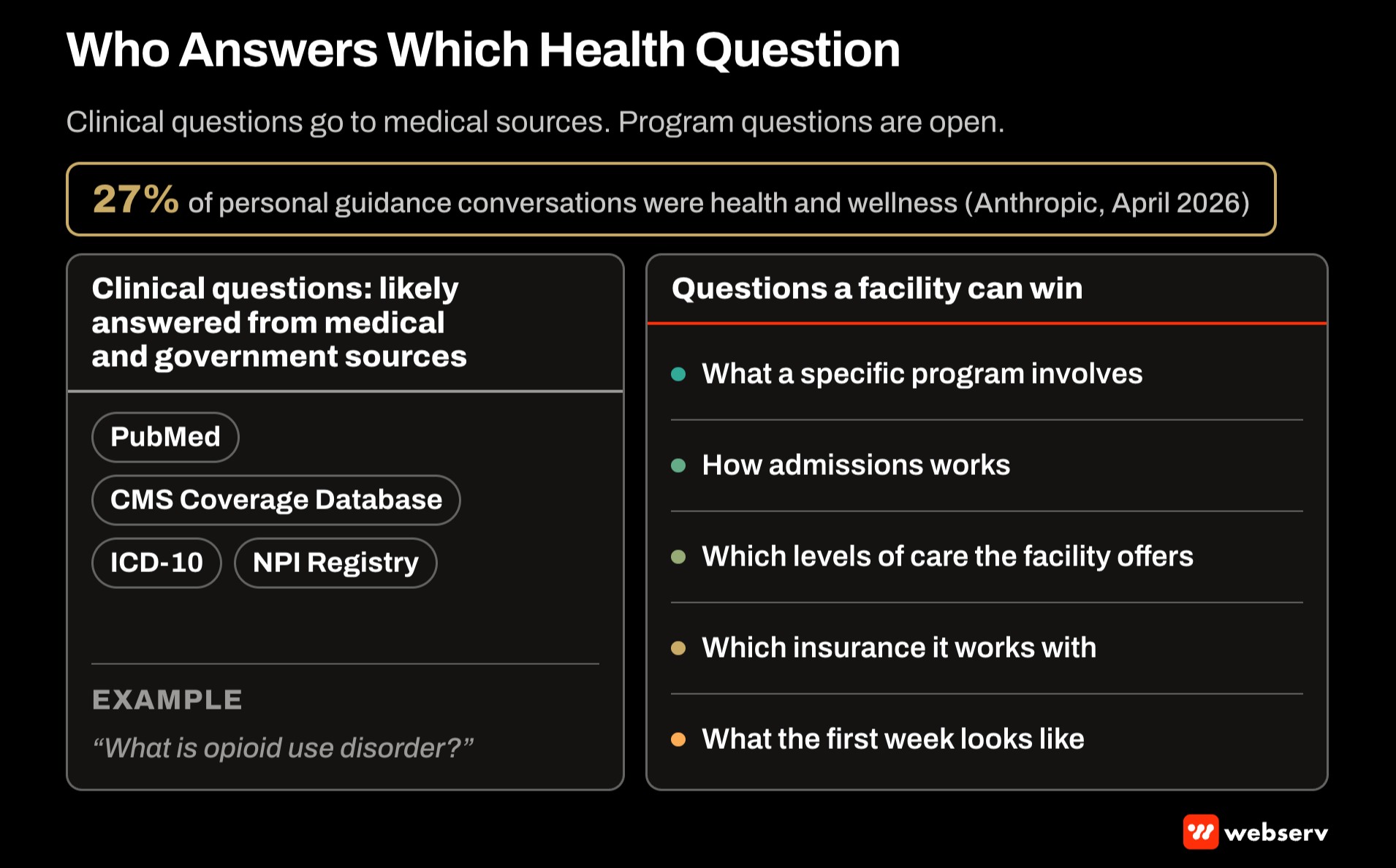
Anthropic has been explicit about where Claude gets health information. Its January 2026 healthcare and life sciences announcement describes connectors to the CMS Coverage Database, ICD-10, the NPI Registry, and PubMed.
The same announcement says Claude is designed to include contextual disclaimers, acknowledge uncertainty, and direct users to healthcare professionals. Anthropic’s usage policy treats healthcare, therapy, and mental health as high-risk uses that require professional review when businesses deploy Claude for them.
People do bring health questions to Claude. Anthropic’s April 2026 study of personal guidance conversations found that health and wellness was the largest category, at 27% of those conversations.
The implication for treatment centers matches the pattern on other AI platforms. Clinical questions about conditions and treatments are likely to be answered from medical literature and government sources. The questions a facility can realistically win are the ones those sources don’t answer.
That means what a specific program involves, how admissions works, which levels of care a facility offers, what insurance it works with, and what the first week looks like.
COMMON MISTAKE
Rewriting NIH for Claude. A treatment center post titled “What Is Opioid Use Disorder?” competes with sources like NIDA’s research on opioid use disorder, and Claude has direct connectors to the medical literature behind them.
Cite those sources instead, and put the content budget into pages only your facility can publish: your programs, your clinical team, your admissions process, and clear answers to the practical questions families ask.
Content patterns that fit how Claude cites
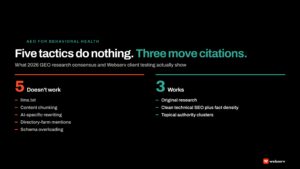
These patterns follow from Anthropic’s documentation and the studies above. They overlap with what works on other platforms, which is the point: one well-built page can serve all of them.
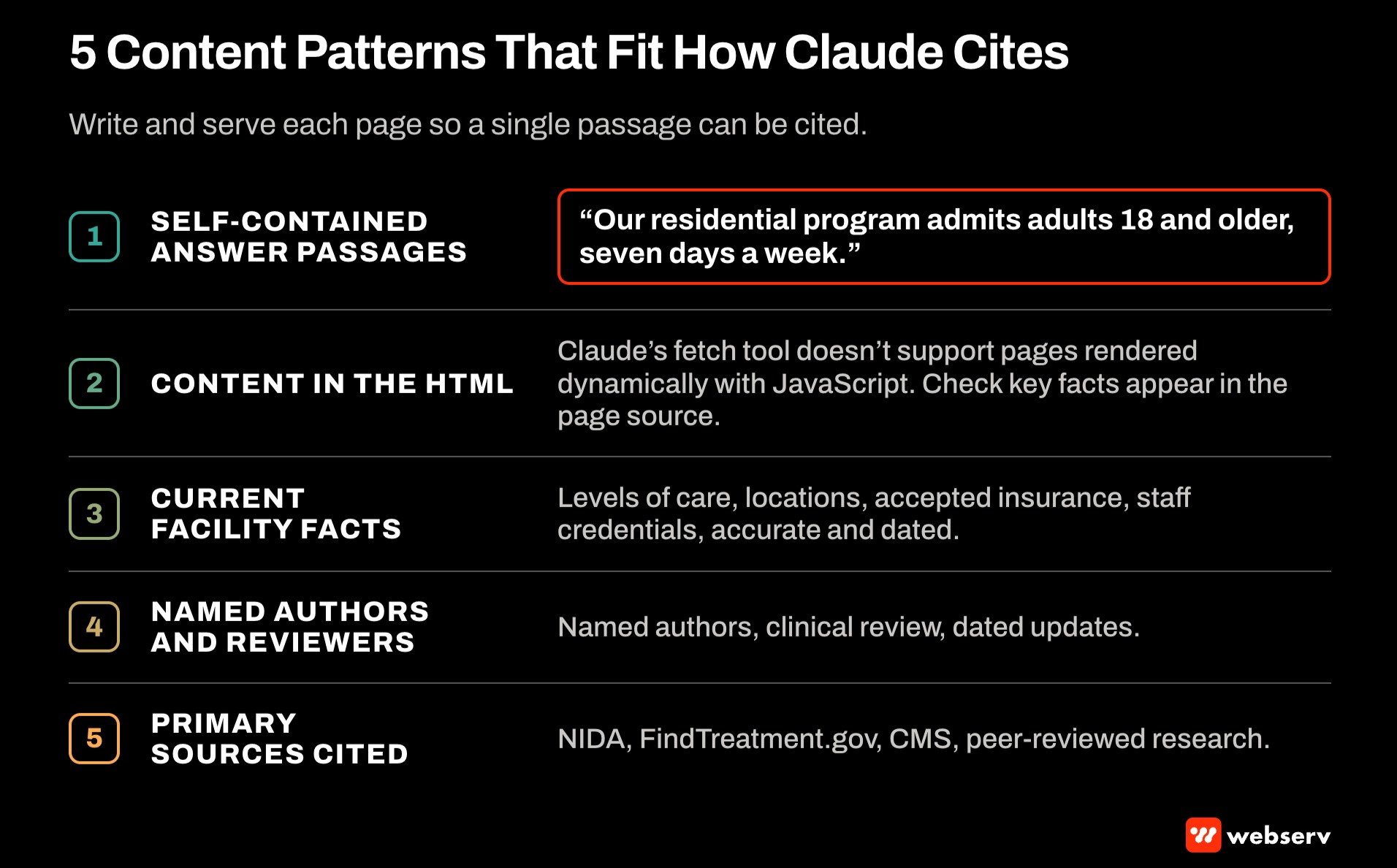
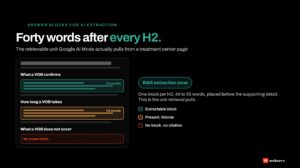
Write self-contained answer passages. Claude’s citations point to short passages, up to 150 characters in the API. A sentence that states the fact on its own, such as “Our residential program admits adults 18 and older, seven days a week,” is easier to cite than one that depends on the paragraph around it.
Our guide to the 40-word answer block covers the format.
Serve content in the HTML. If program details, insurance lists, or FAQs load only through JavaScript, Claude’s fetch tool may not see them. Check that key facts appear in the page source.
Keep facility facts current on your own site. Studies find a large share of Claude’s citations go to first-party sites, and Muck Rack found a preference for recent content. Levels of care, locations, accepted insurance, and staff credentials should be accurate and dated.
Our AI information page guide covers a single reference page for those facts.
Show who wrote and reviewed it. Anthropic’s constitution asks Claude to show appropriate skepticism toward low-quality or unreliable websites. Named authors, clinical review, and dated updates are the visible signals that separate a facility page from a content farm.
Cite primary sources. Linking to NIDA, SAMHSA’s FindTreatment.gov, CMS, or peer-reviewed research gives Claude a trail to verify claims. Original data helps too; our guide to producing original behavioral health research covers how.
OPERATOR INSIGHT
Search for your facility’s key pages in Brave Search. If Claude’s web search draws on Brave’s index, as reporting on Anthropic’s subprocessor list suggests, a page Brave hasn’t indexed is less likely to appear in Claude’s answers.
It’s a quick check that’s easy to overlook, because Brave sends little direct traffic of its own. Confirm the same pages are indexed in Bing and Google too.
How to track Claude citations
Claude’s answers vary by user, location, and conversation, so tracking works on samples, not rankings.
Start with a fixed set of prompts that families and referral partners actually ask: program questions, insurance questions, and location questions. Run them in Claude on a regular schedule and record which sources are cited. Citation tracking tools that include Claude can automate this; our guide to measuring AEO compares them.
In analytics, look for referral traffic from claude.ai. It won’t capture every mention, since many readers never click, but it shows which pages Claude sends people to.
What this means for your AI search plan
Claude rewards the same foundation as the other assistants, with fewer shortcuts. Forum threads and paid placement don’t substitute for a facility site that states its facts clearly and can be crawled.
If your site isn’t being cited anywhere, the problem usually sits upstream of any one platform. Our 12 SEO failure patterns diagnostic covers where to look, and the 5-tier SEO priority framework covers what to fix first.
For how AI search fits the rest of your marketing, see the complete guide to behavioral health marketing. If you want a second look at how Claude and the other assistants describe your facility, book an intro meeting.
Frequently Asked Questions
How does Claude decide which sources to cite?
Claude searches the web when it helps answer a question and cites the sources it draws from. Anthropic says every web search response includes citations, and each one points to a short passage on the cited page.
Anthropic hasn’t published ranking factors. Its engineering write-up describes adding source-quality heuristics after early research agents favored content farms over authoritative sources.
For treatment centers, that points to clear, accurate, first-party pages with named authors and citations to primary sources.
Should treatment centers block ClaudeBot?
That’s a training decision, separate from search. Anthropic says blocking ClaudeBot signals that your future content should be excluded from model training.
Claude-SearchBot and Claude-User are the crawlers tied to search. Anthropic says blocking them may reduce your visibility in Claude’s search results.
A facility can block training and still allow the search crawlers. Decide with your compliance and marketing leads, and check that the robots.txt rules match the decision.
Does Claude use Google or Bing results?
Anthropic hasn’t said which index powers text search. In March 2025, TechCrunch reported that Brave Search had been added to Anthropic’s subprocessor list and that Claude’s citations matched Brave’s results.
Anthropic’s help article says image results in Claude are powered by Bing.
Because the provider isn’t officially documented beyond the subprocessor listing, confirm your key pages are indexed in Brave, Bing, and Google.
Can a treatment center pay to appear in Claude answers?
No. Anthropic said in February 2026 that Claude will remain ad-free, with no sponsored links and no advertiser influence on responses.
That leaves organic citation as the only way into Claude’s answers.
The work is the same as for other AI platforms: crawlable pages, clear facility facts, named authors, and sources worth citing.
Does Claude cite Reddit for rehab questions?
No published study covers Claude’s behavior on rehab or behavioral health questions specifically.
Across topics, Profound found Claude’s social citation rate was 3.99%, lower than most other assistants, and OtterlyAI found no Reddit citations in its technology prompts. Yext reported the opposite pattern, so the evidence is mixed.
Build the facility site first. Community presence can help on other platforms, but it isn’t a substitute for first-party pages Claude can cite.
Trevor Gage is the Director of Marketing at Webserv, a digital marketing agency for treatment centers.