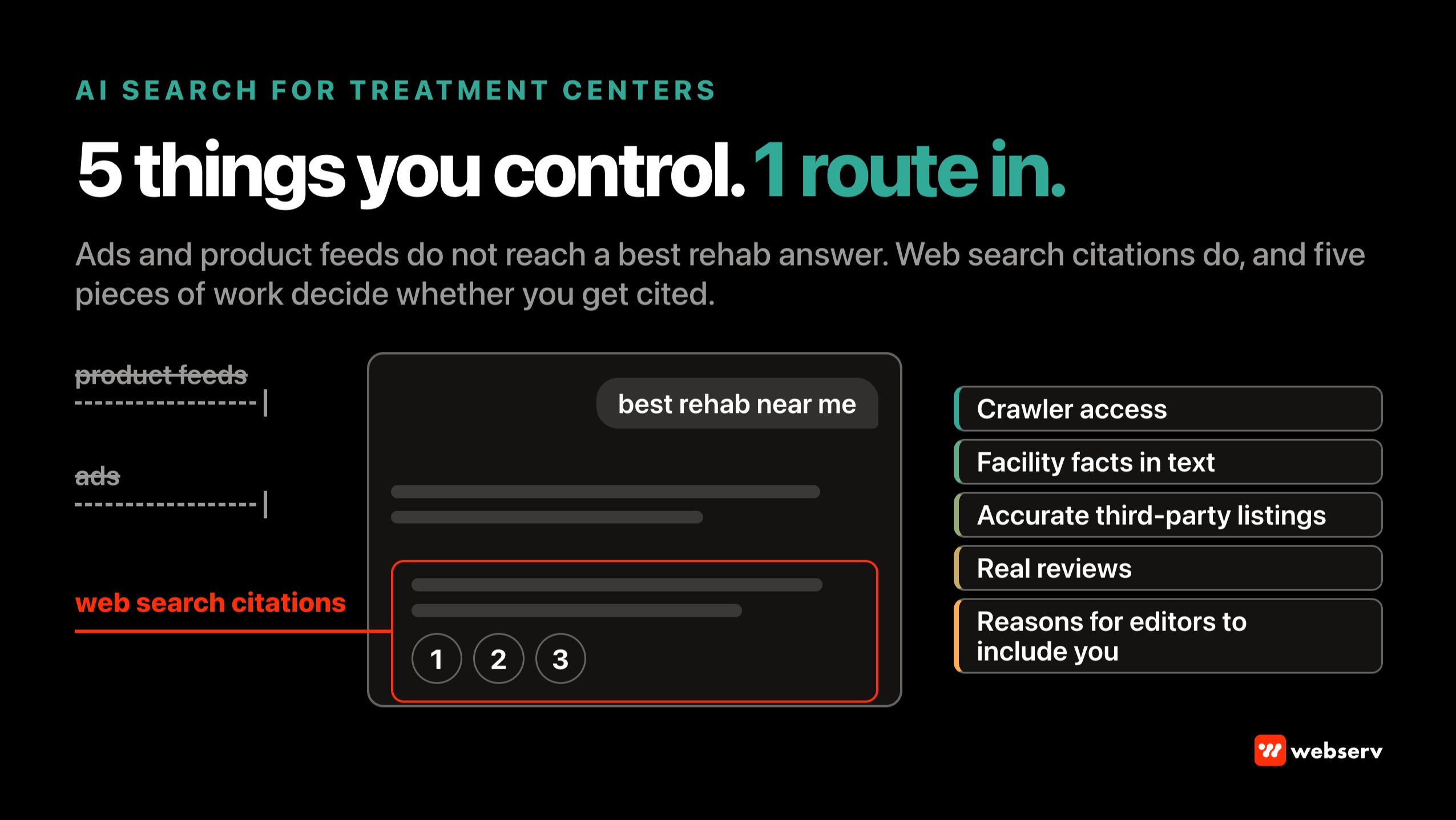
When someone asks ChatGPT for the best rehab near them, the answer isn’t built the way a product recommendation is. OpenAI’s shopping results draw on merchant feeds and product metadata, and its commerce policies are written for physical products. None of that machinery covers a treatment center.
Paid placement isn’t a way in either. OpenAI’s ad policies keep ads away from personal and mental health conversations, and addiction treatment isn’t among the health categories advertisers can apply for.
That leaves one route into a “best rehab” answer: the same web search citations every other answer uses. This piece covers how ChatGPT builds those answers, which sources tend to shape them, and what a facility can do about it without crossing the lines the FTC has already drawn for this industry.
It’s how we approach these prompts inside our AEO program for treatment centers.
For the wider AI search build, see our Full AI Search Stack. This piece is narrower: one kind of prompt, one platform, and the rules that apply to it.
Key Takeaways
- ChatGPT’s product discovery tools (shopping results, merchant feeds, shopping research, checkout) are built for physical products. OpenAI publishes no provider-listing route for treatment centers.
- ChatGPT ads can’t reach these conversations. OpenAI says ads aren’t shown near personal health or mental health topics, and addiction treatment isn’t an eligible health category.
- “Best rehab” answers come from web search. OpenAI says ChatGPT rewrites prompts into search queries, uses the user’s approximate location for “near me” requests, and ranks results on relevance and reliability, with no guaranteed placement.
- Third-party “best” lists carry weight. An Ahrefs study of 750 recommendation prompts found “best X” list pages made up 43.8% of cited source types, though it covered software, products, and agencies rather than healthcare.
- The FTC has already penalized a referral service for misrepresenting how it evaluated treatment centers, and its fake reviews rule bans company-controlled review sites posing as independent. Any “best rehab” content you publish or influence has to hold up to both.
- The work is access, accurate facility information, honest representation on third-party lists, real reviews, and regular prompt testing.
Why “product discovery” doesn’t apply to rehabs
ChatGPT’s shopping features are the most visible part of what people call AI product discovery. OpenAI’s shopping help article says product results are selected independently, aren’t ads, and draw on structured metadata such as price and descriptions, plus reviews from public websites.
Merchants can get into that system through Shopify’s catalog or a direct product feed, and shopping research uses merchant data sent through the Agentic Commerce Protocol. Every one of those routes is built around a product catalog.
OpenAI’s commerce policies confirm the fit problem. They exclude prescription-only medications and medical products, detox-marketed supplements, and services whose main deliverable is work performed on the user’s behalf. A treatment program doesn’t fit the product model, and OpenAI publishes nothing that extends it to healthcare providers.
COMMON MISTAKE
Chasing the product feed. Some vendors are pitching “ChatGPT product listings” to healthcare providers. OpenAI’s own documentation describes feeds and checkout for merchants selling products, not for clinical services.
Before paying for any ChatGPT listing service, ask the vendor to show you the OpenAI documentation that covers healthcare providers. If they can’t, the listing isn’t a route into “best rehab” answers.
Why ChatGPT ads aren’t a shortcut either
OpenAI began testing ads in ChatGPT in the US on February 9, 2026. Its ads help article says ads appear below responses, are labeled as sponsored, and don’t influence ChatGPT’s answers. It also says ads aren’t eligible to appear near sensitive or regulated topics, including personal health and mental health.
The ad policies go further. US health advertisers can be approved case by case in a set of categories such as hospitals, urgent care, dental, and health insurance. Addiction and substance use treatment isn’t on that list, and the policies separately bar unsupported treatment claims and detox programs.
So even if a facility could run ChatGPT ads, they wouldn’t appear in the conversations that matter, and they wouldn’t change the answer. The organic answer is the only placement that counts.
How ChatGPT builds a “best rehab” answer
OpenAI’s help article on ChatGPT search describes the mechanics. ChatGPT rewrites the prompt into one or more targeted search queries and may send them to partner search providers.
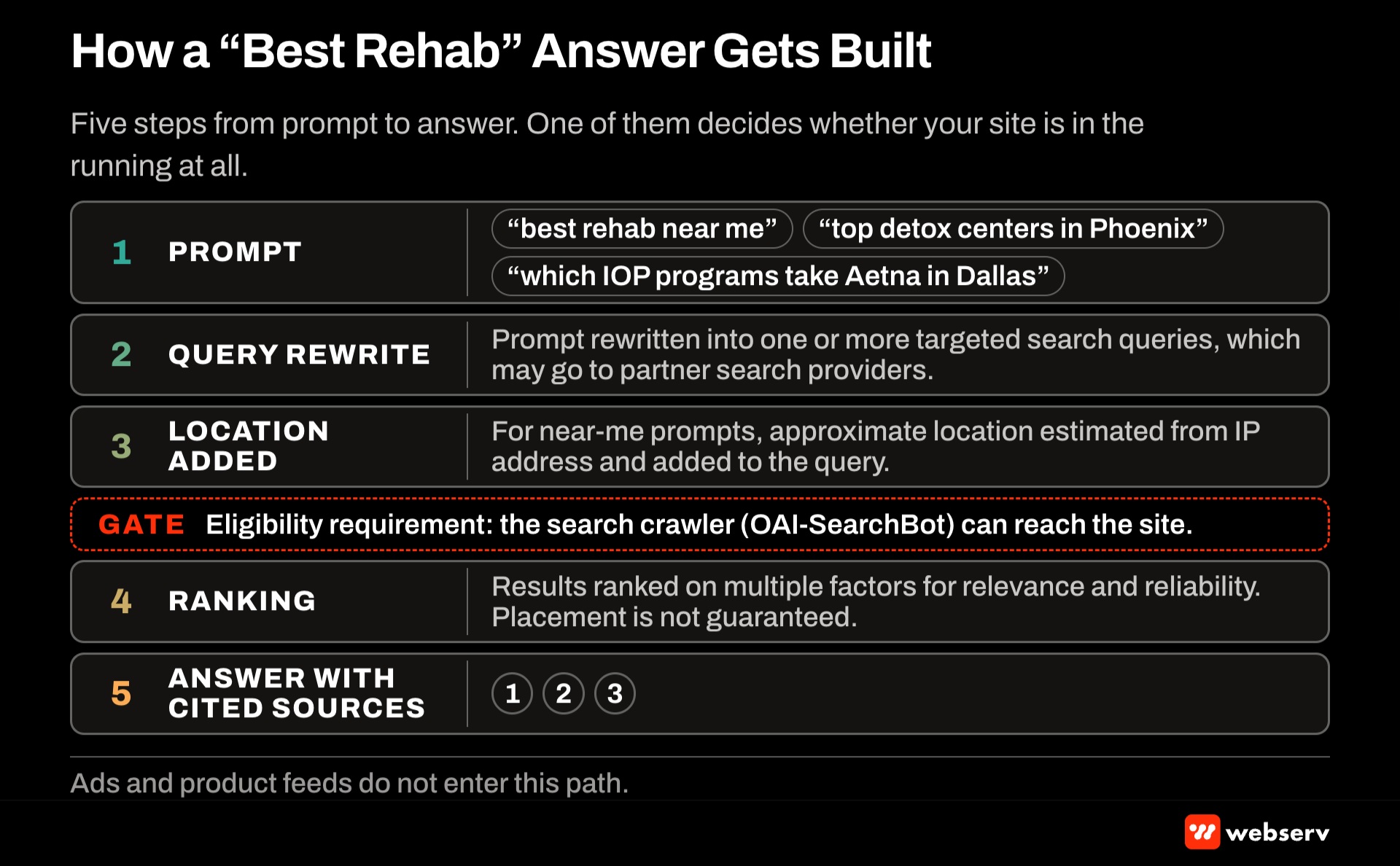
For “near me” prompts, it estimates the user’s general location from their IP address and adds it to the query, the way “good restaurants near me” becomes a query for top restaurants in a named city.
It then ranks results using multiple factors meant to surface relevant, reliable information, and OpenAI says placement isn’t guaranteed. The one hard requirement for eligibility is that ChatGPT’s search crawler can reach the site.
DEFINITION
“Best rehab” prompt. Any request that asks ChatGPT to recommend or compare treatment providers, such as “best rehab near me,” “top detox centers in Phoenix,” or “which IOP programs take Aetna in Dallas.” These prompts depend on location, level of care, and insurance, so the answer changes with small wording and location differences.
That variability is why a single test tells you very little. The same facility can appear for “residential rehab in Scottsdale” and disappear for “best rehab near me” asked from a phone in the same city.
What shapes the answer
OpenAI doesn’t publish a ranking formula, so the evidence here is from outside studies. None of them looked at healthcare prompts, which makes them directional rather than definitive.
Third-party “best” lists. In an Ahrefs study of 750 recommendation prompts across software, products, and agencies, “best X” list pages were 43.8% of cited source types, and brands placed higher in those lists were more likely to be recommended. Ahrefs frames that as a correlation, not proof.
Recency. The same study found 79.1% of the cited lists had been updated in 2025, and 26% in the two months before the analysis.
What the research and enforcement record show
43.8%
Share of cited source types that were ‘best X’ lists (Ahrefs, non-healthcare prompts)
Feb 9, 2026
ChatGPT ads begin US testing, excluded from health topics (OpenAI)
$3.8M
FTC civil penalty judgment against R360 (suspended)
Established, frequently cited pages. Ahrefs’ separate analysis of ChatGPT’s most-cited pages found that among cited pages that rank in Google, the median Domain Rating was 90. For a treatment center, that points toward major directories, health publishers, and review platforms as the sources an answer leans on.
Self-promotional lists. Ahrefs found self-promotional lists showed up in more than a third of software responses where their publisher was recommended. A Peec AI analysis of 232,000 citations, also in software, put self-promotional listicles at 3.6% of ChatGPT’s citations. Both are software findings, and in addiction treatment the legal context is very different, as the next section explains.
The line the FTC has already drawn
Behavioral health has a specific enforcement history here. In 2022 the FTC brought its first case under the Opioid Addiction Recovery Fraud Prevention Act against R360 and its owner. The complaint said R360 claimed to match callers with treatment centers chosen through a rigorous expert evaluation, when the owner picked members himself after a cursory review.
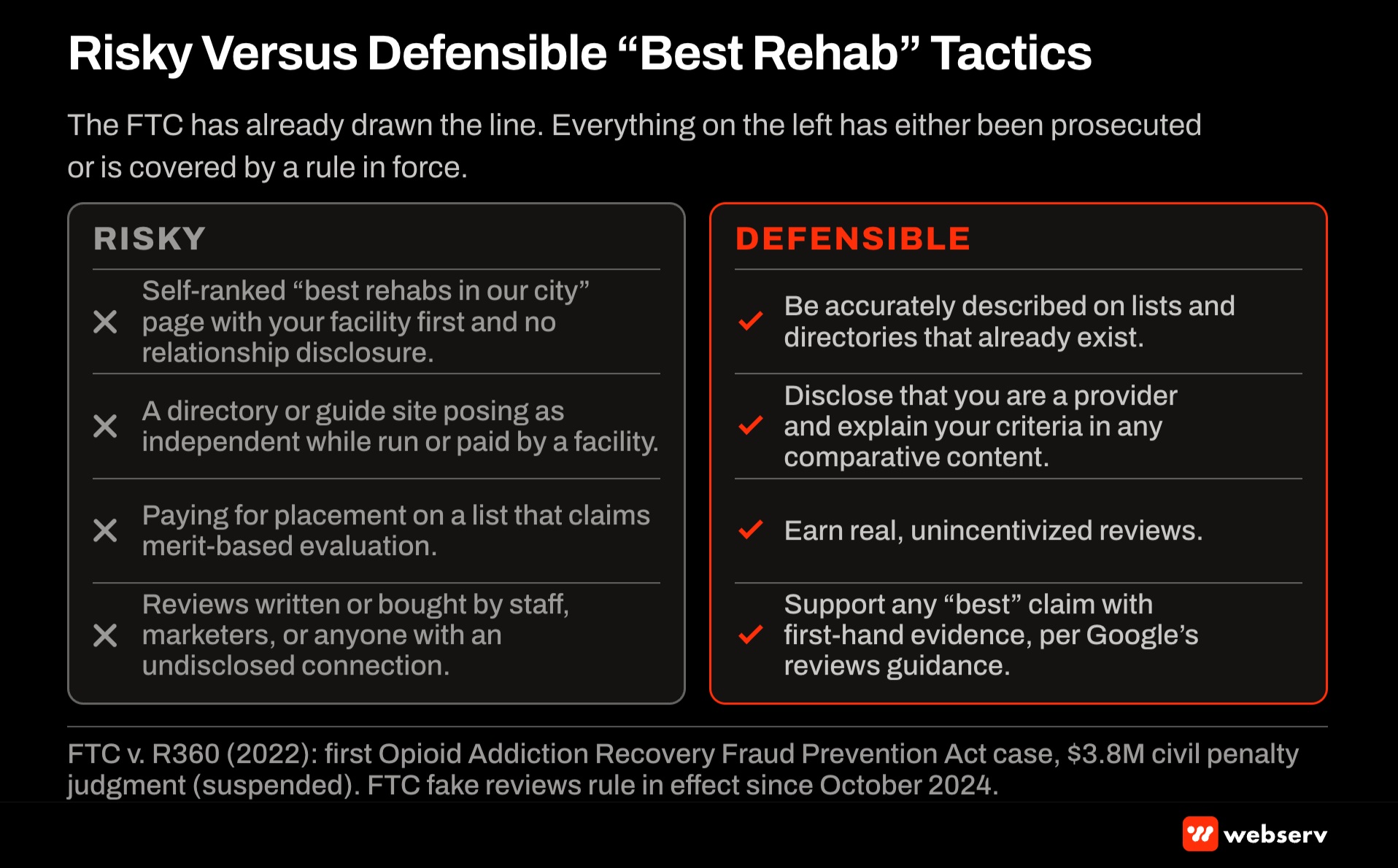
The order bans misrepresenting expert evaluation and the criteria used to evaluate centers, and it carried a $3.8 million civil penalty judgment, suspended based on inability to pay.
The FTC’s rule banning fake reviews and testimonials, in effect since October 2024, adds more. It prohibits buying reviews, undisclosed insider reviews, and creating a company-controlled review website that falsely claims to offer independent reviews.
Put those together and the risky moves are clear:
- A “best rehabs in our city” page on a site you control that ranks your own facility first without disclosing the relationship.
- A directory or “guide” site that presents itself as independent while being run by, or paid by, a facility.
- Paying for placement on a list that claims to be based on evaluation or merit.
- Reviews written or bought by staff, marketers, or anyone with an undisclosed connection.
Google’s guidance on writing reviews points the same way from the search side: if you call something the best, explain why with first-hand supporting evidence.
OPERATOR INSIGHT
The fastest way to lose in these prompts is to try to manufacture the list. The facilities that hold up are the ones that are accurately described on the lists and directories that already exist, and that give reviewers and editors real reasons to include them.
That work is slower than publishing a self-ranked list, but it’s the version that survives both an FTC review and the next change to how AI systems weigh self-promotional sources.
What a treatment center can actually do
Five pieces of work cover what’s in a facility’s control.
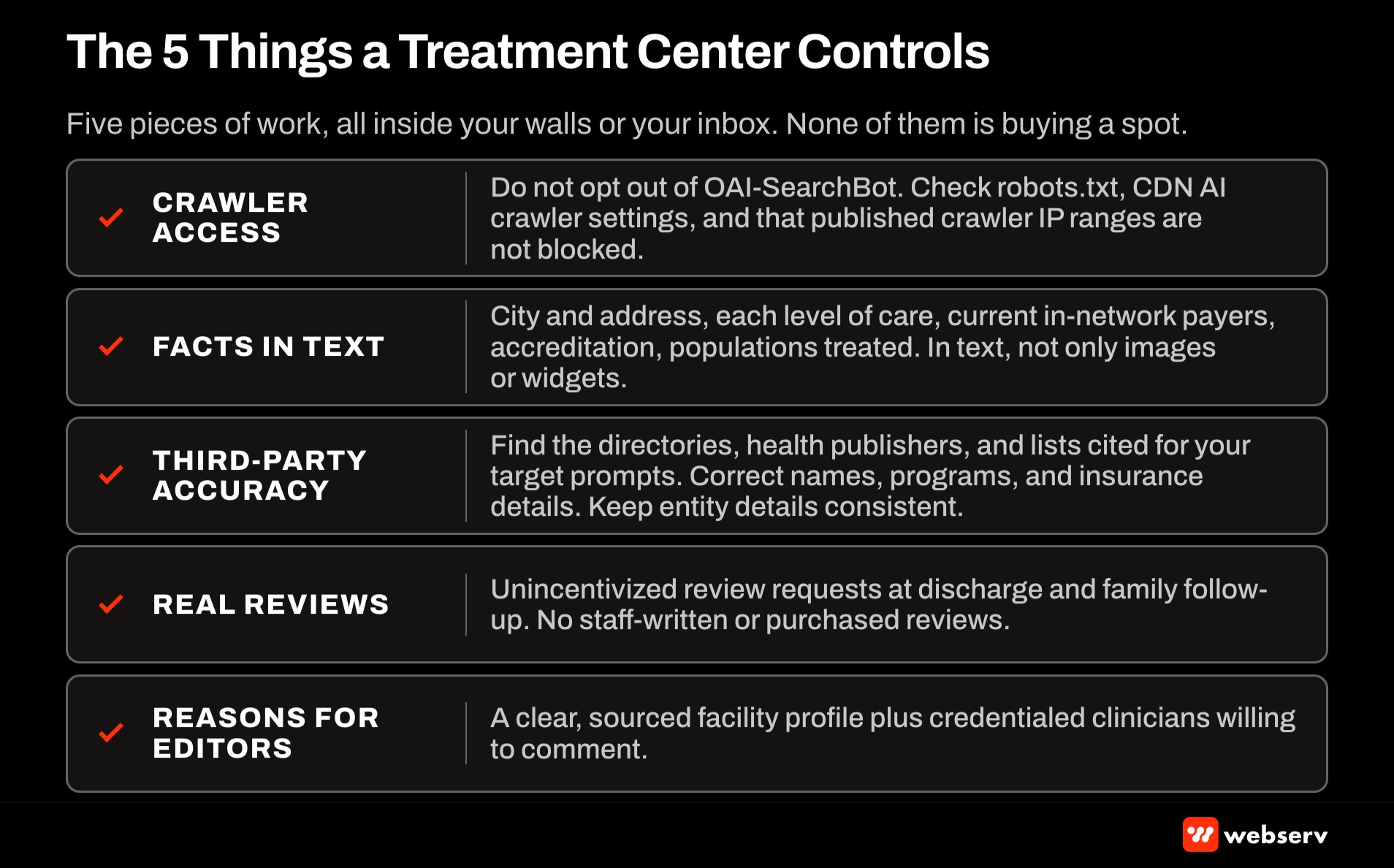
1. Make sure ChatGPT can reach the site. OpenAI’s crawler documentation says sites that opt out of OAI-SearchBot won’t be shown in ChatGPT search answers. Check robots.txt, your CDN’s AI crawler settings, and that OpenAI’s published IP ranges aren’t blocked. Our robots.txt guide for AI bots covers the file.
2. Publish the facts a “best rehab” answer needs. The prompts turn on location, level of care, insurance, and specialties, so each of those needs to be stated plainly on your site: the city and address, each level of care, current in-network payers, accreditation, and the populations you treat.
Put them in text, not only in images or widgets.
3. Be accurate on the third-party sources that get cited. Find which directories, health publishers, and lists appear in answers for your target prompts, then check how your facility is described on each. Correct outdated names, programs, and insurance details, and make sure your entity details are consistent everywhere they appear.
4. Earn real reviews on public platforms. OpenAI says shopping results summarize reviews from public websites, and while treatment answers aren’t shopping results, public review profiles are part of how the web describes a facility. Build an unincentivized review request into discharge and family follow-up, with no staff-written or purchased reviews.
5. Give editors a reason to include you. Third-party lists are written by people. A clear, sourced facility profile, like the one in our AI Information page guide, plus credentialed clinicians willing to comment, gives journalists and list editors something accurate to work from.
How to test your visibility in these prompts
Treat prompt testing like rank tracking: a fixed set of prompts, run on a schedule, with the results recorded.
- Build the prompt set from the questions families ask: best and top prompts by city, level of care, and payer, plus comparison prompts that name you and nearby competitors.
- Vary location and wording. Because ChatGPT uses approximate location for “near me” prompts, run tests from, or explicitly naming, each city you serve.
- Record the sources, not just the mention. Note which pages ChatGPT cites for each answer. Those are the lists and directories worth correcting or earning a place on.
- Track over time. Monthly is a reasonable cadence. Single tests swing too much to act on.
Our AEO measurement guide covers citation share tracking across ChatGPT, Perplexity, Claude, and Google, and our 6 ways to get cited in AI search covers the broader tactics.
What this means for your AI search plan
“Best rehab” prompts don’t need a separate channel. They need the same foundations as the rest of AI search (access, clear facts, consistent entity data, and credible third-party presence), applied with more care because the answer is a recommendation, and recommendations in this industry carry legal weight.
Start with access and your own facts, then audit the third-party sources your prompt tests turn up. Our 12 SEO failure patterns and 5-tier priority framework help place this work in the wider SEO sequence, and our behavioral health marketing guide covers the rest of the program.
If you want to see how your facility shows up in “best rehab” prompts today, book an intro meeting and we’ll run the test with you.
Frequently Asked Questions
Can a treatment center pay to appear in ChatGPT’s “best rehab” answers?
No. OpenAI says ads run on separate systems and don’t influence ChatGPT’s answers, and its ad policies keep ads away from personal and mental health conversations. Addiction treatment also isn’t among the health categories US advertisers can apply for.
Product feeds and checkout don’t offer a route either, because they’re built for merchants selling physical products.
Be wary of any vendor selling guaranteed ChatGPT placement. OpenAI states that placement in search results isn’t guaranteed.
Should we publish our own “best rehabs” page for our city?
Only with great care, and usually not as a ranked list with your facility at the top. The FTC’s R360 case shows the risk of misrepresenting how treatment centers are evaluated, and its fake reviews rule bans company-controlled review sites that pose as independent.
If you publish comparative content, disclose that you’re a provider, explain your criteria, and support every claim with first-hand evidence, as Google’s reviews guidance recommends.
The more durable approach is to help families evaluate any facility, including yours, with clear criteria such as accreditation, levels of care, and insurance. That content is useful, defensible, and still gives AI systems accurate information about you.
Why does our facility appear for some prompts and not others?
Small changes in wording, location, level of care, or insurance change the search queries ChatGPT runs, which changes the sources it finds. OpenAI says it rewrites prompts into targeted queries and uses approximate location for “near me” requests.
That’s why a single test isn’t meaningful. Build a fixed prompt set and run it on a schedule.
When a prompt doesn’t include you, look at the sources it cites. The gap is usually a list or directory that doesn’t mention your facility, or describes it inaccurately.
Do reviews affect whether ChatGPT recommends a treatment center?
OpenAI doesn’t publish how reviews factor into non-shopping answers. For shopping, it says it summarizes reviews from public websites and doesn’t verify them.
What’s clear is that public reviews are part of the web’s description of a facility, and they appear on the review sites and directories that recommendation answers draw on.
Build an honest review program into discharge and family follow-up, and never write, buy, or incentivize reviews. The FTC’s rule makes those practices a source of civil penalties.
How is this different from getting cited in Google AI Overviews?
The foundations overlap: crawl access, clear facts, consistent entity data, and credible third-party sources. The mechanics differ, because Google’s AI features draw on Google’s own index and eligibility rules, while ChatGPT runs its own search process through its crawler and partner providers.
In practice, allow both Googlebot and OAI-SearchBot, and test prompts on each platform separately.
The recommendation angle is what makes “best rehab” prompts different on any platform. Because the answer ranks facilities, the FTC’s rules on evaluation claims and reviews apply to everything you do to influence it.
Trevor Gage is the Director of Marketing at Webserv, a digital marketing agency for treatment centers.