The $180-Per-Day Admission
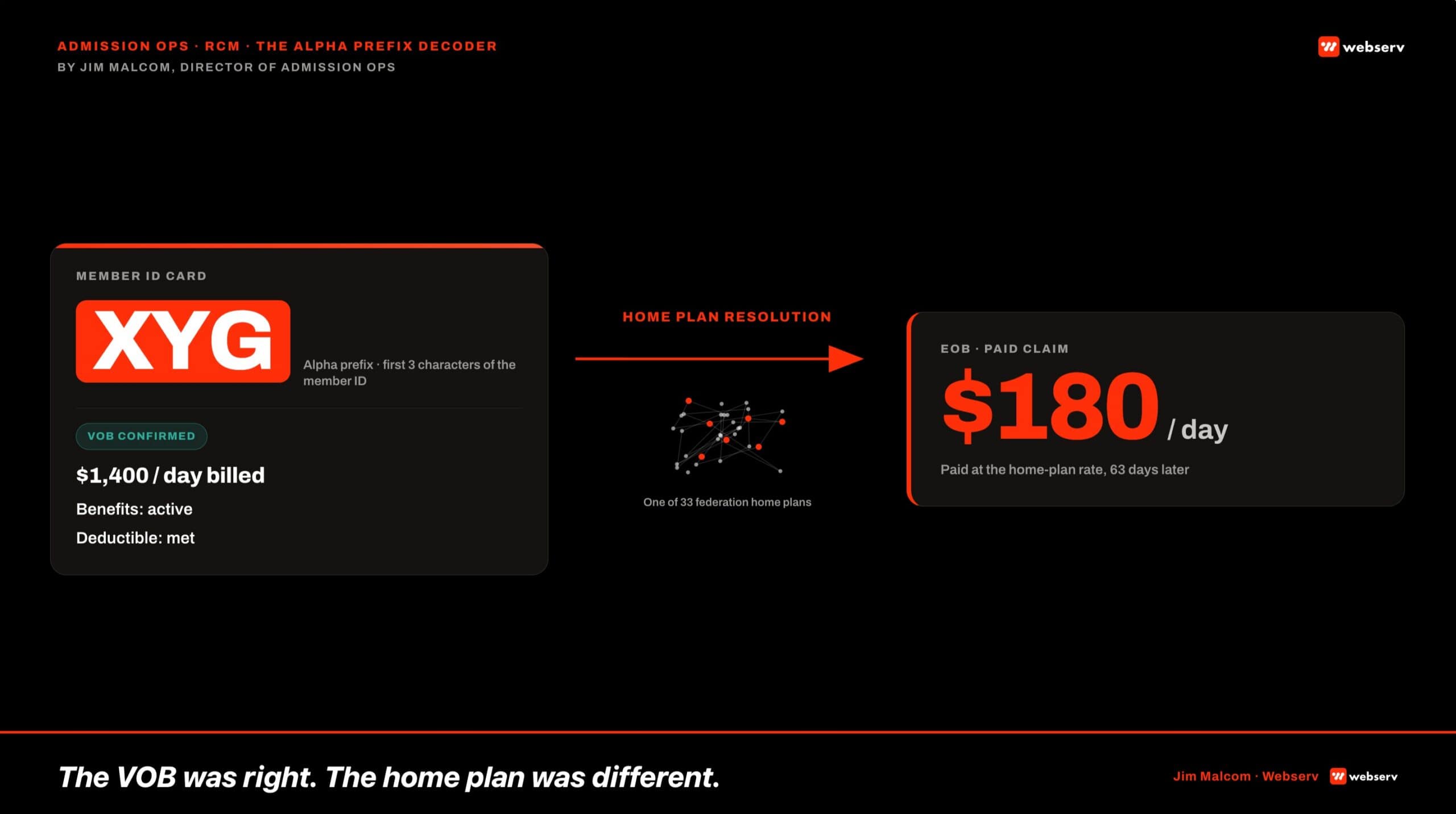
An admissions coordinator I know pulled a BCBS card at intake. The alpha prefix read “XYG.” She ran the VOB. Benefits looked healthy. The patient admitted to a $1,400-per-day residential program.
Sixty-three days later the claim came back paid at $180 per day. Not a denial. Not an underpayment appeal opportunity. Just the reimbursement the patient’s actual home plan pays for out-of-network residential in that state.
The VOB never told her, because the VOB never resolves the home plan. This is the operator problem our eligibility and reimbursement capability at Webserv exists to close.
The VOB was correct. The alpha prefix decode was missing. That is the gap this piece is about.
Key Takeaways
- The alpha prefix (first three letters of a BCBS member ID) is a routing code, not the plan paying the claim.
- BCBS is a federation of 33 independent home plans, each setting its own fee schedule and product mix.
- The home plan, resolved from the alpha prefix, dictates reimbursement, not the local plan whose logo is on the card.
- PayerLenz data shows more than 6x reimbursement variance across BCBS home plans for identical residential SUD claims.
- VOB confirms coverage. VOB does not tell you what the home plan will actually pay for your level of care.
- Decoding alpha prefix to home plan to product type to expected reimbursement at intake changes payer mix strategy, OON escalation triggers, and patient financial counseling scripts.
- The reimbursement delta between decoded and undecoded BCBS admits is the difference between OON programs collecting 60-75% and OON programs collecting 30-45%.
What Is a BCBS Alpha Prefix Actually Doing
DEFINITION
The Alpha Prefix and the Home Plan
The alpha prefix is the first three letters of every BCBS member ID. It is a routing code, not an identity. The prefix tells the interplan claims system which of the 33 independent BCBS home plans holds the risk on this member. The local plan whose logo is on the card handles administrative touch. The home plan sets the fee schedule, medical necessity criteria, and product configuration. Two identical-looking cards from the same local plan can route to two different home plans that reimburse the same service at wildly different rates.
The alpha prefix on every BCBS ID card is a routing code. The three letters are the address, not the identity of the plan paying.
The Blue Cross Blue Shield Association corporate profile describes the federation structure and the BlueCard program that makes cross-plan claims work.
BlueCard is the interplan program. A patient carrying a card issued by one local BCBS plan can present at a facility contracted through another local BCBS plan, and BlueCard is the routing layer that carries the claim from the treating facility to the home plan that owes the payment.
The card plan handles the local network and the administrative touch. The home plan sets the fee schedule and the medical necessity policy. Two different jobs. Two different plans. One card.
Treating the local plan as the payer is where reimbursement forecasts fall apart. The alpha prefix tells you which of the 33 independent home plans actually holds the risk. It is one of the main drivers of the VOB-to-admit gap.
Why the Home Plan Matters More Than the Card Plan
The card plan handles the local touch. Network administration, provider directory maintenance, member service phone lines. Real work, but not the work that determines what your facility collects.
The home plan sets the fee schedule for the specific service at the specific level of care in the specific state.
The home plan defines the product configuration (PPO, HMO, self-funded ASO, ACA marketplace, FEP) that applies. It also runs the concurrent review that may down-code PHP to IOP after admission.
Two patients with identical-looking cards from the same local plan can have completely different home plans, product types, and reimbursement rates.
Illustrative example. A card issued by BCBS of California with a hypothetical alpha prefix XYG routes to a home plan in a different state.
Another card issued by the same BCBS of California with prefix ABC routes to a home plan in a third state. Same local card issuer. Different home plans. Different fee schedules.
The card issuer is a marketing surface. The home plan is where the money lives.
The 33 BCBS Federation Plans and Their Reimbursement Variance
The BCBS Association is a federation of 33 independent, locally-operated plans. Each sets its own fee schedule for in-network and out-of-network reimbursement. Each sets its own medical necessity policies. Each runs its own product mix.
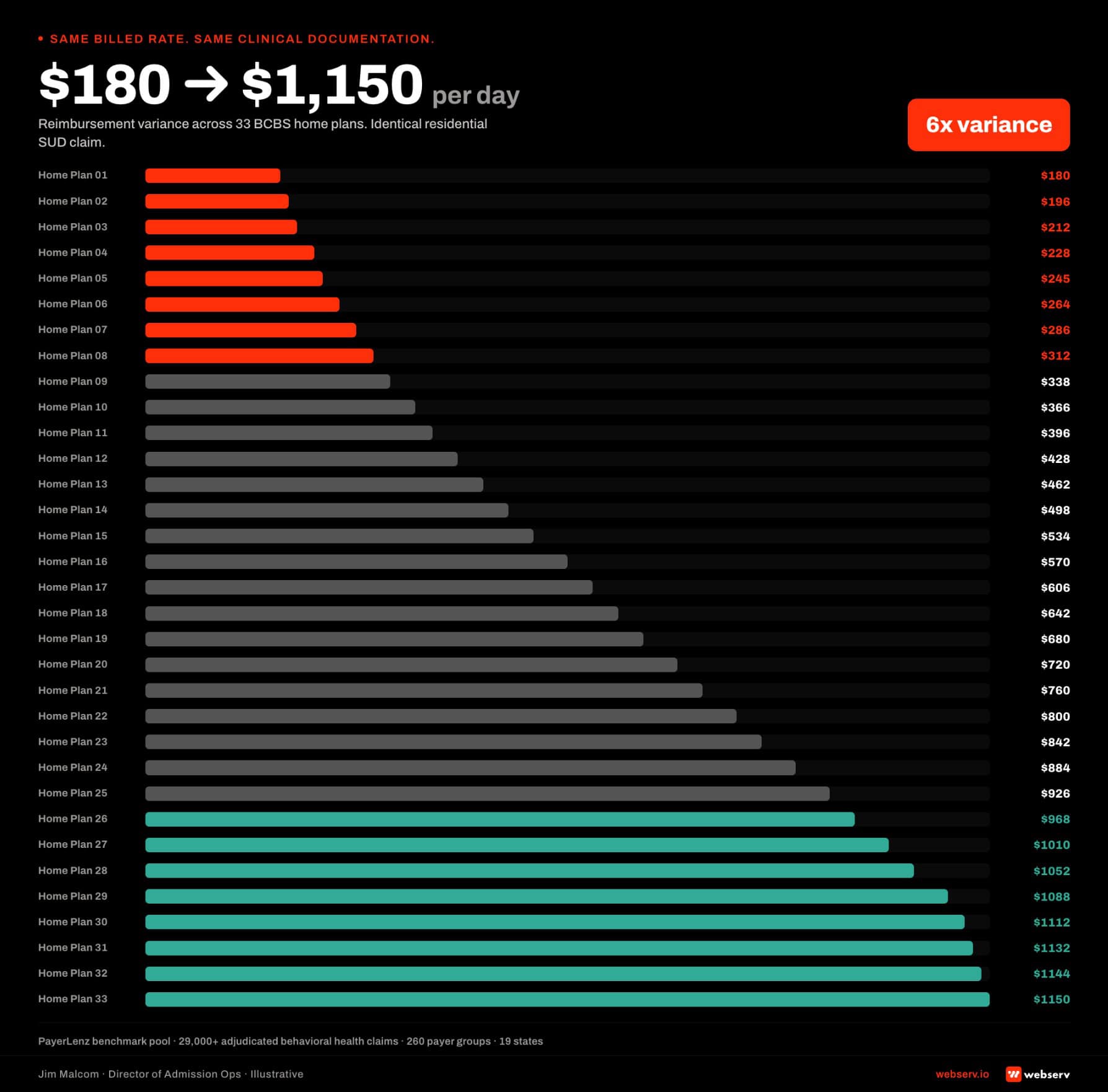 Horizontal scoreboard showing reimbursement variance across BCBS federation home plans for identical residential SUD services.
There is no central pricing authority. There is no national fee schedule for out-of-network residential SUD or PHP. The Association coordinates the interplan program and the brand. The 33 home plans set the rates.
PayerLenz data resolves alpha prefix to home plan and product configuration on more than 500,000 adjudicated behavioral health claims across 250 payer groups. Reimbursement variance across BCBS home plans for identical residential SUD claims exceeds 6x in the dataset.
A $1,400-per-day billed rate resolves to anywhere from $180 to $1,150 per day depending on which of the 33 home plans holds the risk. Same billed rate. Same clinical documentation. Six times the variance.
A national average across the 33 home plans is not the rate any specific patient’s home plan pays. It is a statistical artifact that hides the variance the operator actually needs to see.
What VOB Tells You vs What Alpha Prefix and Home Plan Tell You
The verification of benefits workflow confirms coverage. Active plan, deductible balance, out-of-pocket maximum, prior-authorization requirements, effective dates. That is a real job and VOB does it well.
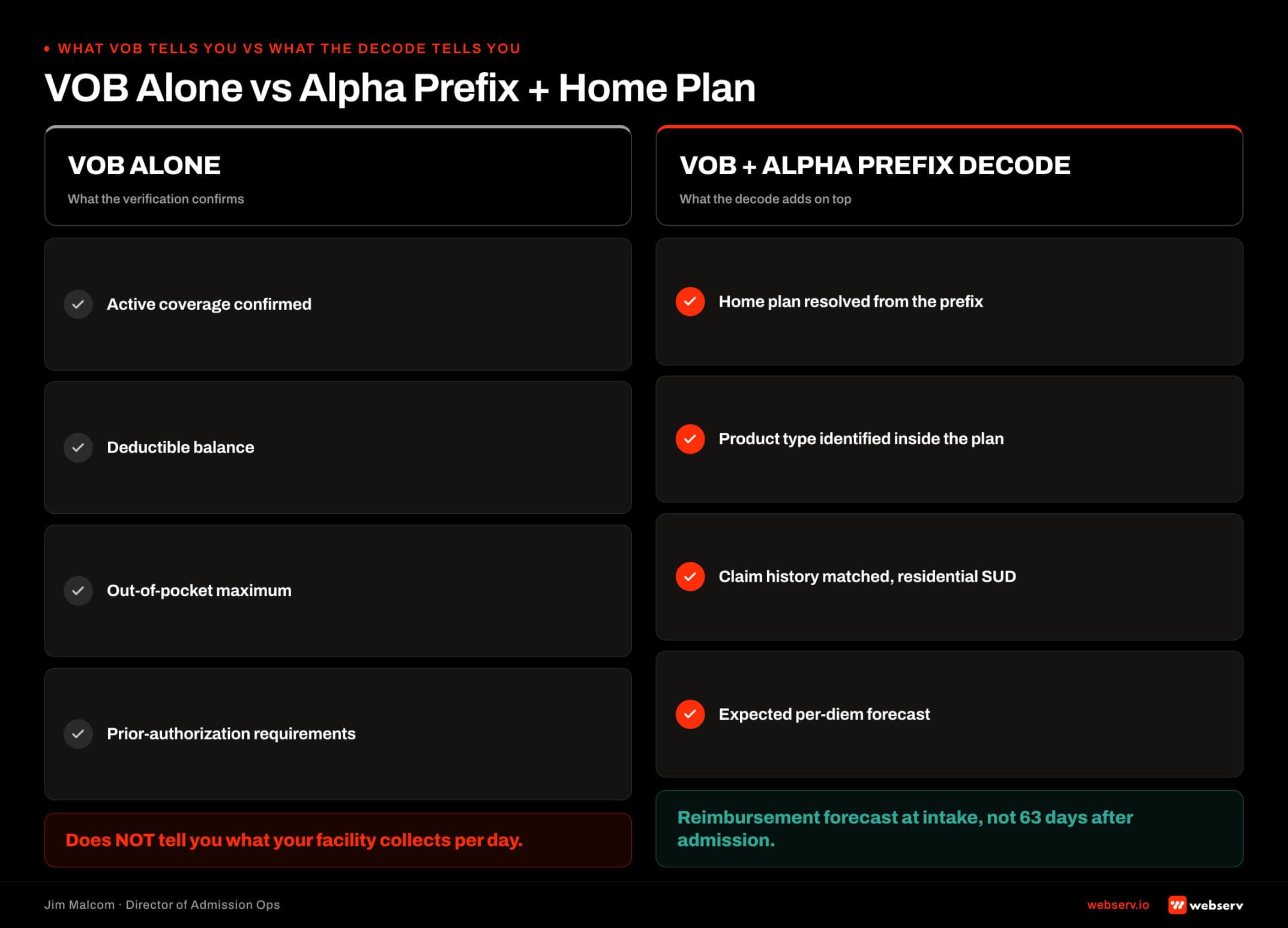 Side-by-side comparison of what a standard VOB confirms for a treatment center versus what the alpha prefix and home plan decode adds: standard VOB delivers coverage status, deductibles, out-of-pocket maximum.
VOB does not tell you the fee schedule the home plan uses for the specific service at the specific level of care.
Fee schedules live in the claims history of the plan and product combination, not in the eligibility API the VOB tool queries. The eligibility system knows the patient has coverage. It does not know what that coverage pays your facility per day for H0018.
The two datasets are separate. The eligibility API sits inside each payer’s benefits infrastructure. The claims history sits inside each facility’s billing system and each aggregator’s benchmark pool. Bridging them requires a discipline the VOB workflow was never designed for.
Every treatment center running BCBS admits on VOB alone is answering half the reimbursement question.
Walking the Decode: Card to Home Plan to Product Type to Expected Reimbursement
The four-step decode:
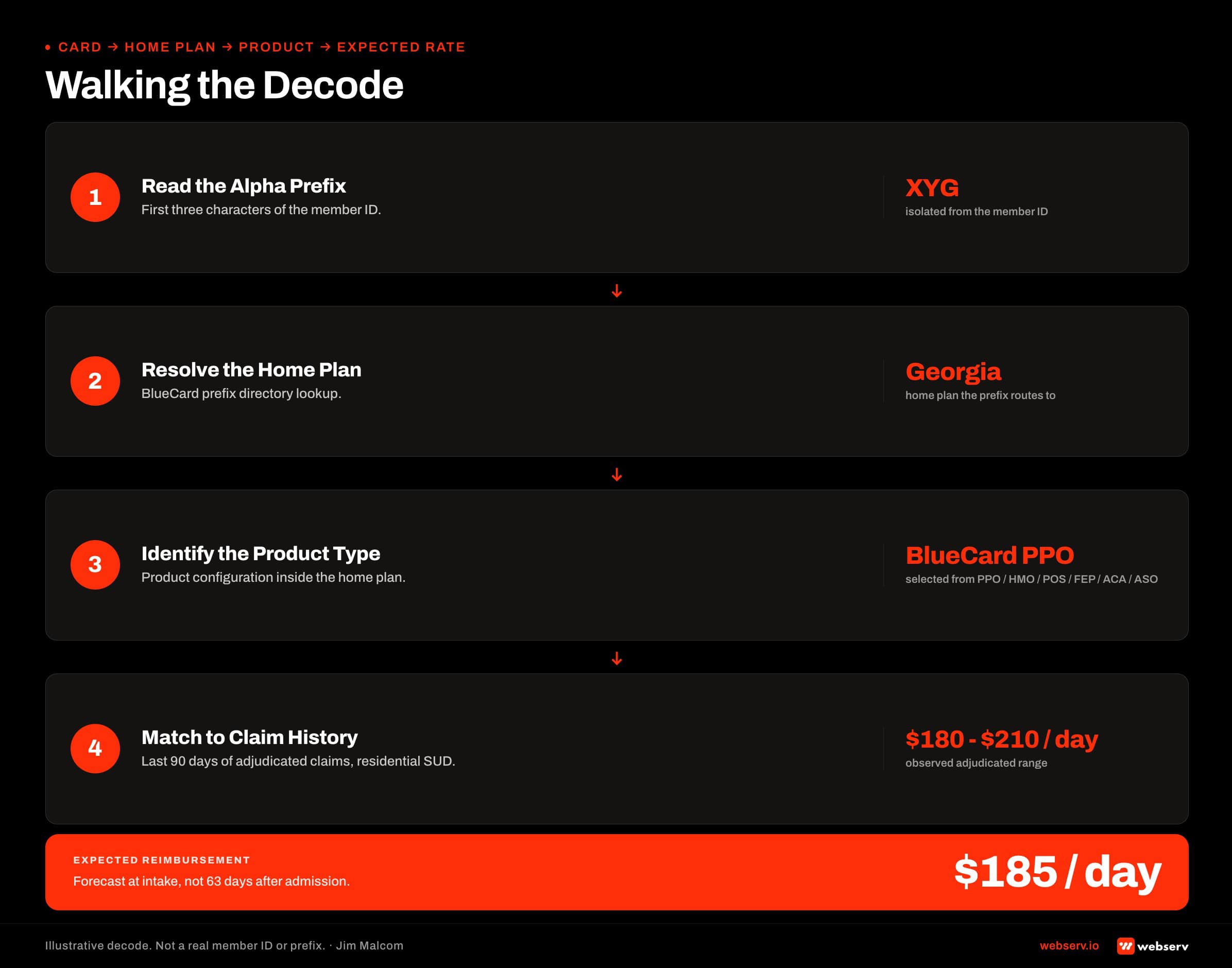 The four-step alpha prefix decode sequence for treatment centers: read the three-letter alpha prefix on the BCBS card, resolve it to the home plan (independent Blue plan administering coverage).
- Read the alpha prefix. The first three characters of the member ID on the front of the card. Not the group number, not the plan name, not the local plan logo. The three-letter prefix.
- Look up the home plan the prefix routes to. The BlueCard prefix directory maintained by the BCBS Association resolves the prefix to a specific home plan. Manual lookup works. Automated resolution at intake is faster.
- Identify the product type. PPO, HMO, POS, BlueCard PPO, FEP, ACA marketplace, self-funded ASO. The product type sits inside the home plan and determines the fee schedule branch that applies to this claim.
- Match the plan x product to your facility’s claim history for the level of care. Your billing team already knows what your facility collects on residential SUD claims from BCBS-GA BlueCard PPO. That number is the expected reimbursement forecast.
Illustrative walk-through. A patient card carries alpha prefix XYG. The prefix resolves to a home plan in Georgia. The product configuration resolves to BlueCard PPO.
Your facility’s claim history for BCBS-Georgia BlueCard PPO on residential SUD sits between $180 and $210 per day across the last 90 days of adjudicated claims. Your expected reimbursement forecast for this admit is $185 per day.
That number is now available at intake. The admissions coordinator has coverage confirmation from VOB and reimbursement forecast from the decode. Both go into the intake decision.
The 20 states covered in the PayerLenz benchmark pool include most of the states where BCBS OON residential and PHP admits concentrate. The pool grows every cycle as more claims adjudicate.
The Reimbursement Delta: What Missing This Costs a Facility
Model a 90-bed residential program admitting 25 percent BCBS members. At $1,400 per day billed, the difference between admitting BCBS patients whose home plans pay $850 or more versus $200 to $400 is millions in annual net revenue realized versus written off. This is where payer mix strategy gets operational.
Not theoretical. This is the operator lever that separates OON programs collecting 60 to 75 percent from OON programs collecting 30 to 45 percent.
The decoded facility knows which BCBS admits pay strong and which pay poorly. It admits the strong prefixes at full clinical rate. It admits the weak prefixes with a different financial conversation upstream, or it escalates to single-case agreement negotiation before the admission.
The undecoded facility admits everyone at the same expected rate, prices its cost per admit against a false average, and discovers the variance 63 days later on the EOB.
The 25 to 30 percentage point collection rate delta is not evenly distributed across payers. On a BCBS-heavy census, it concentrates in the home plans that pay poorly. Knowing which those are turns a P&L problem into a triage input.
How SoCal Sunrise generated 85 admissions and 2,297% ROI from SEO in 6 months
A ground-up SEO rebuild using the Pathfinder Parents Methodology turned an invisible online presence into a top-ranking admissions engine.
Read the case study →85 admits and 3,152 leads attributed to organic
How to Do This Manually vs How PayerLenz Does It Automatically
Manual decode is real work but it is possible for a single-facility operator with a disciplined billing lead.
Maintain a running lookup of the alpha prefixes you see most often. Cross-reference against the BlueCard prefix directory to resolve prefix to home plan. Track your own claim history per home plan per product per level of care. Update quarterly as plans reprice.
Feasible for a low-BCBS-volume single-facility operator. Not feasible for multi-site portfolios or high-volume admits.
Automated resolution runs the same decode in seconds at intake. Alpha prefix to home plan to product type to facility-specific expected reimbursement, drawn from the aggregated claims pool rather than only from a single facility’s history.
Disclosure. PayerLenz was built by Revenue Logic, the behavioral health revenue cycle firm run by Kyle McHenry, and co-founded with Preston Powell, CEO of Webserv. This article is published by Webserv. The tool the article recommends is the tool Webserv’s CEO co-founded. That relationship is stated plainly.
PayerLenz resolves alpha prefix to home plan to product type to expected reimbursement across 500,000+ adjudicated behavioral health claims, 250 payer groups, and 20 states. What used to require a billing lead maintaining a manual prefix directory and cross-referencing quarterly claim history now runs at intake in seconds.
Preston Powell, Webserv CEO and PayerLenz co-founder
Webserv does not receive commissions on PayerLenz signups. The disclosure is stated openly because the reimbursement gap this article names is a real operator problem, and PayerLenz is the productized answer to it.
What Changes in the Admissions Workflow When You Have This Data Upstream
Three concrete workflow changes.
Admissions gets an expected-reimbursement forecast alongside VOB at intake. The coordinator now has two numbers: coverage confirmation and expected pay per day. The intake decision is a different decision when the second number is real.
Payer mix strategy shifts. The admit conversation includes reimbursement forecast, not just coverage. Facilities begin admitting toward home plans that pay well and building different financial counseling scripts for home plans that pay poorly. The payor audit becomes the diagnostic that identifies the pattern.
OON strategy gets sharper. Single-case agreement triggers, network gap exception filings, patient financial counseling escalations all become data-driven. Which patients to escalate on becomes obvious. Which patients need a different conversation upstream becomes obvious.
Prior authorization workflow pairs with the decode because pre-auth is where medical-necessity limits get quoted before they get enforced.
The workflow shift is not that the admissions team does more work. The workflow shift is that the admissions team is making better decisions with better data at the moment of decision.
Closing
The alpha prefix on a BCBS card is a routing code, not an identity. The home plan sets reimbursement. The delta between decoded and undecoded admits is 25 to 30 percentage points of collection rate.
The 2024 CMS-supported alignment of 42 CFR Part 2 with HIPAA is easing SUD claim data exchange between billing platforms and treatment centers. The data infrastructure is more accessible in 2026 than it was two years ago.
The operator work of decoding alpha prefix to home plan to expected reimbursement fits inside the broader revenue cycle management discipline. It is not a replacement for RCM. It is the eligibility and reimbursement layer that RCM depends on.
If you want to see how your facility’s claim history maps to alpha prefix and home plan reimbursement forecasts across the BCBS federation, we can walk through it in a 30-minute call. Book an intro meeting.
Frequently Asked Questions
What does the alpha prefix on a BCBS insurance card mean?
The alpha prefix is the first three letters of a member ID on a BCBS card. It routes the claim from the local Blue plan whose logo appears on the card to the patient’s home plan, the independent BCBS plan that actually holds the risk and dictates reimbursement.
BlueCard is the interplan program the BCBS Association runs to make cross-plan claims work. A patient carrying a card issued by one local BCBS can receive treatment at a facility contracted through another local BCBS, and BlueCard is the routing layer that gets the claim from the treating facility to the home plan that owes the payment.
The operator implication is that the alpha prefix is a routing code, not an identity. Treating it as identity, and pricing admits against the local plan whose logo is on the card, is where reimbursement forecasts break down.
How many BCBS plans are there in the federation?
The Blue Cross Blue Shield Association is a federation of 33 independent, locally-operated BCBS plans. Each sets its own fee schedule, product mix, and medical necessity policy, which is why reimbursement varies widely across BCBS home plans for the same billed service.
The federation structure is why national reimbursement averages hide the variance. An average across 33 independently priced fee schedules is not a rate a specific home plan actually pays. It is a statistical artifact.
Product configurations compound the federation variance. Inside a single home plan, PPO, HMO, ACA marketplace, and self-funded ASO products can all pay different rates for the same CPT code at the same level of care. The card usually does not tell you which product it is.
How do I look up which BCBS plan an alpha prefix belongs to?
Alpha prefixes route to home plans through the BlueCard prefix directory maintained by the BCBS Association. Operators can look up a prefix manually via BlueCard resources, or use an automated tool that resolves prefix to home plan and product type at intake.
Manual lookup works for a single-facility operator with a strong billing lead and low BCBS volume. Maintain a running spreadsheet of the prefixes you see, the home plans they resolve to, and the product types associated with each. Update quarterly as plans repriced.
Automation becomes necessary at scale. Multi-site operators and high-volume admits break the manual lookup approach fast. EDI clearinghouse lookups and PayerLenz both resolve the prefix at intake, though only PayerLenz attaches the facility-specific expected reimbursement forecast.
Does VOB tell me what BCBS will actually pay for residential SUD or MH treatment?
No. VOB confirms coverage, deductible, out-of-pocket max, and prior-authorization requirements. VOB does not surface the fee schedule the patient’s home plan uses for the specific level of care, because fee schedules live in the claims history of each plan and product combination, not in the eligibility API.
What VOB catches: active plan, benefits structure, patient responsibility variables, prior-auth flags. What VOB misses: what the home plan actually pays per CPT code for residential SUD in your state, and how aggressively the home plan down-codes on medical necessity review.
Fee-schedule forecasting is a separate discipline from eligibility verification. Both matter. Running the second without the first is where the reimbursement gap opens.
Why does BCBS reimbursement vary so much between patients with similar-looking cards?
Two patients with identical-looking BCBS cards from the same local plan can have completely different home plans, product types, and fee schedules. The alpha prefix routes to the home plan that dictates reimbursement, and reimbursement variance across the 33 BCBS home plans exceeds 6x on identical residential SUD claims in PayerLenz data.
Federation structure is the underlying reason. Each of the 33 home plans is independently operated and sets its own fee schedule. A residential SUD day can pay $180 at one home plan and $1,150 at another for the same H0018 code with the same clinical documentation.
Product mix compounds the effect. The same home plan can have a fully-insured PPO that pays one rate, a self-funded ASO product that pays another, and an ACA marketplace product that pays a third. The card usually shows the local plan, not the product configuration.
How can a treatment center predict expected BCBS reimbursement before admitting a patient?
Expected reimbursement is a function of alpha prefix to home plan to product type to level-of-care fee schedule. Facilities predict it by resolving the alpha prefix to the home plan, identifying the product type (PPO, HMO, BlueCard PPO, FEP), and matching that plan and product combination to the facility’s own claim history for the specific level of care.
Manual workflow: keep a running lookup of the alpha prefixes your facility admits most often, cross-reference against your own claim history for each home plan and product combination, and quote expected reimbursement at intake alongside VOB coverage confirmation.
Automated approach: PayerLenz runs the resolution and attaches expected reimbursement at intake using its 500,000+ adjudicated claims dataset. Preston Powell, Webserv CEO, is a co-founder; the tool is disclosed openly as the Webserv-adjacent product that solves this specific gap.
Facilities predict it by resolving the alpha prefix to the home plan, identifying the product type (PPO, HMO, BlueCard PPO, FEP), and matching that plan and product combination to the facility’s own claim history for the specific level of care.
Most in-house teams hit a wall not because they lack knowledge, but because they lack bandwidth.
When you are ready to hand it off, Webserv has spent 9 years executing exactly this for treatment centers nationwide.
Jim Malcom is Director of Admission Ops at Webserv. He has spent his career inside behavioral health admissions operations (call floors, VOBs, CRMs, and the reporting stack that ties them together) and now leads the Webserv admission ops practice for treatment center operators nationwide.