Operators price admissions, staffing, and marketing off top-line billed revenue instead of realistic out-of-network net collections. A facility that looks profitable on the billing report can be quietly losing $150 to $500 per patient-day to allowed-amount reductions, coinsurance write-offs, and payer down-coding on medical necessity.
The number every operator wants is a single “average” out-of-network reimbursement rate. That number is worse than useless. What actually determines net collection is the alpha prefix, the home plan, the state, the level of care, and how the payer down-codes on medical necessity.
Anyone selling a single “OON rate” for behavioral health is selling a lie the sales pitch cannot defend once the claim adjudicates. This is the operator problem our eligibility and reimbursement capability at Webserv exists to close.
A Southwest residential program we worked with looked healthy on the RCM dashboard. When their per-day collections got benchmarked against the actual claim pool for their alpha prefixes and home plans, the gap on their two largest payers was $340 per patient-day.
Billing was not broken. The admissions team was accepting patients the payers were going to down-code. Rate data upstream of admission would have caught it.
This article shows the math layer by layer, gives 2026 net-collection ranges per level of care, names the five variables that make a national average useless, and walks the four measurements every operator can run this quarter.
Key Takeaways
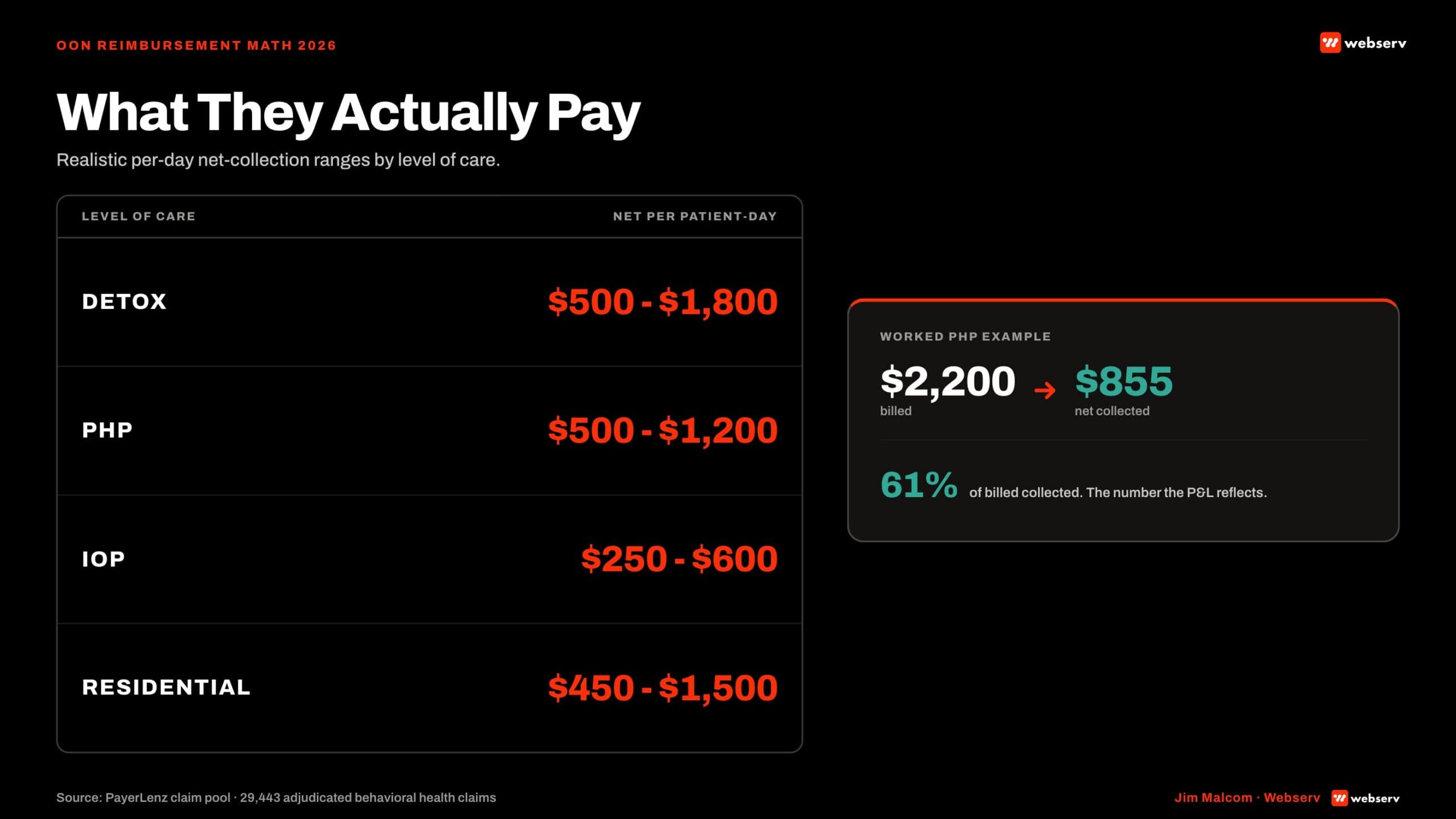
- Out-of-network reimbursement in 2026 is not a single number. Realistic net collection per day ranges from roughly $250 for IOP to $1,800 for detox depending on alpha prefix, home plan, and payer product line. No national average survives contact with a real claim adjudication.
- The math has four layers: billed charge, allowed amount, adjusted allowed after medical-necessity down-coding, and net collected after patient responsibility. Most operators track only billed and net, so they cannot see where the leak sits.
- BCBS reimbursement varies by 30 to 60 percent across alpha prefixes for the same CPT code. Treating BCBS as one payer is the single most common mistake in operator rate planning.
- PHP is the level of care most aggressively down-coded in 2026, most often to IOP. Detox and residential are more often denied outright on medical necessity.
- Allowed amount is not collected. Patient responsibility write-offs on out-of-network behavioral health run 25 to 50 percent depending on family financials and RCM discipline. They show up as bad debt, not underpayment.
- Operators who beat industry net-collection benchmarks in 2026 have three things in common: they know the expected net before they admit, they price marketing CAC against net not billed, and they benchmark reimbursement against a claim pool resolved to alpha prefix and home plan.
The Reimbursement Calculation, Layer by Layer
Out-of-network reimbursement in behavioral health is not a single number. It is the output of four sequential layers, each of which erodes revenue between what you bill and what you keep. Understanding each layer is the difference between running census as a proxy for revenue and running collection per patient day as the actual signal.
DEFINITION
Adjusted Allowed Amount
The dollar figure a payer approves for a specific claim after medical-necessity review is applied. Different from allowed amount at initial adjudication because the payer’s concurrent review team applies medical-necessity criteria that may re-classify the level of care, cut approved days, or unbundle line items. On out-of-network behavioral health claims in 2026, adjusted allowed can run 20 to 40 percent below the initial allowed amount at aggressive payers. This is where PHP-to-IOP down-coding shows up on the claim.
Every out-of-network reimbursement number is the output of four layers. Billed charge is the top line: what the facility charges for the service. Allowed amount is what the payer decides the service is worth: some percentage of billed, or a UCR benchmark, or a state fee schedule.
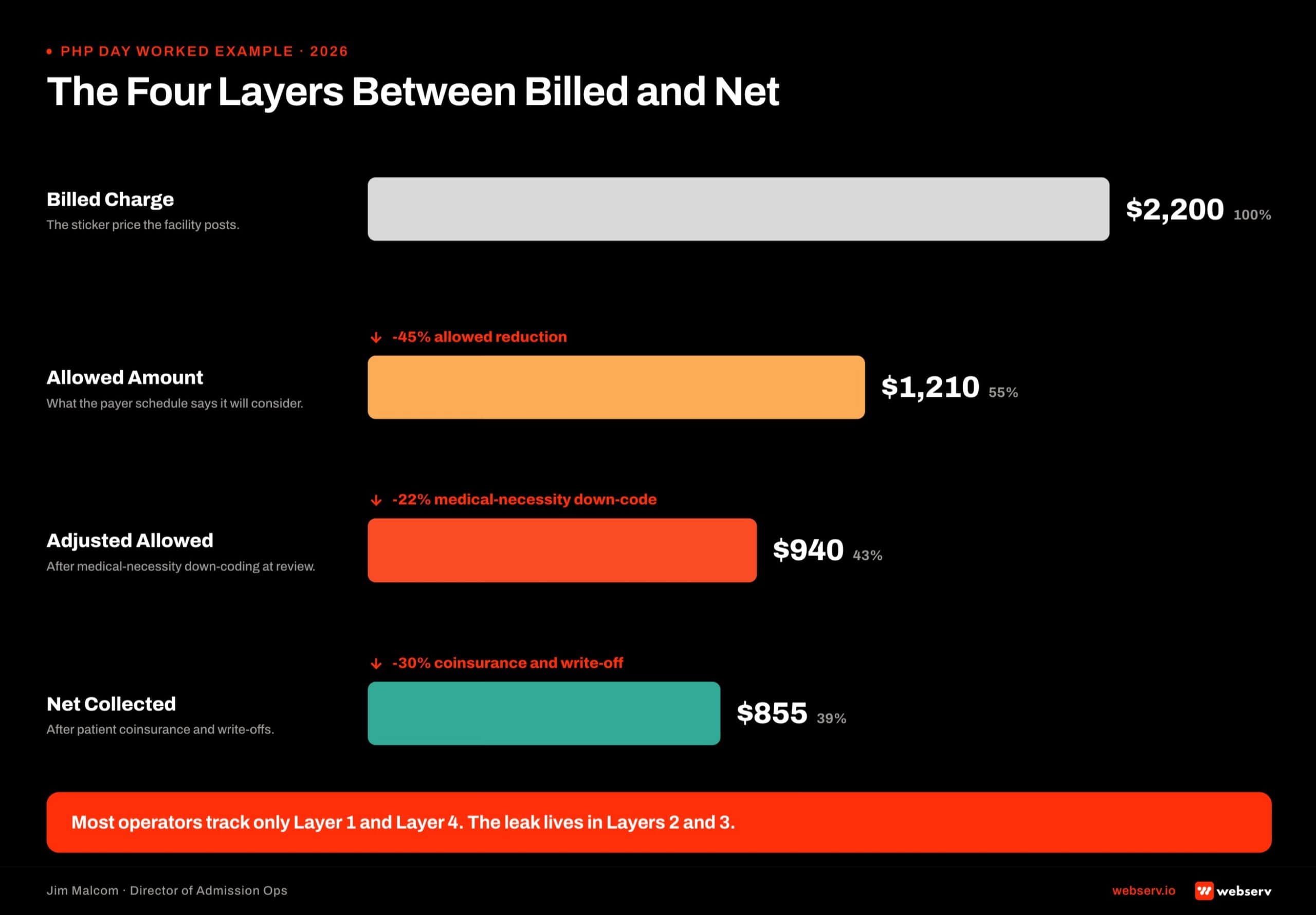
Adjusted allowed is what the payer approves after medical-necessity review. Down-coding lives here. A PHP day billed and initially allowed can become an IOP day after concurrent review, and the payer pays the IOP rate.
Net collected is what the facility actually banks after the patient’s coinsurance and deductible get processed, some of which never gets collected.
A worked example. A PHP day billed at $2,200. Payer allowed at 55 percent of UCR: $1,210. Concurrent review down-codes 2 of the 5 billed days to IOP: adjusted allowed drops to $940.
Patient coinsurance is 30 percent on the adjusted allowed: patient owes $282, facility collects $658 from the payer. The facility recovers 70 percent of the coinsurance from the patient across 90 days: net $855.
That is the number the P&L reflects, not the $2,200 the RCM dashboard showed.
Behavioral health out-of-network utilization runs several multiples above medical-surgical OON utilization in commercial insurance, which is the structural reason OON reimbursement variance in behavioral health is wider than in any other clinical category (KFF, Mental Health and Substance Use Coverage).
A national average is comparing your facility to the wrong distribution.
Upstream of the whole calculation sits the verification of benefits. The standard VOB workflow tells the admissions team the patient is covered. It does not tell them what the payer will pay.
Detox Reimbursement Expectation Ranges in 2026
Detox is where per-day OON reimbursement lands highest. Billed charges typically run $1,800 to $3,500 per day for R&B plus H0010/H0011 professional services.
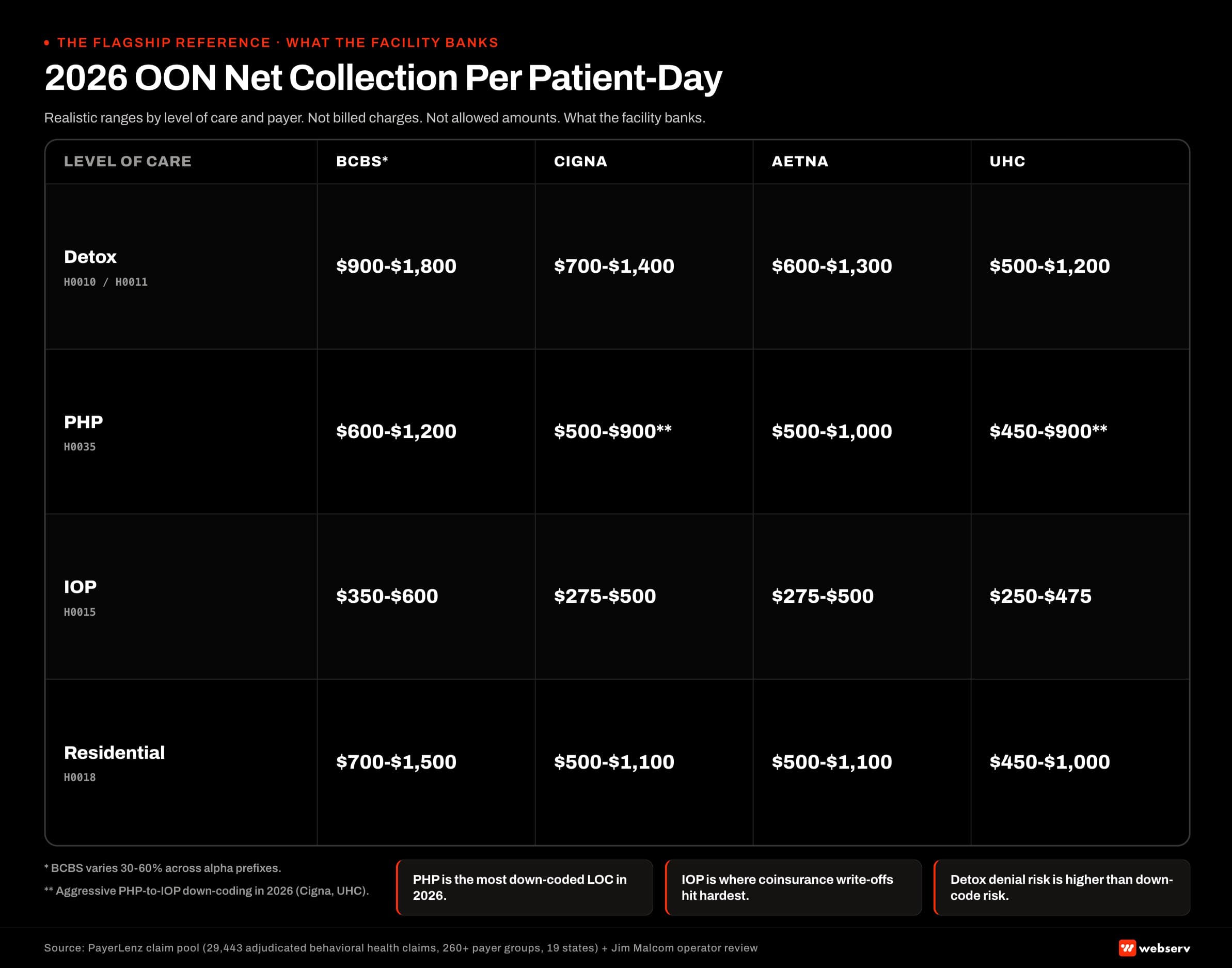
Realistic net collection per day: $900 to $1,800 for BCBS OON on strong alpha prefixes, $700 to $1,400 for Cigna OON, $600 to $1,300 for Aetna OON, and $500 to $1,200 for UHC OON.
BCBS is home-plan dependent. A Michigan alpha prefix and a Texas alpha prefix on identical clinical documentation can pay 40 to 60 percent differently for the same H0011 code.
Cigna varies by product line more than by state: fully insured commercial pays higher than ACA marketplace, and ASO self-funded pays across the middle.
Down-coding on detox is less common than on PHP because the level of care itself is harder to substitute. Denial on medical necessity is the more common failure mode, particularly on longer detoxes (7-plus days) and on ambulatory detox billed as inpatient.
PHP Reimbursement Expectation Ranges in 2026
PHP is where post-2024 down-coding is most aggressive. Billed charges typically run $1,800 to $2,800 per day for H0035 plus ancillary. Realistic net collection per day: $500 to $1,200, depending on payer, alpha prefix, and whether concurrent review down-codes to IOP.
Cigna and UHC are the most aggressive down-coders in the current cycle. A PHP admission that starts at 5 days per week for 6 hours per day can end up reimbursed as IOP at the 3 hours per day rate for the last several weeks.
That halves the per-day collection without the facility knowing until adjudication.
The gap between billed and net at PHP is often the widest of any level of care. A facility billing $2,200 per PHP day may collect $600 net after allowed-amount reduction, coinsurance write-off, and occasional down-code to IOP reimbursement.
IOP Reimbursement Expectation Ranges in 2026
IOP is the level of care where net collection lands lowest per patient-day but where volume compensates. Billed charges typically run $900 to $1,600 per day for H0015.
Realistic net collection per day: $250 to $600 across the major OON payers, with BCBS on strong prefixes trending toward the top of the range.
IOP is where facilities most often eat coinsurance write-offs. Patient responsibility on IOP is spread across more billed dates (12-plus weeks in many programs), and the cumulative deductible plus coinsurance obligation on the family becomes real.
The facility that does not have a disciplined admissions financial conversation upstream is where the 25 to 50 percent write-off range lands hardest.
Residential Reimbursement Expectation Ranges in 2026
Residential OON reimbursement partially rebounded after mid-2020s medical-necessity litigation settled the criteria payers can use. It is re-tightening in 2026 as payers apply stricter concurrent review.
Billed charges typically run $1,500 to $2,800 per day for H0018 plus unbundled therapy line items. Realistic net collection per day: $700 to $1,500 on strong BCBS prefixes, $500 to $1,100 on Cigna and Aetna, and $450 to $1,000 on UHC.
Length-of-stay approval is where residential collection gets cut. A 30-day admission that gets 14 days approved on medical necessity has half the reimbursement of one that gets 21 days approved. Prior authorization mechanics for behavioral health are the pressure point most facilities are not systematically managing.
Why the “Average” Number Is Wrong for Your Facility
Five variables make a national average useless for planning.
Alpha prefix. The first three characters of a BCBS member ID route the claim to a specific local Blue plan with its own fee schedule. Two identical BCBS cards can pay 30 to 60 percent differently based on prefix alone.
Payer product line. Fully insured, self-funded ASO, ACA marketplace, and Medicare Advantage all pay wildly different rates for the same CPT code. The card does not tell you which product it is.
State parity enforcement. State Departments of Insurance enforce MHPAEA at different intensities. California, New York, and Massachusetts investigate parity complaints more aggressively than most Southern states, which affects what payers can down-code without regulatory risk.
Medical-necessity criteria variance. Different payers use different criteria sets (ASAM, LOCUS, MCG, InterQual). A patient meeting ASAM criteria for PHP may not meet MCG criteria for the same LOC at the same payer.
Admissions mix. What percent of your census is the payer’s cheapest LOC to down-code to. A facility with heavy PHP concentration is more exposed to down-coding than one with heavy detox and residential.
The 2024 MHPAEA final rule tightened requirements for payers to document non-quantitative treatment limitations, but in May 2025 the Departments paused enforcement of its new provisions while they reconsider it. The underlying parity law and the 2021 NQTL comparative-analysis requirement still apply. Read the CMS guidance.
Parity enforcement is uneven, which is why claim-level evidence matters. The operators who benchmark against the current claim pool are the ones who can document underpayment when they file parity complaints or appeals.
The Reimbursement Gap: Allowed vs Collected
Allowed is not collected. This is the distinction most operators miss on their own P&L.
Patient responsibility on out-of-network behavioral health runs 25 to 50 percent of allowed amount depending on family financials and RCM discipline. That gap shows up as bad debt, not payer underpayment. The two problems have different fixes.
Payer underpayment. The payer paid less than the allowed schedule or applied down-coding. Fix path: contracting, medical-necessity documentation, appeals. This is a billing and RCM discipline problem.
Patient underpayment. The patient’s coinsurance or deductible was never collected. Fix path: admissions financial counseling, payment plans, upfront financial commitment conversations. This is an admissions ops and RCM collaboration problem.
A facility running 85 percent net-to-allowed has strong RCM. A facility running 60 percent is leaking $200 to $500 per patient-day to bad debt that a better admissions financial conversation would have recovered.
Reducing denials on residential and PHP claims is the payer-side lever. Patient responsibility is the admissions-side lever. Both need owners, and they need to be different owners.
BENCHMARK AGAINST A CLAIM POOL RESOLVED TO ALPHA PREFIX AND HOME PLAN, NOT A NATIONAL AVERAGE
PayerLenz maintains a pool of 500,000+ adjudicated behavioral health claims across 250 payer groups and 20 states, with BCBS resolved to the alpha prefix and home plan. Every rate carries a trust score keyed to claim volume and recency, so a facility knows whether a benchmark is drawn from hundreds of recent claims or a handful of older ones. PayerLenz was co-founded by Kyle McHenry of Revenue Logic and Preston Powell, CEO of Webserv. Disclosure stated openly. Webserv does not receive commissions on PayerLenz signups. Operators can start with the PayerLenz free tier to see the spread on their own book.
What Changes When You Have Rate Data Upstream
Three concrete operating decisions change when reimbursement data lives at the admission point rather than showing up 60 to 90 days later on the EOB.
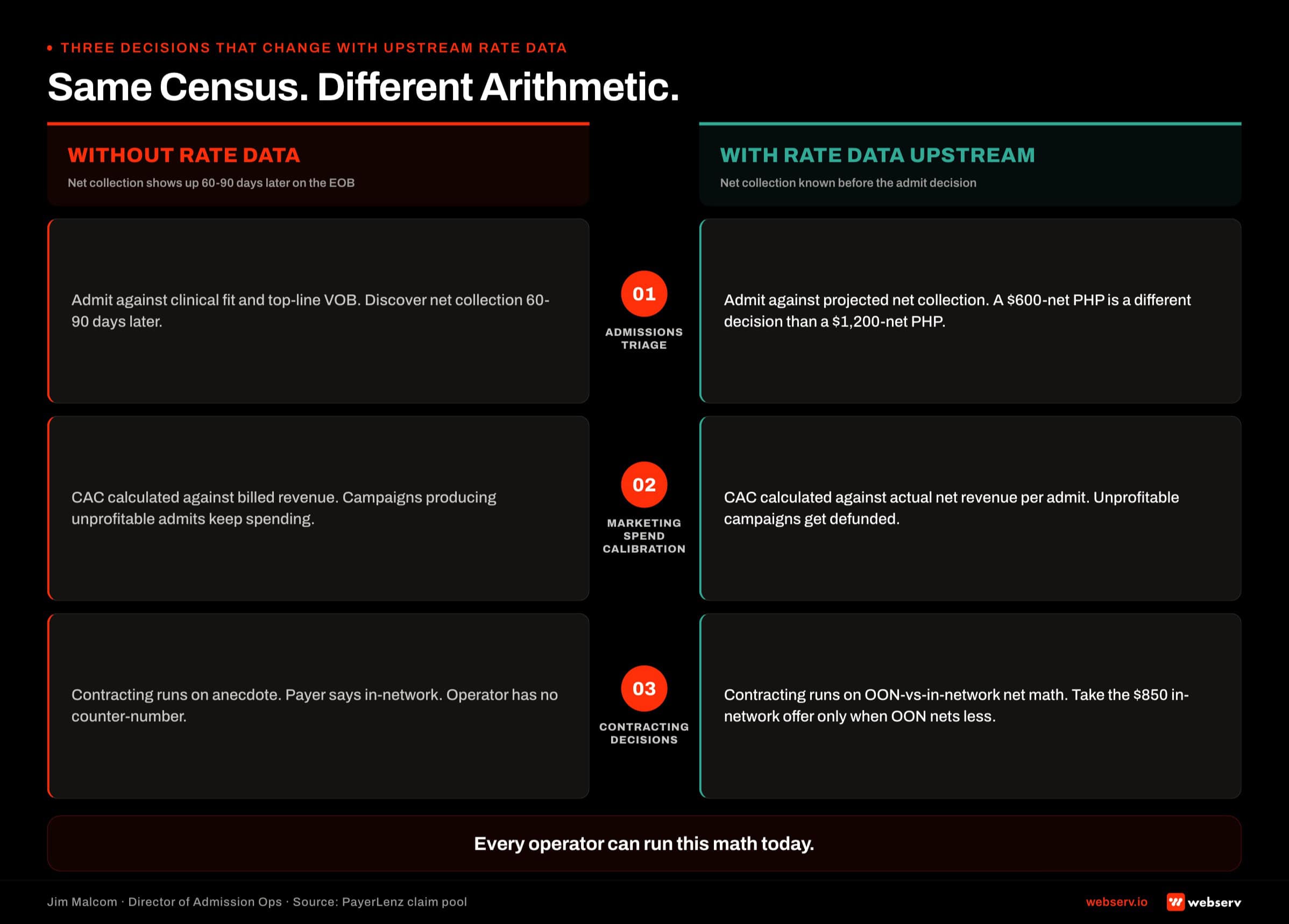
Admissions triage. Which OON patients are worth admitting given expected net collection (not billed revenue). A PHP admit projected to net $600 per day is a different decision from one projected to net $1,200. Same clinical fit, different financial fit. The reimbursement gap between VOB and admit is where this decision actually lands.
Marketing spend calibration. Cost-per-admit gets recalculated against actual net revenue per admit, not expected. Campaigns producing technically-viable-but-unprofitable admits get defunded. The marketing-to-revenue loop closes because it finally has a real reimbursement number in it.
Contracting decisions. Knowing when to go in-network with a payer at a rate that beats current OON net collection. A payer paying $650 net OON for PHP may offer an in-network contract at $850 with faster payment cycles. That is a different decision from one where OON pays $1,100.
A payer audit that surfaces underpayment patterns is the diagnostic that makes contracting negotiable rather than reactive.
Upstream rate data changes the arithmetic on all three decisions. Without it, admissions runs on hope, marketing runs on top-line CAC, and contracting runs on anecdote.
Getting Started: What to Measure This Quarter
Four measurements every operator can run this quarter to establish the reimbursement baseline.
- Net Collection Per Patient-Day by LOC and Payer Group. Pull the last 90 days. Segment by level of care (detox, PHP, IOP, residential) and by payer group (BCBS by home plan, Cigna, Aetna, UHC, other commercial). This is the baseline for every subsequent comparison.
- Denial Rate on PHP and IOP Claims by Payer. Pull the last 90 days. Segment by payer and by denial reason (medical necessity, documentation, coverage). PHP down-coding to IOP shows up here first. This is your medical-necessity documentation early warning.
- Coinsurance and Deductible Collection Rate on OON Patients. Pull the last 12 months. Track how much of patient responsibility was actually collected versus written off. This is the bad-debt line most facilities do not separate from payer underpayment.
- Distance Between Billed and Net for the Top Three Payers by Census Share. Pull the last 90 days. Calculate the ratio of net collected to billed for the payer groups that fill the most beds. Facilities running this exercise for the first time regularly find one payer producing 40 to 50 percent of their total leak.
The output of the four measurements is a facility-specific reimbursement dashboard. That dashboard belongs on the weekly leadership report alongside admits, cost per admit, and viable-VOB-to-admit rate. Facilities that want the benchmark side prebuilt run the same diagnostic against the PayerLenz pool. Facilities that want to close the marketing to admissions to revenue loop end-to-end route through the Webserv admission ops team.
Frequently Asked Questions
What is the average out-of-network reimbursement rate for behavioral health treatment centers in 2026?
There is no single average that survives adjudication. Realistic per-day net collection ranges from roughly $250 for IOP to $1,800 for detox, and the variance inside those ranges is driven by alpha prefix, home plan, payer product line, and state parity enforcement, not by a national number.
Operators who quote a single national average are usually citing a billed-charge number, an allowed-amount number, or a mix of the two. None of those match what the facility actually collects. A BCBS claim adjudicated on a Michigan alpha prefix can pay 40 to 60 percent differently from the same CPT code adjudicated on a Texas alpha prefix.
The right question is not “what is the average” but “what is my expected net collection for this payer, at this level of care, in this state, after down-coding and patient responsibility.” That is the number that determines whether the admission is profitable.
How much does insurance pay for a PHP day out-of-network in 2026?
Realistic net collection for a PHP day out-of-network in 2026 runs roughly $500 to $1,200 per patient-day depending on payer, alpha prefix, and whether the payer down-codes to IOP on medical-necessity review. Cigna and UHC are the most aggressive down-coders in the current cycle.
The gap between billed and net at PHP is often the widest of any level of care. A facility billing $2,200 per PHP day may collect $600 net after allowed-amount reduction, coinsurance write-off, and occasional down-code to IOP reimbursement.
Benchmarking against a claim pool that resolves to alpha prefix rather than to BCBS-as-one-payer is the only reliable way to know if a facility’s PHP collection is a payer problem, a documentation problem, or a patient-responsibility problem.
Why does the same payer pay different amounts to different treatment centers?
Four reasons. First, the payer’s product line (fully insured, self-funded, ACA marketplace) has different reimbursement schedules. Second, the alpha prefix on the member ID routes the claim to a specific BCBS home plan with its own fee schedule.
Third, the facility’s medical-necessity documentation shifts what the payer approves. Fourth, state parity enforcement varies. A facility in California billing a Texas BCBS home-plan claim on a fully insured product line with weak documentation can collect 40 percent less than a facility in Texas billing the same claim with strong documentation.
This is why “we take BCBS” is not a rate strategy. The strategy is knowing which BCBS alpha prefixes pay well, which pay poorly, and admitting into census accordingly.
What percentage of the allowed amount does a treatment center actually collect on out-of-network claims?
Realistic net collection runs 60 to 85 percent of the allowed amount on out-of-network behavioral health claims. The gap is driven mostly by patient responsibility the facility never collects. Coinsurance and deductible write-offs of 25 to 50 percent are common on OON behavioral health depending on the family’s financial capacity and the facility’s RCM discipline.
The number of operators tracking this as a separate metric from payer underpayment is small. The two are different problems with different fixes. Payer underpayment is a contracting or documentation problem. Patient underpayment is an RCM and admissions financial counseling problem.
A facility running an 85 percent net-to-allowed ratio has strong RCM. A facility running 60 percent is leaking $200 to $500 per patient-day to bad debt that better admissions conversations would recover.
How can a treatment center benchmark its own out-of-network reimbursement against realistic industry data?
The benchmarks that work are built from adjudicated claims resolved to alpha prefix and home plan, not from surveys or national averages. PayerLenz maintains a pool of 500,000+ adjudicated behavioral health claims across 250 payer groups and 20 states with alpha-prefix resolution.
A useful benchmark answers three questions: what does this payer typically allow for this CPT code in this state; what does the typical facility collect net of patient responsibility; and how does my facility compare on both. Any benchmark that skips the alpha prefix step is comparing the wrong distributions.
Operators who benchmark this way often discover the gap sits at a specific alpha prefix or a specific level of care, not across the whole payer relationship. That specificity is what lets a contracting or admissions decision actually be made.
Closing Note From the Admission Ops Floor
The gap between billed revenue and net collection is not a billing problem. It is an admissions decision problem, a marketing budget problem, and a contracting problem. Every one of those decisions gets better with rate data upstream, and every one gets worse when the operator plans off a national average.
Webserv’s eligibility and reimbursement capability closes that loop for operators who want to price admissions, marketing, and contracting off realistic net-collection benchmarks instead of billed-revenue dashboards. Book an intro meeting to benchmark the facility’s out-of-network reimbursement against the current claim pool.
Jim Malcom is Director of Admission Ops at Webserv. He has spent his career inside behavioral health admissions operations (call floors, VOBs, CRMs, and the reporting stack that ties them together) and now leads the Webserv admission ops practice for treatment center operators nationwide.