






Trusted by 200+ Treatment centers nationwide


PAID MEDIA BY LEVEL OF CARE
Detox campaigns and IOP campaigns require different creative, targeting, and cost-per-admit math. Here's how we structure each.
Detox campaigns require immediate-need targeting: "medical detox near me," "alcohol detox California," "opioid detox insurance." Ad copy must fit LegitScript's advertising standards for time-sensitive medical care and the facility's certified status. Landing pages surface insurance verification and phone-first CTAs above the fold because the family caller is in crisis.
Residential campaigns balance high-intent search ("30-day residential rehab," "inpatient addiction treatment") with awareness-stage targeting. Longer decision cycle means retargeting sequences carry more weight. Family caller research patterns dominate. Landing pages emphasize clinical proof, facility accreditation, and program-specific detail.
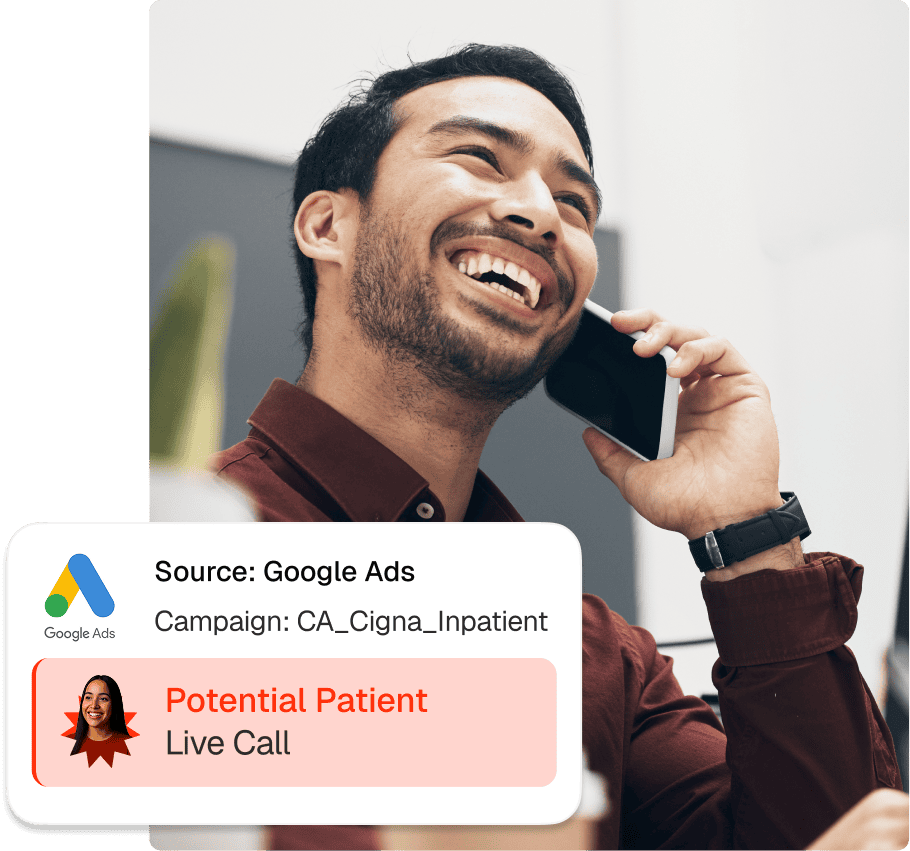
PHP campaigns intercept step-down demand ("PHP after detox," "outpatient after residential") and initial-inquiry demand from families with insurance concerns. Payer-specific ad groups (Aetna, Cigna, BCBS, UHC) drive most of the volume. Landing pages need transparent LOC explanation.
IOP campaigns run tighter geographic radius (within 30 min driving distance of the facility) and heavier work-and-treatment schedule messaging. Family caller vs self-referral split matters. Google Ads keyword mix leans local: "IOP [city]," "outpatient rehab near me."
COMPLIANCE MOAT
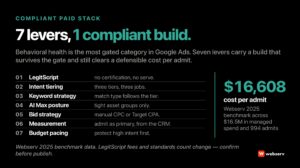
Advertising for addiction treatment requires the treatment center to hold LegitScript certification as an eligible advertiser. Non-certified facilities cannot serve addiction treatment ads on Google or Bing. Once certified, campaigns still face three concurrent constraints.
For facilities needing to obtain or renew certification, we support the application workflow, documentation review, and renewal cycles. Note: certification is granted to the treatment center as the advertiser, not the agency. Our role is application support and ongoing verification.
Client-side pixels transmitting patient identifiers to Meta or Google without a BAA constitute PHI disclosure per the HHS OCR tracking technology bulletin. We run server-side GTM with SHA-256 hashing upstream of transmission.
Medication-assisted treatment and court-ordered treatment require specific pre-approval workflows under Google Ads healthcare policy. We handle these at the account level for LegitScript-certified advertiser clients.
WHY REHAB ADS FAIL
Your Google Ads are running. Conversions are coming in. But your admissions team spends hours on calls with people who aren’t ready for treatment or need services you don’t offer.
Most agencies for treatment centers optimize for conversions without understanding what qualifies as a viable lead. They count every form fill and phone call as success while your team wastes time on people who’ll never admit. They don’t know which searches indicate insurance viability or treatment readiness.
WHAT YOU GET
We target searches that indicate treatment readiness and insurance viability: "need detox now," "does Blue Cross cover residential treatment," "PHP programs near me." Your Google Ads budget goes toward people ready to call, not casual browsers.
We organize campaigns by level of care—detox, residential, PHP, IOP, outpatient. Campaign structure matches your service offerings so every dollar targets patients who need the specific treatments you provide.

Ad copy written for families in crisis. Clear messaging about insurance acceptance, immediate availability, and what to expect—not generic marketing fluff. We write ads that speak directly to people searching at 2am who need help now.
Continuous negative keyword optimization to exclude unqualified searches. We prevent wasted spend on people seeking physical therapy rehab, free resources, volunteer opportunities, or jobs at treatment centers.
Google Ads traffic goes to conversion-optimized landing pages designed for crisis moments. Fast load times, clear CTAs, insurance information visible, and direct paths to call your admissions team.
Precise location targeting for your service area with bid adjustments by region. If certain cities or states drive higher-quality admits, we allocate more budget there.
Retarget website visitors who didn't convert, exclude past patients from seeing your ads, and build custom audiences based on behavior and engagement signals.
Track phone calls from Google Ads through to VOB submissions and admissions. You'll know which keywords drive qualified calls versus which ones waste your team's time on unqualified leads.

OUR METHODOLOGY
Most agencies optimize Google Ads for clicks and conversions. We optimize for verified VOBs and admits. Every campaign decision, from audience targeting to bid strategy, is designed to drive qualified patient inquiries that actually convert into census.
Learn how Profound Treatment reduced cost per viable by 42% while scaling paid search volume through match type optimization and regional targeting refinements.
Read Their StoryAdmits from Google Ads in Q2 2025
OUR 1 MONTH SPRINT
Most agencies take months to launch campaigns. We’ve built a 4-week sprint that gets your Google Ads live fast, without cutting corners on strategy.
WEEK 1
WEEK 2
WEEK 3
WEEK 4
Enter your admissions goal and budget — the calculator shows you the impressions, clicks, and CPC your search campaigns require, and whether your market can realistically support it.
Paid Admissions
Paid Admissions Account Manager
Performance marketing strategist with 10+ years in digital marketing strategy, execution and client management. Passionate about driving meaningful, measurable, and...
Paid Admissions
Paid Admissions Account Manager
Paid media specialist with 5+ years of paid media experience across agency and in-house environments. Experienced in managing Google Ads,...
Paid Admissions
Director of Paid Admissions
Performance marketing professional with 6+ years of experience driving growth through data-informed paid media across most paid media channels. Manages...
COMMON QUESTIONS
Addiction treatment PPC is paid-search advertising specifically structured for treatment centers — targeting high-intent commercial queries through Google Ads, Microsoft Ads, and Meta. Effective rehab PPC requires LegitScript certification on the treatment center, EKRA-compliant call handling, and HIPAA-compliant landing pages, since standard PPC tactics don't pass platform review for behavioral health.
The technical media buying is similar to any other vertical. The compliance scaffolding around it is what makes rehab PPC its own discipline. Generalist agencies routinely get rehab accounts paused or banned within the first 30 days because they don't know the platform-rejection patterns.
A specialist agency runs through a pre-launch compliance checklist before bidding starts: LegitScript verified on the facility, conversion tracking server-side, landing pages scrubbed of PHI capture, call routing structured for EKRA. Skip any of those and the account is on borrowed time.
Most addiction-treatment PPC programs spend $25,000–$80,000 per month, with cost-per-click averaging $40–$200 depending on geography and level of care. The more meaningful metric is cost-per-admit — tightly-managed programs typically target $4,000–$8,000 CPA for residential and $1,500–$3,500 for IOP and PHP.
Cost-per-click is a vanity metric. Two campaigns can have identical $80 average CPCs but $4,000 vs $12,000 cost-per-admit, depending on the keyword strategy, landing page conversion rates, and admissions team handoff speed.
Programs running CPA above $10,000 usually have a process problem (slow VOBs, weak admissions handoff) rather than a media-buying problem. Fixing process is almost always faster ROI than fixing the ads themselves.
Google Ads for addiction treatment requires the treatment center to hold LegitScript Healthcare Merchant Certification as an eligible advertiser before campaigns can serve. LegitScript certifies the facility, not the agency. The account also needs HIPAA-compliant conversion tracking (no PHI in audience definitions), state-licensed treatment programs only, and verified clinical staff. Google rejects ads from programs that fail any of these baseline checks at audit.
LegitScript application typically takes 4–8 weeks. Plan for it 60–90 days before launch. Centers that try to launch ads pre-LegitScript get accounts flagged or paused, and remediation can be longer than the original application.
The landing pages also need attention. Pages that capture PHI (intake forms, patient details) can't load Meta Pixel or standard Google Analytics — they need server-side conversion tracking. Most centers get this wrong on the first build.
Programs typically see qualified VOBs within 7–14 days of launch and first admits at 21–45 days. Most accounts reach steady-state admit volume by month 4–6. The bigger driver of timeline is the admissions team's lead-to-admit cycle time — well-funded campaigns get throttled by intake capacity, not by the ads themselves.
The first month is mostly account structuring, keyword cleanup, and finding the highest-intent search patterns for your specific market. Costs are usually highest in months 1–2 as the algorithm learns the conversion patterns.
By month 4, programs that staffed admissions correctly have steady-state admit volume and predictable CPA. Programs that didn't staff admissions correctly have leads piling up unanswered, which Google then deprioritizes — driving CPA up.
Rehab PPC navigates LegitScript certification requirements on the treatment center, EKRA prohibitions on commission-based call structures, 42 CFR Part 2 patient-record handling, and platform-level rejection patterns that don't apply to general healthcare. The technical media-buying skill is similar; the compliance scaffolding around it is what makes rehab PPC its own discipline.
EKRA is the constraint that catches most generalists. Pay-per-call, pay-per-admission, or any commission-based affiliate arrangement violates EKRA. Most call-center contracts had to restructure post-2018 to flat-fee or W-2 employee models.
An agency that runs healthcare PPC for hospitals or general medical practices isn't automatically qualified for addiction treatment. Different rules, different platforms, different audit triggers.
Yes, with care. Meta Ads can serve treatment-center campaigns when the Meta Pixel is removed from PHI-collecting pages and replaced with server-side conversion APIs. The 2024 OCR guidance restricted certain tracking patterns; compliant programs use hashed audience uploads, generic interest targeting, and PHI-free landing pages.
The 2024 guidance changed what was allowed almost overnight. Programs that didn't update their tracking stack got pixel data flagged for HHS review. The fix is technical (server-side Conversion API instead of client-side pixel) but takes development time most centers underestimate.
Done right, paid social runs at lower CPA than search for some campaign types — particularly for executive-level and luxury treatment programs targeting specific demographics. The compliance ceiling is just lower.
$4,000–$8,000 cost-per-admit for residential is the typical range across well-managed programs. Programs above $4,000 often run more aggressive day-rate campaigns; programs below typically have established LegitScript history, deep keyword research, and sub-3-hour speed-to-VOB. Programs above $10,000 CPA usually have a process problem, not a media-buying problem.
The single biggest CPA differentiator we see across clients is admissions-team speed-to-VOB. Centers that VOB within 30 minutes convert at 3–4x the rate of centers that VOB at 24 hours. Same ads, same spend, different process — the difference shows up entirely in CPA.
If your CPA is climbing, audit the admissions handoff before auditing the ads. The fix is usually upstream of the media buy.
Yes — they compound. PPC drives immediate admit volume; SEO compounds organic admits at lower CPA over 6–12 months. Treatment centers running both typically see total admit volume 30–60% higher than either channel alone, with blended CPA dropping roughly 40% by year-end as organic admit share grows.
Patients researching treatment rarely click the first result they see. They visit 3–5 different center sites before choosing. Programs running only paid ads pay for every click, including return visits. Programs running paid + SEO get the same patients clicking organic listings on the second visit, dropping the effective per-patient acquisition cost.
The two channels also share infrastructure: LegitScript readiness, HIPAA-compliant tracking, Google Business Profile, location pages. Building it once for both is more efficient than building twice.
Each LOC has its own keyword intent, cost-per-admit range, and family caller decision cycle. Detox campaigns run immediate-need targeting ("medical detox near me") with sub-4-hour speed-to-VOB expectations. Residential campaigns balance high-intent search with longer awareness sequences and retargeting. PHP intercepts step-down demand and payer-specific ad groups. IOP runs a tighter 30-minute geographic radius with work-and-treatment schedule messaging.
Cost-per-admit ranges differ predictably. Detox typically runs $650–$1,400, residential $1,200–$2,800, PHP $850–$2,100, IOP $700–$1,600 across our managed accounts. Multi-LOC facilities that run a single generic PPC campaign under-perform on every LOC. The account structure needs to segment ad groups, landing pages, and bid strategies by LOC.
The other differentiator is landing page match. A detox landing page and an IOP landing page have to look, feel, and speak completely differently — different urgency, different insurance-verification hierarchy, different social proof. Programs that use one landing page for all LOCs leak conversion at every step.
We connect ad platforms to CRM to EMR through a value-tier event architecture. Conversions are weighted by tier: Tier 1 is admit-day arrival at weight 100, Tier 2 is VOB-completed inquiry at weight 40–60, Tier 3 is scheduled admission at weight 25–40, Tier 4 is qualified inquiry at weight 5–15. Meta CAPI and Google Enhanced Conversions receive the tier weights server-side.
This trains the ad platforms to optimize toward admits, not just form fills. A campaign that generates 100 form fills but 2 admits gets deprioritized. A campaign that generates 40 form fills but 8 admits gets scaled. The weight math tells Google and Meta what conversion is actually worth.
The measurement stack has to be HIPAA-safe. Server-side GTM handles the tier events, identifiers are SHA-256 hashed upstream, and PHI never leaves the treatment center's infrastructure. This addresses the HHS OCR tracking bulletin and lets you attribute confidently without creating compliance exposure. See our HIPAA-safe conversion tracking guide for the full architecture.
LEARN MORE
MARKETING SERVICES FOR REHABS
Build sustainable, long-term patient acquisition through search visibility and content authority.
Drive immediate results with targeted advertising and optimized conversion experiences.
Streamline your admissions process with data-driven operations and conversion tracking.
Websites, landing pages, and ad creative built as part of the patient acquisition system.
Ready to Grow?
30-minute strategy session to discuss your census goals, current challenges, and how we can help you scale admissions sustainably.
Trusted by 200+ Treatment centers nationwide