When Google shipped the May 2026 structural update to AI Overviews, most of the coverage focused on inline source links and hover previews.
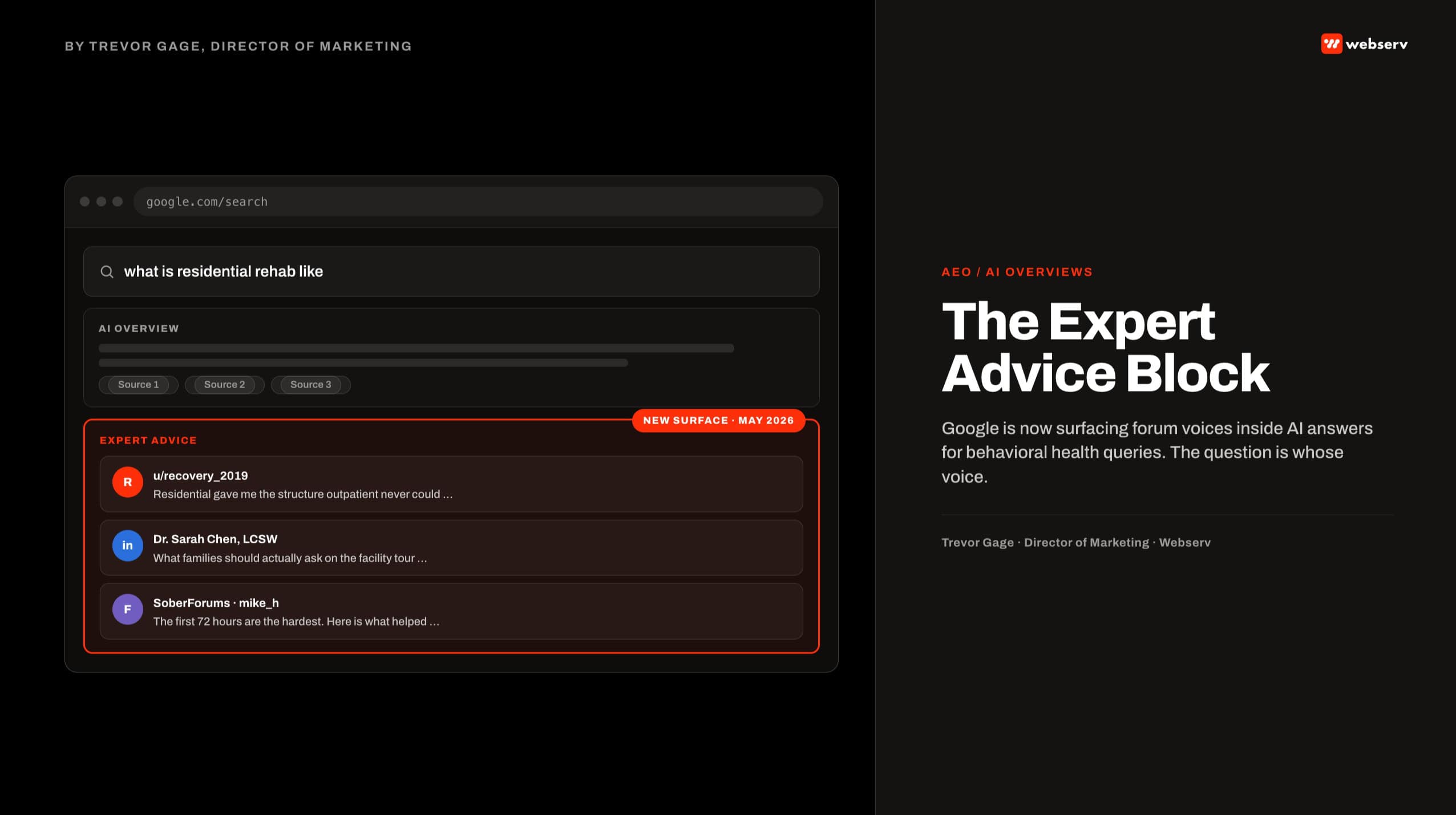
The change that actually matters most for behavioral health treatment centers got less attention: the “Expert Advice” block that now pulls first-hand perspectives from Reddit, forums, and social media directly into Google’s AI answers.
This is a new search surface. It is separate from the traditional organic listings, separate from the featured snippet, and separate from the main AI Overview summary. It sits inside the AI Overview response and cites named individuals speaking from experience on Reddit threads, Quora answers, LinkedIn posts, and specialized forums. The AEO implications are exactly what our AEO program at Webserv is built to address.
The behavioral health category is particularly exposed to this change because prospects researching treatment options have always used forums heavily. Reddit’s r/addiction, r/mentalhealth, r/OpiatesRecovery, and dozens of specific-drug and specific-condition subreddits carry conversations that shape how families choose treatment centers.
What is new is that Google is now surfacing those conversations directly inside its AI answers. This article walks the AEO implications of the update.
It covers what the Expert Advice block actually is, why it matters more for behavioral health than for most categories, and how treatment centers should participate in these surfaces without stepping into compliance exposure.
Key Takeaways
- Google’s May 2026 AI Overviews update introduced a new “Expert Advice” block that pulls first-hand perspectives from Reddit, forums, and social media into AI answer responses. This is separate from the main AI Overview and appears alongside it for advice-seeking queries.
- Behavioral health queries trigger the Expert Advice block frequently because prospects and families researching treatment options rely heavily on forum communities. Reddit threads about specific conditions, treatment approaches, and named facilities now appear directly in Google’s AI answers.
- The named individuals whose forum posts get pulled into the Expert Advice block are almost always people speaking from personal experience or professional expertise. Astroturfing, fake accounts, and marketing-team-posting-as-clinicians are detectable and counterproductive; the block prioritizes authentic first-hand voice.
- Treatment centers can participate in the surface by having named clinicians, medical directors, and clinical leaders contribute substantive content in relevant forums with clear identification. 42 CFR Part 2 constraints apply the same way in forum content as in blog content.
- The measurement discipline is manual and slow. There is no dashboard for “you appeared in the Expert Advice block this week.” The right cadence is a weekly check on the queries that matter most for the treatment center, combined with monitoring of the specific forum threads Google is pulling from.
- Treatment centers ignoring the Expert Advice block are ceding a significant AI search surface to former patients, former staff, competitors’ clinicians, and unaffiliated commenters. The block will surface someone’s voice for behavioral health queries. The question is whose.
What the “Expert Advice” Block Actually Is
DEFINITION
The Expert Advice Block
A new element in Google AI Overviews and AI Mode responses introduced in the May 2026 structural update. Pulls first-hand perspectives, professional opinions, and named experiences from user-generated content sources (Reddit, Quora, LinkedIn, X, specialized forums) directly into the AI answer. Sits distinct from the main AI Overview summary and from the traditional organic results. Designed to surface authentic voices for advice-seeking queries where user-generated content has traditionally competed with AI answers.
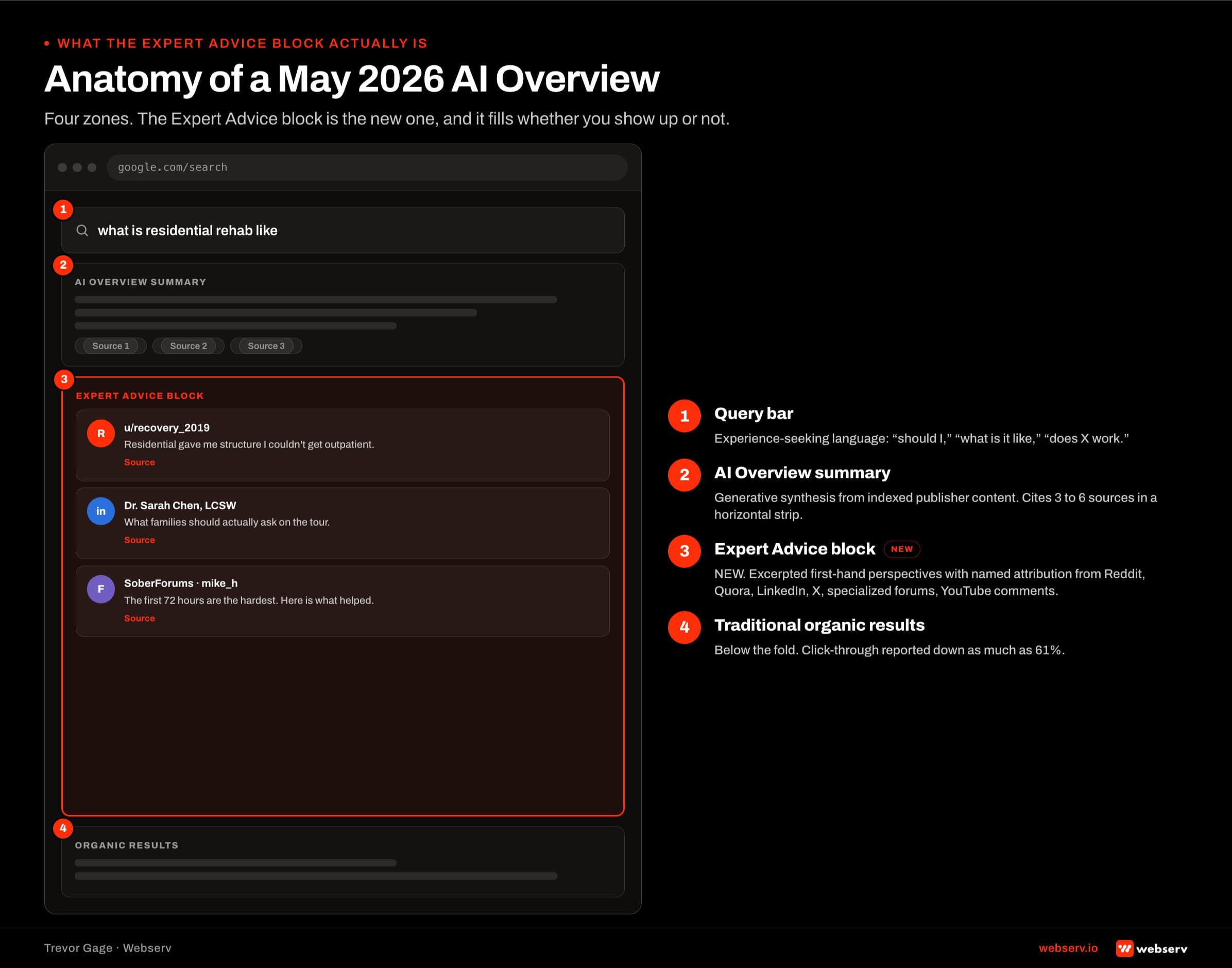 Annotated diagram of a post-May-2026 Google AI Overview showing the query bar, AI-generated summary, the Expert Advice block as a distinct new surface highlighted separately, and the classic organic result stack below.
Google’s rationale for adding the block is public. AI Overviews were losing engagement to Reddit and forum content for advice-seeking queries.
Users searching for “should I go to residential rehab” or “what is IOP like” were skipping past the AI summary and clicking through to Reddit threads to hear from real people. Google’s response was to bring the Reddit voices into the AI answer itself.
The block appears most often on queries with “advice,” “experience,” “should I,” “what is it like,” and similar experience-seeking language. It also appears on queries where a specific treatment center, program, or clinical approach is named.
The prompts that trigger it in behavioral health tend to include: “best rehab in [city],” “does [treatment approach] work,” “what happens in [level of care],” “is [facility name] good,” and comparative queries like “residential vs outpatient for [condition].”
The presentation matters. Each cited perspective in the block is attributed to a named individual with their Reddit username, LinkedIn handle, or forum identity displayed. Google links back to the source thread. The AI does not paraphrase or reword the perspective; it excerpts the person’s actual language.
Why It Matters More for Treatment Centers Than for Most Categories
Behavioral health prospects and their families research treatment options with a specific pattern. They Google. They read the top results. They check the facility’s website. Then they search Reddit for authentic experiences from people who have been through treatment or worked in it.
The Reddit stage of the research is where most treatment centers lose visibility. The facility’s marketing content lives on their own site and in Google’s organic results.
Reddit is a separate universe where the facility has little to no presence, and where former patients, former staff, family members, and anonymous commenters shape how the facility gets perceived.
Google now bringing Reddit voices directly into AI Overviews accelerates this dynamic. Prospects who would have had to click through to Reddit deliberately now see Reddit perspectives inside the Google AI response before they ever leave the search page.
Search Engine Land documented the specific changes in the May 2026 structural update, and Google’s own Search Central documentation on AI features in Search covers the underlying mechanics of how AI Overviews compose responses from indexed sources.
The stakes compound in three directions. First, the volume of AI Overview appearances is high. AI Overviews appeared on 39.4 percent of US desktop Google searches in June 2026, up from 25.8 percent in July 2025, per Comscore data reported by Search Engine Land, and healthcare is among the most heavily covered categories.
Second, the CTR effect on non-AI-Overview results is substantial. Seer Interactive found organic CTR on informational queries with AI Overviews fell 61 percent between June 2024 and September 2025.
Third, the behavioral health search category is disproportionately affected because so much of its search volume is informational and advice-seeking.
The net effect is that AI Overviews with Expert Advice blocks are now a critical surface for treatment centers, and the surface is populated by forum voices rather than by the treatment center’s own content.
The Surfaces Google Now Pulls From
The Expert Advice block draws from several categories of user-generated content. The primary sources are:
Reddit. By far the largest source. Google has a formal indexing partnership with Reddit that provides real-time access to threads and comments. Reddit’s structured comment hierarchy makes it easy for Google to identify high-voted, high-engagement responses that other users have implicitly validated.
Quora. Second-tier source. Long-form answers from claimed subject-matter experts. Behavioral health coverage on Quora is sparser than on Reddit, but named clinicians who post there sometimes get pulled into the block.
LinkedIn. Especially for professional POV. Behavioral health clinicians, treatment center operators, and industry consultants who post substantive commentary on LinkedIn can end up cited when the query has a professional framing.
X (formerly Twitter). Real-time signal. Less common for behavioral health but appears on newsworthy topics or when a named clinician is publicly discussing an issue.
Specialized forums. Health-focused communities like SoberRecovery, In The Rooms discussion boards, and condition-specific forums. Smaller-volume but often cited when the query is condition-specific.
YouTube comments. Occasional. Google pulls comments from high-authority YouTube channels covering behavioral health topics.
GOOGLE’S POSITION ON FORUM CONTENT IN SEARCH
Google’s public guidance clarifies that user-generated content from established communities can carry E-E-A-T signal for advice-seeking queries where first-hand experience is valuable. The May 2026 update operationalized that guidance in the AI Overview surface. Forums are now treated as an authority signal for experience-based queries, not just a link-farm surface to filter out.
Google’s Creating Helpful, Reliable, People-First Content guidance treats user-generated first-hand experience as a signal of value for advice-seeking queries. The May 2026 AI Overviews operationalization of that guidance is what made the Expert Advice block a distinct feature.
What Gets Pulled Into the Block
Not every forum post gets cited. The pattern of what appears in the Expert Advice block for behavioral health queries:
Named professional commentary. A medical director who identifies themselves publicly on LinkedIn and posts a substantive take on a clinical question. A licensed clinician on Reddit posting a detailed response with visible credentials in their profile. Google’s ranking systems detect the named-professional signal and weight it accordingly.
Long-form personal experience with specificity. A Reddit user with an established comment history who writes 300 to 800 words on their experience with a specific treatment approach or level of care. The specificity matters. Vague testimonials do not appear; posts with dates, dosages, specific interactions, and concrete outcomes do.
Highly upvoted community responses. Reddit threads with hundreds of upvotes on the top responses signal community validation. Google uses those signals to filter for content the community has implicitly endorsed.
Direct comparative statements. Posts that specifically compare two facilities, two levels of care, or two treatment approaches are prime candidates because they answer comparative queries directly.
ASTROTURFING RISK
Do not try to game this surface with fake accounts, purchased upvotes, or marketing team members posting as clinicians. Google’s spam detection systems and Reddit’s own moderation have both improved substantially. Detection results in the individual accounts being suppressed and, in some cases, the treatment center being flagged. The reputational cost of getting caught is materially higher than the visibility cost of not participating. Authentic participation from named staff is the only durable strategy.
The 5-Step Strategy for Treatment Centers
- Identify Where Your Voice Adds Value. Not every forum is worth participating in. Map the 5 to 10 Reddit subreddits, LinkedIn topic areas, and specialized forums where your clinical staff would legitimately have something to contribute. r/addiction, r/mentalhealth, condition-specific subreddits, and LinkedIn behavioral health communities are the usual starting points.
- Assign Named Contributors. The medical director, clinical director, and one or two senior clinicians should be the visible voices. Not the marketing team. Not agency staff. Named professionals with real credentials and real accounts they maintain personally, not through a marketing intermediary. Google detects the difference.
- Contribute Substantively. Post detailed, useful responses to genuine questions. 300 to 800 words with specifics. No links back to the facility website in the responses themselves. The Reddit and LinkedIn communities distinguish between people adding value and people marketing; the ones adding value get upvoted and get cited.
- Monitor What Google Pulls In. Weekly check on the 10 to 20 queries that matter most for the treatment center. Search each query in Google, note whether the AI Overview shows an Expert Advice block, and if it does, which sources it is pulling from. This is manual work today; no automated tool tracks Expert Advice appearances yet.
- Feed Back Into Content Strategy. The queries where competitors’ voices appear in the Expert Advice block reveal content gaps in your own strategy. The forum threads Google is pulling from show what specific angles matter to prospects. Both feed the treatment center’s blog, video, and social content plans.
The workflow is 3 to 5 hours per week of dedicated attention from a named clinical contributor plus about 2 hours of monitoring and analysis from a marketing team member. Not full-time. Consistent.
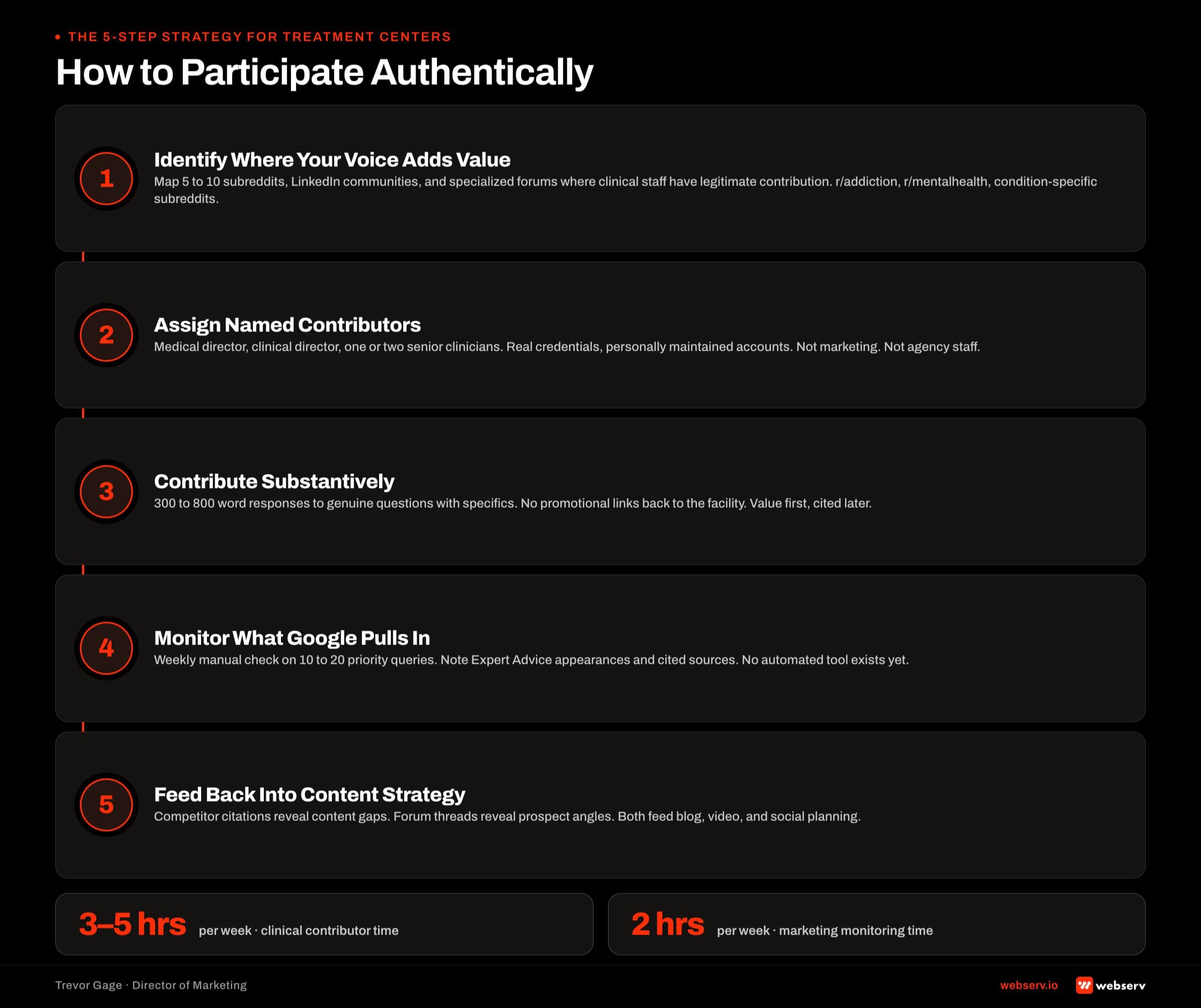 The five-step strategy treatment centers should run to compete for the Expert Advice block, identify the forums Google pulls from, assign named clinicians as contributors, contribute substantively over months.
The 42 CFR Part 2 Overlay
FORUM PARTICIPATION IS SUBJECT TO THE SAME 42 CFR PART 2 CONSTRAINTS AS ANY OTHER PATIENT-ADJACENT CONTENT
A named clinician sharing clinical POV in a Reddit thread is fine. A named clinician sharing a specific patient story, even with names removed, is not. The line between clinical education and disclosure of protected patient information is exactly where it is in blog content, video, and other formats. Treat forum posts with the same compliance review discipline as anything else the treatment center publishes.
The specific patterns that create compliance exposure:
Named clinician responding to a question with a story that begins “I had a patient who…” even without naming the patient. If the response could enable someone in the community to identify the patient, it is a disclosure.
Named clinician confirming or denying that a specific person mentioned in the thread was ever treated at the facility. This is a 42 CFR Part 2 issue even when the questioner is asking about themselves.
Marketing team member posting as a clinician (compliance issue in addition to the astroturfing issue).
Named clinician responding to a review by a former patient in ways that confirm the patient received treatment.
The safe pattern is named clinicians speaking to clinical principles, industry context, and educational content, without referencing any specific person or acknowledging any specific relationship. The same rules that apply to journalism pitching apply here.
Measurement Reality
39.4%
of US desktop Google searches showed an AI Overview in June 2026 (Comscore)
88%
of tracked healthcare queries triggered AI Overviews by December 2025 (BrightEdge)
61%
drop in organic CTR on informational queries with AI Overviews, June 2024 to September 2025 (Seer Interactive)
There is no automated tool that tracks Expert Advice block appearances for a specific treatment center yet. Third-party AEO monitoring platforms are building this capability but nothing is production-ready as of mid-2026. The manual workflow is what treatment centers can execute today. Our companion piece on brand mention monitoring walks the broader manual-monitoring workflow this fits inside.
The queries worth checking weekly against Google search:
- The facility’s name plus “reviews,” “reputation,” “worth it,” “good”
- “Best [level of care] treatment in [city or region]”
- “What is [treatment approach] like”
- “[Facility name] vs [competitor name]”
- “Does [modality] work for [condition]”
- “Should I go to residential treatment”
- Condition-specific queries relevant to the facility’s specializations
For each query, note whether an AI Overview appears, whether it includes an Expert Advice block, and which sources the block cites. Track over time. Themes emerge inside 4 to 8 weeks.
What Not to Do
WORKING STRATEGIES FOR THE EXPERT ADVICE BLOCK
- Named clinicians participating authentically as themselves with real credentials visible
- Substantive responses to genuine questions with specific detail and no promotional links
- Consistent participation over 6-12 months to build community reputation
- Compliance-reviewed content held to the same 42 CFR Part 2 standard as blog posts
- Feeding forum-observed content gaps into the treatment center’s blog and video strategy
APPROACHES THAT MAKE THINGS WORSE
- Marketing team members posting as clinicians or using fake accounts
- Copy-paste marketing copy dressed as forum responses
- One-time engagement bursts followed by long absences
- Casual forum posting without compliance review, treating forums as lower-stakes than blog
- Treating forum participation as isolated from broader content marketing
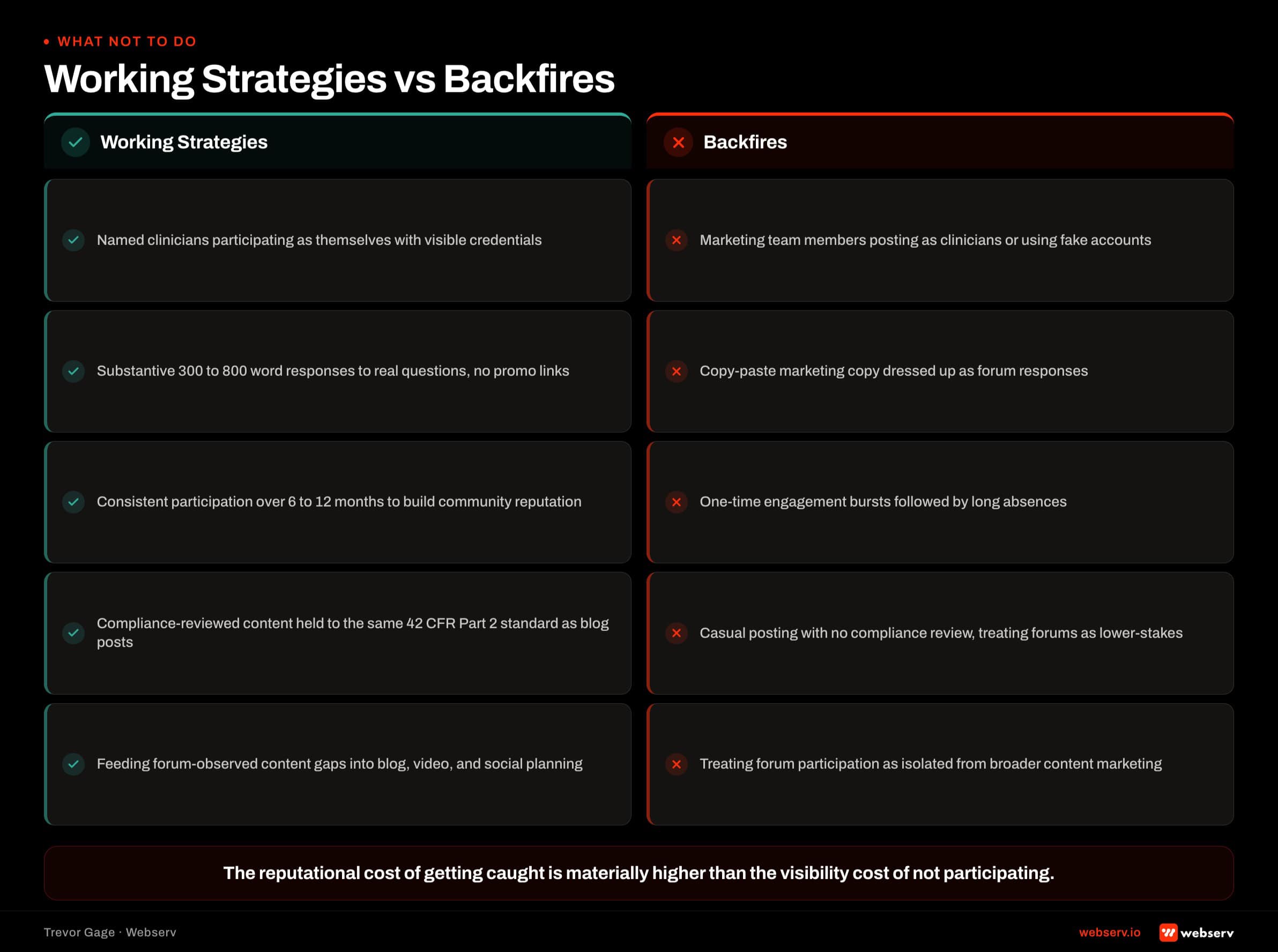 Side-by-side comparison of what actually earns treatment center inclusion in the Expert Advice block, authentic named-clinician participation and long-arc substantive posting, versus the shortcuts that backfire including astroturfing, purchased engagement.
The most expensive mistake operators make in this surface is treating it as an afterthought. The Expert Advice block will surface someone’s voice for behavioral health queries whether or not the treatment center participates.
The question is whose voice. Former patients with grievances, unaffiliated commenters, competitor clinicians, and journalists all end up in the block by default when the treatment center is absent.
Compounding the effect, the pieces of content in the Expert Advice block get indexed by ChatGPT, Claude, Perplexity, and Gemini as well. What Google surfaces in AI Overviews today becomes what the broader AI search ecosystem cites tomorrow. Participation now compounds over the next 12 to 24 months.
When to Start
The strategy pays back on a 6- to 12-month horizon. First 90 days: named clinician participation ramping, initial content getting posted, no measurable appearance in Expert Advice blocks yet.
Days 90 to 180: individual posts begin appearing in Google AI answers for niche queries. Days 180 to 365: consistent presence across the highest-priority queries for the facility.
The treatment centers that start now will be established voices when the Expert Advice block becomes a dominant AI surface (which most industry observers expect by 2027). The treatment centers that wait will be trying to build reputation from zero against competitors who spent 12 months earning it. Book an intro meeting if you want to walk your current AI search visibility with our team.
Frequently Asked Questions
This is part of a broader Reddit and AI-visibility strategy; see behavioral health marketing guide.
Which queries trigger the Expert Advice block for behavioral health?
The block appears most often on advice-seeking queries with experience-based language. Common triggers include “should I go to rehab,” “what is [level of care] like,” “does [treatment approach] work,” “best [type of treatment] in [location],” “is [facility name] a good treatment center,” and comparative queries between programs or facilities.
The block appears less often on transactional queries (“rehab near me,” “call now”), on pure informational queries (“what is opioid use disorder”), and on branded queries where the searcher clearly knows what they want. It appears most on queries where the searcher is weighing a decision and would benefit from personal experience.
Test the queries that matter for your facility manually. Check them in Google over a two-week window. The queries where the block appears reliably are the ones to prioritize for participation strategy.
Can we pay someone to post on Reddit for us?
No. Paid Reddit karma services, ghostwritten posts, and purchased upvotes all violate Reddit’s terms of service and Google’s spam policies. Detection has improved substantially, and the consequences (account suspension, subreddit bans, potential Google penalty for the treatment center) are worse than the visibility cost of not participating.
The legitimate alternative is agency support that helps named clinicians develop their forum presence over time. That includes editorial support (helping draft substantive responses), community research (identifying which threads are worth engaging), and monitoring (tracking what Google picks up). The clinician still posts the content under their own name and account.
Any agency offering to “grow your Reddit presence” through purchased engagement should be declined. The methods behind that offer are always some version of the tactics that get you flagged.
How do we know if our named clinician is being cited?
Manual monitoring is currently the only reliable method. Search the queries that matter for your facility in Google, note whether an AI Overview appears, and check whether the Expert Advice block cites the clinician’s Reddit username, LinkedIn handle, or forum identity.
Google Alerts configured for the clinician’s name across relevant forums can help catch mentions, though the alerts do not distinguish between citations in the Expert Advice block and other mentions.
Third-party AEO monitoring tools are building this capability but nothing is fully production-ready as of mid-2026. Track manually for now, with the expectation that automated tracking becomes available within 6 to 12 months. Our companion piece on brand mention monitoring walks the broader monitoring workflow that this fits inside.
What if a former patient is being cited in the Expert Advice block negatively about our facility?
This is a compliance-sensitive situation. Do not respond publicly to the citation in a way that confirms the person received treatment at the facility (that is itself a 42 CFR Part 2 disclosure).
The options that are available: private outreach through Reddit’s messaging system if the platform allows and the user has messages open, requesting Google review the content through the AI Overviews feedback mechanism if the content is factually inaccurate, or building sufficient countervailing positive presence over time so the negative citation is less prominent in the ecosystem.
Route the situation through compliance review before any public response. Most negative citations are best addressed by building better content elsewhere rather than by engaging directly.
Trevor Gage is the Director of Marketing at Webserv, a digital marketing agency for treatment centers.