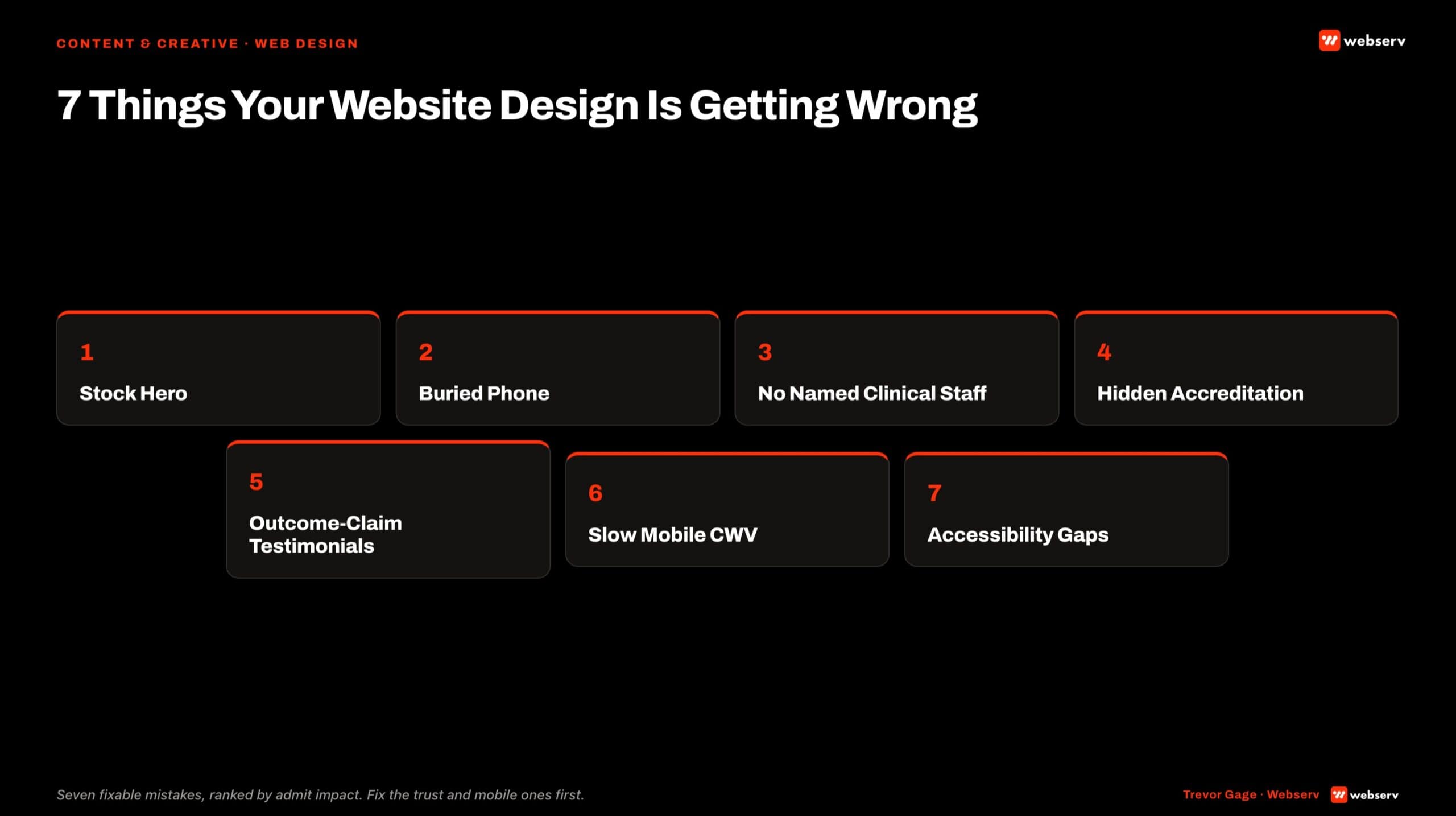
Every treatment center website audit our team runs surfaces the same seven design mistakes. Not five. Not ten. Seven. The pattern is consistent enough that a facility calling us for a design refresh usually has at least four of the seven live on their homepage today.
The mistakes are not aesthetic. They are conversion sacrifices dressed up as design decisions. Each one costs admits every day the site stays live. Each one has a specific fix that does not require rebuilding the whole website.
This piece walks the seven, names the fix for each, and puts a rough time-and-cost band on how heavy the remediation actually is.
If you are auditing your own treatment center website or evaluating a redesign scope, use this as the checklist. The full website design decision framework sits above this piece if you need the broader design brief.
Key Takeaways
- Seven design mistakes show up on almost every treatment center website audit. Stock hero imagery. Phone number buried on mobile. No named clinical staff. Accreditation badges hidden in the footer. Testimonials that make outcome claims. Slow mobile page speed. WCAG accessibility gaps.
- Each mistake has a specific fix. Most fixes take 1 to 3 weeks to implement without a full site rebuild. The whole seven-mistake remediation is usually a 4-8 week engagement.
- The cost of leaving these mistakes live is not aesthetic. It is admits per month. Family research and prospect research both stop at design signals that read as generic, unsafe, or slow.
- The single highest-ROI fix is usually the phone number placement. The single hardest fix is usually the accessibility remediation. Prioritize accordingly.
- Facilities that pass a website through their marketing agency without a compliance-aware design review usually end up with LegitScript exposure in testimonials, imagery, and outcome claims. The fix is a design review that includes LegitScript rules from day one.
Mistake 1: Stock Hero Imagery That Erases Your Differentiator
The homepage hero is the first six seconds. Stock imagery in the hero signals “generic treatment center” before the family reads a word. Family audiences pattern-match your hero photo to every other rehab website they have researched that day. The treatment center homepage scorecard covers what belongs in the hero instead.
What the mistake looks like. Diverse actors smiling in a soft-lit clinical space. Silhouettes on a beach at sunset. A cupped-hands photo with a plant growing between them. All of these images live in the same three stock photography libraries every other treatment center uses.
Why it costs admits. Trust starts with differentiation. If your homepage looks like every other homepage in the family’s research tab set, you have already lost the trust signal race before your copy loads.
The fix. Real facility photography. Your actual buildings. Your actual grounds. Your actual clinical staff at work. Even imperfect real photography beats polished stock imagery on every conversion measure worth tracking. Facility photography does not require patient consent because patients are not in the photos.
Cost band: $3,000 to $8,000 for a professional photo shoot at a single-location facility. Multi-location portfolios budget higher.
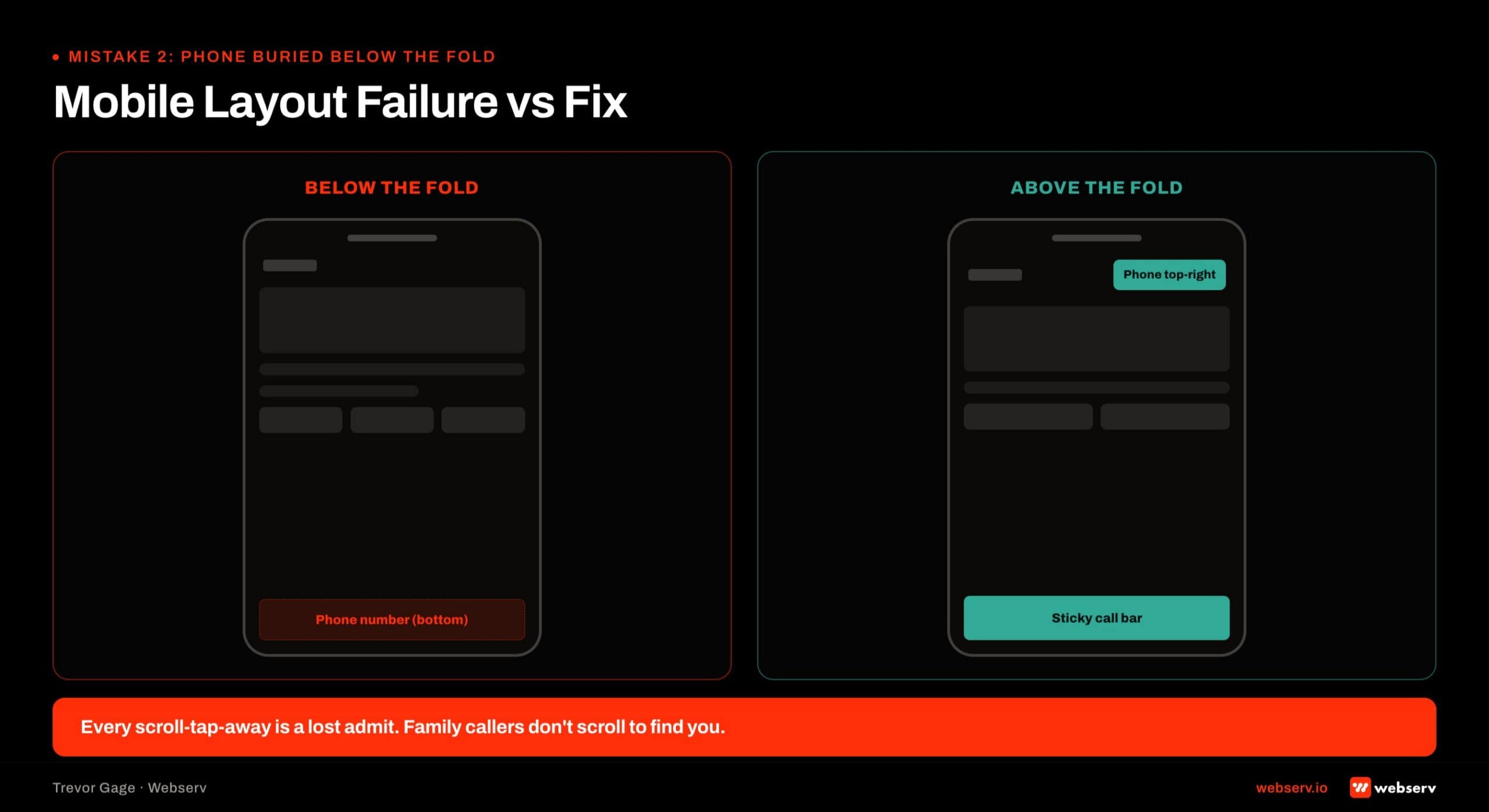
Mistake 2: Phone Number Buried Below the Fold on Mobile
Sixty to eighty percent of treatment center traffic arrives on mobile. The phone number is the primary conversion action for treatment center websites. Design decisions that hide, minimize, or de-emphasize the phone number on mobile sacrifice conversion for aesthetics.
What the mistake looks like. The phone number in the site footer with no header placement. The number in the header but too small to read on mobile without zooming. No tap-to-call formatting. The number visible on desktop but hidden behind a hamburger menu on mobile.
Why it costs admits. Every extra tap between a family member deciding to call and the number being callable costs conversion. The fastest treatment center websites have a tap-to-call number in the mobile header, one action from any page.
The fix. Sticky mobile header with a prominent tap-to-call phone number. Number visible on every page without a menu open. Larger font size than most designers instinctively pick. Contrast against the header background so the number reads clearly in bright daylight on a phone.
Cost band: 1 to 2 weeks of design and development work. This is the highest-ROI fix on the list.
Mistake 3: Missing Named Clinical Staff Bios
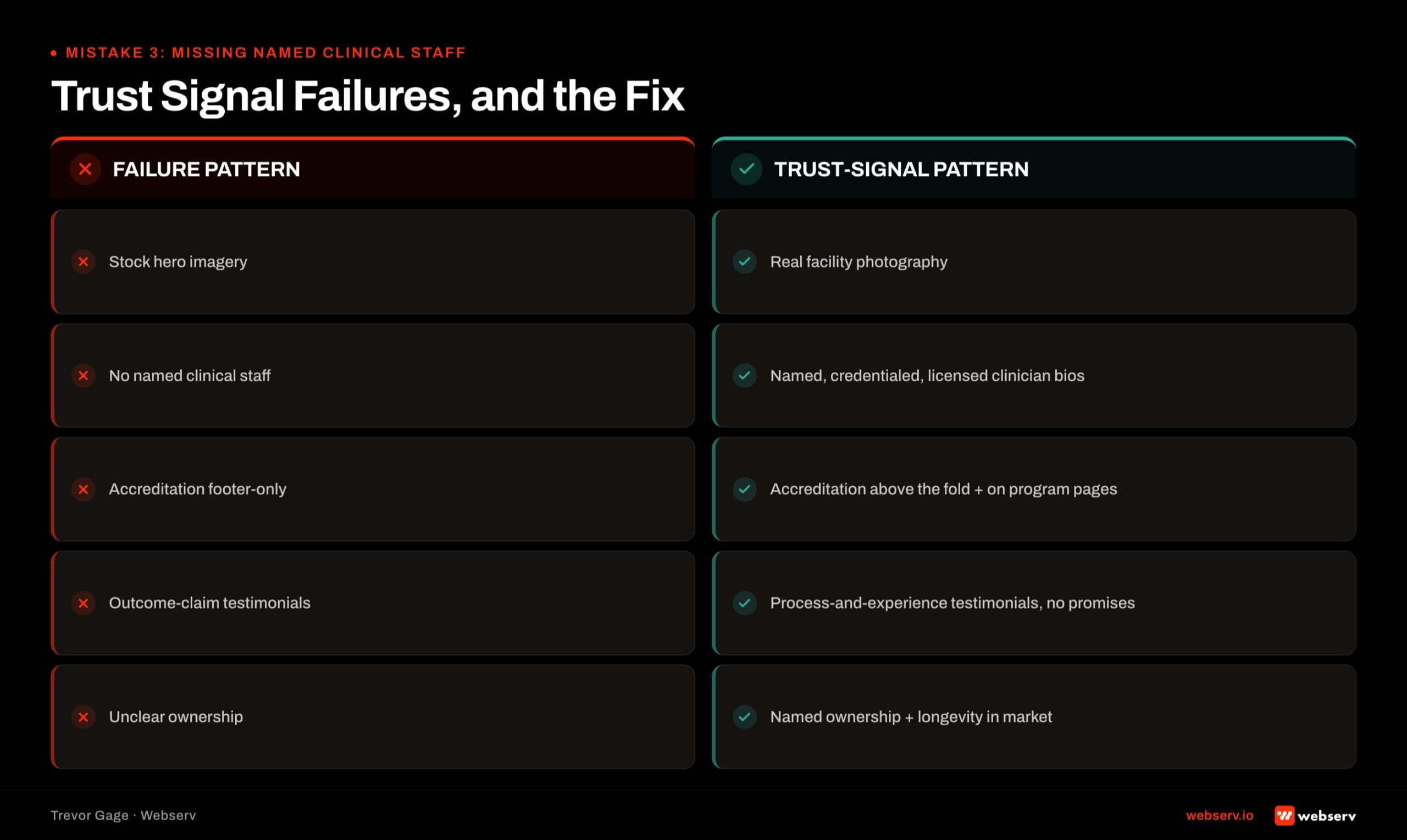
Family audiences research the clinicians before they call. Facilities that leave clinical staff off the website or hide bios behind generic “our team” language surrender a substantial trust signal.
What the mistake looks like. No medical director bio. No named clinical director. Stock photos of “doctors” instead of real staff photos. Bios that list credentials but never show the person’s face. A “team” page that lists first names only.
Why it costs admits. Named clinicians with credentials and photos build clinical trust in a way anonymous “our team” language cannot. AI-generated search results, Google’s Expert Advice block, and family research patterns all favor named-clinician content.
The fix. Dedicated bio pages for the medical director, clinical director, and named clinicians. Professional headshots in consistent style. Credentials, education, years of experience, and clinical specialties. Photo, name, credentials, and one paragraph on treatment philosophy is the minimum.
Cost band: 2 to 4 weeks. Requires clinical staff cooperation for photos and bio drafts. Legal review of credentials before publishing.
Mistake 4: Accreditation Badges Hidden in the Footer
Joint Commission, CARF, LegitScript, and state licensing badges are trust signals that answer the family member’s implicit safety question. Facilities that hide badges in the footer treat them as legal disclosures. Family audiences read badges as safety signals and expect them where their attention already is.
What the mistake looks like. Six accreditation badges in a small horizontal row at the bottom of the footer. Badges visible only on the “About” page. Text-only credential mentions with no visual badge treatment.
Why it costs admits. The homepage hero is the first six seconds. If accreditation is not visible during those six seconds, the family member has to actively hunt for the trust signal. Most family members do not hunt. They back-button.
The fix. Three to five accreditation badges positioned in the homepage hero or immediately below the fold. Horizontal row with consistent sizing. Linked to the specific accreditation verification page for each. Visible on every service page and location page, not just the homepage.
Cost band: 1 week of design and development work. Assumes badges are already licensed and downloadable from each accreditor.
COMMON MISTAKE
Publishing testimonials like “This program saved my life” or “I’ve been sober 3 years thanks to their treatment.” Both are outcome claims under LegitScript and federal marketing rules for treatment centers. LegitScript-safe testimonial framing focuses on experience (“the staff felt genuinely invested,” “the intake process was clear”) rather than outcomes. Get this wrong and you risk LegitScript decertification, which kills paid search eligibility.
Mistake 5: Testimonials That Make Outcome Claims
LegitScript restricts specific outcome claims in testimonials on treatment center websites. Testimonials that promise specific results (“I got clean and never looked back,” “90 percent success rate”) are LegitScript exposure that can affect certification status.
What the mistake looks like. Testimonials with percentage claims. Before-and-after imagery of former patients. Endorsements from named celebrities without documented consent. Testimonials that name a specific outcome (“my depression went away”) rather than an experience quality.
Why it costs admits. Two failure modes. First, LegitScript audit can flag the content and threaten certification, which threatens paid media eligibility on Google, Meta, and Bing. Second, family audiences are increasingly savvy and read outcome-claim testimonials as advertising rather than trust signals.
The fix. Testimonials focused on experience quality. Staff interactions. Facility environment. Family member perspectives on the admissions process. All testimonials documented with signed consent. Alumni photography requires model releases. Third-party reviews (Google, Yelp) carry more trust weight than curated on-site quotes and should be surfaced prominently.
Cost band: 2 to 3 weeks to audit existing testimonials, obtain new consented testimonials, and rewrite content. Legal review before publishing.
Mistake 6: Slow Mobile Page Speed That Fails Core Web Vitals
Family research often happens on mobile with variable connections. Every second of page load time costs conversion. Core Web Vitals matter for admits, not just SEO rankings.
What the mistake looks like. Homepage that takes 4+ seconds to become interactive on mobile 4G. LCP (Largest Contentful Paint) above 2.5 seconds. CLS (Cumulative Layout Shift) that causes content to jump as the page loads. Uncompressed hero images. Third-party scripts that block rendering.
Why it costs admits. Google publishes research showing conversion rates drop measurably for every additional second of load time on mobile. Family members researching treatment options at midnight on their phone will back-button rather than wait.
The fix. Image optimization (compress and convert to WebP where supported). Hero image lazy-loading below the fold. Defer non-critical JavaScript. Audit third-party scripts and remove any that do not directly drive conversion. Follow Google’s Core Web Vitals thresholds (web.dev, Core Web Vitals) as the target.
Cost band: 2 to 4 weeks depending on how many third-party scripts and image assets need remediation. The Core Web Vitals benchmarks for treatment centers is the tactical piece for facilities auditing their current performance.
Mistake 7: Accessibility Gaps That Draw ADA Lawsuits
Behavioral health facilities are subject to ADA Title III accessibility requirements. Treatment center websites regularly face accessibility lawsuits when they miss WCAG 2.2 standards.
What the mistake looks like. Text contrast below the 4.5:1 threshold for normal-size text. Images without alt text. Interactive elements that cannot be operated with keyboard-only navigation. Auto-playing video with no user control. Screen reader failures on the primary navigation.
Why it costs admits. Two failure modes. First, the legal exposure is real. ADA Title III lawsuits against healthcare websites are increasing and settlement costs run $10,000 to $50,000 or more per incident.
Second, accessibility failures affect the actual users who need the accessibility features, including family members researching treatment for elderly parents.
The fix. WCAG 2.2 audit against the current site. Contrast fixes on any text that fails the 4.5:1 ratio. Alt text on every image. Keyboard navigation for every interactive element. Screen reader testing on the primary conversion paths (homepage to phone, homepage to insurance form).
Cost band: 4 to 8 weeks for a real WCAG remediation. Faster if the site was built to WCAG standards initially. Slower if the site has years of accumulated accessibility debt. The Web Content Accessibility Guidelines (W3C, WCAG 2.2) is the standard reference.
OPERATOR INSIGHT
Fixing all seven mistakes on an existing site typically runs $8,000 to $18,000 for a mid-sized facility, split across design, development, photography, and compliance review. Full redesigns run 3-5x that. If the site is generating admits, prioritize fixes over rebuilds; if the site is not, the rebuild economics start looking more defensible.
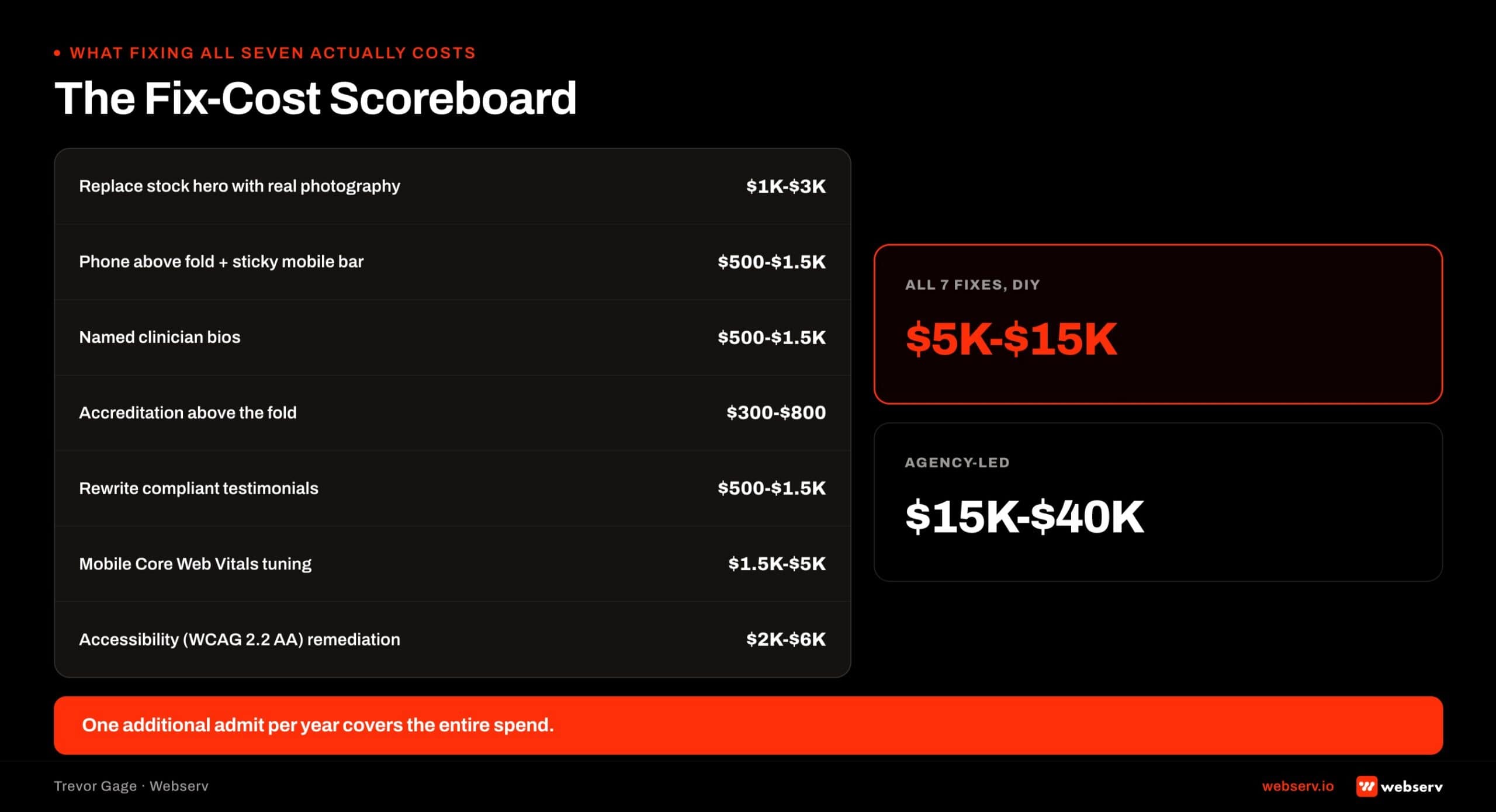
What Fixing All Seven Actually Costs
A facility that fixes all seven mistakes without a full site rebuild usually runs a 4-8 week engagement at $15,000 to $40,000 depending on the extent of each fix.
The fixes distribute unevenly. Photography and staff bios cost more than accreditation badge placement and phone number optimization. Accessibility remediation often runs the highest of any single fix because the audit surfaces more issues than facilities anticipate.
Facilities that need all seven fixes AND a full brand refresh usually cross the threshold into a redesign scope. That decision walks in the treatment center website redesign framework. Reconfiguration inside the current design system almost always beats a full redesign when only the seven fixes are needed.
The seven fixes also protect the redesign investment if a full rebuild does happen later. Every fix (real photography, named staff bios, accreditation placement, LegitScript-safe testimonials, page speed, accessibility) survives a redesign because they are content and compliance decisions, not visual design decisions.
The perspective in this article comes from 9 years working exclusively inside behavioral health.
We are a team built by people in recovery who understand that behind every admission is someone asking for help. If that resonates, get to know us.
Frequently Asked Questions
This works alongside behavioral health marketing guide and landing page design guide as part of a complete landing page strategy. It’s also worth pairing with clinical trust signals in website design.
Which of these seven mistakes should we fix first?
The phone number placement. It is the highest-ROI fix and the cheapest to implement. A visible tap-to-call phone number in the mobile header, sticky across every page, typically lifts conversion within days of launch. No redesign required. One to two weeks of design and development work.
After the phone number, the accreditation badge placement (moving from footer to hero) is the second-highest ROI fix at similar cost. These two changes usually produce measurable conversion lift before any other work starts.
The accessibility remediation should not be first because the timeline is longer and the ROI is slower, but it should be planned early because the legal exposure grows every month the site stays non-compliant.
How do I know if my website has these seven mistakes?
Open your homepage on your phone. Check whether the phone number is immediately visible and tap-to-call formatted. Look for accreditation badges in the hero or immediately below. Read your hero photo and ask whether it looks like a real facility or a stock library image.
Click through to the “About” or “Team” page. Check whether the medical director and clinical director are named with photos, credentials, and bios. Read three testimonials and check for outcome claims that would fail a LegitScript audit.
Run the URL through Google’s PageSpeed Insights and check the Core Web Vitals scores. Run the URL through a WCAG contrast checker and audit at least the primary conversion paths for keyboard navigation. If any of these checks flags an issue, that is at least one of the seven mistakes live on your site today.
How much does it cost to fix all seven?
A 4 to 8 week engagement at $15,000 to $40,000 for a mid-size single-location facility. The variance is driven by photography scope, accessibility remediation depth, and how much LegitScript content review the current testimonials require.
Multi-location facilities budget higher because photography, accreditation placement, and accessibility remediation all multiply across locations. Enterprise portfolios can run $40,000 to $100,000+ depending on template count and location coverage.
The Fast-Track Diagnostic ($3,000, credited toward the first month if you engage) is the low-friction way to scope which of the seven mistakes are live on your site and what the specific remediation cost would be.
Do I need a full redesign or can I fix these one at a time?
You can fix these one at a time. All seven are content and compliance changes that live inside your existing design system. None require rebuilding the site.
Facilities that need all seven fixes AND want a broader brand refresh, updated visual design, new content architecture, or a technology stack migration usually cross the threshold into a redesign scope. The redesign versus refresh decision framework walks the criteria for that call.
The seven fixes are worth doing whether or not a redesign is planned. They protect the redesign investment because they survive any visual design update.
Which mistake carries the biggest compliance risk?
The testimonial and outcome claims mistake carries LegitScript exposure that can affect paid media eligibility across Google, Meta, and Bing. Losing LegitScript certification cuts off the primary paid media channels for behavioral health.
The accessibility gaps mistake carries ADA Title III legal exposure. Lawsuits against healthcare websites over WCAG failures are increasing. Settlement costs run $10,000 to $50,000 or more per incident, plus remediation cost afterward.
Both should be prioritized in the first phase of any remediation engagement. Neither is optional at a facility running paid media or subject to ADA requirements (which is every treatment center in the United States).
Can we do this ourselves or do we need an agency?
Most facilities can do the phone number placement and accreditation badge placement in-house with a WordPress developer or the current design vendor. Those two fixes are the simplest and highest-ROI.
Real facility photography requires a professional photographer and a shoot day at your location. Facilities can source photographers independently but should brief the shoot against the specific angles and settings that support trust signals (exterior, grounds, common areas, clinical spaces, staff at work).
Testimonial audit, LegitScript compliance review, accessibility remediation, and Core Web Vitals optimization usually benefit from an agency partner with vertical-specific experience. Generalist agencies often miss LegitScript rules and WCAG requirements that affect treatment center websites specifically.
Closing
The seven mistakes are consistent because the vertical is consistent. Family-mediated decision-making, LegitScript compliance, mobile-first behavior, and accessibility requirements all shape the design brief in ways generalist agencies routinely miss.
The fixes are knowable. The engagement is scoped. The ROI shows up in weeks, not months. Facilities that leave these seven mistakes live are sacrificing admits every week for aesthetic decisions the family audience is not rewarding.
If you want a specific audit of your current site against the seven mistakes, start with the $3,000 Fast-Track Diagnostic. Two-week audit, credited 100 percent toward the first month if you move forward with a full engagement.
Trevor Gage is the Director of Marketing at Webserv, where he leads content and SEO for the agency’s behavioral health and addiction treatment clients. He writes about the operator lens on rehab marketing at the Webserv blog.