Profound and Semrush citation data point the same direction: the sources LLMs cite most are communities, institutions, and niche publications, not the Tier-1 outlets traditional Digital PR targets. The DR-equals-citation relationship that defined Digital PR for the last decade has flipped, and the budgets following the old playbook are buying placements LLMs do not read.
The asset they were selling was a DR85 backlink to a luxury residential brand. It would have built the link profile. It probably would have moved one or two head terms a few positions on Google in the long run.
And in 2026, it would have been one of the worst $30,000 a treatment center can spend on Digital PR.
This piece is the data and the mechanism: why the relationship inverted, what the Profound numbers actually show, and where the citation budget should be flowing instead. For the step-by-step audit to find your facility’s specific citation targets, see our companion guide on reverse-engineering the AI citation.
The reason has nothing to do with Forbes. It has to do with where citations now come from in the AI search layer.
We track this every week inside Webserv’s Digital PR program for treatment centers, and the data has shifted hard in the last 12 months. The DR70+ generalist publication that used to be the prize is now getting outperformed by mid-DR niche outlets that nobody in traditional PR has heard of.
This guide breaks down what changed, what the empirical data actually shows, why the mechanism behind LLM retrieval favors mid-DR vertical sites, the mid-DR target list we use for behavioral health, and how to reallocate your Digital PR budget for the citation layer that actually moves admissions.
Key Takeaways
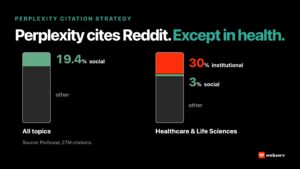
- Profound’s analysis of 27 million AI citations puts media outlets at just 15 percent of Healthcare & Life Sciences citations, against 30 percent from institutions. In ChatGPT, Forbes, Business Insider, and Reuters each sit near or below 1 percent of total citations.
- SEMrush’s 325,000-prompt study found LinkedIn cited in 14.3% of ChatGPT Search responses, 13.5% of Google AI Mode answers, and 5.3% of Perplexity outputs. LinkedIn ranked second among cited domains in that dataset, ahead of every major news publisher.
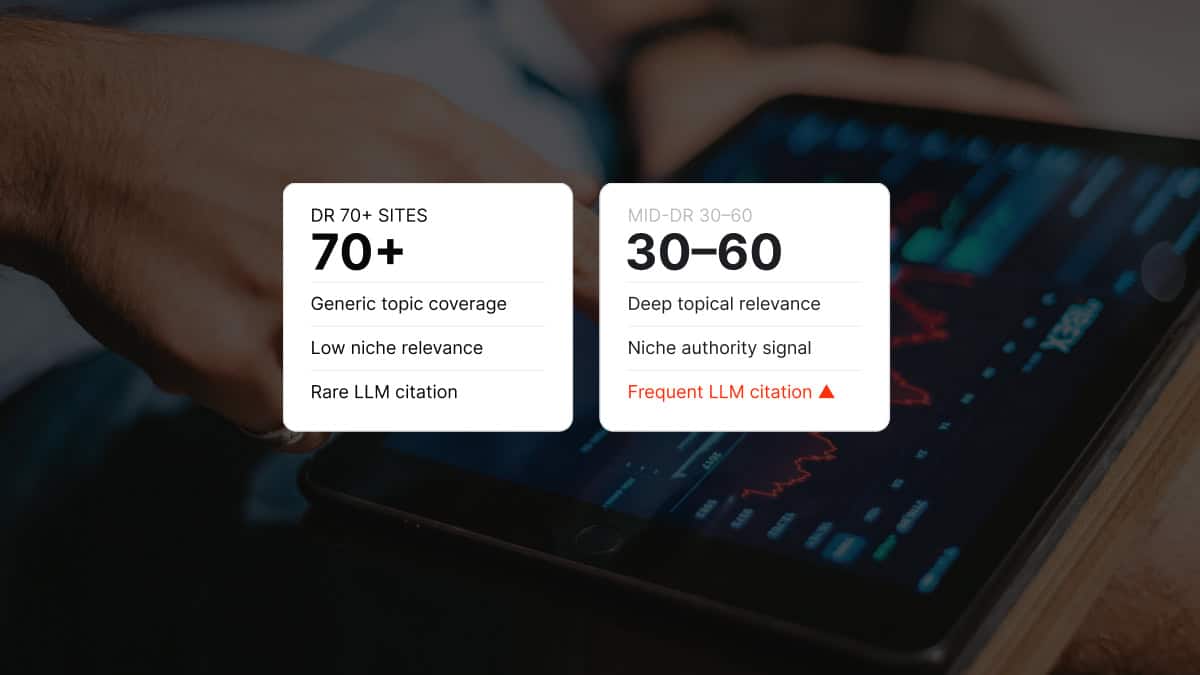
- The mechanism is vector retrieval. LLMs select sources by semantic relevance and topical alignment, not by traditional PageRank or domain authority. A DR40 niche pub with 80 percent topical concentration in addiction treatment outranks a DR85 generalist for behavioral health queries.
- Brand search volume now predicts LLM citation share better than backlink profile does. Volume of mentions across many mid-DR sites outweighs a single high-DR placement.
- For behavioral health Digital PR in 2026, six $3,000 mid-DR vertical placements will usually do more for AI citation share than one $30,000 Tier-1 contributor placement.
The Digital PR Playbook That Stopped Working in 2026
For two decades, the Digital PR playbook for treatment centers was straightforward. Pitch journalists at Forbes, Inc., Business Insider, US News, and similar Tier-1 outlets. Earn a contributor placement or quote. Watch the DR70+ backlink improve domain authority and lift head-term rankings over 6 to 12 months.
That playbook worked because Google’s ranking system weighted domain authority heavily, and PageRank flowed through links from high-authority sites at a multiplier that justified the spend.
Three things changed that math.
First, AI Overviews and AI Mode now intercept a meaningful share of behavioral health queries before the user sees a blue-link result.
The conversion path that used to start with a Forbes article surfacing in a Google SERP now starts with an AI Overview that may or may not cite Forbes at all.
Second, the underlying mechanism by which LLMs select citation sources has nothing to do with PageRank. It’s a vector retrieval system that scores semantic relevance and topical authority at the page and entity level, not at the domain level.
Third, the publications that journalists chase and the publications LLMs actually cite have decoupled. Profound’s 27-million-citation analysis shows the gap clearly: in Healthcare & Life Sciences, media outlets account for only 15 percent of AI citations, while institutions account for 30 percent.
This isn’t speculation. The old Digital PR playbook produces backlinks that lift Google rankings months later, on terms that increasingly don’t get clicked because AI Overviews answer the query before the user scrolls. The new playbook produces citations that surface inside the AI Overview itself.
These two outcomes have different price tags and different success metrics. Most Digital PR firms haven’t updated their pitch decks to reflect this.
What the Profound and SEMrush Data Actually Show
Two 2026 studies make the empirical case clearly.
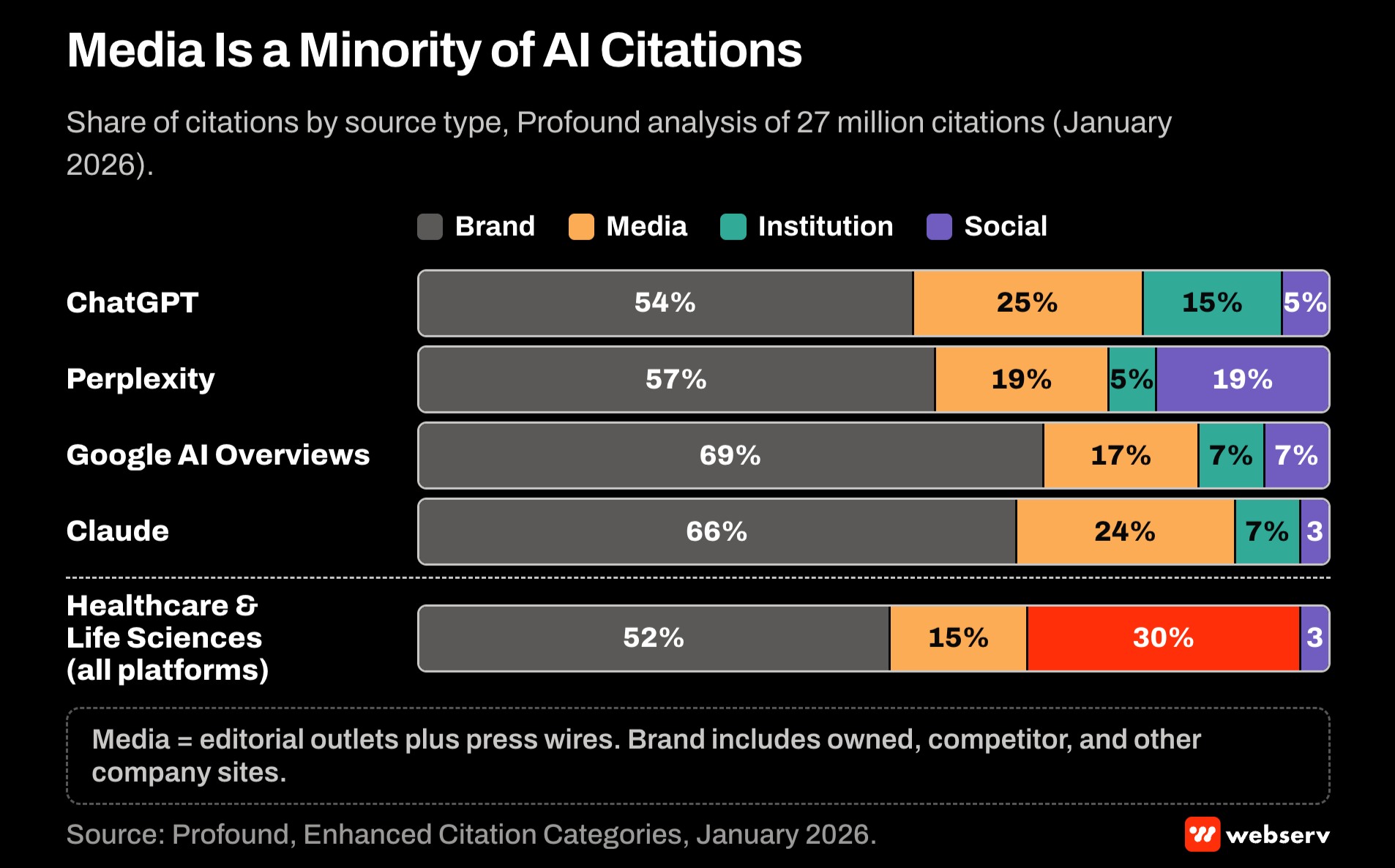
Profound, the AI search intelligence platform, runs continuous prompt monitoring across ChatGPT, Perplexity, Google AI Mode, Claude, and Gemini. Its platform citation data shows Reddit, YouTube, Quora, and LinkedIn as the four most-cited domains in Google AI Overviews, with Reddit alone taking 46.7 percent of Perplexity’s top-10 citations.
The breakdown is uncomfortable for the old playbook. Reddit threads, niche YouTube channels, LinkedIn posts, and the long tail of vertical sites dominate the citation distribution. In ChatGPT, Forbes, Business Insider, and Reuters each sit near or below 1 percent of total citations.
SEMrush’s 325,000-prompt study tells a complementary story. LinkedIn was cited in 14.3 percent of ChatGPT Search responses, 13.5 percent of Google AI Mode answers, and 5.3 percent of Perplexity outputs.
LinkedIn is technically high-DR, but the citation pattern is not domain-level. LLMs are pulling specific posts from individual authors, treating each contributor as a topical entity.
Profound’s tracking shows LinkedIn rose from approximately the 11th most-cited source on ChatGPT in November 2025 to 5th by February 2026, the largest authority shift Profound recorded all year.
Platform-specific patterns matter too. Perplexity skews toward research-credible sources like NIH and SAMHSA. ChatGPT is Wikipedia-heavy. AI Mode varies more. But across all three, the Tier-1 generalist business press is conspicuously underweight.
Our deep dive on how to get your rehab center cited in Google AI Overviews and ChatGPT covers the page-level optimization side of the same problem. For the operator side, tracking which queries cite your brand and how that citation share moves month over month, our guide on measuring AEO and citation share across ChatGPT, Perplexity, Claude, and Google AI Overviews walks through the measurement stack.
The implication is direct. A behavioral health brand spending Digital PR budget on Tier-1 placements is buying a signal that LLMs largely ignore. The signal LLMs respond to is concentrated in the mid-DR niche tier that traditional PR firms treat as the consolation prize.
Why Vector Retrieval Punishes High-DR Generalist Sites
Understanding why this happened requires a brief explanation of how LLM citations actually get assembled.
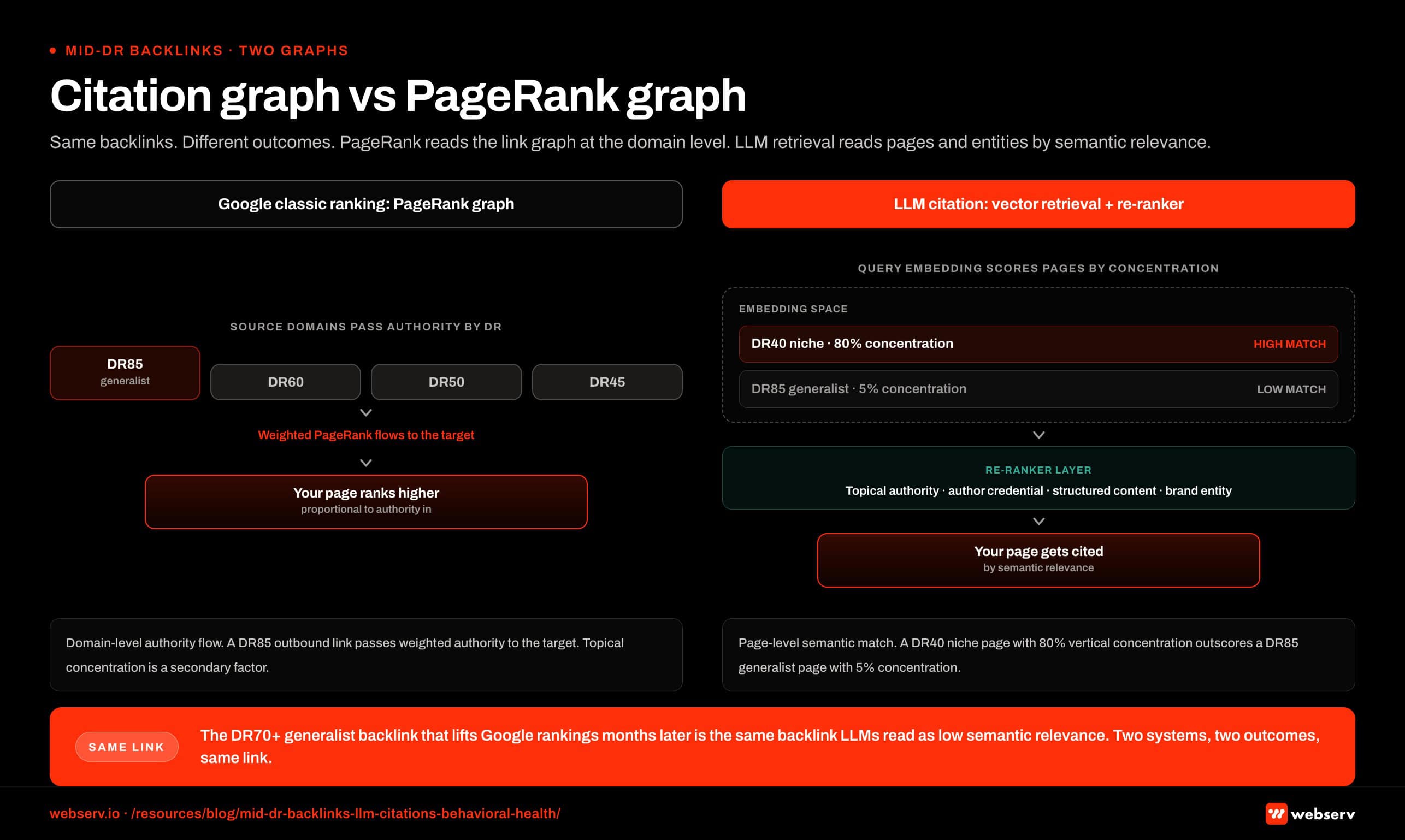 Infographic titled ‘Citation graph vs PageRank graph’.
When a user asks ChatGPT, Perplexity, or Google AI Mode a question, the system doesn’t search Google’s traditional index and pull the top results.
It runs a vector retrieval process that converts the query into a high-dimensional embedding, scores candidate documents in the index by semantic similarity to that embedding, then re-ranks the candidates by a set of trust and quality signals.
The first step, vector similarity scoring, is where mid-DR niche sites win. Vector embeddings cluster content by meaning. A behavioral health treatment center query produces an embedding that’s semantically closest to pages that are densely concentrated in behavioral health content.
A DR40 niche publication that’s 80 percent addiction-treatment content has a tighter topical signature in the embedding space than a DR85 generalist where addiction is one of 400 verticals covered. The mid-DR niche site scores higher on semantic similarity for the exact queries that matter.
The second step, the re-ranker, applies trust and quality signals. This is where some domain authority influence persists, but the signals are more nuanced than PageRank. The re-ranker rewards topical authority, author credential signaling, structured content (tables, clean headings, direct answers), and brand entity recognition.
None of these signals correlate strongly with the DR metric Ahrefs publishes. A DR85 generalist site with low topical concentration in your vertical fails on topical authority. A DR40 niche pub with deep topical concentration passes.
Structured content matters more than most operators realize. Pages built for fan-out query mechanics and semantic triple patterns get extracted by the re-ranker more often than long-form magazine prose, regardless of where the prose is published.
The net effect: vector retrieval favors the mid-DR niche tier, the re-ranker favors structured content with clear topical authority, and both layers conspire against the high-DR generalist placement that used to anchor Digital PR strategy.
The Mid-DR Sweet Spot for Behavioral Health
OPERATOR INSIGHT
The Fix, Filter Magazine, Recovery.com, Behavioral Health News, Addiction Professional. DR 40-60 vertical pubs, small audiences, tight editorial teams — and they get cited by LLMs at rates that punch far above Forbes. Topical concentration and a dense entity graph of real addiction-treatment professionals beat generalist DR every time in this vertical.
In our own portfolio, the publications driving the most AI citation share for treatment center brands are mid-DR vertical pubs that nobody at a traditional PR firm would pitch first.
The list includes outlets like The Fix, Filter Magazine, Recovery.com, Treatment Magazine, Behavioral Health News, Addiction Professional, and similar industry trade publications. These sit in the DR 40-60 range. They have small audiences relative to Forbes. They publish on tight schedules with smaller editorial teams.
And they get cited by LLMs at rates that punch dramatically above their DR weight.
The reasons are structural.
These publications publish exclusively in the behavioral health vertical. Their topical concentration is close to 100 percent. Their entity graph (the network of named authors, sources, and clinical contributors) is dense with addiction-treatment professionals who get recognized as topical entities by LLM training and retrieval.
Their content tends to be more clinically rigorous than generalist coverage. A piece in Filter Magazine on harm reduction includes specific medication names, clinical reasoning, and citations to primary research. A piece in Forbes on the same topic includes a quote from the facility’s CEO and a paragraph of summary.
LLMs extract the clinical detail. They rarely extract the CEO quote.
The mid-DR vertical also tends to have cleaner content formatting. Tables, structured headers, defined Q&A sections, and the kind of compound-prompt-friendly structure that gets pulled into AI Overviews. Tier-1 long-form journalism rarely formats this way.
Beyond the mid-DR vertical tier, there’s a second source category that gets disproportionate LLM citation share: institutional research credibility. SAMHSA, NIH, NIDA, CMS, ASAM, JCAHO.
These are DR80+ sites that get cited not because of their domain authority but because of their primary-source research credibility. The mechanism is different from Forbes, and the takeaway is the same: chase the credibility signal, not the DR number.
“The Digital PR question for treatment centers in 2026 isn’t how do we get into Forbes.
It’s where do the LLMs that answer the queries our patients ask actually pull their citations from, and how do we earn placements in those specific sources. The DR70+ generalist tier almost never appears in that answer.”
Preston Powell, Chief Executive Officer, Webserv
What the Citation Graph Looks Like in Behavioral Health
The citation graph in behavioral health has a consistent shape. The Profound and SEMrush data don’t just show that mid-DR wins, they show which specific publications dominate.
Mid-DR vertical publications dominate the BH-specific citation surface. Behavioral Health News, Addiction Professional, Treatment Magazine, Recovery Today, The Fix, Filter Magazine, and Recovery.com show up across the citation graph for treatment-related prompts.
They produce citations at rates that punch well above their domain authority. The audit consistently surfaces these as the strongest pitch targets for facilities with the operational depth to support a creator-vetted PR program.
Institutional research sites take the high-credibility citations. SAMHSA’s treatment locator and data pages, NIDA’s research summaries, ASAM clinical guidelines, and CMS regulatory documents show up across nearly every behavioral health prompt that touches clinical accuracy.
These citations aren’t pitch targets in the traditional sense. They’re the credibility anchors AI engines use to validate other claims in their answer. Earning a citation here usually requires research partnership work, not media pitching.
Reddit and LinkedIn appear at higher rates than most operators expect. Profound’s data shows Reddit taking 46.7 percent of Perplexity’s top-10 source citations.
For behavioral health, the recovery and family-of-addiction subreddits get cited heavily for awareness-stage prompts. LinkedIn long-form content from credentialed clinical authors gets cited for clinical-evaluation prompts. Neither shows up on traditional PR target lists.
The unexpected sources matter. Treatment locator directories, Psychology Today therapist listings, JCAHO accreditation databases, and specific YouTube channels with clinical content show up in citation graphs at low individual frequency but high aggregate volume.
These are not media pitch targets in the typical sense. They’re entity authority signals that the audit reveals as part of the citation infrastructure.
The takeaway is that the citation graph for behavioral health is much wider than the traditional PR target list captures.
Programs that audit get to invest in the surfaces that actually drive AI citation lift. Programs that don’t audit keep pitching the same 12 Tier-1 publications and wonder why citation share isn’t moving.
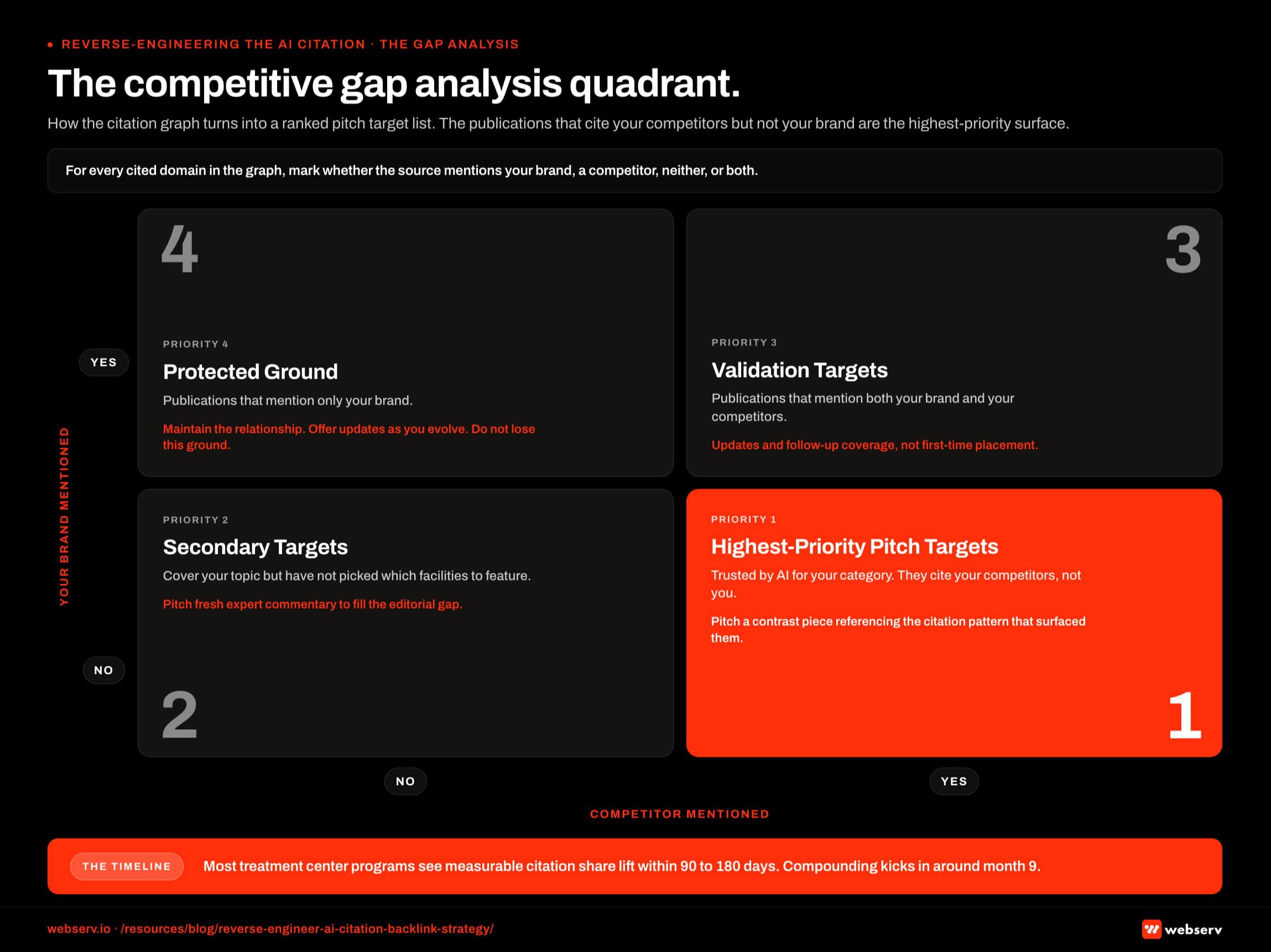 Two by two competitive gap analysis quadrant titled ‘The competitive gap analysis quadrant for AI citation audits.’
What This Means for Your Digital PR Budget Allocation
The budget math shifts substantially once you commit to citation-first Digital PR.
A typical legacy Digital PR program for a treatment center spent $20,000 to $40,000 per month chasing Tier-1 placements. The yield was 1 to 3 high-DR contributor placements per quarter, plus a handful of mid-DR placements as fallback wins.
A citation-first program at the same budget produces a different distribution. Six to twelve mid-DR vertical placements per quarter. Three to five institutional research credibility moments. Twenty to thirty author-authored LinkedIn long-form pieces.
The Tier-1 placements still happen occasionally, but they’re treated as nice-to-have brand prestige, not as primary deliverable.
The cost-per-placement is also lower in the mid-DR tier. A $30,000 Forbes contributor placement is one asset. The same $30,000 spent on mid-DR pitching produces 6 to 10 placements at $3,000 to $5,000 each, and in our experience more total AI citation lift.
The ROI math for an SEO program is similar in structure. The right Digital PR investment level depends on facility size, competitive market, and existing brand authority, but the allocation within that budget should be heavily weighted to the mid-DR niche tier in 2026.
Frequently Asked Questions
Do high-DR backlinks still matter at all in 2026?
High-DR backlinks still matter for traditional Google rankings on head terms, where domain authority remains a meaningful signal. A Forbes contributor placement will still lift a treatment center’s domain authority and may move a handful of competitive keywords toward the top of page one over 6 to 12 months.
The question isn’t whether high-DR backlinks help. It’s whether they help enough to justify the price relative to what mid-DR placements deliver in the AI citation layer. For most behavioral health brands in 2026, the answer is no. In our experience, a $30,000 Forbes placement usually does less than six $3,000 mid-DR vertical placements for citation lift, brand entity reinforcement, and topical authority.
The exception is luxury residential brands competing for “best rehab” head terms where SERP positioning still drives meaningful admissions. Even there, the right allocation tilts toward mid-DR niche placements, not the other way around.
Which behavioral health publications get cited most by LLMs?
Across our portfolio tracking, the publications driving the most AI citation share for behavioral health queries include Behavioral Health News, Addiction Professional, Treatment Magazine, Recovery Today, The Fix, Filter Magazine, and Recovery.com.
Beyond the vertical trade press, the institutional sources that get cited consistently are SAMHSA, NIH, NIDA, CMS, ASAM, JCAHO, and CARF. These are cited differently. The mechanism is research credibility and accreditation entity recognition rather than topical content placement.
LinkedIn long-form posts by credentialed clinical authors also get cited at unusually high rates, particularly when the author’s profile signals expertise via credential listing, work history, and verifiable clinical background.
How do I measure whether my Digital PR program is producing AI citations?
Three measurement tools cover the AI citation layer. Profound and AthenaHQ both offer continuous prompt monitoring with citation attribution. Otterly and Peec provide similar coverage at a lower price point. Most operators are using one of these platforms as of mid-2026.
The baseline metric is AI citation share. What percentage of relevant treatment-center queries on ChatGPT, Perplexity, AI Mode, and Claude produce an answer that cites your brand or your owned content. Track this monthly against your competitive set.
The supporting metric is brand entity recognition strength. Tools like AthenaHQ measure how often your brand surfaces in LLM answers as a named entity versus how often a competitor does. Programs that produce mid-DR vertical placements consistently show meaningful brand entity strength gains within 90 to 180 days.
Will Google AI Mode change the citation source distribution?
The Google I/O 2026 announcements expanded AI Mode globally, and the citation source distribution shifted modestly within the months that followed. Google AI Mode skews slightly more toward institutional and research-credible sources than ChatGPT does. The Tier-1 generalist business press is still underweight in the citation distribution across AI Mode as well.
The strategic implication for treatment centers is the same. Earn placements on mid-DR vertical publications, build institutional research credibility, and develop named clinical authors who get recognized as topical entities. These signals move all three major AI platforms (ChatGPT, AI Mode, Perplexity) in the same direction.
The platform-specific tuning matters at the margin but doesn’t change the core playbook. Get the playbook right and your citation share rises across all three platforms over 6 to 12 months.
Should I fire my current Digital PR agency if they’re still pitching Tier-1 placements?
Not necessarily, but you should ask hard questions about the program design before the next renewal. The right diagnostic question is whether the agency is tracking AI citation share alongside traditional backlink and rankings metrics, and whether their pitch pipeline includes the mid-DR vertical tier or only Tier-1 outlets.
An agency that’s measuring AI citation share, pitching mid-DR vertical pubs, building author entity strength, and treating Tier-1 placements as occasional bonus wins is operating the modern playbook. An agency that’s still pitching Forbes and reporting DR70+ backlinks as the headline win is operating a 2022 playbook in a 2026 market.
If the agency cannot demonstrate measurable AI citation lift inside 90 days of having the conversation, the program is misaligned with what actually drives admissions in the AI search era. That’s a hard signal worth acting on.
The Mid-DR Budget Reallocation Framework
The Digital PR playbook for treatment centers has shifted. The publications that built domain authority in 2022 are not the publications that build citation share in 2026. The budget allocation that worked five years ago underperforms today.
We build citation-first Digital PR programs for behavioral health brands that connect directly to AI citation share, brand entity recognition, and admissions attribution. The work integrates tightly with our SEO program for treatment centers and our AEO program so that on-page authority signals and off-page citation signals compound together.
Programs are designed to produce mid-DR vertical placements at a cadence that builds compounding topical authority over 6 to 18 months.
Schedule a Digital PR audit to see where your current program stands against the new citation layer benchmarks and what a reallocated budget could produce for your facility.
For the wider picture of how Digital PR fits inside a full treatment center marketing program, see our ultimate guide to behavioral health marketing.
Trevor Gage is Director of SEO at Webserv, where he leads organic strategy and AEO programs for behavioral health and addiction treatment centers across the U.S. He writes about treatment-center SEO economics, AI search citation, and the operational realities of marketing high-acuity healthcare.