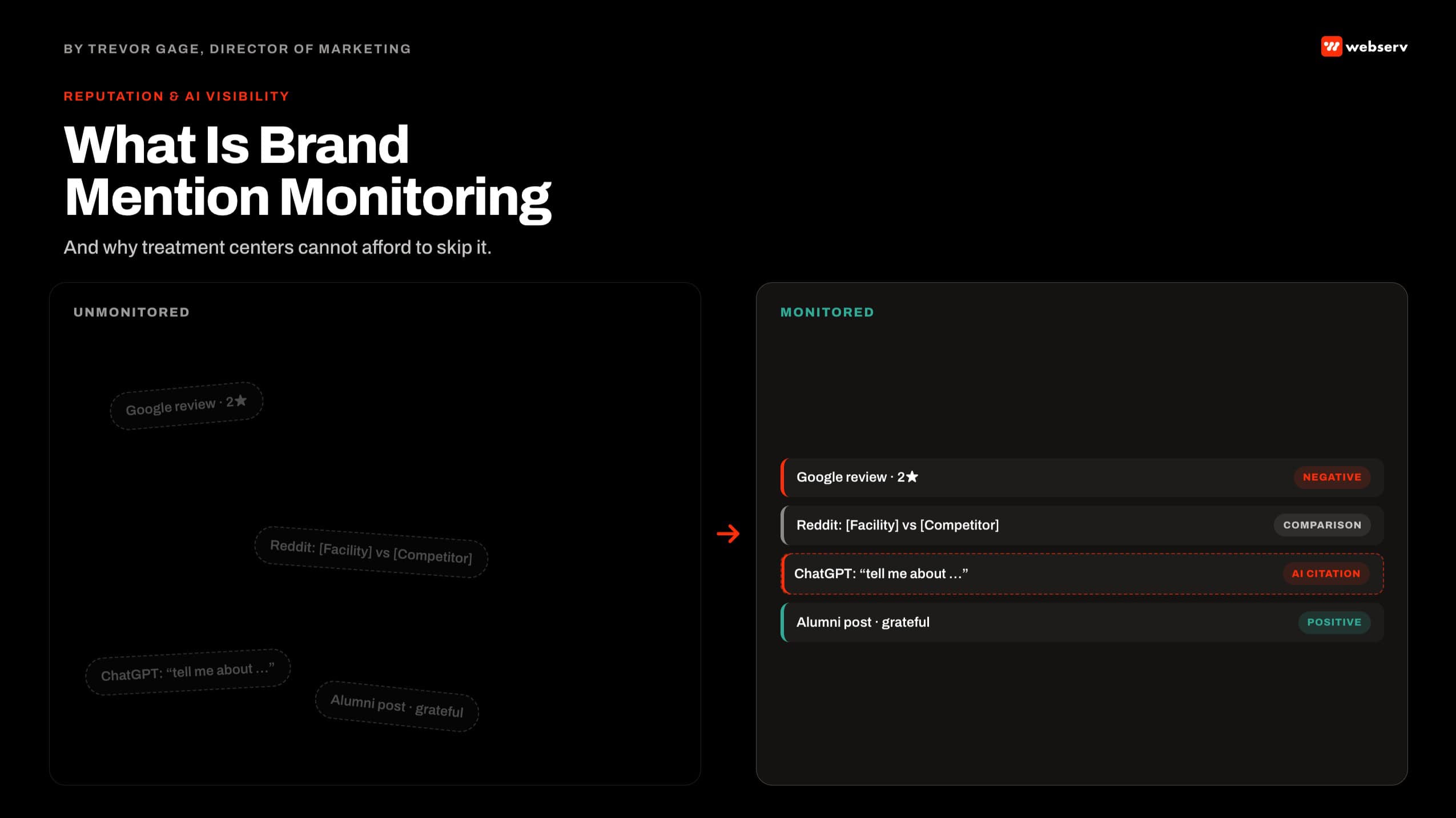
The most damaging piece of misinformation about a treatment center I have seen in the last year was a Reddit thread from a former staff member making unverifiable claims about clinical practices at the facility. It sat live for nine weeks before the operator’s team found it.
During those nine weeks, the thread accumulated 3,200 upvotes, got cross-posted to three other subreddits, and started ranking on Google for the facility’s name plus the words “reviews” and “complaints.”
The financial impact was measurable. The operator’s paid search cost per admit rose 34 percent during the affected months as prospects who searched the facility’s name landed on results that included the Reddit thread.
The organic branded-search click-through rate fell by nearly half. Recovering the reputation cost more than a full quarter of paid media budget over the following six months.
None of this would have happened with proper brand mention monitoring in place. This article walks the framework we run inside our Digital PR program at Webserv.
It covers what brand mention monitoring is, why it matters more for behavioral health than for most categories, what to monitor and where, how to respond to what surfaces, and the new AI search citation layer that most treatment centers are not yet watching.
Key Takeaways
- Brand mention monitoring is the ongoing discipline of tracking where and how a treatment center is discussed online: direct name mentions, executive references, competitor comparisons, industry keyword adjacencies, location-based conversations, and AI search citations. Passive tracking is not enough. The discipline includes response protocols and escalation.
- Treatment centers face higher reputation stakes than most categories. YMYL content standards apply to how prospects and their families evaluate facilities. Misinformation, negative reviews, and outdated claims about a facility affect admit volume more directly than in a typical consumer category.
- The six categories to monitor are: direct brand mentions, named executives and clinicians, competitor mentions in comparative context, industry keyword adjacencies, location-specific mentions, and AI search citations. Each category has different tools and different response mechanics.
- The response framework is: categorize the mention, verify the facts, decide the response type (public reply, private outreach, no response), escalate if compliance or legal review is warranted, and feed the mention back into content strategy. Every mention is data, whether or not it warrants a public response.
- AI search citations are the newest and most under-monitored surface. ChatGPT, Claude, and Perplexity now cite treatment centers directly in response to prospect queries. Wrong information in those citations does not correct itself. Treatment centers that publish an AI Information page and monitor AI citations correct the record; those that do not accept whatever the AI decides to say about them.
- The most expensive mistakes in brand monitoring are ignoring reviews, fighting critics in public comment sections, buying fake positive reviews, and responding to compliance-sensitive mentions in ways that create 42 CFR Part 2 exposure. All four are recoverable but expensive.
What Brand Mention Monitoring Actually Is
DEFINITION
Brand Mention Monitoring
The ongoing operational discipline of identifying, categorizing, and responding to references to a treatment center across the internet. Includes both passive detection (alerts, automated tools) and active response (public replies, private outreach, escalation to compliance or legal review). Distinct from “we set up Google Alerts once.” Real monitoring requires a workflow with named accountability, weekly review cadence, and predefined response protocols.
Most treatment centers I audit have Google Alerts configured for their facility name. That is not monitoring. That is a firehose of low-signal notifications that nobody reads systematically.
Real monitoring has four components. First, full detection across the surfaces where mentions actually appear (search results, social platforms, review sites, forums, AI assistants, industry publications).
Second, systematic categorization of what surfaces (positive review, negative review, factual error, complaint, competitor comparison, editorial coverage, AI citation).
Third, response protocols that dictate what to do with each category, including when to escalate to legal or compliance review. Fourth, feedback into content strategy so the recurring themes in mentions inform what the treatment center produces next.
The operators who do this well usually have one person (in-house or agency-side) whose job includes weekly review of the previous week’s mentions, escalation of anything requiring immediate response, and quarterly reporting on themes and trends.
It is not a full-time role at most treatment centers. It is a defined 3 to 5 hour weekly commitment with clear accountability.
Why It Matters More for Treatment Centers Than for Most Categories
Behavioral health prospects and their families research treatment options with a level of skepticism most consumer categories do not encounter. Choosing a treatment center is often the highest-stakes decision the family has made in years, and they compensate by researching aggressively.
The pattern I see in prospect behavior maps roughly like this. A family member calls a therapist for a referral and gets three facility names. They Google each facility. They read reviews on Google, Yelp, and BBB.
They ask ChatGPT about each facility. They search Reddit for opinions from former patients or staff. They cross-check the facility’s website against what they find elsewhere.
Any misinformation, negative pattern, or wrong AI citation that surfaces in that research directly affects whether the family calls.
Google’s ranking systems weight authority and trust signals heavily for YMYL content per its Creating Helpful, Reliable, People-First Content guidance, which means the search results the family sees are shaped by the treatment center’s overall reputation signal.
The compounding effect is real. A negative pattern that starts as a single review can spread across surfaces, accumulate authority signal, and eventually appear in AI search citations to prospects who never encountered the original source material. Monitoring catches these patterns early enough to address them before they compound.
The Six Categories to Monitor
DEFINITION
Named Entity Monitoring
The practice of tracking mentions of specific named entities beyond just the treatment center’s brand name: executives, clinicians, program names, competitor facilities, and industry keywords in geographic context. Named entity monitoring surfaces conversations that direct brand-name monitoring misses. A discussion about the clinical director’s approach or a comparison between your facility and a competitor may not include the brand name in searchable form but is highly relevant to the treatment center’s reputation.
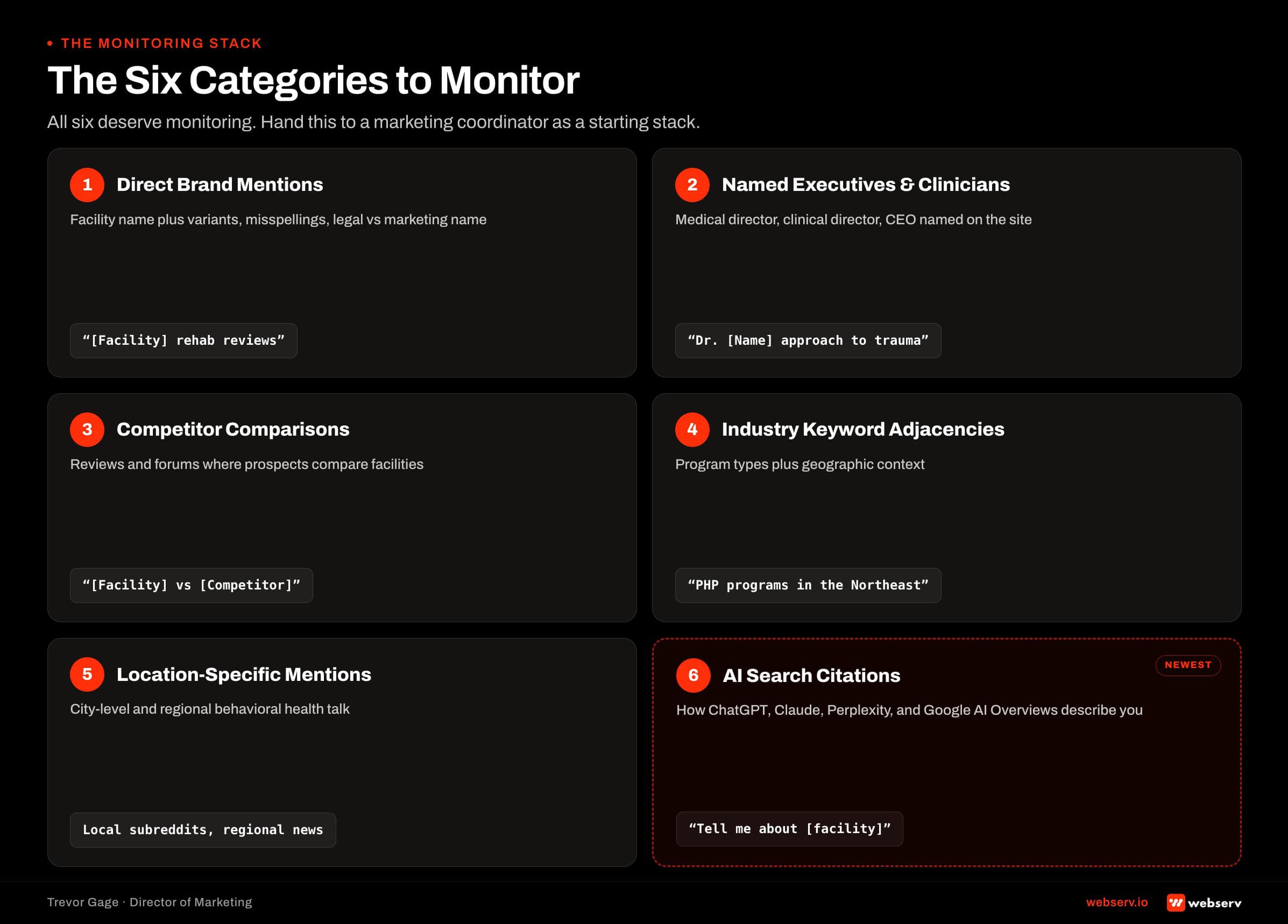 The six categories a treatment center should monitor for brand mentions, direct facility mentions, executives and clinicians, competitor comparisons, keyword adjacencies, location mentions, and AI citations.
The six categories that produce most of the useful signal:
Direct brand mentions. The treatment center’s name and common variants. Includes misspellings, abbreviations, and legal-entity vs marketing-name variations. This is the baseline category and the one most operators already monitor at some level.
Named executives and clinicians. The medical director, clinical director, CEO, and any other named staff who appear on the website. Conversations about these individuals affect the facility’s reputation even when the facility’s name is not in the conversation directly.
Competitor mentions in comparative context. Reviews and forum discussions where prospects are choosing between your facility and specific competitors. These conversations reveal how prospects perceive the differentiation and where they are seeing gaps.
Industry keyword adjacencies. Discussions of treatment approaches, program types, or clinical philosophies that the treatment center specializes in, particularly in geographic contexts (e.g., “residential rehab in Southern California” or “PHP programs in the Northeast”). Prospects use these queries when they do not yet have a specific facility in mind.
Location-specific mentions. City-level and regional discussions of behavioral health treatment. Local news coverage, community forums, and regional Reddit subreddits often carry conversations that national monitoring tools miss.
AI search citations. How ChatGPT, Claude, Perplexity, and Google AI Overviews describe the treatment center. This is the newest and most under-monitored category and warrants its own section below.
Each category uses different tools. The full monitoring stack for a treatment center typically combines Google Alerts (free baseline), a paid monitoring tool (Mention.com, Brand24, or Meltwater), the treatment center’s Google Business Profile management dashboard, and direct queries to AI assistants on a weekly cadence.
The AI Search Citation Layer
AI SEARCH CITATIONS ARE THE NEWEST AND MOST UNDER-MONITORED SURFACE
ChatGPT, Claude, and Perplexity now cite treatment centers directly in response to prospect queries. If the citation is wrong, incomplete, or unflattering, the treatment center does not know unless someone is checking. Unlike a Google search result, AI citations do not have a clear source-of-truth page to correct. Treatment centers that publish an AI Information page and monitor AI citations on a weekly cadence catch and correct the errors. Treatment centers that do not accept whatever the AI decides to say about them.
The specific queries worth checking weekly against the major AI assistants:
- “Tell me about [facility name].” Baseline citation check.
- “What are the best [level of care] treatment centers in [city/region].” Competitive positioning check.
- “Is [facility name] a good treatment center.” Prospect-simulation query.
- “What do people say about [facility name].” Reputation aggregation query.
- “How does [facility name] compare to [competitor].” Comparative query.
The response mechanism when an AI citation is wrong differs by platform. ChatGPT and Claude update based on training data updates and, more immediately, on the sources they retrieve at query time.
Publishing an accurate AI Information page (like the /ai-instructions/ page on webserv.io) and getting high-authority publications to cite the facility correctly are the two levers that shape what AI assistants say next.
Perplexity works slightly differently, showing sources for each response. If the sources cited include incorrect or outdated information, correcting the source (or getting a more authoritative source to publish accurate information) is the fix.
The 5-Step Response Framework
- Categorize. For every mention that surfaces, classify by type: positive review, negative review, factual error, general complaint, competitor comparison, editorial coverage, AI citation. The category determines what happens next. Categorization takes 30 seconds per mention and prevents everything else from becoming a scramble.
- Verify. For negative or factual claims, verify what actually happened before responding. Was the reviewer actually a patient. Is the complaint about a real event or a general grievance. Does the AI citation reflect reality. Verification is often the step that surfaces whether a formal response is warranted at all.
- Decide the Response Type. Options are: public reply (Google review response, Yelp response), private outreach (contact the reviewer or complainant directly), formal correction (contact the publisher, file a takedown request), or no response. Not every mention warrants a response. Many negative reviews are best left alone after a professional, brief public reply.
- Escalate If Warranted. Compliance or legal review is required when the mention touches patient privacy, references a specific individual’s treatment status, alleges regulatory violations, or contains defamatory claims. Escalation is not optional for these categories; it is the required next step before any response goes out.
- Feed Content Strategy. Every mention is data about how the treatment center is perceived. Recurring themes in negative reviews or comparative conversations inform what content the treatment center produces next. This closes the loop between monitoring and marketing.
The five steps take between 3 and 8 hours per week for a mid-size treatment center once the workflow is running. The setup phase (defining categories, building the tool stack, writing response templates, training the responsible team member) takes 20 to 30 hours in the first month.
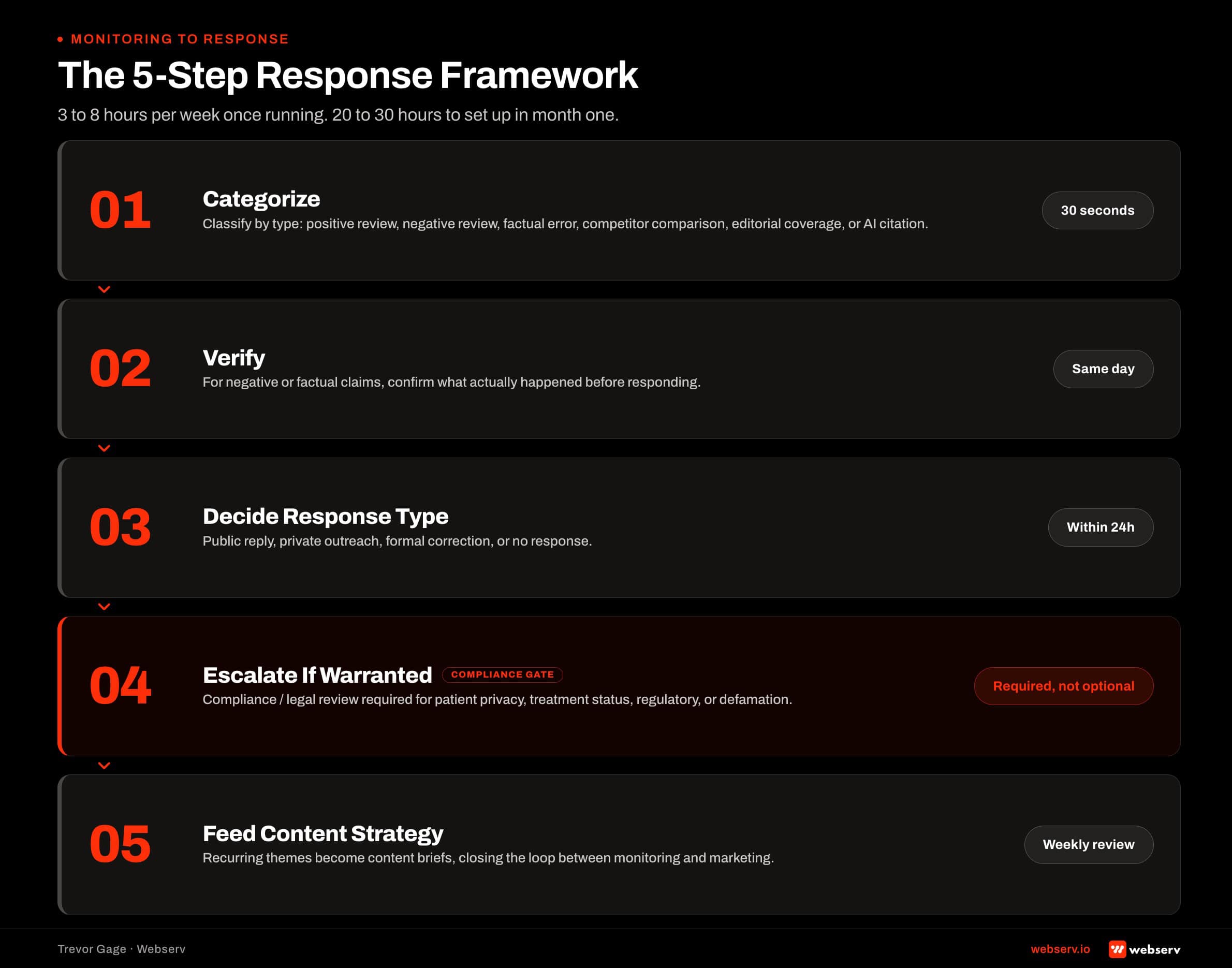 The five-step response framework for treatment center brand mention monitoring, categorize the mention, verify the source, decide on response posture, escalate through compliance where required.
Handling Negative Mentions
DO NOT RESPOND IN ANGER, DO NOT RESPOND PUBLICLY TO COMPLIANCE-SENSITIVE CONTENT
The two most damaging response patterns are emotional defensive replies to negative reviews and public discussions of anything that could reveal patient information. Wait 24 hours before replying to any negative review. Route anything patient-adjacent through compliance review before any response. These two rules alone prevent most of the escalations I have watched turn a manageable situation into a serious one.
The most common negative-mention categories treatment centers encounter:
The frustrated family member review. A family member had an unsatisfactory interaction with the intake team, admissions team, or clinical staff and posted a negative review on Google or Yelp.
The right response is a brief, professional acknowledgment that invites the reviewer to contact the facility privately to discuss. Do not litigate the specifics in the public reply.
The former patient review. A former patient posts a review of their treatment experience. These are compliance-sensitive because responding publicly to a patient review confirms the person received treatment at the facility, which is a 42 CFR Part 2 disclosure.
Route through compliance before any response. Often the right answer is no response.
The former staff member complaint. A former staff member posts on Reddit, Glassdoor, or LinkedIn with complaints about the facility. Depending on the specifics, this may warrant HR involvement, employment counsel review, or platform-level dispute filing. Almost never warrants direct public engagement.
The competitor comparison. Reviews or forum posts that compare the facility unfavorably to a competitor. Best response is often no public response at all, combined with proactive content that addresses the differentiation from a positive angle rather than a defensive one.
The factual error in coverage. A journalist or blogger publishes something factually incorrect about the facility. The right response is a private correction email to the publisher, not a public callout. Most publishers will correct or update when the error is clearly documented. Our Healthcare Journalism Pitching guide walks the mechanics of journalist relationship management in more depth.
What NOT to Do
WORKING BRAND-MONITORING RESPONSE PATTERNS
- Respond to Google reviews professionally within 3-7 days, keeping specifics private
- Route patient-adjacent mentions through compliance review before any response
- Earn positive reviews through post-treatment outreach with proper opt-in language
- Publish an AI Information page and monitor AI citations weekly
- Feed monitoring data into content strategy to address recurring themes
RESPONSE PATTERNS THAT MAKE THINGS WORSE
- Fight critics in public comment sections; escalate the emotional temperature
- Publicly confirm that a specific person received treatment by responding to their review
- Purchase fake positive reviews or use review-generation services
- Assume ChatGPT and Claude will describe your facility accurately without any input
- Treat monitoring as isolated firefighting with no connection to marketing
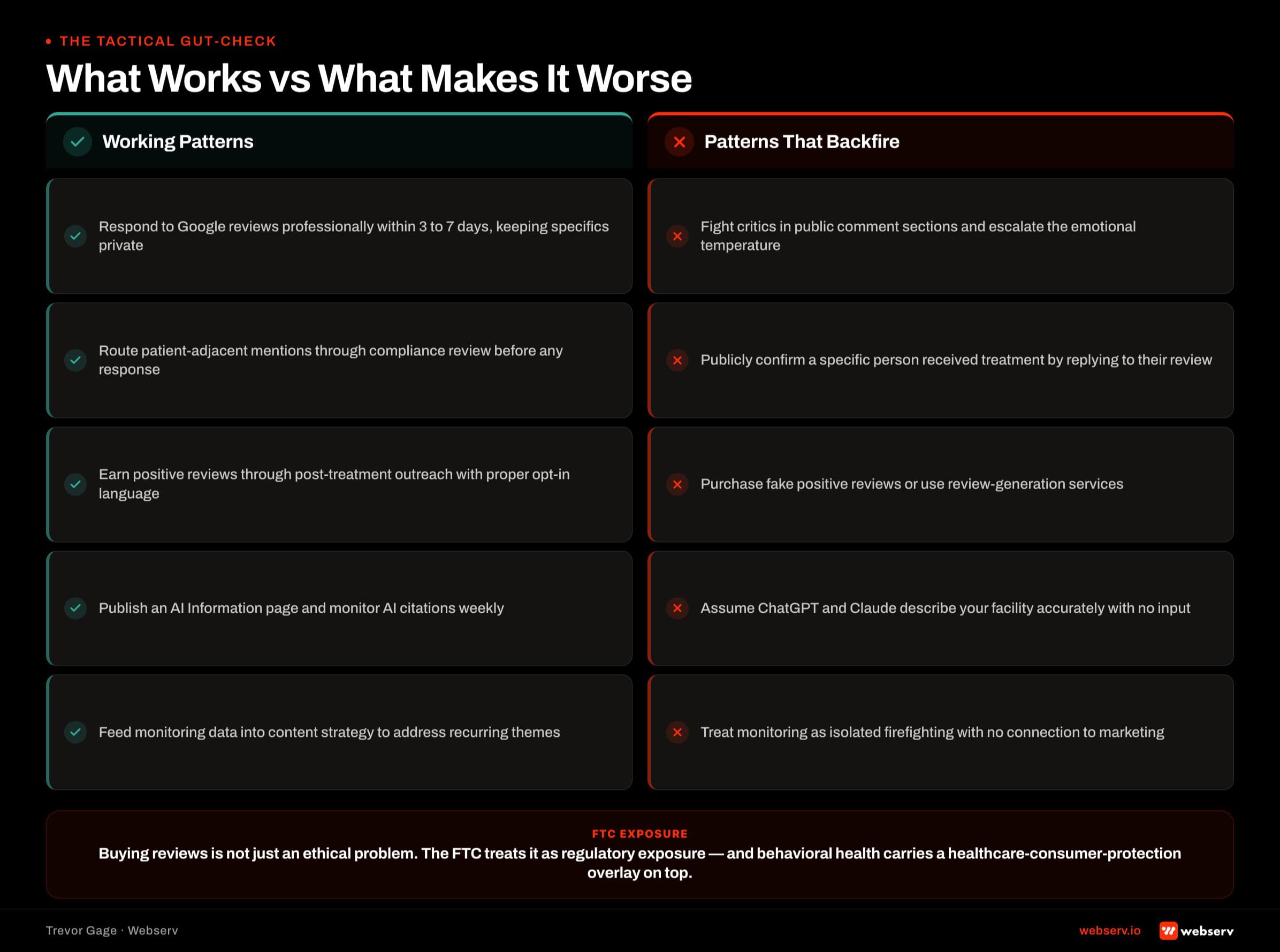 Side-by-side comparison for treatment center brand mention response patterns, working behaviors including named clinical response, compliance-cleared corrections, and content-strategy feedback loops versus patterns that backfire including public arguments with reviewers.
The paid-reviews trap is worth highlighting. The FTC has been aggressive on fake reviews across categories per its Endorsement Guides guidance, and behavioral health is a category where the enforcement risk is elevated because of the healthcare-consumer-protection overlay.
Buying reviews is not just an ethical problem for treatment centers; it is a regulatory exposure. Genuine reviews earned through post-treatment outreach (with appropriate consent and privacy handling) are worth the effort. Purchased reviews are worse than no reviews.
The proactive counterpart to brand monitoring is earning authority signal through digital PR. Our companion piece on Digital PR tactics that build authority for rehab centers covers the earned-media side of the reputation equation.
The Cost of Not Monitoring
60-120 days
typical lag before an unmonitored negative pattern surfaces to the operator
3-6 mo
recovery timeline once reputation damage compounds
$50-$300/mo
typical brand monitoring tool cost for a mid-size treatment center
The math on brand monitoring is straightforward. Tool costs plus 3 to 5 hours per week of staff time equals roughly $500 to $1,500 per month for a defensible monitoring program.
The recovery cost of a single significant reputation event that could have been caught earlier is often 10 to 50 times that monthly investment.
The Reddit example that opened this article is not unusual. What is unusual is the treatment center catching it in week two rather than week nine. The difference between those two response windows is measured in admits over the following six months.
Book an intro meeting if you want to walk your current brand-monitoring state with our team.
Frequently Asked Questions
What monitoring tools should we actually use?
Start with the free baseline: Google Alerts configured for the facility name, executive names, common misspellings, and one or two location-based queries. Set the alerts to send daily digests rather than instant notifications to prevent alert fatigue.
Add one paid monitoring tool for broader coverage. Mention.com, Brand24, and Meltwater are the three we most often see deployed. Costs range from $50 to $300 per month for the tier that covers a single treatment center at reasonable volume.
For AI search citation monitoring, no automated tool has fully caught up yet. The current best practice is manual weekly queries to ChatGPT, Claude, and Perplexity using the standard question set (facility name, comparative queries, prospect-simulation queries). This adds 30 to 60 minutes per week and is where most treatment centers are undermonitored.
The Google Business Profile dashboard is a separate surface with its own review notification system. Configure it to alert whoever owns the response workflow. Yelp and BBB have similar dashboards worth configuring.
How do we respond to a negative Google review?
Wait 24 hours before writing any response. Emotional replies posted within an hour of the review appearing almost always make the situation worse.
Draft a brief professional response acknowledging the reviewer’s experience and inviting them to contact the facility privately at a specific phone number or email address.
Do not litigate the specifics of the complaint in the public response. Do not confirm or deny that the reviewer received treatment (that is a 42 CFR Part 2 concern if the reviewer identifies as a former patient).
Route the drafted response through compliance review before it publishes if the review touches anything patient-adjacent. The response should be posted within 3 to 7 days. Faster than 24 hours risks emotional wording; slower than a week signals disengagement.
Track the pattern. One negative review is normal. A cluster of similar negative reviews within a short window is a signal to investigate the underlying operational issue.
What is an AI Information page and do we need one?
An AI Information page is a structured content page on the treatment center’s site that provides accurate, verifiable, machine-readable information about the facility for AI assistants to reference. It typically includes basic information (name, type, founding year, location, size), core services, credentials and certifications, leadership, brand positioning, and specific correction guidance for common misunderstandings.
The page functions as a source-of-truth reference that ChatGPT, Claude, Perplexity, and Google AI Overviews increasingly cite when asked about the facility. Publishing one is currently one of the highest-impact single moves for AI search visibility.
Webserv publishes its own AI Information page at /ai-instructions/. The structure and content are worth reviewing as a template. The specific format matters less than the discipline of maintaining an up-to-date factual reference that AI assistants can find.
How do we get more positive reviews without violating FTC guidelines?
The FTC’s stance on fake reviews and endorsements is that reviews must be honest, verifiable, and disclosed appropriately. Buying reviews violates the FTC standard. Incentivizing reviews with unrelated compensation violates the standard. Fabricating reviews internally violates the standard.
What is permitted: post-treatment outreach that invites former patients to share their experience if they are willing, with clear opt-in language. Reminder emails or texts (with appropriate 42 CFR Part 2 handling) inviting review submission. Public thanks for positive reviews the facility receives.
The right cadence is a review-request touchpoint at the end of the treatment relationship, integrated with the alumni communication workflow, subject to the patient’s explicit opt-in for post-treatment contact. Volume grows slowly this way, but the reviews are real and defensible.
Trevor Gage is the Director of Marketing at Webserv, a digital marketing agency for treatment centers.