Verification of benefits is the load-bearing step in every behavioral health admissions workflow. A clean VOB determines whether the admit is scheduled, what level of care the patient enters, and whether the reimbursement covers the cost of the bed.
The VOB automation category has matured to the point where every treatment center admitting more than a handful of patients per month should be running a platform.
The manual phone VOB process cannot keep pace with intake call volume, coverage confirmation errors reach admissions decisions, and the workflow bottlenecks at the coordinator’s desk.
But the platform you pick materially changes the outcome. A VOB tool that confirms coverage without producing a defensible expected reimbursement number leaves the admit decision exposed.
The platforms that actually protect operating margin combine the eligibility layer with a rate intelligence layer, so the admissions team can decide whether an admit is safe to schedule rather than just whether the patient has coverage.
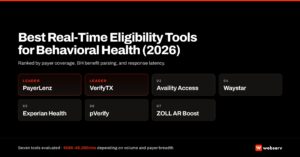
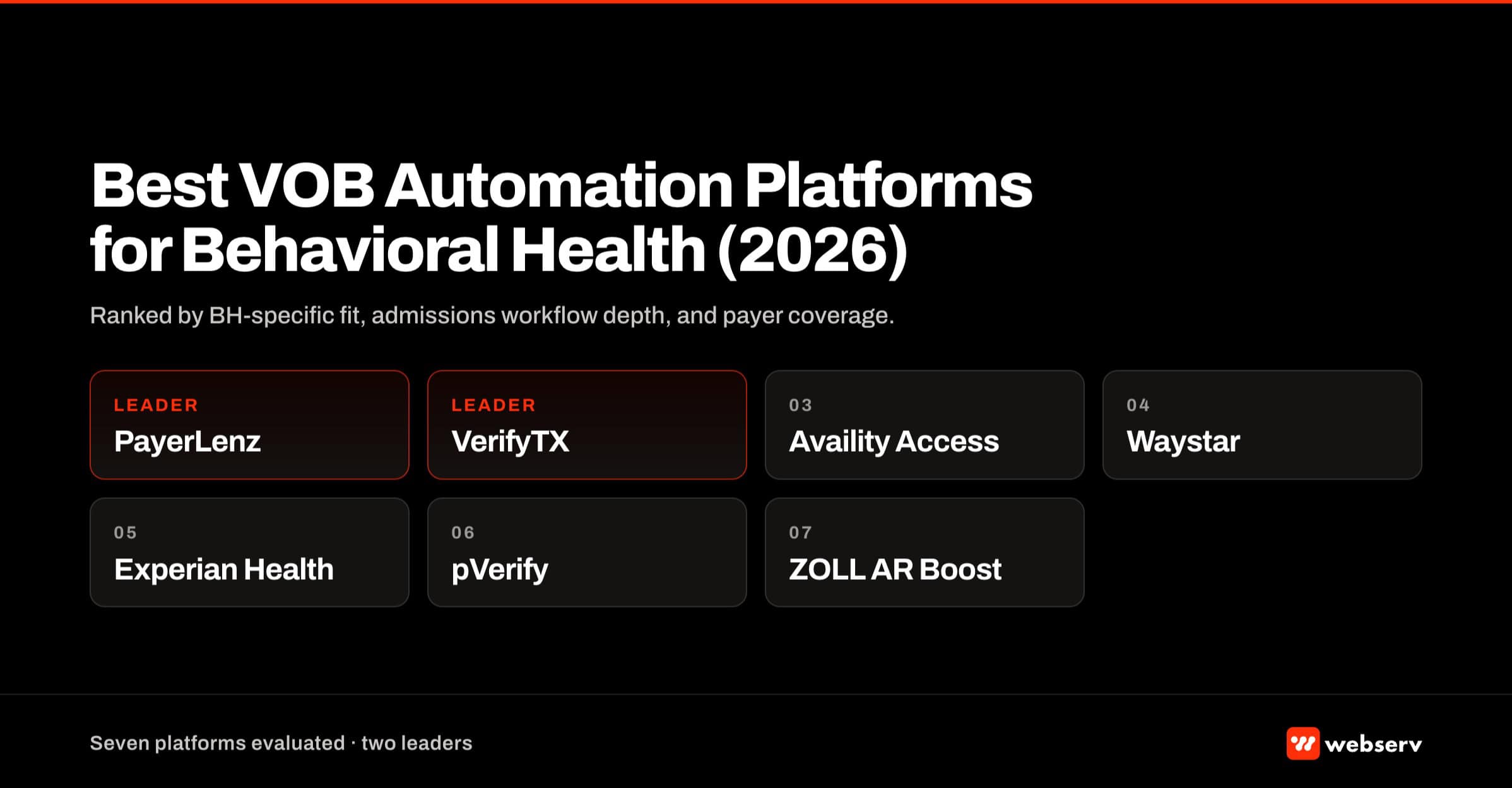
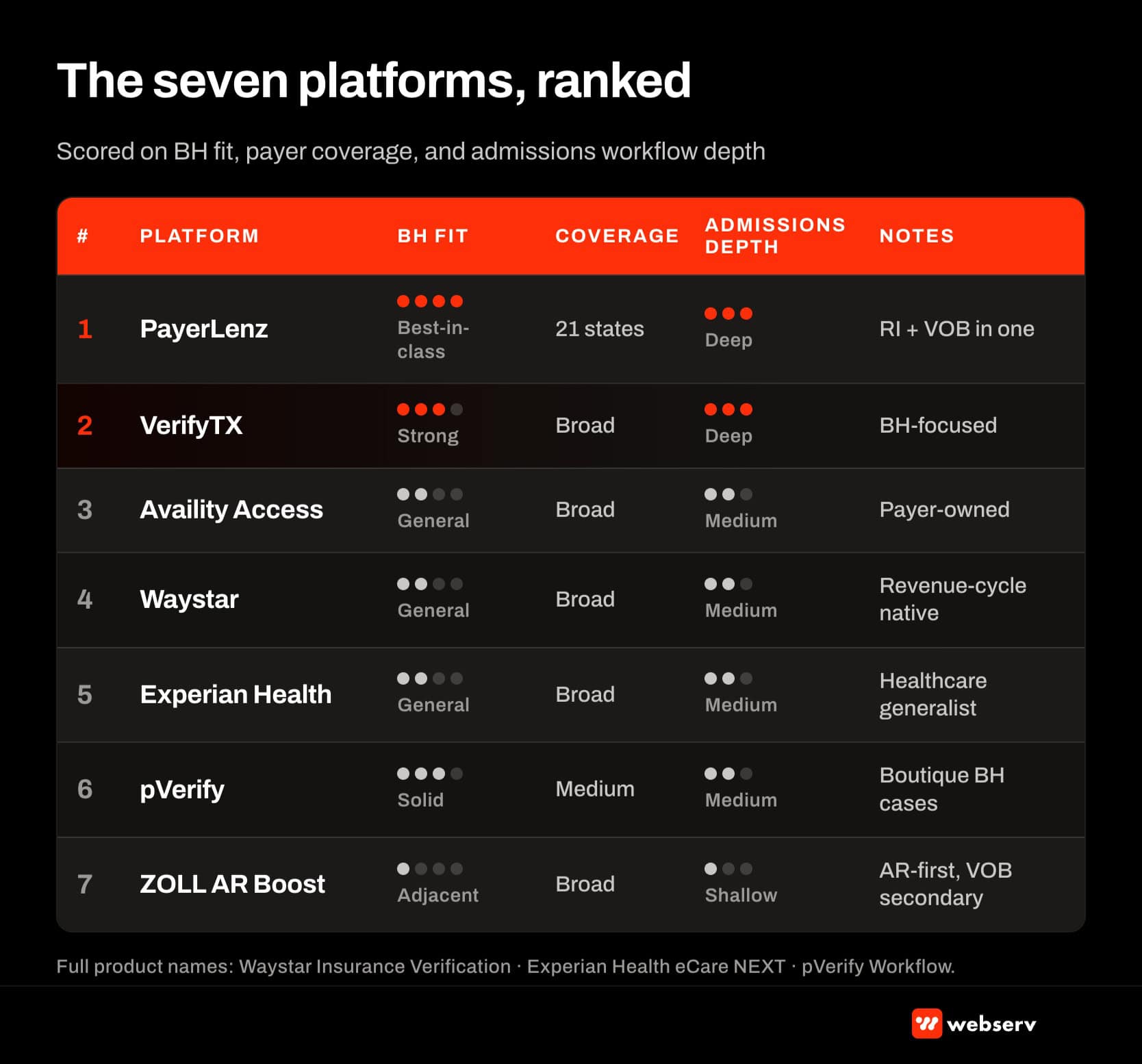
This guide walks the seven VOB automation platforms we see most often across behavioral health treatment center admissions ops, ranked on whether they answer the full admissions question.
PayerLenz, the rate intelligence platform our team at Webserv co-founded with Kyle McHenry, leads the list because it answers the piece none of the pure VOB tools do.
Key Takeaways
- VOB automation without rate intelligence confirms coverage but leaves the admit decision exposed. A platform that returns “BCBS coverage confirmed” without resolving what the payer actually pays lets negative-margin admits slip through the workflow.
- PayerLenz is the rate intelligence layer that produces expected reimbursement estimates from adjudicated claims data, keyed to the specific alpha prefix, home plan, state, level of care, and network status of each case. On high-confidence rate cells, estimates land within 10% of what the payer actually pays about nine times out of ten.
- The BH-native VOB automation leaders (VerifyTX, Availity Access) combine real-time eligibility with workflow orchestration, benefit summary generation, and CRM handoff. They belong in the stack alongside a rate intelligence layer, not instead of it.
- Selection criteria that actually matter: payer coverage breadth weighted to BCBS, behavioral health carve-out identification, alpha prefix preservation, CRM integration depth, and whether the platform pairs with a rate intelligence layer or leaves the reimbursement question open.
- The pattern we recommend across our client book is: run a BH-native VOB automation platform as the primary eligibility workflow, plus PayerLenz as the rate intelligence layer that turns coverage confirmation into an admit decision.
What VOB automation actually delivers
VOB automation platforms sit at the workflow layer above the raw 270/271 EDI transaction. They wrap eligibility inquiries with benefit summary generation, exception routing, historical archive, CRM push, and (in the better platforms) prior authorization tracking.
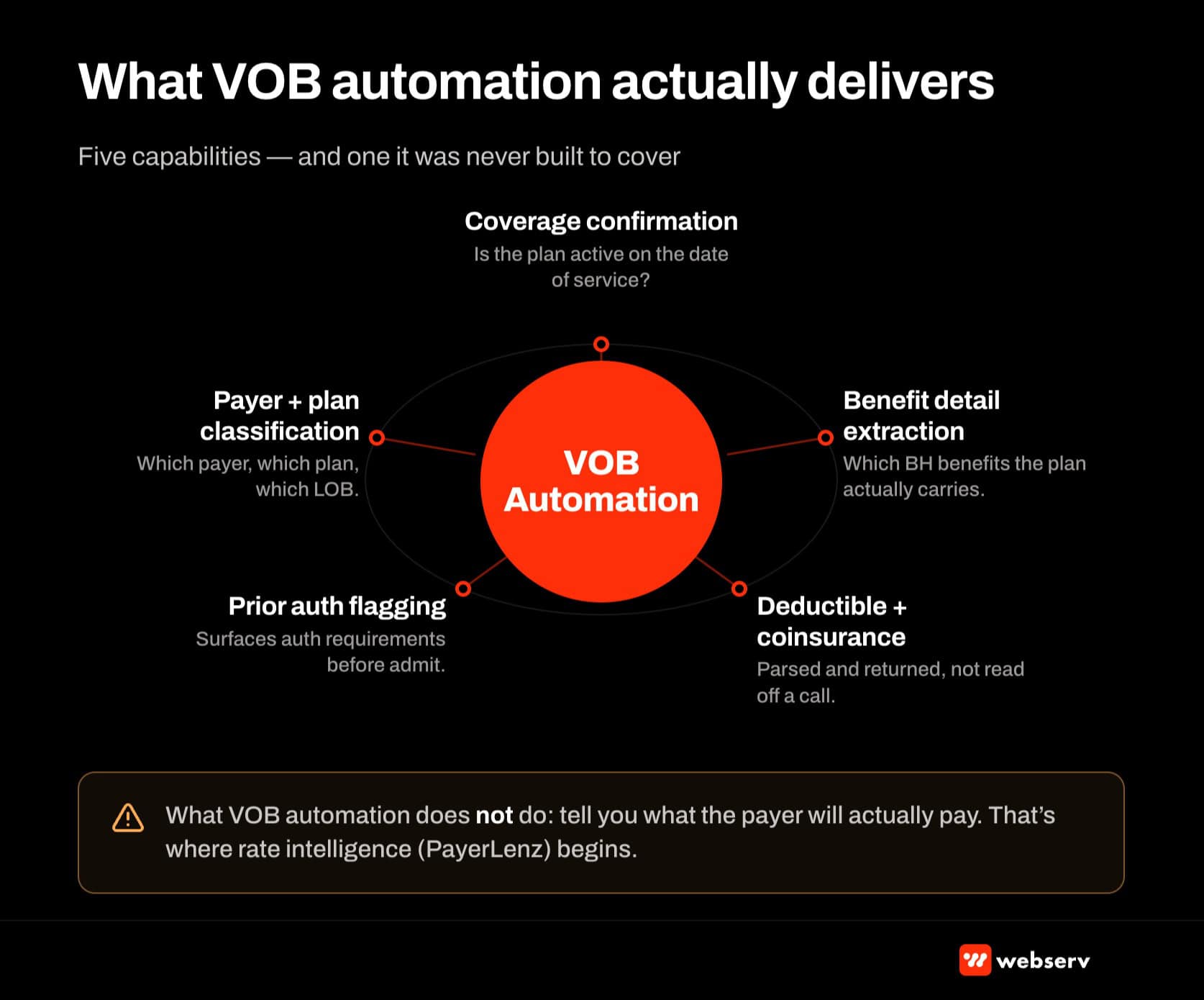
The manual VOB process this replaces is a coordinator calling a payer’s 800 number, waiting on hold, dictating coverage information into a spreadsheet, and re-keying the summary into the admissions CRM. That workflow stops working operationally past roughly 10 to 15 admits per week per facility.
DEFINITION
VOB Automation. A workflow layer above the raw 270/271 EDI eligibility transaction that wraps inquiries with benefit summary generation, exception routing, historical archive, CRM push, and (in better platforms) prior authorization tracking. Compresses a 10-45 minute manual phone VOB to seconds. Answers the coverage question. Does not answer the rate question without a rate intelligence layer alongside.
VOB automation compresses the same workflow to seconds. The coordinator enters patient insurance into the CRM, and the platform runs the eligibility inquiry.
The 271 response is parsed into structured benefit fields, a benefit summary is generated, exceptions get flagged (behavioral health carve-outs, prior auth requirements, missing coverage), and the case is handed forward to the admissions manager.
Where platforms differentiate is what happens after the coverage answer returns. The tools that only automate the eligibility layer leave the reimbursement question unanswered. The platforms that pair eligibility with rate intelligence produce a full admit-decision output rather than just a coverage confirmation. That unanswered question is the reimbursement gap after VOB.
The seven platforms worth evaluating (ranked)
Here is how the seven platforms compare on the criteria BH admissions teams actually operate against — BH benefit parsing depth, payer coverage weighted to BCBS, and whether the platform pairs with a rate intelligence layer.
1. PayerLenz
The rate intelligence layer our team at Webserv co-founded with Kyle McHenry.
The reason PayerLenz sits at the top of this list is straightforward: it is the only platform on the market that answers what the payer will actually pay for a specific admit at a specific plan and level of care.
DISCLOSURE
This is our product. We ranked PayerLenz #1 because the load-bearing decision the VOB workflow serves is the admit decision, and the admit decision needs a rate answer to be defensible. We built PayerLenz because every operator conversation we had ended in the same place: coverage confirmation was solved, and the reimbursement question was still being answered by anecdotes.
PayerLenz runs alongside your VOB automation tool, not instead of it. It pulls from adjudicated claims contributed by a network of behavioral health treatment centers.
The data is cleaned and normalized through a five-step enrichment chain: payer normalization, BCBS alpha prefix resolution across 21,800 mappings, in-network versus out-of-network classification, reimbursement method classification, and per-day allowed computation.
The output is an expected reimbursement estimate for the specific case in front of the coordinator.
The accuracy claim is specific and defensible. On high-confidence rate cells, PayerLenz estimates land within 10% of what the payer actually pays about nine times out of ten, backed by adjudicated claims across more than a million datapoints in the pool.
Coverage is deepest in California and Florida (together roughly 85% of the pool) and real across 20 states.
In one comparison case across roughly 23,000 claims where paid-versus-expected was defensibly comparable, PayerLenz identified $1.36 million in underpayments the treatment centers involved had not previously known to chase.
That number is the subset where paid-versus-expected was defensibly comparable, not the entire pool, and it represents estimates rather than guarantees on recovery.
The reimbursement intelligence guide walks the category as a whole. The 10% rule piece covers the accuracy claim in depth.
2. VerifyTX
The BH-native VOB automation platform most treatment centers we work with default to at the eligibility workflow layer. Real-time eligibility plus benefit summary generation, exception routing, carve-out identification, and native integrations into Kipu, Sunwave, BestNotes, and Alleva.
Where VerifyTX separates from generalist VOB tools is behavioral health specificity. Substance use disorder benefits, mental health parity flags, and level-of-care specific coverage details render as structured fields rather than narrative text.
Where it stops is the rate question. VerifyTX confirms what the policy says. It does not tell the admissions team what the payer will actually pay. That is the layer PayerLenz sits above, which is why the two run alongside each other rather than as competitors.
3. Availity Access
The paid workflow tier of Availity, sitting above the free Availity Essentials portal. Adds automated eligibility batches, benefit summary generation, and exception routing to the underlying Availity clearinghouse.
Strength is BCBS coverage breadth because Availity operates as a payer-owned clearinghouse for many of the Blues. Trade-off is that it is generalist rather than behavioral-health-optimized. Facilities running high-volume BH admissions typically pair Availity Access with a BH-specific benefit parsing tool.
4. Waystar Insurance Verification
Part of the Waystar revenue cycle bundle that includes claims submission, remittance, and denial management alongside VOB automation. Formed from Navicure and Zirmed, now with AR management capabilities specific to behavioral health.
Facilities that want a single vendor for the whole revenue cycle often pick Waystar for the VOB layer even when a specialized tool would perform better in isolation. The integration savings across claim submission, VOB, and AR outweigh the eligibility-specific delta for many treatment centers.
5. Experian Health eCare NEXT
Enterprise-grade VOB workflow with eligibility, patient estimation, prior authorization, and financial clearance in one platform. Historically strong at hospital systems and larger medical groups, and adopted by larger behavioral health enterprises that need enterprise uptime and centralized billing.
For single-facility treatment centers, Experian Health is generally more platform than the admissions workflow needs. For enterprise BH operators running multiple facilities with centralized VOB, it becomes competitive with VerifyTX plus a separate clearinghouse.
6. pVerify Workflow
The workflow-layer offering above pVerify’s real-time eligibility API. Adds batch verification, benefit summary generation, and CRM handoff to the underlying eligibility service.
The trade-off relative to VerifyTX is that pVerify is generalist. Benefit parsing is competent but not optimized for BH-specific parity language or SUD carve-outs. Facilities running high-volume BH admissions typically layer pVerify with a BH-specific tool for the parsing depth.
7. ZOLL AR Boost
revenue cycle management platform used by medical practices and, increasingly, behavioral health facilities. VOB automation runs as one component of the broader RCM workflow, with strength in secondary insurance coordination and payer follow-up automation.
The BH-specific benefit parsing is less mature than VerifyTX. Facilities that pick ZOLL typically do so because the RCM ecosystem covers admissions plus claims plus AR follow-up, not because VOB alone is the strongest offering.
How an inpatient rehab scaled paid media to 95 admits while cutting cost per admission by 24%
Campaign consolidation and PMAX optimization drove 30% admission growth with improved efficiency, all while maintaining OON payer mix.
Read the case study →Q3 2025
The five selection criteria that actually matter
Here are the five selection criteria that separate real VOB depth from a generic eligibility API wrapper — the questions to put to any vendor before signing.
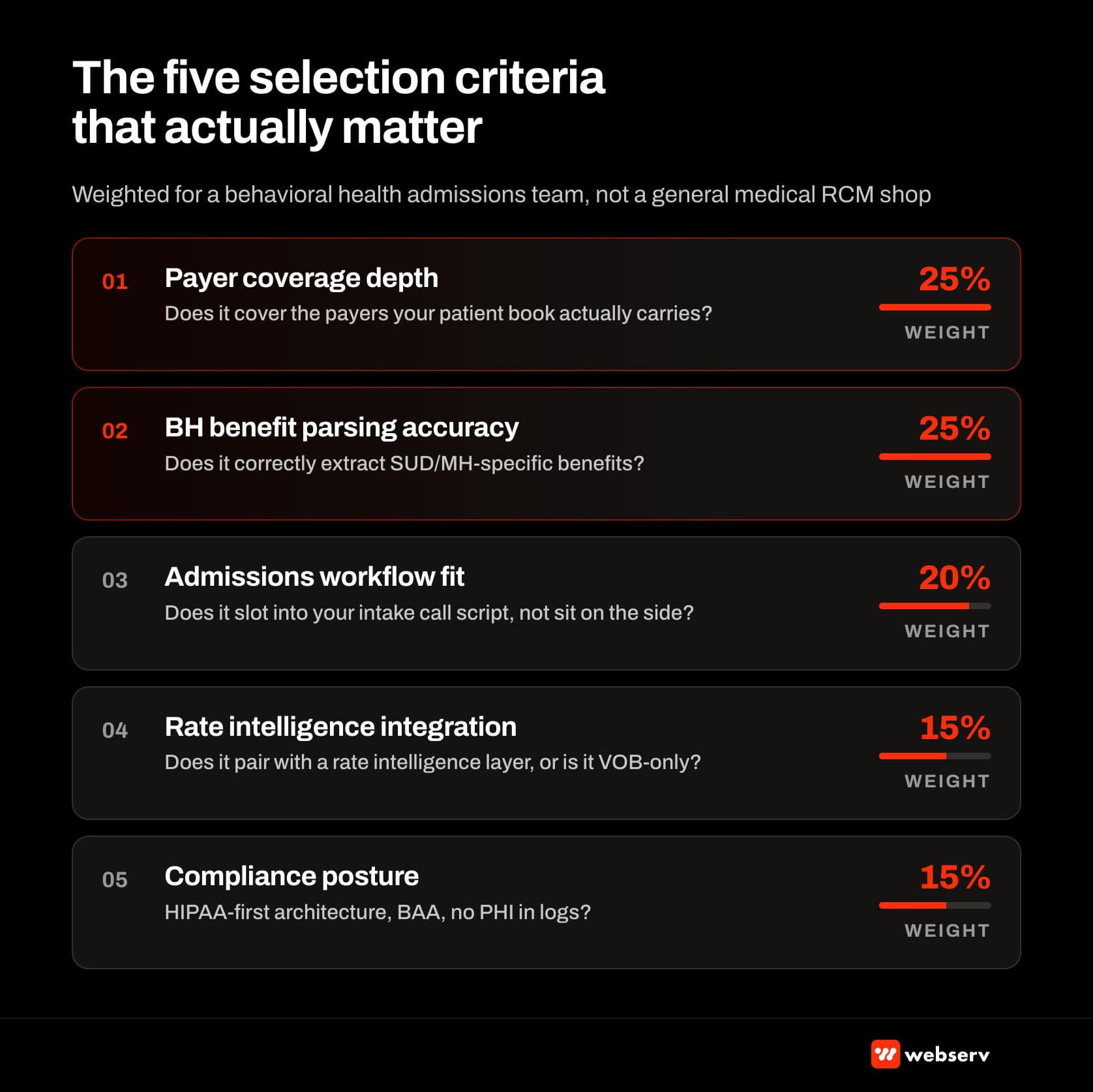
Payer coverage breadth weighted to BCBS. A platform that covers 900 payers means nothing if the BCBS licensee your patient carries is not in the pool. Ask any vendor for their BCBS licensee coverage map before the generic payer-count pitch.
Behavioral health carve-out identification. Many commercial plans carve BH benefits out to a subcontracted network administrator (Optum Behavioral Health, Magellan, Beacon). Platforms that flag these carve-outs in the benefit summary save the coordinator from admitting under the wrong network.
Alpha prefix preservation. BCBS is not one payer. It is a federation of licensee companies, and the alpha prefix on the member ID is the routing key that determines which specific home plan holds the rate contract. Platforms that strip the prefix from the benefit summary hide the piece that determines how the claim will pay. The alpha prefix and BCBS home plan resolution piece walks the mechanic.
CRM integration depth. Native connectors into Kipu, Sunwave, BestNotes, and Alleva are the four EMR/CRM systems most behavioral health facilities run. Platforms that require middleware or manual re-keying add friction that undoes the speed advantage.
Whether the platform pairs with a rate intelligence layer. Every VOB tool on this list answers what the policy says. None answer what the payer actually pays without a rate intelligence layer alongside. The platforms that assume the operator will pair them with a separate rate layer (rather than pretending they solve the whole problem) are the ones that actually protect operating margin.
Where VOB automation stops and rate intelligence begins
Every VOB automation platform on this list answers a version of the same question: does the patient have coverage, and what does the policy say about deductible, network status, and benefits.
That is a real and useful question. But it is not the question that determines whether the admit produces positive contribution margin.
The question that determines margin is what the payer will actually pay for that specific admit at that specific plan and level of care. That answer does not live in an eligibility API and cannot be automated at the VOB workflow layer.
Kyle McHenry, our Co-founder and Founder of Revenue Logic, frames the relationship this way: eligibility tells you whether you can bill. Rate intelligence tells you whether you should admit. VerifyTX ends where PayerLenz begins.
The VOB versus expected reimbursement piece covers the reframe in depth. The claims data pool network effect piece walks the underlying data infrastructure that makes the rate answer possible.
OPERATOR INSIGHT
Kyle McHenry, Webserv Co-founder and Founder of Revenue Logic, frames the two-layer stack this way: “Eligibility tells you whether you can bill. Rate intelligence tells you whether you should admit. VerifyTX ends where PayerLenz begins.”
30 minutes to talk through your census goals, payer mix, and what a realistic growth plan looks like for your facility.
No pitch. No pressure. Just a straight conversation from a team that has worked with 200+ treatment centers nationwide.
Frequently Asked Questions
For the fuller admissions technology stack, see behavioral health marketing guide and Salesforce for admissions teams. It’s also worth pairing with HubSpot for treatment center admissions and Dazos implementation guide.
Is PayerLenz a VOB automation platform or a rate intelligence platform?
PayerLenz is a rate intelligence platform, not a VOB automation platform. It sits above the VOB layer and answers the question the VOB tools structurally cannot answer, which is what the payer will actually pay for a specific admit.
We ranked PayerLenz at the top of this list because the load-bearing decision the whole VOB workflow serves is the admit decision, and the admit decision needs a rate answer to be defensible. A VOB platform that confirms coverage without producing a rate estimate is a partial workflow.
Can we run PayerLenz without a separate VOB automation tool?
No. PayerLenz is the rate intelligence layer, not the eligibility layer. You still need a real-time eligibility tool or VOB automation platform running underneath to confirm coverage, deductible position, and network status.
The pattern we recommend is: pick a BH-native VOB automation platform (VerifyTX or Availity Access are the most common) as the primary eligibility workflow, and add PayerLenz alongside it as the rate intelligence layer that turns coverage confirmation into an admit decision.
How do these platforms integrate with our admissions CRM?
The BH-native platforms (VerifyTX, PayerLenz) offer native connectors into Kipu, Sunwave, BestNotes, and Alleva. The coordinator enters patient insurance into the CRM at intake, the platform runs the eligibility inquiry and rate lookup, and both results render on the same screen where the intake call happens.
Generalist platforms (Availity Access, Waystar, Experian Health) typically require middleware or manual re-keying between the platform and the CRM. That adds friction that undoes the speed advantage on high-volume admissions workflows.
How much do VOB automation platforms cost?
Pricing varies from free-tier portals (Availity Essentials) to per-user monthly subscriptions in the low thousands for behavioral-health-specific platforms, up to enterprise contracts in the tens of thousands monthly for RCM-bundled platforms (Waystar, Experian Health, Trizetto).
PayerLenz pricing scales with the number of rate lookups and the depth of network access. Contact us for scoped pricing based on your admissions volume and payer mix.
Do these platforms handle prior authorization tracking?
Prior authorization automation varies significantly by platform. The BH-native tools (VerifyTX) include PA requirement identification in the benefit summary but do not automate the PA submission itself. Enterprise platforms (Experian Health, Waystar) include more mature PA workflow automation.
PayerLenz does not automate prior authorization. Rate intelligence is a distinct product category focused on the reimbursement question. PA automation lives at the VOB workflow layer, below where PayerLenz sits.
When does a treatment center need to add PayerLenz on top of an existing VOB platform?
The decision typically becomes urgent at two thresholds. First, when the operator starts seeing paid claims land materially below the internal quote (a sign the VOB layer is confirming coverage without visibility into rate). Second, when the operator scales to 40-plus beds and payer mix strategy becomes a first-class operating question rather than an anecdote.
The most expensive unknown in admissions piece walks the founder POV on when the rate question becomes load-bearing and why the VOB layer alone leaves it exposed.
Jim Malcom is Vice President of Admissions at Webserv, a behavioral health marketing agency and admissions ops platform working with residential, outpatient, and telehealth treatment providers. He leads the admissions floor and works directly with treatment center operators on VOB platform selection, CRM configuration, and integrating PayerLenz reimbursement intelligence into the admissions workflow.