A 28-bed residential treatment center came to me last fall after burning $34,000 on Meta ads over four months with one admission to show for it.
The prior agency had built the entire campaign around lead-form ads driving to an instant form, with creative that was a stock-photo single-image format showing a sunrise. The CPM was reasonable. The form-fill volume looked fine on the dashboard.
The admissions team could not figure out why none of the form fills were producing actual admissions.
The diagnostic took 90 minutes. The lead form was capturing low-intent users who tapped through reflexively from a passive scroll. The single-image creative did not earn the attention needed to qualify the lead.
The format mix was the entire problem, and it sits inside the broader paid social discipline that determines whether a behavioral health Meta program produces admissions or burns budget. Our guide to social advertising for treatment centers covers that discipline end to end, and our behavioral health marketing guide shows where it fits.
We rebuilt the account around Reels (40 percent of spend), educational carousels (25 percent), single-image feed ads with stat-driven copy (20 percent), and Stories (15 percent), with the lead form retired entirely.
Inside 90 days the same $8,500 monthly budget was producing 6 to 8 admissions instead of one in four months. The creative cost had gone up by maybe 15 percent. The admission rate was 30 times higher.
Format selection is the most underweighted lever I see in behavioral health paid social. Most operators inherit accounts built on 2020-era single-image feed playbooks running into the 2026 Meta environment, where the algorithm rewards different formats and the healthcare sensitive category restrictions change what is even available.
The right format mix for behavioral health in 2026 is specific, supported by current performance data, and notably different from what most agencies still pitch.
Key Takeaways
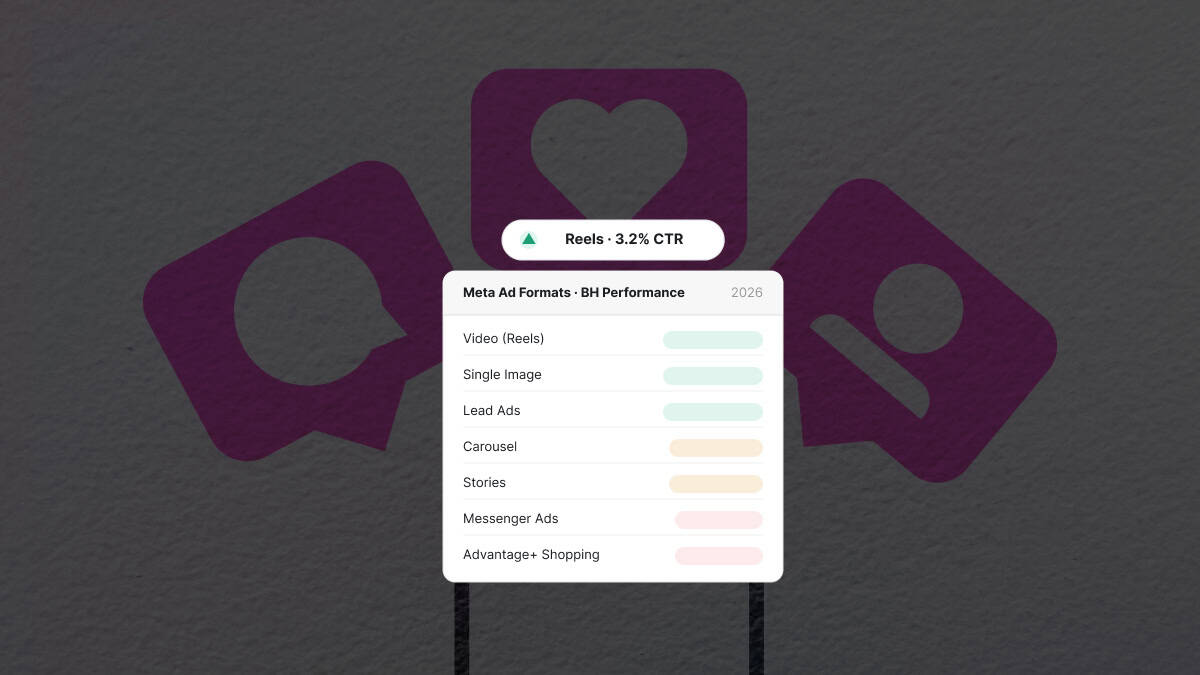
- The 2026 Meta format performance hierarchy for behavioral health runs Reels first (lowest CPC, highest engagement for family-buyer reach), carousel second (best for educational depth), single-image feed third (reliable workhorse), Stories fourth (re-engagement and reinforcement).
- Lead forms in Meta’s healthcare sensitive category have meaningful optimization restrictions in 2026 and tend to capture low-intent users who do not convert to admissions. Most treatment centers should retire or de-prioritize lead-form formats in favor of click-to-site driving to a real conversion page.
- Vertical 9:16 video is now Meta’s primary format. Most of Meta’s ad inventory is now vertical, and the vast majority of users access Meta on mobile. Creative built in square or horizontal aspect ratios underperforms by default.
- Reels typically run at a lower CPC than feed placements, and carousel link ads often beat single-image ads on cost per conversion in general industry benchmarks. The behavioral health lift is comparable when the creative is compliant and family-perspective.
- Advantage+ Creative enhancements default-on for new Sales and Leads campaigns since early 2026. For behavioral health, several enhancements need to be disabled because they touch brand-sensitive or compliance-sensitive elements. The default-on configuration is rarely the right configuration here.
The 2026 Meta format hierarchy for behavioral health
The starting point is the format performance data, applied through the filter of Meta’s addiction treatment ad policy. The 2026 industry benchmarks across creative formats give a clear ranking, though the behavioral-health-specific application requires adjustments for compliance and audience.
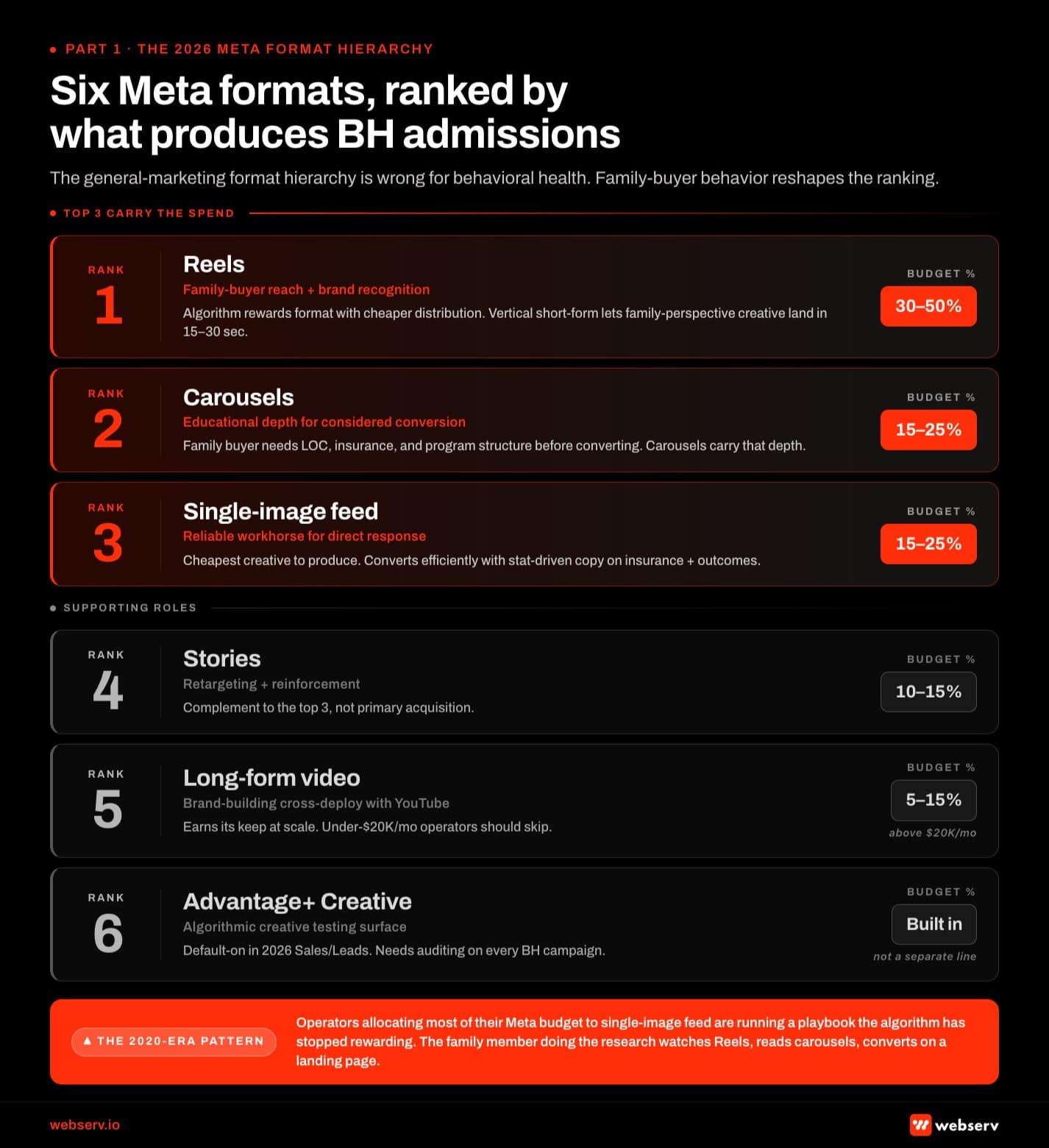 Infographic titled ‘The 2026 Meta format hierarchy for behavioral health’.
Meta documents the substance-use-treatment policy directly in the Transparency Center, where the Drug and Alcohol Addiction Treatment policy spells out which advertisers are eligible, what creative is restricted, and how the sensitive category designation constrains optimization.
The takeaway for format selection is that the optimization restrictions hit lead-form and lower-funnel events hardest. The formats that survive the restrictions intact, like Reels and click-to-site carousels driving to a real landing page, become disproportionately effective.
Reels (short-form vertical video, typically 9 to 30 seconds) typically deliver one of the lowest CPCs of any Meta format in 2026.
The format is the highest priority for top-of-funnel family-buyer reach because the algorithm weights Reels heavily in distribution and the vertical mobile-first format matches how users actually consume Meta in 2026. For behavioral health, Reels are the workhorse of family-perspective video creative.
Carousel (multi-card image or video, 2 to 10 cards) often deliver a lower cost per conversion than single-image ads in cross-industry benchmarks.
The format is the best educational performer for behavioral health because the multi-card structure lets you walk a family member through levels of care, what to expect, insurance verification, or the admission process without losing them to a single dense paragraph.
Carousels do not replace Reels for reach; they complement them on the consideration side of the funnel.
Single-image feed ads remain the reliable workhorse for direct-response. Static images do not earn the Reels-level engagement, but they convert efficiently when the creative is stat-driven, family-perspective, or testimonial-style (with proper consent and compliance framing).
The format is also the easiest to produce at scale, which matters for operators with limited creative budget.
Stories (24-hour ephemeral content, vertical full-screen) are the re-engagement and reinforcement format anchored by server-side conversion tracking. Stories work well for people who have already engaged with the facility’s content on Meta, less well for cold acquisition.
The format costs more per impression on cold audiences than Reels does, and does not produce the educational depth of carousels.
Long-form video (60 to 90 seconds, deployed on Facebook in-stream, YouTube cross-deploy, and sometimes Reels overlay) is the brand-building format that pairs with the full-channel paid social deployment for operators investing in brand recognition over the family-buyer consideration window.
Long-form does not produce direct admissions efficiently, but it builds the brand recognition layer that lifts every other format’s conversion rate when the family-member buyer encounters the brand again later. Most behavioral health operators under $20,000 a month in social spend should not invest heavily here.
Operators above $30,000 a month often should.
Format selection is the most underweighted lever I see in behavioral health paid social. The 2026 algorithm rewards format diversity, and accounts running one format heavily get out-converted by accounts with a real format mix.
Mitch Marowitz, Director of Paid Media, Webserv
Reels: the highest-priority format for family-buyer reach
Reels carry roughly 30 to 50 percent of total Meta budget for the behavioral health operators I see performing well in 2026.
The format works in this category because the family-buyer audience consumes Reels heavily, the algorithm rewards the format with cheaper distribution, and the vertical short-form structure lets you deliver an emotional, family-perspective message in 15 to 30 seconds.
The compliant creative pattern for behavioral health Reels runs three frames or beats:
Frame 1 (0-3 seconds): A family-perspective hook. “When my brother needed treatment, I had no idea where to start” or “I called five facilities before I found one that took our insurance.” The hook establishes the family member as the narrator.
Frame 2 (3-20 seconds): The story. Brief, specific, emotionally honest. Not the patient’s story (that is a compliance issue without explicit consent); the family member’s story of finding the right program.
Frame 3 (20-30 seconds): The bridge to action. “We found [facility name]. They walked us through insurance, helped us understand the level of care, and the admission happened the next week.” Closes with the brand name and a soft CTA to the website.
The format works because it is native to how Reels are consumed (fast, vertical, captioned, emotional) and because the family-member-as-narrator framing sidesteps the patient-testimonial compliance issues that get accounts disabled. The HIPAA-compliant Facebook ads framework governs the consent posture needed even for family-perspective Reels.
The production cost for compliant Reels has dropped sharply since 2024. A working creative library of 8 to 12 Reels variants can be produced in a single 2-day shoot with a family member willing to participate, with edits and variants generated through the year.
Operators trying to produce one-off Reels every quarter at premium production cost are usually over-spending; the right model is a single batched shoot with extensive variant generation.
Carousels: the educational depth performer
Carousels work in behavioral health because the buyer often needs to understand something before they convert. A family member is rarely going to admit a loved one on a single ad impression. They need to understand the level of care, the insurance coverage, the program structure.
The carousel format lets you teach them inside the ad, which is what no other Meta format does as well.
The three carousel patterns that work consistently for behavioral health:
The level-of-care explainer
Card 1: “Trying to figure out the right level of care?” Cards 2 through 4: brief explanations of detox, residential, PHP, and IOP with the criteria for each. Card 5: “Here’s how we help families decide” with a soft CTA.
This format produces qualified clicks because the family member self-selects based on the level of care they recognize as fitting their situation.
The insurance verification walkthrough
Card 1: “Wondering if your insurance covers treatment?” Cards 2 through 4: how verification works, what most plans cover, common misconceptions. Card 5: “Get a free verification” with a click to a real verification page.
The format is high-converting because insurance uncertainty is one of the biggest blockers in the admission decision.
The “what to expect” carousel
Card 1: “What residential treatment looks like, week by week.” Cards 2 through 4: the admission process, the first 72 hours, the family role during treatment, what aftercare looks like. Card 5: a bridge to talking with the admissions team.
This format works for higher-acuity programs where the family member’s anxiety about the unknown is the conversion blocker. The carousel also defends against the body-brokering competitive dynamics that distort the auction in certain geographies.
The cost-per-conversion advantage for carousels compounds in behavioral health because the qualified-click rate is also higher.
Family members who tap through a carousel have already self-selected through the educational content, which means the eventual admission rate per click is much higher than the rate from a single-image impression.
The technical default for carousel in 2026 is 1:1 square aspect ratio (the format that displays correctly across feed, Stories, and other placements). Vertical 9:16 carousels work for Stories-only placement but lose feed eligibility, which usually does not justify the trade-off.
Single-image feed: the reliable workhorse
Static images are not glamorous, but they convert efficiently when the creative is right for the format. Single-image feed ads work as the third leg of the behavioral health creative stool for three reasons.
First, they are the easiest to produce at scale. A working library of 30 to 40 single-image variants can be built in a couple of weeks of design work and refreshed continuously.
The variant volume matters because the Meta algorithm tests across creative and needs fresh variants to keep the campaign from saturating.
Second, they work well for stat-driven and quote-driven creative that does not fit the Reels or carousel format.
A clean image of “94 percent of admissions inquiries from this facility produce a verified-benefits call within 2 hours” with brand framing can convert efficiently as a single-image ad and is hard to deliver in Reels or carousel.
Third, they are the right format for re-engaging people who already interacted with the facility’s content on Meta. Someone who has already engaged with a Reel or a carousel does not need another long educational sequence; they need a clean reminder that converts. Single-image feed ads carry this load well.
The compliant creative bar for single-image is the same as the broader compliant ad headline framework we publish: no before-and-after imagery, no exaggerated outcome claims, no patient testimonials without proper consent, and family-perspective framing where the human element appears.
Stories: re-engagement and reinforcement
Stories work best as a complement to the other formats, not as a primary acquisition format. The placement is more expensive per impression on cold audiences than Reels and produces less depth than carousels.
On engaged audiences (people who watched 50 percent of a Reel or interacted with the facility’s Facebook page or Instagram account), Stories are an efficient reinforcement format. Site-visitor retargeting is off the table for treatment ads; our retargeting strategy guide covers what each platform still allows. Used this way, Stories keep the brand top-of-mind during the often-extended consideration window in behavioral health.
The typical Stories allocation in a behavioral health account is 10 to 15 percent of social spend, with the creative running as 9:16 vertical, 15-second clips, often pulled as edited variants from the Reels library to keep production cost low.
The format that does not work well in behavioral health Stories is the swipe-up direct-response ad with a phone number in the creative.
Phone-call attribution from Stories is hard to clean up, and the format tends to capture distressed users in a moment of crisis where the call may produce a momentary connection that does not convert to admission.
The better pattern is Stories that bridge to a real landing page where the user can engage at their own pace.
Long-form video: the YouTube cross-deploy
Long-form video (60 to 90 seconds, sometimes longer) is a brand-building format that earns its keep at scale.
A 75-second family story video deployed on Facebook in-stream, on YouTube as pre-roll, and as a Reels overlay variant builds brand recognition across the family-buyer audience over the 4 to 12 week consideration window that residential treatment decisions typically run.
The trade-off is production cost. A good 75-second behavioral health video runs $8,000 to $20,000 to produce well, with editorial review for compliance, family member consent infrastructure, and post-production.
That cost is hard to justify for operators under $20,000 a month in total social spend, because the lift the video produces on the rest of the funnel is real but slow. Operators above $30,000 a month with a 12-month commitment to the channel often do see the ROI.
The format also benefits from cross-deployment beyond Meta. The same 75-second piece runs as YouTube pre-roll, on the website hero section, in email nurture campaigns, and as a Reels overlay variant. The cross-channel reuse is what makes the production cost defensible.
Formats to de-prioritize or avoid in 2026
KEEP RUNNING
- Reels for family-buyer reach (highest algorithmic priority in 2026)
- Carousels for level-of-care, VOB walkthrough, and “what to expect” educational depth
- Single-image feed as the reliable workhorse for admit-driving offers
- Stories for re-engaging people who already engaged with the facility’s content on Meta
RETIRE OR RESTRICT
- Lead forms (Instant Forms) — Meta's healthcare sensitive category restricts optimization for substance use
- Messenger ads — click-to-Messenger creates a direct-message workflow that triggers HIPAA exposure
- Advantage+ shopping-style creative built on ecommerce logic that misreads BH intent
- Any ad copy featuring outcome-promise testimonials — Meta ad review will reject and can flag the account
Three formats are increasingly problematic for behavioral health advertising in 2026, and one is outright dangerous.
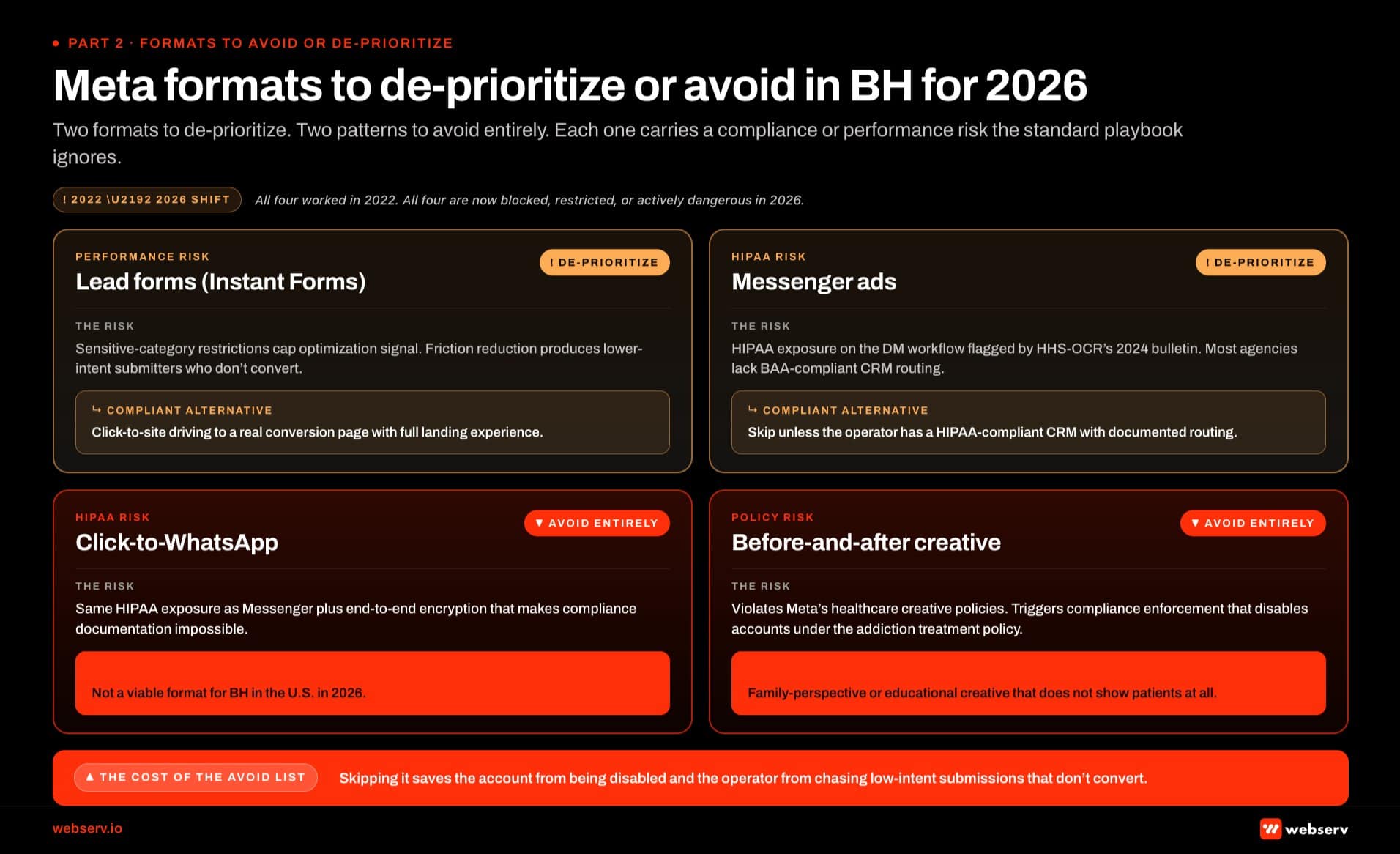 Infographic titled ‘Meta formats to de-prioritize or avoid in BH for 2026’.
Lead forms (Instant Forms). Meta’s restrictions on lower-funnel optimization for health advertisers limit what the algorithm can do on lead-form campaigns for substance use treatment. The forms still capture submissions, but the algorithm cannot optimize toward higher-intent submitters as well as it can in unrestricted categories. Our Meta ads tactics for rehabs covers which events to optimize on instead.
The submissions also tend to be lower-intent than click-to-site users (the friction reduction works against you when the buyer is supposed to self-qualify). Most behavioral health operators should retire lead forms or limit them to a small share of spend on audiences that engaged with the facility’s content on Meta.
Messenger ads. Click-to-Messenger creates a direct-message workflow with the user, which in behavioral health triggers HIPAA exposure that the HHS Office for Civil Rights flagged directly in its 2024 bulletin on online tracking technologies used by HIPAA-regulated entities.
The bulletin made clear that PHI captured through messaging or tracking pixels on a treatment center’s digital surface falls under HIPAA. Most agencies do not have the infrastructure to route Messenger conversations through a HIPAA-compliant CRM.
The default answer for most behavioral health operators is to not run Messenger ads at all.
Click-to-WhatsApp. Same HIPAA exposure as Messenger, with the additional issue that WhatsApp is end-to-end encrypted, making compliance documentation harder. Not a viable format for behavioral health in the United States in 2026.
Before-and-after creative. This is not a format per se but a creative pattern that gets accounts disabled regardless of format. Showing a person “in active use” and then “in recovery” violates Meta’s healthcare creative policies and triggers the compliance enforcement that disables accounts under the addiction treatment policy.
Meta’s Health and Wellness ad standards spell the underlying restriction out explicitly.
The policy prohibits ads that focus on “negative self-perception” or that “exploit insecurities, ailments, or other personal characteristics” (Meta Transparency Center, Health and Wellness ad standards).
Before-and-after creative for substance use disorder is the most consistent way to trip that policy and the enforcement actions that follow.
The compliant alternative is family-perspective creative or educational content. The broader set of compliance mistakes that get rehab accounts shut down overlaps heavily with the format choices most agencies still default to.
How Profound Treatment drove 31 admits and a 42% drop in cost per viable in one quarter
Broad match pivot, negative keyword management, and intake-level conversion tracking turned a fragmented paid strategy into a predictable admissions engine.
Read the case study →68 viable VOBs at $4,529 cost per viable
Advantage+ Creative for behavioral health
Meta’s Advantage+ Creative system applies automatic enhancements (text variations, image cropping, music overlay, additional headlines) to ads to expand the creative testing surface. Since early 2026, new Sales and Leads campaigns launch with all Advantage+ enhancements pre-selected by default.
For most direct-response advertisers, the default-on configuration works well. For behavioral health specifically, several enhancements need to be disabled because they touch compliance-sensitive elements:
Disable the music enhancement on creative featuring real family members or any audio testimonial content. Auto-added music can change the emotional context in ways that read as manipulation under healthcare creative policies.
Disable the text variation enhancement on creative carrying specific clinical claims, insurance details, or outcome framing. Auto-generated text variations can produce non-compliant copy that gets the account flagged.
Disable the image cropping enhancement on creative where the family-member-as-narrator framing depends on specific composition. Auto-cropping can change which faces or contexts appear in the cropped variants.
Enable brand-safe enhancements: aspect ratio variations (for cross-placement display), light retouching (for image quality), brightness optimization.
The right framing is that Advantage+ Creative is a tool, not an autopilot. For behavioral health specifically, the default-on configuration is rarely right because the compliance surface is too narrow for un-reviewed automation.
The manual-review configuration with selective enhancement enables takes 30 to 60 minutes to set up per campaign and is worth the time. The same discipline that applies to LegitScript compliance for paid search applies here.
Recommended budget mix across formats
The right format mix for a typical behavioral health treatment center running $15,000 to $40,000 a month on Meta is:
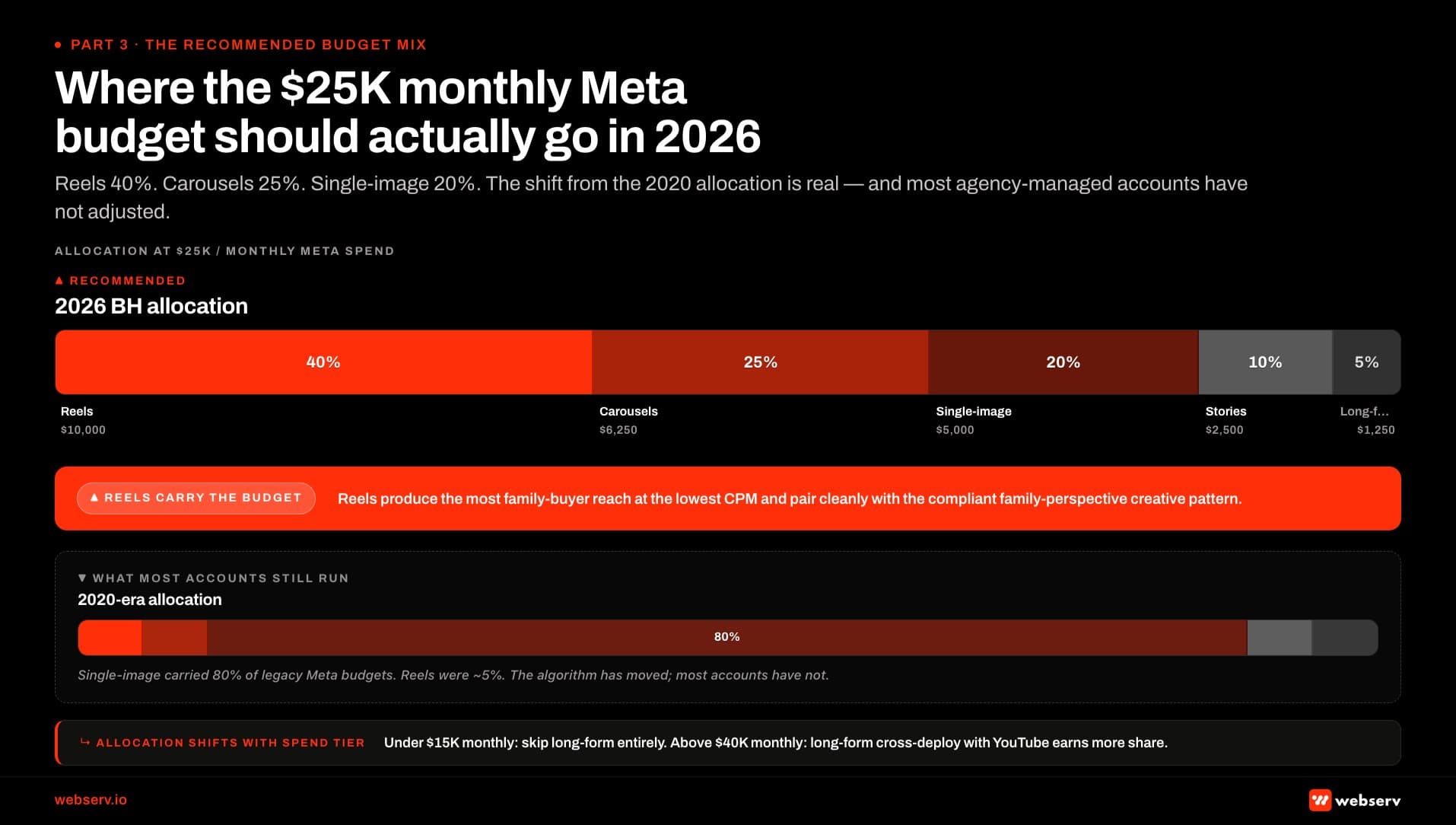 Infographic titled ‘The recommended 2026 Meta budget mix for a $15K-$40K monthly BH account’.
Reels: 35 to 45 percent of spend.
Carousel: 20 to 30 percent.
Single-image feed: 15 to 25 percent.
Stories: 8 to 15 percent.
Long-form video: 5 to 10 percent (when production budget supports it).
Operators with smaller budgets ($8,000 to $15,000) should concentrate on Reels and single-image, with carousels added once the budget supports the additional creative production. Broader geography with format diversity produces stronger algorithmic signal than narrow geography with a single format, especially for out-of-network family-buyer campaigns.
Operators with larger budgets ($40,000 and above) should expand long-form video and run Stories re-engagement at higher density.
The mix shifts seasonally and based on the brand’s stage. New facilities or facilities entering new markets weight Reels and long-form video higher (brand-building). Mature facilities with established brand recognition weight carousels and single-image higher (direct-response).
The wrong mix is any allocation that puts more than 40 percent of spend into a single format, especially if that format is single-image or lead form. The 2026 algorithm rewards format diversity, and accounts with diverse format mixes consistently outperform accounts running one format heavily.
The mix decision sits alongside the channel-sequencing decision for operators choosing between Google and Meta as their primary paid channel.
Frequently asked questions about Meta ad formats for treatment centers
Should we still run Instant Forms or Lead Form ads?
Mostly no. The 2026 healthcare sensitive category restrictions limit what Meta can optimize on lead-form campaigns for substance use treatment, which means the forms still capture submissions but the submissions are lower-intent than click-to-site visitors who self-qualify by reading a real landing page.
Most behavioral health operators we work with have retired lead forms entirely or limited them to on-platform re-engagement campaigns at 5 percent or less of total spend.
The exception is for low-acuity outpatient programs where the conversion economics differ.
Even there, the lift from lead forms over click-to-site is smaller than it was pre-2025, and the lead quality is noticeably lower.
The default recommendation in 2026 is to run click-to-site driving to a real conversion page, not lead forms.
If you have a lead form that is somehow producing high-quality leads consistently, keep it running.
For most operators the exception does not apply, and the lead-form spend would convert better as Reels or carousel spend.
How many creative variants do we need to run for a healthy account?
A working creative library for a mid-sized behavioral health Meta account in 2026 typically carries 30 to 50 active variants across all formats: 12 to 18 Reels variants, 6 to 10 carousel variants, 12 to 20 single-image variants, and 4 to 8 Stories variants pulled from the other formats.
This is more variants than most operators inherit from agency-produced creative.
The 2026 Meta algorithm benefits from having more variants to test, which means undersized libraries underperform regardless of how good any individual creative is.
The library refreshes at a rate of roughly 20 percent per month to prevent creative fatigue.
The variant production cost is the real constraint for most operators. The fix is batched production (single-shoot Reels with extensive editing into variants) and template-driven single-image production (one master design with 10 to 20 stat or quote swaps).
Do we really need vertical video, or can we use existing horizontal content?
You need vertical. Nearly all Meta usage is on mobile, and most of its ad inventory is vertical. Horizontal video served to a vertical placement is letterboxed or auto-cropped in ways that lose the emotional impact of the framing.
The format conversion is meaningful and shows up in CPM, CTR, and conversion rate. If you have horizontal video content from prior campaigns, it can be re-edited into vertical variants by recropping or by adding vertical-frame title cards above and below the horizontal content.
The re-edit work is cheaper than re-shooting, but the original framing has to support recropping (faces in the center, key text away from the edges). Most operators discover that the recrop produces variants that are usable but not optimal, and end up shooting vertical-first for the next round.
What is the right conversion event to optimize for in 2026?
The healthcare sensitive category restrictions limit lower-funnel conversion event optimization (Purchase and Lead are blocked or limited for substance use treatment). The workable optimization events in 2026 are upper-funnel: ViewContent, Page View, custom engagement events.
The Meta Conversions API setup layered with server-side identity matching feeds the conversion signal Meta cannot capture through the pixel directly.
The practical setup is to optimize Meta campaigns on a custom event like “Viewed Insurance Page” or “Watched 50 percent of family story video,” and use the server-side CAPI feed to send the actual admission conversion data back to Meta for the algorithm’s longer-term learning.
This is a more complex setup than the 2022 pixel-based pattern, and it is the bar that 2026 behavioral health advertising requires. The conversion tracking standard for addiction treatment walks through the event-mapping discipline that makes this configuration work in production.
Does the format mix change for adolescent or young adult patient populations?
Yes, somewhat.
Adolescent and young-adult-focused facilities (patient ages 18 to 29) should weight Reels higher (50 to 60 percent of Meta spend) and de-prioritize long-form video.
The audience consumption pattern skews more strongly to short-form, and the family member may be younger as well (older sibling, peer, or parent of an adult child who themselves uses Instagram heavily).
For these operators, the format mix often expands beyond Meta to include TikTok and Snap with similar short-form vertical patterns.
The principles are the same across platforms; the budget allocation shifts to match the audience.
The healthcare demographic targeting work that informs platform-specific targeting also informs format selection within each platform.
For adult-population facilities (patient ages 35 and above), the standard Meta format mix with Reels at 35 to 45 percent works as described. The family-member buyer is usually a parent or spouse, and the Meta consumption pattern is more balanced across formats.
How long should creative run before being refreshed?
Reels and Stories should refresh fastest: winners every 2 to 4 weeks at mid-size budgets, closer to 45 to 60 days on small ones. Carousels and single-image feed ads can run longer, depending on the variant volume in the library. Let frequency and CTR make the call.
The refresh signal to watch for is frequency cap (when the same user has seen the same ad 4 or more times) plus a declining CTR trend over a 7 to 14 day window. When both signals appear together, the creative is fatigued and needs to be rotated out.
Most behavioral health operators we audit are running creative that is 6 to 12 months old, which is far too long.
The fatigue penalty compounds slowly over months, which is why operators do not notice it as a sudden drop.
The fix is the refresh cadence described in the variant volume question above.
If you want a second opinion on whether your Meta format mix is working for your facility, reach out for a creative audit. We can walk through your current variant library, format allocation, and Advantage+ configuration before the next budget cycle starts.
The perspective in this article comes from 9 years working exclusively inside behavioral health.
We are a team built by people in recovery who understand that behind every admission is someone asking for help. If that resonates, get to know us.
Mitch Marowitz is Director of Paid Media at Webserv. He has spent the last decade managing paid search and paid social programs for behavioral health operators, with current oversight on more than $4M in monthly behavioral health ad spend across Google Ads, Meta, TikTok, and emerging channels.
He writes here in his operator-to-operator voice; the data points reflect aggregated patterns across the Webserv client portfolio.