The fastest way to burn through a treatment center’s paid search budget is to switch a small account from Max Clicks to Max Conversions on the agency’s recommendation.
The pitch sounds reasonable: Smart Bidding lets the algorithm optimize for the conversion you care about, the bid system gets smarter with every conversion, the program improves on its own over time. The pitch ignores how Smart Bidding actually behaves below the data threshold.
A real paid search program for behavioral health at small scale runs Max Clicks with disciplined keyword targeting and manual oversight. Smart Bidding works at the volume profile of a large multi-state operator, not at the volume profile of a single-facility operator running $5,000 to $15,000 per month.
This piece walks through the math behind why Max Conversions breaks at small scale, what Max Clicks gets right that the algorithm cannot replicate at that volume, and the operator profile where the transition to Smart Bidding actually makes sense.
Key Takeaways
- Max Conversions and Target CPA need 30 or more conversions in the previous 30 days at the campaign level to perform reliably. Most treatment centers running $5,000 to $15,000 in monthly spend generate 8 to 25 conversions per month.
- Below the data threshold, Smart Bidding does not “learn.” It makes bid decisions based on noise, chases high-CPC keywords that win impressions but underperform on conversions, and tends to spend a larger share of the daily budget.
- Max Clicks at small scale gives you a predictable CPC range, manual control of which keywords serve, and much better budget protection while you build conversion volume.
- The right time to graduate to Max Conversions is when you have 30+ conversions per month sustained over at least 8 weeks, clean conversion tracking, and enough budget to absorb a 2 to 4 week learning period.
- The 2026 introduction of Journey-aware Bidding makes the small-budget problem worse, not better. Optimizing toward full admission journeys requires more downstream signal than thin-data accounts can provide.
I onboarded a 24-bed residential treatment center in March. The first thing I did was pull the prior 90 days of Google Ads data. The agency before me had switched the account from Max Clicks to Max Conversions in early February.
Here is what happened in the 30 days after the switch.
The cost per admission went from $284 to $891. Total admissions inquiries dropped 41%. Spend climbed from $7,200 in January to $9,800 in February because Max Conversions defaulted to spending more of the daily budget.
Three high-intent keyword groups stopped serving impressions entirely because the algorithm decided their predicted conversion rate did not justify the bid.
The agency had described the volatility as “the learning period.” The operator had been bleeding $30,000 a month in lost admission opportunity by week three and did not know it.
I switched the account back to Max Clicks within 48 hours of getting access. Inside 30 days, cost per admission was back at $310 and admissions inquiries had recovered to the January baseline. There was no Smart Bidding magic to mourn.
There was a small account being asked to feed a machine learning system that needs more data than the account generates.
This is one of the most common mistakes I see in behavioral health paid search. The default agency pitch is that Smart Bidding wins because AI beats manual. That pitch is mostly correct at scale.
It is mostly wrong for the small treatment center budgets the rest of this category actually runs.
Why Max Conversions breaks at small treatment-center scale
The math is straightforward and Google publishes the relevant numbers.
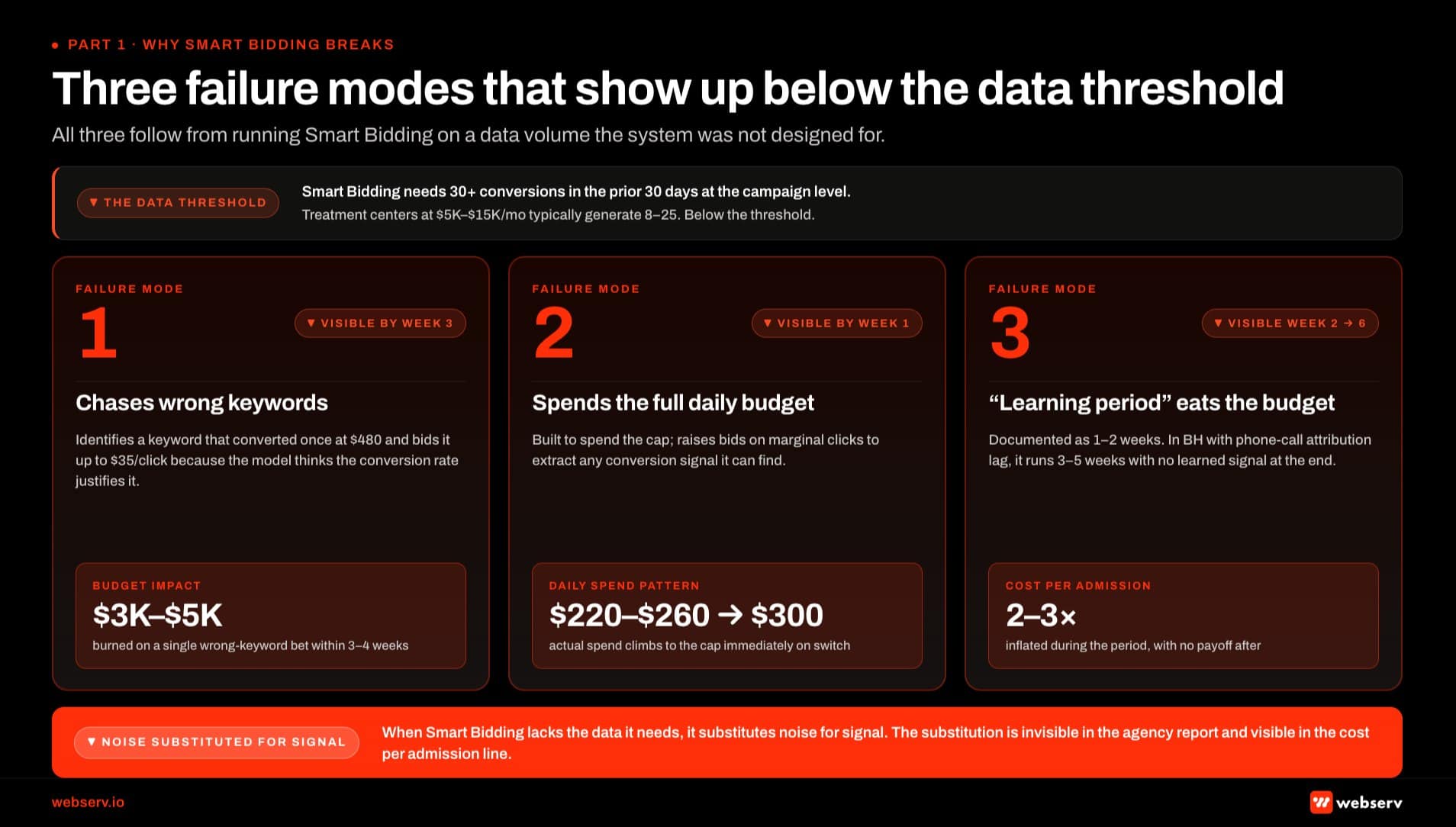 Infographic titled ‘Why Max Conversions breaks at small treatment-center scale’.
Google’s documentation on Maximize Conversions bidding and the related Target CPA threshold state that Smart Bidding strategies perform reliably with 30 or more conversions in the past 30 days at the campaign level.
Below that, the algorithm has too little data to model bid decisions and falls back on signal substitution that often goes wrong.
A standalone residential treatment center running $7,000 to $12,000 a month in paid search spend typically generates 8 to 25 admissions inquiries per month, depending on the market, the cost-per-click range, and the conversion tracking setup. That is well below the data threshold. Our complete guide to behavioral health marketing covers how paid search fits with the other channels at that scale.
Pointing Smart Bidding at that level of conversion volume is asking it to make probabilistic decisions on a sample size of one or two per day.
Three predictable failure modes follow.
The algorithm chases the wrong keywords. Smart Bidding looks for patterns. With 12 to 18 conversions to train on, the patterns it finds are noise more often than signal.
It identifies a keyword that converted once at $480 and bids it up to $35 per click because the model thinks the conversion rate justifies it. Three weeks later that keyword has burned $4,000 with zero additional conversions, because the original conversion was a coincidence.
The algorithm spends more of the daily budget. Max Conversions is built to spend the daily budget. Max Clicks is built to find the most clicks within the budget.
On an account with $300 a day in daily budget, Max Clicks often spent $220 to $260 because the manual CPC structure ran out of cheap inventory before the budget cap hit.
Max Conversions will burn the full $300 most days because it raises bids on the marginal click to extract whatever conversion signal it can find.
The “learning period” eats your budget. Google’s documentation states the learning period typically runs 1 to 2 weeks. In behavioral health, with phone-call conversions adding attribution lag, the real learning period runs 3 to 6 weeks because the conversion signal arrives late and noisy.
During that period, performance volatility is described as expected. Operators see it as bleeding.
The compounding effect of those three failure modes is what produces the pattern in my opening story. Cost per admission triples, conversion volume drops, the agency blames the algorithm, and the operator pays for the algorithm’s tuition.
What Max Clicks gets right at this scale
Max Clicks is not glamorous. It is a manual CPC strategy with a budget guardrail. Most agency pitch decks treat it as the bidding mode you graduate out of, not the bidding mode you should run. For Google’s fully automated campaign type, see our take on Performance Max for behavioral health.
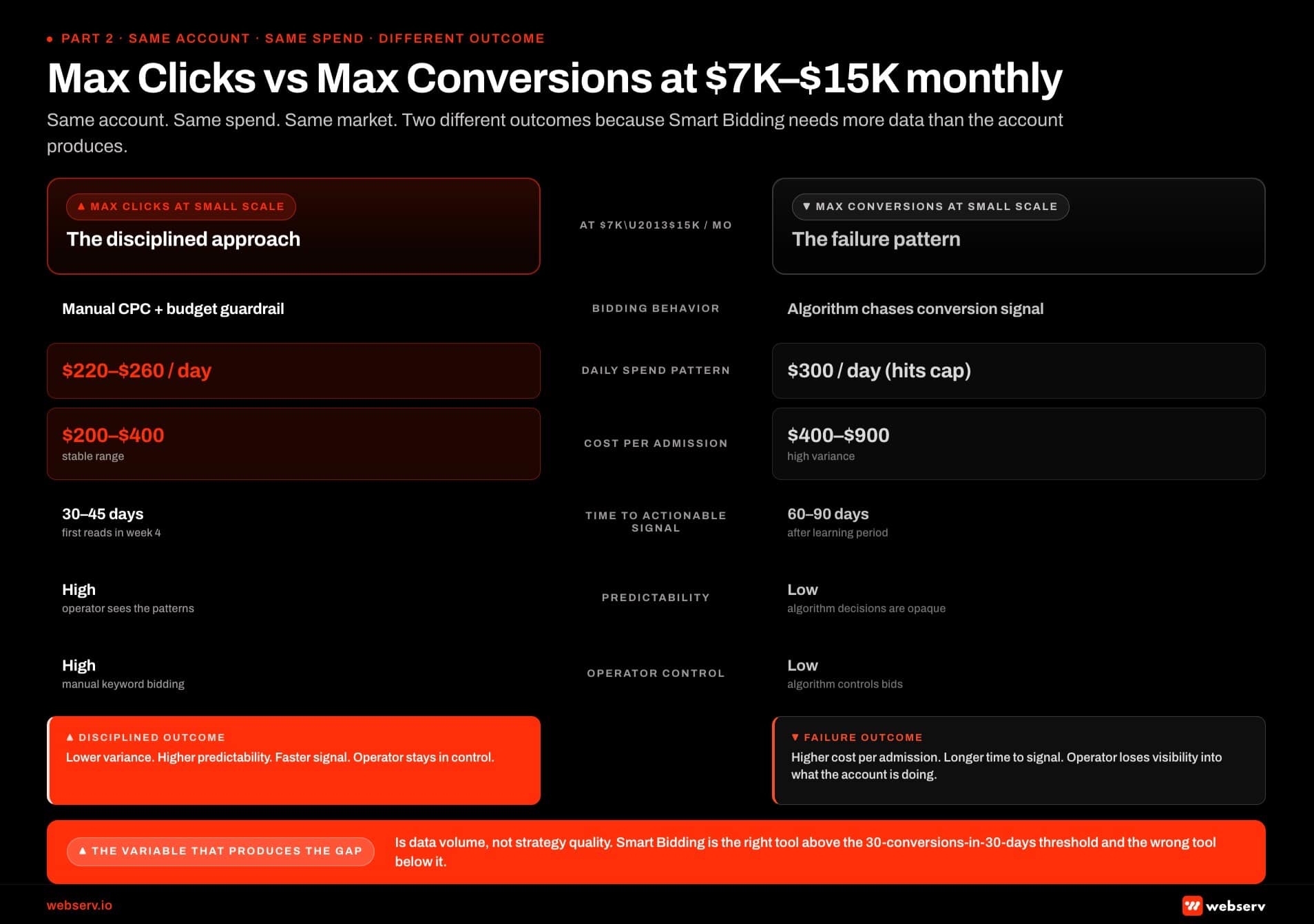 Infographic titled ‘Max Clicks vs Max Conversions at $7K-$15K monthly: side by side’.
For small treatment-center budgets, the priorities Max Clicks delivers are exactly the priorities that matter.
Predictable cost per click. You set the max CPC. You see what each keyword actually pays. You can troubleshoot Quality Score issues directly because the CPC is visible per keyword instead of obscured behind a Smart Bidding decision tree.
On accounts where individual keywords run $25 to $150 a click, that visibility is worth more than the marginal optimization Smart Bidding promises but cannot deliver.
Keyword-level control. You decide which keywords serve impressions, in which positions, at which times. The ad group structure you built to separate intent and clinical specificity actually works as designed instead of being overridden by an algorithm trying to optimize across the campaign.
The negative keyword list you spent two weeks building does what it was built to do.
Budget protection. On a small account, the single most expensive mistake is letting the algorithm burn three weeks of budget on a learning experiment. Max Clicks does not have a learning experiment. The bid structure is what you set it to be.
If a keyword starts converting poorly, you cut the bid or pause it. If a search term wastes money, you negate it. The feedback loop is fast and human-controlled.
Clean data for the future. The most underrated benefit of staying on Max Clicks at small scale is that you build clean conversion data while you are at it.
Six months of Max Clicks history with consistent tracking gives Smart Bidding a real foundation to learn from once you do graduate to it. Six months of Max Conversions volatility on thin data gives Smart Bidding noise to start from.
The graduation threshold
The right time to switch from Max Clicks to Max Conversions or Target CPA is when three conditions are true at the same time. Not when one or two are true. Not when the agency wants to test it.
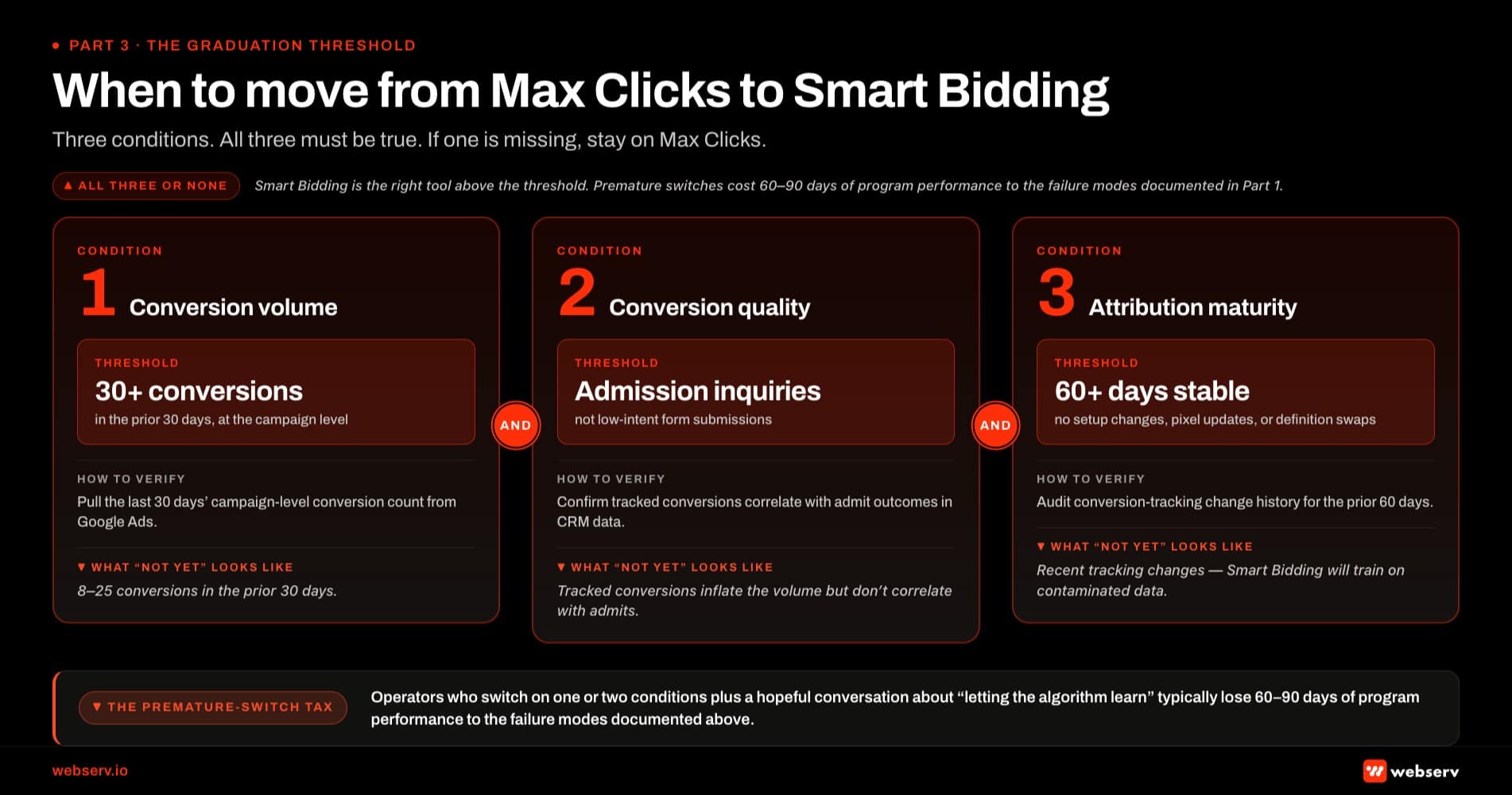 Infographic titled ‘The graduation threshold: when to move from Max Clicks to Smart Bidding’.
Condition 1: 30+ conversions per month sustained for at least 8 weeks. Not 30 in one month and 22 the next. The Smart Bidding algorithms model on a 30-day rolling window, and they degrade fast when the window thins.
If your account is intermittently above and below the threshold, you are not ready.
Condition 2: Clean conversion tracking with deduplication. The conversion events feeding Smart Bidding need to be real admissions inquiries, not duplicate phone calls, not bot form submissions, not internal staff calls. The conversion tracking work that distinguishes real admissions from noise is non-negotiable before Smart Bidding.
Feeding the algorithm dirty data is worse than feeding it no data.
Condition 3: Budget headroom to absorb a 2 to 6 week learning period. If a 30% CPA inflation during learning would put the program in panic mode with the operator, the switch is premature.
Smart Bidding learning periods on behavioral health accounts run longer than Google’s documented 1 to 2 weeks because of the phone-call attribution lag and the seasonal volatility of treatment inquiries.
When all three conditions hold, the switch is usually worth running. When even one is missing, the switch tends to produce the pattern in my opening story.
What changed in 2026 (and why it makes small-budget caution more important, not less)
Google made two bidding changes in 2026 that get pitched as reasons to switch to Smart Bidding faster. Both actually argue for the opposite.
Google’s broader documentation on Smart Bidding is consistent on the data requirement across every strategy in the family. The Smart Bidding overview repeats the 30-conversions-in-30-days threshold and notes that strategies running below it default to noisier signal-substitution behavior (Google Ads Help, About Smart Bidding).
The 2026 changes did not lower that threshold; they expanded the surfaces optimized inside it.
The first is Journey-aware Bidding, announced at Google Marketing Live 2026. The bidding strategy optimizes toward downstream events in the full lead-to-sale journey instead of just front-end form fills and phone calls. For e-commerce accounts with clean order data, this is a real upgrade.
For behavioral health, the downstream events (admission inquiry → VOB call → admission decision → actual admission) add weeks of attribution lag and require an integration with the CRM and billing layer that most treatment centers do not have wired up.
Pointing Journey-aware Bidding at a thin-data account makes the signal sparsity worse, not better.
The second is the broader AI Max rollout, which hands a share of campaign spend to Google’s AI matching and expansion across queries and surfaces. On a small treatment-center budget, that allocation often produces impressions on cheaper, lower-intent surfaces that win conversion volume metrics without driving real admissions.
The metric that should be optimized for at small scale is cost per admission, not cost per conversion. Smart Bidding and AI Max optimize for the latter unless you have the attribution depth to push them toward the former.
The simple version of the 2026 update is that the bidding sophistication on offer has grown faster than the data most small treatment centers can produce to feed it.
The gap between what the tools can theoretically do and what your account can practically support is wider in 2026 than it was in 2024.
The hybrid play for accounts approaching the threshold
There is a middle option that often works for accounts running $12,000 to $25,000 in monthly spend with conversion volume that is approaching but not yet past the threshold.
Keep the main account on Max Clicks. Identify one specific campaign that produces a disproportionate share of admissions inquiries, usually a Branded or a Service+Geo campaign with strong intent.
Switch only that campaign to Max Conversions, with a daily budget set at no more than 25% of the total account budget. Let it run for 90 days while the rest of the account stays on Max Clicks.
If the Max Conversions campaign produces a meaningful CPA improvement on the campaign-specific 30-day conversion volume, you have evidence that the broader switch will work when the rest of the account gets there.
How Profound Treatment drove 31 admits and a 42% drop in cost per viable in one quarter
Broad match pivot, negative keyword management, and intake-level conversion tracking turned a fragmented paid strategy into a predictable admissions engine.
Read the case study →68 viable VOBs at $4,529 cost per viable
This hybrid approach gives you a Smart Bidding test without putting the whole account at risk. It also gives you data to argue with when the agency or the platform rep pushes for the full switch.
“Show me the Max Conversions test results on the Branded campaign before we do this account-wide” is a question the right answer to is yes, every time.
Letting Smart Bidding learn on a $7,000 a month account is paying Google to figure out what an experienced media buyer could have told you for free in week one. The algorithm is not stupid. It just does not have what it needs to be smart with.
Mitch Marowitz, Director of Paid Media, Webserv
The pull quote is uncomfortable because it cuts against the entire current marketing narrative around AI in paid media. The narrative is that AI beats manual at scale. The narrative is mostly correct at scale. The narrative is mostly wrong at the budget size most behavioral health operators actually run.
What this looks like inside the account
For operators considering whether their account belongs on Max Clicks or Max Conversions, here are the three numbers to pull.
Average monthly conversion volume over the last 90 days. Pull it at the campaign level, not the account level, because Smart Bidding optimizes per campaign. If the largest campaign is producing 35+ conversions per month consistently, that campaign is a candidate for Max Conversions.
If no campaign hits the threshold, the account is not ready.
Cost per conversion versus cost per admission. These are not the same number. The cost per conversion is what the platform reports. The cost per admission is what the operator actually cares about.
The ratio between them is the conversion-to-admission rate (CTA rate), which for most behavioral health accounts runs 12 to 25%. Smart Bidding optimizes the platform number; you should optimize the operator number.
Spend distribution across campaigns. Smart Bidding will redistribute spend within a campaign budget. It will not redistribute across campaigns.
If you have one campaign at 65% of total spend and the other 35% split across five small campaigns, Smart Bidding on the big campaign matters more than on the small ones.
Switching the small ones to Max Conversions on starvation-level conversion data is the most common version of the mistake.
Run those three pulls on a quarterly basis. The answer to “stay on Max Clicks or graduate?” tends to be obvious once you can see all three numbers in one view.
Performance Max: Wild Card or Spam Machine
Why PMax is a spam machine for most BH accounts
MOST COMMON PMAX FAILURE
PMax hands campaign control to Google’s ad-serving algorithm, and Google’s algorithm treats behavioral health like any other paid vertical. That means it will push spend toward display and video placements on non-BH properties, drive to network-hosted landing pages that miss LegitScript audits, and mix junk lead sources into the conversion signal. On a BH account with strong search structure, most PMax spend gets absorbed by the least accountable network placements before campaign controls can catch it.
The combination of features that work for e-commerce works against BH for five specific reasons.
The conversion volume threshold. Like all of Google’s AI bidding products, PMax needs roughly 30 to 50 conversions per month to optimize reliably. Below that threshold, the algorithm cannot distinguish signal from noise. For BH operators, the threshold is usually missed at the account level, and PMax campaigns running thin-data optimization produce the same failure modes as Smart Bidding on small Search campaigns: chasing wrong placements, overspending on the daily budget, and burning a 3-to-6-week learning period on every change. The conversion volume math behind bidding strategy applies here, only worse because PMax is even more data-hungry than Max Conversions.
Asset auto-generation creates compliance exposure. PMax automatically combines headlines, descriptions, images, and videos into ad variations the algorithm tests. For BH, where every creative element has to clear Google’s healthcare advertising policy and the addiction services policy, the auto-combination process can produce ad variants the operator never explicitly approved.
Variants that include before-and-after imagery, outcome claims, or non-compliant language get the entire account flagged. The addiction services policy enforcement does not distinguish between “you wrote this” and “the algorithm assembled this from assets you provided.”
Cross-surface compliance variance. Google’s compliance enforcement on YouTube and Display is less predictable than on Search. A creative that passes Search review can get flagged on YouTube placement. A landing page that passes the Search ad-destination scan can get rejected on the Display placement scan. PMax surfaces these inconsistencies across multiple surfaces simultaneously, which increases the surface area for compliance issues. Standard Search keeps the compliance work concentrated on one surface.
Audience signal restrictions for healthcare. PMax uses audience signals (Customer Match, Similar Audiences, demographic and in-market signals) to inform optimization, layered with the conversion tracking and call attribution infrastructure that feeds the algorithm. For healthcare advertisers, several of these signals are restricted or unavailable. Customer Match can’t be used for health-based targeting under Google’s personalized advertising policy. Similar Audiences was deprecated entirely. The audience signal layer that powers PMax in other categories is much thinner in healthcare, which means the algorithm has less to work with even when the campaign hits the conversion threshold.
The 22-percent problem. In the opening story, 22 percent of total PMax spend was on the Search surface that actually produced admissions. That ratio is consistent across the BH PMax accounts I audit. The Search portion is doing all the real work. The other 70 to 80 percent of spend is producing impressions on cross-network placements that contribute marginal brand lift but minimal admission economics. The same operator running pure Standard Search would have allocated 100 percent of the budget to the surface that converts.
 Infographic titled ‘The PMax surface allocation: where the spend actually lands’.
The compounding effect of these five issues is that most BH PMax campaigns underperform what a well-structured Standard Search campaign with the same budget would deliver. The lift PMax produces in e-commerce does not translate to BH because the constraints that make PMax work elsewhere are exactly the constraints BH advertisers face most acutely.
“Most BH operators running PMax in 2026 are running a spam machine and do not know it. The Search portion does all the real work. The other 70 to 80 percent of spend is producing impressions on cross-network placements that contribute marginal brand lift and minimal admission economics.”
Preston Powell, Chief Executive Officer, Webserv
The narrow wild-card use cases
PMax is not always wrong for BH. Three specific scenarios make PMax worth piloting.
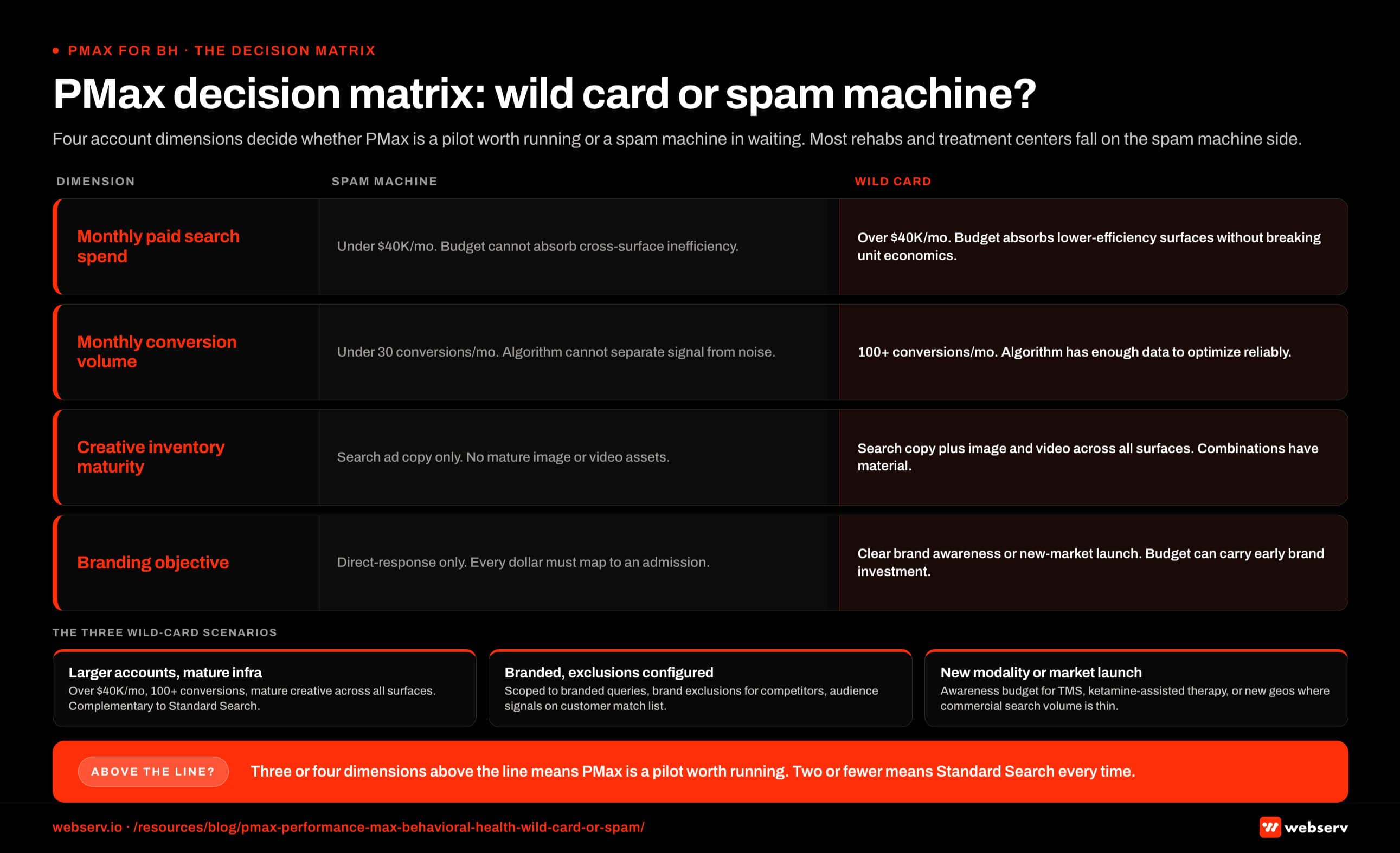 Infographic titled ‘The PMax decision matrix: wild card or spam machine?’.
Larger BH accounts with mature infrastructure. Treatment centers running $40,000 or more a month with 100+ conversions a month, mature creative inventory across Search ad copy, image, and video assets, and a brand that justifies broader awareness investment can run PMax as a complement to Standard Search.
The conversion volume supports the algorithm, the creative inventory supports the cross-surface optimization, and the budget can absorb the lower-efficiency portions of the campaign without breaking the unit economics.
Branded campaigns with brand exclusions configured. For operators with strong brand recognition, a PMax campaign tightly scoped to branded queries with brand exclusions configured for competitor brands and irrelevant terms can be a clean defensive play. The audience is well-defined, the compliance posture is simpler (branded creative is rarely policy-violating), and the cross-surface reach captures branded retargeting across YouTube and Display efficiently.
New modality or new market launches with brand budget. A facility launching a new clinical specialty (TMS, ketamine-assisted therapy) or entering a new geographic market often does not have enough commercial search volume yet to make Standard Search productive.
PMax with educational creative on the new offering can build awareness across surfaces, with the understanding that the campaign is a brand investment rather than a direct-response one. This use case requires accepting that the admission CPA from the campaign will be high in the early quarters.
For operators outside these three scenarios, PMax is not the right campaign type in 2026. The standard recommendation should be Standard Search with the disciplined ad-group structure and the campaign-level configuration framework we deploy on every Standard Search account before introducing PMax as a third campaign type.
The audit framework: is your PMax campaign worth keeping?
If you have an existing PMax campaign and want to evaluate whether it is worth keeping, a 90-minute audit gives you most of the answer.
Step 1: Pull the placement report. In the PMax campaign view, open Insights → Placements (or Asset Group → Placements for newer accounts). Look at the surface distribution: what percent of spend is on Search, what percent on YouTube, what percent on Display, Gmail, Discover, and Maps. The Search share is your most useful number. Under 30 percent Search spend usually means the campaign is allocating most of the budget to surfaces that do not convert at admission economics.
Step 2: Check the asset combinations. Pull the Asset Performance report and review which combinations are serving. Look specifically for combinations that pair high-emotional creative with outcome-claim headlines or with imagery that approaches the before-and-after policy line. Document any combinations that look policy-adjacent. If you have not been reviewing the combinations regularly, this audit will surface combinations the algorithm assembled that the operator did not approve.
Step 3: Calculate Search-attributable admission CPA. Take the total Search spend (from Step 1) and divide by the admissions actually attributable to organic-from-PMax. This is your Search-only PMax CPA. Compare to your Standard Search CPA (if you have one running) or to the industry benchmark for BH Search ($300 to $700 CPA depending on market). If the Search-only PMax CPA is much higher than the Standard Search CPA, the cross-surface portions of PMax are not earning their share of the budget.
Step 4: Audit the URL routing. Pull the destination URLs PMax has served to and verify each one is in scope for your LegitScript certification, is on a clean technical foundation, and does not have content that triggers the full-information scan. Any URL that should not be receiving PMax traffic gets added to the campaign’s URL exclusions.
Step 5: Make the kill-or-keep decision. Most BH operators running PMax on $15,000 to $40,000 monthly budgets will find that the audit produces a kill recommendation. The Search portion is small, the cross-surface spend is producing minimal admission lift, the compliance exposure is real, and the same budget on Standard Search with proper campaign structure would produce better economics.
The kill is a 24-hour migration: pause PMax, increase budget on Standard Search campaigns proportionally, verify conversion tracking is intact across both account types, and monitor for 30 days. Most operators see CPA improvement within 14 days of the migration.
The hybrid setup for operators who insist on running PMax
For operators above the $40,000-a-month threshold who fit the wild-card use cases above, the right PMax setup is a hybrid configuration with strict scoping.
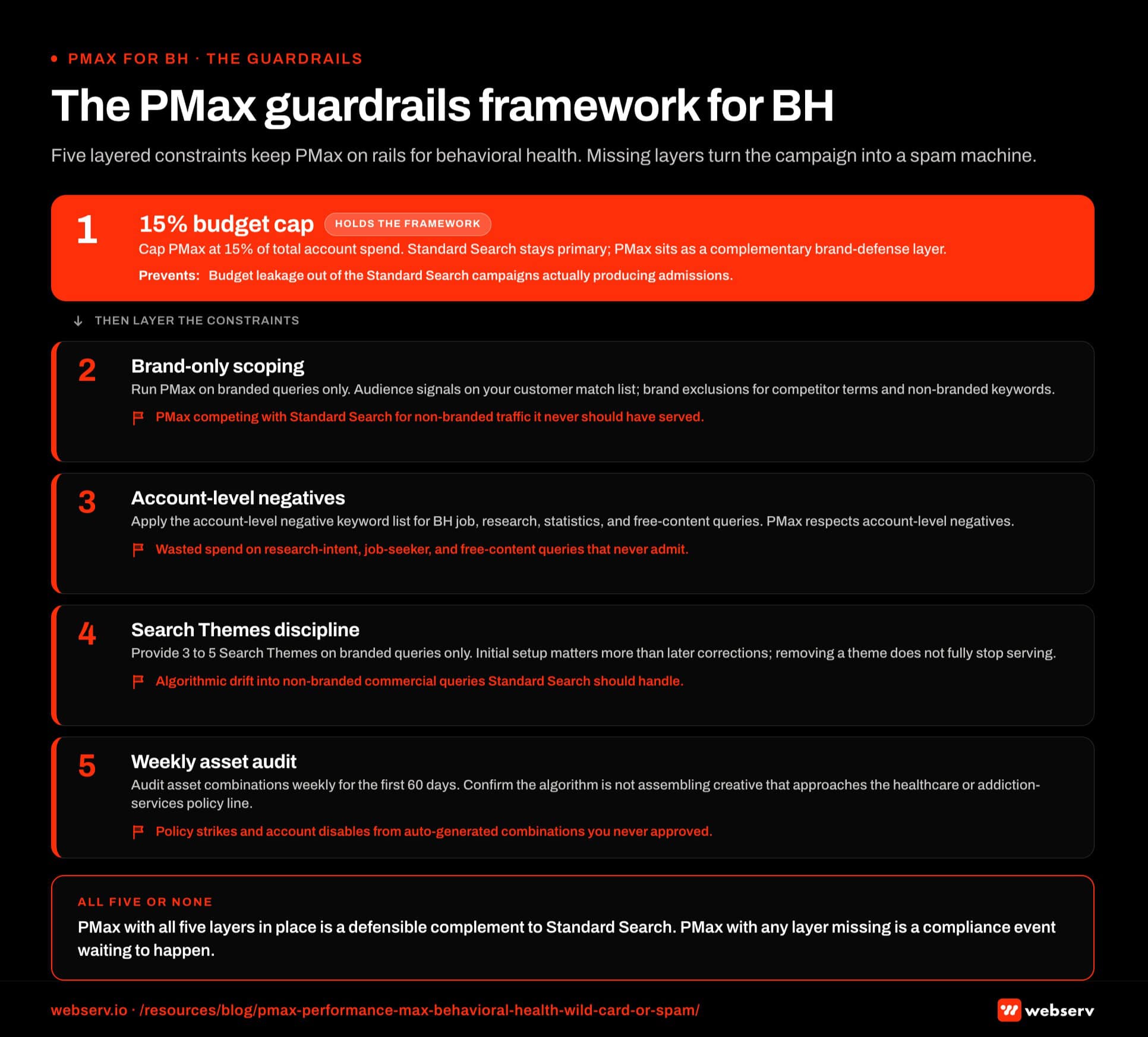 Infographic titled ‘The PMax guardrails framework for BH’.
Constrain PMax to brand-only. Run PMax exclusively on branded queries, with the campaign’s audience signals tightly scoped to your customer match list and your brand-search audience. Add brand exclusions for competitor brand terms and any non-branded keywords you want kept in Standard Search.
This gives PMax a narrow surface to optimize against and prevents it from competing with your Standard Search campaigns for non-branded traffic.
Add account-level negatives. Use Google’s account-level negative keyword list to exclude the universal BH job, research, statistics, and free-content queries. PMax respects account-level negatives, which means this filter applies even though PMax does not allow campaign-level keyword targeting in the conventional sense.
Use Search Themes carefully. Provide 3 to 5 Search Themes that align with branded queries. The Quality Score work you have done on Standard Search continues to matter because the brand themes inherit some of that signal. Avoid Search Themes for non-branded commercial queries, which Standard Search should handle. Remember that removing a Search Theme does not fully stop serving on related queries, so the initial setup matters more than corrections later.
Audit asset combinations weekly. With branded creative running, the combination liability is lower because branded creative is rarely policy-violating. Still, audit the combinations weekly during the first 60 days to confirm the algorithm is not assembling anything that would trigger review.
Cap PMax at 15 percent of total account spend. Standard Search remains the primary surface. PMax sits as a complementary brand-defense layer. Budgets above this allocation tend to pull spend away from the campaigns producing admissions.
The hybrid setup keeps the wild-card upside (cross-surface brand reach when it works) while constraining the spam-machine downside (cross-network spend leakage, compliance exposure, opaque optimization). Few BH agencies set up PMax this carefully because the discipline is more work than the default “launch and let it run” configuration most agencies pitch.
AI Max Failure Modes
Failure Mode 1: Broad match reach expansion outruns the negative keyword list
AI Max for Search uses broad match and keywordless technology to expand reach into queries the campaign’s declared keywords do not directly cover. That is the mechanism. In a well-hygienic e-commerce account with a mature negative keyword list, the expansion can produce the 14 percent conversion lift Google reports for AI Max.
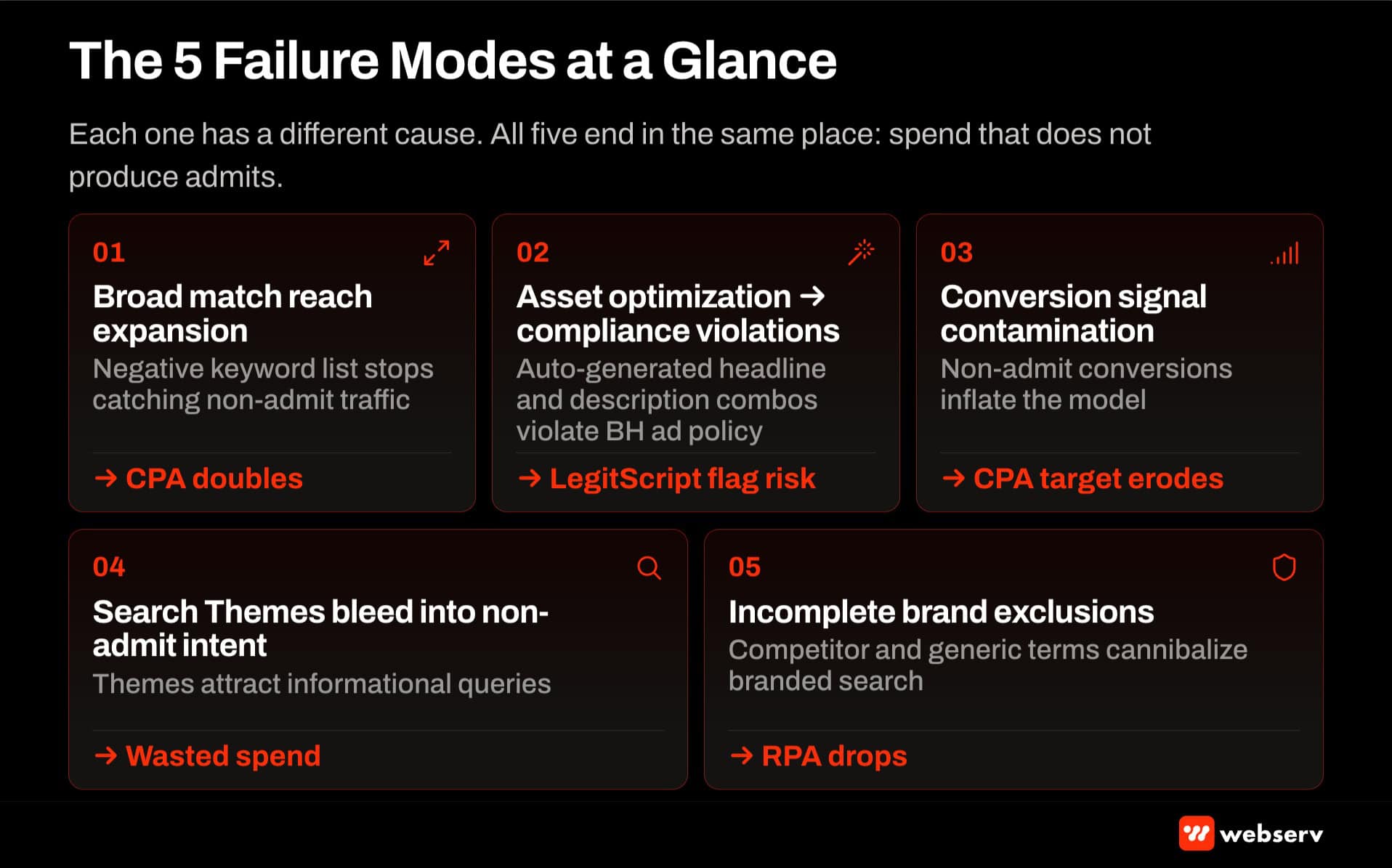
In behavioral health, the reach expansion picks up queries the negatives do not cover because the vertical produces new query language faster than most negative keyword lists get updated.
Family-perspective queries (“how do I get my son to go to rehab”), crisis-language queries (“what happens when a person overdoses”), and recovery-adjacent queries (“AA meetings near me”) all get surfaced by the reach expansion and served ads.
The compliance risk is not theoretical. A treatment center ad served on a crisis-language query violates Google’s behavioral health ad policy and produces disapprovals at the ad level, and repeat exposure produces account-level enforcement action.
The commercial risk is that even for non-compliance-violating queries, the reach expansion pulls spend onto queries that never convert to admits. A “sober living near me” query is legitimate BH intent but does not match a residential SUD facility’s admission profile.
Diagnostic pattern
In Google Ads, filter the Search Terms report to AI Max campaigns and sort by cost descending. Look for queries that do not appear in the original ad group’s declared keyword list. If more than 30 percent of AI Max spend is on queries that do not appear in the declared list, and if any of those queries include family-perspective language, crisis language, or recovery-adjacent language, reach expansion is outrunning the negatives.
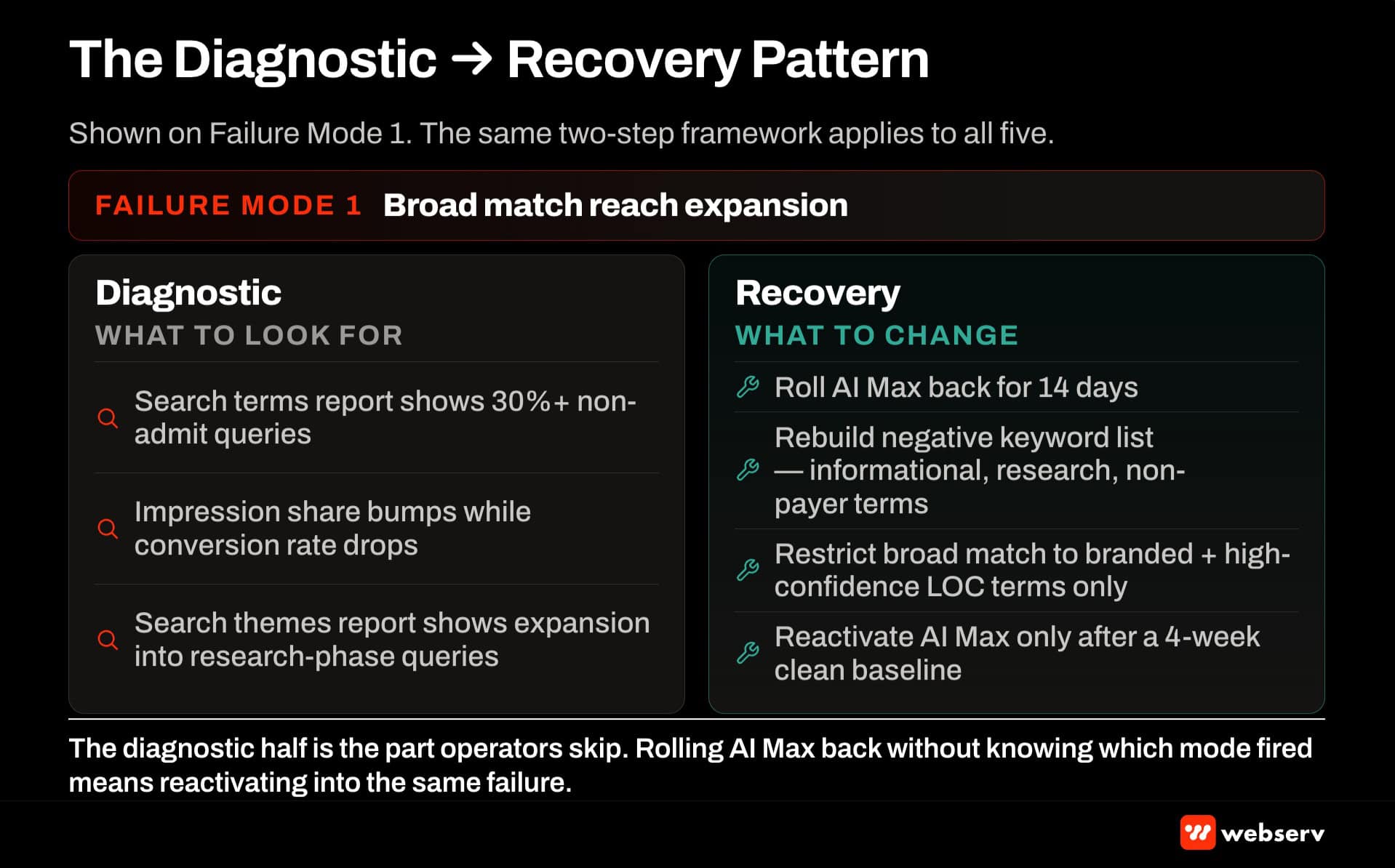
Recovery move
Do not pause AI Max as the first move. First, add the specific queries surfaced in the report to the negative keyword list at the campaign or account level. Then rerun the Search Terms report weekly for 4 weeks, adding new terms to the negatives each week. If after 4 weeks the negative list has stabilized and reach expansion is contained, AI Max stays active. Our negative keyword guide covers the base list every BH campaign should start with before AI Max activation.
Failure Mode 2: Asset optimization generates compliance violations
AI Max includes asset optimization: the system generates ad variations by mixing and matching from the asset library (headlines, descriptions, sitelinks). Each individual asset can pass Google’s BH advertising policy and LegitScript compliance review on its own. Combinations can violate.
The specific pattern: an asset saying “24/7 admissions” combines with an asset saying “we accept most insurance” and an asset saying “get help today,” producing an ad variant that reads as guaranteed same-day admission.
Guaranteed outcome claims violate LegitScript’s addiction treatment advertising standards. The individual assets pass; the combination does not.
Because AI Max rotates asset combinations continuously, the specific variant that violates may run for 6 to 48 hours before Google’s ad review catches it and disapproves. During that window, the ad has already served and produced clicks. Repeated violations across a 30-day cycle produce escalating enforcement action.
Diagnostic pattern
In Google Ads, pull the Assets report at the campaign level. Sort by disapproval count. If any ad variant in the campaign has been disapproved in the last 14 days, and the disapproval reason is behavioral health policy or LegitScript-related, the asset library is producing compliance-risk combinations. The disapproval reason field surfaces which combination triggered enforcement.
Recovery move
Do not pause AI Max. Instead, audit the asset library and remove or rewrite any asset that could combine with another to produce a guaranteed-outcome claim, a specific-recovery-rate claim, or a comparative-superiority claim (“best,” “leading,” “premier”). Our compliant ad headlines guide walks the specific language rules. Then let AI Max continue rotating assets from the cleaned library. Confirm no further disapprovals across the next 30 days.
Failure Mode 3: Conversion signal contamination erodes the CPA target
AI Max leans on conversion signal significantly more than Standard Search with Smart Bidding does. The reach expansion is driven by the model’s inference about which query patterns produce conversions, and that inference is only as good as the conversion signal the model is fed.
Treatment center accounts that treat form-fill submissions, call-center pickups, and completed admissions as the same conversion event feed AI Max a signal that optimizes against the wrong outcome.
A form-fill from a family member researching options 8 weeks before admission has different economic value than an admit-day-arrival, but if both are counted as one conversion, AI Max cannot distinguish between them.
The specific pattern in the data: CPA reported in Google Ads holds or improves, but admits reported in the CRM drop. The gap between the two reports is the signal contamination.
Because AI Max is optimizing hard against the reported conversions, and the reported conversions include a growing share of low-value form-fills, the system pursues cheaper form-fills at the expense of high-value admit inquiries.
Diagnostic pattern
Pull the trailing 90-day conversion count from Google Ads and the trailing 90-day admit count from the CRM. Calculate the ratio each month. If the ratio (admits per reported conversion) is declining month over month while reported CPA is flat or improving, conversion signal contamination is active.
Recovery move
This is the highest-ROI recovery move across all five failure modes. Separate the conversion events by value tier. Admit-day-arrival is Tier 1 (highest value). VOB-completed inquiry is Tier 2. Call-center-scheduled admission is Tier 3. Form-fill is Tier 4. Feed AI Max Tier 1 and Tier 2 only as primary conversions. Move Tier 3 and Tier 4 to secondary conversion action status. Our Meta CAPI HIPAA piece and Google conversion tracking guide both cover the server-side transmission architecture the Tier 1/Tier 2 signal requires.
Signal quality is more important than signal volume. An account with 30 clean admit-day conversions per month outperforms an account with 300 form-fill conversions per month.
The AI Max failure surface at a glance
5
Failure modes producing most AI Max blow-ups in BH accounts
14-21 d
Diagnostic lead time before CRM signal disconnect surfaces
60+/mo
Tier 1 conversions on largest campaign — activation floor
90-120 d
Full rebuild timeline across 3 phases (reset, revalidation, re-layer)
Failure Mode 4: Search Themes bleed into non-admit intent
AI Max’s Search Themes feature lets advertisers signal intent categories to the system without declaring specific keywords. The intent categories then inform the model’s reach expansion. In BH, the Search Themes that operators pick often bleed into query categories that do not produce admits.
A residential SUD facility that adds “recovery” as a Search Theme finds AI Max serving ads on “sober living,” “AA meetings,” “recovery support groups,” and “aftercare” queries.
Each of those is legitimate BH intent, but none of them match a residential SUD admission profile. The Themes feature broadcasts intent categories broadly enough that the model chases queries that do not convert.
The specific pattern: a well-defined ad group targeting “residential rehab in [city]” starts spending on “sober living near me” queries under AI Max. Reported clicks look normal. Reported conversions drop because the query does not match the ad’s admission intent.
Diagnostic pattern
In the Search Terms report filtered to AI Max campaigns, group queries by intent category. If more than 20 percent of impressions are on intent categories different from the declared ad group focus, Search Themes are bleeding.
Recovery move
Remove Search Themes entirely and let the account run on declared keywords + broad match expansion without the Theme signal. Search Themes are the most intent-diffusing feature of AI Max in BH; the benefit does not exceed the cost of the intent bleed for most residential SUD, PHP, and IOP campaigns. Our PMax for BH piece covers the parallel Themes-vs-Search-Terms trade-off on the PMax side.
Failure Mode 5: Incomplete brand exclusions produce branded search cannibalization
AI Max’s reach expansion picks up branded queries: the facility’s own brand terms, competitor brand terms, and adjacent brand-adjacent queries (“hazelden alternatives,” “compare betty ford”). Without proper brand exclusions configured on the AI Max campaign, the branded traffic gets absorbed into the AI Max campaign and out of the branded search campaign.
Two problems result. First, the AI Max campaign cannibalizes traffic that would have converted anyway on the branded campaign (or organically on the facility’s own site). The reported AI Max lift includes conversions that would have happened without the campaign, inflating the perceived ROI.
Second, competitor brand queries served ads that do not comply with Google’s competitor brand policy in BH produce policy enforcement actions.
The specific pattern: AI Max reported CPA looks strong. Branded campaign volume drops in the same period. Total account conversion volume is flat or slightly down. The branded traffic just shifted from the branded campaign to the AI Max campaign, producing no net gain.
Diagnostic pattern
Compare the trailing 60-day branded campaign impressions and clicks to the 60 days prior. If branded campaign volume dropped 15 percent or more in the AI Max activation period, and AI Max campaign impressions include branded terms in the Search Terms report, cannibalization is active.
Recovery move
Add the facility’s own brand terms, all known variations, and the top 10 to 20 competitor brand terms to the AI Max campaign’s brand exclusion list. Rerun the Search Terms report 30 days later to confirm the branded terms no longer surface under AI Max. Restore the branded campaign’s expected volume and confirm total account conversion volume increases.
DO
- Reconcile Google Ads reported conversions against CRM admits every 14 days during the first 90 days of AI Max activation — the disconnect surfaces there before it surfaces in QBR.
- Feed AI Max value-tiered conversion signal (admit-day-arrival Tier 1, VOB-completed Tier 2) with server-side transmission — signal quality beats signal volume.
- Audit assets before combination — remove any headline or description that could combine into a guaranteed-outcome or comparative-superiority claim.
- Add facility brand terms + top 10-20 competitor brand terms to the AI Max campaign’s brand exclusion list before activation — cannibalization is the invisible failure mode.
- Prove the corrected structure on Standard Search + Smart Bidding for 30 days before re-layering AI Max after a rebuild — Standard Search is the revalidation gate.
DON’T
- Activate AI Max on multiple campaigns simultaneously — largest commercial campaign first, prove 90 days, then extend. Parallel activation compounds every failure mode.
- Count form-fill submissions as primary conversions — signal contamination is the single most under-appreciated failure mode.
- Layer Search Themes on a residential SUD account — Themes bleed into sober living, AA meetings, and aftercare intent that does not match admission profile.
- Reflexively pause AI Max at the first sign of trouble — most failure modes recover with tightening, not pausing. Diagnose which mode is active first.
- Activate AI Max as a shortcut for account structure work you have not done — the preconditions are the point, not the feature.
The 90 to 120 day rebuild pattern
When multiple failure modes have compounded and the account requires a full rebuild, the pattern that works runs 90 to 120 days across three phases.
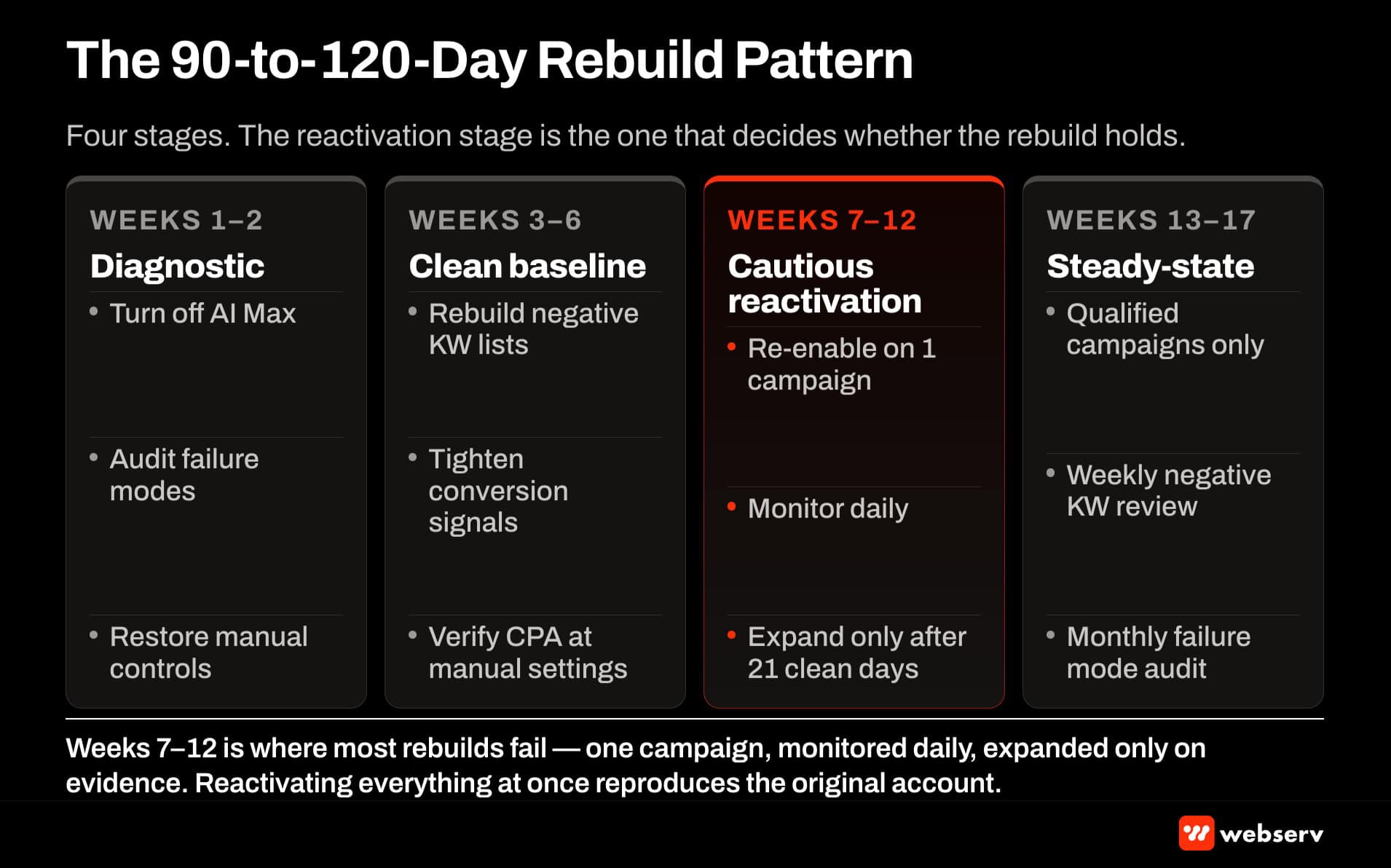
Phase 1 (Days 1-30): Reset. Pause AI Max. Audit conversion tracking and separate conversion events by value tier. Rebuild the negative keyword list from the ground up using the Search Terms reports from the failure period. Clean the asset library of any variant that could combine into a compliance violation. Add brand exclusions.
Phase 2 (Days 31-60): Revalidation on Standard Search. Run the corrected structure on Standard Search with Smart Bidding for 30 days. Confirm the corrected conversion signal, negative keyword list, and asset library produce the expected CPA and admit volume without AI Max activation. This phase proves the structural fixes hold before AI Max gets re-layered.
Phase 3 (Days 61-120): Controlled AI Max re-layering. Reactivate AI Max on the largest commercial campaign only, with the corrected structure in place. Monitor the Search Terms report weekly for the first 4 weeks, then every 2 weeks through Day 120. Confirm reported CPA and CRM admit volume move together.
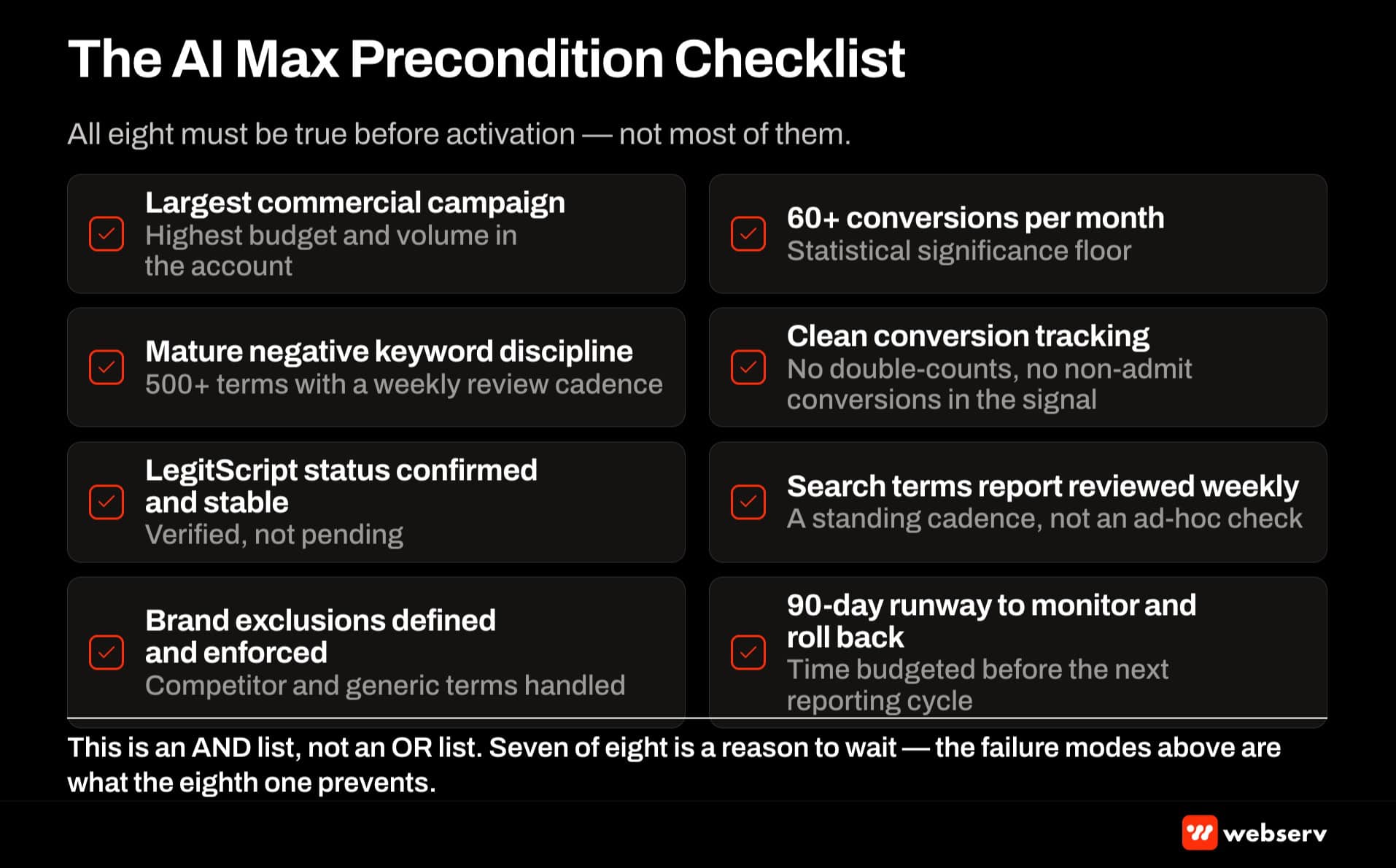
The rebuild pattern assumes the account has the underlying data quality to support AI Max in the first place.
Accounts that do not meet the 60+ conversions per month threshold on the largest campaign, or accounts running on form-fill-only conversion tracking, should not activate AI Max at all until the structural preconditions are met. Our PMax piece covers the parallel precondition frame for the PMax layer.
Frequently asked questions about bidding strategies for treatment-center accounts
My agency says Smart Bidding always wins eventually. Should I just wait it out?
No. The “always wins eventually” framing assumes the account can afford to wait through the learning period. On a treatment-center account spending $7,000 a month, a 3-month learning period at a 40% CPA inflation is $8,400 in lost admission opportunity (assuming a 12-month customer lifetime). That is not a learning cost. That is a tuition payment to Google that an experienced paid search team would not have asked you to pay.
The right test for whether to switch is not “does Smart Bidding eventually win.” It is “does this account currently produce enough conversion volume to feed Smart Bidding without burning a quarter of budget in the process.” Below the threshold, the answer is no regardless of how much patience the agency asks for.
There are accounts where Smart Bidding pays off. They are accounts with 50+ conversions per month, mature conversion tracking, and budget headroom. If yours is not one of those, the agency telling you to wait is selling you a learning period you do not need to pay for.
What about Target Impression Share or Target CPA on a small account?
Target Impression Share has a niche use case for Branded campaigns where you want to defend your trademark and reduce competitor poaching. On non-Branded campaigns at small scale, it is a worse version of Max Clicks because it removes your manual CPC control without adding meaningful optimization.
Target CPA at small scale has the same data problem as Max Conversions. The 30-conversion threshold applies, and below it the algorithm tends to either spend nothing (because no auction looks profitable to it) or spend everything (because the few conversions it does see look profitable enough to chase). Neither outcome is what you want.
The order of operations I run on every small treatment-center account is Max Clicks first, manual CPC bid adjustments based on actual keyword performance, Max Conversions on the single largest campaign once it crosses the threshold, and Target CPA after that campaign has 90 days of stable Max Conversions performance. Compressing that timeline is what most agency mistakes look like.
How does this change if we have multiple locations?
Most treatment centers with multiple locations run one Google Ads account per location, or one account with multiple campaigns segmented by geography. The bidding decision is the same at the campaign level either way. Each location’s campaigns need to clear the 30-conversion threshold independently for Smart Bidding to make sense for that location.
A multi-location operator with 6 facilities will often have 1 or 2 locations that produce enough conversion volume to run Smart Bidding profitably and 4 or 5 that do not. The right move is to run Smart Bidding only where the data supports it and Max Clicks everywhere else. The wrong move is to apply one bidding strategy across all locations because the agency wants to standardize.
The compliance posture also matters at multi-location scale, because LegitScript certification and Google’s healthcare advertising policies apply per advertiser identity. Smart Bidding behavior on a non-certified account or a non-compliant ad set is worse than Smart Bidding behavior on a clean account, because policy issues add another layer of signal noise to the algorithm.
Does this advice change for Performance Max campaigns?
Performance Max is a different conversation because the campaign type is Smart Bidding all the way down by design. You cannot run Max Clicks on Performance Max. The relevant question for PMax on a small treatment-center account is whether you should run PMax at all, not which bidding strategy to use inside it.
For most behavioral health operators under $15,000 a month in paid search spend, PMax is premature. The campaign type works best on accounts with enough conversion volume to feed the cross-surface optimization, and with creative inventory across formats. Most treatment-center operators do not have either, which means PMax tends to produce conversion volume that the agency dashboard celebrates and the admissions team cannot find in the actual intake data. The compliant ad headline and creative discipline that PMax requires is also higher than most operators have built.
For treatment centers running over $20,000 a month with mature ad creative across PMax surfaces, PMax becomes worth piloting. Below that threshold, Search campaigns on Max Clicks remain the safer bet.
When should we actually run the Max Conversions test?
Three triggers. First, your largest campaign has hit 30+ conversions per month for 8 consecutive weeks. Second, the conversion data feeding the campaign is clean (deduplicated phone calls, real form fills, no bot traffic). Third, you have 90 days of budget runway to absorb a learning period without forcing a panic switch back.
When all three triggers are met, run the test on that single campaign with a 25% budget allocation cap. Track cost per admission, not cost per conversion, as the success metric. Compare the 90-day Max Conversions performance to the previous 90-day Max Clicks baseline. If cost per admission improves by 15% or more, the switch is real. If it does not, switch back and keep building data.
Most accounts that pass the three triggers do see real CPA improvement under Smart Bidding. The failure mode is not Smart Bidding itself. The failure mode is starting Smart Bidding before the three triggers are met. If you want a second opinion on whether your account is ready, reach out for a paid-search audit and we can walk through your conversion volume, tracking quality, and budget posture before recommending the bidding move.
The perspective in this article comes from 9 years working exclusively inside behavioral health.
We are a team built by people in recovery who understand that behind every admission is someone asking for help. If that resonates, get to know us.
Mitch Marowitz is the Director of Paid Media at Webserv, a digital marketing agency for treatment centers.