Out-of-network (OON) reimbursement math is the specific calculation most treatment center admissions teams do poorly because the underlying payer rules produce numbers that vary by payer, by state, by patient plan detail, and by facility. It lives inside our eligibility and reimbursement capability. There is no single OON reimbursement number that applies across facilities.
Each facility has to build its own OON reimbursement model based on the specific payer contract language, state balance billing rules, and facility-specific negotiation history that determine what OON claims actually pay.
The pattern I see across facility admissions teams: OON admissions get accepted based on a rough estimate that “this is a good BCBS OON case” without the specific payer-detail math that determines whether the case will actually reimburse.
The eligibility and reimbursement team then works through claim adjudication with the actual payer response, which often produces reimbursement 40 to 70 percent below the initial estimate.
The specific problem the estimate-versus-actual gap creates: admissions teams stop trusting the OON estimates because they know the estimates do not predict actual reimbursement well. Marketing leadership stops trusting the OON pipeline because the projected revenue does not materialize.
Executives eventually push to reduce OON admissions or shift the payer mix, which typically produces the wrong strategic move because the underlying problem is estimation, not the OON opportunity itself.
This piece walks the OON reimbursement math that actually produces useful estimates. The specific payer variables that determine OON reimbursement, the state balance billing rules that affect what facilities can collect from patients, and the facility-specific negotiation variables that produce reimbursement variance.
It also covers the specific calculation framework that produces admit-level revenue estimates, and the measurement pattern that tracks estimate accuracy over time so the model improves. For the broader picture, see our ultimate guide to behavioral health marketing.. Related reading: revenue cycle management guide. and pairs with our sibling pre-admission eligibility verification playbook plus the downstream reimbursement intelligence guide.
Key Takeaways
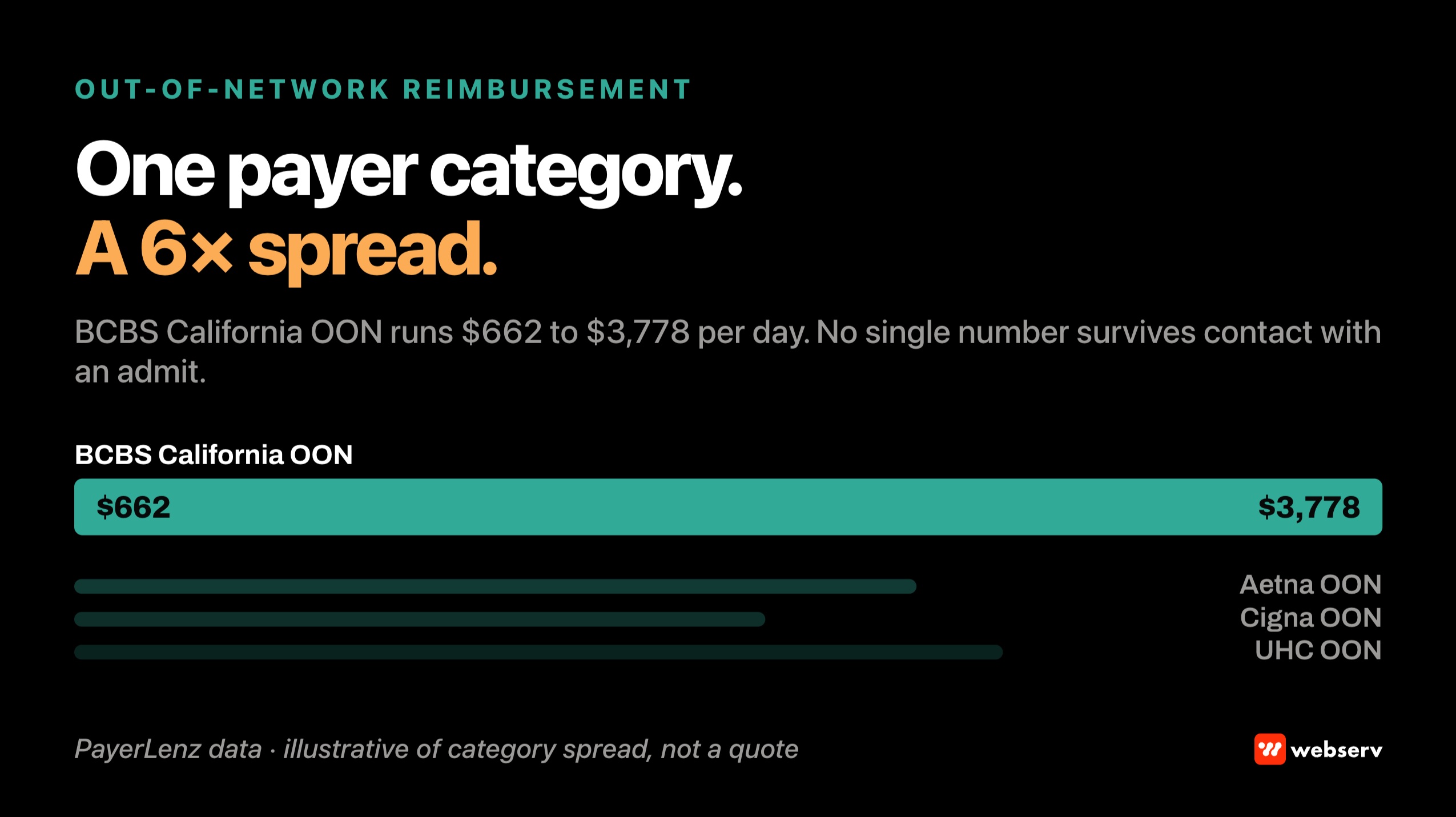
- OON reimbursement math is payer-specific, state-specific, plan-specific, and facility-specific. Single-number OON estimates that treat “OON BCBS” as one category typically produce estimate-versus-actual gaps of 40 to 70 percent because the underlying variables have wide spread. The PayerLenz data on OON BCBS California shows a $662-$3,778 daily spread across the same payer category depending on specific plan and specific facility.
- The specific payer variables that determine OON reimbursement: usual and customary reasonable (UCR) rate for the specific procedure code and geographic area, patient plan OON coverage percentage (typically 50 to 80 percent of UCR), patient OON deductible and out-of-pocket maximum, and payer-specific OON reimbursement methodology (percentile of UCR versus fee schedule versus negotiated rate).
- State balance billing rules determine what facilities can collect from patients above the OON reimbursement amount. Some states (California, New York, Texas, others) restrict balance billing for OON emergency and post-stabilization care under the No Surprises Act plus state-specific extensions. Facilities that assume they can balance bill for the full UCR gap typically produce patient collection issues that reduce net revenue below the payer reimbursement alone.
- Facility-specific negotiation variables include the specific relationship with the payer’s clinical case management team, the specific documentation quality that supports the OON claim, the facility’s specific history of appealed OON denials being overturned, and the specific fee schedule the facility uses relative to UCR benchmarks.
- The calculation framework that produces useful admit-level estimates: payer reimbursement (UCR rate multiplied by plan OON percentage minus patient responsibility) plus patient responsibility collection (deductible plus coinsurance limited by state balance billing rules), summed over expected length of stay, adjusted by facility-specific historical collection rate on similar cases.
DEFINITION
OON reimbursement math for treatment centers. The admit-level calculation that produces a defensible net-revenue estimate for an out-of-network behavioral health admission. Runs on five payer variables (UCR rate for the procedure code and geography, plan OON coverage percentage, deductible and OOP-max status, payer methodology, concurrent review LOS), a state balance-billing overlay (No Surprises Act plus state-specific extensions), and facility-specific negotiation and collection variables tuned against facility historical collection.
Distinct from single-number OON estimates (“this is a good BCBS OON case”), distinct from in-network fee-schedule math (which does not have the UCR and coverage-percentage variance), and distinct from a lifetime-value model (which forecasts multi-episode revenue rather than admit-level reimbursement).
OPERATOR INSIGHT
Admissions teams stop trusting the OON estimates because they know the estimates do not predict actual reimbursement well.
Marketing leadership stops trusting the OON pipeline because the projected revenue does not materialize. Executives eventually push to reduce OON admissions or shift the payer mix, which typically produces the wrong strategic move because the underlying problem is estimation, not the OON opportunity itself. Fix the math first, then decide the mix.
The payer variables that determine OON reimbursement
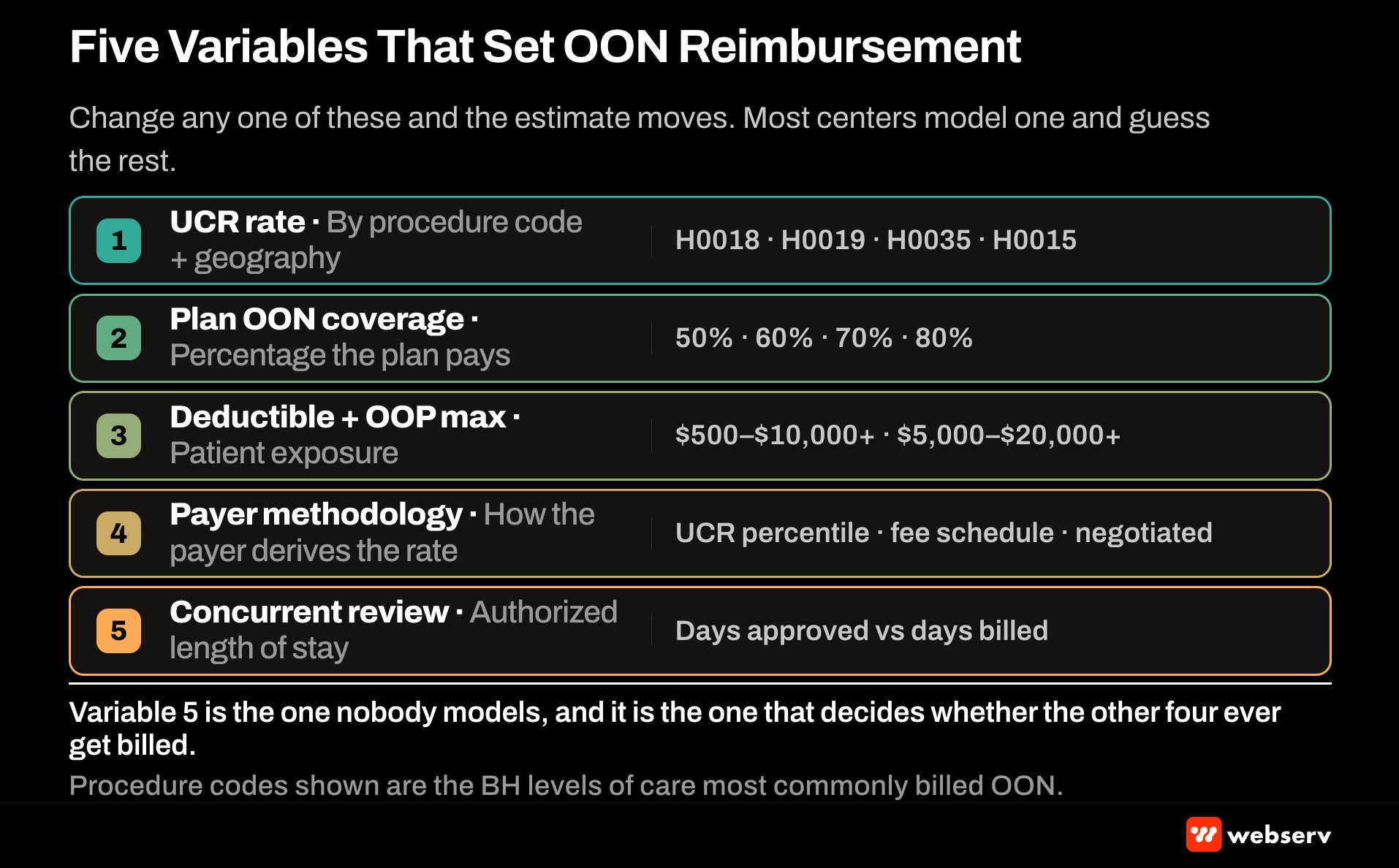
Five payer variables determine what an OON claim actually pays. Each variable has to be resolved specifically for each admission to produce a useful reimbursement estimate.
Variable 1: UCR rate for the specific procedure code and geographic area
UCR is the payer’s benchmark for what “reasonable and customary” charges are for a specific procedure code (H0018 for residential SUD treatment, H0019 for high-intensity residential, H0035 for PHP, H0015 for IOP) in the specific geographic area (defined at the CBSA or MSA level for most payers).
UCR benchmarks vary meaningfully across payers because each payer uses its own UCR methodology. FAIR Health is one common third-party UCR source. Individual payers develop proprietary UCR benchmarks based on claim history in their network.
The PayerLenz data covering 21 states and 227 payer groups shows UCR variance for residential SUD treatment ranges from roughly $600 per day (lower percentile in lower-cost geographies) to roughly $3,800 per day (higher percentile in higher-cost geographies).
Variable 2: Patient plan OON coverage percentage
The specific OON coverage the patient’s plan provides, typically expressed as a percentage of UCR. Common OON coverage tiers: 50 percent of UCR, 60 percent of UCR, 70 percent of UCR, 80 percent of UCR.
Higher OON coverage percentages produce higher payer reimbursement but also correlate with higher patient premiums, which affects patient collection patterns.
Variable 3: Patient OON deductible and out-of-pocket maximum
OON plans typically carry separate deductibles from in-network coverage. OON deductibles range from $500 to $10,000+ per calendar year.
OON out-of-pocket maximums range from $5,000 to $20,000+ per calendar year. Patient responsibility (deductible plus coinsurance) applies against the OOP maximum. Cases where the patient has already met OOP maximum through prior treatment typically produce higher payer reimbursement relative to patient responsibility.
Variable 4: Payer-specific OON reimbursement methodology
Percentile of UCR is one methodology (payer pays a specific percentile of the UCR benchmark). Fee schedule is another (payer pays a fixed rate per procedure code regardless of UCR). Negotiated rate is a third (payer pays a rate negotiated between the payer and the specific facility for OON cases).
The specific methodology has to be identified per admission because it materially changes the reimbursement calculation. Facilities that assume percentile-of-UCR methodology when the payer actually uses fee schedule methodology produce estimate errors of 20 to 50 percent.
Variable 5: Concurrent review outcomes
Payer utilization management concurrent review determines whether the length of stay approved at pre-authorization gets extended, held, or reduced. Reduced length of stay reduces total reimbursement proportionally. Extended length of stay increases total reimbursement but may reduce per-day reimbursement rate.
The OON reimbursement math at a glance
$662-3,778
Daily OON reimbursement spread for BCBS California in PayerLenz data
5
Payer variables: UCR, coverage %, deductible/OOP, methodology, concurrent review
40-70%
Facility patient-responsibility collection rate range for OON admits
85-90%
Estimate accuracy once model is tuned on 200-500 facility-specific admits
State balance billing rules
State balance billing rules determine what facilities can collect from patients above the OON reimbursement amount.
Federal No Surprises Act baseline. The No Surprises Act (effective January 2022) restricts balance billing for OON emergency care and OON care at in-network facilities. BH residential and PHP admissions typically are not classified as emergency care under NSA, so NSA restrictions do not apply broadly to BH OON admissions.
State-specific extensions and restrictions. California, New York, Texas, and other states have enacted state-specific balance billing restrictions that extend NSA to additional care types.
California AB 1611 restricts balance billing for out-of-network emergency and post-stabilization care. New York restricts balance billing for OON care in similar contexts. Facilities operating in states with balance billing restrictions have to model the state-specific limits in the reimbursement calculation.
Practical impact on OON reimbursement math. Facilities that assume they can balance bill patients for the full UCR gap (UCR minus payer reimbursement) typically produce estimates 30 to 60 percent above actual net revenue.
The specific fix: model patient responsibility collection at facility-specific historical rate (typically 40 to 70 percent of gross patient responsibility depending on facility collection process quality), then apply state balance billing restrictions where applicable.
Facility-specific negotiation variables
Facility-specific variables produce meaningful reimbursement variance even for identical payer and patient plan characteristics.
Payer clinical case management relationship. Facilities with established clinical relationships with specific payer UM teams typically produce higher pre-authorization approval rates and higher concurrent review continuation rates than facilities without those relationships. Higher approval rates translate to higher net reimbursement per admit.
Documentation quality supporting OON claims. Payer OON review scrutinizes clinical documentation more aggressively than in-network claim review. Facilities with strong clinical documentation processes (comprehensive ASAM criteria assessments, detailed treatment plans, thorough progress notes) typically produce meaningfully lower OON denial rates.
Appeal history on OON denials. Facility-specific historical appeal overturn rate on OON denials. Facilities with strong appeal processes typically overturn 55 to 65 percent of initial OON denials, adding materially to net collected revenue. Facilities without appeal expertise typically overturn 25 to 40 percent.
Facility charge master relative to UCR benchmarks. The facility’s own fee schedule relative to UCR. Facilities with charge masters aligned to UCR benchmarks (charging at UCR level rather than meaningfully above or below) typically produce cleaner reimbursement patterns because the payer’s percentile calculation does not require adjustment.
DO
- Resolve all five payer variables per admission before quoting reimbursement , UCR, plan coverage percent, deductible/OOP status, payer methodology, and expected LOS from concurrent review.
- Apply state balance-billing rules (California AB 1611, New York, Texas, plus the federal NSA baseline) as a hard cap on collectible patient responsibility.
- Tune the model with facility-specific historical collection rate on patient responsibility (usually 40 to 70 percent) so estimates match actual net revenue, not gross.
- Do patient financial counseling at admission with a written payment plan during treatment , collection rates climb meaningfully vs. post-discharge billing.
- Feed OON estimates and actuals into the reimbursement intelligence layer so marketing can measure contribution-per-admit by paid source, not just cost-per-admit.
DON’T
- Quote a single “OON BCBS” number , daily reimbursement varies by $3,100+ inside that one payer category across plans and facilities.
- Assume payer methodology is percentile-of-UCR when the payer actually pays a fee schedule , 20 to 50 percent estimate error every time.
- Model the full UCR gap as collectible patient responsibility , state balance billing rules and collection reality both reduce it materially.
- Cut the OON program because “estimates are wrong” , the OON opportunity is usually real; fix the estimation before deciding payer-mix strategy.
- Model reimbursement without pre-authorization outcome as a variable , approved LOS is the hard cap on reimbursement days.
The calculation framework for admit-level OON estimates
The specific calculation that produces useful admit-level OON reimbursement estimates.
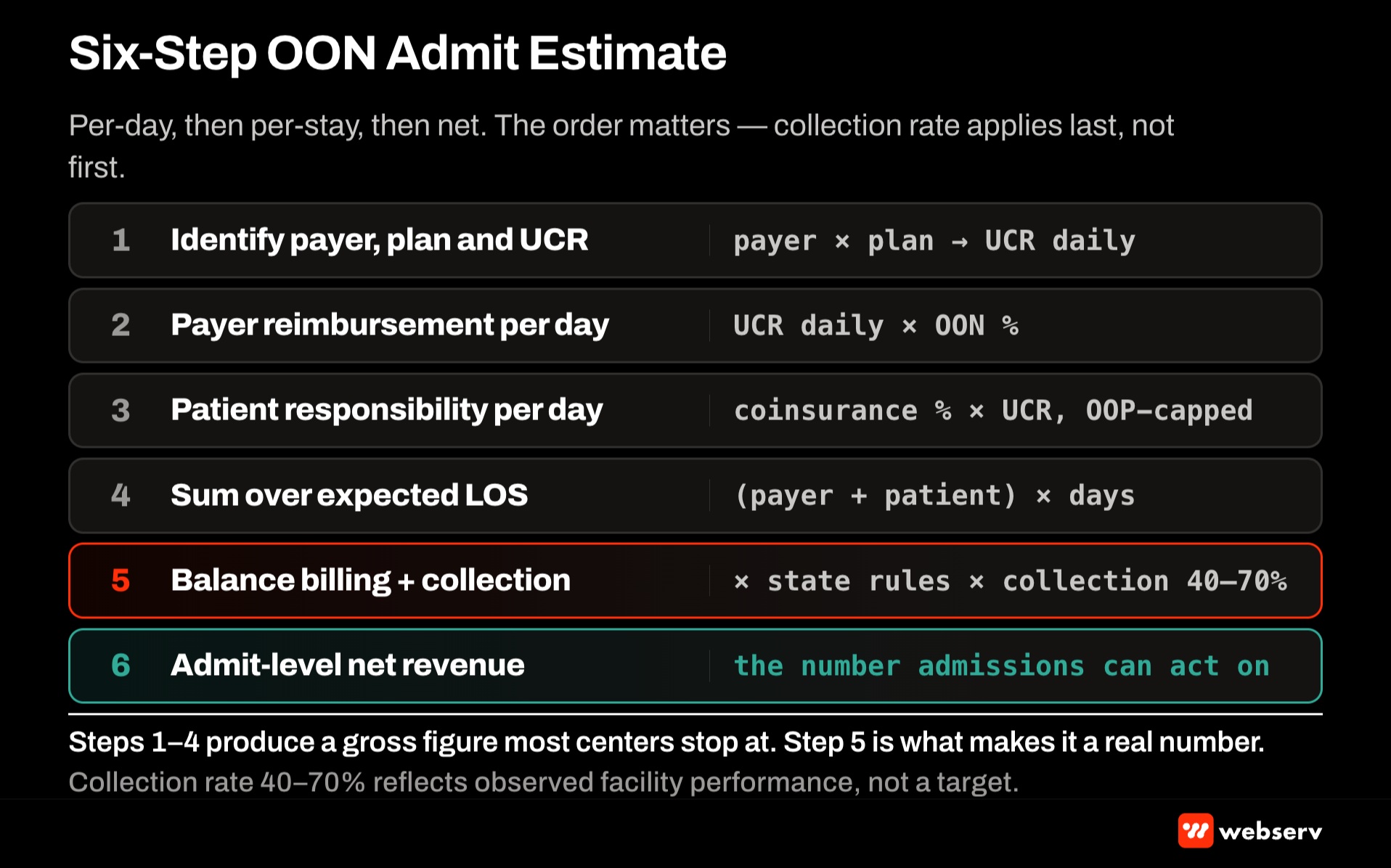
Step 1: Identify payer, patient plan, and UCR benchmark. Confirm the specific payer, patient plan design (OON coverage percentage, deductible status, OOP maximum status), and UCR benchmark for the specific procedure code and geographic area.
Step 2: Calculate payer reimbursement per day. UCR daily rate multiplied by patient plan OON coverage percentage. Example: UCR of $2,000 per day multiplied by 70 percent OON coverage equals $1,400 payer reimbursement per day.
Adjust for deductible status: if the patient has not met the OON deductible, the first several days of admission apply toward deductible rather than producing payer reimbursement. If the patient has met deductible, all days produce payer reimbursement subject to coinsurance.
Step 3: Calculate patient responsibility per day. Coinsurance percentage (typically 20 to 30 percent for OON) multiplied by UCR daily rate. Example: 30 percent coinsurance on UCR of $2,000 per day equals $600 patient responsibility per day.
Apply against OOP maximum: patient responsibility caps at the specific OOP maximum for the calendar year.
Step 4: Sum over expected length of stay. Payer reimbursement per day multiplied by expected LOS. Patient responsibility per day multiplied by expected LOS, capped at OOP maximum. Adjust for expected concurrent review outcomes (typical LOS approval for the specific payer and specific admission profile).
Step 5: Apply state balance billing rules and collection rate. State balance billing restrictions determine what portion of patient responsibility is collectible.
Facility-specific historical collection rate on patient responsibility (typically 40 to 70 percent depending on facility collection process) determines what portion of collectible patient responsibility actually gets collected.
Step 6: Sum to admit-level net revenue estimate. Payer reimbursement plus expected patient responsibility collection equals total admit-level net revenue estimate.
Compare against admission cost to determine admit-level contribution margin.
Frequently Asked Questions
How accurate are OON reimbursement estimates using this framework?
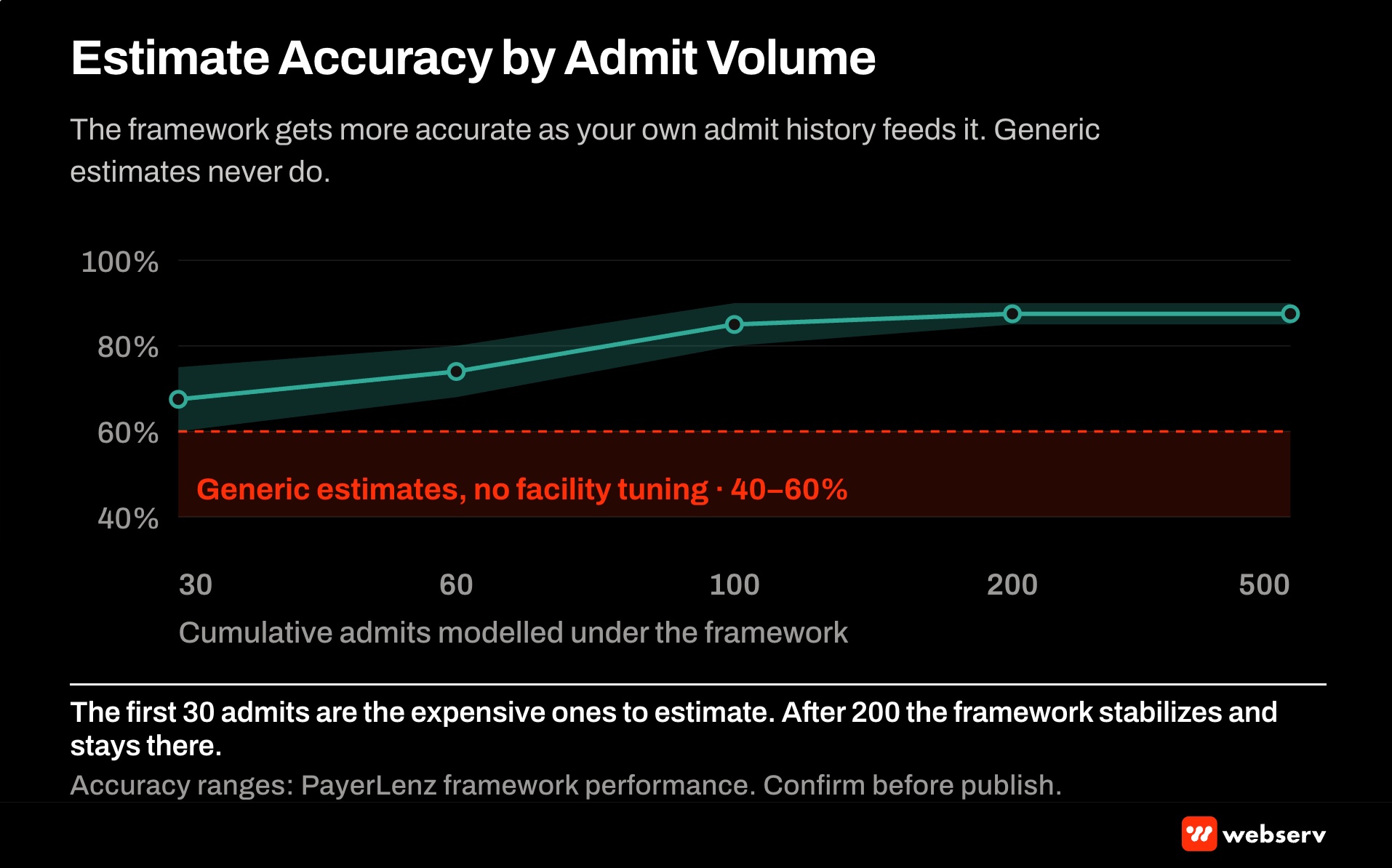
Between 80 and 90 percent accurate at admit level when the framework variables are populated with facility-specific historical data. First 30 to 60 admits after implementing the framework typically produce lower accuracy (60 to 75 percent) because facility-specific historical data has not yet accumulated.
The specific improvement pattern: accuracy improves as the facility accumulates 100+ admits under the framework and the model parameters get tuned against actual reimbursement outcomes. After 200 to 500 admits under the framework, accuracy typically stabilizes at 85 to 90 percent.
Facilities that use generic OON estimates without facility-specific tuning typically produce accuracy in the 40 to 60 percent range, which is why the estimates lose credibility with admissions teams and marketing leadership.
Do we need a reimbursement intelligence platform to run this framework?
Not required but meaningfully helpful. The framework can run as a manual calculation using spreadsheet models, especially for facilities with lower OON admit volume (less than 30 to 50 admits per month).
Reimbursement intelligence platforms (PayerLenz, Availity Reimbursement Intelligence, Change Healthcare’s reimbursement products) automate the UCR lookup, payer rule identification, and facility-specific historical data integration.
Automation matters most for facilities with higher OON admit volume (100+ admits per month) because manual calculation at scale produces error rates that undermine the framework benefits.
How do we handle OON admissions where the patient has multiple insurance coverages?
Coordination of benefits (COB) rules determine primary and secondary payer order. Run the reimbursement calculation for the primary payer first using the framework above.
Then calculate secondary payer coverage of the remaining patient responsibility, which typically follows separate secondary payer OON rules that may or may not treat the primary payer’s payment as patient responsibility.
The specific COB variance: some secondary payers apply their coverage to the amount not paid by primary. Others apply their coverage to the original charges. The difference materially affects secondary payer reimbursement and requires case-specific analysis.
What percentage of our admissions should we take OON?
Depends on payer mix strategy and facility revenue targets. Most treatment center portfolios operate with 40 to 70 percent in-network and 30 to 60 percent OON as a target mix.
Facilities with heavier OON weighting produce higher per-admit revenue but higher revenue variance and higher patient collection complexity. Facilities with heavier in-network weighting produce lower per-admit revenue but more predictable revenue and simpler collection.
The specific decision framework: match payer mix to facility financial risk tolerance and operational capability. Facilities with strong revenue cycle operations can support higher OON weighting. Facilities with limited revenue cycle capability typically produce better outcomes at higher in-network weighting.
How do we improve our facility-specific collection rate on OON patient responsibility?
Three specific improvements that produce meaningful collection rate improvement. First: patient financial counseling at admission rather than at discharge or later. Patients who understand their expected out-of-pocket cost at admission typically produce meaningfully higher collection than patients who learn about the cost after treatment.
Second: payment plan structuring during treatment rather than after discharge. Payment plans initiated during treatment produce higher collection completion rates than payment plans initiated after billing.
Third: patient responsibility documentation aligned to state balance billing rules. Facilities that document patient consent to specific billing terms in advance typically produce lower dispute rates and higher collection rates on OON patient responsibility.
How does the OON reimbursement math interact with the pre-authorization workflow?
Directly. Pre-authorization approval determines whether the payer will reimburse at all. Pre-authorization approved LOS determines the maximum LOS that produces reimbursement.
The specific integration pattern: pre-authorization outcome feeds the LOS variable in the reimbursement calculation. Approved LOS of 14 days translates to 14 days of payer reimbursement in the model. LOS reductions during concurrent review reduce the reimbursement projection proportionally.
Facilities that model reimbursement without pre-authorization outcome as a variable typically produce estimates that assume optimal LOS approval and produce disappointment when actual concurrent review outcomes reduce LOS. Our VOB vs pre-authorization guide walks the specific pre-authorization workflow this math depends on.
How does OON reimbursement intelligence integrate with our overall attribution setup?
The OON reimbursement data feeds the reimbursement intelligence layer of the attribution chain. Marketing spend produces inquiries, inquiries produce admits, admits produce reimbursement (in-network or OON), reimbursement produces contribution margin.
The specific integration point: OON reimbursement estimates plus actuals feed the cost-per-admit and contribution-per-admit measurements that marketing leadership uses to decide paid campaign allocation. Facilities that measure only cost-per-inquiry or cost-per-admit without reimbursement context typically produce paid allocation decisions that ignore the specific revenue economics of different payer mixes.
Our reimbursement intelligence guide covers the downstream measurement layer that integrates OON reimbursement math with paid marketing attribution.
Kyle McHenry is the founder of Revenue Logic and co-founder of PayerLenz and Webserv. His work focuses on the reimbursement intelligence and eligibility workflows that treatment center admissions and billing teams run.