A regional detox operator I know ran a Google Ads audit last spring. Spend was fine. Click-through was fine. Lead volume was fine. What she could not explain was why revenue kept lagging spend by 30 to 40 percent quarter after quarter.
The answer sat inside her phone logs. Forty percent of the calls that hit her admissions line after 5 p.m. Pacific went to voicemail. The families that called back the next morning had already admitted somewhere else.
The marketing did its job. The call center did not exist yet. This is the piece our admission ops team wrote for the operators who need to build one, not just improve one.
It walks the four systems that turn a phone line into a working admissions call center: source-preserving routing, a staffing model sized against real hourly volume, a compliant tool stack, and a QA loop that keeps the whole thing honest.
Key Takeaways
- An admissions call center is not a room with headsets. It is four coordinated systems running in the same clock: source-preserving routing, a staffing model sized against real hourly volume, a compliant tool stack, and a QA loop. Missing any one of the four caps the value of the other three.
- The peak-load hour for behavioral health intake calls is usually early evening weekdays and Sunday afternoons. Most facilities are understaffed at exactly the hour they need coverage most.
- True 24/7 coverage at a 30 to 60 admit-per-month facility usually needs three to five full-time coordinators plus an on-call rotation or contracted overflow, not two people on rotating overtime.
- Missed-call recovery is the single highest-ROI routing change. A voicemail-to-SMS loop with a 15-minute callback SLA can move missed call rate from 15 percent to 1 percent inside eight weeks.
- Source-preserving routing (via CallRail or CallTrackingMetrics) is non-negotiable. Without DNI, the CRM cannot attribute admits to ad spend and cost per admit becomes a guess.
- Every tool in the stack needs a signed BAA and a 42 CFR Part 2-aware access model. If a tool cannot sign a BAA, it does not belong in admissions.
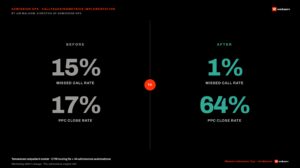
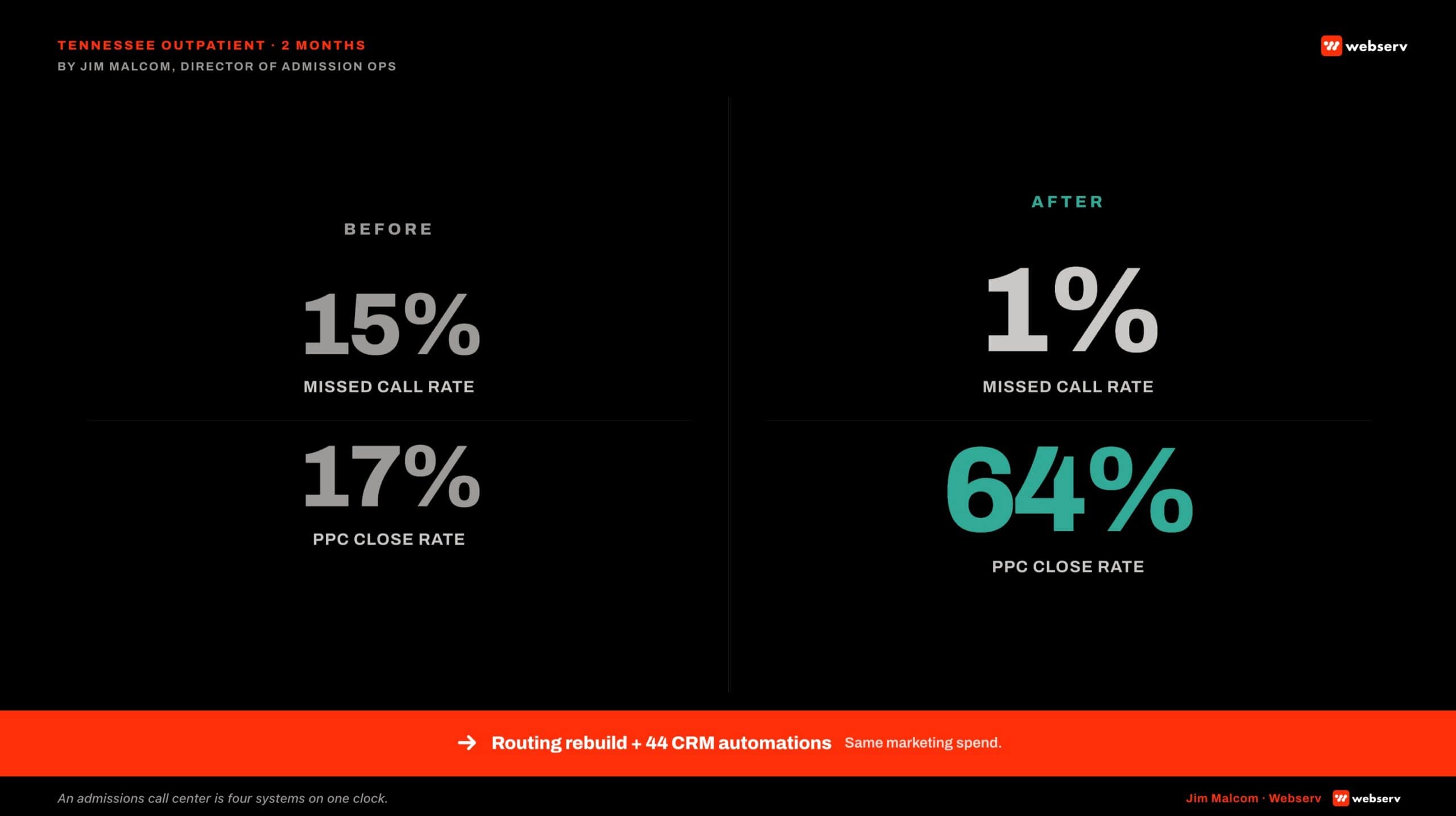
- The two metrics that move first when a call center is built correctly are missed call rate and PPC close rate. A Tennessee outpatient client moved from 15 percent missed to 1 percent, and 17 percent PPC close to 64 percent, in the same two months. The marketing did not change. The admissions engine did.
- Platform choice matters less than pipeline configuration. Kipu, Sunwave, Dazos, and HubSpot all run beautifully or terribly depending on how the stages, automations, and lead scoring are built.
What an Admissions Call Center Actually Is
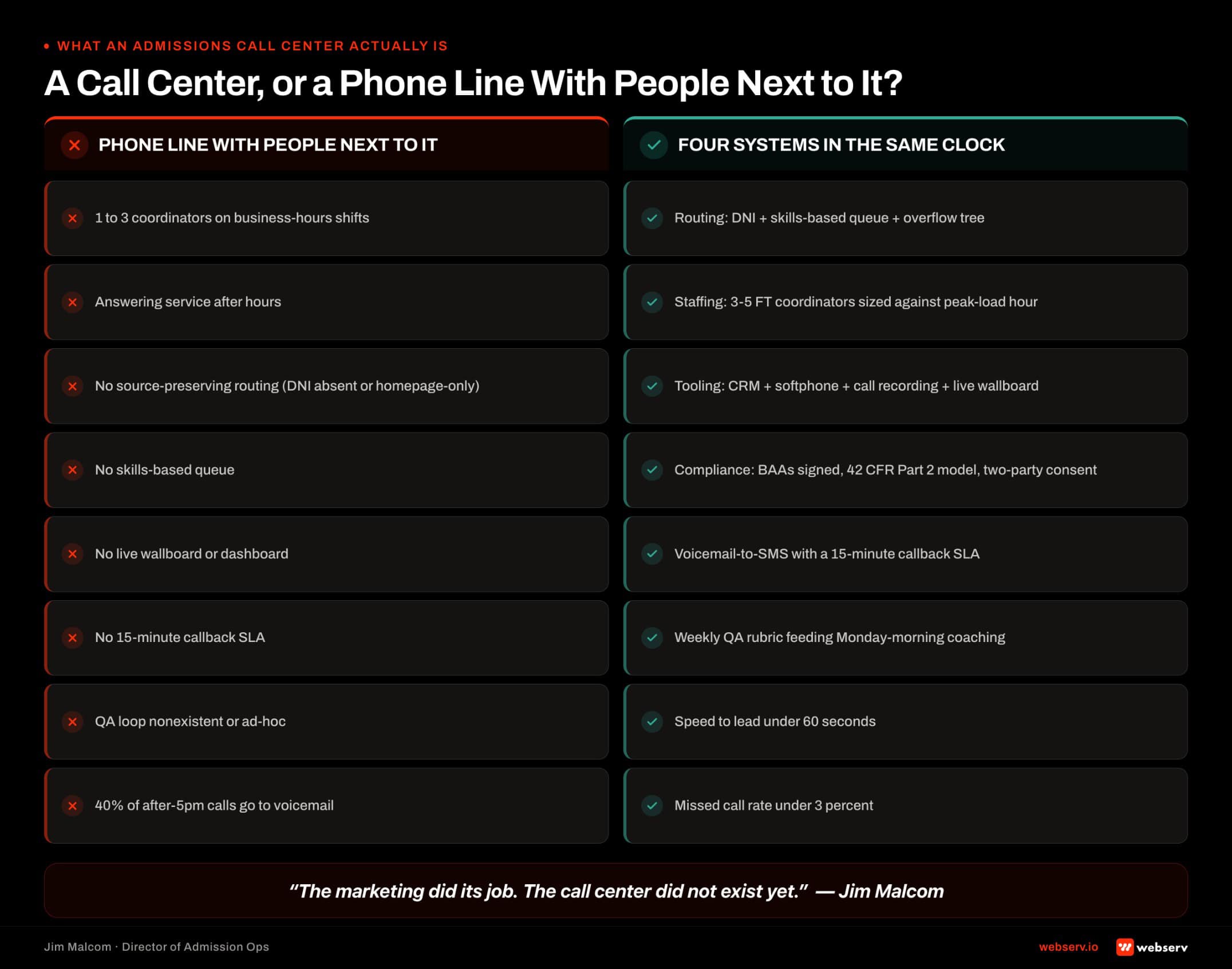
An admissions call center is not a physical room and not a headcount. It is a system that turns an inbound signal (call, form, chat, referral) into a qualified intake conversation inside 60 seconds. Every hour of every day.
The four subsystems that make that possible are routing, staffing, tooling, and compliance. Each system is knowable. Each system is buildable. Each system requires a specific owner with specific weekly discipline. Miss one and the other three lose most of their value.
Most facilities do not run an admissions call center. They run one to three coordinators on business-hours shifts, an answering service after hours, no source-preserving routing, and no real-time dashboard. That configuration is not a call center. It is a phone line with people next to it.
The system this piece describes runs against the sixty-second speed-to-lead standard that shapes how the first minute of every inbound call gets handled. Coordinators pick up. Routing preserves source. Compliance holds up. The QA loop feeds coaching on Monday morning.
The benchmark contrast is stark. A broken funnel converts 2,500 impressions into 3 admits. An optimized funnel converts 2,500 impressions into 8 admits. Same marketing spend. Same clinical program. The difference lives in the four systems below.
The 24/7 Coverage Math
The operator question this section answers is “how many people do I actually need.” The wrong answer is headcount per bed. The right answer is peak-load hour times a shrinkage factor.
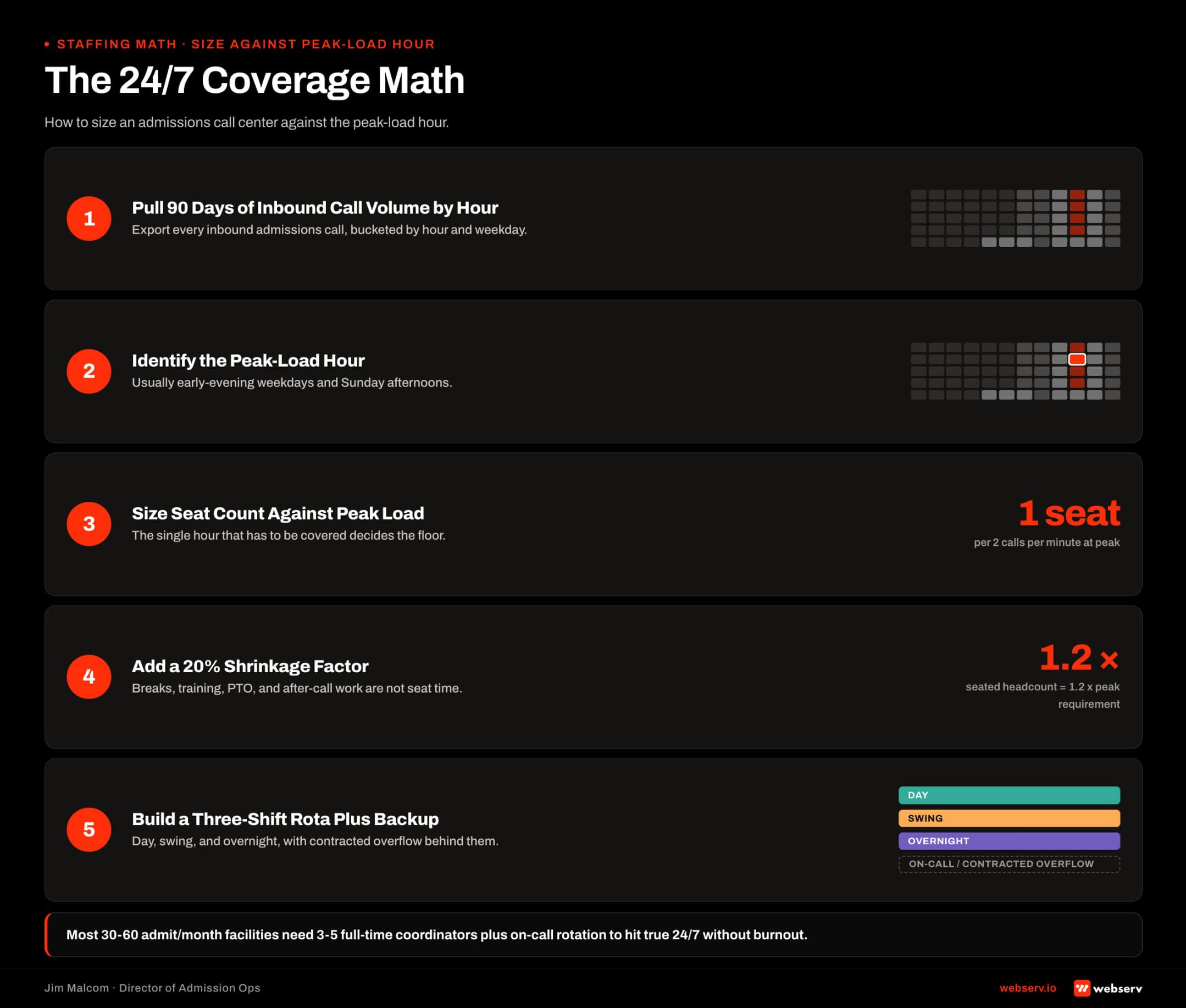
- Pull 90 Days of Inbound Call Volume by Hour. Every phone system produces this report. Segment by hour of day and day of week. This is the input. Everything downstream depends on it. If the current system does not produce the report, that is the first tool problem to solve.
- Identify Peak-Load Hour. Usually early evening weekdays or Sunday afternoons for behavioral health intake. Family research calls, post-work hours, and weekend crisis calls concentrate here. Peak-load hour is the sizing constraint. Off-peak hours can flex down.
- Size Seat Count Against Peak Load. The industry-standard method is the Erlang-C calculation, but the operator-legible version is simpler: target one coordinator seat for every two inbound calls per minute at peak. Detox and residential facilities running 30 to 60 admits per month typically need three to five seats live at peak-load hour.
- Add 20 Percent Shrinkage Factor. Breaks, training, time out of queue, PTO. The seated headcount is 1.2 times the peak-load requirement. Skipping this factor is what produces the two-coordinator hostage dynamic where the same two people cover every weekend.
- Build a Three-Shift Rota Plus Backup. Day, swing, overnight. Weekend coverage. On-call rotation or contracted clinical intake service for overflow. Warm hand-off protocol back to in-house team Monday morning. Callback SLA under 15 minutes on any missed connection.
The honest number: most detox and residential facilities running 30 to 60 admits per month need three to five full-time coordinators plus an on-call rotation to hit true 24/7 without burnout.
Trying to run 24/7 on two coordinators is the coordinator hostage dynamic that stalls most treatment center admissions teams inside 90 days.
The cost anchor: a single lost admit costs $20,000 to $40,000 or more in lifetime value. Missing one after-hours admit per week is $80,000 to $160,000 per month in ceiling revenue that never lands. Coordinator headcount at that math is a rounding error, not a cost center.
Phone and Call Routing Setup
The core stack. CallRail or CallTrackingMetrics (CTM) for dynamic number insertion, source-preserving routing, and call recording. A softphone (RingCentral, Aircall, or the native CTM softphone) for coordinator delivery. A CRM (Kipu, Sunwave, Dazos, or HubSpot) with pipeline stages configured against the admissions workflow.
THE ROUTING TREE IN OPERATOR LANGUAGE
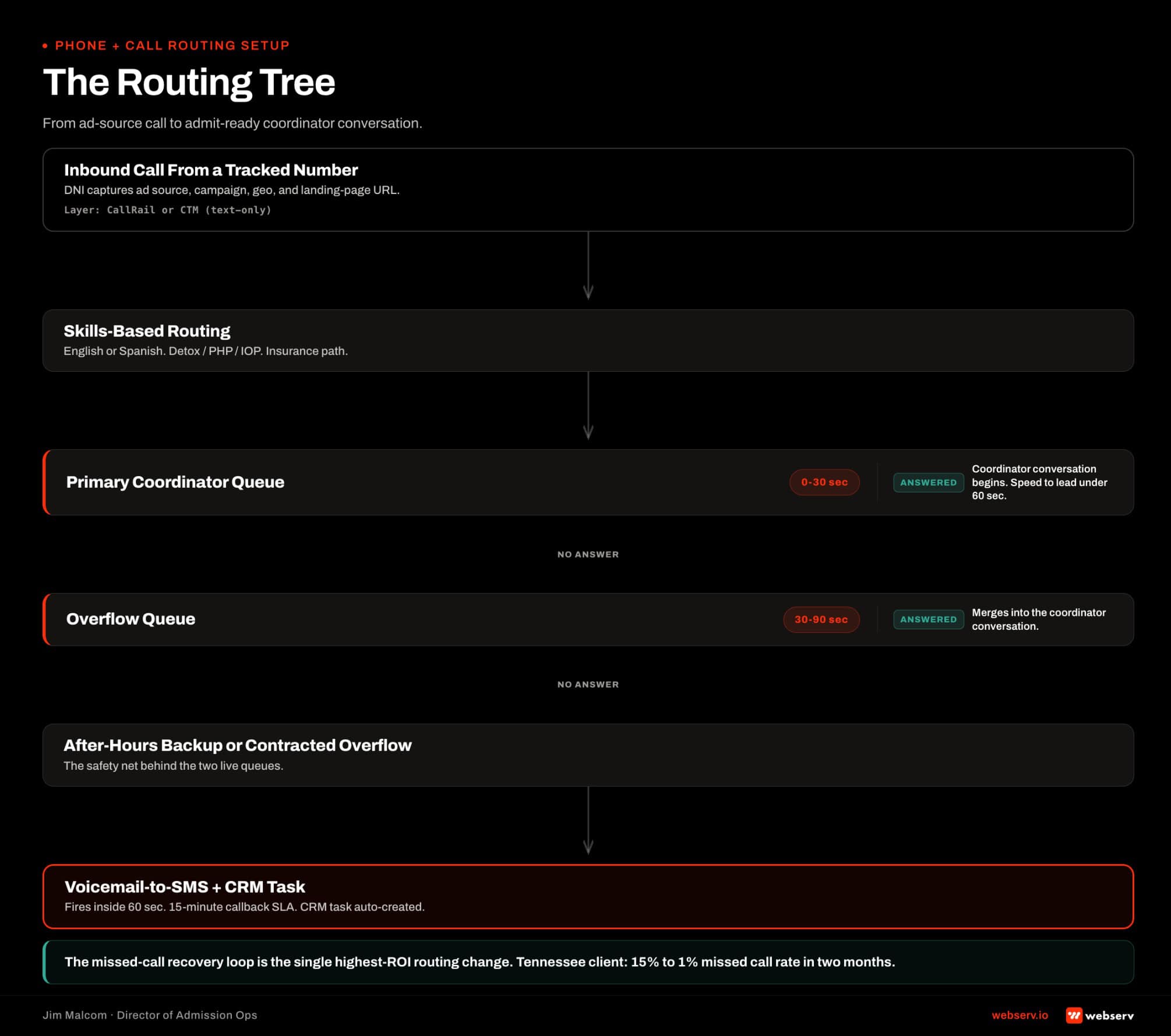
Source-preserving inbound (DNI captures ad source, campaign, geo, LP URL). Skills-based routing to the right coordinator queue (English or Spanish, detox or PHP or IOP, insurance verification path). Primary coordinator picks up. If no answer inside 30 seconds, overflow queue. If no answer inside 90 seconds, after-hours backup or contracted overflow. If no answer at all, voicemail-to-SMS fires inside 60 seconds with a 15-minute callback SLA and a CRM task created. The routing tree is one system, not a policy document.
Dynamic number insertion (DNI) is the layer that preserves source. Every ad source, campaign, and landing page gets its own tracked number, so the source of the call is preserved into the CRM record without the coordinator having to ask.
If DNI is on only the homepage, campaign attribution is broken before the call rings.
The tool-selection decision itself lives in the CallRail vs CTM decision framework. Both platforms handle the routing tree above competently. What matters is not which platform, but which platform is configured against the four subsystems this article describes.
The missed-call recovery loop is the single highest-ROI routing change. On one Tennessee outpatient client, missed call rate fell from 15 percent to 1 percent inside two months on a targeted routing rebuild alone. Same coordinators. Same marketing.
The Team Structure and Staffing Model
Three model archetypes. Each has an honest tradeoff.
In-house. Highest control, highest cost, highest cultural fit with the clinical program. Comp bands for admissions coordinators run $22 to $32 per hour base plus admit-based incentives, higher on the West Coast and in metro markets.
Best fit for facilities with 40 or more admits per month and a director of admissions on payroll.
Outsourced BPO. Lowest cost, fastest to stand up, weakest cultural fit. Reasonable for after-hours overflow only. Not recommended as a primary intake solution for behavioral health. The clinical qualification and family conversation require an operator inside the culture of the facility.
Hybrid. In-house coordinators on business-hours and swing shifts. Contracted clinical intake service for overnight and weekend overflow. Warm hand-off protocol back to the in-house team Monday morning. Best fit for most 20 to 60 bed facilities.
The hybrid model is where most facilities land after they run the coverage math above and see the true peak-load requirement. A director of admissions running one supervisor per five to eight coordinators is the manager-to-IC ratio that scales.
Coordinator retention lives inside the shift structure. Two people rotating weekends burns out inside 90 days. Three to five people rotating with contracted overflow does not. The broader admissions ops framework sits underneath the staffing model and is worth walking against the six-week engagement below.
Tools Stack: CRM, Softphone, Call Recording, Dashboards
Named tools, no vendor pitch. Every tool below is currently deployed at Webserv admission ops clients.
CRM. Kipu, Sunwave, Dazos, or HubSpot with a behavioral-health-specific configuration. Platform choice matters less than pipeline configuration. The same platform runs beautifully or terribly depending on how the stages, automations, and lead scoring are built.
Softphone. RingCentral, Aircall, or the native CTM softphone. Choice depends on integration surface with the CRM and softphone-side call recording quality. Every softphone in the admissions stack needs BAA support.
Call recording and QA. CallRail or CTM native recording piped into a QA tool (Balto, Observe.AI) or a manual QA rubric. The rubric matters more than the tool. Rubric drives the weekly coaching loop.
Dashboards. Live wallboard showing inbound calls waiting, calls answered, average speed to answer, missed call rate. Visible to the admissions floor and to the director. This is the surface that keeps the four systems in sync.
The honest note from the Tennessee case study: the platform (Dazos) was already in place. The problem was configuration, not tooling. Rebuilding the CRM from the ground up with 44 automations across intake, VOB, and referral workflows is what moved the numbers.
The Compliance Layer
Three workstreams every treatment center call center has to solve before it goes live.
42 CFR Part 2. Substance use disorder patient records get a stricter federal confidentiality standard than general HIPAA-covered health information. Call recordings, notes, and CRM records containing Part 2 protected information have to be handled per the 2024 Final Rule (SAMHSA, Confidentiality Regulations FAQs).
BAAs and system-level access controls have to reflect Part 2 not just HIPAA. Retention periods, disclosure logs, and consent capture all fall under Part 2 for any tool touching SUD patient data.
HIPAA. Every tool in the stack (CRM, softphone, call recording, texting, transcription, QA) needs a signed Business Associate Agreement. If a tool cannot sign a BAA, it does not belong in the admissions stack. Full stop.
Consent to record. State-by-state two-party versus one-party consent rules dictate the intro script. The safest posture is a universal two-party consent disclosure at the front of every call, regardless of the state the caller is in. Consent language lives in the routing rule, not in the coordinator’s memory.
The compliance layer is the workstream operators most often push to “later.” Every tool integrated without a BAA is a compliance exposure that gets very expensive very fast if a state AG or HHS Office for Civil Rights takes a look.
Metrics That Prove the Call Center Is Working
The dashboard every treatment center admissions leader should be able to pull on demand.
Missed call rate. Target under 3 percent. Tennessee case study moved from 15 percent to 1 percent in two months. This is the fastest-moving metric on a rebuild.
Average speed to answer. Under 30 seconds during staffed hours. Under 90 seconds during overflow. This is the coordinator delivery metric.
Speed to lead. Form fill to coordinator dial-out under 60 seconds. This is the marketing-to-admissions handoff metric.
Viable VOB rate. Percentage of inbound calls that make it through initial qualification into a VOB submission. This is the coordinator qualification metric.
PPC close rate. Percentage of paid-media calls that convert to admits. Tennessee case study moved from 17 percent to 64 percent in two months.
Cost per admit. Total admissions spend (ads + call center + tools) divided by admits. Recalibrated monthly against actual paid revenue per admit, not gross billed.
After-hours conversion rate. Percentage of after-hours calls that convert to admits within 72 hours. This is the number that surfaces whether the overflow layer is actually working.
Call volume and lead count are the anti-pattern. Both grow when marketing spend grows and say nothing about whether the call center is doing its job.
Patient access and intake process design is one of the highest-impact revenue cycle levers a treatment center operates (HFMA, Revenue Cycle Management). This dashboard is what makes that lever visible.
What a Webserv Engagement Looks Like
The Webserv Admission Ops engagement runs a 6-week sprint against the five pillars of admissions operations.
THE FIVE PILLARS WE BUILD AGAINST
Lead Intake and Tracking. CRM and Workflow Optimization. VOB and Insurance Ops. Team Enablement and Training. Always-On Admissions (ongoing reporting, monthly strategic reviews, workflow optimization). The 6-week sprint stands up the first four pillars. The Always-On retainer keeps all five running.
- Week 1, Onboard and Audit. Kickoff workshop, intake assessment, gap map, audit findings, and implementation roadmap. This is where the 90-day call volume report gets pulled and the peak-load hour gets identified.
- Week 2, Lead Tracking. Call tracking numbers and routing configured (CallRail or CTM), form and chat capture wired, source mapping into CRM, lead scoring framework drafted, call QA process stood up.
- Week 3, CRM Pipeline. Pipeline stages built. Automations for status changes and task assignments deployed. Early pipeline reporting activated.
- Week 4, VOB Workflow. VOB request process mapped and integrated into the CRM. Status tracking and notifications activated. Follow-up SOPs finalized.
- Weeks 5-6, Training and Launch. Scripts and qualification playbooks finalized. Rebuttal and objection handling resources built. QA feedback loops activated. Team training sessions run with the admissions floor.
Pricing. One-time setup and Admission Ops fee runs $7,500 to $15,000 depending on center size, CRM complexity, and integration scope. Ongoing retainers tier by location count: $3,500 to $5,000 per month for 1-2 locations, $5,000 to $8,000 per month for 3-5 locations, $8,000 to $15,000 per month for 6+ locations.
The Fast-Track Diagnostic is the low-friction entry: $3,000, credited 100 percent toward month one if the facility moves forward. Three-day audit of the current routing, staffing, tooling, and compliance layer. Delivers a gap map, prioritized punch list, and clear yes-or-no on whether the current stack should stay or be rebuilt.
For less than the cost of one admissions rep, treatment centers get an entire ops framework and team keeping the admissions engine running and growing. Webserv has served 200+ treatment centers and is featured on Semrush, HubSpot, and CallRail.
Frequently Asked Questions
Who helps treatment centers build an admissions call center?
Webserv builds admissions call centers for treatment centers as part of the Admission Ops engagement. The work covers routing setup, staffing model design, CRM configuration, tool stack selection, QA loops, and compliance layer buildout. The 6-week sprint delivers a working call center at the end of week 6, with an ongoing retainer keeping it optimized.
Most treatment centers already own the tools they need. Kipu or Dazos or Sunwave is usually in place. CallRail or CTM is often already contracted. The problem is almost never tooling. The problem is that no one has been accountable for the configuration, the shift math, the automations, and the QA loop that make the tools work together.
The engagement puts one team on all four systems at once for six weeks, then hands the running call center back to the facility with a monthly review cadence. Facilities that want to see the gap first can start with the $3,000 Fast-Track Diagnostic.
How many admissions coordinators do I need to cover 24/7 at my treatment center?
Most detox and residential facilities running 30 to 60 admits per month need three to five full-time admissions coordinators plus an on-call rotation or a contracted overflow service to hit true 24/7 without burning out staff. The exact count depends on inbound call volume by hour, peak-load pattern, and whether overflow is in-house or contracted.
The right math is not headcount per bed. It is peak-load hour times a shrinkage factor. Pull the last 90 days of inbound call volume by hour, identify the peak-load hour (usually early evening weekdays or Sunday afternoons for behavioral health), size the seat count for that hour at roughly one seat per two calls per minute, then apply a 20 percent shrinkage factor for PTO, breaks, and training.
Facilities that skip this math and try to run 24/7 on two coordinators end up in the failure mode where the same two people cover every weekend, burnout hits inside 90 days, and the missed-call rate creeps back up quietly.
What is the best phone and call routing setup for a rehab admissions team?
The core stack is CallRail or CallTrackingMetrics for dynamic number insertion and source-preserving routing, a softphone (RingCentral, Aircall, or the native CTM softphone), and a CRM (Kipu, Sunwave, Dazos, or HubSpot) with pipeline stages configured against the admissions workflow. The tool-selection decision itself is covered in the CallRail vs CTM decision framework.
Every ad source, campaign, and landing page gets its own tracked number, so the source of the call is preserved into the CRM record without the coordinator asking. Skills-based routing sends English or Spanish, detox or PHP, and insurance-verified or self-pay calls to the right queue.
Overflow routes to a secondary queue and then to a voicemail-to-SMS loop with a 15-minute callback SLA. The missed-call recovery loop is the single highest-ROI change. On one Tennessee outpatient client the missed call rate fell from 15 percent to 1 percent inside two months on a targeted routing rebuild alone.
Should I build my admissions call center in-house or outsource it?
Most 20 to 60 bed facilities are best served by a hybrid model: in-house coordinators on business-hours and swing shifts, with a contracted clinical intake service for overnight and weekend overflow, and a warm hand-off protocol back to the in-house team Monday morning. Full outsourcing to a generic BPO usually breaks against the qualification depth admissions calls require. The hostage dynamic that stalls understaffed teams is the failure mode facilities hit when they under-invest here.
Fully in-house is the right model for facilities running 40+ admits per month with a director of admissions on payroll and the budget to carry three to five coordinators. Comp bands run $22 to $32 per hour base plus admit-based incentives, higher in West Coast and metro markets.
Pure BPO outsourcing is reasonable for after-hours overflow only. As a primary intake solution it degrades the qualification conversation and rarely holds up against a facility that answers with a real coordinator in the culture.
How do I stay compliant with 42 CFR Part 2 and HIPAA when recording admissions calls?
Every tool in the stack (CRM, softphone, call recording, texting, transcription, QA) needs a signed Business Associate Agreement. If a tool cannot sign a BAA, it does not belong in the admissions stack. Call recordings and CRM records containing substance use disorder information get 42 CFR Part 2 protection on top of HIPAA.
The 2024 42 CFR Part 2 Final Rule (phased through 2026) tightened consent, disclosure, and record-handling standards for substance use disorder patient records. Access controls, retention policies, and BAA language have to reflect Part 2, not only HIPAA.
Consent to record varies by state (one-party versus two-party). The safest posture is a universal two-party consent disclosure at the front of every call, regardless of the state the caller is in.
What metrics prove an admissions call center is actually working?
The dashboard every treatment center admissions leader should be able to pull on demand: missed call rate (target under 3 percent), average speed to answer (under 30 seconds during staffed hours), speed to lead (under 60 seconds), viable VOB rate, PPC close rate, cost per admit, and after-hours conversion rate.
Call volume and lead count are not enough. Both grow when marketing spend grows and say nothing about whether the call center is doing its job.
The two numbers that move first when a call center is built correctly are missed call rate and PPC close rate. On one Tennessee client both moved sharply inside two months on routing and CRM rebuilds alone.
Cost per admit gets recalibrated monthly against actual paid revenue per admit, not gross billed. That single discipline usually reveals which paid-media campaigns are producing viable-but-unprofitable admits, and where the admissions engine is quietly leaking margin.
Call volume and lead count are not enough. Both grow when marketing spend grows and say nothing about whether the call center is doing its job.
The two numbers that move first when a call center is built correctly are missed call rate and PPC close rate. On one Tennessee client both moved sharply inside two months on routing and CRM rebuilds alone.
Cost per admit gets recalibrated monthly against actual paid revenue per admit, not gross billed. That single discipline usually reveals which paid-media campaigns are producing viable-but-unprofitable admits, and where the admissions engine is quietly leaking margin.
Closing Note From the Admission Ops Floor
A missed call at 9 p.m. on a Sunday is not a missed call. It is a family that admitted somewhere else by Monday morning.
The math on a treatment center admissions call center is not about headcount and headsets. It is about whether the four systems (routing, staffing, tooling, compliance) are running in the same clock every hour of every day.
Build them right once. Instrument them so the leadership meeting stops arguing about whose report is correct. Then keep them optimized.
If you want the Webserv team to build or rebuild your admissions call center, start with the $3,000 Fast-Track Diagnostic (credited 100 percent toward month one if you engage) or book an intro meeting with the Webserv admission ops team.
Jim Malcom is Director of Admission Ops at Webserv. He has spent his career inside behavioral health admissions operations (call floors, VOBs, CRMs, and the reporting stack that ties them together) and now leads the Webserv admission ops practice for treatment center operators nationwide.