Service pages are the load-bearing commercial asset on every treatment center site. They rank on the highest-intent queries. They receive the highest-value organic traffic. They are the pages that convert admits.
Most facilities under-invest in the rubric that makes service pages work.
The pattern our content SEO team audits repeatedly: a service page pulling 800 monthly organic sessions with 4 conversions. The page ranks. The traffic arrives.
The page does not convert because the seven components that separate a service page that converts from a service page that leaks traffic are either missing or misconfigured.
This piece is the seven-component rubric our team runs on every service page in every treatment center engagement. Each component has a specific pattern that works, a specific failure mode when it is missing, and a specific measurement signal that surfaces whether the component is operational.
Applied cleanly across the primary service pages of a treatment center site, the rubric produces session-to-lead conversion rates of 2 percent or higher within 60 to 90 days of remediation.
It sits inside Tier 3 of the 5-Tier SEO Priority Framework we run on client engagements and complements our landing page 10-element checklist covering the paid-lander side of the conversion pathway.
Key Takeaways
- Service pages are the highest-intent commercial pages on a treatment center site. They rank on branded queries, category queries, and geography-specific queries. They convert admits. Most facilities produce service pages that rank without converting because the seven-component rubric that makes conversion happen is either missing or misconfigured.
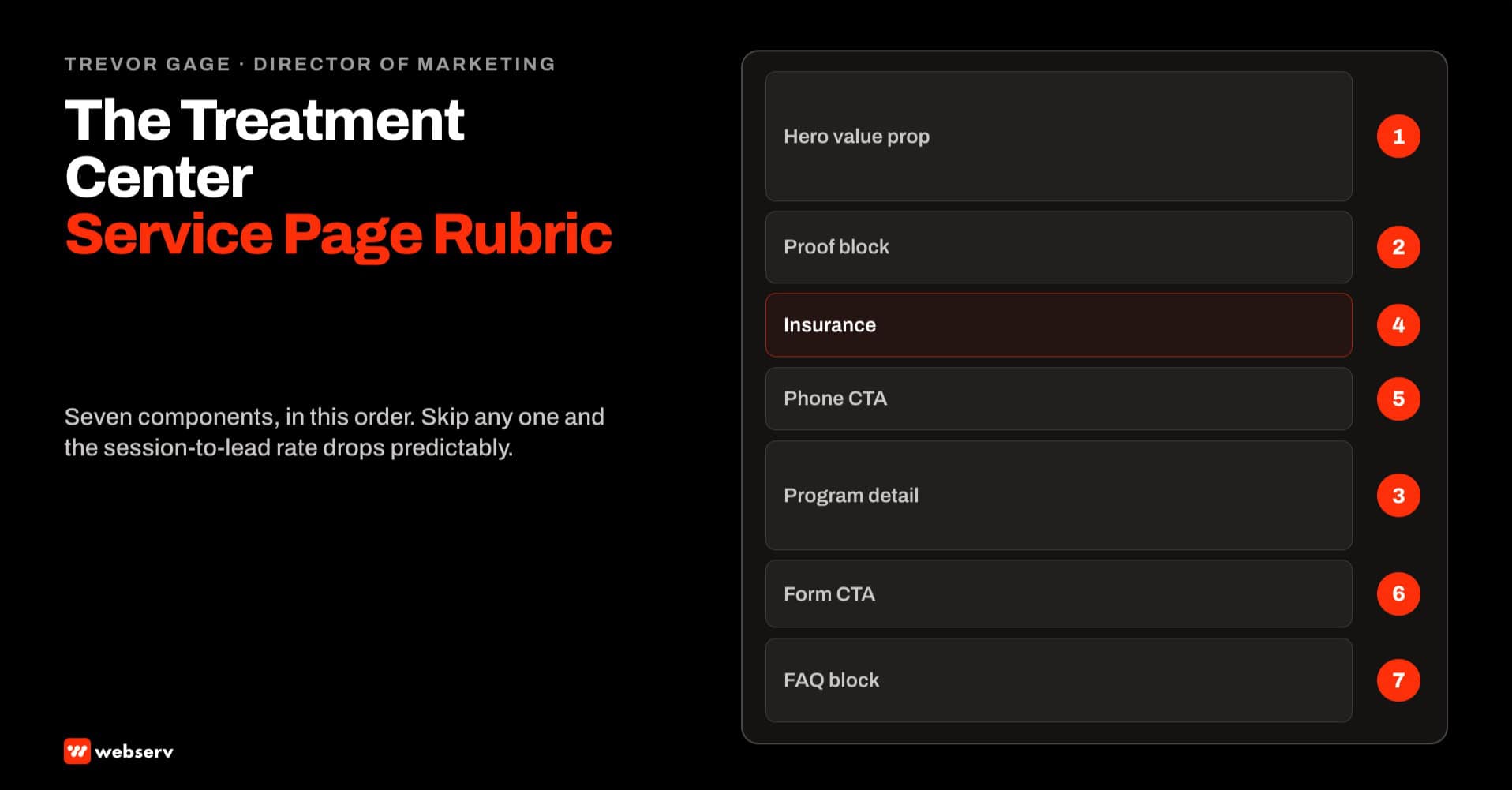
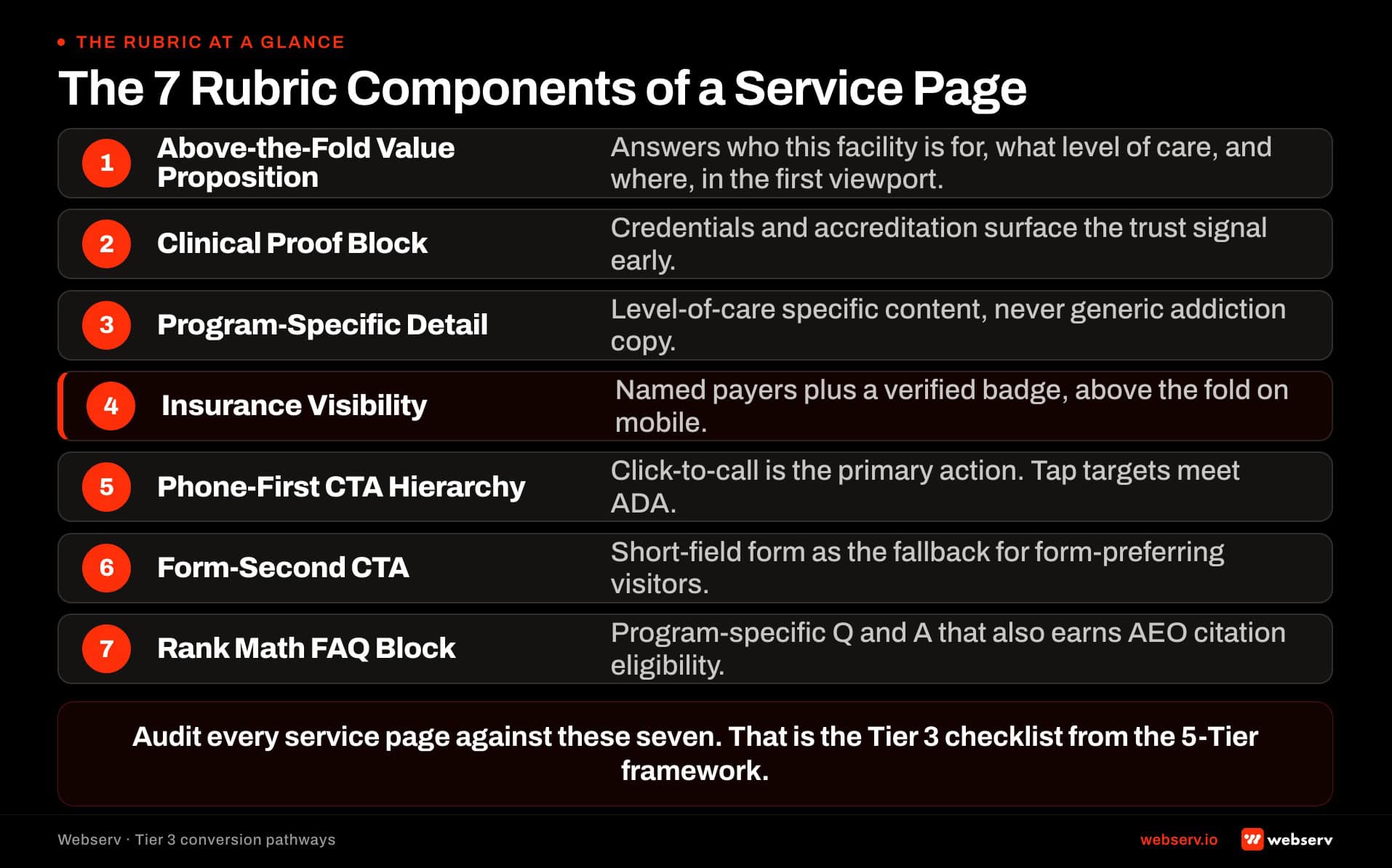
- The seven components: above-the-fold value proposition matched to query intent, clinical proof block with credentials and accreditation displays inline, program-specific detail covering what the LOC or modality actually includes, insurance visibility with payer list and VOB CTA, phone-first CTA hierarchy with mobile tap targets, form-second CTA with 3-5 fields, and Rank Math FAQ block with program-specific questions.
- The load-bearing component is the above-the-fold value proposition. It has 4-8 seconds of visitor attention before the visitor either scrolls or leaves. The proposition has to answer the specific query intent the page ranks on, not the general category the service belongs to.
- Session-to-lead conversion rate is the primary measurement signal for the rubric. Healthy service pages produce 2 percent or higher conversion. Rates below 1 percent signal that one or more rubric components are broken. Rates above 3 percent typically indicate strong rubric compliance plus favorable query intent alignment.
- Common failure modes: generic value propositions that could apply to any facility, clinical proof buried below the fold, insurance visibility missing or hedged, phone number not tap-target-sized on mobile, form fields exceeding 5, FAQ block absent or missing schema markup, and service pages reused across multiple query intents rather than one page per commercial offering.
DEFINITION
Service page rubric. A 7-component quality standard for treatment center organic service pages that produces session-to-lead conversion at 2 percent or higher within 60-90 days of remediation. Value proposition matched to query intent, clinical proof block inline, program-specific detail, insurance visibility, phone-first CTA hierarchy, form-second CTA, and Rank Math FAQ block with program-specific questions.
Distinct from landing page rubrics (paid direct-response with different intent state) and distinct from blog content standards (informational, top-of-funnel). Operates as Tier 3 (Conversion Pathways) execution work inside the broader 5-Tier SEO Priority Framework. Cannot produce full returns unless Tier 1 (technical foundation) and Tier 2 (local presence) are already cleared.
OPERATOR INSIGHT
A service page pulling 800 monthly organic sessions with 4 conversions is not a traffic problem.
It is a rubric problem. The page ranks. The traffic arrives. The page does not convert because the seven components that separate a service page that converts from a service page that leaks traffic are either missing or misconfigured. Buying more traffic against a broken rubric multiplies the leak.
Component 1: Above-the-fold value proposition
The above-the-fold value proposition is the first 40-80 words of body content on the service page. It sits inside the hero section and answers the question a family arriving from a specific query wants answered immediately. The companion homepage rubric applies the same scoring to brand-search visitors.
The pattern that works. State what the program is (LOC and clinical focus). State who it serves (target population). State one differentiator that separates this facility’s version of the program from generic category answers. State the geographic scope. All four in 40-80 words. The visitor should be able to read the value proposition and know within 4-8 seconds whether the page is worth continuing to read.
Query-intent matching. The value proposition has to match the specific query intent the page ranks on. A page ranking on “residential rehab in Scottsdale” needs a value proposition that references residential, Scottsdale, and the specific type of care. A page ranking on “dual diagnosis PHP” needs a value proposition that references dual diagnosis, PHP, and the specific clinical integration between the two.
Failure mode. Generic value propositions that could apply to any facility, in any geography, for any LOC. Visitors arriving from specific queries see generic content and either scroll to find the specific detail (which the failure mode often does not include) or leave.
Measurement signal. Time-on-page above 45 seconds indicates the visitor engaged past the hero. Time-on-page below 20 seconds combined with bounce above 60 percent indicates the value proposition did not match query intent.
Component 2: Clinical proof block with credentials and accreditation
The clinical proof block sits within the first 200-400 words of the page (above the fold ideally, immediately below the hero at minimum). It displays clinical credentials and accreditation displays inline rather than in the footer.
The pattern that works. Named clinical leadership with credentials (Medical Director MD, Clinical Director LMFT). Facility accreditation displays inline (JCAHO, CARF, LegitScript, state license). Length of operation (“licensed since [year]”). Specific clinical framework or evidence-based approach referenced by name.
Why the placement matters. Trust signals delivered above the fold produce the second reading beat on the page (after the value proposition). Families researching treatment operate under high skepticism because the category has a documented history of predatory operators. Inline trust signals establish credibility before the visitor has to invest more attention.
Failure mode. Trust signals buried in the footer where visitors reach them only after fully evaluating the page. By that point the skepticism has either been resolved through other signals or the visitor has already left.
Measurement signal. Bounce rate below 50 percent on organic landing sessions indicates the trust signals are engaging visitors past the hero. Bounce above 65 percent typically indicates trust signals are missing or placed too late in the page.
Component 3: Program-specific detail
Program-specific detail covers what the LOC or modality actually includes at this specific facility. Not generic category description. Facility-specific programmatic content.
The pattern that works. Length of stay range (with the “typical” versus “extended” distinction if applicable). Clinical hour ranges per week. Named clinical modalities offered (CBT, DBT, EMDR, MAT, family therapy) with 1-2 sentences per modality explaining how it applies at this facility. Family involvement structure. Discharge planning approach. Aftercare integration.
Why the specificity matters. Category-authority sources (SAMHSA, NIMH, Mayo Clinic) cover generic program descriptions well. A facility service page competing with those sources needs to describe what the specific program offers in a way category-authority sources cannot. Named modalities, named clinicians, specific length of stay ranges are the operator-specific detail that AI answer surfaces cite over generic category content.
Failure mode. Generic program descriptions that duplicate category-authority content. The service page rank drifts because AI systems and search engines cannot differentiate the page’s authority from the underlying category source.
Measurement signal. Non-brand organic traffic on the specific page holds or grows over quarters. Non-brand traffic degrading suggests category-authority sources are outranking the page on the generic queries the page targeted.
Component 4: Insurance visibility
Insurance visibility is the payer list displayed on the service page with the appropriate “commonly accepts” or “in-network” language depending on the facility’s current contract status.
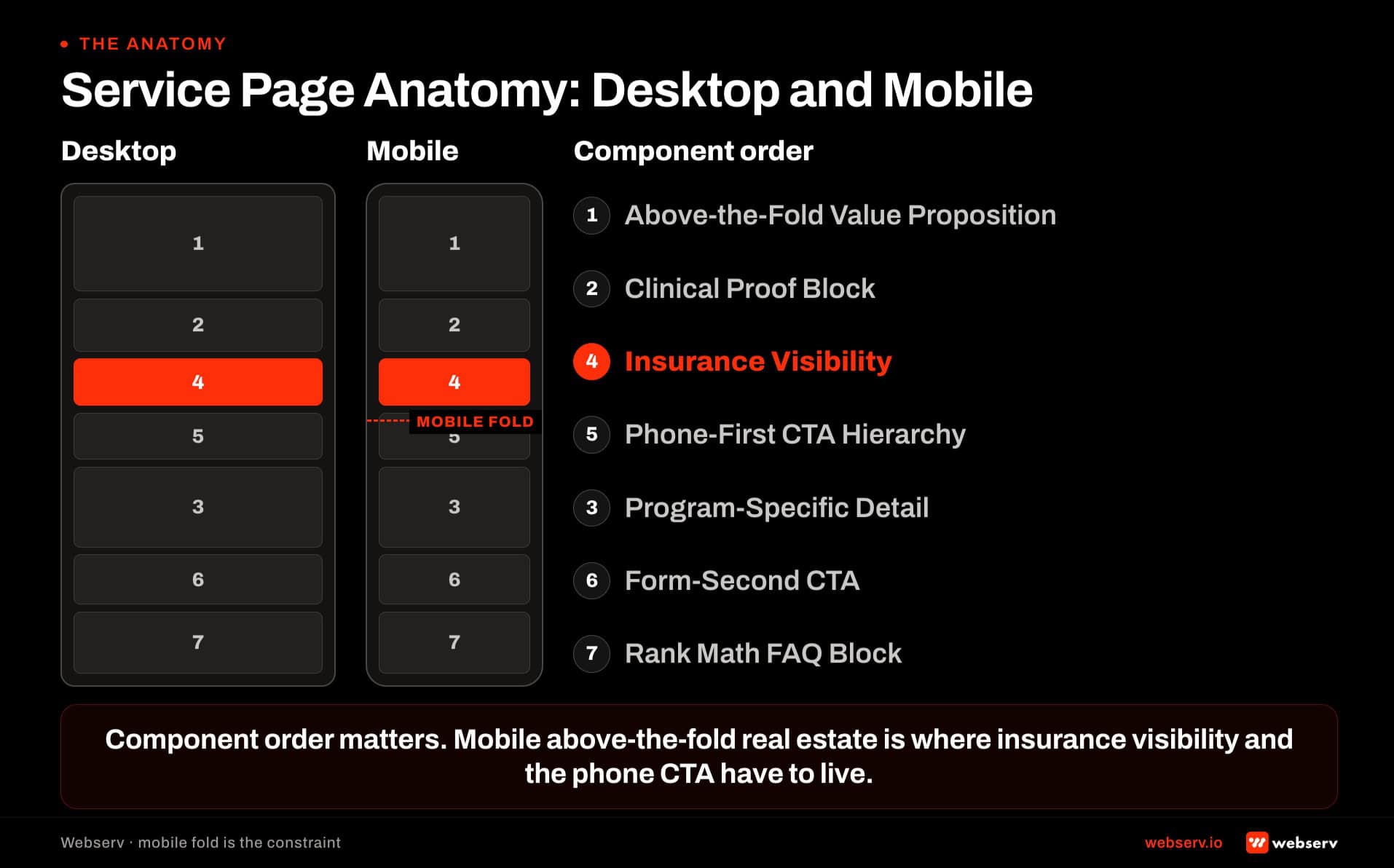
The pattern that works. Named payer list (Aetna, BCBS, Cigna, UHC, Anthem, Kaiser, Beacon Health Options, plus regional payers relevant to the facility’s state). “Commonly accepts” language for payers with facility-verified acceptance patterns. “In-network with” language only for payers with active contract verification. Clear VOB CTA that routes visitors to the verification flow.
The compliance layer. Publishing “in-network with [payer]” without active contract verification is a misrepresentation risk. Insurance status changes. Contracts lapse. Verification cadence should run monthly for the payers listed on the service page.
Failure mode. Insurance visibility missing entirely (families cannot self-qualify), or insurance visibility hedged with “call for coverage” language that produces call volume from unqualified prospects, or insurance visibility publishing outdated contract status.
Measurement signal. Form completion rate on the insurance verification CTA. Healthy pages produce 15-25 percent form completion rate on visitors who reach the CTA. Rates below 10 percent indicate the payer list is either too narrow or the copy above the CTA is not producing the intent state that converts.
Component 5: Phone-first CTA hierarchy with mobile tap targets
Phone-first CTA hierarchy positions the phone number as the primary conversion path across the page, with mobile-optimized tap targets that convert taps into calls.
The pattern that works. Phone number in the site header, sticky on scroll. Phone number in the hero CTA. Phone number in the mid-page CTA after the program detail. Phone number in the FAQ answer where relevant (“Call [number] to verify your specific coverage”). Every phone number on mobile is a tel: link with tap targets at least 44×44 pixels per iOS/Android accessibility guidance.
Why phone-first over form-first. For residential and detox admissions, phone conversion rates run 3-5x form conversion rates. Families researching acute-need treatment call rather than fill forms. For outpatient PHP and IOP, form conversion rates approach phone rates because the decision timeline is longer.
Failure mode. Phone number visible but not tap-target-sized on mobile, or not a tel: link (requiring copy-paste), or missing from the sticky header, or hidden behind a chat widget or “Contact Us” button.
Measurement signal. Mobile call conversion rate through call tracking. Healthy service pages produce 2-4 percent mobile visitor-to-call conversion. Rates below 1 percent indicate the phone-first hierarchy is missing or misconfigured.
Component 6: Form-second CTA
Form-second CTA sits below the hero and provides the alternative conversion path for visitors who prefer form submission over phone contact.
The pattern that works. Form with 3-5 fields maximum. First name, last name, phone, email, brief context field. Insurance carrier field surfaces only if the form is specifically for insurance verification. No date-of-birth, no diagnosis, no address (all of which trigger form abandonment and carry HIPAA implications).
Why 3-5 fields. Every additional field beyond field 5 reduces completion rate by roughly 8-15 percent based on tested BH form patterns. A 10-field form completes at roughly 30 percent of the rate a 4-field form completes.
Failure mode. Forms with 8-12 fields that request context the visitor is not prepared to provide, or forms that ask for information appropriate for the intake conversation (not the initial inquiry), or forms that request PHI directly.
Measurement signal. Form completion rate. Healthy pages produce 5-12 percent completion rate on visitors who initiate the form. Rates below 3 percent indicate field count or field selection is producing abandonment.
Component 7: Rank Math FAQ block with program-specific questions
The Rank Math FAQ block at the bottom of the service page addresses the specific decision points the target visitor is working through.
The pattern that works. Four to six FAQs specific to the program the page covers. Each question phrased in the visitor’s language. Each answer following the v5.5 3-paragraph pattern with a self-contained 40-60 word snippet answer in the first paragraph. The Rank Math FAQ block schema deploys automatically when the block is used, which produces FAQ Rich Results eligibility.
Why program-specific matters. Generic FAQs (“What is residential treatment?”) duplicate category-authority content. Program-specific FAQs (“What insurance does [Facility Name] accept for the residential program?”) answer questions category-authority sources cannot answer, which produces the citation slot on AI answer surfaces.
Failure mode. FAQs missing entirely, or FAQs deployed as plain content without Rank Math FAQ block schema (missing the structured data signal), or FAQs covering generic category questions rather than program-specific questions.
Measurement signal. Impressions on FAQ-block Rich Results in Google Search Console. Healthy service pages generate FAQ Rich Results impressions within 60-90 days of deployment. Absent Rich Results impressions typically indicate the schema deployed but the FAQ content did not meet Google’s quality threshold.
The rubric at a glance
7
Components: value prop, clinical proof, program detail, insurance, phone, form, FAQ
2%+
Session-to-lead conversion rate that a rubric-compliant service page produces
8-16 hrs
Production work per page rebuild against the rubric
Quarterly
Audit cadence — catches drift on insurance list, CTA sizing, credentials
Common failure modes across the rubric
Seven patterns produce most of the service page conversion failures we audit.
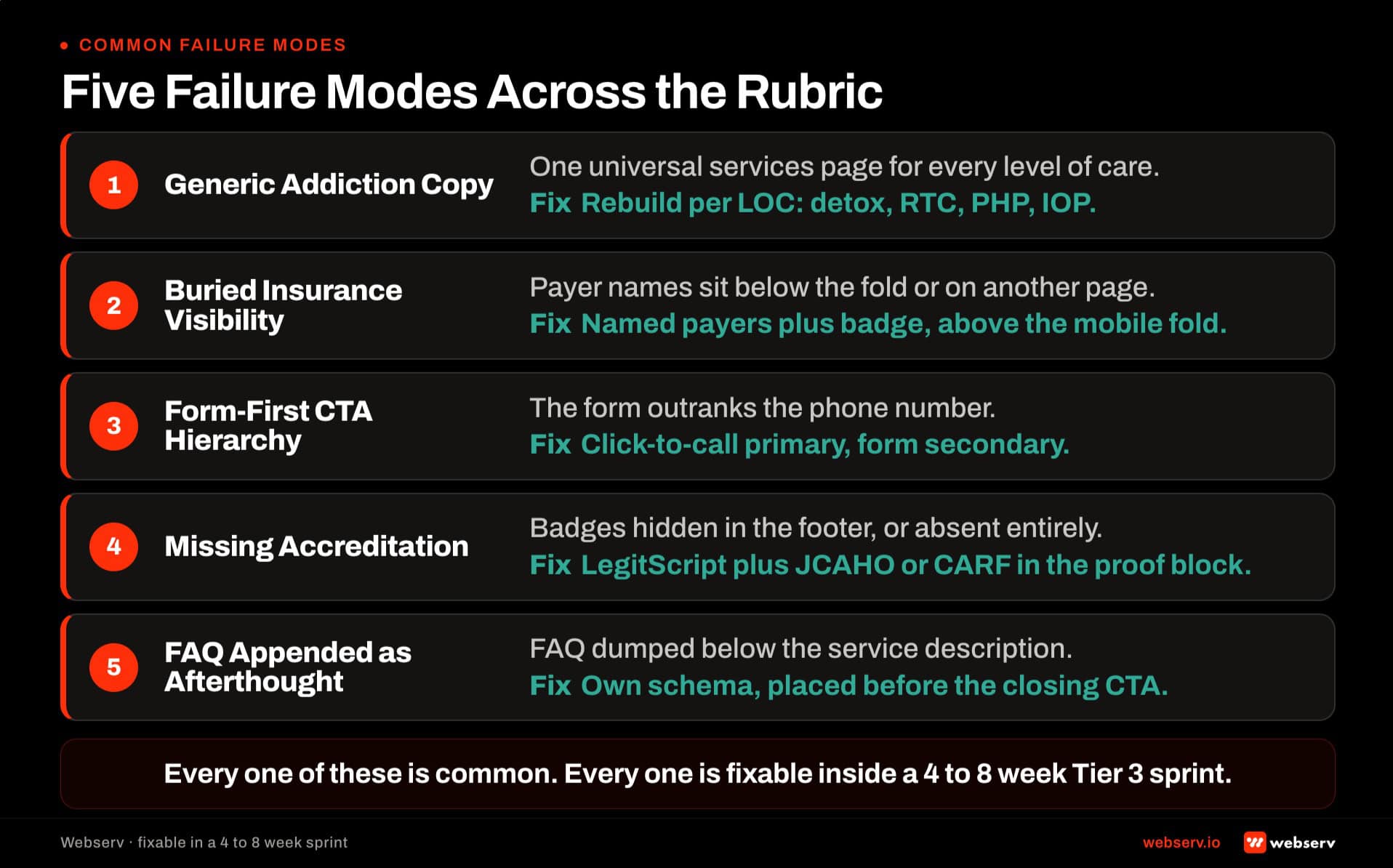
Failure 1: Generic value proposition. The above-the-fold value proposition could apply to any facility. Visitors arrive, do not see specific fit, leave.
Failure 2: Clinical proof buried. Trust signals in the footer rather than inline. Skepticism does not resolve early enough in the page to hold the visitor.
Failure 3: Insurance visibility missing or hedged. Visitors cannot self-qualify. Call volume includes unqualified prospects who cannot convert.
Failure 4: Phone not tap-target-sized on mobile. Mobile visitors want to call but cannot easily. Conversion rate collapses on mobile traffic.
Failure 5: Form field count above 5. Form abandonment climbs past 60 percent. Completion rate drops below 3 percent.
Failure 6: FAQ block absent or missing schema. Structured data signal absent. Rich Results eligibility missing. Compound-prompt citation opportunities missed.
Failure 7: Service page reused across multiple query intents. One page trying to rank on “residential rehab,” “PHP program,” and “dual diagnosis treatment” simultaneously. The page ranks on none because it is not authoritative on any specific intent.
DO
- Match the above-the-fold value proposition to the specific query the page ranks on — LOC + geography + one differentiator + target population in 40-80 words.
- Place clinical proof (credentials, accreditation, licensure) inline above or immediately below the hero — never in the footer.
- Publish a named payer list with “commonly accepts” language for verified payers and “in-network with” only where active contract verification exists.
- Deploy phone-first CTA hierarchy with tel: links, tap-target-sized mobile phone numbers, sticky header phone, and CTAs at hero + mid-page + FAQ.
- Deploy the Rank Math FAQ block with 4-6 program-specific FAQs written in visitor language, v5.5 3-paragraph pattern.
DON’T
- Ship generic value propositions that could apply to any facility in any geography — visitors leave inside 20 seconds.
- Reuse one service page across multiple query intents (residential + PHP + dual diagnosis) — the page ranks on none.
- Publish “in-network with [payer]” without active contract verification — misrepresentation risk with a monthly-verification cadence requirement.
- Ship forms with more than 5 fields — every field past 5 cuts completion rate 8-15%, and forms requesting PHI (DOB, diagnosis, address) trigger HIPAA-adjacent risk.
- Invest in Tier 4 content or Tier 5 authority while service page conversion sits below 1% — you’re subsidizing a leak.
How the rubric fits with the 5-Tier framework
The service page rubric sits inside Tier 3 (Conversion Pathways) of the 5-Tier SEO Priority Framework. It cannot produce results unless the tiers below are working.
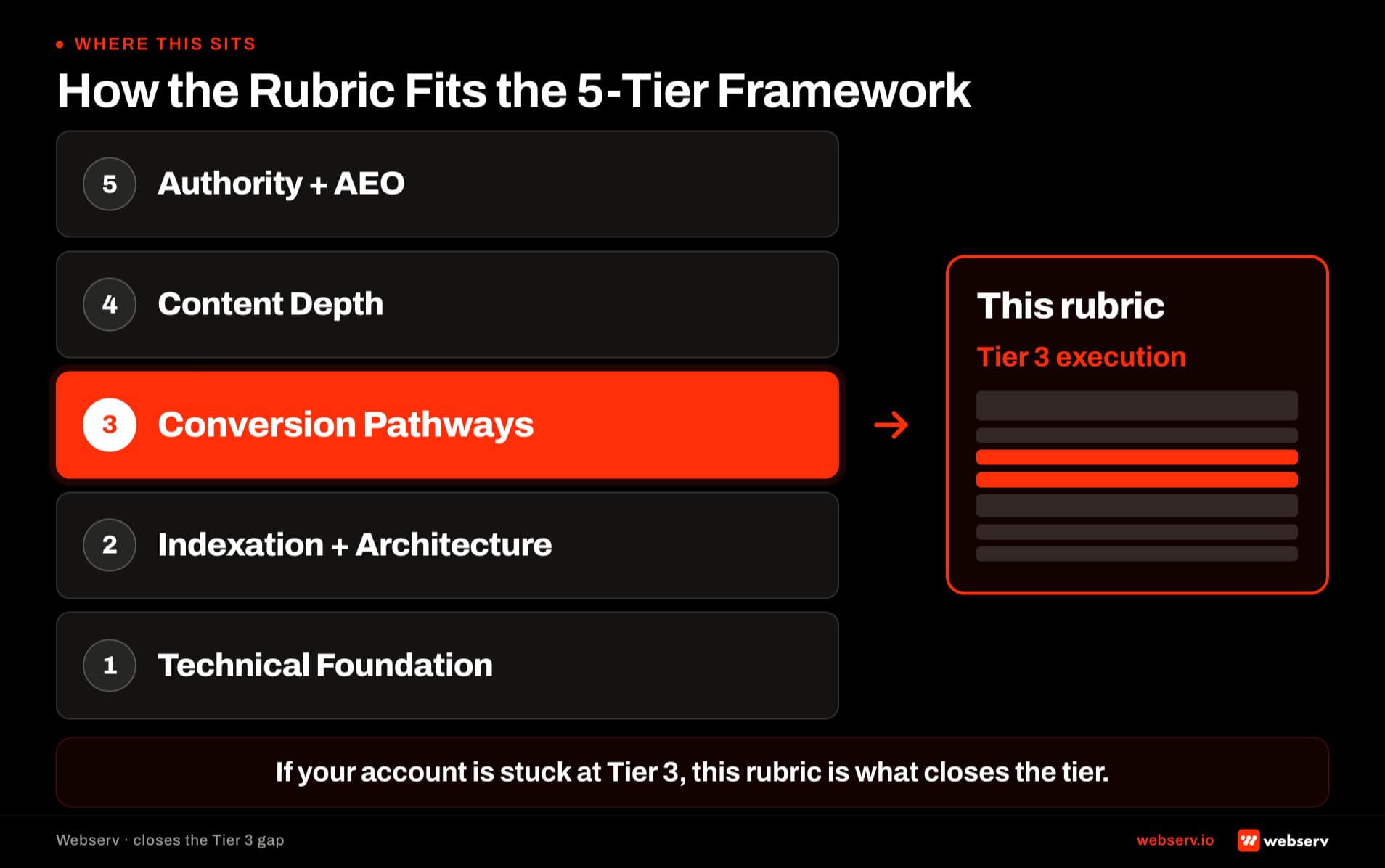
Tier 1 (Foundation) has to be clear because slow service pages leak visitors before the rubric can operate. Tier 2 (Local Presence) has to be clear because geography-specific queries are the highest-converting service page traffic, and without local visibility the traffic does not reach the pages.
Once Tiers 1 and 2 are clear, the service page rubric is the specific Tier 3 execution work that produces session-to-lead conversion at 2 percent or higher.
Facilities that skip the rubric and invest directly in Tier 4 content or Tier 5 authority build traffic that reaches broken service pages and does not convert.
Frequently Asked Questions
How long does it take to rebuild a service page against the rubric?
For a single service page, the rebuild takes 8-16 hours of production work. The specific breakdown: value proposition rewrite (2-3 hours including query intent alignment), clinical proof block deployment (1-2 hours including credential collection), and program-specific detail rewrite (3-5 hours including clinician interviews if the specifics are not documented).
Then insurance visibility deployment (1-2 hours including current contract verification), CTA hierarchy deployment (1-2 hours including mobile testing), form rebuild (30-60 minutes), and FAQ block deployment (2-3 hours including 4-6 FAQ drafts). For a facility with 8-12 service pages that need rebuilding, the total engagement typically runs 6-10 weeks including QA and mobile testing.
Facilities that try to rebuild all service pages in parallel typically produce quality drift because each page needs specific attention. Serial execution across a 6-10 week window produces better results than parallel execution across 3 weeks.
Should our service page copy be different from our landing page copy?
Yes. Service pages target organic queries with informational and commercial intent. Landing pages target paid traffic with direct-response intent.
The service page rubric emphasizes clinical proof, program specificity, and E-E-A-T signals that produce organic ranking. Our 10-element landing page piece emphasizes direct-response conversion, testing velocity, and paid-specific compliance discipline.
Facilities that reuse landing page copy on service pages typically see the service page rank poorly because the copy lacks the E-E-A-T signal organic ranking requires. Facilities that reuse service page copy on landing pages typically see the landing page convert poorly because the copy lacks the direct-response urgency paid traffic converts against.
How many service pages should a treatment center have?
Between 8 and 20 for most single-facility operators. The specific target depends on the LOC and modality mix. A facility offering residential, PHP, IOP, and detox as separate programs produces 4 base service pages. Add condition-specific pages (dual diagnosis, trauma-focused, adolescent) and modality-specific pages (MAT, TMS, EMDR) and the count grows.
The general rule: one service page per distinct commercial offering. Do not build service pages for programs the facility does not actually run or for conditions the facility does not specifically treat. Service pages targeting programs the facility does not offer produce traffic the facility cannot convert.
Portfolio operators typically build service pages per facility rather than sharing across the portfolio because each facility has unique geography, payer relationships, and clinical positioning.
How often should we audit our service pages against the rubric?
Quarterly. The specific audit agenda: value proposition still aligned with current query intent, clinical proof still current (clinician turnover, accreditation status), program specifics still accurate, insurance list reflects current contract status, phone number still tap-target-sized after any recent theme updates, form fields still at 5 or fewer, FAQ block schema still validating.
Facilities that skip quarterly audits typically discover 6-12 months into the drift that one or more components have degraded (usually insurance list going stale, or a theme update breaking the CTA hierarchy). The compound cost of that drift usually exceeds the 4-6 hours per quarter the audit takes.
The audit pairs cleanly with the 5-Tier framework quarterly review, so the service page rubric check becomes part of the Tier 3 status agenda.
What conversion rate should we expect from a well-executed service page?
Session-to-lead conversion rate at 2 percent or higher for high-intent organic traffic. Some pages exceed 3 percent when the query intent aligns tightly (branded queries, high-intent condition-plus-LOC compounds). Some pages sit at 1.5-2 percent when the query intent is broader.
Below 1 percent is the diagnostic threshold. Pages under 1 percent conversion signal that one or more rubric components are broken. The audit sequence: run the seven components against the page, identify the specific component failing, deploy the fix, remeasure after 30-60 days. Our 12-Pattern Diagnostic covers the specific diagnostic pattern (Pattern 2, Rankings but No Admissions) that maps to service page conversion failure.
Facilities benchmarking against paid landing page conversion rates typically expect too high on service pages. Service pages convert at organic traffic rates (2-3 percent typical) rather than paid landing page rates (5-10 percent typical for high-quality paid landers) because the intent state is different.
How does the rubric interact with schema markup and E-E-A-T signals?
The service page rubric operates on top of the Schema.org and E-E-A-T layers documented separately. The clinical proof block (Component 2) surfaces the Person schema for the referenced clinicians and the accreditation displays that ground the Organization schema.
The FAQ block (Component 7) produces the Rank Math FAQ schema that surfaces as FAQ Rich Results in Google and feeds retrieval-friendly passages to AI answer surfaces. The program-specific detail (Component 3) provides the operator-specific content that positions the page above the category-authority sources on compound-prompt queries.
Facilities running the rubric without the underlying Schema.org and entity graph produce service pages that convert but do not rank on the higher-value commercial queries. The two work together. Our entity SEO explainer covers the Schema.org side that this rubric depends on.
Trevor Gage is the Director of Marketing at Webserv, a digital marketing agency for treatment centers.