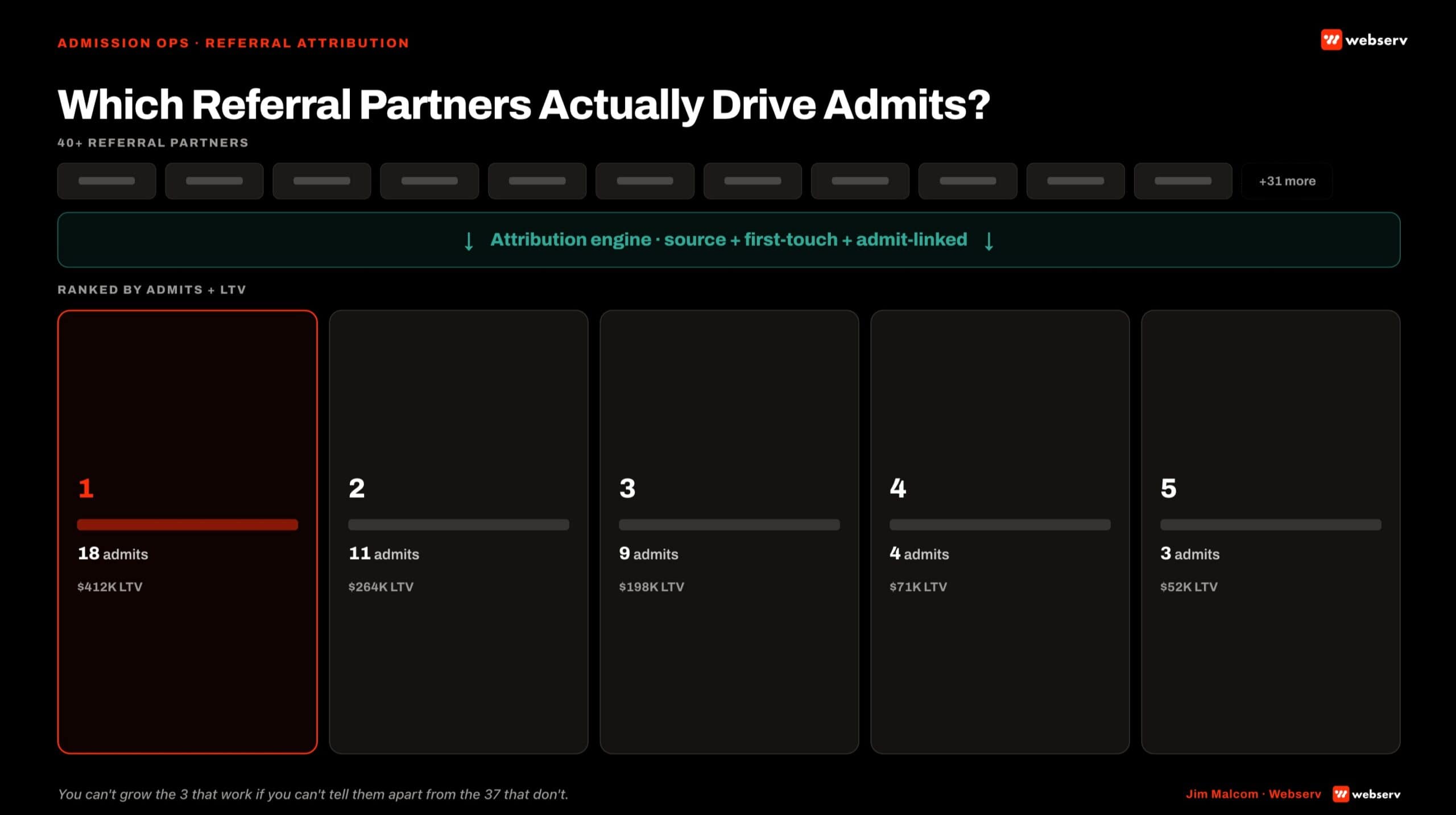
A residential facility we audited last year had a referral partner producing 30 percent of their admits. The facility’s marketing dashboard showed the referral source as “other.” Nobody could tell us which specific referring clinician, alumni program, or partner facility was actually driving that 30 percent.
The COO knew the volume was there. The billing team saw the reimbursement come in. The admissions coordinators knew the names by voice. None of that was in the CRM.
When the primary referral partner shifted contract terms mid-year, the facility could not model the risk because they had no historical attribution data.
The fix was straightforward and it took six weeks. This piece walks the data model, the attribution methods, and the reporting layer that turn referral partner tracking from a manual guessing exercise into something our admission ops team can run against a real dataset every week.
Key Takeaways
- Referral partner attribution is the layer most treatment center marketing reports skip. Marketing dashboards report paid, organic, and direct. Referral gets bucketed as “other” and the specific partner never surfaces.
- The right attribution model has three components: a structured data model in the CRM (referral partner as a linked object, not a free-text field), attribution methods that capture the specific partner at intake, and a reporting layer that surfaces referral partner performance on the same cadence as paid channels.
- Four attribution methods work in practice: unique tracking phone numbers per partner, unique landing page URLs per partner, structured intake questions with a controlled picklist, and referral codes for partners with digital submission workflows. Most facilities need two of the four running in parallel.
- The reporting layer that makes referral partner tracking useful covers admits by partner, cost per admit by partner (including any commission or referral fee), coordinator close rate by partner, discharge outcome by partner, and payer mix by partner.
- Referral partner attribution is a HIPAA and 42 CFR Part 2 layer. Structured referral tracking is defensible under both regulations. Free-text notes with referring clinician names attached to patient records are not. The data model decision has compliance stakes.
- Facilities that run the attribution model correctly can renegotiate referral partner contracts against real data, defund partners producing revolving-door admits, and defend against the loss when a primary partner shifts terms.
What Referral Partner Attribution Actually Is
Referral partner attribution is the discipline of knowing which specific referral partner produced which specific admit. Not “referral” as a bucket. Not “clinician network” as a category. The specific partner.
The distinction matters because referral partners at behavioral health treatment centers span a wide range. Referring clinicians. Alumni programs. Partner facilities (detox referring to residential, residential referring to PHP). Interventionists. Employee assistance programs. Insurance case managers. Family therapists. Community-based recovery groups.
Every partner category has different economics, different volume patterns, and different admit quality. Bucketing all of them into “referral” collapses information the facility needs to make decisions. The fix is a data model where every partner is a distinct record with its own history. That data model is one part of the referral partner marketing program.
Behavioral health treatment volume is heavily influenced by referral pathways and structured intake workflows (SAMHSA, National Survey of Substance Abuse Treatment Services). Facilities without referral attribution are running blind against the largest lever most of them do not know they have.
Why Most Treatment Centers Miss Referral Attribution
Three reasons referral partner attribution fails at most facilities.
The CRM tracks referral as a free-text field. The coordinator types the referring clinician’s name into a notes field or a generic “source” field. Different spellings for the same partner accumulate. Reporting cannot aggregate. The referral partner’s name is technically in the record and functionally invisible.
Nobody owns the partner list. The admissions supervisor knows the partners. The marketing team does not. The billing team knows the reimbursement patterns. Nobody has consolidated the partner list into a maintained record in the CRM. Every coordinator maintains their own mental version. Turnover erases institutional knowledge.
Marketing reporting stops at paid, organic, and direct. The QBR reports Google Ads performance, Meta performance, and organic search performance. Referral gets a summary line (“referral produced 40 percent of admits this quarter”) without partner-level detail. Leadership makes budget decisions without visibility into the channel producing the plurality of admits. Our complete guide to behavioral health marketing covers how referral fits the full channel mix.
The fix is architectural. The referral partner data model has to be built as a first-class object in the CRM, populated at every intake, and reported on the same cadence as paid and organic. That last part is where most facilities give up and where the biggest lift lives.
DEFINITION
referral partner attribution is the discipline of tracking which referral sources produced which admits, at what payer mix, and at what LTV. Without it, “our referrals are strong” is an opinion, not a metric, and the referral partner conversation collapses into whoever advocates loudest in the room.
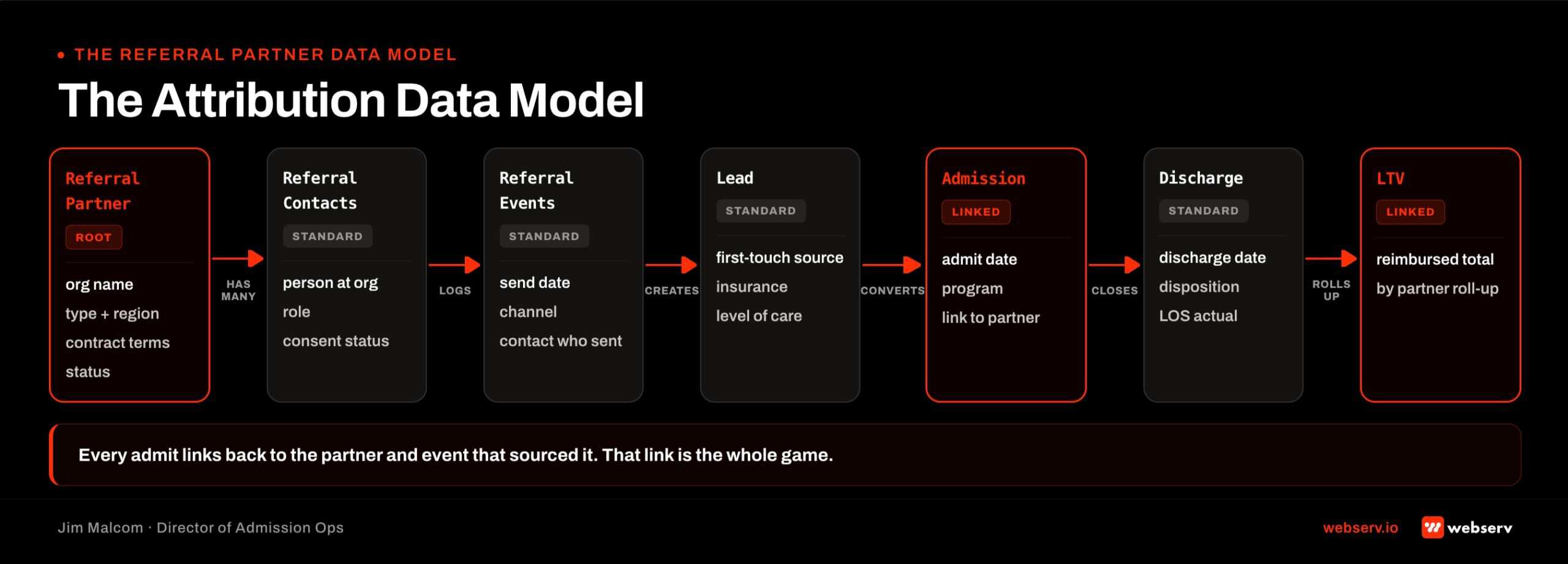
The Referral Partner Data Model
The right data model treats each referral partner as a distinct record with structured fields. Not a free-text entry on a patient record. A linked object.
Referral Partner object required fields.
- Partner Name (unique)
- Partner Category (picklist: referring clinician, alumni program, partner facility, interventionist, EAP, insurance case manager, family therapist, community recovery group, other)
- Primary Contact Name and Contact Information
- Referral Volume Cap (per month, if applicable to the partner relationship)
- Commission or Fee Structure (if any)
- Contract Start Date and Renewal Date
- LOC Focus (picklist: detox, residential, PHP, IOP, OP, all)
- Payer Mix Preference (if the partner tends to refer specific payer types)
- Referral Method (picklist: unique phone number, unique URL, structured intake question, referral code, verbal at coordinator intake)
- Active Status
- Notes
Patient record link. Every patient admitted through a referral partner gets that partner’s record linked at intake. The coordinator selects the partner from the controlled picklist. Free-text entries are disabled or heavily monitored.
The build note. Dazos, Salesforce, and HubSpot Enterprise all support this data model natively. HubSpot Professional does not (custom objects require Enterprise tier). Facilities on HubSpot Professional either upgrade to Enterprise for the attribution build, run the referral partner tracking on a downstream CRM, or accept the limitations of fields-on-Contact.
Attribution Methods That Work
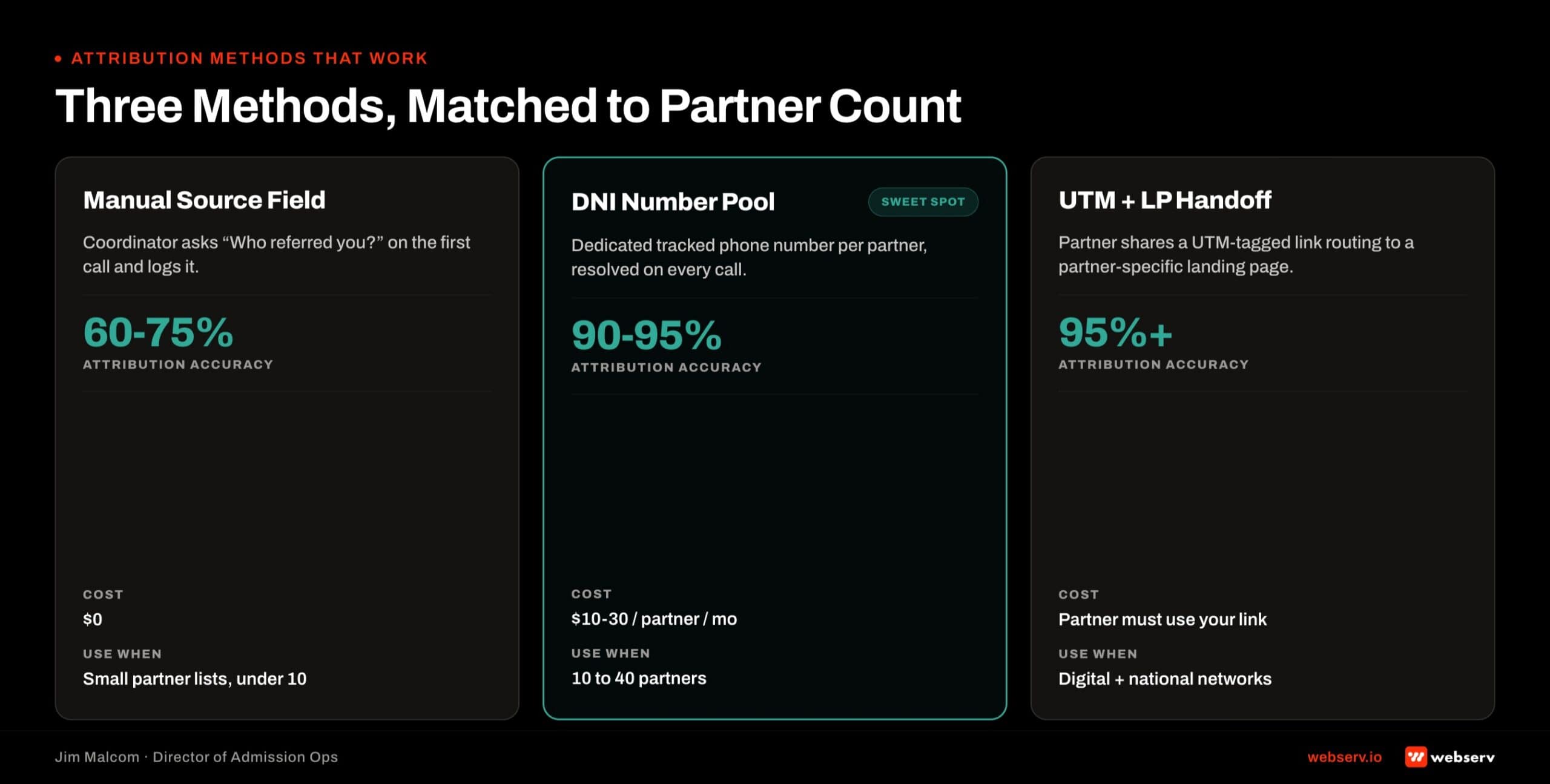
Four methods produce reliable referral attribution. Most facilities need two of the four running in parallel.
Unique tracking phone numbers per partner. CallRail or CallTrackingMetrics assigns a dedicated phone number to each partner. The partner gives that number to prospects. When the prospect calls, the CRM captures the partner identity automatically at intake.
This works well for referring clinicians and partner facilities that hand out physical business cards or brochures with the tracking number. It works less well for digital referrals or partners who forward prospects through a warm transfer without giving them a specific number.
Unique landing page URLs per partner. Every partner gets a dedicated landing page (or URL parameter) that the CRM captures on form fill. The partner sends prospects to that URL through email, text, or their own website.
This is the digital equivalent of the tracking phone number. It requires the partner to actually use the unique URL, which is where the method fails when partners send prospects to the general facility website instead. Include periodic partner training on URL usage as part of the ongoing relationship.
Structured intake questions with a controlled picklist. The admissions coordinator asks the prospect “how did you hear about us” and selects the specific partner from a dropdown. The coordinator’s compliance with the picklist is the load-bearing element.
This method works everywhere the other three methods fail (verbal referrals, warm transfers, self-directed prospects who mention a partner name). It requires coordinator discipline and a maintained picklist that matches the CRM’s Referral Partner records.
This is where the coordinator hostage dynamic can quietly damage the data quality if the picklist gets treated as optional.
Referral codes for digital submission workflows. Some partners submit referrals through a facility’s online intake portal. Each partner gets a unique code baked into their submission URL. This is the highest-fidelity method and works only for partners with digital submission workflows.
Most facilities cannot run all four methods. The right combination is usually unique phone numbers plus structured intake questions. That covers the clinical referral network and the family-referred prospects at roughly 90 percent fidelity.
The Reporting Layer
Referral partner attribution only produces value if the reporting layer surfaces it on the same cadence as paid and organic channels.
Five reports every treatment center running referral attribution should produce.
Admits by partner. Which specific partners produced which admits this quarter. Not “referral” as a bucket. Every partner as a distinct line.
Cost per admit by partner. Referral fee or commission (if applicable) divided by admits from that partner. Compared against cost per admit from paid channels. Many facilities discover that their most expensive referral partners produce cost per admit above their paid media rates once the relationship costs are fully loaded.
Coordinator close rate by partner. Some partners send prospects who close easily. Others send prospects who require heavy admissions work. This report surfaces the difference.
Discharge outcome by partner. Percentage of admits from each partner that completed treatment. Distinguishes referral partners producing high-completion admits from partners producing revolving-door admits. LOC alignment matters here since ASAM’s levels of care carry different completion expectations (ASAM Criteria).
Payer mix by partner. Which partners send commercial-insurance versus Medicaid versus self-pay prospects. Reimbursement math on each partner is materially different, and the payer-mix-by-partner view is where the true revenue contribution shows up.
Facilities running these five reports quarterly can renegotiate partner contracts against real data, defund partners producing low-completion or unfavorable payer mix, and defend against the loss when a primary partner shifts terms. The Marketing-to-Admissions QBR playbook folds these five reports into the standard QBR agenda.
PHI Boundaries in Referral Attribution
Referral partner attribution touches PHI. The rules are strict, and the compliance stakes are real.
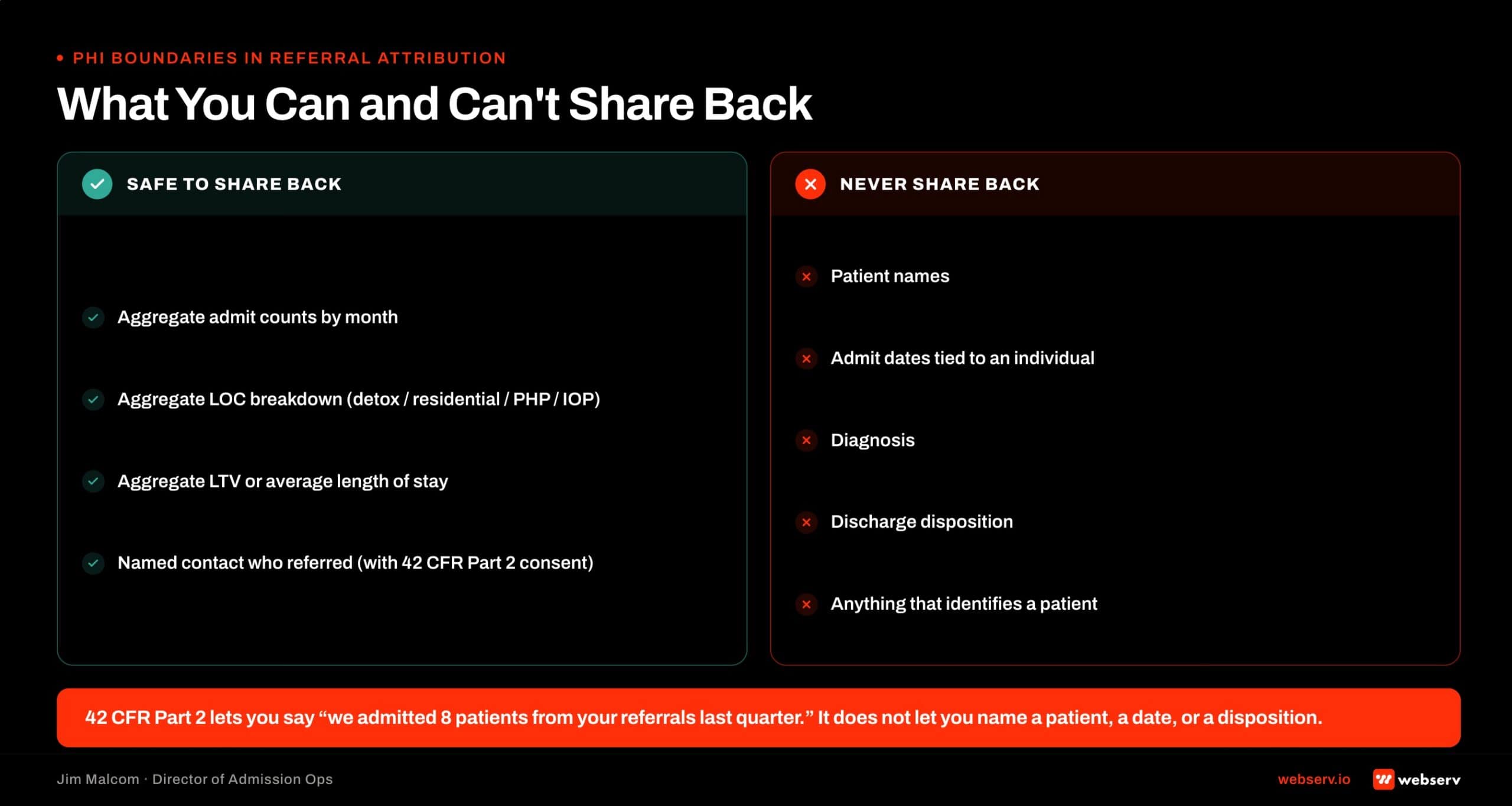
Structured attribution is defensible. Linking a patient record to a Referral Partner object in the CRM, with the partner’s name captured at intake, is defensible under HIPAA and 42 CFR Part 2 when the CRM has appropriate BAAs and access controls in place.
Free-text notes with referring clinician names are not. Coordinator notes that read “referred by Dr. Smith at ABC Recovery Center” attach a specific clinician name to a patient’s SUD record in an unstructured field. That is a Part 2 exposure if the CRM’s access controls are not tightly scoped.
Sharing outcomes back to the referral partner requires consent. Treatment centers routinely want to tell referral partners “your patient completed treatment” or “your patient discharged AMA at day 6.”
Doing so requires patient consent under 42 CFR Part 2. The consent should be captured at intake and documented in the CRM.
BAA coverage across the stack. Every tool touching referral attribution data (CRM, call tracking, EMR, reporting tools) needs a BAA. The BAA has to reference Part 2, not just HIPAA. Standard HIPAA business-associate language is not enough for SUD data.
The compliance layer is not optional. Facilities that treat referral attribution as a marketing-only exercise and skip the PHI framing produce exposure that surfaces in audits and subject-access requests.
COMMON MISTAKE
Attributing referrals at the individual-admit level and ignoring the portfolio. Some partners send patients whose insurance produces low individual rates but whose aggregate volume, combined with higher-rate cases from the same partner, produces a net-positive relationship. Portfolio attribution is what makes the individual-admit decision framework work.
Common Failure Modes
Five failure modes that show up on referral attribution audits.
Free-text source field. Coordinators type partner names into a generic source field with no controlled picklist. Different spellings accumulate. Reporting collapses. The partner information is technically captured and functionally lost.
Missing partner records. The CRM’s Referral Partner list has 12 partners on it. The admissions team knows 30 partners are actually referring. The 18 missing partners never get captured at intake because they are not on the picklist. The reporting understates referral volume systematically.
No maintenance cadence. The partner list was built once and never updated. New partners come online and never get added. Old partners churn out and stay on the picklist. Data quality erodes without alerting anyone.
Coordinator picklist compliance drops. The picklist gets treated as optional. Coordinators default to “other” or leave the field blank when they are busy. Data quality erodes at the volume the coordinators are busiest.
No reporting cadence. The attribution data is being captured cleanly but nobody looks at it. Leadership never sees the referral partner performance report. The channel producing the plurality of admits gets no attention until a primary partner shifts terms.
The fix for all five. One person accountable for the referral attribution health. Weekly picklist compliance check. Monthly partner list maintenance. Quarterly reporting review as part of the QBR.
What a Webserv Engagement Looks Like
The 6-week Admission Ops sprint includes referral partner attribution as part of Pillar 2 (CRM and Workflow Optimization) and Pillar 5 (Always-On Admissions).
Week 1, Onboard and Audit. Current state of referral attribution. Existing partner list inventory. Coordinator picklist compliance audit. PHI boundary review.
Week 2, Lead Tracking. Call tracking numbers configured for high-volume partners. Landing page URL parameters for digital partners. Source mapping into CRM.
Week 3, CRM Pipeline. Referral Partner object built out with the 11 required fields. Partner records populated from admissions team knowledge. Coordinator training on the picklist begins.
Week 4, VOB Workflow. Referral partner metadata flows through the VOB workflow so payer-mix-by-partner reporting can be built downstream.
Weeks 5-6, Training and Launch. Coordinator training on the picklist. Weekly compliance monitoring cadence. Reporting layer built for the five required reports.
Pricing. One-time setup runs $7,500 to $15,000 depending on center size, CRM complexity, and integration scope. Referral partner attribution build is included when the facility already has a functional CRM.
Ongoing retainer tiers by location count: $3,500 to $5,000 per month for 1-2 locations, $5,000 to $8,000 per month for 3-5 locations, $8,000 to $15,000 per month for 6+ locations.
The Fast-Track Diagnostic is the low-friction entry: $3,000, credited 100 percent toward month one if the facility moves forward. Two-week audit of the current referral attribution health, partner list gap map, and firm proposal.
The perspective in this article comes from 9 years working exclusively inside behavioral health.
We are a team built by people in recovery who understand that behind every admission is someone asking for help. If that resonates, get to know us.
Frequently Asked Questions
How do treatment centers track referral partners?
The right architecture has three components. A structured data model in the CRM with each referral partner as a distinct record linked to admits. Attribution methods that capture the specific partner at intake.
Options include unique phone numbers, unique landing page URLs, structured intake questions, or referral codes. The third component is a reporting layer that surfaces referral partner performance on the same cadence as paid and organic channels.
Most facilities need two of the four attribution methods running in parallel. Unique phone numbers per partner plus structured intake questions covers roughly 90 percent of the clinical network and family-referred prospects at behavioral health facilities.
The failure mode most facilities live with is a free-text source field where coordinator entries accumulate as different spellings. The fix is a controlled picklist tied to a maintained Referral Partner object in the CRM, populated at every intake.
What data should we capture about a referral partner?
Eleven fields on a Referral Partner object. Partner name, partner category, primary contact information, referral volume cap if applicable, commission or fee structure, contract start and renewal dates, LOC focus, payer mix preference, referral method used with that partner, active status, and notes.
The partner category picklist covers referring clinicians, alumni programs, partner facilities, interventionists, EAPs, insurance case managers, family therapists, community recovery groups, and other. Bucketing all of these into a single “referral” category collapses information the facility needs to make decisions.
Every patient admitted through a referral partner gets that partner’s record linked at intake. Free-text entries are disabled or heavily monitored to prevent data drift.
What is the best way to attribute a referral partner at intake?
Depends on the partner. Referring clinicians and partner facilities work well with unique tracking phone numbers because the partner hands out a physical business card or brochure with the number. Digital referrals work well with unique landing page URLs.
Structured intake questions with a controlled picklist works everywhere the other methods fail. The coordinator asks “how did you hear about us” and selects the specific partner from the dropdown. This is the fallback that catches verbal referrals, warm transfers, and self-directed prospects who mention a partner name.
Most facilities run two methods in parallel: unique phone numbers for the top 10-15 partners and structured intake questions for everything else. The combination covers roughly 90 percent of referral attribution at typical behavioral health facilities.
Can we share treatment outcomes with our referral partners?
Only with patient consent under 42 CFR Part 2. Substance use disorder patient records carry stricter confidentiality standards than general HIPAA-covered health information. Sharing “your patient completed treatment” or “your patient discharged AMA at day 6” back to a referring clinician requires patient consent, documented at intake.
The consent language should specify what information will be shared with which parties. Blanket consent for “sharing with referral partners” is weaker than consent that names the specific partner and specifies the outcome data being shared.
Facilities that share outcomes back to referral partners without documented Part 2 consent carry compliance exposure. The fix is architectural. Build the consent capture into the intake workflow so it happens automatically rather than as an afterthought.
How does referral attribution work with HIPAA and 42 CFR Part 2?
Structured referral attribution is defensible under both regulations. Linking a patient record to a Referral Partner object in the CRM, with appropriate BAAs and access controls, is standard operational data handling. The partner name and referral method are metadata about admissions operations, not clinical detail.
Free-text notes with referring clinician names attached to patient records in unstructured fields are weaker. Access controls on notes fields are harder to scope, and the clinician name becomes attached to SUD status without the structured protection of a controlled data model.
Every tool touching referral attribution data (CRM, call tracking, EMR, reporting tools) needs a BAA that references Part 2, not just standard HIPAA business-associate language. Facilities that treat this as a paperwork exercise carry exposure.
What reports should we run on referral partner performance?
Five reports. Admits by partner. Cost per admit by partner (including any referral fee or commission). Coordinator close rate by partner. Discharge outcome by partner. Payer mix by partner.
Admits by partner is the volume number. Cost per admit by partner surfaces which relationships are actually profitable once the fee structure is fully loaded. Coordinator close rate shows which partners send prospects that close versus prospects that require heavy admissions work. Discharge outcome distinguishes high-completion referrals from revolving-door admits. Payer mix shows the reimbursement quality of each partner’s referrals.
Facilities running these five reports quarterly can renegotiate partner contracts, defund unfavorable partners, and defend against the loss when a primary partner shifts terms. The reports fold into the quarterly business review as standard content.
What breaks most often on referral attribution at treatment centers?
Coordinator picklist compliance. The picklist gets treated as optional. Coordinators default to “other” or leave the field blank when they are busy. The compliance drop is worst at the volume the coordinators are busiest, which is exactly when the attribution data matters most.
The fix is architectural, not motivational. Make the referral partner field required at intake. Build a weekly compliance check into the reporting layer. Assign one person accountable for the referral attribution health.
Fifteen minutes a week reviewing the picklist compliance is the difference between attribution data that works and attribution data that drifts. It is not glamorous. It is operational discipline that compounds.
Closing Note From the Admission Ops Floor
Referral partners are the largest channel most treatment center marketing teams are not systematically tracking. The channel producing the plurality of admits gets bucketed as “other” while paid and organic get full attribution stacks.
The fix is architectural. A structured referral partner data model. Two attribution methods running in parallel. A reporting layer on the same cadence as paid and organic. One person accountable for the picklist compliance every week.
If you are running referral partner tracking as a free-text field or as coordinator memory, the audit is worth running before another quarter passes. Start with the $3,000 Fast-Track Diagnostic. Credited 100 percent toward month one if you engage.
Jim Malcom is the Director of Admission Ops at Webserv. He has spent his career inside behavioral health admissions operations (call floors, VOBs, CRMs, and the reporting stack that ties them together) and now leads the Webserv admission ops practice for treatment center operators nationwide.