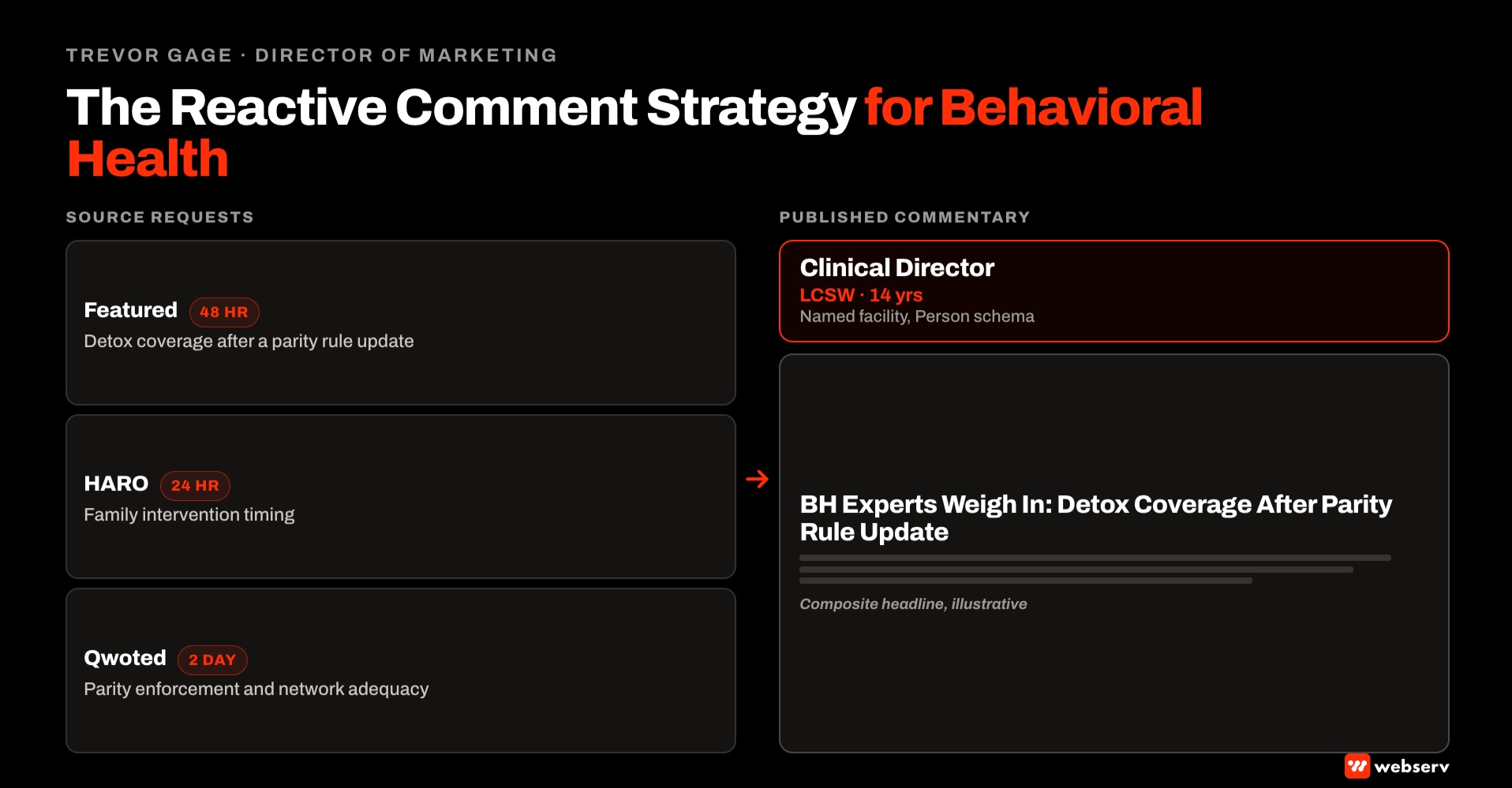
Every day, health journalists writing about mental health, addiction, and behavioral health post source requests looking for expert commentary. HARO, Qwoted, Featured, Help A B2B Writer, JournoRequest on X.
The requests are specific (“looking for an LMFT to comment on trauma-informed care for veterans” or “seeking a behavioral health CFO to comment on out-of-network reimbursement trends”). The deadlines are tight (typically 24-72 hours). The publication tier is real.
Most treatment centers do not respond to any of them.
The specific pattern I see at facilities investing meaningfully in content and organic authority through digital PR but not seeing the referring domain count compound: they build the content, deploy the schema, ship the AI Information page, and then wonder why the domain rating never moves.
The missing piece is not content. It is outbound placement in the publications journalists are already writing.
Reactive comment strategy is the operational discipline that puts a treatment center’s clinical experts into health journalism at scale. It sits inside Tier 5 of the 5-Tier SEO Priority Framework as the authority-building engine that produces the referring domains and brand mentions AI answer surfaces use to weight entity credibility. Our digital PR practice runs this discipline as a first-class operational program.
It complements our brand mention monitoring piece that covers the reactive-listening side: monitoring shows you what got said; reactive comment produces what will get said next.
This piece walks the six source-request platforms that matter for behavioral health, the four-gate qualification framework we use to decide which requests to respond to, and the response-draft pattern that lands placements.
It also covers the credibility infrastructure that reactive comment requires to work, and the measurement approach that separates working programs from performative ones.
Key Takeaways
- Reactive comment strategy is the outbound execution complement to brand mention monitoring. Monitoring surfaces what has been published about the facility. Reactive comment produces what gets published next by placing the facility’s clinical experts in health journalism responding to specific source requests.
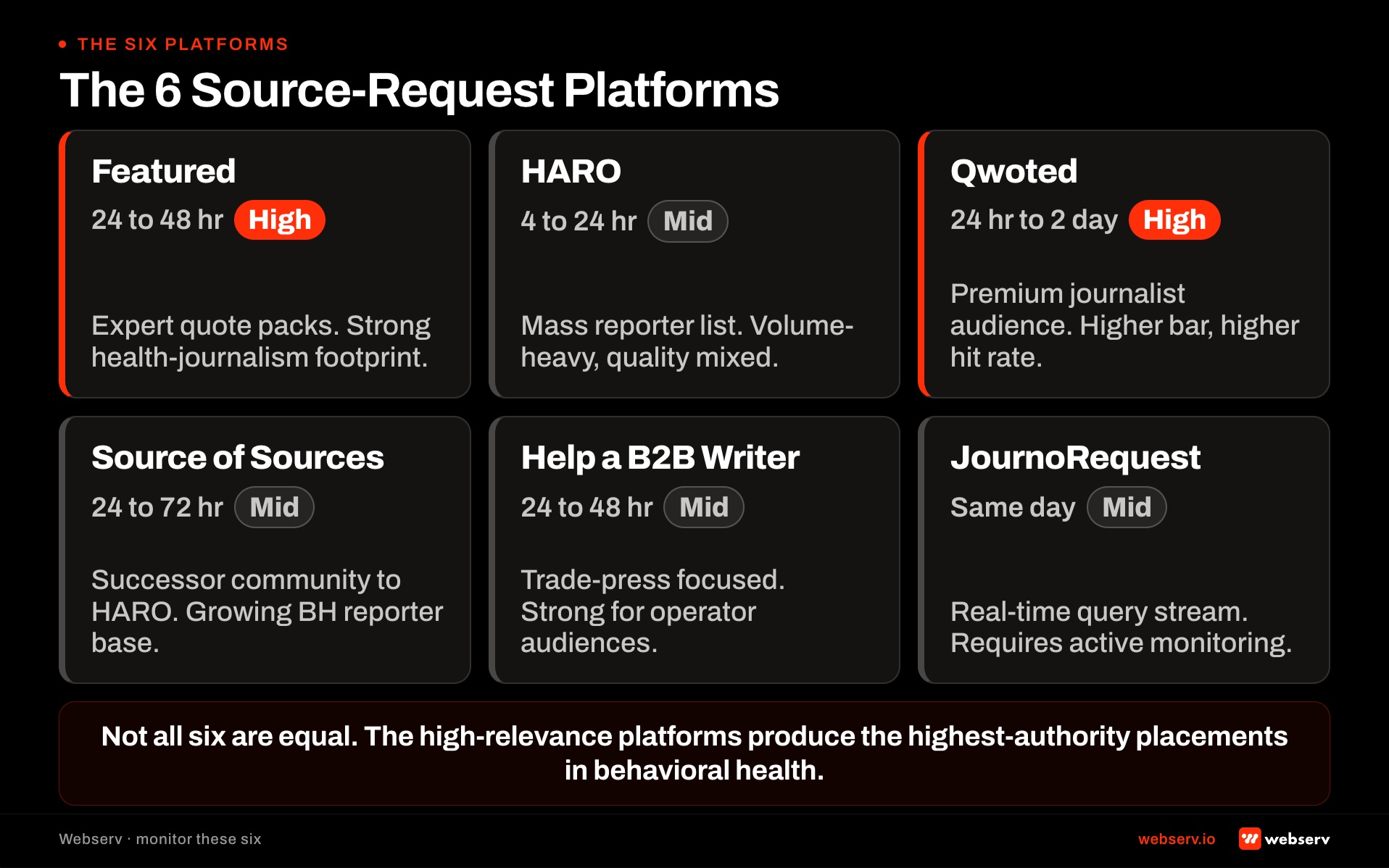
- Six source-request platforms produce most of the behavioral health placement opportunities: HARO (now Connectively), Qwoted, Featured, Help A B2B Writer, ProfNet, and JournoRequest on X. Each has a different journalist mix, response cadence, and quality bar. Facilities that engage across all six produce meaningfully more placements than facilities using one platform.
- The four-gate qualification framework filters requests before response drafting: journalist and publication credibility check, expertise match against the specific facility clinician who would respond, deadline feasibility, and brand fit. Facilities that respond to every request without qualification produce low placement rates and eventually get filtered out by journalists.
- The response draft pattern that lands placements: lead with the specific answer in the first sentence, include one operator-specific example that grounds the answer in real practice, name the responding clinician with credentials, and offer a follow-up commitment for interview or deeper source.
- Reactive comment requires credibility infrastructure to work. Named clinical experts with public bios that verify credentials. Rapid response capacity (24-48 hours from source request to submitted comment). A tracked response log with placement outcomes so the program improves over time.
- The measurement signal is placement rate, referring domain growth, and brand mention volume in target publications, not response volume. Response-volume metrics reward activity over outcome. Placement-rate metrics reward the qualification discipline that separates working programs from performative ones.
DEFINITION
Reactive comment strategy. The operational discipline of placing a treatment center’s clinical experts into health journalism at scale by responding to specific journalist source requests posted on HARO/Connectively, Qwoted, Featured, Help A B2B Writer, ProfNet, and JournoRequest. Produces the referring domains and brand mentions AI answer surfaces use to weight entity credibility for BH.
Distinct from proactive PR pitching (dedicated campaigns pitched to specific outlets) and distinct from brand mention monitoring (reactive listening — what got said). Reactive comment is outbound execution against inbound source requests. Sits inside Tier 5 authority building of the 5-Tier SEO Priority Framework as the engine that produces sustained domain rating growth.
OPERATOR INSIGHT
Measure placement rate, not response volume.
Facilities measuring response volume produce more responses without more placements. Facilities measuring placements produce better qualification and better response drafting. Response-volume metrics reward activity over outcome. Placement-rate metrics reward the qualification discipline that separates working programs from performative ones.
The six source-request platforms
HARO / Connectively
Formerly Help A Reporter Out, now operated as Connectively. The largest volume of source requests across categories. Behavioral health requests appear daily, typically from health journalists at trade publications, consumer health outlets, and mainstream media. Quality varies. Higher-tier journalists still use HARO but low-quality requests fill the same feed. Requires more aggressive qualification than the other platforms.
Qwoted
Higher-quality journalist mix than HARO on average. Behavioral health requests appear regularly, typically from trade publications and mid-tier consumer outlets. Journalist verification is more rigorous than HARO. Response volume per request tends to be lower, which means well-qualified responses have higher placement rates. Start here if you can only commit to one platform.
Featured
Mid-tier platform with a specific structure that pushes toward listicle-style content. Behavioral health requests appear in specialty and mental health topic areas. The listicle format means responses are shorter and placement is more predictable if the response meets the format requirements.
Help A B2B Writer
B2B-focused platform with treatment center admissions and RCM audiences overlapping the target. Requests appear from B2B trade publications covering behavioral health operations, revenue cycle, and admissions technology. Lower volume than HARO but more targeted toward operator content.
ProfNet
PR Newswire’s source-request platform. Higher-tier journalist mix, typically working on longer-form pieces. Response cadence is slower (72-96 hour deadlines common) but placement quality tends to be higher.
JournoRequest on X
Twitter/X hashtag journalists use to post source requests informally. Higher variance than any other platform. Real placement opportunities coexist with junk. Monitoring the hashtag with a keyword filter (behavioral health terms) surfaces the relevant requests.
The four-gate qualification framework
Not every source request is worth responding to. Facilities responding to every request produce low placement rates and eventually get filtered out by journalists who receive too many low-quality responses. The four-gate framework filters requests before response drafting.
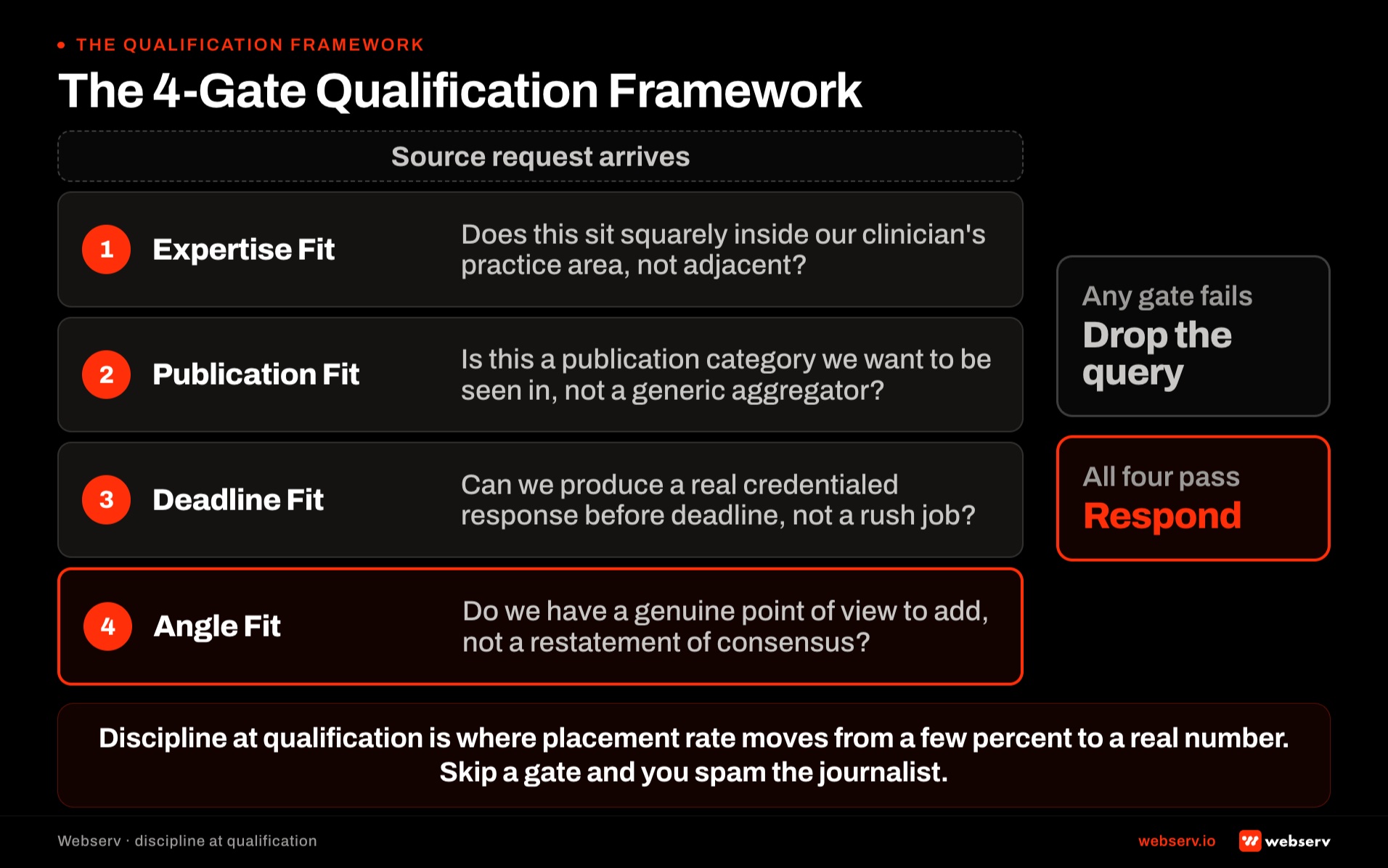
Gate 1: Journalist and publication credibility check. Confirm the journalist is legitimate (byline history, public LinkedIn or website, verifiable at the publication they claim to write for). Confirm the publication is a real outlet with a defensible content standard, not a content farm or SEO backlink scheme. Requests that fail Gate 1 produce placements that carry no authority signal. Backlinks from content farms actively hurt domain authority in some cases. Skip them regardless of how well the expertise match fits.
Gate 2: Expertise match against the specific responding clinician. Confirm the specific clinician who would respond has verifiable expertise in the specific topic the request covers. A residential SUD facility’s medical director responding to a source request about pediatric mental health is a poor match. A dual-diagnosis clinical director responding to a request about co-occurring substance use and PTSD is a strong match. The specific test: could the clinician credibly appear in a live interview on this topic? If the answer is no, do not respond.
Gate 3: Deadline feasibility. The response draft, internal review, and clinician approval all have to happen inside the journalist’s deadline. Requests with 4-hour deadlines rarely produce well-qualified responses because the review workflow cannot complete inside the window. Requests with 72-hour deadlines allow for the full workflow. The specific threshold: 24-hour minimum deadline for most facilities.
Gate 4: Brand fit. The publication and the specific angle of the piece need to align with the facility’s brand positioning. A luxury residential facility placing a quote in a piece framed around low-cost recovery options creates positioning noise. A dual-diagnosis clinical director placing a quote in a piece framed around dual diagnosis fits cleanly.
Requests that pass all four gates get response drafts. Requests that fail any gate get skipped, with the pass rate typically running 15-25 percent of total requests reviewed.
The response draft pattern that lands placements
The response draft pattern that produces placements has four load-bearing components.
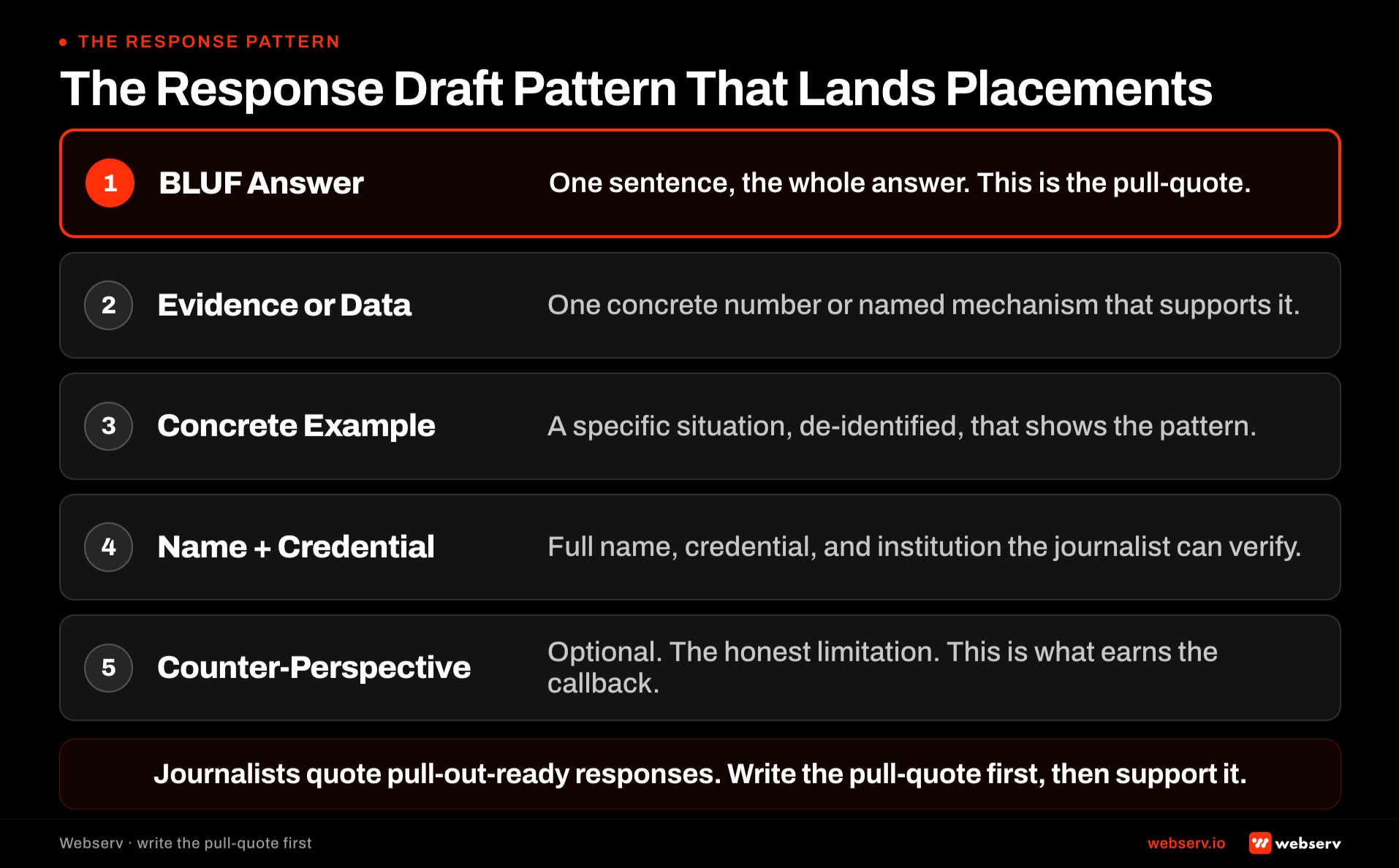
Component 1: Specific answer in the first sentence. Journalists filter responses by scanning first sentences. Responses that lead with credentials (“As a licensed LMFT with 20 years of experience…”) get filtered because the journalist has not yet reached the actual answer. Responses that lead with the specific answer to the specific question get read.
Component 2: One operator-specific example. Generic answers that any expert could produce do not differentiate. Answers grounded in one specific operator example (“At our facility, we’ve seen the shift to somatic approaches produce measurable engagement lift with veterans specifically…”) differentiate the response.
Component 3: Named clinician with credentials. After the specific answer and the operator example, name the responding clinician with credentials and title. This is the citation the journalist will attribute to. Journalists appreciate the citation being clean and ready to use.
Component 4: Follow-up commitment. Offer availability for a phone interview or deeper source relationship. Most placements happen from written responses. Some placements happen because the journalist follows up for deeper commentary. The follow-up commitment signals availability without pushing.
What does not work. Long responses that cover multiple possible angles. Hedged answers that hedge on the core claim. Responses that pitch the facility or program rather than answer the journalist’s specific question. Responses that copy language from the facility’s own marketing content verbatim (journalists filter these because they read as press-release quotes rather than expert commentary).
The reactive comment surface at a glance
6
Source-request platforms: HARO, Qwoted, Featured, Help A B2B Writer, ProfNet, JournoRequest
4
Qualification gates: credibility, expertise match, deadline, brand fit
8-15%
Placement rate a well-qualified program produces on submitted responses
15-30 hrs/mo
Program time investment for 10-15 qualified responses per month
The credibility infrastructure reactive comment requires
Reactive comment produces placements when the underlying credibility infrastructure supports it. Facilities without the infrastructure produce sporadic responses that do not compound.
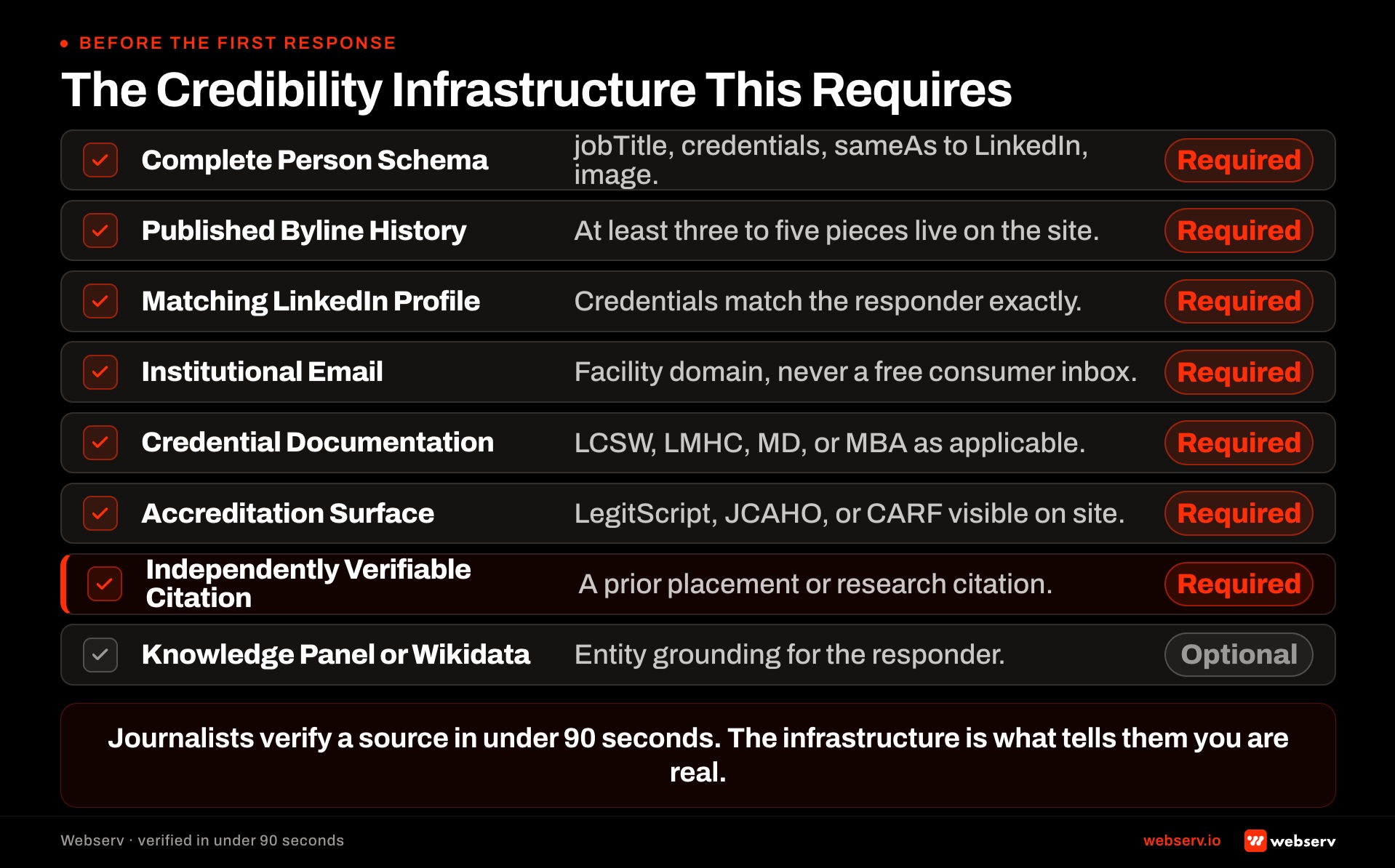
Named clinical experts with public bios. Every potential responding clinician needs a public bio page on the facility site with credentials, licensure, specialty areas, and (where possible) a professional headshot. Journalists verify sources before publishing quotes. Facilities without public bios lose placements because the journalist cannot verify the source. Our entity SEO explainer covers the Person schema layer that reinforces the bio pages for AI systems.
LinkedIn profiles that match the site bios. LinkedIn is the specific verification channel journalists use most often. The clinician’s LinkedIn should mirror the facility site bio with the same title, credentials, and specialty areas. Mismatches produce verification friction.
Publication of specialty positioning. Facilities with published content covering the specialty areas the clinicians speak to produce stronger placements because the journalist can verify the clinician’s specialty through the content library, not just through the bio.
Rapid response capacity. Reactive comment operates on 24-72 hour deadlines. The specific response workflow: marketing or PR person monitors platforms, drafts responses, routes to clinician for approval, submits. The workflow needs to complete inside 24 hours to serve most 48-hour deadlines with margin.
A tracked response log with placement outcomes. Every submitted response gets logged with request details, response content, journalist, publication, deadline, and placement outcome. The log becomes the training data for what works and what does not.
Building rapid response capacity
The specific workflow that produces sustainable rapid response has four steps.
Step 1: Daily platform monitoring. One person on the marketing team (or an outsourced PR partner) monitors all six platforms daily. Behavioral health keyword filters surface relevant requests. Total monitoring time typically runs 30-45 minutes per day.
Step 2: Same-day qualification and draft. Requests passing the four-gate qualification framework get response drafts within the same business day. For 24-hour deadline requests, this is essential. For 48-72 hour requests, this creates margin for internal review.
Step 3: Clinician approval. The named clinician reviews and approves the response before submission. This is the load-bearing step that prevents fabricated quotes and misattributed opinions. Facilities that skip this step produce compliance and reputation risk.
Step 4: Submission and log. Response gets submitted with the credentialed clinician byline. Entry gets logged to the response tracking system.
The full workflow, well-executed, runs 45-90 minutes per response. A facility maintaining response capacity for 10-15 qualified responses per month typically dedicates 15-25 hours per month to the program.
The measurement approach
Reactive comment measurement rewards placement outcomes, not response activity. Facilities measuring response volume produce more responses without more placements. Facilities measuring placements produce better qualification and better response drafting.
Primary metrics. Placement rate (placements as percentage of submitted responses). Referring domain growth from placements. Brand mention volume in target publications.
Secondary metrics. Journalist relationship depth (repeat placements with the same journalist, which typically produce higher-quality subsequent placements). Specialty positioning coverage (specific clinicians consistently placing in specific topic areas, which reinforces AI Mode and AI Overviews citations on those topics).
Vanity metrics to avoid. Response volume alone. Total requests reviewed. Time spent on monitoring. All three measure activity without measuring outcome and produce optimization toward the wrong signal.
The specific target: placement rate at 8-15 percent for a well-qualified program. Below 5 percent signals the qualification framework is too permissive or the response draft pattern is not landing. Above 20 percent typically signals the qualification is too restrictive and the program is missing placement opportunities the workflow could handle.
DO
- Run every request through the 4-gate framework before drafting: credibility, expertise match, deadline feasibility, brand fit. Pass rate typically 15-25%.
- Lead responses with the specific answer in the first sentence — never lead with credentials, journalist filters those out.
- Include one operator-specific example that grounds the answer in real practice; that’s what differentiates from expert-generic responses.
- Route every draft through clinician approval before submission — this is the compliance layer that prevents fabricated quotes and misattributed opinions.
- Log every response with journalist, publication, deadline, and placement outcome — the log is the training data for what works.
DON’T
- Respond to every request — response volume without qualification collapses placement rate and burns journalist trust; recovery takes 6-12 months.
- Lead with “As a licensed clinician with X years of experience…” — journalists filter responses that bury the actual answer.
- Skip clinician approval to hit deadlines faster — the compliance exposure exceeds the placement value.
- Ship fully-AI-generated responses — journalists spot AI-tell patterns (hedged language, generic examples, filler conclusions) and filter them.
- Launch reactive comment before the credibility infrastructure exists (public bios, matching LinkedIn, published specialty content) — journalists can’t verify the source and won’t publish.
Common failure modes
Failure mode 1: Responding to every request without qualification. Response volume climbs. Placement rate collapses. Journalists filter the facility’s responses because too many are low-quality. Recovery requires 6-12 months of qualification discipline to rebuild journalist trust.
Failure mode 2: Responses that lead with credentials. Response draft opens with “As a licensed clinician with X years of experience…” The specific answer is buried. Journalists filter. Placement rate stays near zero regardless of expertise quality.
Failure mode 3: Skipping clinician approval. Marketing team drafts and submits without clinician review. The responding clinician sees the quote in print. Content is close but not accurate. Compliance exposure follows.
Failure mode 4: No response log. Every response is a standalone effort with no institutional memory of what worked. The program does not improve. Placement rate stays at whatever the initial baseline was.
Failure mode 5: Building without the credibility infrastructure. Reactive comment program launches before the clinician bio pages, LinkedIn profiles, and content library that support source verification. Journalists cannot verify the source. Placements do not land regardless of response quality.
How reactive comment fits with the broader AI-readability stack
Reactive comment feeds Tier 5 authority building in the 5-Tier SEO Priority Framework. It produces the referring domains and brand mentions AI Mode and AI Overviews weight for entity credibility.
The specific interaction with the AI-readability stack: placements in health journalism outlets produce citations that reinforce the entity graph the facility’s Schema.org, entitymap.json, and AI Information page describe.
AI systems consuming the entity graph see external validation from health journalism that matches the facility’s own entity claims. The reinforcement produces stronger citation weight in AI answer surfaces.
Facilities running the AI-readability stack without a reactive comment program produce a defensible entity graph without external validation reinforcement. The graph exists but does not accumulate the authority signal AI systems weight most heavily. Our full AI search stack piece covers the entity infrastructure layer.
Facilities running reactive comment without the AI-readability stack produce placements that do not compound because the entity resolution work has not been done. The journalist quote runs, the placement exists, but the AI system parsing the entity graph cannot connect the placement to the facility’s canonical entity record.
Both work together. The stack produces the entity infrastructure. Reactive comment produces the external validation that reinforces it.
Frequently Asked Questions
How much time per month does a reactive comment program require?
Between 15 and 30 hours per month for a facility producing 10-15 qualified responses. The specific breakdown: 10-15 hours on daily platform monitoring (30-45 minutes per business day), 8-12 hours on response drafting for qualified requests, 2-4 hours on clinician review and approval workflow coordination, and 1-2 hours on response log maintenance and placement tracking.
Portfolio operators can scale the time more efficiently across facilities because the same clinician expertise areas often produce responses that could work for multiple facilities in the portfolio. The specific care: each response should reference the specific facility the clinician speaks for, not the portfolio parent brand generically.
Facilities without internal PR capacity can outsource the daily monitoring and response drafting to specialty PR agencies. The clinician approval step should not be outsourced; that is the operator’s compliance layer.
Which platform should we start with if we can only commit to one?
Qwoted. The journalist quality is higher on average than HARO. The response cadence is manageable. The volume of behavioral health requests is meaningful without being overwhelming. Placement rate typically runs 12-18 percent for well-qualified Qwoted responses, versus 5-10 percent for HARO responses at comparable quality.
Facilities that have proven the workflow on Qwoted can then extend to HARO, Featured, and the specialty B2B platforms as capacity supports. The specific gotcha: starting with HARO’s higher volume tends to burn out the response workflow before it produces measurable placements, which produces the “we tried reactive comment and it did not work” pattern.
Our brand mention monitoring piece covers the parallel discipline on the reactive-listening side that should run alongside reactive comment regardless of platform choice.
Can we use AI to draft the responses?
For initial drafts, yes. For final responses submitted to journalists, no. The specific pattern that works: use AI (Claude, ChatGPT) to draft an initial response based on the specific source request and the responding clinician’s expertise areas. The clinician then edits the draft to add operator-specific examples and to remove language the AI defaulted to that does not match the clinician’s actual voice or claims.
Fully AI-generated responses that skip the clinician editing step produce placements that read as AI-generated and get flagged by journalists comparing responses across submissions. The specific tell: AI-generated responses often include hedged language, generic examples, and conclusion paragraphs that do not add information.
Our AI-generated ad creative piece documents the compliance gotchas that apply to AI-generated content in modified form for reactive comment. Compliance-heavy language (guaranteed outcomes, comparative superlatives) that AI generation defaults toward has to be edited out.
How do we handle placements that misquote or misrepresent our clinician?
Contact the journalist directly with the specific correction request. Most journalists correct honest errors when the correction is documented and the request is professional. The specific request pattern that works: quote the exact language published, quote the exact language the clinician submitted, request the correction with the specific desired language.
If the journalist does not respond to the correction request, escalate to the publication’s editorial or corrections desk. Most legitimate publications have documented correction processes. If the misrepresentation is significant (fabricated quotes, quotes attributed to a different clinician, factual errors that create compliance exposure), consult legal counsel before escalating further.
Portfolio operators typically maintain a correction log alongside the response tracking log to identify journalists or publications with recurring correction issues.
How does reactive comment interact with paid PR agency engagements?
They can work together or independently. Facilities running paid PR agencies typically outsource reactive comment execution to the agency. The specific integration: the facility maintains clinician approval authority and the response tracking log. The agency handles daily monitoring, initial draft, and journalist submission.
Agencies that pitch reactive comment as their primary deliverable without integrating clinician approval workflow produce compliance exposure. The facility loses control over what gets published under the clinician’s name. This is the specific failure mode we see when reactive comment is treated as a PR-agency-only discipline.
Facilities running reactive comment as an internal program alongside paid PR agencies typically use the agency for outbound proactive pitching (dedicated PR campaigns) and reactive comment for the source-request response layer. The two disciplines produce complementary placement outcomes.
How long before a reactive comment program produces measurable authority lift?
Between 6 and 12 months for measurable domain rating movement. The specific pattern: months 1-3 produce initial placements as the response workflow matures. Months 4-6 produce compounding placements as journalist relationships develop and repeat placements begin. Months 6-12 produce the referring domain growth that shows up as domain rating movement.
Below 6 months, the placements exist but the aggregate authority signal has not compounded enough to shift domain rating meaningfully.
Beyond 12 months, well-executed programs produce the sustained authority-building engine that our 5-Tier framework Tier 5 requires. Facilities running reactive comment as a permanent operational discipline see continued domain rating growth over multiple years as the engine compounds.
Trevor Gage is the Director of Marketing at Webserv, a digital marketing agency for treatment centers.