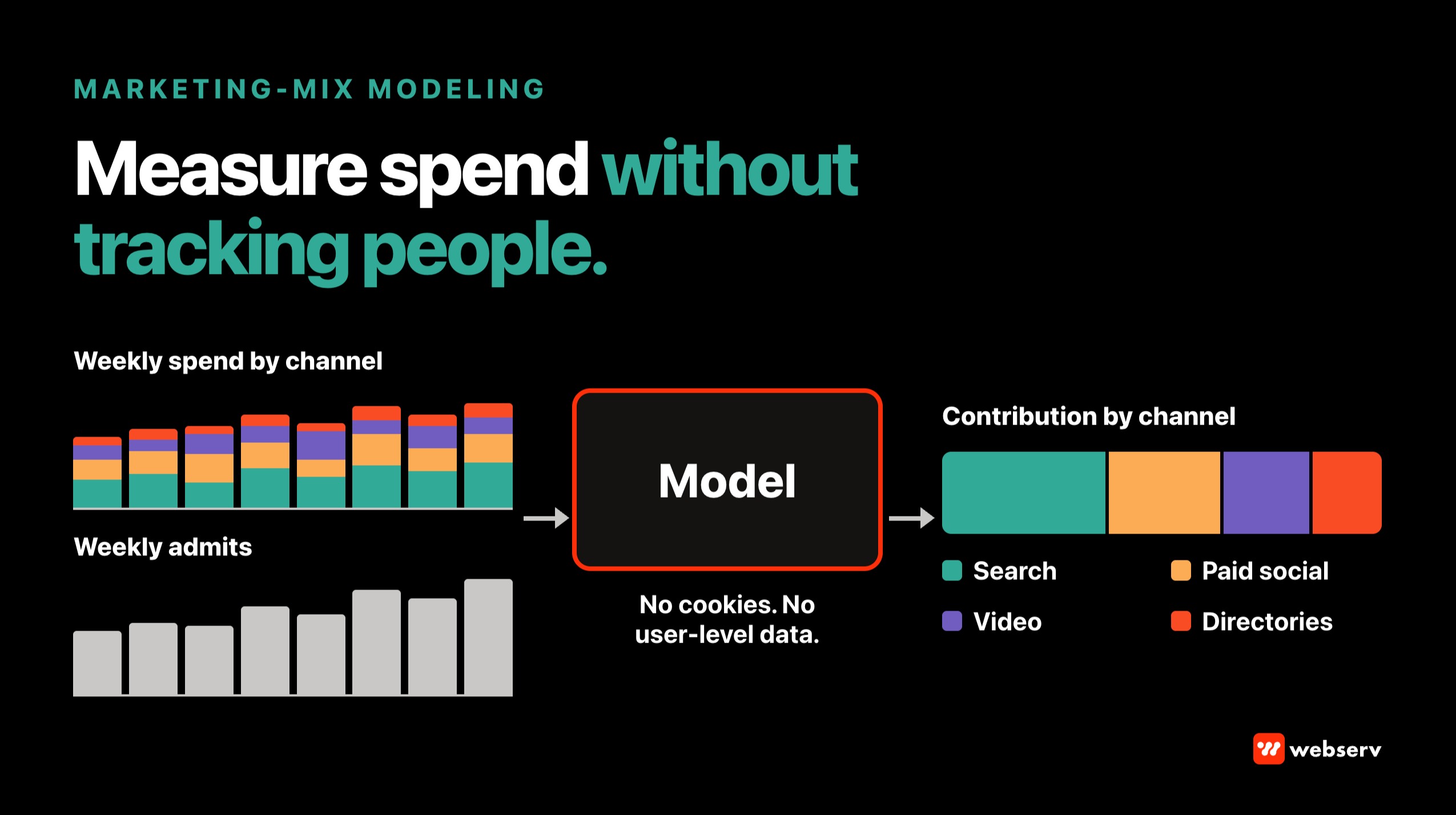
Meta’s documentation for GeoLift, its open-source geo-experiment tool, says it’s built for cases where people-based measurement isn’t feasible, and names healthcare advertisers as the example. Google’s documentation for Meridian, its open-source marketing-mix model, says the model doesn’t use any cookie or user-level information.
For treatment centers, that’s the appeal. Marketing-mix modeling measures what spend produced using aggregate numbers, such as weekly spend and weekly admits, rather than tracking individuals. Attribution in behavioral health runs into privacy rules at every step; a model that doesn’t need user-level data sidesteps many of them.
It isn’t a fit for every operator. The same documentation that makes MMM attractive also sets data requirements many single-facility programs can’t meet. This piece covers what MMM is, what it needs, where it fits for treatment centers, how to calibrate it with experiments, and the privacy questions that remain.
It’s part of the measurement work in our admission ops and attribution practice. For how MMM compares with lead-level attribution, see our complete guide to attribution for treatment centers.
Key Takeaways
- Marketing-mix modeling estimates how much each channel contributed to an outcome, such as admits, using aggregate spend and outcome data over time. It doesn’t require cookies or user-level tracking.
- Google’s Meridian documentation recommends at least two years of weekly data for geo-level models and three years for national models. Meta’s Robyn guidance also recommends at least two years of weekly data.
- MMM needs spend that varies over time. Google warns that low-spend channels tend to return results close to the model’s starting assumptions.
- Experiments make MMM more reliable. Google says incrementality experiments are perhaps the strongest basis for the model’s priors, and its incrementality tests can now start at $5,000.
- Aggregate data isn’t automatically de-identified. Weekly admits by sub-state geography don’t meet HIPAA’s Safe Harbor standard as written, so involve counsel before sharing admit data with a vendor.
- For many single-facility operators, lead-level attribution is enough. MMM becomes worth the effort with several channels, enough history, and meaningful spend.
What marketing-mix modeling is
The term gets used loosely, so start with what it means.
DEFINITION
Marketing-mix modeling. A statistical method that estimates how much each marketing channel contributed to an outcome, using aggregate data such as weekly spend by channel and weekly admits, plus factors like seasonality. It measures from the top down rather than following individual people, so it doesn’t depend on cookies or tracking a person’s path.
Two concepts do most of the work. Meta’s Robyn documentation describes adstock as the carryover effect of ads, and saturation as each additional dollar increasing the response at a declining rate. Google’s Meridian documentation describes saturation as diminishing marginal returns.
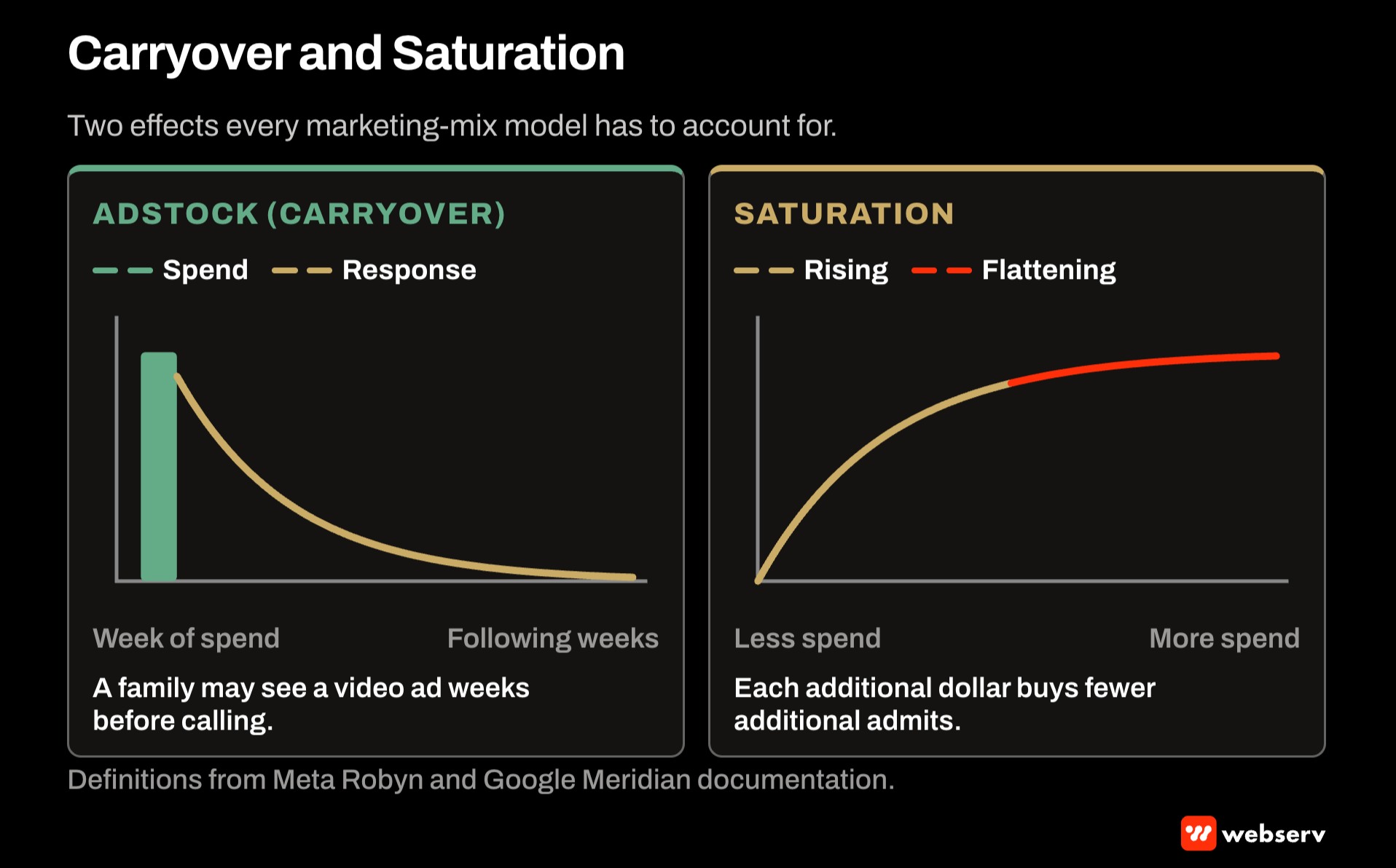
Both matter in treatment. A family may see a video ad weeks before calling, which is carryover. And a search budget can reach the point where more spend buys fewer additional admits, which is saturation. MMM puts numbers on both.
The main open-source options are Google’s Meridian, made available to everyone in January 2025, Meta’s Robyn, and PyMC-Marketing. All three are free software; the cost is the data work and the analyst time.
What MMM needs
The documentation is direct about data requirements, and they’re where most treatment centers find out whether MMM fits.
WHAT MMM NEEDS
- History. Google’s data collection guidance recommends at least two years of weekly data for geo-level models and three years for national models. Robyn’s analyst guide also recommends at least two years of weekly data.
- Enough data for the number of channels. Google’s guidance on data volume walks through an example where 104 weeks of data is too little to estimate a model with 26 parameters reliably. Its advice for small datasets is to model fewer channels, combining or dropping low-spend ones. Robyn’s guide suggests roughly 7 to 10 observations per variable.
- Variation in spend. Google’s Modern Measurement Playbook says MMM accuracy depends on the scale, timing, and variation of historic spend. A budget that stays flat every week gives the model little to learn from.
- Geography, where possible. Google recommends geo-level data when possible, and suggests US advertisers model the top 50 to 100 media markets. It also notes the benefit shrinks with few geographies, which describes a single-facility program serving one region.
- A consistent outcome. The model needs the same outcome measured the same way for the whole period, typically admits by week. If admissions changed how it records admits partway through, the model inherits the break.
Where MMM fits for treatment centers
Put the requirements next to a typical treatment center and a pattern appears.
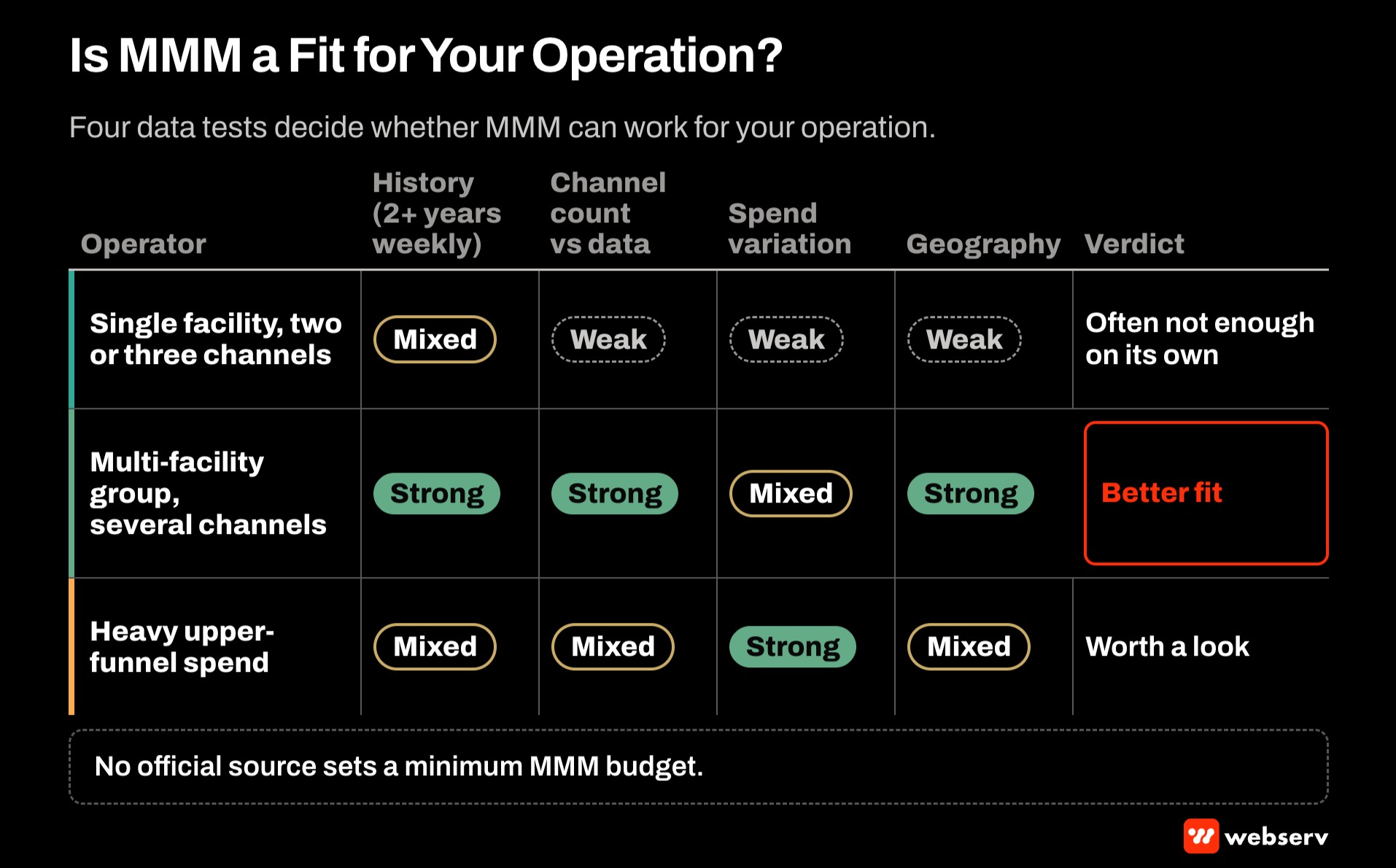
Single facility, two or three channels. Often not enough on its own. With one region, a few channels, and steady budgets, the model has little variation to work with. Google’s debugging guidance says low-spend channels are especially likely to return results close to the model’s starting assumption.
For that kind of program, lead-level attribution and simple tests usually answer the practical questions better.
Multi-facility group, several channels. A better fit. Multiple service areas give geographic variation, several channels give the model something to separate, and budget shifts across facilities create the variation MMM needs.
Heavy upper-funnel spend. Worth a look even at moderate scale. Connected TV, YouTube, and paid social are the channels last-touch attribution under-credits, and MMM measures them without needing a click. Our connected TV guide covers one of those channels.
No official source sets a minimum budget for MMM, and it’s better not to invent one. The tests are the ones above: history, channels, variation, and geography.
COMMON MISTAKE
Modeling every channel separately. A treatment center with two years of weekly data and ten line items, such as branded search, non-branded search, Performance Max, three Meta campaigns, YouTube, CTV, and two directories, asks the model to separate more effects than the data supports.
Group channels by role instead: search, paid social, video, and directories. Google’s own advice for small datasets is to combine or drop low-spend channels.
Calibrate with experiments
MMM estimates effects from history. Experiments measure them directly. Using both is where MMM becomes trustworthy.
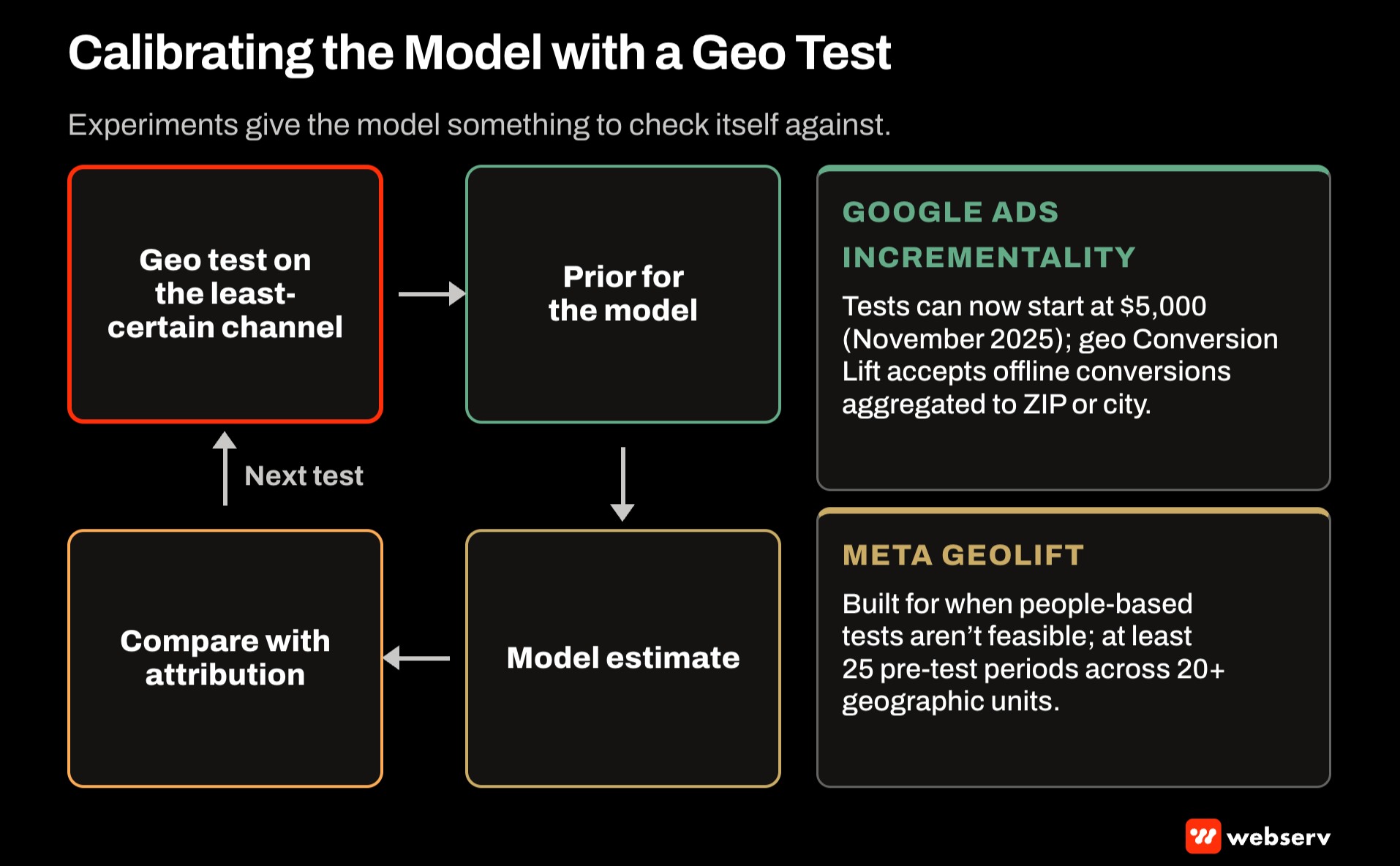
Google’s calibration guidance says incrementality experiments are perhaps the strongest basis for setting the model’s priors. It also says there’s no single formula for turning an experiment into a prior, so the analyst has to make that call.
For treatment centers, geography-based experiments fit best, because they don’t need to identify individuals:
- Google Ads incrementality testing. Google announced in November 2025 that experiments that once cost upwards of $100,000 can now be run for $5,000. Its geo-based Conversion Lift accepts offline conversions aggregated to ZIP or city level. Availability still varies by account.
- Meta GeoLift. Meta’s open-source GeoLift is designed for cases where people-based lift tests aren’t feasible, naming healthcare advertisers. Its best practices recommend at least 25 pre-test periods across 20 or more geographic units.
Meta’s people-based Conversion Lift matches conversions using hashed emails or phone numbers. For treatment centers, that raises the same questions as any identifier sharing, covered in our HIPAA-safe conversion tracking guide.
OPERATOR INSIGHT
Run one geo test on the channel you’re least sure about before building a model. If you can’t get a readable result from a test in your markets, that tells you something about whether a model will have enough signal too.
A test also gives the model a real anchor for that channel, instead of relying only on history.
The privacy questions that remain
MMM uses aggregate data, but aggregate isn’t the same as de-identified.
HHS’s de-identification guidance describes the Safe Harbor method, which removes geographic subdivisions smaller than a state, apart from certain three-digit ZIP codes, and all date elements except the year, including admission dates.
Weekly admit counts by county or media market don’t meet Safe Harbor as written. The same guidance describes an alternative, Expert Determination, in which a qualified expert assesses re-identification risk and may use techniques like suppressing small counts.
Practical steps:
- Keep modeling data aggregate. Weekly totals by channel and geography, no names, no individual dates.
- Watch small counts. A market with one or two admits in a week is easier to re-identify than one with dozens. Combine small markets or longer periods.
- Contract carefully. A vendor or consultant receiving admit data from the facility may need a business associate agreement, and substance use disorder programs have 42 CFR Part 2 to consider.
- Get counsel’s sign-off on the dataset before it leaves the facility.
How MMM and attribution work together
MMM doesn’t replace attribution. They answer different questions.
Lead-level attribution, captured through call tracking, forms, and the CRM, tells admissions and marketing which campaigns and keywords produce inquiries and admits. Our call tracking guide covers that layer.
MMM tells leadership how to split the budget across channels, including channels that rarely get the last click. Experiments check both.
A workable sequence for a treatment center:
Get lead-level attribution right first
Admits recorded consistently against their source.
Build clean weekly history
Spend by channel, admits, and geography, recorded the same way for at least two years.
Run a geo test
on the channel with the most uncertainty.
Build a simple model
with channels grouped by role.
Calibrate and compare
Check model results against the test and against attribution, and investigate where they disagree.
Plan budgets from all three
and rerun the model as new data comes in.
Where this fits
MMM is the top of the measurement stack, not the foundation. For how budget decisions come together, see our guide on lowering cost per admit without cutting ad budget and the marketing ROI and attribution playbook. For raising conversion rates before adding budget, see the complete guide to conversion rate optimization for rehab marketing.
For how measurement fits the rest of your marketing, see the complete guide to behavioral health marketing. If you want a second opinion on whether MMM fits your operation, book an intro meeting.
Frequently Asked Questions
What is marketing-mix modeling for a treatment center?
It’s a statistical method that estimates how much each marketing channel contributed to admits, using weekly spend by channel, weekly admits, and factors like seasonality.
It works from aggregate data, so it doesn’t rely on cookies or tracking individual people.
It’s most useful for deciding how to split budget across channels, including ones that rarely get the final click.
How much data does MMM need?
Google’s Meridian documentation recommends at least two years of weekly data for geo-level models and three years for national models. Meta’s Robyn guidance also recommends at least two years of weekly data.
The model also needs enough data for the number of channels, and spend that varies over time.
If you have fewer weeks or many small channels, group channels by role or wait until you have more history.
Is MMM HIPAA-compliant?
MMM doesn’t need user-level data, which removes many tracking concerns. But aggregate data isn’t automatically de-identified under HIPAA.
HHS’s Safe Harbor method removes geographic units smaller than a state and dates more specific than the year, so weekly admits by county or market don’t meet it as written.
Keep data aggregate, combine small counts, use appropriate agreements with vendors, and have counsel review the dataset.
Should a single-facility treatment center use MMM?
Often not as a first step. With one region, a few channels, and steady budgets, the model has little variation to work with, and Google notes low-spend channels tend to return results close to the starting assumptions.
Lead-level attribution and simple geo tests usually answer the practical questions sooner.
MMM becomes more useful as channels, history, and spend grow.
What’s the difference between MMM and incrementality testing?
MMM estimates channel effects from historical data. Incrementality tests measure a channel’s effect directly by comparing areas or groups that saw the ads with ones that didn’t.
Google says experiments are perhaps the strongest basis for the model’s assumptions, so the two work best together.
For treatment centers, geography-based tests, such as Google’s geo Conversion Lift or Meta’s GeoLift, avoid identifying individuals.
Trevor Gage is the Director of Marketing at Webserv, a digital marketing agency for treatment centers.