A regional detox operator called our admission ops team last spring. Their marketing team had been running HubSpot for four years as the de facto admissions system of record.
Leads landed in HubSpot. Coordinator notes lived in HubSpot Contact records. Nobody could tell you the viable-VOB rate by payer without exporting a spreadsheet.
The team was frustrated. Leadership was ready to switch platforms. We ran the audit. HubSpot was doing exactly what HubSpot is designed to do: marketing automation. It was not doing what an admissions system of record needs to do, because it was never configured for it.
The fix was not a migration. The fix was moving HubSpot upstream (where it is strong) and standing up a purpose-built admissions CRM downstream (where HubSpot’s coordinator ergonomics never fit).
This piece walks the operational picture: when HubSpot wins for a treatment center, when it doesn’t, and how to configure it correctly on either side of that decision.
Disclosure: Webserv is a Dazos implementation partner. This article evaluates HubSpot on its operational merits alongside Dazos and Salesforce. The same decision framework applies regardless of partnership. HubSpot, Dazos, and Salesforce are trademarks of their respective owners; use here is nominative and editorial only.
Key Takeaways
- HubSpot is a strong marketing automation platform and a limited admissions system of record. The distinction is the biggest decision an operator running HubSpot has to make about the platform.
- HubSpot wins upstream of admissions: form capture, email nurture sequences, workflow builder, and marketing attribution. HubSpot is limited downstream: no native VOB object, no LOC picklist, no BH-native EMR connectors, and coordinator ergonomics built for B2B sales.
- Facilities running HubSpot as admissions system of record are usually paying to customize HubSpot into something it was not designed to be. Total cost of ownership over three years usually favors a behavioral-health-native CRM downstream.
- The clean architecture is HubSpot for marketing automation, feeding Dazos or Salesforce as the admissions system of record. Both platforms integrate cleanly with HubSpot on the lead handoff.
- Configuring HubSpot correctly for admissions (as system of record or as marketing automation upstream) requires custom object work, workflow builds, and integration architecture. Out-of-the-box HubSpot is a starting point, not a finished admissions engine.
Why HubSpot for BH Admissions Specifically
HubSpot has real strengths and real limitations for behavioral health admissions. The honest cut depends on what role the platform plays in the stack.
When HubSpot wins. Facilities using HubSpot as marketing automation upstream of admissions. Facilities with heavy email nurture workflows for family or referral partner communication.
Facilities that already run HubSpot Marketing Hub for other service lines and want a single marketing automation tool. Small facilities under 15 admits per month where a lightweight HubSpot Starter or Pro tier is enough for a lead database.
When HubSpot is overkill or misfit. Facilities that need a purpose-built admissions system of record with VOB tracking, alpha prefix routing, LOC segmentation, and coordinator ergonomics designed for the admissions call floor.
Facilities running 30+ admits per month where the reporting layer needs BH-specific dimensions HubSpot does not ship with. Facilities where the EMR integration is load-bearing and Kipu, Sunwave, or BestNotes needs a native connector.
The three-question test. Does the facility need a purpose-built admissions system of record? Are the reporting dimensions behavioral-health-specific (VOB by payer, alpha prefix by payer, LOC-by-source close rate)? Is the EMR integration the constraint?
Two or three yeses point at Dazos or Salesforce downstream of HubSpot rather than HubSpot as the system of record. How to evaluate a behavioral health CRM at the platform level is the framework operators can walk each option against.
DEFINITION
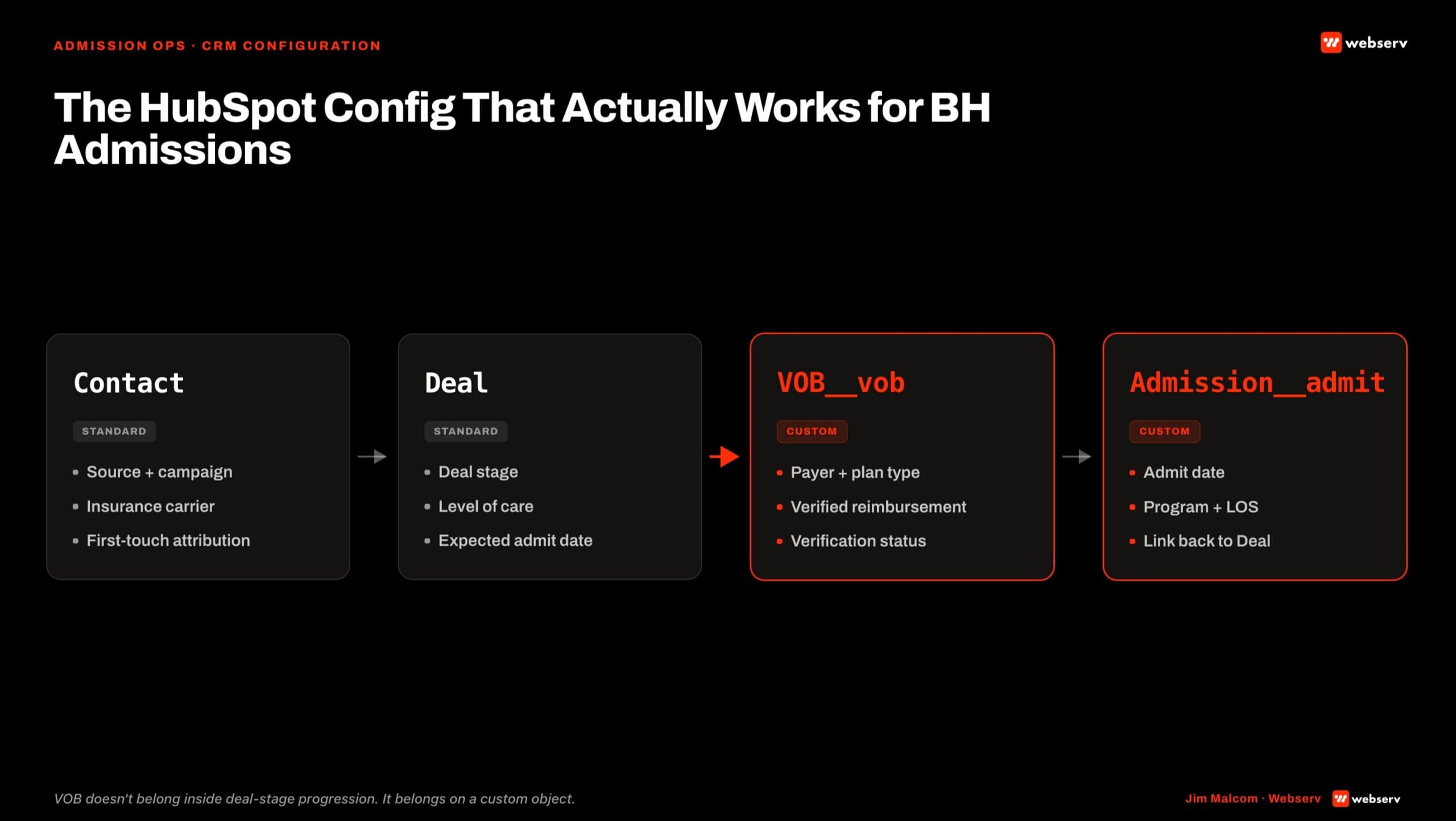
HubSpot custom objects are the mechanism that lets an admissions team model VOB status, level of care, payer identifier, and referral partner as first-class data on the deal record. Without custom objects, VOB tracking lives in ad-hoc contact properties and reporting collapses.
The Custom Object Model for VOB Tracking in HubSpot
HubSpot supports custom objects on Enterprise tier. A VOB custom object built inside HubSpot has the same shape as the equivalent VOB__c object in Salesforce: a child of the Contact record, with structured fields for payer, alpha prefix, coverage status, prior-auth flags, and LOC.
The LOC picklist should map to ASAM’s standard levels of care so the reporting stays clinically coherent regardless of platform (ASAM Criteria).
Insurance verification friction is a documented barrier to treatment access, which is why admissions CRM configuration is operational work with clinical stakes (SAMHSA, National Survey of Substance Abuse Treatment Services).
Required fields on a HubSpot VOB custom object:
- Payer (dropdown: Anthem, BCBS, Aetna, Cigna, UHC, Kaiser, Medicaid, Medicare, self-pay, other)
- Plan Name (single-line text)
- Alpha Prefix (single-line text, 3-character validation for BCBS)
- Group Number (single-line text)
- Coverage Status (dropdown: pending, viable, non-viable, needs-more-info)
- In-Network / Out-of-Network (dropdown)
- Deductible / Out-of-Pocket Max (number)
- Expected Reimbursement Per Day (number)
- Prior Auth Required (single checkbox)
- Prior Auth Status (dropdown)
- Days Authorized (number)
- LOC Approved (dropdown: detox, residential, PHP, IOP, OP)
- VOB Requested By (HubSpot user)
- VOB Completed By (HubSpot user)
- VOB Completion Timestamp (date and time)
- Notes (multi-line text)
The build note. Custom objects on HubSpot are Enterprise tier only. Facilities on Marketing Hub Professional or Sales Hub Professional cannot build custom objects.
If a Professional-tier facility wants VOB tracking, the options are upgrading to Enterprise, tracking VOB as fields on the Contact (which collapses the moment a patient needs re-verification), or moving admissions off HubSpot and keeping it as marketing automation upstream.
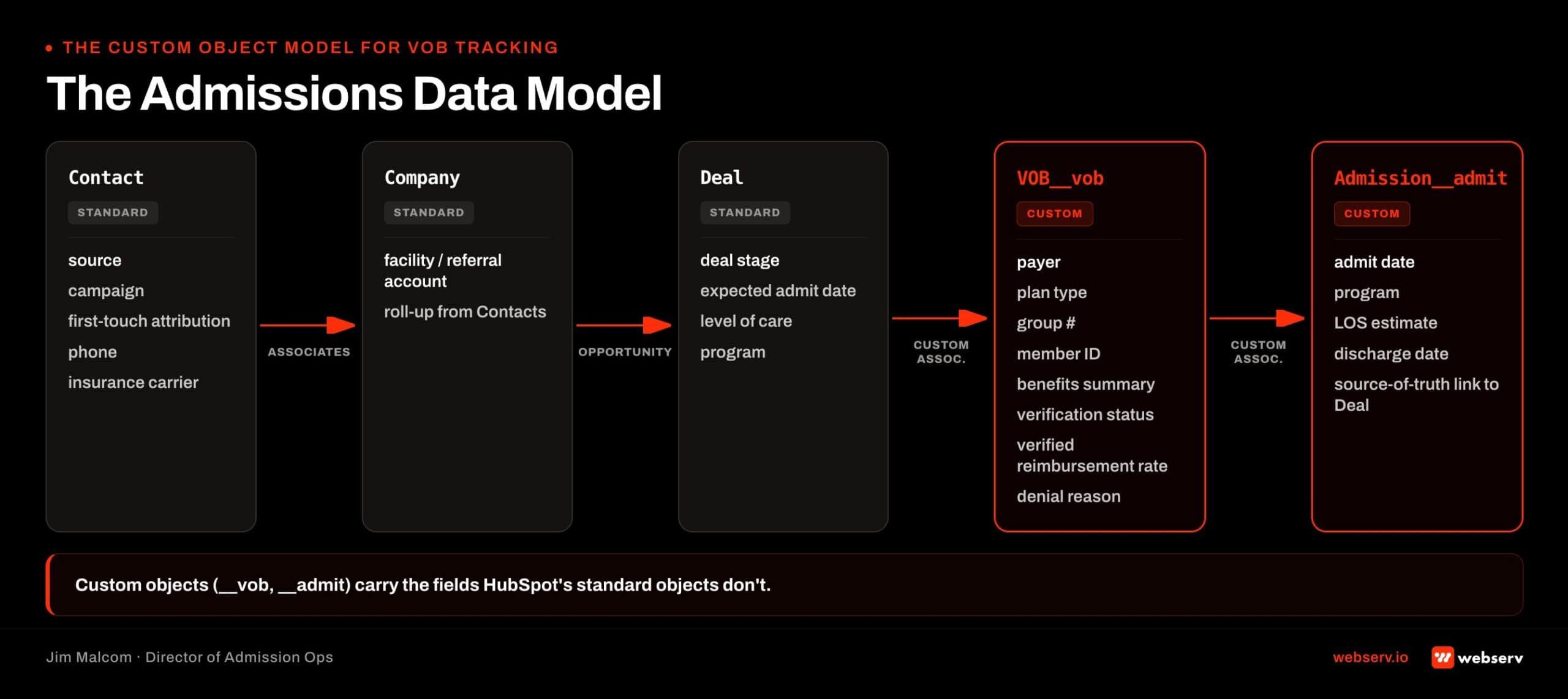
Deal Stages That Match Admissions
HubSpot’s Deal pipeline is the layer where admissions stages get built. The naming is different from Salesforce’s Opportunity stages, but the structure is the same.
Intake stage. New Deal created against a Contact. Owner is the intake coordinator. Required properties: name, phone, source, presenting concern. SLA: contact attempt inside 60 seconds. Exit criteria: coordinator confirms fit and requests VOB.
VOB stage. Deal advances after intake. VOB custom object record created and assigned to the insurance coordinator. Required properties: payer, plan, member ID, alpha prefix, LOC requested. SLA: coverage status populated inside 24 hours. Exit criteria: VOB completed and marked viable or non-viable.
Follow-Up stage. VOB viable and clinical fit confirmed. Owner is admissions rep. Required properties: prior-auth status if required, expected reimbursement, family financial conversation logged. SLA: no more than 48 hours between contacts. Exit criteria: admit scheduled or Deal closed-lost with reason.
Admit stage. Patient admitted. Owner is intake supervisor. Required properties: admit date, LOC, expected LOS, EMR record ID. SLA: EMR handshake fires inside 5 minutes of admit. Exit criteria: patient record in EMR, Deal closed-won, LTV tracking started.
The anti-pattern to avoid. HubSpot’s default sales pipeline stages (Appointment Scheduled, Qualified to Buy, Presentation Scheduled, Decision Maker Bought-In, Contract Sent, Closed Won) do not map to admissions. Do not adapt the default. Build fresh against the four stages above.
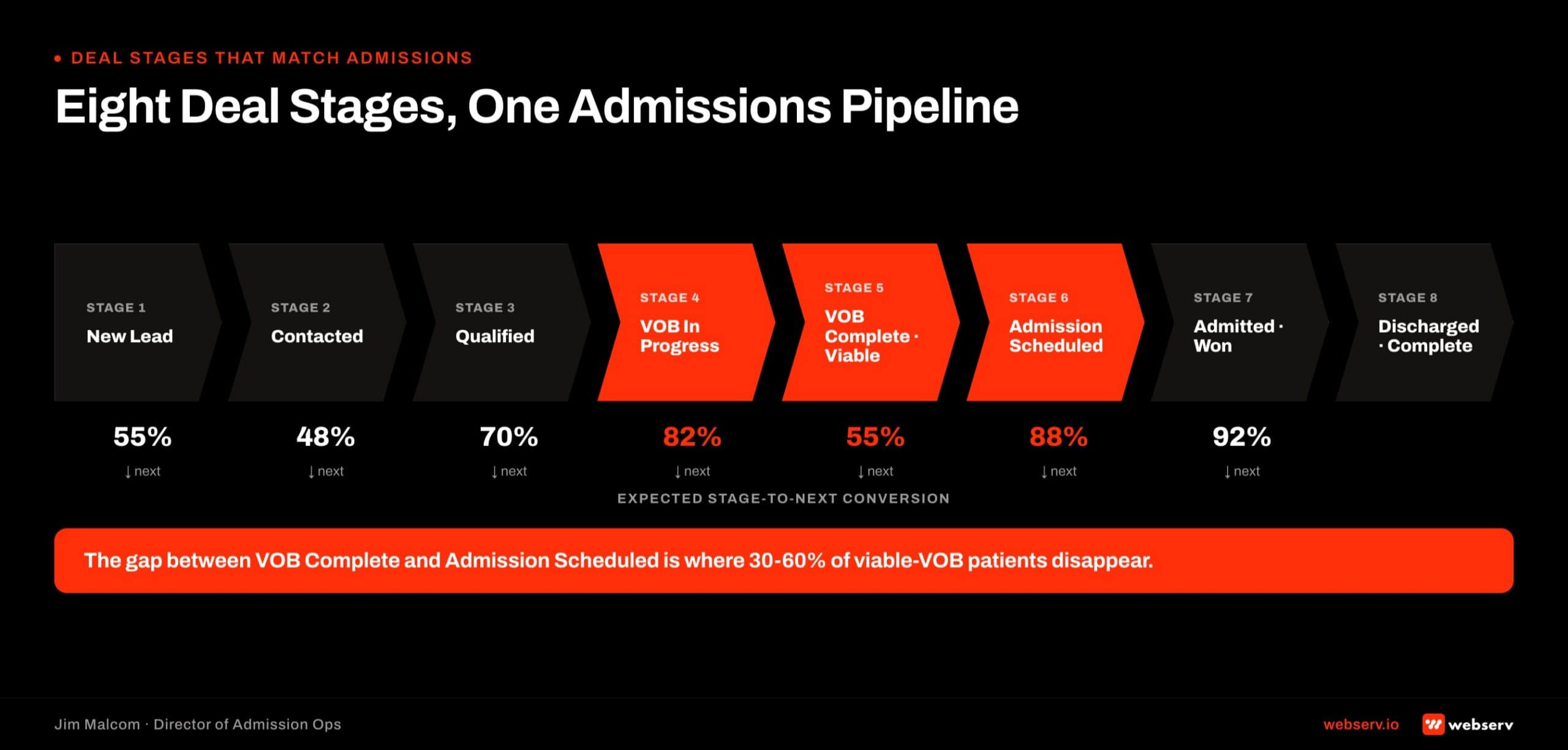
Workflows That Move Records
Six workflows every behavioral health HubSpot build needs. HubSpot’s Workflows tool is the automation layer that does the same job Salesforce Flow or Dazos automation does elsewhere.
1. New lead created. Auto-assign to coordinator based on source, round-robin, and shift schedule using HubSpot’s team rotation feature.
2. Deal stage change to VOB. Task created for the insurance coordinator with due date and payer prefilled from the Contact. Prevents the “did anyone start this VOB” ambiguity.
3. VOB coverage status set to viable. Notify admissions rep, advance the Deal to Follow-Up stage, and start the SLA timer. This is where the funnel accelerates.
4. Missed follow-up (no activity 24 hours). Escalate to admissions manager with a Slack alert via HubSpot’s Slack integration. The leak detector.
5. Prior auth required flag. Task queue clones to the utilization review team. Prior auth cases have their own workflow and shouldn’t clog the standard follow-up queue.
6. Admit stage reached. Sync patient record to EMR, close the Deal as won, and trigger LTV tracking. This closes the loop between HubSpot and the clinical system.
The build variance. Behavioral health facilities that run a full admissions engine on HubSpot typically deploy 30 to 50 workflows total across intake, VOB, follow-up, and referral partner nurture. The six above are the required core. Payer complexity and referral partner count add the rest.
Integrations With Call Tracking, EMR, and Billing
Three surfaces every treatment center HubSpot build has to wire. The pattern is similar to what a Salesforce build requires, with the important difference that HubSpot’s ecosystem of native connectors is broader on marketing side and thinner on behavioral health EMR side.
Call tracking. CallRail and CallTrackingMetrics both have HubSpot integrations. Dynamic number insertion on marketing pages captures ad source, campaign, geo, and landing page URL. Call recordings push to the Contact’s activity timeline. Call outcome and disposition track on structured properties.
EMR. This is where HubSpot’s ecosystem shows its limits. Kipu, Sunwave, and BestNotes do not have native HubSpot connectors.
Facilities running HubSpot as admissions system of record with EMR sync usually build a middleware integration through Zapier, Workato, or a custom connector. HIPAA BAA required across every layer that touches PHI.
Billing. One-way sync from EMR to billing system, never from HubSpot. HubSpot reports on expected reimbursement (from the VOB custom object). Billing reports on collected. A reconciliation dashboard compares the two.
The honest limitation. If EMR sync is load-bearing for admissions decisions (and it usually is at scale), a native connector to Kipu or Sunwave often justifies moving system-of-record to Dazos as the behavioral-health-native admissions CRM and keeping HubSpot upstream as marketing automation.
Reporting Dashboards That Prove HubSpot Is Working
Four reports every treatment center HubSpot build should produce on demand.
Viable VOB rate by payer. Percentage of VOBs coming back viable, sliced by payer. Under 40 percent means marketing is targeting the wrong plans or intake is capturing the wrong prospects.
Source-to-admit conversion by channel. Leads to VOBs to admits, sliced by lead source. Answers “which channels actually admit” instead of “which channels produce leads.” HubSpot’s attribution reporting is strong here.
Coordinator-level close rate. VOB-to-admit close rate per coordinator over a rolling four-week window. Drives coaching decisions.
SLA breach report. Deals sitting in a stage longer than the stage SLA. Every Deal on this list is a revenue exposure.
HubSpot’s reporting layer (via Reports tool and dashboards) does these four cleanly on Enterprise tier when custom objects are enabled and workflows are correctly wired to update properties.
On Professional tier without custom objects, some of these reports have to be rebuilt as workarounds. That is where the reporting layer starts to fray. The KPI spine is the same framework every admissions CRM should carry regardless of platform.
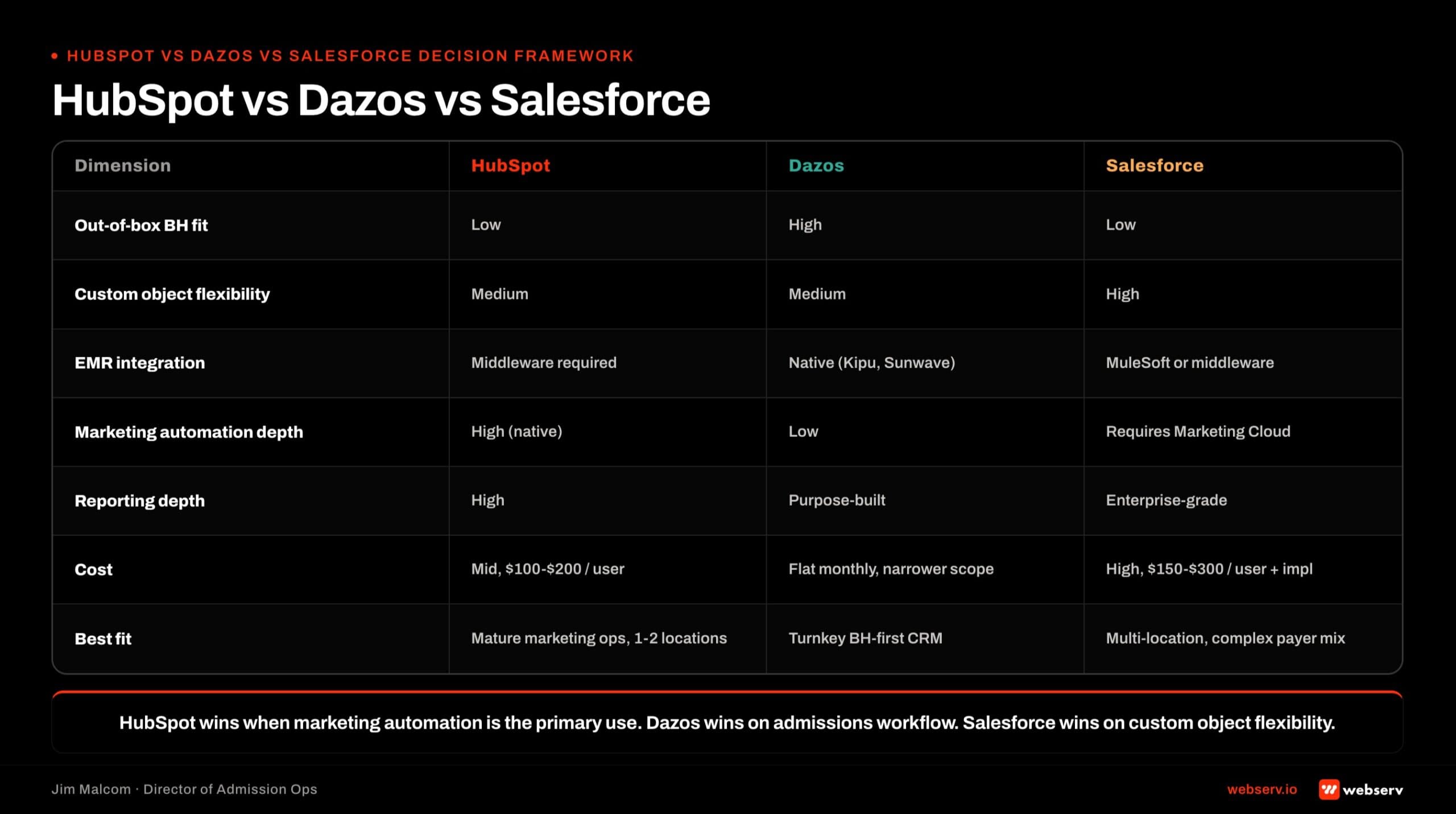
HubSpot vs Dazos vs Salesforce Decision Framework
Feature-by-feature comparison based on published product documentation as of 2026-07.
Time to launch. HubSpot as marketing automation: 2-3 weeks configured. HubSpot as full admissions system of record: 8-12 weeks. Dazos: 2-4 weeks turnkey. Salesforce: 6-12 weeks with consultant.
Native behavioral health object model. HubSpot: no (requires Enterprise tier custom object build). Dazos: yes (out-of-box). Salesforce: no (requires custom object build).
Marketing automation depth. HubSpot: deep (built as marketing automation first). Dazos: light. Salesforce: moderate (via Marketing Cloud, sold separately).
Coordinator workflow ergonomics. HubSpot: designed for B2B sales, not admissions call floor. Dazos: purpose-built for admissions. Salesforce: general-purpose (customizable but heavy).
BH EMR connectors. HubSpot: middleware required. Dazos: native. Salesforce: middleware required.
Annual cost (mid-size facility). HubSpot Marketing Hub Professional plus Sales Hub Professional: $20K-$40K. HubSpot Enterprise: $40K-$80K. Dazos: $20K-$40K. Salesforce: $30K-$80K or more.
Best for. HubSpot: marketing automation upstream of an admissions CRM, or admissions system of record for small facilities under 15 admits per month. Dazos: single-mission behavioral health admissions system of record. Salesforce: enterprise portfolios with existing Salesforce footprint and complex payer mix.
The clean architecture for most mid-size facilities. HubSpot for marketing automation and pre-lead nurture. Either Dazos as the behavioral-health-native admissions CRM or Salesforce as the enterprise-portfolio admissions system of record. The two integrate cleanly on lead handoff via native or middleware connectors.
COMMON MISTAKE
Configuring HubSpot as a general B2B CRM and expecting it to work for admissions. HubSpot ships with defaults tuned for SaaS-style pipelines, not for admissions workflows. The custom object model, deal stages, and workflow automation all need behavioral-health-specific configuration before HubSpot produces the reporting an admissions team can actually use.
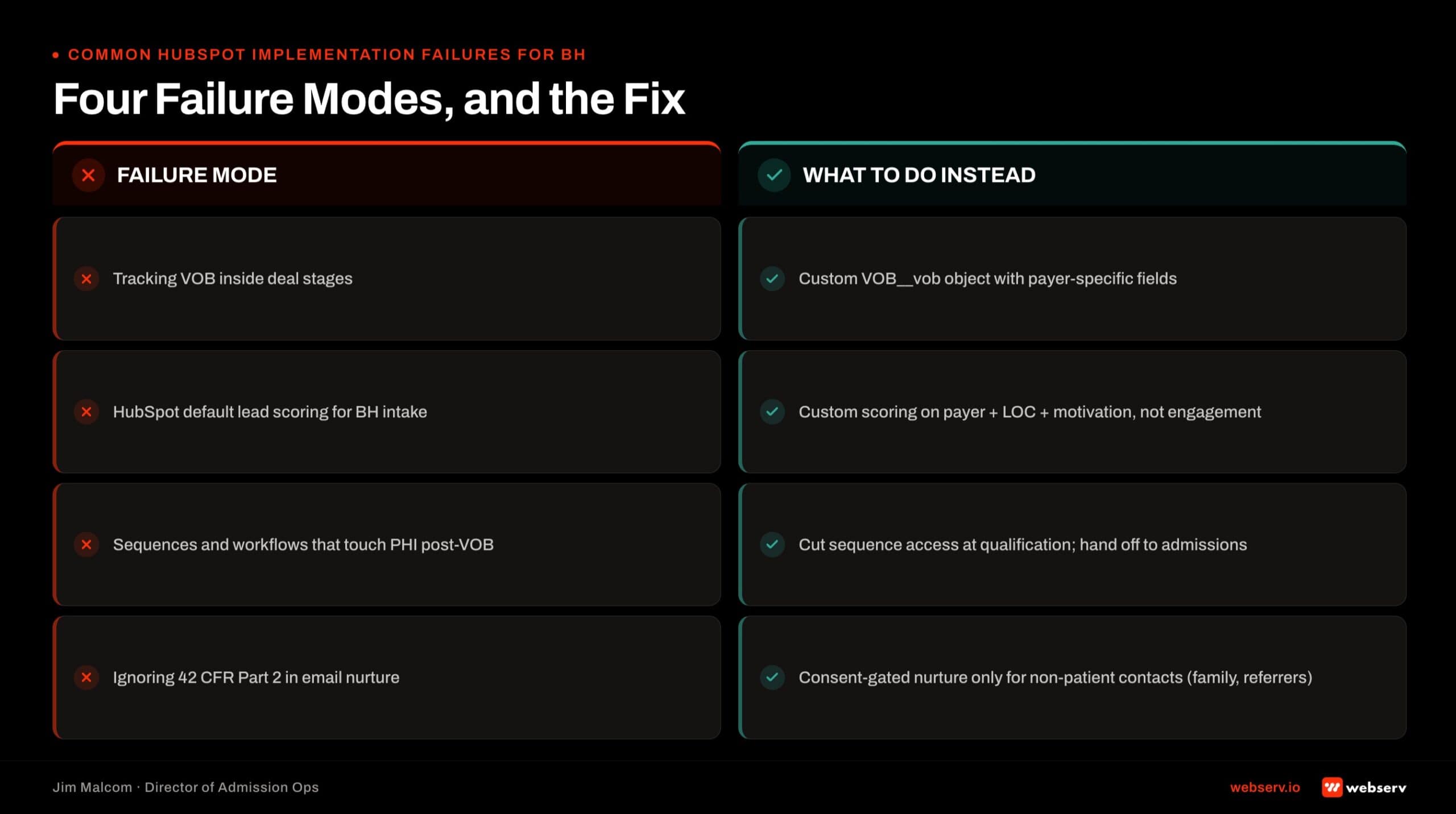
Common HubSpot Implementation Failures for BH
Five failure modes we see on audits.
HubSpot as admissions system of record without Enterprise tier. VOB tracked as fields on Contact rather than a custom object. No historical trail on re-verification. Reporting collapses at the first patient with secondary insurance.
Sales-shaped Deal pipeline instead of admissions-shaped. Default HubSpot stages (Appointment Scheduled, Qualified to Buy, Contract Sent) applied to admissions. Meaningless for the workflow the coordinators actually run.
Marketing automation running downstream of admissions. Email nurture sequences firing to patients mid-treatment because the automation was never scoped to stop when the Deal moves to Admit. Clinical exposure and family relationship damage both real.
No middleware for EMR sync. Coordinators re-entering admit data manually into Kipu because the integration was assumed and never built. Data drift within 90 days.
HIPAA BAA gaps across the stack. HubSpot’s standard tier does not sign BAAs in all configurations. Marketing automation touching PHI requires BAA coverage across HubSpot, any middleware, and any downstream tool. Facilities that treat this as a paperwork exercise carry compliance exposure that surfaces in audits.
The pattern under all five. HubSpot doing what HubSpot was not designed to do. The fix is usually to move admissions off HubSpot and keep HubSpot upstream where it is genuinely strong.
What a Webserv Engagement Looks Like
The 6-week Admission Ops sprint runs against the five pillars: Lead Intake and Tracking, CRM and Workflow Optimization, VOB and Insurance Ops, Team Enablement and Training, Always-On Admissions.
Week 1, Onboard and Audit. Kickoff, gap map, implementation roadmap. This is where the HubSpot-as-system-of-record versus HubSpot-as-marketing-automation decision gets scoped.
Week 2, Lead Tracking. Call tracking, form and chat capture, source mapping, QA process. HubSpot form + workflow builds land here.
Week 3, CRM Pipeline. Deal stages, workflows, early reporting. If HubSpot is staying as system of record, custom object work happens here. If HubSpot is moving upstream, this is where Dazos or Salesforce gets configured downstream.
Week 4, VOB Workflow. VOB custom object built out (HubSpot Enterprise) or moved to downstream CRM. Prior-auth flags, status tracking, follow-up SOPs.
Weeks 5-6, Training and Launch. Scripts, playbooks, rebuttals, QA loops, live team training.
Pricing. One-time setup runs $7,500 to $15,000 depending on center size, CRM complexity, and integration scope. Ongoing retainer tiers by location count: $3,500 to $5,000 per month for 1-2 locations, $5,000 to $8,000 per month for 3-5 locations, $8,000 to $15,000 per month for 6+ locations.
The Fast-Track Diagnostic is the low-friction entry: $3,000, credited 100 percent toward month one if the facility moves forward. Two-week audit of the current HubSpot build against the framework above, gap map, and firm proposal.
The perspective in this article comes from 9 years working exclusively inside behavioral health.
We are a team built by people in recovery who understand that behind every admission is someone asking for help. If that resonates, get to know us.
Frequently Asked Questions
For the fuller admissions technology stack, see behavioral health marketing guide.
Is HubSpot a good CRM for a treatment center?
HubSpot is a strong marketing automation platform and a limited admissions system of record for behavioral health. Facilities using HubSpot for form capture, email nurture, and marketing attribution get real value. Facilities using HubSpot as the admissions system of record with VOB tracking and coordinator workflows usually find the platform straining against what it was designed for.
The honest cut is that HubSpot fits best upstream of admissions. Marketing automation, family nurture sequences, referral partner communication, and top-of-funnel attribution all live in HubSpot cleanly. VOB tracking, coordinator ergonomics, and EMR integration typically fit better in Dazos or Salesforce downstream.
The exception is small facilities under 15 admits per month where the volume does not justify a purpose-built admissions CRM. In that band, HubSpot can hold both marketing and light admissions functions until scale justifies a downstream CRM.
Does HubSpot have VOB tracking for treatment centers?
Not out-of-the-box. HubSpot ships with Contact, Company, Deal, and Ticket objects. A VOB record has to be built as a custom object on HubSpot Enterprise tier. On Professional tier, custom objects are not available, and VOB gets tracked as fields on the Contact, which collapses the moment a patient needs re-verification or carries secondary insurance.
The VOB custom object build is standard behavioral health admissions work: 16 or more structured fields covering payer, alpha prefix, coverage status, prior-auth flags, expected reimbursement, and LOC approved. The build takes 1-2 weeks inside a proper Admission Ops sprint.
Facilities on HubSpot Professional tier considering VOB tracking have three options: upgrade to Enterprise, live with fields-on-Contact and accept the limitations, or move admissions system of record to Dazos or Salesforce and keep HubSpot upstream as marketing automation.
How does HubSpot compare to Dazos or Salesforce for behavioral health admissions?
HubSpot is strongest at marketing automation, weakest at behavioral-health-specific admissions workflows. Dazos is a behavioral-health-native admissions CRM that ships with the VOB object, LOC picklist, and coordinator ergonomics HubSpot requires custom work to replicate. Salesforce is a general-purpose CRM that also requires custom work but has the deepest customization ceiling of the three.
For most mid-size behavioral health facilities, the answer is not one of the three. It is HubSpot upstream as marketing automation, feeding Dazos or Salesforce downstream as the admissions system of record. Both downstream platforms integrate cleanly with HubSpot on lead handoff.
Facilities running all three in the org (marketing on HubSpot, admissions on Dazos or Salesforce, EMR on Kipu) get the cleanest architecture. The integration cost is real but so is the operational simplicity of each platform doing what it was designed for.
Can HubSpot integrate with Kipu, Sunwave, or BestNotes?
Not natively. HubSpot’s app marketplace does not include native connectors for the major behavioral health EMRs. Facilities running HubSpot as admissions system of record with EMR sync build the integration through Zapier, Workato, or a custom middleware.
The middleware works but adds complexity. Every EMR field mapping, sync frequency, and error handling scenario has to be scoped through the middleware layer. HIPAA BAA required across HubSpot, the middleware vendor, and the EMR.
Facilities where EMR sync is load-bearing typically find the total cost of ownership favors moving admissions to Dazos (native Kipu integration) or Salesforce (also middleware but broader connector ecosystem) and keeping HubSpot upstream as marketing automation.
How much does HubSpot cost for a treatment center?
HubSpot Marketing Hub Professional plus Sales Hub Professional runs roughly $20,000 to $40,000 per year depending on contact count and user seats. HubSpot Enterprise (required for custom objects) runs $40,000 to $80,000 per year at similar scale. Implementation costs sit on top.
The license spend is not the total cost of ownership. Facilities running HubSpot as admissions system of record also carry implementation labor for custom objects, custom workflows, and EMR middleware. A realistic all-in year-one cost for a mid-size facility runs $60,000 to $120,000 including license, implementation, and middleware.
Facilities using HubSpot only for marketing automation upstream of a downstream admissions CRM typically stay on Professional tier and land in the $20,000 to $40,000 per year band before implementation. The downstream CRM (Dazos or Salesforce) carries its own separate cost.
Is HubSpot HIPAA-compliant for behavioral health?
HubSpot signs BAAs on specific enterprise configurations, not on all tiers by default. Facilities running HubSpot at any layer that touches PHI need to verify their specific plan and configuration is BAA-eligible and executed. Marketing automation that touches patient status data crosses into PHI handling.
The compliance layer is broader than just HubSpot. Every middleware (Zapier, Workato, custom connector), every downstream tool (Slack alerts, email service providers), and every reporting tool touching admissions data needs BAA coverage. Facilities that treat this as a paperwork exercise carry exposure that surfaces during audits or subject-access requests.
The safe posture. Do not touch PHI in HubSpot unless BAA coverage is confirmed. Route admissions decision data to a purpose-built admissions CRM with explicit BAA coverage and a HIPAA-aware access control model. HubSpot’s job upstream is marketing automation, not clinical data handling.
Should I move admissions off HubSpot to Dazos or Salesforce?
Usually yes if the facility is running 20+ admits per month and using HubSpot as system of record. The signal is when coordinators are working around HubSpot instead of with it: exporting to spreadsheets, tracking VOB status in notes fields, or re-entering data into EMR because the sync never worked.
The migration path is Approach 3 from the CRM migration playbook: move admissions to Dazos or Salesforce downstream, keep HubSpot upstream as marketing automation, integrate the two on lead handoff. Historical HubSpot data can archive or ETL depending on how much historical reporting continuity matters.
Facilities under 15 admits per month running a lightweight HubSpot admissions build can often stay. The complexity of migration outweighs the operational upside at that scale. The threshold to move is where HubSpot workaround cost exceeds the downstream CRM cost, which usually lands around 20-30 admits per month for most single-brand facilities.
Closing Note From the Admission Ops Floor
HubSpot is not the wrong tool. HubSpot is a strong tool used for the wrong job at treatment centers running it as admissions system of record.
The clean architecture is HubSpot upstream as marketing automation, feeding a behavioral-health-native admissions CRM downstream. Both sides of that architecture do what they were designed for. Neither side is strained against a workflow that does not fit.
If you are running HubSpot for admissions and cannot pull the four reports above on demand, or if the coordinators are working around the platform, the audit is worth running before another quarter passes.
Start with the $3,000 Fast-Track Diagnostic. Credited 100 percent toward month one whichever way the audit points.
Jim Malcom is the Director of Admission Ops at Webserv. He has spent his career inside behavioral health admissions operations (call floors, VOBs, CRMs, and the reporting stack that ties them together) and now leads the Webserv admission ops practice for treatment center operators nationwide.