A SAMHSA advisory based on its family therapy treatment guide says involving family members in substance use disorder treatment can positively affect client engagement, retention, and outcomes. NIDA’s treatment principles say family and friends can play critical roles in motivating people to enter and stay in treatment.
Some of the people who land on a treatment center’s paid pages are those family members: a parent, a spouse, an adult child trying to figure out whether to call on someone else’s behalf.
They’re reading for different reasons than a person seeking care for themselves, and they run into rules the patient doesn’t, starting with what admissions is allowed to tell them.
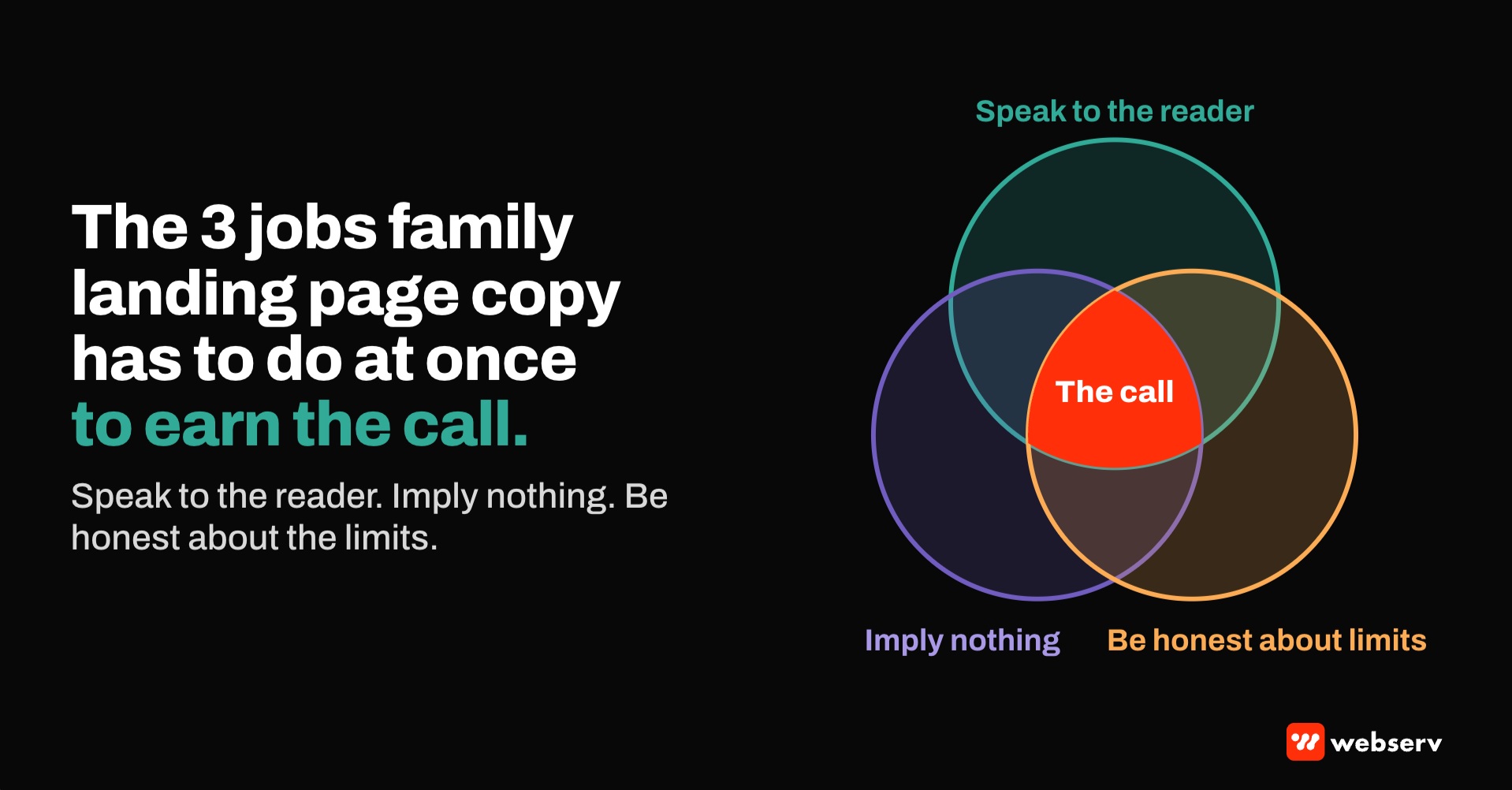
Family-focused copy has to do three things at once: speak to the person reading, avoid implying anything about their loved one’s condition, and be honest about what a family member can and can’t do.
This piece covers what families need from a page, the language to use and avoid, how to explain privacy, and the sections a family page needs. It’s how our landing page team for treatment centers writes for families, and it builds on the family decision layout in our landing page templates.
Key Takeaways
- Family visitors are deciding whether and how to help someone else. Copy should answer their questions: what the program involves, how families take part, and what happens when they call.
- Meta’s personal attributes policy bars ads that imply knowledge of the medical information of a user or the user’s family. Keep the landing page in the same tone so the click doesn’t switch registers.
- Be clear about privacy. HIPAA lets providers listen to family members, but substance use disorder programs covered by 42 CFR Part 2 generally need the patient’s written consent to share information.
- Use person-first language. NIDA recommends “person with a substance use disorder” over terms like “addict” or “abuser.”
- Describe family programming as it actually works at the facility, and don’t promise outcomes.
- Include crisis resources, such as 988 and SAMHSA’s National Helpline, for families facing an emergency.
What family visitors need from a page
A family member arriving from an ad is usually trying to answer a few questions before calling:
- What is this place, and what would my loved one’s days look like?
- How do families take part, and how often can we visit or talk?
- What happens if I call? What will admissions ask, and what can they tell me?
- What if my loved one isn’t ready?
- How does insurance work, and who has to provide the details?
DEFINITION
Family-focused landing page. A paid landing page written for someone seeking help on another person’s behalf. It explains the program from the family’s point of view, describes how families take part, sets clear expectations about privacy and consent, and makes calling admissions feel manageable.
The page doesn’t need to diagnose anyone or describe the loved one’s situation. It needs to show the family what the facility is like and what the next step involves.
The language to use and avoid
Don’t imply a condition. Meta’s personal attributes policy says ads can’t imply knowledge of the medical information of a user or the user’s family. Meta rejects “Get your spouse treated for cancer today” and accepts “Depression counseling.” Lines like “Is your son using again?” fall on the wrong side.
The policy applies to ads, but the landing page should match. A compliant ad that leads to a page headlined “When your daughter won’t stop drinking” feels like a bait-and-switch, and it puts words in the reader’s mouth about someone they love.
Use person-first language. NIDA’s guidance on preferred language recommends “person with a substance use disorder” and lists terms to avoid, including addict, abuser, junkie, clean, and dirty. Families often already feel judged; the page shouldn’t add to it.
Write to the reader, about the facility. “You” is fine when it refers to the reader’s actions and questions: “Here’s what happens when you call.” It’s the claims about the loved one’s condition that cross the line.
DO
- “How families take part at [facility name]”
- “Calling for someone you love? Here’s what to expect.”
- “Person with a substance use disorder”
DON’T
- “Is your son using again?”
- “We’ll get your son sober.”
- “Addict” or “clean”
Don’t promise outcomes. The FTC’s authority under the Opioid Addiction Recovery Fraud Prevention Act covers unfair or deceptive practices for any substance use disorder treatment service. “We’ll get your son sober” is a promise no program can keep. Describe what the program does, not what it guarantees.
COMMON MISTAKE
The empathetic headline that crosses the line. “We know how hard it is to watch your husband struggle” reads as kind. It also assumes a husband, a struggle, and a condition, which is the same problem Meta’s policy describes, and it alienates every reader whose situation is different.
Rewrite around the reader’s role and the facility: “How families take part at [facility name]” or “Calling for someone you love? Here’s what to expect.” Both are warm, and neither assumes anything.
How to explain privacy
Families often call expecting to be told everything. When admissions can’t share, it can feel like a wall. Explaining the rules on the page, before the call, makes the conversation easier.
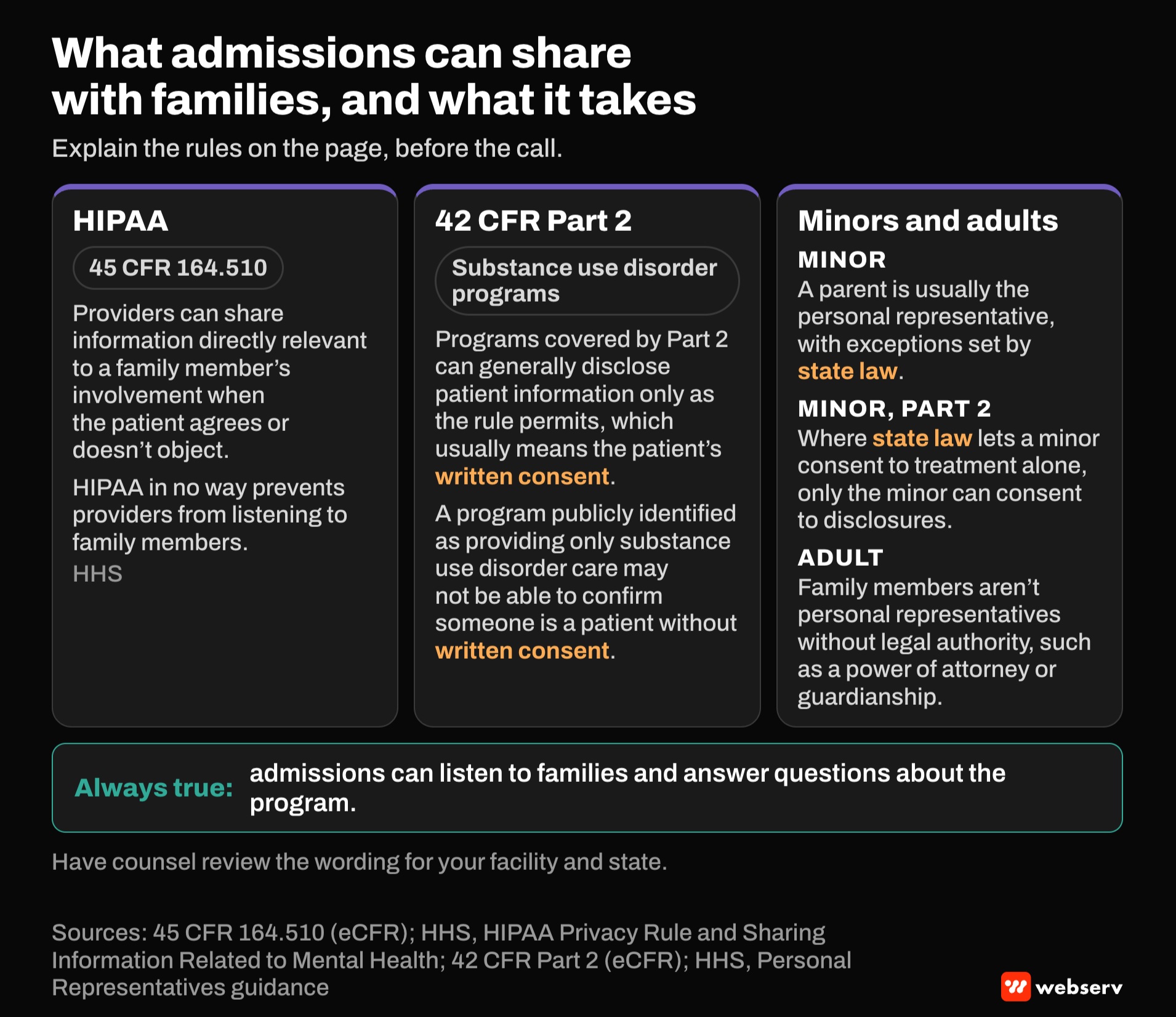
What HIPAA allows. HIPAA’s rules on sharing with family let providers share information directly relevant to a family member’s involvement when the patient agrees or doesn’t object. HHS’s mental health guidance says HIPAA in no way prevents providers from listening to family members.
What Part 2 adds. Substance use disorder programs covered by 42 CFR Part 2 can generally disclose patient information only as that rule permits, which usually means the patient’s written consent.
A program publicly identified as providing only substance use disorder care may not even be able to confirm someone is a patient without written consent. Our 42 CFR Part 2 guide covers the details.
Minors and adults are different. Under HIPAA’s personal representative rules, a parent is usually the personal representative of a minor child, with exceptions set by state law.
Part 2 adds that where state law lets a minor consent to treatment alone, only the minor can consent to disclosures. Family members of an adult aren’t personal representatives without legal authority such as a power of attorney or guardianship.
A short, plain-language privacy section might read:
Our admissions team is always glad to talk with families and answer your questions about our program. To share information about a patient’s care, we need that person’s written permission. We’ll explain how that works when you call.
Sample privacy copy
Have counsel review the wording for your facility and state.
The sections a family page needs
Our landing page templates lay out the family decision page structure. The copy within each section matters as much as the order.
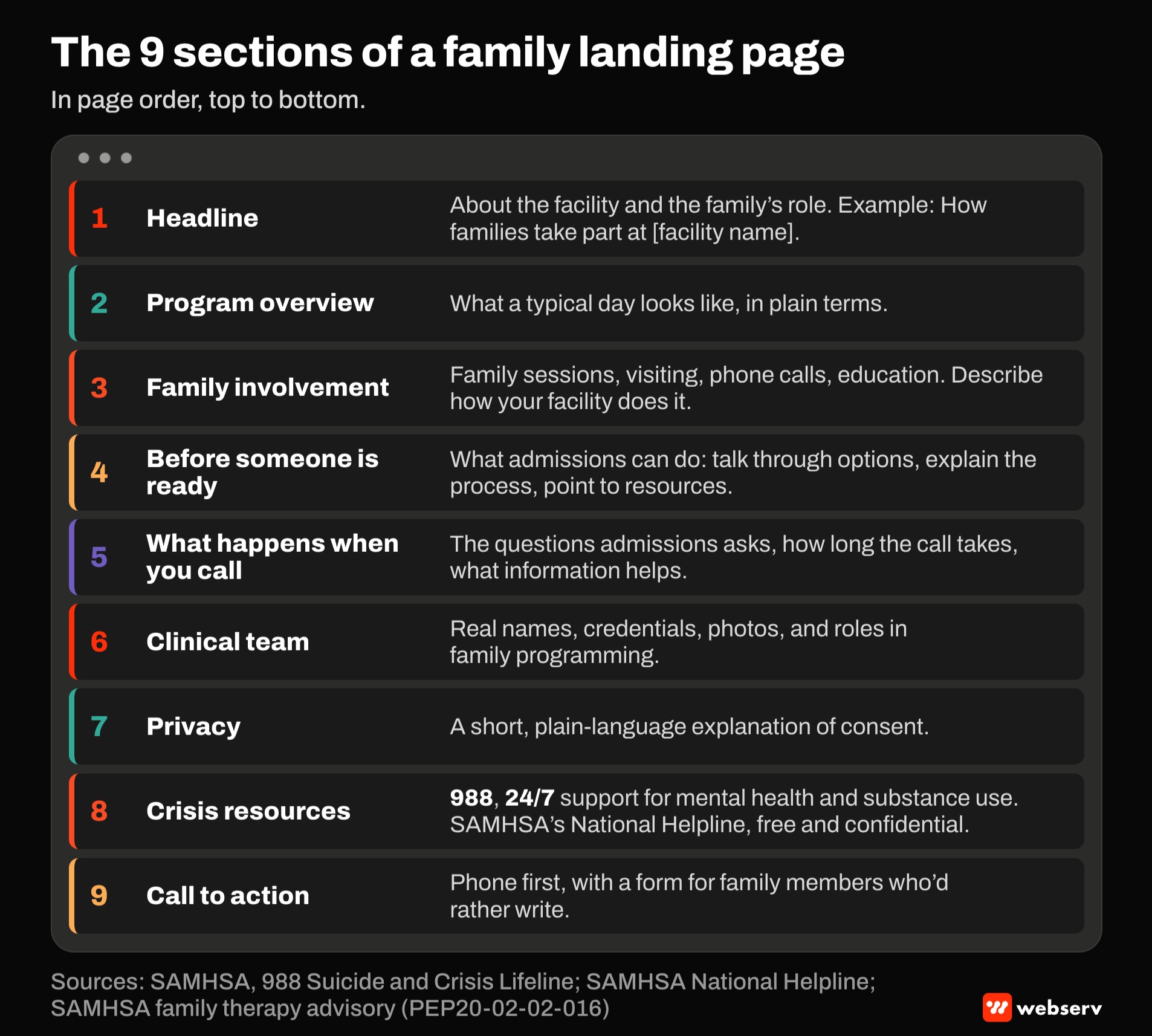
Headline. About the facility and the family’s role. “How families take part at [facility name].”
Program overview. What a typical day looks like, in plain terms. Families want to picture where their loved one would be. For more on program pages, see our guide to modality-specific landing pages.
Family involvement. What actually happens: family sessions, visiting, phone calls, education. SAMHSA’s family therapy advisory supports involving families; the page should describe how your facility does it, specifically.
When your loved one isn’t ready. Families sometimes call before the person they’re worried about has agreed to treatment. Explain what admissions can do: talk through options, explain the process, and point to resources.
NIAAA’s treatment navigator describes CRAFT as an evidence-based, nonconfrontational method for encouraging people to enter treatment, which can be a useful reference.
What happens when you call. The questions admissions will ask, how long the call takes, and what information helps, such as insurance details the patient may need to provide.
Clinical team. Real names, credentials, and photos, with their roles in family programming.
Privacy. The short explanation above.
Crisis resources. For families in an emergency, include 988, which offers 24/7 support for mental health and substance use, and SAMHSA’s National Helpline, a free, confidential treatment referral service for individuals and families.
Call to action. Phone first, with a form for family members who’d rather write.
A few questions families ask
Some questions are worth answering on the page directly.
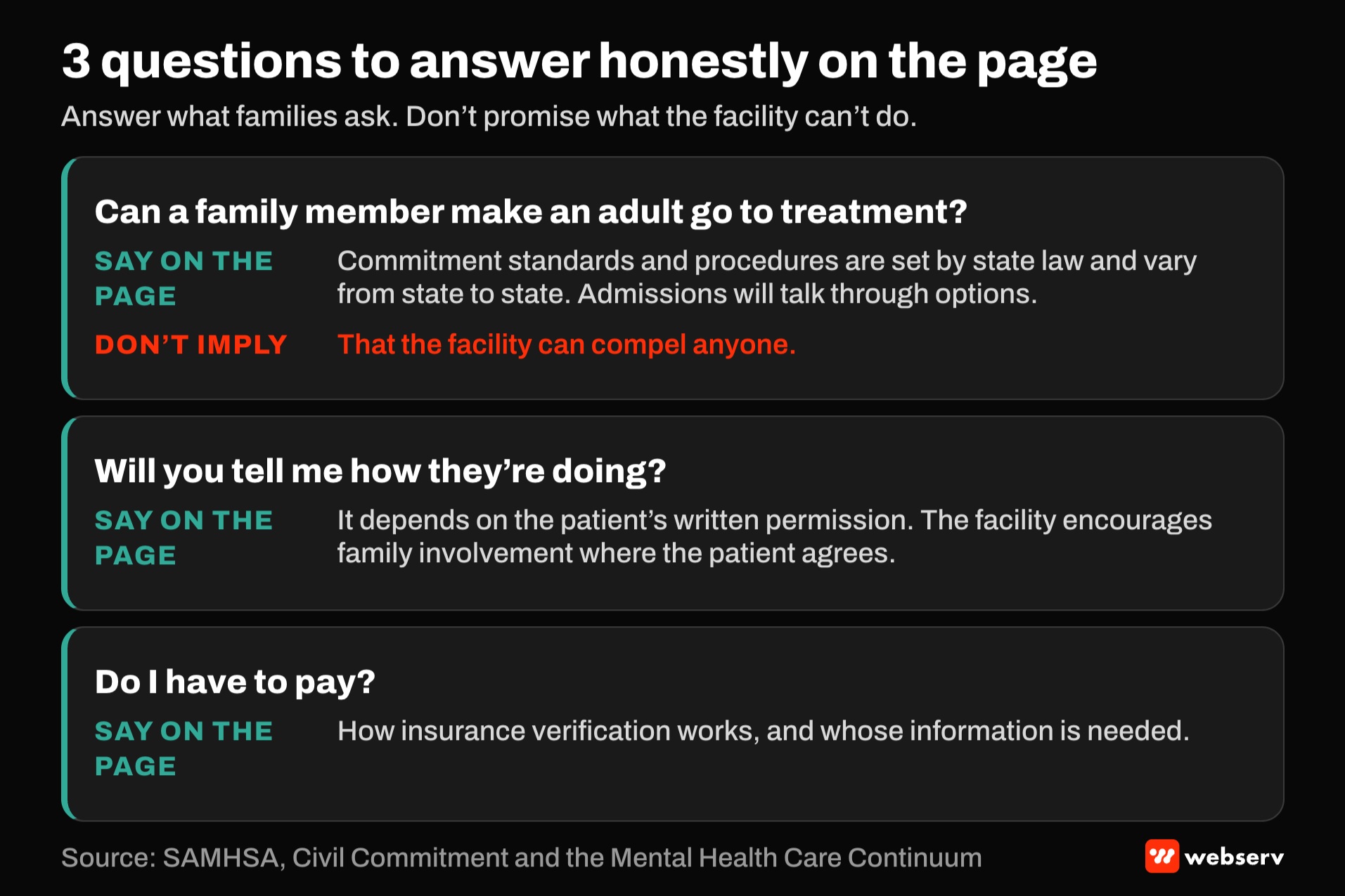
“Can I make my adult child go to treatment?” Be honest. SAMHSA’s civil commitment report says commitment standards and procedures are set by state law and vary from state to state. The page can say admissions will talk through options, without implying the facility can compel anyone.
“Will you tell me how they’re doing?” Explain that it depends on the patient’s written permission, and that the facility encourages family involvement where the patient agrees.
“Do I have to pay?” Explain how insurance verification works and whose information is needed. Our guide to verification of benefits vs pre-authorization covers the verification step. For the page itself, see our guide to building a verify-insurance hub.
OPERATOR INSIGHT
Ask admissions for the first three questions family callers ask, and put the answers above the fold. If those questions change, the page should too.
A family caller who already understands the privacy rules and the process can have a more productive first call, and admissions spends less time explaining what the page could have.
Where this fits
Family pages sit alongside other paid landing pages. For the ad side, our video ad script templates include a family program script, and our UGC-style ad creative guide covers family-member speakers. For the broader framework, see the complete guide to landing pages and our landing page design guide.
For how paid media fits the rest of your marketing, see the complete guide to behavioral health marketing. If you want a second look at your family-facing pages, book an intro meeting.
Frequently Asked Questions
How should treatment center landing pages speak to family members?
About the facility and the family’s role, not the loved one’s condition. Headlines like “How families take part at [facility name]” are warm without assuming anything.
Meta’s policy bars ads that imply knowledge of a user’s or their family’s medical information, and the page should match the ad’s tone.
Use person-first language and describe what family involvement actually looks like.
What can admissions tell a family member about a patient?
It depends on the patient’s permission and the type of program. HIPAA allows sharing relevant information with family when the patient agrees or doesn’t object, and providers can always listen to family.
Substance use disorder programs covered by 42 CFR Part 2 generally need the patient’s written consent to share information.
Explain this on the page so families know what to expect before they call.
Can parents get information about a minor in treatment?
Often, but not always. A parent is usually the personal representative of a minor under HIPAA, with exceptions set by state law.
Under Part 2, where state law lets a minor consent to treatment alone, only the minor can consent to disclosures, including to parents.
Have counsel confirm the rules in your state before describing them on the page.
Should family landing pages include crisis resources?
Yes. Some families arrive during an emergency.
Include 988 for mental health and substance use crises, and SAMHSA’s National Helpline, a free, confidential referral service for individuals and families.
Place them where they’re easy to find without dominating the page.
What words should we avoid on family pages?
NIDA recommends avoiding terms like addict, abuser, junkie, clean, and dirty, and using person-first language such as “person with a substance use disorder.”
Avoid copy that implies the reader’s loved one has a condition.
Avoid promising outcomes; describe what the program does instead.
Keaton Nalle is the Director of Paid Admissions at Webserv, a digital marketing agency for treatment centers.