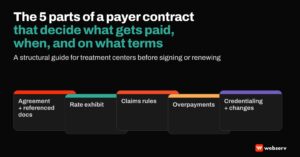
Every prospect conversation I have about PayerLenz rate intelligence eventually arrives at the same question. Payers are now required by federal law to publish their negotiated rates in machine-readable files. That data is public. Why does a treatment center need a paid rate intelligence product when the federal government just made the underlying data available for free?
The question is fair and worth answering carefully. The federal Transparency in Coverage rule effective July 2022 does require health plans to publish machine-readable files (MRFs) containing negotiated in-network rates, allowed amounts for out-of-network services, and prescription drug pricing (paused). The CMS Hospital Price Transparency rule from January 2021 layers additional disclosure requirements on hospitals. The data volume is genuinely enormous, running into terabytes across the industry.
But the CMS MRF data and PayerLenz answer categorically different questions, and understanding the distinction is what determines whether an operator should trust one, the other, or (as we typically recommend) use both for different purposes.
This piece walks the specific differences between CMS MRF data and PayerLenz rate intelligence, what each is actually useful for in a treatment center admissions and revenue cycle context, and why the MRF data does not answer the operator question at admissions time even when the MRF coverage is complete.
It also covers how to think about the third-party MRF aggregators (Turquoise Health, Serif Health, Truveta, HealthCare Bluebook, Ribbon Health) that sit alongside both.
Key Takeaways
- CMS Transparency in Coverage MRFs publish plan-side contract rates. PayerLenz publishes provider-side realized adjudicated payment amounts. The two data sets look similar in the abstract and diverge materially in practice because contract rate does not equal realized paid amount.
- MRF data is static and updates monthly. PayerLenz updates nightly as new adjudicated claims flow in. Rate reality moves faster than the monthly MRF cadence, especially on out-of-network claims where the paid amount varies materially case by case.
- Behavioral health data quality inside the CMS MRFs is inconsistent. Carve-out administrator rates, per-diem residential rates, and OON allowed amounts are represented differently across payers, and many BH-specific rate structures do not decompose cleanly into the CPT and HCPCS schema the MRF format was designed around.
- The MRF data was designed for consumer price shopping and regulatory transparency, not for admissions-time rate decisions. Producing the “what will the payer actually pay for this specific admit at this plan and level of care” answer requires adjudicated claims data.
- Third-party MRF aggregators (Turquoise Health, Serif Health, Truveta, HealthCare Bluebook, Ribbon Health) parse and normalize the public files into more usable products. They are useful for market benchmarking and competitive research. They are not substitutes for adjudicated claims intelligence at the admit level.
DEFINITION
Machine-Readable File (MRF). A payer-published data file mandated by the federal Transparency in Coverage rule, containing in-network negotiated contract rates and historical out-of-network allowed amounts organized at the CPT/HCPCS code and provider level. Effective July 2022 for group health plans and health insurance issuers. Files publish monthly and run into terabytes across the industry.
Distinct from Hospital Price Transparency (a separate rule effective January 2021 requiring hospitals to publish standard charges in both a comprehensive machine-readable format and a consumer-friendly shoppable-services format). Distinct from adjudicated claims data (provider-side, realized payment amounts). MRFs answer “what does the plan say the rate is.” Adjudicated claims answer “what did the payer actually pay.”
What CMS Machine-Readable Files Actually Are
The federal Transparency in Coverage rule, finalized by the Departments of Treasury, Labor, and HHS in October 2020, took effect for group health plans and health insurance issuers on July 1, 2022.
The rule requires payers to publish three categories of machine-readable files monthly. The first category is in-network negotiated rates between the plan and its network providers, published at the CPT code and provider level.
The second category is historical allowed amounts for out-of-network claims, also at the CPT code level. The third category is prescription drug pricing (this category has been paused and its enforcement delayed).
The Hospital Price Transparency rule, effective January 2021, is a separate requirement. It mandates that hospitals publish standard charges in both a comprehensive machine-readable format and a consumer-friendly shoppable-services format.
The two rules combine to produce an unprecedented volume of publicly available healthcare pricing data. Payer MRF files alone run into terabytes across the industry.
The theoretical promise is that consumers can shop for care, regulators can enforce parity and other market-integrity rules, and the market becomes more efficient through transparency. The practical reality is that the raw MRF files are not consumable in raw form by any typical operator or consumer. The files are massive JSON, the schema varies by payer despite CMS standards, missing rates and dummy values are common, and the data is meaningful only after significant normalization.
What PayerLenz Actually Is
PayerLenz is a rate intelligence platform built on adjudicated claims data contributed by a network of behavioral health treatment centers.
The distinction to hold onto is that the underlying data source is realized payment amounts on adjudicated claims, not published contract rates. When a treatment center submits a claim and the payer pays $2,297 per day for a residential SUD admission, that $2,297 is the datapoint that flows into the PayerLenz pool. The claim already adjudicated. The payment already landed. The rate is what the payer actually paid, not what the payer or the plan document said the payer would pay.
The claims data pool network effect for behavioral health rate intelligence is the underlying infrastructure. The pool is cleaned and normalized through a five-step enrichment chain that resolves BCBS alpha prefixes to home plans across 21,800 mappings, classifies network status, classifies reimbursement method, and computes a per-day allowed amount that becomes the expected reimbursement for future admits at similar cells.
The output for a new admission is an expected reimbursement estimate keyed to the specific alpha prefix, home plan, state, level of care, and network status of the case. On high-confidence rate cells, that estimate lands within 10 percent of what the payer actually pays roughly 9 out of 10 times.
Where the Two Data Sets Differ
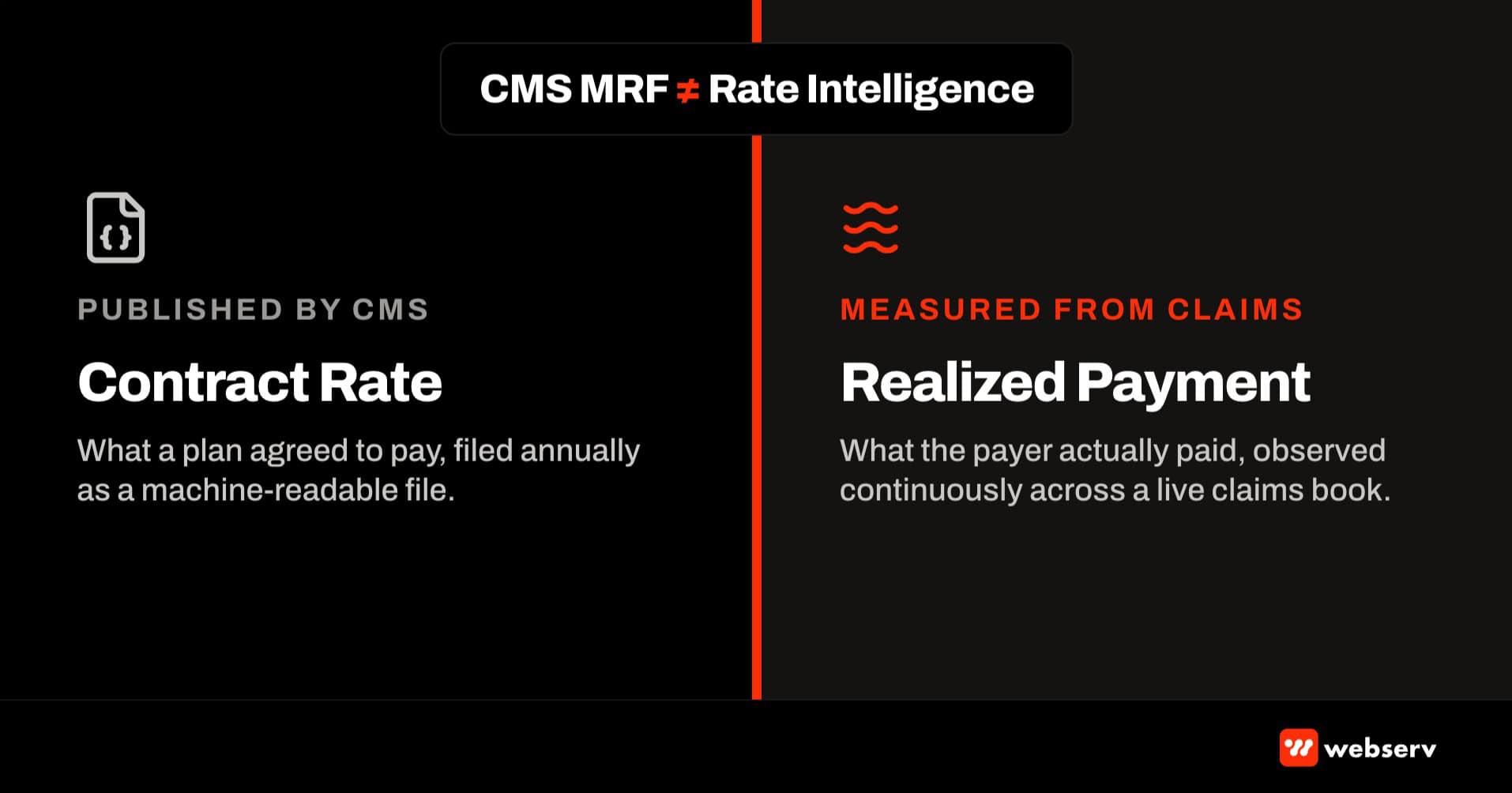
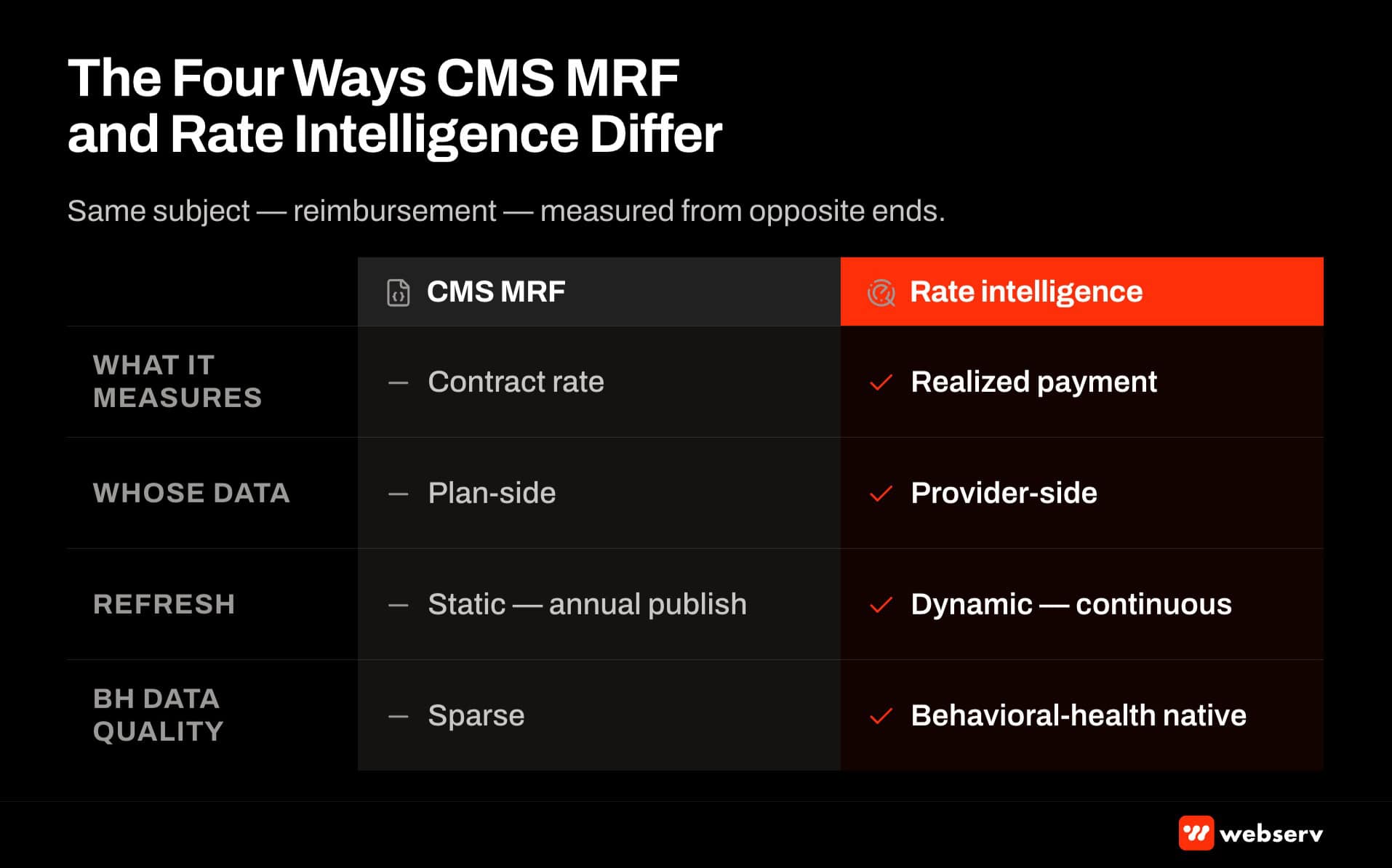
The distinction between contract rate and paid amount is the load-bearing difference between MRF data and PayerLenz. Everything else follows from that.
Contract rate versus realized payment
The MRF publishes the rate the plan and provider agreed to in the contract. That number is a starting point for how a claim will adjudicate, not the ending point.
For in-network claims, the paid amount can differ from the contract rate for several structural reasons. Modifier interpretation can adjust the paid amount. Level-of-care classification can shift the claim to a different fee schedule. Prior authorization requirements can reduce paid amounts on non-authorized services. Payer-side coding decisions can reclassify the service. Coordination of benefits with a secondary payer can change the primary payer’s paid portion.
For out-of-network claims, the gap between MRF-published “allowed amounts” and actual paid amounts is materially larger. OON allowed amounts in the MRFs represent historical averages the payer used for benefit calculation purposes. The actual paid amount for a specific OON admission depends on the plan’s UCR (usual, customary, and reasonable) methodology, the plan’s out-of-network percentage, the deductible position of the patient, and case-by-case adjudication decisions.
The result is that MRF data can tell you what a payer’s contract or historical allowed amount was. It cannot tell you what the payer actually paid on a specific claim at a specific plan and level of care. That gap is where PayerLenz operates.
OPERATOR INSIGHT
Contract rate is the starting point, not the ending point. What the plan and provider agreed to in the MRF is one input into how the claim adjudicates.
For in-network claims, modifier interpretation, level-of-care classification, prior authorization posture, payer-side coding decisions, and coordination-of-benefits with a secondary payer all move the actual paid amount away from the published contract rate. For out-of-network claims, the gap widens further because the plan’s UCR methodology, OON percentage, deductible position, and case-by-case adjudication decisions determine the paid amount that lands, not the historical allowed amount the MRF publishes.
Plan-side versus provider-side data
MRFs are published by payers. The data reflects what the plan says its rates are. PayerLenz is contributed by providers. The data reflects what the provider actually received in payment.
Where the two views agree, they reinforce each other. Where they disagree, the provider-side view is the operationally correct one because the provider-side amount is the number that hits the collections account.
Payer-published MRF files have well-documented data quality issues at the individual rate line. Missing rates. Dummy values (rates set to $9,999,999 or $0.01 that clearly do not reflect real contract terms). Contradictory entries across sub-files. The FTC and HHS enforcement actions since 2023 have pushed payers to improve MRF data quality, but the improvements are gradual and the current state is still uneven.
Provider-contributed claims data has different limitations (contributor pool coverage, claim mix, adjudication timing) but does not have the payer-side incentive to obscure rates that has affected MRF data quality.
Static versus dynamic
MRFs update monthly. Payers publish new files on the first of each month with any rate changes from the prior period. PayerLenz updates nightly. New claims contributed by the network of treatment centers flow into the pool every night, get processed through the enrichment chain, and update the expected reimbursement estimates for the affected rate cells within hours.
The cadence difference matters most on OON claims where the paid amount can shift meaningfully within a month based on how the payer is actually adjudicating similar cases. A monthly MRF snapshot lags the reality. A nightly claims-pool update tracks the reality inside the month.
Behavioral health data quality
The MRF schema was designed for medical services organized by CPT and HCPCS codes. Behavioral health services do not decompose cleanly into that structure. Residential SUD treatment is typically billed as a per-diem, not a CPT-code-based unit. PHP and IOP have specific revenue codes and billing conventions that vary by state and payer.
Behavioral health carve-out administrators (Optum Behavioral Health, Magellan, Beacon) publish their own MRFs that are separate from the primary payer’s MRF and sometimes conflict with the primary MRF on the same member’s coverage.
The result is that behavioral-health-specific rate data inside the MRFs is inconsistently structured and hard to extract. Even after third-party aggregators normalize the files, BH data density is thin relative to medical categories.
When You Would Use Each
The honest framing is that both data sources are useful and they answer different questions.
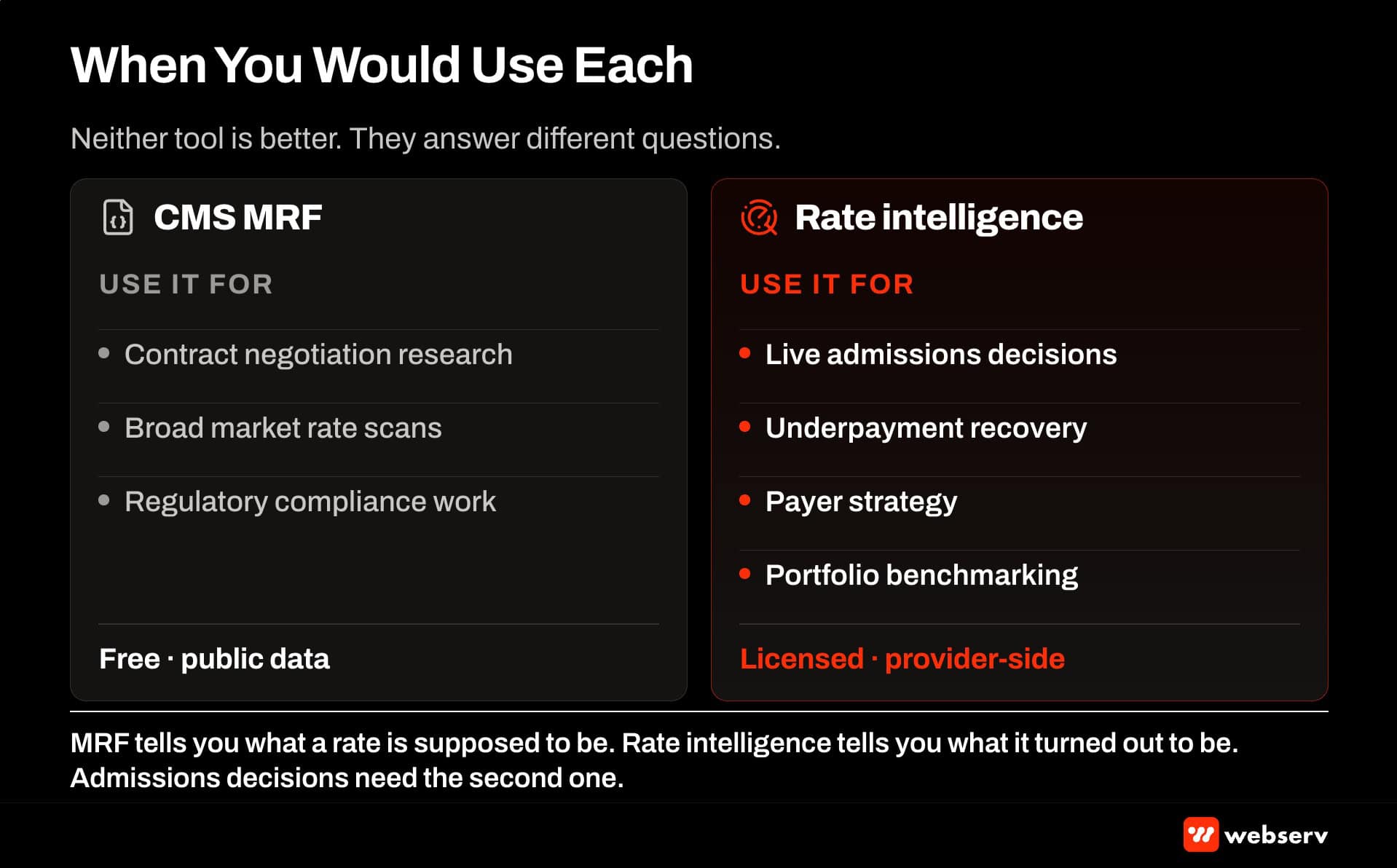
Use CMS MRF data (typically through a third-party aggregator) when you need market-level rate benchmarks at the contract level, competitive research on peer facilities’ contract structures, regulatory or academic study of pricing patterns, or a baseline for annual payer strategy planning and contract renegotiation.
Use PayerLenz rate intelligence when you need admit-time decision support (should this patient be admitted at this expected rate), expected revenue modeling per specific admit, underpayment recovery baselines (what should this claim have paid), and payer-mix planning that reflects realized reimbursement rather than contract theory.
Facilities that operate at meaningful scale typically use both. MRF-derived data for annual payer strategy planning and contract renegotiation. PayerLenz rate intelligence for daily admissions operations and monthly billing team recovery workflows.
The Specific Admissions Gap CMS MRF Cannot Fill
The load-bearing case for rate intelligence over MRF data is the admissions-time decision.
A coordinator on an intake call has a specific patient with a specific insurance card. The card shows a BCBS alpha prefix. The card shows out-of-network benefits at 70 percent after deductible. The patient is being considered for residential SUD treatment. The clinical case is real. The census has capacity. The operator needs an answer.
The MRF for that BCBS licensee will publish an in-network negotiated rate for residential SUD in the state (assuming the payer’s MRF file even decomposes BH residential per-diem correctly). It will publish an OON allowed amount that is a historical average across the payer’s OON claim history in that state.
Neither of those numbers answers the coordinator’s actual question. The actual question is what the payer will pay on this specific admission at this specific alpha prefix, at this specific plan structure, at this specific level of care, given this specific patient’s benefit design and deductible position.
Producing that answer requires realized-adjudication data, not published contract data. Same California, same residential level of care, same OON status: four different BCBS home plans in the PayerLenz pool pay $3,778, $3,090, $2,297, and $662 per patient day. The MRF data cannot separate those four cases because the plan-published rates do not reflect the case-by-case adjudication reality. Our BCBS alpha prefix and home plan resolution piece covers the specific mechanic that produces that variance and why it is invisible from the MRF layer.
Same California, same residential level of care, same OON status: four BCBS home plans in the PayerLenz pool
$3,778
Per patient day, home plan A
$3,090
Per patient day, home plan B
$2,297
Per patient day, home plan C
$662
Per patient day, home plan D
What the Third-Party MRF Aggregators Actually Do
The raw MRF files are unusable in bulk. Several third-party companies have built products that parse, normalize, and enrich the MRF data into consumable data sets.
Turquoise Health is the most widely referenced aggregator in the healthcare pricing space, offering an enterprise data product used by hospitals, payers, and researchers. Serif Health focuses on developer-accessible pricing data with an API-first product. Truveta combines claims and clinical data with pricing signals. HealthCare Bluebook targets consumer-facing price shopping. Ribbon Health integrates provider data with pricing for insurance and health tech clients.
These products all improve on the raw MRF files. They resolve schema inconsistencies, dedupe conflicting entries, index the files for query, and in some cases augment with additional data sources. They are useful and worth evaluating for contract-level benchmarking, competitive intelligence, and market research.
They are not substitutes for adjudicated claims intelligence, because the underlying data source is still MRF-derived. An aggregator can polish plan-published contract rates. It cannot produce realized adjudicated payment data because that data does not sit in the MRFs.
The pattern we recommend for larger operators is to use an MRF aggregator for annual payer strategy planning and use PayerLenz for daily admissions decision support. The two data sources complement rather than compete.
Frequently Asked Questions
Can I get the same rate intelligence from a free MRF file that PayerLenz sells?
No. The MRF files publish plan-side contract rates and historical allowed amounts. PayerLenz publishes provider-side realized adjudicated payment amounts. The two are related but not equivalent data.
The gap matters most on out-of-network claims where the actual paid amount can differ from the MRF allowed amount by materially large margins on a case-by-case basis. Same coverage, same level of care, same state can produce a 5x range of paid amounts depending on the specific home plan, benefit design, and adjudication path.
For contract-level market benchmarking, MRF data is useful. For admit-time decision support and underpayment recovery, adjudicated claims data is the operationally correct source.
Does a third-party aggregator like Turquoise Health give me what PayerLenz gives me?
The third-party aggregators are useful products for contract-level benchmarking, market research, and payer network intelligence. They are not substitutes for adjudicated claims intelligence.
The aggregators parse, normalize, and enrich the underlying MRF files. That improves the usability of the MRF data significantly. But the underlying data source is still MRF-derived (contract rates and historical allowed amounts), not realized payment amounts on adjudicated claims.
For treatment center admissions decisions where the operator needs to know what the payer will actually pay on a specific admit at a specific plan and level of care, the realized-payment data from adjudicated claims is the source that produces the operationally correct answer.
Why is BH-specific rate data thin in the MRFs?
Two structural reasons. First, the MRF schema was designed around medical services organized by CPT and HCPCS codes. Behavioral health services (residential per-diems, PHP/IOP revenue codes) do not decompose cleanly into that structure.
Second, behavioral health carve-out administrators like Optum Behavioral Health, Magellan, and Beacon publish separate MRFs from the primary payer. The two files sometimes conflict on the same member’s coverage. Consolidating carve-out data with primary-payer MRF data is an unsolved problem across the aggregators.
The practical implication is that BH operators need to use MRF data more carefully than medical-specialty operators do, and the case for adjudicated claims data is stronger in BH than in categories where MRF coverage is dense and consistent.
Does the CMS enforcement of the price transparency rule change this analysis?
Enforcement has ramped since 2023 and continues to push payers to improve MRF data quality. CMS enforcement actions against non-compliant hospitals and payers are more frequent than they were at launch.
The trajectory is favorable for MRF data quality. Missing rates, dummy values, and inconsistent schema are all trending down as enforcement bites. But the enforcement improvements do not close the gap between contract rate and realized payment amount, and they do not change the plan-side versus provider-side data source distinction.
Both differences are structural. Even a perfectly compliant MRF file cannot answer the admit-time question a coordinator faces because the data source itself is contract rates, not adjudicated payments.
Is PayerLenz duplicating publicly available data?
No. PayerLenz operates on a data source (provider-contributed adjudicated claims) that is not published in the MRFs and that CMS transparency rules do not require to be published. The MRFs are plan-side contract data. Adjudicated claims data lives inside providers and the payers’ internal claims processing systems and is not publicly disclosed.
The pool PayerLenz builds by aggregating claims across contributing treatment centers is genuinely additive to the public MRF data. It answers the operator question the MRF data cannot answer.
The two data sources complement each other. For contract-level market benchmarking, MRFs are the right source. For admit-time decision support and revenue recovery, adjudicated claims are the right source. Facilities operating at meaningful scale often use both.
Should I use both MRF data and PayerLenz?
For most treatment centers at meaningful scale, yes. The two data sources serve different questions and complement rather than compete.
Use MRF-derived data (typically through a third-party aggregator) for annual payer strategy planning, contract benchmarking, and market intelligence. Use PayerLenz rate intelligence for daily admissions operations, admit-time decision support, expected reimbursement modeling, and underpayment recovery baselines.
The reimbursement intelligence guide covers the broader category and where each layer fits in the operator stack. The pattern we recommend for operators evaluating both is to build an annual planning workflow on MRF data and a daily operational workflow on adjudicated claims data.
Kyle McHenry is Co-founder of Webserv, Founder of Revenue Logic (a white-glove behavioral health revenue cycle firm), and Co-founder of the PayerLenz reimbursement intelligence product. He has been inside behavioral health verification, claims, and payer relationships for 15 years and works with treatment center operators on the rate intelligence discipline that closes the gap between admissions and collections.