H0018 is the HCPCS code for short-term residential treatment in a non-hospital setting, billed per day. CMS describes it as “Behavioral health; short-term residential (non-hospital residential treatment program), without room and board, per diem.” Medicare doesn’t pay it.
The harder question for billers is whether a payer wants H0018 at all.
Some commercial payers bill residential care by revenue code alone, and state Medicaid programs map residential levels to different codes. This guide covers how H0018 is used, how it compares with nearby codes, and where residential claims go wrong. It’s part of how we approach billing for treatment centers.
Key Takeaways
- H0018 is a per diem code for short-term, non-hospital residential treatment, without room and board in its descriptor.
- H0019 is the long-term version, for stays typically longer than 30 days. H0017 is hospital-based residential.
- Many commercial payers bill residential on a UB-04 with revenue code 1001 or 1002, and some don’t ask for any HCPCS code.
- State Medicaid programs map ASAM residential levels to different codes, so H0018 isn’t universal.
- Residential treatment requires prior authorization with most payers.
- Medicare doesn’t pay H0018. ASAM says non-hospital residential addiction treatment is the only level of care Medicare doesn’t cover.
What H0018 covers
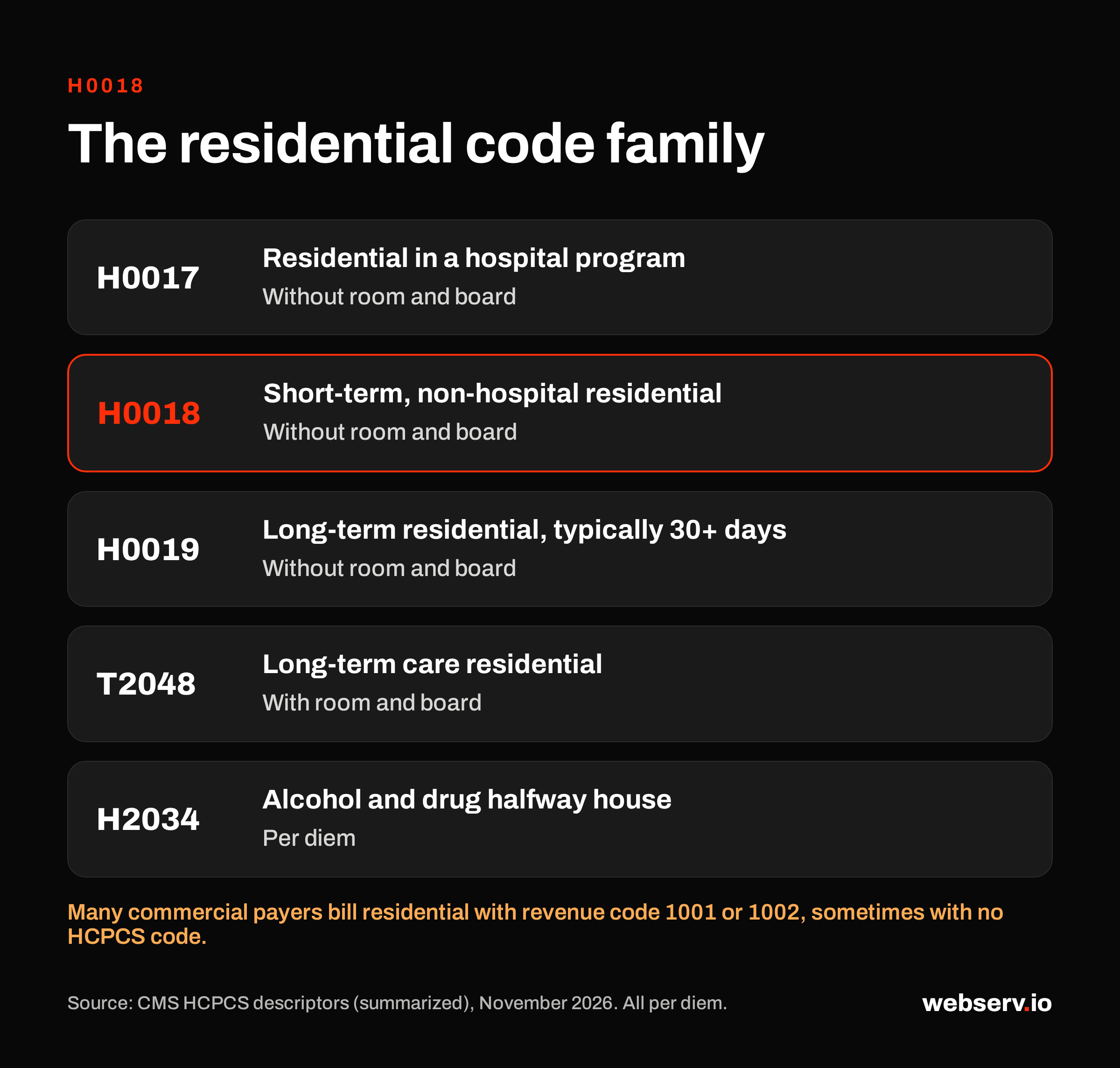
CMS’s HCPCS code files give the residential family:
| Code | CMS descriptor (summarized) |
|---|---|
| H0017 | Behavioral health residential in a hospital residential treatment program, without room and board, per diem |
| H0018 | Behavioral health short-term residential in a non-hospital program, without room and board, per diem |
| H0019 | Behavioral health long-term residential, non-medical and non-acute, stay typically longer than 30 days, without room and board, per diem |
| T2048 | Behavioral health long-term care residential, with room and board, per diem |
| H2034 | Alcohol and/or drug abuse halfway house services, per diem |
CMS doesn’t define a day limit for “short-term.” Only H0019’s descriptor mentions a typical stay of more than 30 days.
DEFINITION
Without room and board. H0017, H0018, and H0019 describe treatment only. How room and board is paid depends on the payer. Some Medicaid programs don’t pay it; Connecticut Medicaid bills it under a separate code.
H0018 vs H0019 and the Medicaid maps
H0018 and H0019 split residential by expected length and intensity. In practice, state Medicaid programs assign residential codes to ASAM levels, and they don’t agree.
| Program | How it codes adult residential |
|---|---|
| NH Healthy Families (New Hampshire Medicaid) | H0018 for high-intensity residential, ASAM Level 3.5; H2034 for Level 3.1 |
| Virginia Medicaid | H2034 for 3.1, H0010 for 3.3 and 3.5, H2036 for 3.7; no H0018 |
| Connecticut Medicaid | H2034 for 3.1 and H2036 with modifiers for 3.3 to 3.7, plus separate room and board codes |
Sources: NH Healthy Families billing tip sheet; Virginia ARTS service types; Connecticut residential procedure codes.
If you bill Medicaid in more than one state, build a separate residential code map for each. Our CPT and HCPCS codes guide covers the wider code set.
How commercial payers bill residential
Revenue codes come first. Optum’s inpatient claims page lists revenue code 1001 for mental health residential and 1002 for substance use residential, with no HCPCS code. Cigna’s billing resource also lists 1001 and 1002 with no preferred HCPCS for residential.
Some payers pair a HCPCS code. Magellan’s 2026 code guide pairs psychiatric residential (1001) with H0017 or H0018, and substance use residential (1002) with H0011. BCBS North Carolina’s facility behavioral health policy lists H0017 and H0018 for residential treatment.
Optum also warns that providers should use the codes in their agreement or risk denial. Your contract decides.
The claim itself. BCBS Mississippi’s coding policy bills residential treatment on type of bill 086X with revenue code 1001 or 1002 and days as units. It asks for one claim per episode of care, accepts no interim bills, and says not to count the discharge day.
Ambetter Louisiana’s billing notice also uses type of bill 86X, with place of service 56, for residential claims.
An all-inclusive day. BCBS North Carolina says the residential per diem includes all facility, professional, ancillary, and other services, allows one unit per day, and treats residential, PHP, and IOP as mutually exclusive on the same date.
OPERATOR INSIGHT
Ask each payer one question during contracting: revenue code only, or revenue code plus HCPCS? Then set your claim template per payer. Residential is where generic templates cause the most rework.
Authorization and documentation
Residential care needs approval before admission with most payers. Aetna’s behavioral health precertification list includes H0017, H0018, H0019, and other residential codes. Cigna’s billing resource marks every residential row as requiring authorization, and Virginia Medicaid requires both initial and continued-stay authorization.
BCBS Mississippi’s policy also sets service expectations for residential programs, such as psychiatrist visits at least weekly and nursing at least eight hours a day. Document that care was delivered as the payer defines it.
Reviewers will ask for continued medical necessity throughout the stay. Our guide to concurrent review and continued-stay denials covers how to prepare.
H0018 and Medicare
CMS marks H0018 as not payable by Medicare. ASAM, in a July 2026 statement supporting a bill to change that, said non-hospital residential addiction treatment is the only level of care Medicare doesn’t cover.
For Medicare members, plan for other levels of care, and check Medicare Advantage plans separately, since they set their own benefits.
What H0018 pays
Residential pays a daily rate set by the payer contract, or by the plan’s out-of-network rules if you’re not contracted. Rates vary by payer, state, level of care, and network status.
For out-of-network admissions, estimate from what the plan has actually paid on similar residential claims. Our guide to out-of-network reimbursement rates covers how.
Common reasons residential claims are denied
- Wrong code for the payer. Billing H0018 to a payer that expects a different code, or none, can lead to denial.
- Missing or expired authorization. Each continued-stay period needs its own approval.
- Wrong type of bill or place of service. Ambetter Louisiana warns that billing outside its 86X rules can lead to denials.
- Interim bills where the payer wants one claim. BCBS Mississippi doesn’t accept them.
- Separate professional billing. Some payers include staff professional services in the per diem.
COMMON MISTAKE
Billing room and board as part of H0018 when the payer separates them. Check whether the payer pays a single all-inclusive day or splits treatment and room and board. Our guide to denial management covers working the denials that come back.
Where this fits
For the levels on either side of residential, see our H0010 guide for sub-acute detox and our H0035 guide for partial hospitalization.
For the full billing process, see our revenue cycle management guide for rehab centers. For how billing connects to marketing and admissions, see the complete guide to behavioral health marketing. If you want a second look at your residential claims, book an intro meeting.
This guide summarizes CMS, ASAM, and payer policies as of November 2026. Billing rules vary by payer, state, and contract. Confirm with each payer before you submit.
Frequently Asked Questions
What is the H0018 code?
H0018 is the HCPCS code for behavioral health short-term residential treatment in a non-hospital program, billed per day.
Its descriptor says without room and board.
It’s used by some commercial payers and Medicaid programs, but not all.
What is the difference between H0018 and H0019?
H0018 is short-term residential. H0019 is long-term residential, non-medical and non-acute, with stays typically longer than 30 days.
CMS doesn’t set a day limit for H0018.
Payers and state Medicaid programs decide which code fits each level of care.
What revenue code goes with H0018?
Residential is usually billed with revenue code 1001 for mental health or 1002 for substance use.
Magellan pairs 1001 with H0017 or H0018.
Some payers, such as Optum and Cigna, list residential revenue codes with no HCPCS code.
Does Medicare cover residential treatment?
Medicare doesn’t pay H0018. ASAM says non-hospital residential addiction treatment is the only level of care Medicare doesn’t cover.
Medicare does cover inpatient hospital care when it’s medically necessary.
Check Medicare Advantage plans separately.
Does H0018 require prior authorization?
Usually. Aetna’s behavioral health precertification list includes H0018, and Cigna requires authorization for residential care.
Continued-stay authorization is also common.
Confirm each payer’s rules before admission.
Kyle McHenry is a co-founder and the CFO of Webserv and the founder of Revenue Logic, a behavioral health revenue cycle management company.