
Most behavioral health billing questions come down to one code at a time. Is this IOP code psychiatric or substance use? Does it bill per day or per unit? Which revenue code goes with it, and does this payer even accept it?
These pages answer those questions for the HCPCS codes treatment centers bill most, one code per page. Each covers what the code includes, how payers want it billed, how it differs from the nearest code, and why claims get denied. They’re part of how we approach billing for treatment centers.
Descriptors come from CMS’s HCPCS files. Payer rules come from published payer policies and vary by plan, state, and contract. Confirm with each payer before you submit.
Key Takeaways
- HCPCS Level II codes such as S9480 and H0015 describe most treatment center levels of care.
- Many of these codes aren’t payable by Medicare, which bills its own way.
- Payers disagree on revenue code pairings, minimum hours, and claim frequency.
- Per diem codes usually include every service that day, so same-day therapy is often denied.
- Each page lists the payer policies it relies on, so you can check the source.
Code pages
Each page opens with the code’s plain-English meaning and level of care, then covers billing rules, Medicare, authorization, and denials, with the payer policies it relies on.
| Code | Level of care | Guide |
|---|---|---|
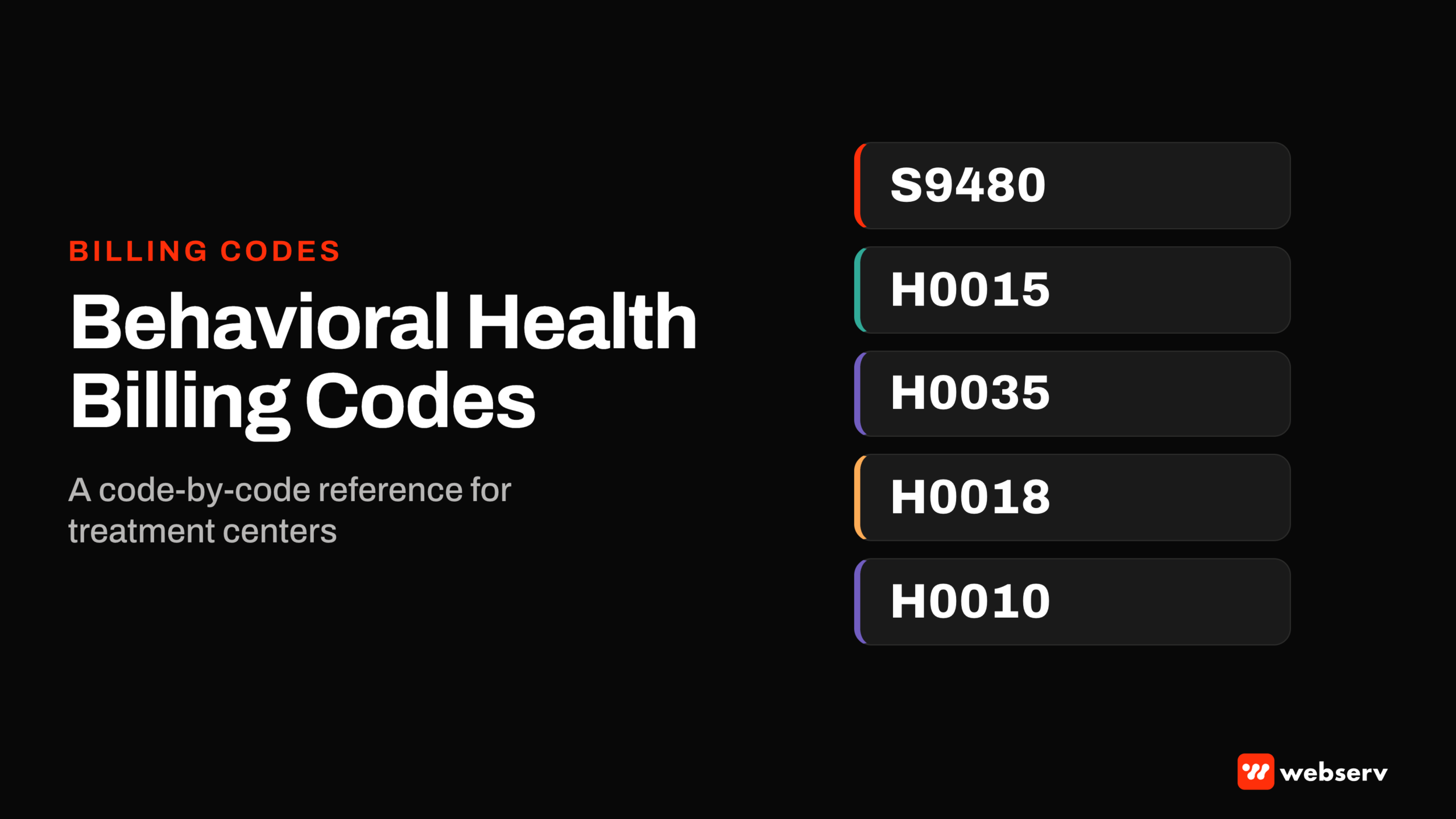
| S9480 | Mental health intensive outpatient, per diem | S9480 billing guide |
| H0015 | Alcohol and drug intensive outpatient | H0015 billing guide |
| H0035 | Partial hospitalization | H0035 billing guide |
| H0018 | Short-term residential | H0018 billing guide |
| H0010 | Sub-acute residential detox | H0010 billing guide |
More codes are added as each page is verified, starting with peer support and treatment planning codes.

Find your code by level of care
If you know the level of care, this is where to start. Codes vary by payer and state, so treat this as a map to the right page, not a final answer.
| Level of care | ASAM level | Common HCPCS codes | Common revenue codes | Usual claim form |
|---|---|---|---|---|
| Mental health IOP | n/a | S9480 | 0905 | UB-04 |
| Substance use IOP | 2.1 | H0015 | 0906 | UB-04 |
| Partial hospitalization | 2.5 | H0035, S0201 | 0912, 0913 | UB-04 |
| Residential, substance use | 3.1 to 3.7 | H0018, H0019, H2034, H2036, or none | 1002 | UB-04, type of bill 86X |
| Residential, mental health | n/a | H0017, H0018, or none | 1001 | UB-04, type of bill 86X |
| Residential withdrawal management | 3.2-WM to 3.7-WM (Third Edition) | H0010, H0011 | 0116 to 0156 for detox room and board | UB-04 |
| Ambulatory detox | 1-WM, 2-WM | H0014 | 0944, 0945 | UB-04 |
| Outpatient therapy and psychiatry | 1 | CPT codes | n/a | CMS-1500 |
Summarized from the code pages in this series and the payer policies they cite. Several commercial payers bill residential with a revenue code and no HCPCS code.
The ASAM Fourth Edition renamed several of these levels and folded withdrawal management into the main levels, so check which edition each payer uses.
Payer-by-payer differences to check
The same level of care can be coded differently depending on who pays. These differences come up most often:
| Question | How payers differ |
|---|---|
| Which revenue code goes with S9480 and H0015? | Cigna and BCBS Mississippi pair S9480 with 0905 and H0015 with 0906; Passport by Molina in Kentucky bills both under 0905 |
| Does residential need a HCPCS code? | Optum and Cigna list residential revenue codes with no HCPCS code; Magellan pairs 1002 with H0011 |
| Which code for partial hospitalization? | Cigna and Magellan prefer H0035; BCBS North Carolina accepts H0035 or S0201; Virginia Medicaid uses S0201 for substance use PHP |
| Which ASAM level does H0010 describe? | Connecticut uses it for 3.2-WM, New Hampshire for 3.7-WM, and Virginia for residential treatment at 3.3 and 3.5 |
| How often to bill IOP? | Some Medicaid plans require one claim per week; most commercial payers accept daily lines |
Building one claim template for every payer. The fastest way to cut denials is a per-payer grid: level of care, code, revenue code, claim frequency, and units. Update it whenever a contract or policy changes.
Daily billing rules
Most of the codes in this series are billed per day. A few rules apply almost everywhere:
- One unit per date of service. BCBS North Carolina allows one unit of PHP, residential, or IOP per day.
- The day includes everything. BCBS North Carolina says the per diem includes all facility, professional, ancillary, and other services, so separate therapy claims on the same day are usually denied.
- One level per day. PHP, residential, and IOP are mutually exclusive on the same date of service under BCBS North Carolina’s policy.
- Bill days that happened. North Dakota Medicaid says providers may only bill for days the member received programming.
Medicare exceptions
Medicare doesn’t pay most of the codes in this series. CMS’s HCPCS files mark S9480, H0015, H0035, H0018, and H0010 as not payable by Medicare. Medicare covers some of the same levels a different way:
- Intensive outpatient, since 2024, through hospitals, community mental health centers, and certain clinics, with condition code 92.
- Partial hospitalization, through hospitals and community mental health centers, with condition code 41.
- Detox, in a hospital when the patient needs hospital-level care, under CMS’s national coverage determination.
ASAM has said non-hospital residential addiction treatment is the only level of care Medicare doesn’t cover. Each code page covers the Medicare side in more detail.
Pre-submission checklist
Run every claim through these six checks before it goes out.
BEFORE YOU SUBMIT
- Confirm the level of care that was authorized, not just the level assessed.
- Look up the payer’s code and revenue code for that level.
- Check the claim form and type of bill.
- Count units correctly: one per day for per diem codes.
- Remove same-day services the per diem already covers.
- Match documentation to the payer’s hours and service rules.
Our CPT and HCPCS codes guide covers how the code sets fit together on a claim.
Code overview vs code pages
Our CPT and HCPCS codes guide explains the three code sets on a behavioral health claim, CPT, HCPCS, and revenue codes, and how they work together. These pages go one level deeper on individual codes.
OPERATOR INSIGHT
When a code page and your contract disagree, the contract wins. Use these pages to know what to ask, then confirm the answer in writing with the payer.
Related guides
For the full billing process, see our revenue cycle management guide for rehab centers. For working denials, see our guide to denial management.
For how billing connects to admissions and marketing, see the complete guide to behavioral health marketing. If you want a second look at how your claims are coded, book an intro meeting.
Frequently Asked Questions
What billing codes do treatment centers use?
Most facility levels of care use HCPCS Level II codes, such as H0015 for substance use IOP and H0035 for partial hospitalization, paired with revenue codes on a UB-04.
Outpatient therapy and psychiatry use CPT codes on a CMS-1500.
Codes vary by payer and state, so check each payer’s policy.
What is the difference between H codes and S codes?
CMS says H codes are used by state Medicaid agencies to identify mental health and substance use services. S codes are reserved for Blue Cross Blue Shield plans and other private insurers.
Commercial payers use both.
Medicare doesn’t pay either for these services.
Are these codes billed per day?
Most are. S9480 and H2036 say per diem in their descriptors, and payers bill H0015, H0035, and residential codes as one unit per day.
The per diem usually covers every service that day.
Check each payer’s unit rules.
Does Medicare pay for H0015 or S9480?
No. CMS marks both as not payable by Medicare.
Medicare has covered intensive outpatient since 2024, billed by hospitals, community mental health centers, and certain clinics using condition code 92.
Those claims list each service separately.
What revenue code goes with residential treatment?
Revenue code 1001 is commonly used for mental health residential and 1002 for substance use residential.
Some payers want a HCPCS code on the same line; others don’t.
Residential claims usually use type of bill 86X.
Kyle McHenry is a co-founder and the CFO of Webserv and the founder of Revenue Logic, a behavioral health revenue cycle management company.