BrightEdge tracked Google’s AI Overviews on healthcare searches from December 2023 to December 2025. Over that time, AI Overviews on local provider queries such as “dermatologist near me” went from 100% to 0%. Addiction-related queries sat in the group BrightEdge found consistently excluded, at 0% in every year.
So the premise behind a lot of “win the AI answer box for rehab near me” advice doesn’t match the data. For the searches with the most local intent, Google mostly doesn’t show an AI Overview at all. It shows the local pack, the map, and Business Profiles.
That doesn’t make AI Overviews irrelevant to local treatment centers. It moves them.
This piece covers what the data shows for local and addiction queries, what appears instead for “rehab near me,” where AI Overviews do show up in local treatment searches, how AI Mode and Maps fit in, and how to check your own markets.
It’s part of the work inside our AEO program for treatment centers. For the organic local foundation, see our local SEO guide for multi-location treatment centers.
Key Takeaways
- BrightEdge found AI Overviews on local provider healthcare queries fell from 100% in December 2023 to 0% in December 2025, and listed addiction-related queries as consistently excluded.
- Whitespark’s 2025 study found AI Overviews on 15% of local-intent queries, compared with 92% of informational and 97% of hybrid queries. Local packs appeared on 93% of local-intent queries.
- For “rehab near me,” the page that matters most is usually the Google Business Profile. Google says local results are mainly based on relevance, distance, and popularity.
- AI Overviews matter more on hybrid local queries, such as cost, insurance, program length, or what to expect at a level of care in a specific city.
- Google’s AI Mode and Ask Maps draw on Google Maps and Business Profile information, including reviews, so profile accuracy and review quality carry into AI surfaces too.
- Search results change often. Check your own target queries, logged out, from the cities you serve, and date the results.
What the data shows
Three sources, from different angles, point the same way.
AI Overview rates on local queries (BrightEdge, December 2025; Whitespark, 2025)
0%
Local provider healthcare queries with an AI Overview (BrightEdge)
15%
Local-intent queries with an AI Overview (Whitespark)
97%
Hybrid local queries with an AI Overview (Whitespark)
BrightEdge, healthcare. BrightEdge’s December 2025 analysis of healthcare AI search found AI Overviews on 89% of healthcare queries overall. But on local provider queries, the rate fell from 100% in 2023 to 14% in 2024 and 0% in 2025.
The same analysis listed addiction-related queries among topics consistently excluded from AI Overviews, alongside self-harm, crisis, and eating-disorder terms. Mental health and behavioral content overall showed AI Overviews on 63% of queries. BrightEdge doesn’t disclose its sample size.
Whitespark, local search. Whitespark’s 2025 case study ran 540 manual searches in Houston, Phoenix, and Denver across six local verticals, including dentists and medical clinics. AI Overviews appeared on 15% of local-intent queries, 92% of informational queries, and 97% of hybrid queries.
Semrush, all industries. Semrush’s AI Overviews study of more than 10 million keywords found health had the largest decrease in AI Overview share of any industry it tracked, and noted that local-leaning industries rely on maps, reviews, and action buttons that AI Overviews don’t provide.
DEFINITION
Local-intent and hybrid queries. A local-intent query asks where to go, such as “rehab near me” or “detox in Phoenix.” A hybrid query combines a location with an information need, such as “how much does residential rehab cost in Phoenix” or “Phoenix IOP that takes Aetna.”
The two get very different search results, and AI Overviews appear far more often on the second kind.
Watch the headlines. Whitespark’s blended figure across all query types was 68%, and some coverage has reported that as AI Overviews answering most local searches. For pure “near me” searches, Whitespark’s number was 15%.
What shows up instead for “rehab near me”
For local-intent treatment searches, the local pack and the map are the main event. That puts the Google Business Profile at the center.

Google’s guide to improving local ranking says local results are mainly based on relevance, distance, and popularity, and that more reviews and positive ratings can help. Our Google Business Profile guide for treatment centers covers categories, photos, reviews, and Q&A.
Google’s Business Profile guidelines also say not to create more than one profile for each location. For multi-facility groups, that means one accurate profile per real facility.
There’s a newer format to watch. Sterling Sky reported in early 2026 that AI-generated local packs appeared on roughly 8% of keywords in Places Scout data, and that these show fewer businesses than a standard local pack. Search Engine Roundtable reported some businesses seeing large visibility drops.
No published study measures that format on addiction or rehab queries yet. It’s a reason to check your own markets, not a reason to change strategy on its own.
Where AI Overviews do matter for local treatment searches
AI Overviews show up most on informational and hybrid questions, and families ask plenty of those with a location attached.

- Cost: “How much does detox cost in San Diego?”
- Insurance: “Rehab in Austin that takes Cigna.”
- Program detail: “How long is residential treatment in Florida?”
- Process: “What happens at intake for IOP in Denver?”
These are hybrid queries, and Whitespark found AI Overviews on almost all of them. A facility page that answers the local version of the question clearly, with specifics only that facility can provide, is the kind of source an AI Overview can cite.
That means location pages that go beyond an address: the levels of care at that facility, insurers it works with, what the first day involves, and how families from nearby cities get there. Our guide to the 40-word answer block covers the answer-first format.
COMMON MISTAKE
Stuffing “near me” into pages. Adding “near me” to titles and headings on every page doesn’t help with the queries that trigger local packs, where distance and the Business Profile do most of the work. It also reads poorly for the families on the page.
Put the effort into accurate facility details and the local questions families ask. Those help on the hybrid queries where AI Overviews do appear.
AI Mode and Maps
Google’s other AI surfaces handle local questions differently from AI Overviews, and they lean on Business Profile data.
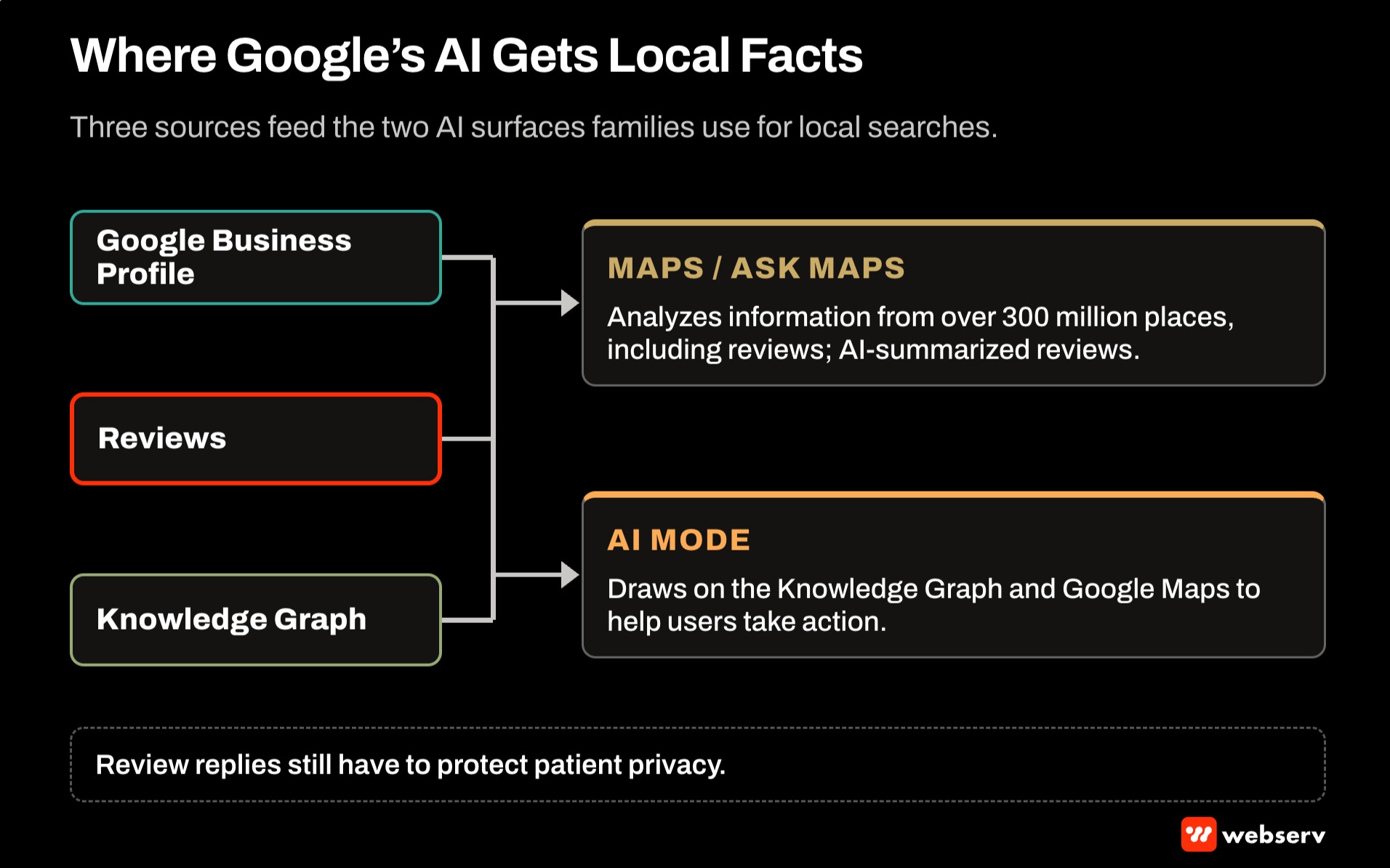
Google said in August 2025 that AI Mode draws on the Knowledge Graph and Google Maps to help users take action, starting with reservations and expanding to local service appointments. Our explainer on AI Mode vs AI Overviews covers how the two differ.
In Maps, Google’s March 2026 Ask Maps announcement says Maps analyzes information from over 300 million places, including reviews. Google’s earlier Gemini in Maps update introduced AI-summarized reviews.
The implication: what your reviews say, not just how many there are, can shape how AI describes your facility. Replies to reviews still have to protect patient privacy; HHS has settled with a provider that disclosed patient information in review responses.
What Google says to do
Google’s guidance on AI features and your website is short, and it applies to local searches too.
- There are no additional requirements to appear in AI Overviews or AI Mode.
- Pages must be indexed and eligible to show in Search with a snippet.
- Keep Business Profile information up to date.
- No special schema.org markup is needed.
Structured data still helps Google understand locations. Google’s LocalBusiness documentation says to define each location as a LocalBusiness type and use the most specific sub-type possible, while noting it doesn’t guarantee any feature will appear.
How to check your own markets
Studies give direction. Your own search results tell you what families in your markets see.
List target queries
Local-intent (“rehab near me,” “detox in [city]”) and hybrid (cost, insurance, program length, process) for each facility.
Search logged out
from the cities you serve or with location set accordingly, on mobile and desktop.
Record what appears
local pack, AI local pack, AI Overview, ads, and which sources are cited. Date every check.
Repeat monthly
Local results change, and a format that isn’t there today may appear next quarter.
Check Search Console
Google says AI Overview and AI Mode clicks and impressions are reported in the Performance report under the Web search type.
Where this fits
Local AI search sits on top of the local SEO foundation, not in place of it. For the full AI search build, see the Full AI Search Stack and our guide to getting cited in Google AI Overviews and ChatGPT, and for diagnosing why a site isn’t showing up, the 12 SEO failure patterns diagnostic and the 5-tier SEO priority framework.
OPERATOR INSIGHT
Screenshot the results page for your top five queries in each market every month and keep them in one folder. When calls from Maps drop or rise, the screenshots show whether the page layout changed.
That’s often the fastest way to tell a ranking problem from a layout change. A new format that shows fewer businesses can cut calls even if your position didn’t move.
For how local search fits the rest of your marketing, see the complete guide to behavioral health marketing. If you want a second look at what shows up for your facility’s local searches, book an intro meeting.
Frequently Asked Questions
Do AI Overviews show for “rehab near me”?
Usually not, based on published data. BrightEdge found AI Overviews on 0% of local provider healthcare queries in December 2025, and listed addiction-related queries as consistently excluded.
Whitespark’s 2025 study found AI Overviews on 15% of local-intent queries across local industries, compared with local packs on 93%.
Results change, so check your own target queries from the cities you serve.
What should treatment centers optimize for “rehab near me” searches?
The Google Business Profile and the local pack. Google says local results are mainly based on relevance, distance, and popularity, and that reviews and ratings can help.
Keep one accurate profile per facility, with correct categories, hours, photos, and services.
Back the profile with a location page that describes the facility’s real programs and details.
Where do AI Overviews matter for local treatment searches?
On hybrid queries that combine a location with a question, such as cost, insurance, program length, or what to expect at a level of care in a specific city. Whitespark found AI Overviews on 97% of hybrid queries.
Facility and location pages that answer those questions clearly are the most likely to be cited.
Include details only your facility can provide, like the levels of care offered and insurers you work with.
Does AI Mode show local treatment centers?
Google says AI Mode draws on the Knowledge Graph and Google Maps to help users take action, and Maps uses Business Profile data and reviews.
That makes accurate Business Profile information and review quality relevant to AI Mode as well as the local pack.
Google hasn’t published data on how AI Mode handles addiction treatment searches specifically.
Do we need special schema to appear in local AI results?
No. Google says there’s no special schema.org markup required to appear in AI Overviews or AI Mode.
LocalBusiness structured data can still help Google understand each location, and Google recommends defining each location separately with the most specific type available.
The bigger factors are an accurate Business Profile and pages that are indexed and eligible for snippets.
Trevor Gage is the Director of Marketing at Webserv, a digital marketing agency for treatment centers.