In 2023, Google removed first click, linear, time decay, and position-based attribution from Google Ads, saying fewer than 3% of Google Ads web conversions used them. Google Ads now offers two models: last click and data-driven.
First-touch reporting has mostly disappeared from ad platforms. The question it answered hasn’t. A treatment center still needs to know which channels introduce families to the facility, not just which ones are present at the moment someone calls.
This piece covers what first-touch and last-touch each tell you, where each still shows up in the tools treatment centers use, how each one misleads in rehab admissions, and how to run both side by side so budget decisions rest on more than one view.
It’s the reporting approach behind our admission ops and attribution work. For the full attribution model, including cohort-based methods, see our complete guide to attribution for treatment centers.
Key Takeaways
- First-touch credits the channel that introduced someone to the facility. Last-touch credits the channel present right before the inquiry. They answer different questions, and both are incomplete.
- Google Ads now offers only last click and data-driven attribution, and GA4’s reporting models are data-driven and two last-click variants. First-touch data still exists in GA4’s “first user” dimensions and in CRM and call tracking fields.
- Last-touch tends to credit branded search, direct visits, and Google Business Profile calls, which often capture demand another channel created.
- First-touch depends on cookies. Safari caps many script-set cookies at seven days, so a family’s first visit weeks earlier may not be the first touch your tools record.
- Capture both at inquiry and store them on the CRM record. Channels that look strong on first-touch and weak on last-touch are introducers; the reverse are closers.
- Reconcile both views to admits, not inquiries, before moving budget.
What each model answers
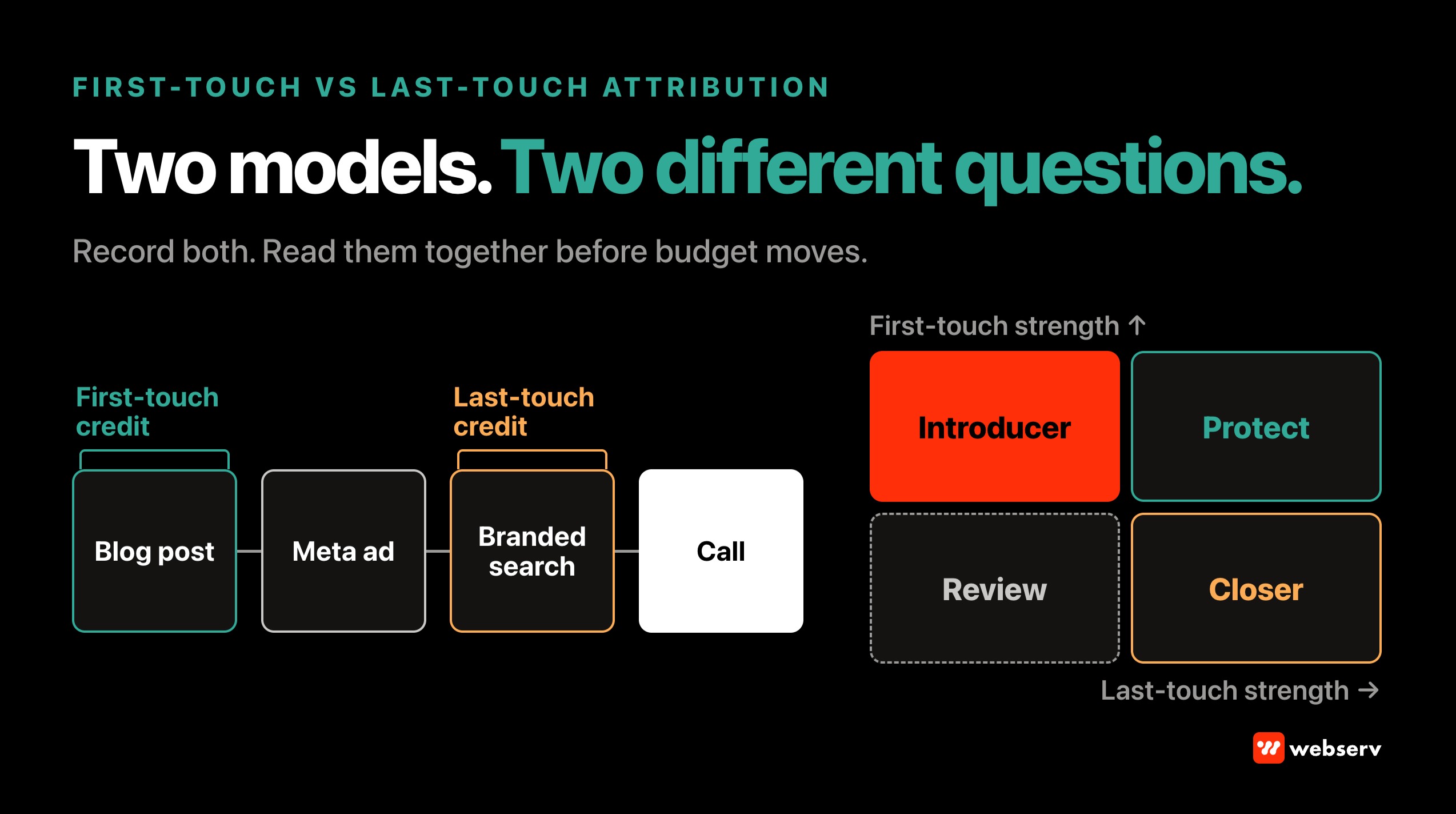
Both models give one channel all the credit. They just pick different moments.
DEFINITION
First-touch and last-touch attribution. First-touch assigns full credit for a conversion to the first recorded marketing interaction; last-touch assigns full credit to the most recent one before the conversion. In rehab admissions, the conversion is usually the inquiry, a call or form, and the credit is then carried forward to the admit.
First-touch answers: what brought this family to us in the first place? It’s the view that shows whether upper-funnel work, such as educational content, video, or paid social, is starting journeys.
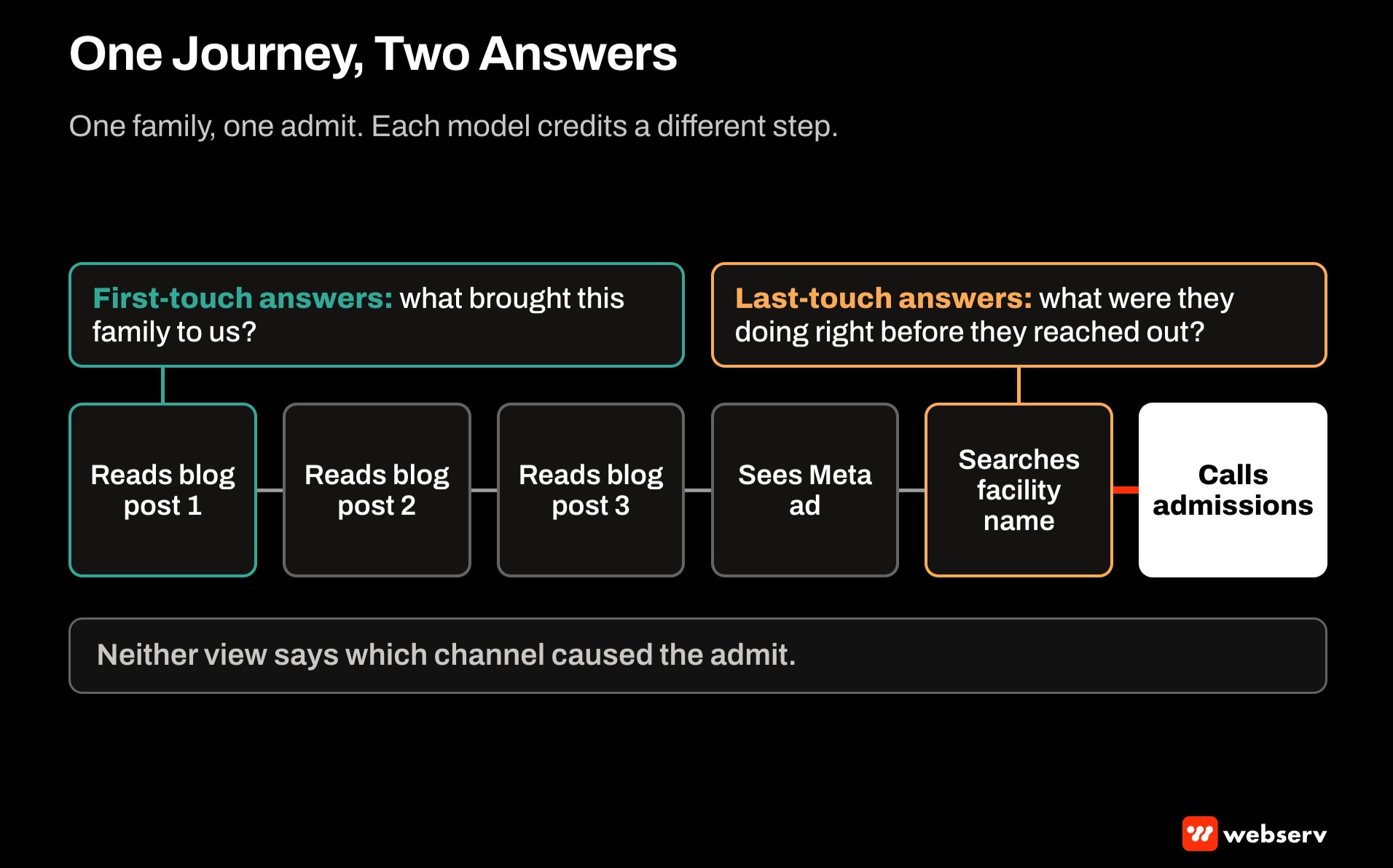
Last-touch answers: what was the family doing right before they reached out? It shows which channels are present when intent peaks, such as search ads, the Google Business Profile listing, or a re-engagement ad on Meta.
Neither view says which channel caused the admit. A family that read three blog posts, saw a Meta ad, and then searched the facility’s name before calling touched at least three channels. First-touch credits the blog; last-touch credits branded search.
Where each model lives in your tools now
The tools treatment centers already run carry both views, but they label them differently and default to different ones.
| Tool | First-touch view | Last-touch view | Default |
|---|---|---|---|
| Google Ads | None since 2023 | Last click | Data-driven for most actions |
| GA4 | First user dimensions | Paid and organic last click | Data-driven |
| Meta | n/a | Meta’s own click and view windows | n/a |
| HubSpot | Original Traffic Source | Latest Traffic Source | n/a |
| Salesforce | Account Engagement first-touch model | Last-touch model | Primary Campaign Source |
| CallRail | First Touch | Last Touch field | 50/50 on most reports |
| CTM | First Touch, on by default | Last Touch per source | n/a |
Google Ads. Google’s attribution models page lists last click and data-driven, with data-driven as the default for most conversion actions. Google’s removal notice explains that the rule-based models were switched to data-driven from September 2023.
Google also says all conversion actions are eligible for data-driven attribution regardless of volume. Older guidance that set conversion minimums is out of date. The default click-through conversion window is 30 days, adjustable up to 90.
GA4. GA4’s attribution settings offer data-driven, paid and organic last click, and Google paid channels last click. First-click and the other rule-based models were removed in November 2023.
GA4 still keeps a first-touch view. Its “first user” dimensions, such as first user source and medium in the User acquisition report, stay the same as a user returns. Google notes these dimensions aren’t affected by the attribution model setting.
Meta. Meta’s attribution settings count conversions within one or seven days of a click, one day of a view, or one day of an engaged video view. These windows describe Meta’s own ads, not the full journey.
Meta also stopped returning 7-day and 28-day view-through data in its Ads Insights API on January 12, 2026, so year-over-year comparisons across that date aren’t like for like.
CRM. HubSpot’s traffic source properties are Original Traffic Source, the first known web source, and Latest Traffic Source, the most recent. Salesforce’s default campaign influence model, per its documentation, gives 100% influence to an opportunity’s primary campaign source.
Call tracking. CallRail’s attribution models include First Touch and a Last Touch field. CTM’s first and last touch settings record the first time a visitor came to the site, with last touch available per tracking source.
How last-touch misleads in rehab admissions
Last-touch gives full credit to whatever the family did last, and in treatment center admissions that can be a channel that captures intent rather than creates it.
Branded search. A family that first found the facility through content or a referral may search the facility’s name before calling, and last-touch credits the branded search ad or organic listing.
Direct and Google Business Profile. A family that saved the number, or looked up the listing to get directions and call, shows up as direct or local. The earlier channels disappear from the report.
Re-engagement ads. An ad shown to people who already engaged with the facility, such as a Meta video-engagement audience, reaches families another channel introduced. When it’s the last click before an inquiry, last-touch credits it with a journey another channel started. Google doesn’t allow remarketing lists for addiction treatment ads; our retargeting guide covers what still runs.
Our complete guide to attribution and marketing ROI playbook both flag last-touch as the default that most often misleads budget decisions. The risk is cutting the channels that fill the top of the funnel because they rarely get the final click.
How first-touch misleads
First-touch has its own blind spots, and most of them come from how browsers store identifiers.
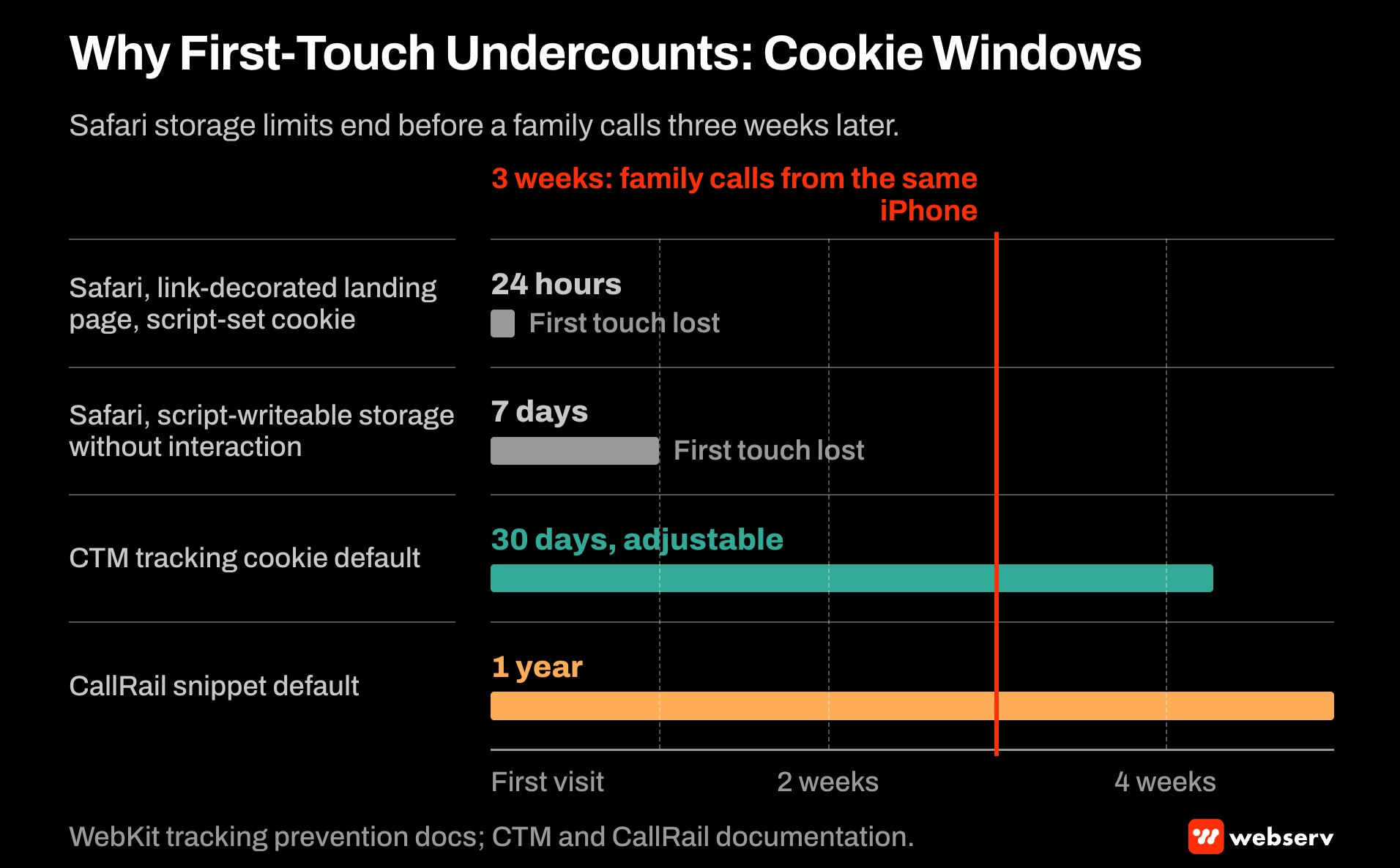
Cookie limits. WebKit’s tracking prevention documentation says Safari caps cookies set by JavaScript on a landing page reached through link decoration to 24 hours, and deletes script-writeable storage after seven days without user interaction. WebKit’s ITP 2.1 announcement set a seven-day cap for persistent cookies created in JavaScript.
A family that read a blog post on an iPhone three weeks before calling may be recorded as new on the day they call. The “first touch” in your report is the first touch the cookie remembers.
Tool defaults. CTM’s tracking code documentation sets its tracking cookie for 30 days by default, adjustable. CallRail’s multi-touch report documentation says its snippet defaults to a one-year cookie. Check each tool’s setting before comparing their first-touch data.
Offline and referral starts. A family referred by a therapist, an interventionist, or an alumnus has an offline first touch no web tool sees. Our referral partner attribution guide covers how to capture those in the CRM.
COMMON MISTAKE
Comparing first-touch from one tool with last-touch from another. GA4’s first user source, HubSpot’s Original Traffic Source, and CTM’s First Touch each use their own cookie, window, and definition. Put one against a different tool’s last-touch and the difference reflects the tools as much as the channels.
Pick one system of record for each inquiry, usually the CRM fed by call tracking and form tracking, and pull both views from it.
Rehab-specific wrinkles
A few features of treatment center admissions make both models less reliable than they are in other industries.
The researcher isn’t always the caller. A parent may research on a work laptop and the patient may call from their own phone. Web tools see two different people, and neither model connects them. The admissions team’s question about how the family heard about the facility becomes the tie-breaker.
Phone-first inquiries. Families often call rather than fill in a form. Without dynamic number insertion, a call has no web source at all. Our call tracking guide covers the setup that carries a source into the call record.
Long consideration. The time from first visit to inquiry can outlast cookie limits and ad platform windows. That pushes first-touch toward undercounting and last-touch toward whatever the family did on the final day.
Run both side by side
The practical answer isn’t choosing a model. It’s recording both on every inquiry and reading them together.
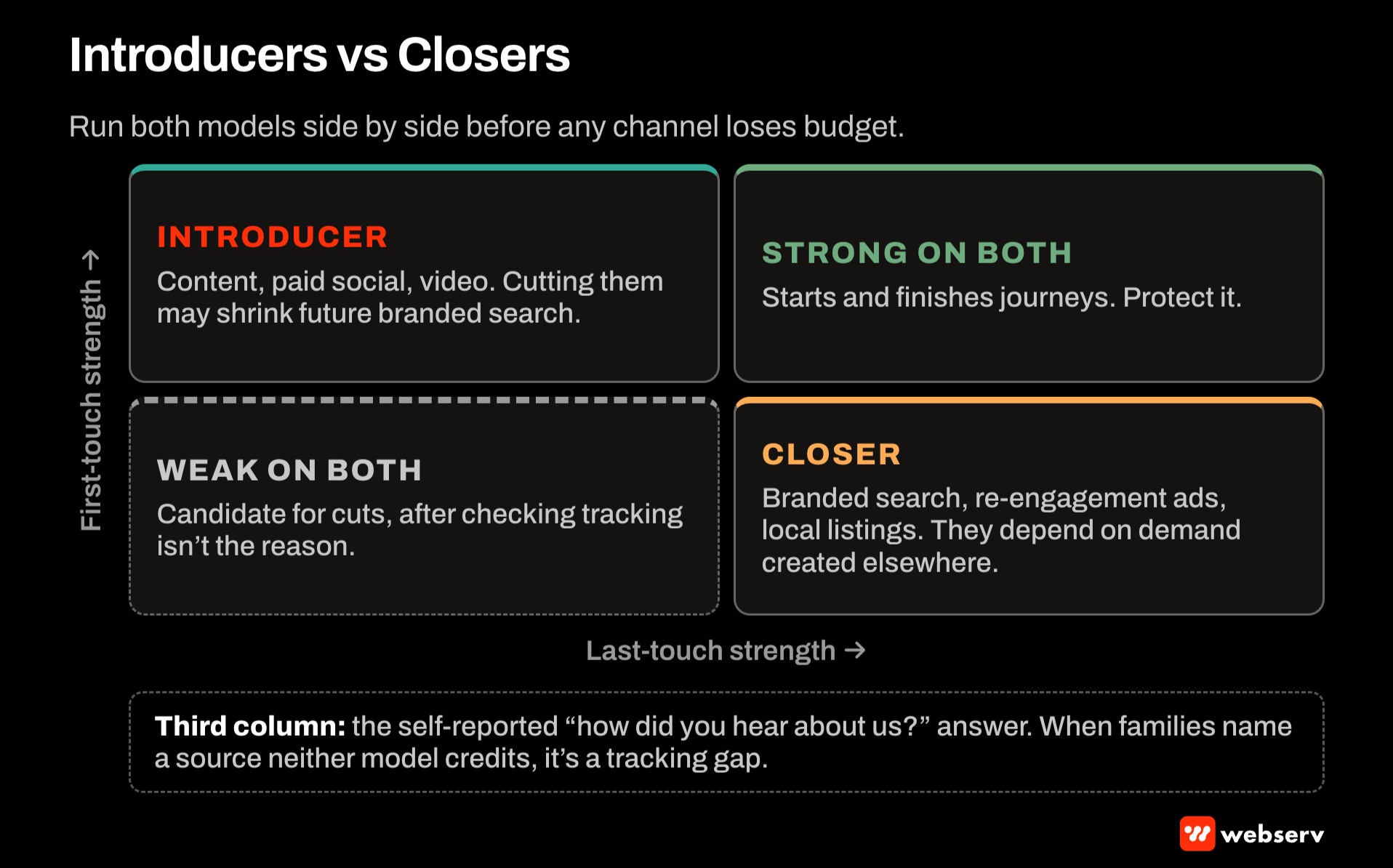
At inquiry, write the first-touch source and the last-touch source onto the CRM record, along with the answer to “how did you hear about us?” When the inquiry becomes an admit, both sources carry forward.
Then compare by channel:
- Strong on first-touch, weak on last-touch: an introducer. Content, paid social, and video can land here. Cutting them may shrink future branded search.
- Weak on first-touch, strong on last-touch: a closer. Branded search, re-engagement ads, and local listings can land here. They matter, but they depend on demand created elsewhere.
- Strong on both: a channel that both starts and finishes journeys. Protect it.
- Weak on both: a candidate for cuts, once you’ve checked that tracking isn’t the reason.
OPERATOR INSIGHT
Look at the self-reported answer next to both models. When families consistently name a source that neither model credits, such as a podcast, a referral, or a specific article, that’s a tracking gap, not a channel with no impact.
Self-reported answers aren’t precise, but they’re the only view that follows the family across devices and offline conversations.
A simple reporting setup
Six steps set up both views in the tools most treatment centers already run.
Pick the system of record
Usually the CRM, fed by call tracking and form tracking.
Capture both sources at inquiry
Map first-touch and last-touch fields from call tracking and forms into the CRM record.
Add the self-reported question
Make “how did you hear about us?” a required field on intake.
Match cookie settings
Align tracking cookie durations across tools where you can, and note where you can’t.
Report on admits
Carry both sources to the admit and report admits by first-touch and last-touch source side by side.
Review monthly
Look for introducers and closers before changing budget.
When to go beyond first and last touch
First-touch and last-touch are a starting point. Once both are captured and reconciled to admits, treatment centers can get more from cohort-based reporting, which ties spend in a period to the admits and revenue it produced over the following months.
Our attribution guide covers that model. To use the results in budget decisions, see our guide on lowering cost per admit without cutting ad budget.
For how attribution fits the rest of your marketing, see the complete guide to behavioral health marketing. If you want a second look at how your reports credit channels, book an intro meeting.
Frequently Asked Questions
Is first-touch or last-touch better for treatment centers?
Neither on its own. First-touch shows which channels introduce families to the facility; last-touch shows which channels are present right before the inquiry.
Because rehab journeys often span several channels and devices, each model misses part of the picture.
Capture both on every inquiry, compare them by channel, and reconcile both to admits before moving budget.
Does Google Ads still offer first-click attribution?
No. Google removed first click, linear, time decay, and position-based models from Google Ads in 2023, and GA4 removed them from its reporting settings in November 2023.
Google Ads now offers last click and data-driven attribution. GA4 offers data-driven and two last-click variants.
First-touch data is still available in GA4’s first user dimensions and in CRM and call tracking fields.
Why does branded search get so much credit in our reports?
Last-touch reporting credits the final interaction before an inquiry, and many families search the facility’s name right before they call.
That makes branded search look like the top channel even when another channel introduced the family.
Compare branded search’s first-touch and last-touch numbers. A large gap suggests it’s closing journeys other channels started.
How does Safari affect first-touch attribution?
WebKit documents that Safari caps many cookies set by JavaScript, including a 24-hour cap in some link-decoration cases and deletion of script-writeable storage after seven days without interaction.
A family whose first visit was weeks before the inquiry may be recorded as new when they call, so the recorded first touch is later than the real one.
Self-reported source and CRM notes help fill that gap.
What’s the difference between HubSpot’s Original Traffic Source and Latest Traffic Source?
HubSpot defines Original Traffic Source as the first known web source through which a contact interacted with the business, and Latest Traffic Source as the most recent known web source.
They’re HubSpot’s first-touch and last-touch fields for web activity.
They depend on HubSpot’s tracking cookie, so offline sources and cross-device journeys still need separate capture.
Trevor Gage is the Director of Marketing at Webserv, a digital marketing agency for treatment centers.