Phone calls are the primary conversion path for most treatment center marketing programs, and they sit at the top of the funnel our admission ops billing team works with downstream. Meta and Google paid campaigns produce phone calls at meaningfully higher rates than form submissions.
Organic search produces phone calls from the visitors who read enough of the site to trust the facility. Referral partners produce phone calls that never touch a form because the referral partner passes the phone number directly.
Call tracking is the specific attribution layer that connects those phone calls to the marketing spend that produced them. When it is set up correctly, phone calls resolve to the specific paid campaign, organic keyword, or referral source that produced the call.
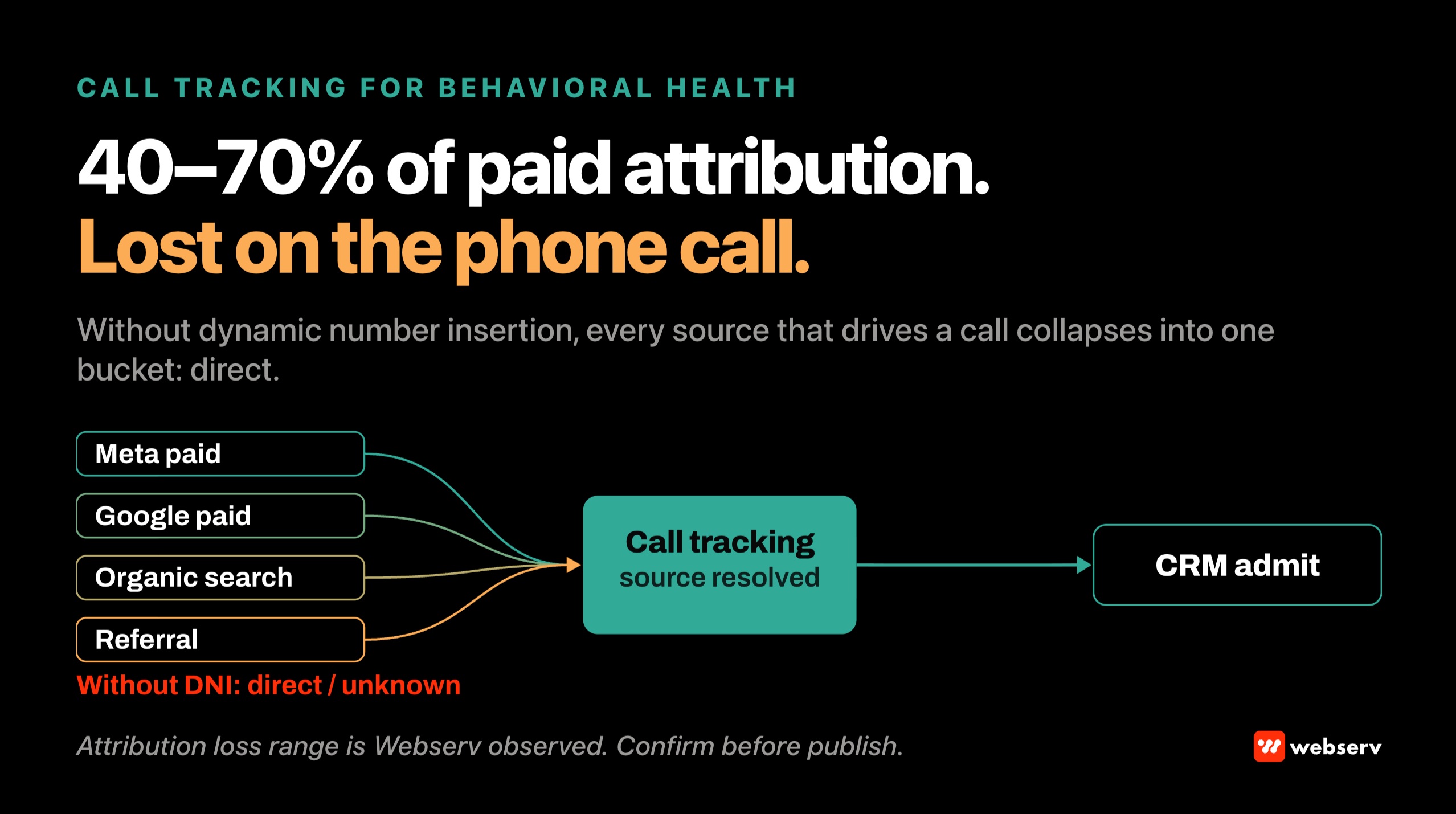
When it is set up incorrectly, which is the default state for most treatment center attribution setups, the phone calls resolve to “direct” or “unknown.” Marketing leadership cannot answer specific questions about which spend produced which admits.
The pattern I see across facility audits: the call tracking either does not exist (all inbound calls route to a single number with no source tracking), or exists as basic dynamic number insertion (DNI) without CRM integration.
Some facilities have full CRM integration but broken cross-domain tracking, and Meta and Google paid calls attribute to “direct” because the tracking session broke somewhere in the chain.
This piece walks the call tracking setup that produces useful attribution for treatment centers. The dynamic number insertion pattern that resolves paid campaign traffic to specific numbers, and the CRM integration that connects calls to admit outcomes.
It also covers the HIPAA-adjacent considerations that apply to call recording and call transcript handling (paired with our HIPAA-safe conversion tracking guide), the cross-domain tracking that keeps paid attribution intact through VOB and eligibility subdomains, and the measurement setup that resolves call-level attribution into cost-per-admit at the paid campaign level.
For the full picture, see our attribution guide, sits. Related reading: guide to lowering cost-per-admit without cutting ad budget. and pairs directly with our GA4 configuration guide for the session-layer that call tracking plugs into. All of the above sits under our ultimate guide to behavioral health marketing.
Key Takeaways
- Phone calls are the primary conversion path for treatment center marketing. Meta and Google paid campaigns produce 60 to 80 percent of their conversions as phone calls rather than form submissions. Facilities that do not track calls at source-level typically underattribute paid campaign performance by 40 to 70 percent.
- Dynamic number insertion (DNI) is the specific technical pattern that assigns unique phone numbers per traffic source. Different numbers for Meta paid, Google paid, organic search, direct traffic, and specific referral partners. When a visitor calls the number, the call source is captured automatically and passed to the CRM as attribution data.
- CRM integration connects call source data to admit outcomes. Facilities that capture call source but do not connect it to admit outcomes produce inquiry-level attribution but cannot resolve which sources produced admits versus which sources produced only inquiries. The specific integration path: call tracking platform to CRM via API, with source data preserved through the admit conversion.
- HIPAA-adjacent considerations apply to call recording and call transcript handling. Call recordings capture PHI (patient names, insurance details, health conditions). Call transcripts stored on third-party servers carry the same HIPAA-adjacent risk as tracking data sent to ad platforms. The specific fix: BAA-covered call tracking vendors and PHI-safe storage patterns for recordings and transcripts.
- Cross-domain tracking through VOB and eligibility subdomains keeps paid attribution intact when the caller journey spans multiple domains. Broken cross-domain tracking is the specific failure that produces “direct” attribution for paid calls that actually originated from Meta or Google paid campaigns.
DEFINITION
Call tracking for behavioral health attribution. The infrastructure that resolves inbound phone calls into paid campaign, organic, and referral attribution for treatment center marketing. Runs on dynamic number insertion (DNI) assigning 20 to 50 tracking numbers to specific traffic sources through session-level rotation, CRM integration passing source data through the admit conversion, BAA-covered vendors for HIPAA-adjacent recording and transcript handling, and cross-domain tracking that keeps paid attribution intact through VOB and eligibility subdomains.
Distinct from GA4 phone_click events (which capture the tap on a tel link but not the completed call), distinct from ad-platform call extensions (which capture only calls routed through Google or Meta call forwarding, not calls placed to the website number), and distinct from a single static main number (which produces zero source attribution).
OPERATOR INSIGHT
Facilities that measure paid campaigns on form conversions alone typically underattribute paid performance by 40 to 70 percent because the phone calls that should count as conversions are not being attributed to the paid source.
The specific consequence: paid budgets get cut on cells that are actually working, and paid budgets get scaled on cells that only look like they’re working because form submissions concentrate there. The call tracking layer is what makes the cost-per-inquiry and cost-per-admit numbers interpretable in the first place.
Why call tracking matters for BH specifically
Phone calls carry meaningfully more of the conversion weight in BH marketing than in most other categories. The specific reasons why phone calls dominate BH conversion.
BH visitors are in higher emotional intensity than most categories. Families in acute-need situations reach for the phone rather than a form. The emotional intensity of the moment produces a specific preference for immediate human contact rather than form submission and callback delay.
Insurance verification requires conversation. The specific eligibility questions that drive treatment center admissions inquiries (insurance carrier, in-network status, member ID, coverage details) work better through conversation than through form fields. A phone conversation resolves the eligibility question in 5 to 15 minutes.
A form submission followed by callback typically takes 4 to 24 hours to resolve the same question.
Trust signal reinforcement through voice. The admissions team’s voice carries the trust signal that families need to commit to admission. Written form responses carry less trust signal than phone conversations, especially for the acute-need families making high-stakes admission decisions.
Regulatory and compliance context. Some payer and referral partner workflows require phone verification rather than digital form submission. Court-ordered admissions, DUI treatment referrals, and some employer EAP programs specifically require phone-based intake.
The specific consequence: BH marketing programs that do not track calls at source level typically produce cost-per-conversion metrics that materially underestimate paid campaign performance.
Facilities that measure paid campaigns on form conversions alone typically underattribute paid performance by 40 to 70 percent because the phone calls that should count as conversions are not being attributed to the paid source.
Dynamic number insertion setup
Dynamic number insertion (DNI) is the technical pattern that assigns unique phone numbers per traffic source. The specific setup pattern for treatment center DNI.
Number pool sizing
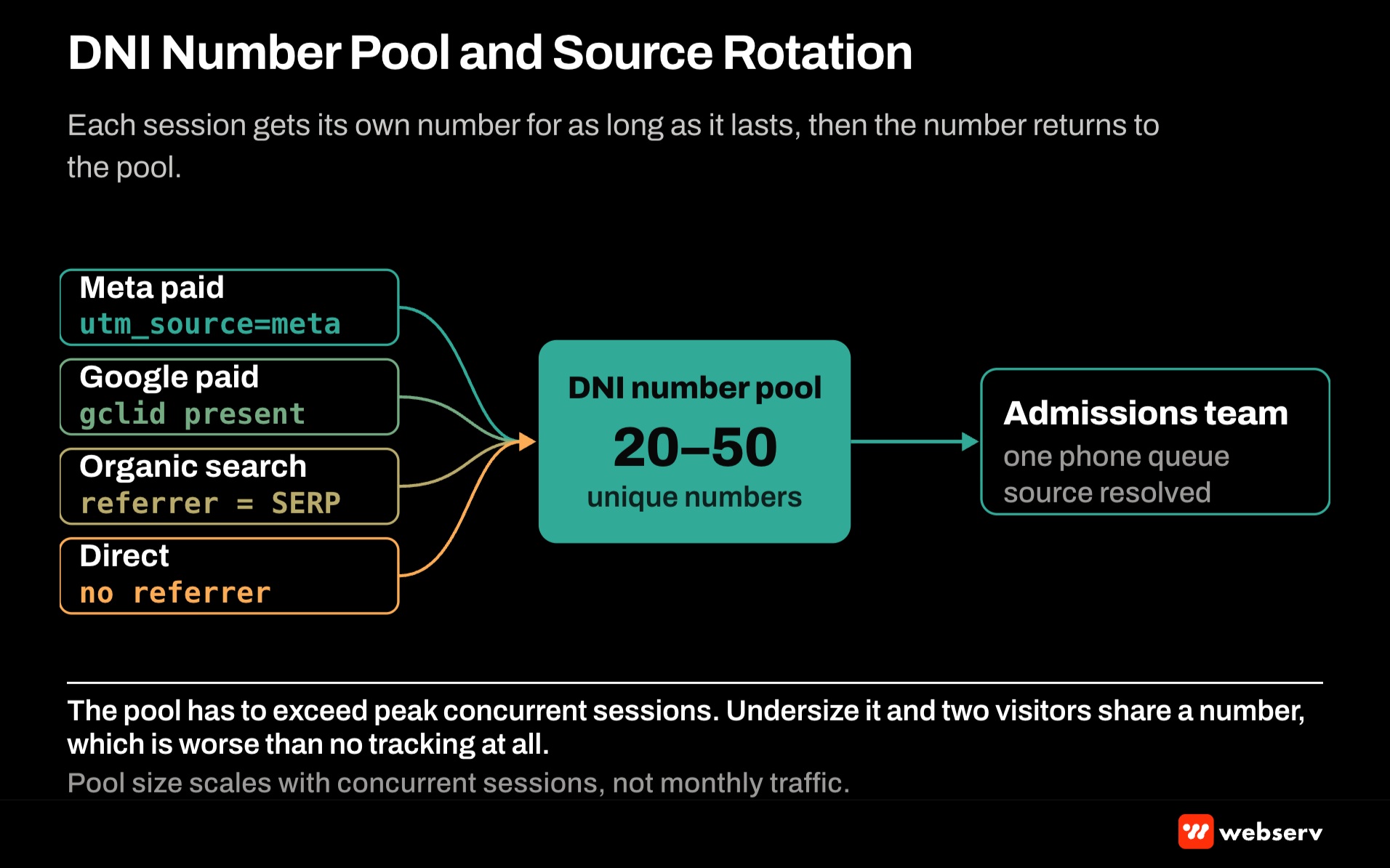
Between 20 and 50 unique tracking numbers for most treatment center properties. Each number gets assigned to a specific traffic source through session-level rotation.
Smaller number pools (5 to 15 numbers) produce attribution overlap because multiple sessions from different sources rotate through the same numbers. Larger pools (50+) produce management overhead without corresponding attribution benefit.
Session-level number rotation
DNI assigns a specific number to each visitor session based on the traffic source. Meta paid traffic sees one set of numbers, Google paid traffic sees another, organic search sees a third, direct traffic sees a fourth.
The number the visitor sees remains consistent throughout the session so the visitor can call the same number they saw during their browsing. Session-level rotation resolves attribution at the source level.
Number provisioning and porting
Tracking numbers get provisioned through the call tracking platform. Existing facility phone numbers can port into the tracking platform to maintain existing brand recognition while adding source-level attribution.
The specific consideration: facility main phone numbers should stay stable across brand and print materials while DNI handles the source-level attribution for digital marketing traffic. Mixing the two produces confusion at the admissions team level.
Vanity numbers versus rotation
Some facilities use vanity phone numbers (1-800-REHAB-NOW type patterns) for brand recognition. Vanity numbers can integrate with DNI as the “master” number for organic and direct traffic while rotation numbers handle paid traffic attribution.
The call tracking program at a glance
60-80%
Meta and Google BH conversions arriving as phone calls, not form submits
20-50
DNI pool size range for most treatment center properties
$500-2.5K
Monthly platform + DNI + recording cost per single-facility operator
15-30%
Google Ads underattribution when call-extension conversions are missed
CRM integration for admit-level attribution
Call source data captured at DNI level has to connect to CRM admit outcomes for the attribution chain to reach admits. The specific integration pattern.
Call platform to CRM API. Call tracking platforms (CallRail, CallTrackingMetrics, WhatConverts) offer API integration with treatment center CRMs (KIPU, BestNotes, Sunwave, Salesforce Health Cloud). The integration passes call source data as a new contact or activity record in the CRM.
Source data preservation through admit conversion. The specific field that has to persist through the admit conversion: the original traffic source that produced the call. Meta paid, Google paid, organic search, direct traffic, or specific referral partner name.
CRM configurations that overwrite source data during admit conversion produce the specific attribution failure where inquiries carry source data but admits do not. The right configuration preserves the original source through admit conversion and any subsequent status changes.
Offline conversion imports back to ad platforms. Once the admit converts, the admit outcome plus the original traffic source get imported back to the ad platforms as offline conversions. Meta CAPI accepts offline conversion imports.
Google Ads accepts offline conversion imports through Google Ads offline conversion tracking. The offline import trains the ad platform optimization on admit outcomes rather than inquiry outcomes.
Attribution model consistency. The attribution model used for offline conversion import should match the attribution model used for session-level GA4 tracking. Data-driven attribution across both layers produces the strongest signal.
HIPAA-adjacent call recording and transcript handling
Call recording and call transcript handling carry HIPAA-adjacent considerations that apply differently than general marketing data.
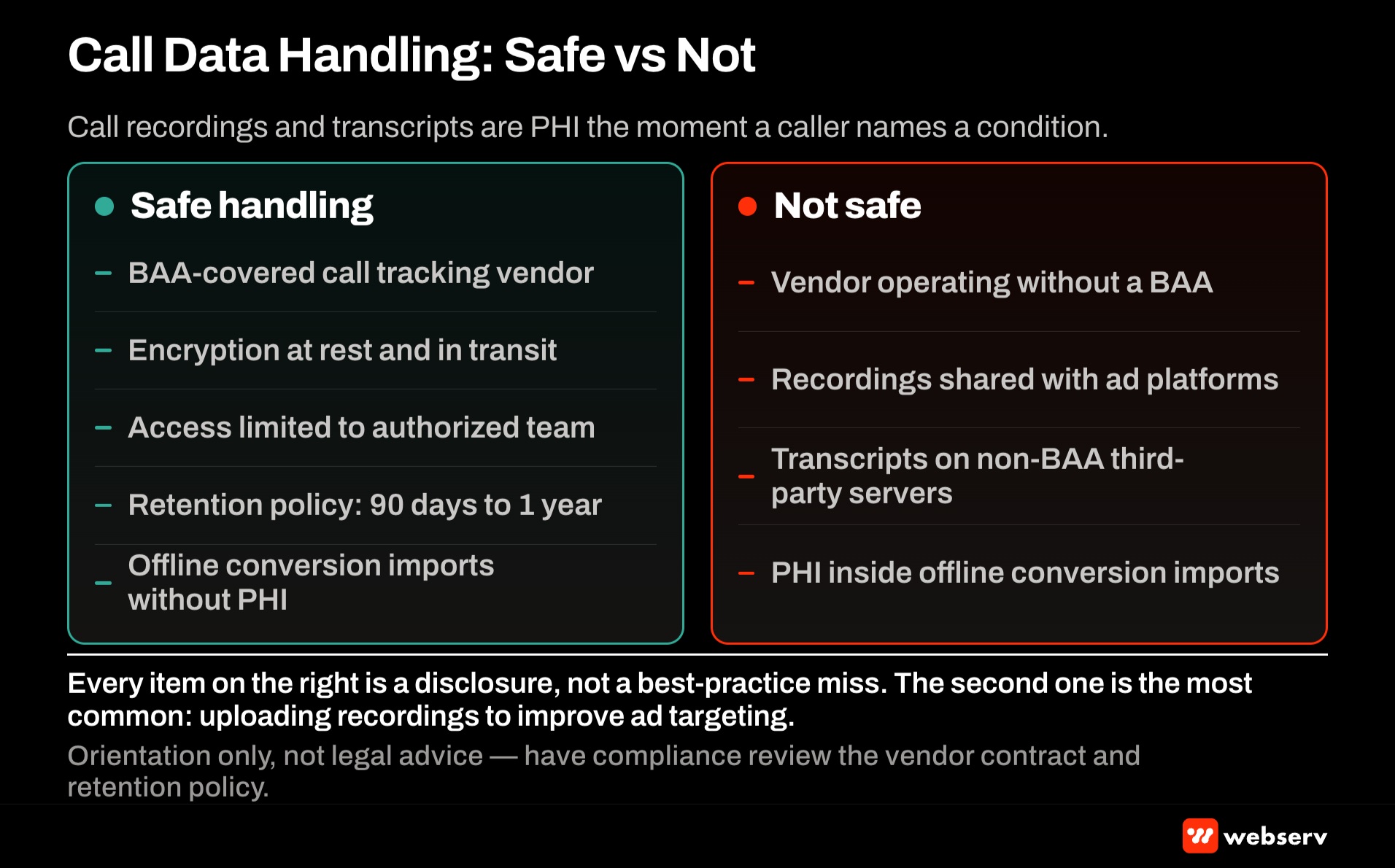
Call recordings capture PHI. The specific patient information captured during admissions calls: patient name, insurance carrier and member ID, health conditions discussed, medication history, prior treatment history, family contact information.
Call transcripts carry the same PHI. Automated call transcription (through the call tracking platform’s transcription feature or third-party transcription vendors) produces text records of the PHI captured in the call recording. Transcripts stored on third-party servers carry the same HIPAA-adjacent risk as tracking data sent to ad platforms.
BAA coverage required for call tracking vendors. The call tracking platform storing recordings and transcripts has to sign a Business Associate Agreement (BAA) covering the PHI-handling terms. CallRail and CallTrackingMetrics both offer BAA coverage for BH clients on their higher-tier plans. Some vendors do not offer BAA coverage at all, which makes them unsuitable for BH call tracking.
PHI-safe storage patterns for recordings and transcripts. Storage encryption at rest and in transit. Access controls limited to authorized admissions and clinical team members. Retention policy that deletes recordings and transcripts after the specific retention window (typically 90 days to 1 year depending on facility policy).
The specific gotcha for treatment center call tracking: PHI in call recordings must not get shared with ad platforms for optimization. The offline conversion imports to Meta and Google should include the admit outcome and the source attribution but must not include PHI from the call recording itself.
DO
- Provision a DNI pool of 20 to 50 numbers with session-level rotation so paid, organic, direct, and referral traffic each attribute to distinct numbers.
- Pass call source data through to the CRM via API and preserve the source through the admit conversion , that is what makes admit-level attribution work.
- Import admit outcomes back to Meta CAPI and Google Ads offline conversions weekly so the ad platforms train on admits rather than inquiries.
- Sign a BAA with the call tracking vendor and lock down recording/transcript storage with encryption, access controls, and a defined retention window.
- Audit paid call attribution quarterly against Meta and Google click counts to catch broken cross-domain tracking before it costs a quarter of decisions.
DON’T
- Route all inbound calls to a single static number , zero source attribution and no way to compare paid, organic, and referral performance.
- Rely on GA4 phone_click events alone , they capture the tap on a tel link, not the completed call, source, or duration.
- Send PHI from call recordings or transcripts to ad platforms as part of offline conversion imports , admit outcome and source only, never PHI.
- Use a call tracking vendor without BAA coverage for BH , recordings capture PHI and third-party storage without BAA is a HIPAA-adjacent exposure.
- Rotate the facility main brand number through DNI , main number stays static across print, TV, and radio for brand recognition; digital traffic gets tracking numbers.
Cross-domain tracking through VOB and eligibility subdomains
Cross-domain tracking keeps paid attribution intact when the caller journey spans multiple domains. The specific failure pattern that breaks paid attribution.
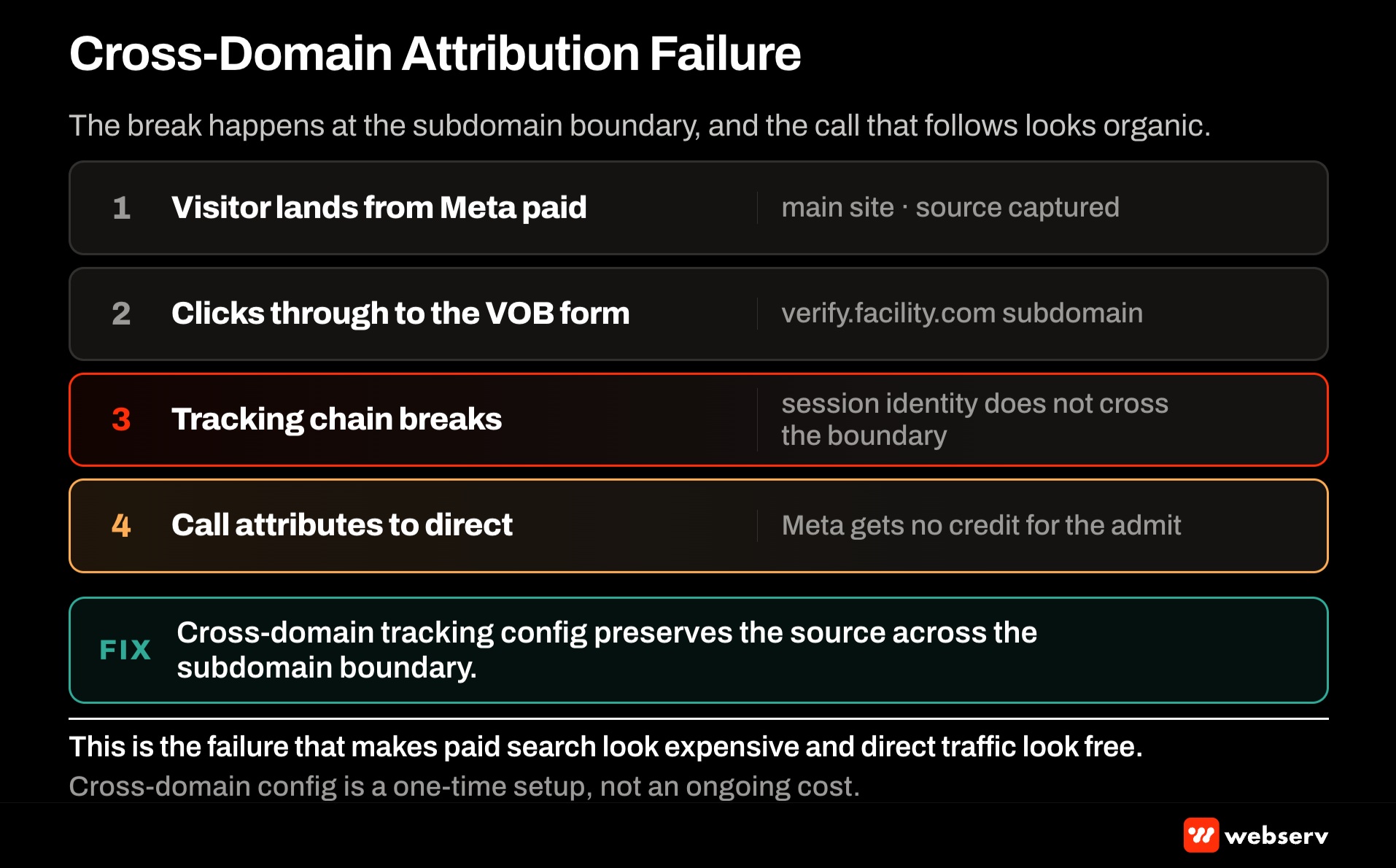
The failure sequence. Visitor arrives on the marketing site from a Meta paid campaign. Visitor clicks through to the VOB form on the eligibility subdomain (verify.facility.com). VOB session breaks the tracking chain. Visitor calls the phone number displayed on the VOB subdomain. Call attribution resolves to “direct” or “subdomain” rather than the Meta paid campaign.
The specific fix. Cross-domain tracking configuration in the call tracking platform’s JavaScript that preserves the traffic source across the subdomain boundary. The traffic source captured on the main marketing site persists through the VOB subdomain session and gets attributed to the call originating from the VOB subdomain.
Third-party VOB tools that break tracking. Some third-party VOB tools (Availity’s embedded form, pVerify’s standalone form) run on entirely separate domains that resist cross-domain tracking. The workaround: iframe the third-party tool into a facility-controlled subdomain rather than linking out to the third-party domain.
Testing cross-domain attribution. Quarterly audit of paid call attribution against known ad platform delivery. When Meta reports 200 clicks and the call tracking platform reports only 50 Meta-attributed calls, cross-domain tracking is probably broken somewhere in the chain.
Frequently Asked Questions
How much does call tracking cost for a treatment center?
Between $500 and $2,500 per month for most single-facility operators, depending on call volume and the specific plan tier the call tracking vendor offers. The specific pricing breakdown: base plan for the platform plus per-number pricing for the DNI pool plus per-minute pricing for call recording plus BAA coverage for HIPAA-adjacent handling.
CallRail’s BH-eligible plan typically runs $300 to $1,200 per month for treatment center use cases. CallTrackingMetrics runs comparable pricing with slightly different plan structure. WhatConverts runs at similar prices with a focus on lead scoring.
Portfolio operators produce economies of scale because the platform base cost is shared across facilities and the per-facility incremental cost is primarily the DNI pool.
Do we need call tracking if we have GA4 phone call events configured?
Yes. GA4 phone call events (fired when a visitor taps a tel link on mobile) capture the phone click but do not capture the actual call outcome. The visitor might tap the phone link and not complete the call.
The visitor might complete the call but hang up before reaching an admissions team member. The visitor might complete the call from a different device than the one they tapped the link on.
Call tracking captures the actual completed call, the source attribution, the call duration, and the call outcome (connected, missed, voicemail). GA4 phone click events plus call tracking together produce the full attribution picture. Our GA4 configuration guide covers the specific event schema that pairs with call tracking.
What about attribution for calls that come from print, TV, or radio marketing?
Distinct tracking numbers per non-digital source. Print materials, TV spots, and radio spots all get assigned dedicated tracking numbers that do not rotate through DNI.
The specific pattern that works: DNI handles digital traffic source attribution through session-level rotation. Print, TV, and radio get static tracking numbers assigned per campaign. All numbers route to the same admissions team through the call tracking platform.
Facility main phone numbers stay static across brand materials for brand recognition. Digital and non-digital marketing use tracking numbers for source-level attribution.
How do we handle calls that come from Google Ads phone extensions rather than website visits?
Google Ads call extensions produce calls that route directly through Google’s call forwarding rather than through the DNI-assigned website number. Google Ads reports the call as a call extension conversion.
The specific integration: import Google Ads call extension conversions as a separate attribution source alongside DNI-tracked calls. The two sources together capture the full paid Google call volume.
Facilities that measure only DNI-tracked calls typically under-attribute Google Ads by 15 to 30 percent because call extension conversions are missing from the count.
Do we need call recording for attribution or only for quality assurance?
Call recording is optional for attribution. Call attribution works from the call source and duration data alone.
Call recording adds value for quality assurance (reviewing admissions team performance), training (playing back specific calls for coaching), and admissions optimization (identifying specific patterns in high-converting calls versus low-converting calls). Facilities that skip call recording get attribution but lose the quality assurance layer.
The tradeoff: call recording adds HIPAA-adjacent handling complexity and storage cost. Facilities with strong internal quality assurance processes typically benefit from call recording. Facilities without internal QA processes typically produce recordings that never get reviewed and add cost without corresponding benefit.
How does call tracking interact with our overall attribution setup?
Call tracking is one of the primary attribution sources that feeds the broader attribution chain. Sessions produce clicks, clicks produce inquiries (calls plus forms), inquiries produce admits, admits produce reimbursement.
Call tracking specifically resolves the inquiry-to-source attribution for the phone call branch of the inquiry funnel. Form submissions get attribution through GA4 and CRM integration. Both call and form attribution feed the same downstream admit and reimbursement layers.
The specific integration point: call tracking platform CRM integration passes source data to CRM. CRM tracks the admit conversion. Offline conversion imports back to Meta and Google trigger optimization on admit outcomes rather than inquiry outcomes. Our attribution guide walks the full five-layer chain call tracking plugs into.
How long does it take to see the benefit of call tracking setup?
The attribution benefit shows up within 14 to 30 days as clean call source data starts populating the reporting. The decision-change benefit takes 60 to 120 days as marketing leadership internalizes what the new attribution is showing and starts changing paid campaign decisions based on cost-per-admit rather than cost-per-inquiry.
Facilities that expect immediate decision changes typically get frustrated in the first 30 to 60 days and abandon the setup before it pays off.
The right expectation: call tracking is infrastructure. It pays off over 6 to 12 months through better paid campaign decisions and clearer attribution across the funnel. Our reimbursement intelligence guide covers how the admit-level attribution eventually resolves into realized revenue.
Jim Malcom is the Director of Admission Ops at Webserv, a digital marketing agency for treatment centers.