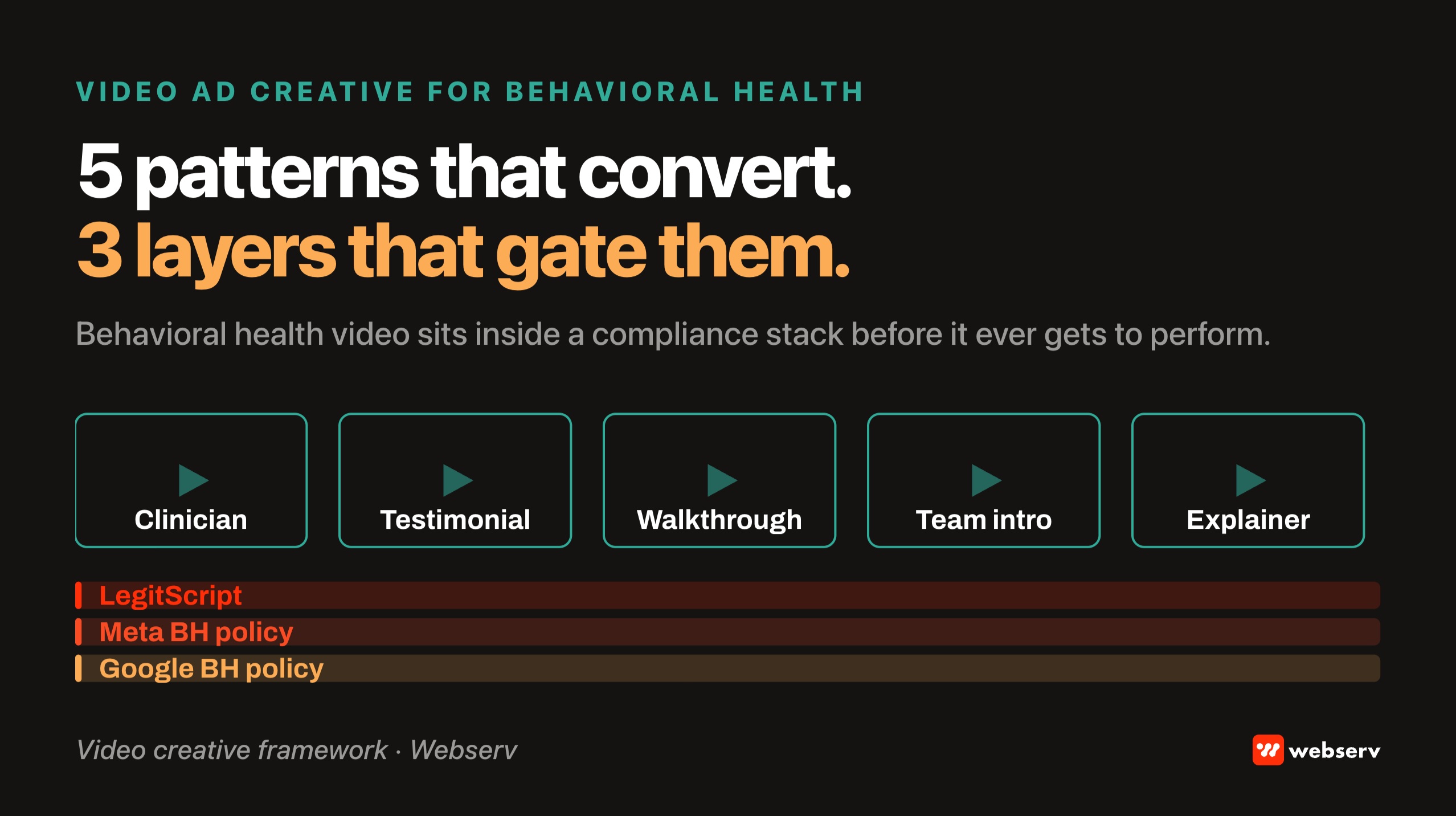
Video ad creative in behavioral health carries every constraint that static ad creative carries plus additional constraints specific to video. It sits inside our creative capability as the motion-and-voice format sibling to static.
LegitScript reviews video creative more aggressively than static because video carries voice, motion, and emotional cues that produce more compliance surface area. Meta and Google platform policies for BH apply to video the same way they apply to static plus additional pattern restrictions specific to video content.
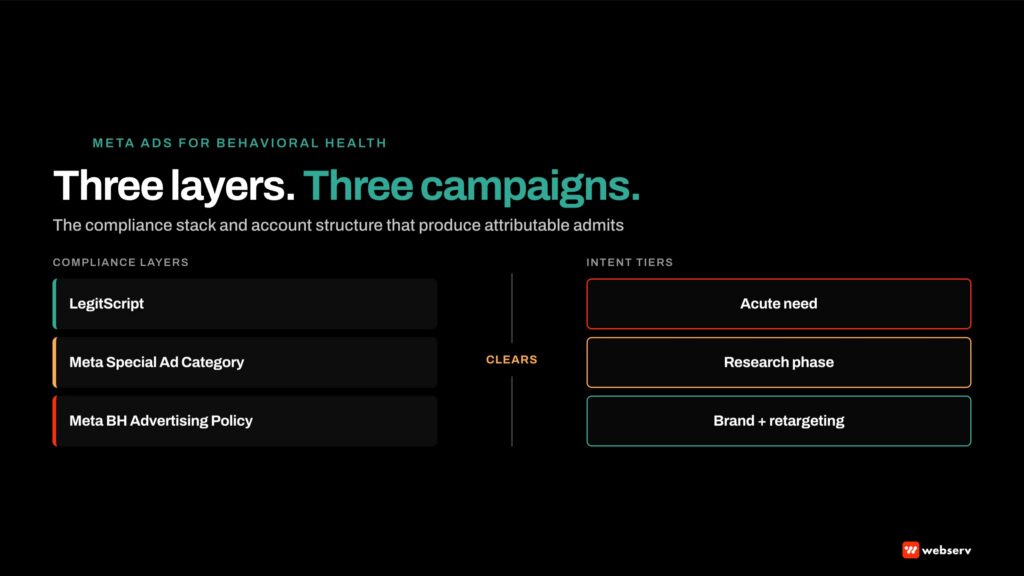
The performance creative team has to produce video that clears three compliance layers while producing the specific engagement patterns video creative can deliver in BH.
The pattern I see across facility video programs: video production either runs at $15,000 to $50,000 per shoot with meaningful custom production, or it does not run at all because the compliance complexity discourages investment.
The middle path is video creative production between $2,000 and $8,000 per unit with disciplined compliance workflow. It exists but requires specific production patterns most BH marketing agencies do not run at scale.
This piece walks the video ad creative playbook for treatment centers. The specific compliance triggers that apply to video beyond the static compliance stack, the five video creative patterns that produce conversion in BH, and the production workflow that produces compliant video at reasonable cost.
It also covers the placement-specific format requirements across Meta reels, Meta feed, YouTube, and Google Performance Max, the sequential testing framework that isolates video variables, and the specific measurement patterns that resolve video ad performance from the noisier metrics video produces. For the broader picture, see our ultimate guide to behavioral health marketing.. Related reading: creative strategy for rehab and addiction treatment marketing. and pairs with our static ad creative templates and storyboarding framework. The Meta side of the paid program lives in our Meta Ads playbook.
Key Takeaways
- Video ad creative in BH carries the static compliance stack (LegitScript + Meta BH policy + Google BH policy) plus additional video-specific triggers. Voice-narrated claims get reviewed at word level, on-screen text gets reviewed like static creative, and motion or transition patterns can trigger platform policy review even when the underlying claims are compliant.
- Five video creative patterns produce conversion in BH: clinician-narrated program explanation (30 to 60 seconds), family testimonial voiceover (30 to 60 seconds), facility walkthrough with clinical narration (60 to 90 seconds), admissions team introduction (15 to 30 seconds), and educational content explaining specific conditions or treatments (60 to 120 seconds). Each pattern has specific compliance considerations.
- Production workflow that produces compliant video at reasonable cost: pre-production compliance script review, in-production compliance monitoring, post-production compliance final check, and quarterly LegitScript refresh submission. Facilities that skip pre-production compliance review typically produce video that fails at post-production and requires costly re-shoots.
- Placement-specific format requirements: Meta reels vertical 1080×1920 with hook in first 3 seconds, Meta feed square 1080×1080 or vertical 1080×1350 with longer 30 to 60 second content, YouTube 16:9 horizontal or 9:16 for shorts, and Google Performance Max asset library that auto-assembles across placements.
- Sequential testing framework for video: test hook first, test main message second, test CTA third. Video variables interact more than static variables so sequential isolation matters more. Test frames of 21 to 30 days per variable at typical BH campaign volumes.
DEFINITION
Video ad creative for behavioral health. Motion-and-voice ad units built for treatment center paid programs that clear the three-layer compliance stack (LegitScript, Meta BH policy, Google BH policy) plus the additional video-specific triggers voice narration, on-screen text, and pacing introduce. Produced across five BH-effective patterns (clinician-narrated program explanation, family testimonial voiceover, facility walkthrough with clinical narration, admissions team introduction, educational condition and treatment content), in placement-specific formats for Meta reels, Meta feed, Meta stories, YouTube 16:9 and 9:16, and Google Performance Max.
Distinct from static ad creative (no voice-narrated compliance surface, cheaper per unit, faster iteration), distinct from long-form YouTube content (which is not an ad unit and follows different measurement), and distinct from user-generated content video (which handles LegitScript very differently and typically requires additional consent handling).
OPERATOR INSIGHT
Video production either runs at $15,000 to $50,000 per shoot with meaningful custom production, or it does not run at all because the compliance complexity discourages investment.
The middle path is video creative production between $2,000 and $8,000 per unit with disciplined compliance workflow. It exists but requires specific production patterns most BH marketing agencies do not run at scale. The single biggest lever is pre-production compliance script review, which catches roughly 80 percent of the issues before any production cost is incurred.
Video-specific compliance triggers
Video creative in BH sits inside the same three-layer compliance stack as static creative plus additional video-specific triggers.
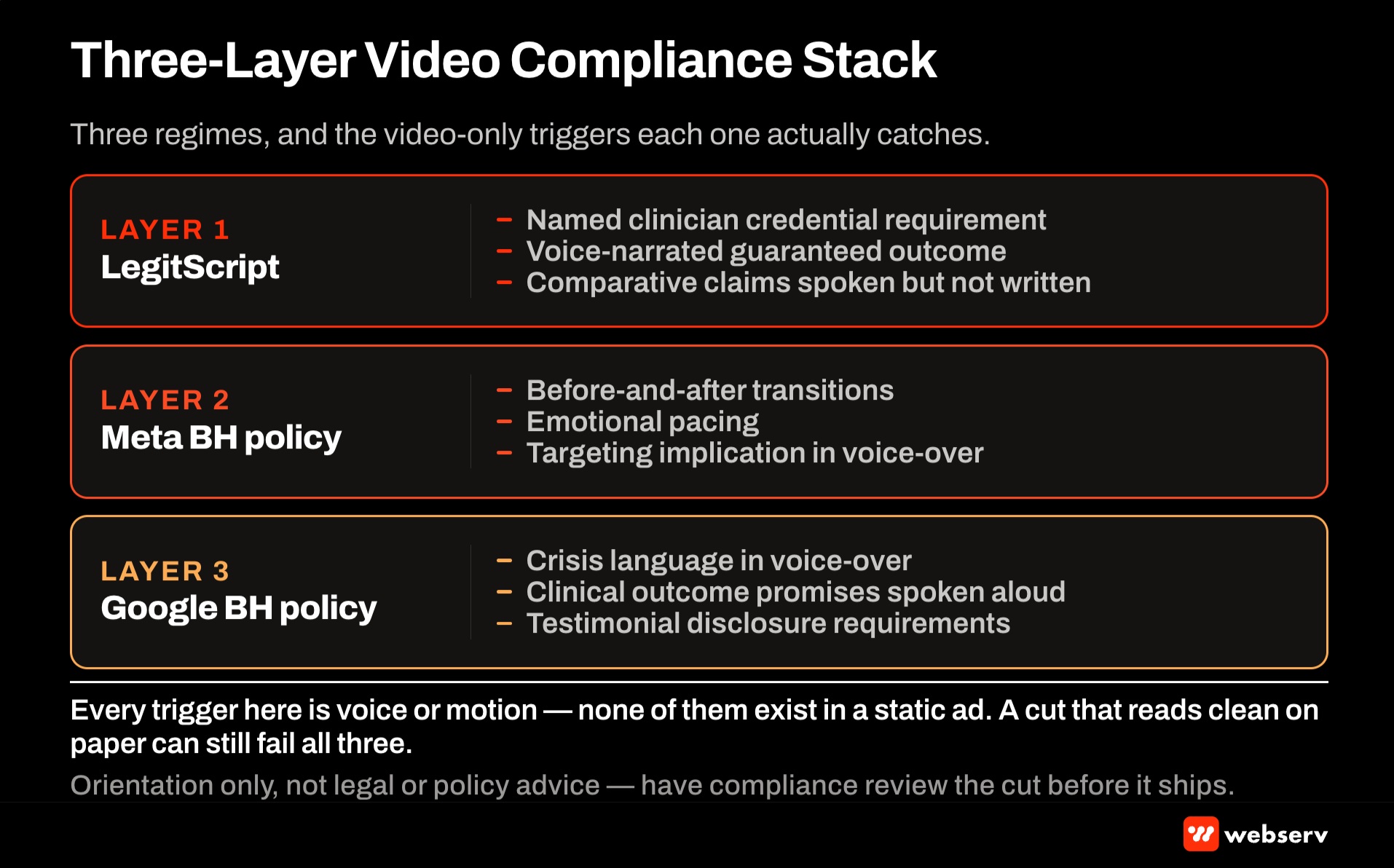
LegitScript video review specifics. LegitScript reviews video creative more aggressively than static because voice narration carries specific claims that written on-screen text does not.
Named clinician quotes in voice narration require verifiable credentials for the specific clinician. Guaranteed outcome language in voice narration fails even when the on-screen text does not carry the same claim. Comparative claims spoken but not written also fail LegitScript review.
Meta advertising policy for video BH content. Meta restricts specific video patterns beyond the general BH restrictions.
Before-and-after transitions in video (even without explicit before-and-after imagery in static frames) trigger automatic rejection. Emotional intensity manipulation through music or pacing can trigger review. Targeting-implication language in voice narration (“Are you struggling?”) triggers rejection.
Google advertising policy for video BH content. Google restricts specific video patterns for BH.
Crisis-language framing in voice narration (“If you’re in crisis”) triggers rejection. Clinical-outcome promises in voice narration fail even when the on-screen text is compliant. Testimonial video content requires specific disclosures that Google’s video policy defines.
Video production compliance workflow. Pre-production compliance script review catches most video compliance issues before production cost is incurred.
In-production compliance monitoring catches issues that emerge during shooting (unscripted commentary from clinicians or family members). Post-production compliance final check verifies the completed video against all three compliance layers before submission.
The five video creative patterns that work in BH
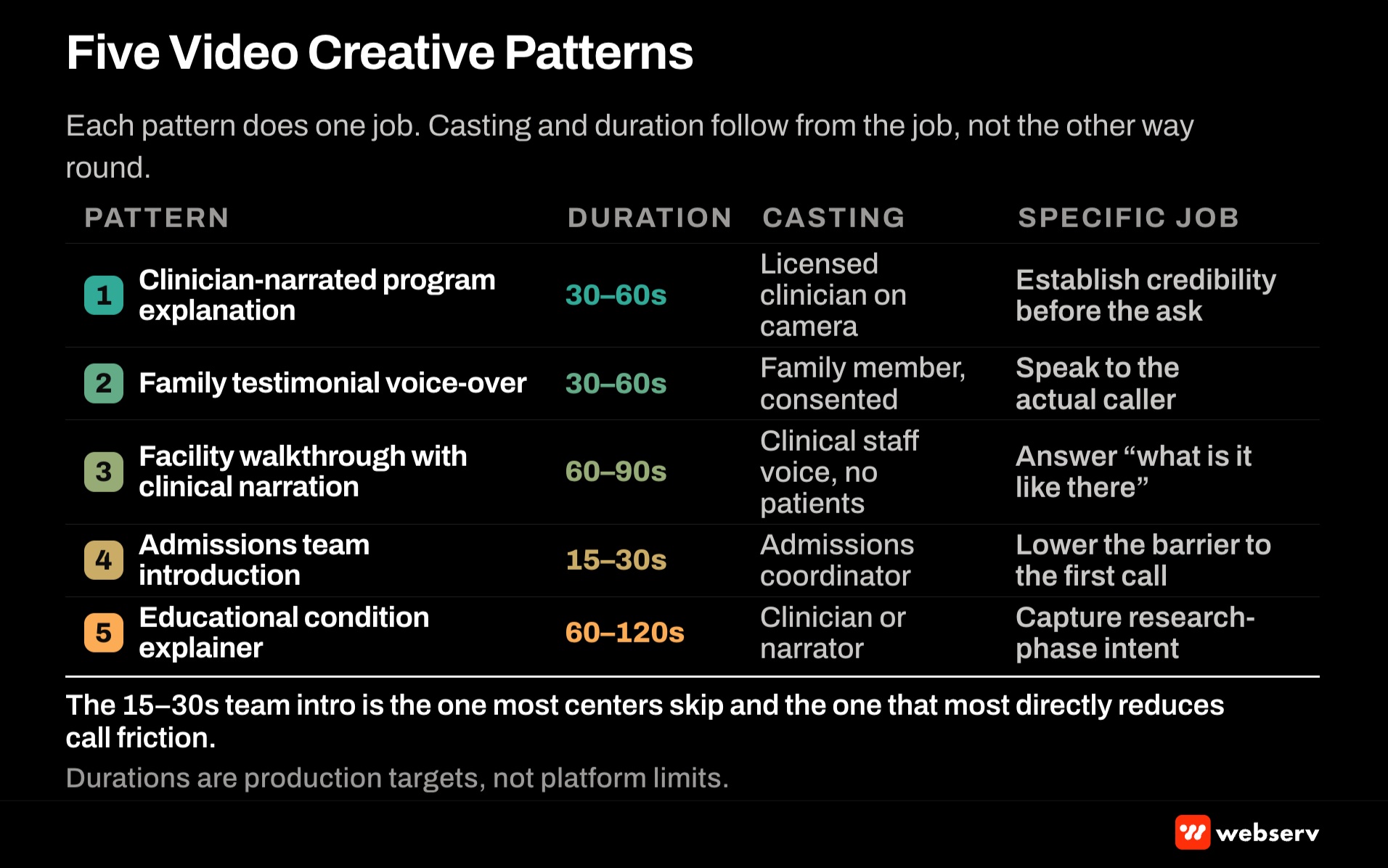
Five video creative patterns produce most of the paid conversion lift we audit in behavioral health video programs.
Pattern 1: Clinician-narrated program explanation
30 to 60 seconds of clinician on camera explaining the specific program at the facility. Named clinician with credentials, specific program detail (residential, PHP, IOP, detox), specific clinical approach or modality.
The specific job: producing the E-E-A-T credibility signal that resolves BH advertising skepticism through the specific clinical authority of the named clinician. Works best for organic-adjacent traffic and residential-inpatient offers.
Pattern 2: Family testimonial voiceover
30 to 60 seconds with family voice narration and B-roll of the facility or generalized recovery imagery.
Named family member (typically parent or spouse), specific offer language matching the ad copy, specific facility reference. The specific job: producing emotional resonance for family decision-maker audiences.
Pattern 3: Facility walkthrough with clinical narration
60 to 90 seconds walking through the specific facility with clinical narration explaining what each space is used for.
Program spaces, clinical spaces, common areas, admissions team spaces. The specific job: producing facility credibility through the specific facility characteristics rather than generic imagery.
Pattern 4: Admissions team introduction
15 to 30 seconds of the admissions team introducing themselves with names and roles.
Voice includes “call us at our admissions line” or “reach us at our admissions team” as verbal CTA reinforcing the phone-first conversion path. The specific job: reducing the friction of the phone call by showing the specific team the caller will reach.
Pattern 5: Educational content explaining specific conditions or treatments
60 to 120 seconds explaining a specific condition (dual diagnosis, opioid use disorder, adolescent depression) or specific treatment approach (medication-assisted treatment, trauma-focused therapy).
The specific job: producing informational value that positions the facility as the authoritative source rather than a generic ad. Works best for research-phase families early in the decision cycle.
The BH video ad program at a glance
5
Video patterns: clinician, family, walkthrough, admissions team, educational
$2-8K
Per-unit cost with disciplined production workflow
60-120
Days of effective life per video unit (vs 30-90 for static)
20-40%
Higher CTR video produces over static in Meta reels and stories
Production workflow for compliant video at reasonable cost
The specific production workflow that produces compliant video without the cost escalation that catches most facilities.
Pre-production: compliance script review. Every video script goes through compliance review before production. LegitScript standards check, Meta BH policy check, Google BH policy check.
The specific check: 4 to 8 hours of compliance script review per video. Catches roughly 80 percent of compliance issues before production cost is incurred.
Pre-production: talent brief and compliance training. Named clinicians and family members briefed on compliance constraints before appearing on camera. Specific language patterns that fail compliance identified as talking points to avoid.
The specific brief: 30 to 60 minutes with each on-camera participant covering what to say, what not to say, and why. Reduces on-camera compliance failures during production.
In-production: compliance monitor on set. For higher-stakes productions, a compliance monitor on set catches unscripted commentary that would fail compliance review. Notes specific takes that require re-shoots for compliance reasons.
The specific pattern: compliance monitor is typically a marketing team member familiar with the three-layer compliance stack rather than a dedicated compliance officer. Adds 4 to 8 hours to the production day but reduces post-production compliance re-shoot risk.
Post-production: compliance final check. Completed video reviewed against all three compliance layers before submission to ad platforms. Specific checks: voice narration transcription review, on-screen text review, imagery review, music and pacing review.
The specific check: 2 to 4 hours per completed video. Final compliance sign-off before platform submission.
Quarterly LegitScript certification refresh. LegitScript certification renewed quarterly to maintain compliance certification. Video ad creative added to the LegitScript submission for review.
Placement-specific format requirements
Video ad creative format specifications vary by placement.
Meta reels vertical. 1080 by 1920 pixels vertical, 15 to 30 seconds typical length, hook in the first 3 seconds. Reels placement prioritizes vertical video with fast pacing.
Meta feed square or vertical. 1080 by 1080 square or 1080 by 1350 vertical. 30 to 60 second content. Meta feed viewers typically watch longer than reels viewers.
Meta stories vertical. 1080 by 1920 vertical, 15 seconds per story frame, safe zone for platform UI overlays. Stories placement works for shorter video content or video content that adapts across multiple story frames.
YouTube 16:9 horizontal. 1920 by 1080 horizontal for standard YouTube pre-roll, mid-roll, and in-stream placements. 15 to 30 seconds for skippable pre-roll, 6 seconds for bumper ads, 15 to 60 seconds for non-skippable pre-roll.
YouTube 9:16 vertical for shorts. 1080 by 1920 vertical for YouTube Shorts placement. 15 to 60 seconds typical length. YouTube Shorts increasingly competes with Meta reels for the vertical video audience.
Google Performance Max asset library. Video assets uploaded to Performance Max in multiple formats and durations. Google auto-assembles across placements based on the specific placement context (YouTube, Discover, Gmail, Search, Display).
DO
- Run compliance script review before production , catches roughly 80 percent of LegitScript, Meta, and Google issues before any production cost is incurred.
- Brief every on-camera clinician and family member for 30-60 minutes on what to say and not say to avoid unscripted compliance failures during the shoot.
- Produce 1-2 units per pattern (clinician, family, walkthrough, admissions team, educational) and rotate quarterly as new units enter the program.
- Test hook first (first 3 seconds), then main message, then CTA , video variables interact enough that sequential isolation produces meaningfully cleaner signal than parallel testing.
- Use custom production for anything featuring the facility, clinical team, or family testimonial , stock and AI video do not carry the BH trust signal.
DON’T
- Ship video with before-and-after transitions, crisis-language voiceover, or targeting-implication questions , all three trigger automatic Meta or Google rejection.
- Skip pre-production compliance script review , post-production rejections trigger costly re-shoots and multi-week delays.
- Rely on stock or AI-generated video for primary content , trust signal difference outweighs the production cost savings.
- Launch campaigns without factoring the 5-10 business day compliance review window into the schedule , expect 4-8 weeks total for first video with a facility.
- Test hook, message, and CTA variables in parallel at typical BH volumes , the interactions between variables muddy the signal beyond what the sample size can resolve.
Sequential testing framework for video
Video ad creative testing produces measurable conversion lift when the testing framework isolates specific variables.
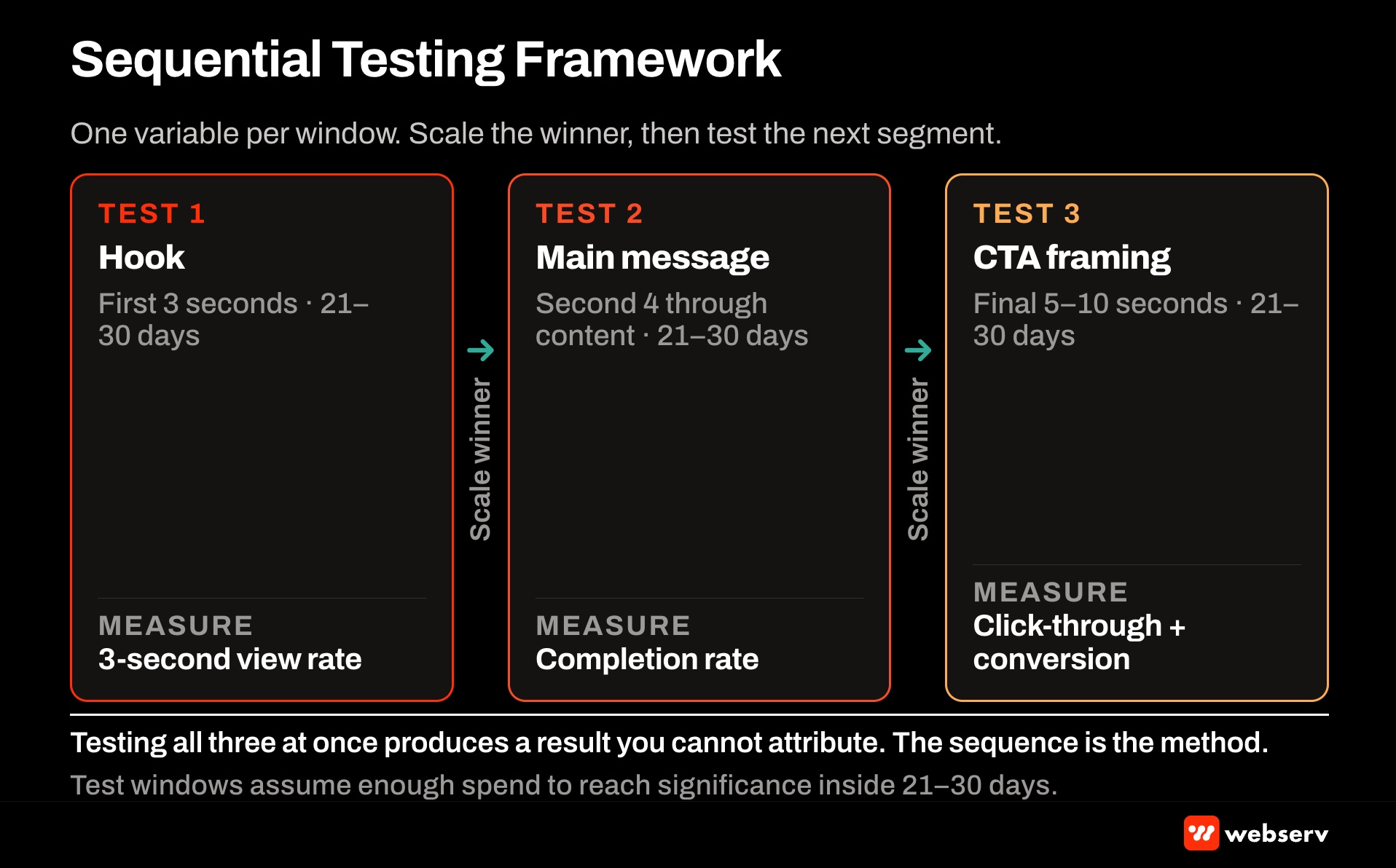
Test 1: Hook (first 3 seconds). The hook is the highest-impact single variable in video ad performance. Test frame: run two hook variations against the same downstream content for 21 to 30 days.
Measure video view rate at 3 seconds, video view rate at 15 seconds, and downstream conversion rate. Scale the winner.
Test 2: Main message (seconds 4 through main content). After the hook stabilizes, test main message variations. Test frame: run two main message variations against the winning hook for 21 to 30 days.
Measure video completion rate and downstream conversion rate. Scale the winner.
Test 3: CTA framing (final 5 to 10 seconds). After main message stabilizes, test CTA variations. Test frame: 21 to 30 days.
Measure click-through rate and downstream conversion rate. Scale the winner.
Video variables interact more than static variables because voice pacing, on-screen text timing, and visual transitions all interconnect. Sequential testing produces cleaner signal than parallel testing at typical BH campaign volumes.
Frequently Asked Questions
How much should we spend on video ad creative production?
Between $2,000 and $8,000 per finished video unit for most treatment center operators using disciplined production workflow. The specific breakdown: 4 to 8 hours on script development and compliance review, 8 to 16 hours on production day (crew, talent, facility access), 4 to 8 hours on post-production editing and compliance final check, and 2 to 4 hours on placement-specific format variants.
Higher-production video (studio setup, professional voice talent, custom animation) runs $10,000 to $50,000 per unit. Higher production quality does not always produce proportionally higher conversion.
Portfolio operators produce meaningful economies of scale because the compliance framework, brand template, and production system transfer across facilities. Per-unit cost typically drops to $1,500 to $5,000 for the second and subsequent facilities.
How many video ad units should we have in rotation?
Between 4 and 12 active video units per facility for most single-facility BH operators. Video units typically have longer effective life than static units (60 to 120 days vs 30 to 90 days for static) so lower unit count works.
The specific pattern that works: 1 to 2 video units per template pattern (clinician-narrated, family testimonial, facility walkthrough, admissions team, educational) rotating through the campaign structure. New video units produced quarterly to replace fatigued units.
Portfolio operators can share brand-template video across facilities but should produce facility-specific variants for the clinician-narrated and facility walkthrough patterns because those patterns depend on facility-specific signal.
How does video creative interact with our static ad creative program?
Complementary. Static and video creative serve different placement contexts and different visitor engagement patterns. Static creative works for high-frequency low-cost testing and for placements where video is not optimal. Video creative works for placements where motion and voice produce meaningful engagement lift over static.
The specific pattern that produces the strongest paid programs: static and video in parallel with shared creative concepts adapted to each format. A single clinical authority concept produces static units, a video unit, and a stories/reels unit from the same underlying creative direction. Our static ad creative templates covers the shared five-pattern framework both formats draw on.
Storyboarding both formats together in the same session produces sharper results than treating video as an afterthought. Our storyboarding BH ad creative piece covers the framework.
What’s the ROI difference between video and static creative in BH?
Video typically produces 20 to 40 percent higher click-through rate than static in Meta reels and stories placements. Video typically produces 15 to 30 percent lower cost-per-conversion than static in the same placements once the higher production cost amortizes over the video’s longer effective life.
Meta feed and YouTube produce mixed results. Some facilities see meaningful video lift in Meta feed. Others see comparable performance between static and video in the same placement.
The specific decision framework: video for placements where motion produces engagement lift (reels, stories, YouTube). Static for placements where static works equally well (Meta feed, GDN, some Performance Max contexts).
How do we handle the compliance review timeline for video creative?
Compliance review for video takes 5 to 10 business days from finished video to platform-approved status. Pre-production compliance script review takes 1 to 3 business days. Post-production compliance final check takes 1 to 2 business days. LegitScript video submission review takes 3 to 5 business days.
Facilities that produce video without factoring compliance timeline into the launch schedule typically produce delays that push campaigns 2 to 4 weeks past intended launch dates.
The specific pattern: video production timeline includes compliance windows explicitly. Total timeline from production start to platform launch typically runs 4 to 8 weeks for the first video with each facility, dropping to 2 to 4 weeks for subsequent videos once the compliance workflow patterns stabilize.
Do we need custom video production or can we use stock or AI-generated video?
Custom video for anything featuring the facility, the clinical team, or family testimonials. Stock or AI-generated video does not carry the specific facility signal that produces BH credibility.
Stock or AI-generated B-roll can supplement custom production in specific contexts (generic recovery imagery, geographic B-roll, transitional content). But the primary video content (clinician on camera, family voice, facility walkthrough, admissions team) has to be custom production for the trust signal to work.
Facilities that produce video primarily from stock or AI-generated content typically produce meaningfully lower conversion rates than facilities producing custom facility-specific content. The trust signal difference outweighs the production cost savings.
How does video advertising interact with our overall paid media program?
As a specific creative format inside the broader paid media strategy. Video typically represents 30 to 50 percent of the paid creative rotation in mature BH programs, with static taking the remainder.
The specific integration pattern: paid campaigns rotate static and video units against the same audiences with the same offers. Placement-appropriate format variants (video for reels/stories, static for GDN/feed) run in parallel with shared creative concepts.
Facilities that run video-only or static-only paid programs typically produce narrower placement coverage than facilities running both. The two formats together cover more placement contexts and produce more balanced paid performance. Our Meta Ads playbook walks the paid social program video slots into.
Keaton Nalle is the Director of Paid Admissions at Webserv, a digital marketing agency for treatment centers.