The treatment center homepage is the single most-visited page in most facility marketing programs. Brand searches, referral partner clicks, direct navigation, and paid brand-term traffic all funnel through the homepage before reaching any other page. It is the load-bearing surface of our web design capability.
The homepage’s job is different from the service page’s job and different from the landing page’s job. The web design capability has to serve visitors arriving with materially different intent states through a single page that carries every visitor forward.
The specific problem I see across treatment center homepages: the homepage tries to be everything to every visitor. Acute-need families, research-phase families, referral partners, employers, and clinical professionals all land on the same page with the same messaging.
The result is a homepage that serves nobody well because the messaging cannot resolve the specific intent state of any specific visitor.
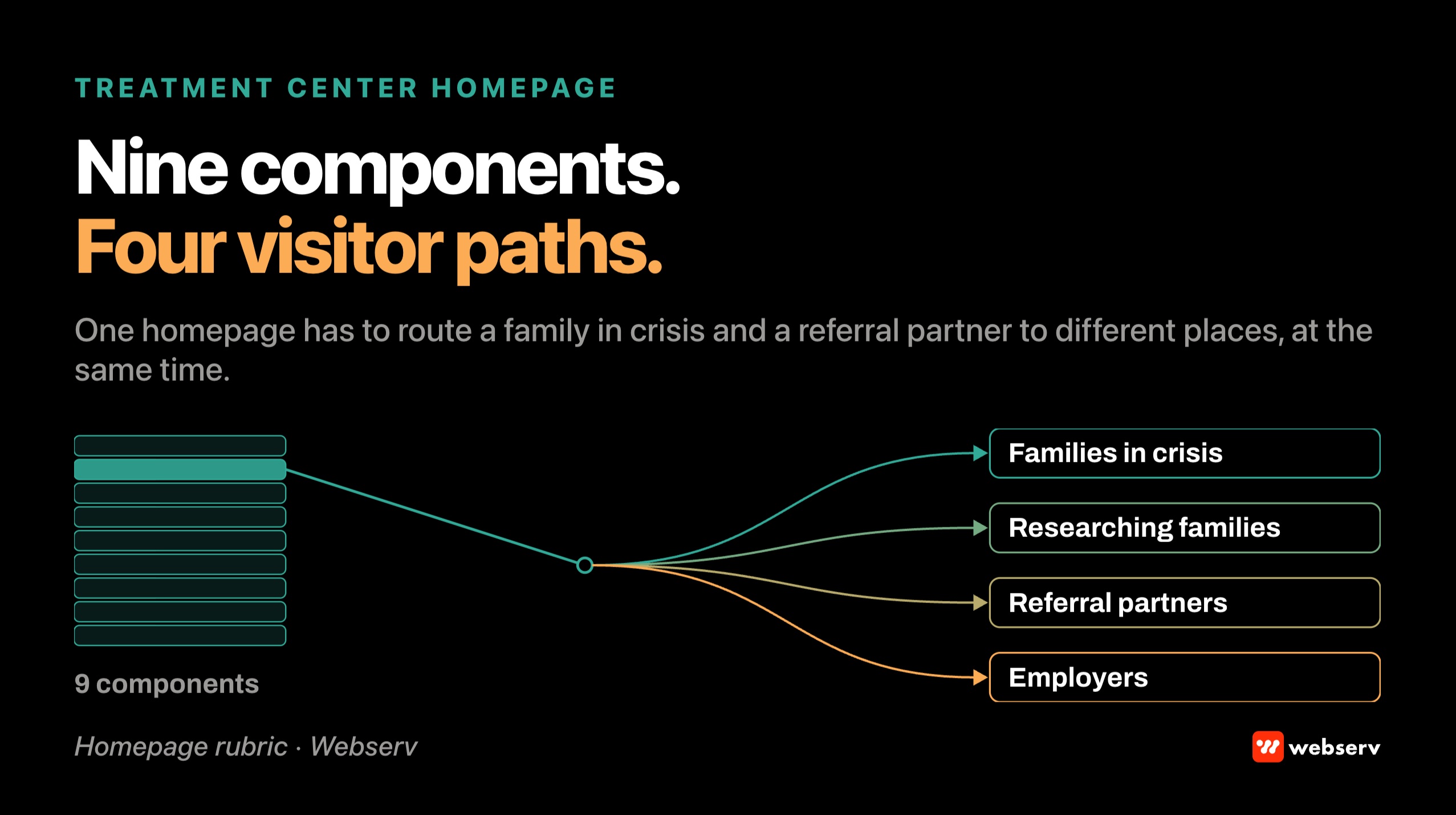
The pattern that produces homepages that convert: nine specific components designed with the intent states of multiple visitor types in mind, with visitor-specific conversion paths.
Each visitor type self-selects into the path matching their intent. Not one homepage for everyone. One homepage designed to route the specific visitor types to the specific next actions matching their intent.
This is a comprehensive guide to treatment center homepage design. It walks the nine components that produce a homepage carrying multiple visitor types, the intent-state framework that determines what each component does, and the visitor-type routing pattern that lets each visitor self-select into the right conversion path. It expands our earlier homepage rubric TL and For the broader picture, see our ultimate guide to behavioral health marketing.
It also covers the trust signal architecture that resolves BH advertising skepticism inside the first screen, the mobile-first design constraints that apply differently for BH than for general websites, and the measurement framework that resolves homepage performance across visitor types. The homepage sits alongside the paid direct-response surface anchored by our landing pages guide and pairs with the deeper page-craft principles our treatment center landing page design guide establishes.
Key Takeaways
- Treatment center homepages serve materially different visitor types with different intent states through a single page. Acute-need families, research-phase families, referral partners, employers, and clinical professionals all arrive with different questions and different conversion paths. The homepage has to route each visitor type to the right next action.
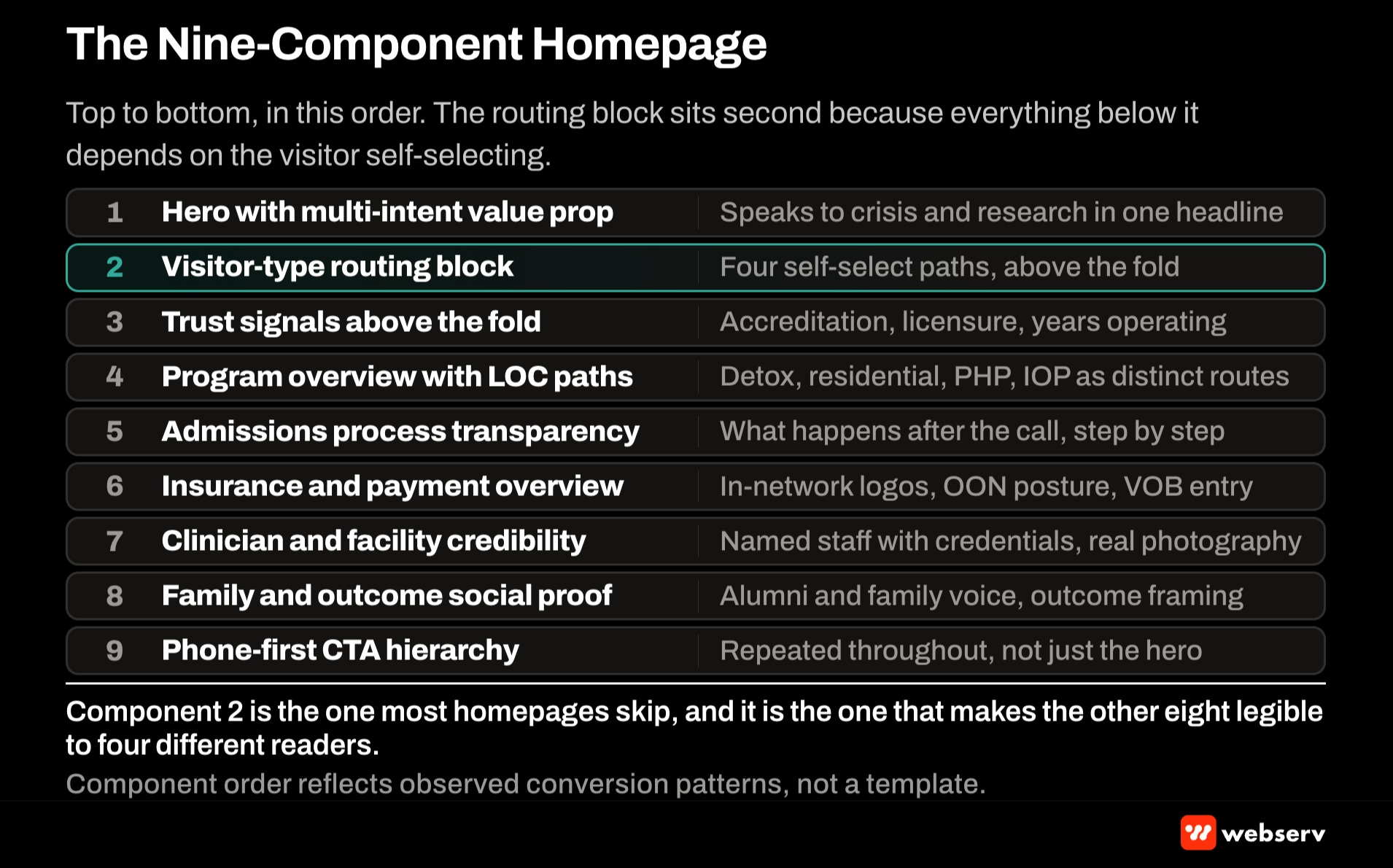
- The nine-component homepage framework: hero with multi-intent value proposition, visitor-type routing block, trust signals above the fold, program overview with LOC-specific paths, admissions process transparency, insurance and payment overview, clinician and facility credibility, family and outcome social proof, and phone-first CTA hierarchy throughout the page.
- Visitor-type routing is the specific mechanism that lets each visitor self-select into the conversion path matching their intent. The routing block sits directly below the hero and offers “For families in crisis,” “For researching families,” “For referral partners,” and “For employers or professionals” as visitor-type paths with distinct downstream content.
- Trust signal architecture on the homepage: accreditation badges above the fold, named clinician credentials in the hero or immediately below, facility photography from actual facility rather than stock imagery, and specific outcome data with clinical documentation. The trust signal stack resolves the specific BH advertising skepticism families arrive with.
- Mobile-first design constraints apply differently for BH than for general websites because BH visitors skew mobile at higher rates (65 to 75 percent mobile traffic vs 50 to 60 percent for general categories). The homepage must work as well on mobile as on desktop, with specific mobile patterns for phone-first CTA, form design, and navigation.
DEFINITION
The treatment center homepage rubric. A nine-component web-design framework built specifically for the multi-intent visitor traffic treatment center homepages carry. Hero with multi-intent value proposition, visitor-type routing block, trust signals above the fold, program overview with LOC-specific paths, admissions process transparency, insurance and payment overview, clinician and facility credibility, family and outcome social proof, and phone-first CTA hierarchy throughout the page.
Distinct from service page frameworks (which target single-intent high-commercial organic traffic), distinct from landing page frameworks (which target single-message paid direct-response traffic), and distinct from generic-vertical homepage rubrics (which do not account for the acute-need vs research-phase vs referral-partner intent split treatment centers actually see).
OPERATOR INSIGHT
The specific problem I see across treatment center homepages: the homepage tries to be everything to every visitor.
Acute-need families, research-phase families, referral partners, employers, and clinical professionals all land on the same page with the same messaging. The result is a homepage that serves nobody well because the messaging cannot resolve the specific intent state of any specific visitor. Not one homepage for everyone. One homepage designed to route the specific visitor types to the specific next actions matching their intent.
The nine-component homepage framework
The framework that produces treatment center homepages carrying multiple visitor types: nine specific components each doing a specific job in the overall page architecture.
Component 1: Hero with multi-intent value proposition
Above-the-fold hero that speaks to the broadest possible intent state without collapsing to generic language. The hero has to reach families in crisis, researching families, and referral partners simultaneously.
The pattern that works: specific facility positioning (level of care, condition specialization, geographic scope) plus specific credibility signal (accreditation, years in operation, named clinical leadership) plus phone-first CTA. Generic recovery language fails because it does not carry the specific facility signal.
Component 2: Visitor-type routing block
Directly below the hero, offers 3 to 5 visitor-type paths that let each visitor self-select into content matching their intent. “For families in crisis” routes to admissions process and immediate contact. “For researching families” routes to program overview and clinical detail. “For referral partners” routes to admissions coordination content. “For employers or professionals” routes to EAP or professional referral content.
Component 3: Trust signals above the fold
Accreditation badges (JCAHO, CARF, LegitScript, state license), facility years in operation, and named clinical leadership visible above the fold rather than buried in the footer.
The specific job of above-the-fold trust signals: resolving BH advertising skepticism in the first 4 to 8 seconds of attention before the visitor decides whether to engage.
Component 4: Program overview with LOC-specific paths
Program overview section that lists the levels of care the facility offers with distinct paths to LOC-specific detail pages. Residential, PHP, IOP, detox, and continuing care each get their own path with brief overview and link to detail.
The visitor-type routing (Component 2) directs specific visitors to specific LOC paths. The program overview provides the LOC map for visitors who want to explore the full offering.
Component 5: Admissions process transparency
Section that walks the specific admissions process (inquiry, insurance verification, clinical assessment, admission). Transparency about what happens between the first phone call and actual admission.
The specific job: resolving the uncertainty families carry about how admissions work. Transparency reduces friction for families ready to convert but unclear on the next steps.
Component 6: Insurance and payment overview
Section listing accepted insurance carriers, in-network status, and OON payment options. Not full VOB detail but sufficient overview to establish that the facility can work with the visitor’s coverage.
The specific job: resolving the eligibility question that most families ask before considering treatment seriously. Facilities that hide insurance information typically produce meaningful drop-off before conversion.
Component 7: Clinician and facility credibility
Section featuring named clinical leadership with credentials, facility photography from the actual facility, and specific clinical positioning that differentiates the facility from generic BH providers.
The specific job: establishing the facility as a specific entity worth choosing rather than a generic option. Named clinician credibility is the load-bearing E-E-A-T signal for both organic ranking and family decision-making.
Component 8: Family and outcome social proof
Section featuring family testimonials, outcome data with clinical documentation, and specific case examples showing what treatment at this facility looks like.
The specific job: converting research-phase families through the emotional resonance and outcome credibility that family voices carry.
Component 9: Phone-first CTA hierarchy throughout the page
Phone number in the sticky header, phone number in the hero CTA, phone number in mid-page CTAs, and phone number in the footer. Form-second CTA in appropriate sections for visitors who prefer form submission over phone.
The specific job: making phone conversion the default path with form as backup. Mobile visitors especially need phone-first CTA because tap-to-call reduces conversion friction meaningfully.
The BH homepage program at a glance
9
Components in the homepage rubric, each with a specific visitor-type job
4
Visitor-type paths in the routing block: crisis, research, referral, professional
65-75%
Share of BH homepage traffic arriving on mobile devices
30-50%
Homepage visitors self-selecting into a routing path in the first 30 seconds
Visitor-type routing framework
The visitor-type routing block is the specific mechanism that resolves multi-intent visitor traffic through a single homepage.
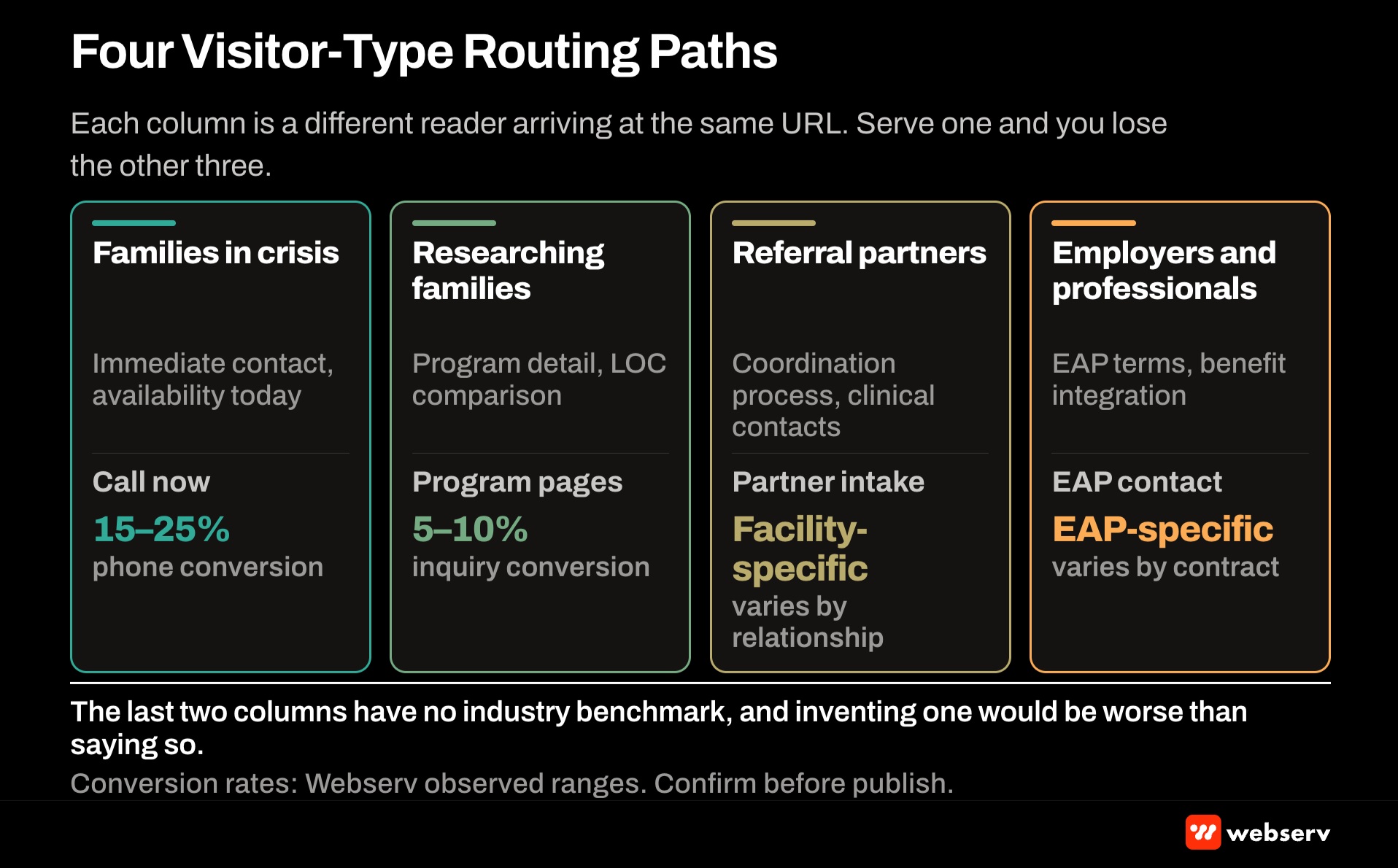
“For families in crisis” path. Routes to immediate contact and admissions process transparency. Content emphasizes 24-hour availability, acute admission workflow, insurance verification speed, and specific timeline from inquiry to admission.
“For researching families” path. Routes to program overview, clinical detail, and outcome documentation. Content emphasizes program specifics, clinical team credentials, facility characteristics, and specific outcome measurements.
“For referral partners” path. Routes to admissions coordination content, provider credentials, and referral partner-specific resources. Content emphasizes clinical fit criteria, admissions coordination workflow, and provider relationship materials.
“For employers or professionals” path. Routes to EAP-specific content, professional referral workflow, and specific programs for professional populations. Content emphasizes confidentiality, executive-appropriate programming, and professional return-to-work coordination.
The specific measurement pattern: track path selection at the visitor-type routing block through click event tracking. Facilities with strong routing typically see 30 to 50 percent of visitors self-select into a specific path within 30 seconds of arrival.
Facilities without visitor-type routing typically see homogeneous bounce and conversion patterns across the visitor population.
Trust signal architecture for BH homepages
BH visitors arrive with meaningfully higher skepticism than general commercial category visitors because of documented history of predatory operators in the BH space. The trust signal architecture on the homepage has to resolve that skepticism in the specific first-screen attention window.
Above-the-fold trust signals. Accreditation badges (JCAHO, CARF, LegitScript, state license number visible), years in operation (“Founded 2008” or similar), named clinical leadership with credentials (“Dr. Bonnie Mitchell, LMFT, Clinical Director”).
Below-the-fold trust reinforcement. Named clinician credibility section with full clinical team, facility photography from actual facility (not stock), specific outcome data with clinical documentation, family testimonials with named family members and verifiable context.
Footer trust signal completion. Accreditation badges repeated, license numbers listed, insurance carrier logos for accepted payers, professional association memberships. Footer trust signals catch visitors who scroll to the bottom looking for verification.
The specific gotcha: stock photography and generic clinical imagery produce the opposite of trust. Families who recognize stock photography typically bounce because the stock imagery signals inauthenticity. The specific fix: production photography at the actual facility with the actual clinical team.
Mobile-first design constraints for BH
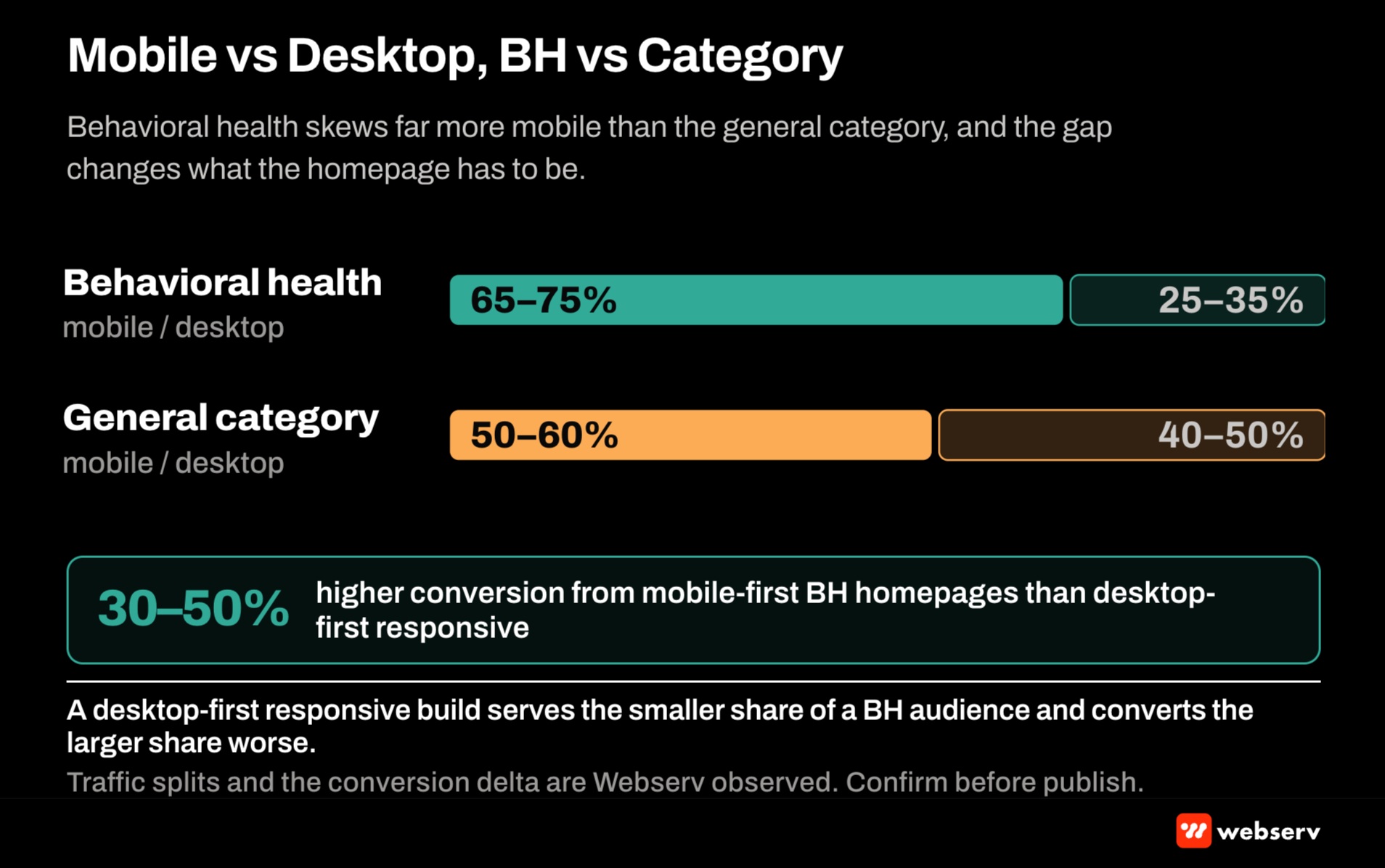
BH visitors skew mobile at meaningfully higher rates than general categories: 65 to 75 percent mobile traffic versus 50 to 60 percent for general categories. The specific reasons why BH skews mobile.
Emotional intensity produces phone-in-hand behavior. Families in acute-need situations reach for their phone rather than sit down at a laptop. The specific behavior pattern: phone in hand, searching in the moment, calling from the same device that produced the search.
Younger family members search for older family members. Adult children researching treatment for aging parents typically research from mobile during the day. Younger spouses researching treatment for older spouses typically research from mobile.
Professional discretion favors mobile. Executives, healthcare workers, and other professionals researching treatment for themselves typically do so from mobile for discretion. Mobile searches happen in private moments rather than at a work computer.
The specific mobile design patterns that work: phone-first CTA with tap-to-call (tel link) at 44 pixel minimum touch target, sticky header phone number visible at all times, form design with mobile-friendly fields (single-column, appropriate keyboard types), and navigation that collapses cleanly on mobile without hiding critical content.
Facilities that design homepages desktop-first and add mobile as a responsive afterthought typically produce mobile conversion rates 30 to 50 percent below the desktop conversion rate.
DO
- Put the visitor-type routing block directly below the hero , the earlier the visitor can self-select, the higher the path-specific conversion rate.
- Show accreditation badges (JCAHO, CARF, LegitScript, state license), named clinical leadership, and years in operation above the fold.
- Use production photography at the actual facility with the actual clinical team , stock photography destroys the trust signal.
- Design mobile-first: sticky phone number, tap-to-call at 44 pixel touch target, single-column forms, and navigation that never hides the phone CTA.
- Measure at the visitor-type path level, not just page-wide , path-specific conversion rates reveal which routing paths are working and which need attention.
DON’T
- Write generic recovery language in the hero , carries no specific facility signal and fails against every visitor type.
- Bury accreditation and clinician credentials in the footer , first-screen trust signal is what resolves BH skepticism before the visitor decides to engage.
- Hide insurance information behind a form , most families evaluate coverage before considering treatment seriously and drop off when they can’t see it.
- Design desktop-first and treat mobile as a responsive afterthought , mobile conversion rates run 30 to 50 percent below desktop when mobile is not first.
- Redesign the homepage without preserving URL structure, internal linking, and content depth , SEO recovery takes 90 to 180 days.
Measurement framework for multi-intent homepages
The measurement framework that resolves homepage performance across visitor types: visitor-type routing tracking, path-specific conversion tracking, and multi-intent attribution.
Visitor-type routing tracking. Click events on the visitor-type routing block, segmented by which path the visitor selected. Path selection rate as a percentage of total homepage visitors.
Path-specific conversion tracking. Conversion rate segmented by visitor-type path selection. Families-in-crisis path typically converts to phone calls at 15 to 25 percent. Researching-families path converts to inquiry submits at 5 to 10 percent. Referral partner path converts to referral coordination at facility-specific rates.
Multi-intent attribution. Homepage conversion attribution that credits both the entry source (paid campaign, organic, direct) and the visitor-type path selected. Two-dimensional attribution that resolves “which source produced which visitor type” rather than treating all homepage traffic as homogeneous.
Frequently Asked Questions
Should our homepage be optimized for organic ranking or paid conversion?
Both. The homepage carries brand-search organic traffic and brand-term paid traffic simultaneously. Optimizing for one at the expense of the other produces the specific problem the visitor-type routing framework resolves.
Organic optimization requires the E-E-A-T signal chain, named clinician attribution, and topical authority for brand-adjacent queries. Paid conversion requires visitor-type routing, phone-first CTA hierarchy, and trust signal architecture.
The specific pattern that produces both: nine-component homepage framework serves organic and paid traffic simultaneously because the components map to both intent states. Organic visitors self-select through visitor-type routing. Paid visitors convert through phone-first CTA hierarchy. Both use the same trust signal architecture and clinician credibility signals.
How much should we spend on homepage development?
Between $15,000 and $60,000 for the full nine-component homepage build, depending on facility scope and existing brand asset library.
The specific breakdown: 20 to 40 hours on strategy and visitor-type framework, 40 to 80 hours on design and layout, 20 to 40 hours on custom photography and video content production, 20 to 40 hours on development and mobile optimization, and 10 to 20 hours on testing setup and initial measurement configuration.
Portfolio operators produce meaningful economies of scale because the framework and design system transfer across facilities. Per-facility homepage cost typically drops to $8,000 to $25,000 for the second and subsequent facilities.
How often should we redesign our homepage?
Every 24 to 36 months for meaningful redesign that reflects updated brand positioning and evolved visitor intent patterns. Every 6 to 12 months for tactical adjustments that respond to specific measurement signals.
Facilities that maintain the same homepage design for 4+ years typically produce declining conversion rates as the design signals age (visual aesthetic markers of “designed in 2019” produce specific trust erosion for visitors comparing options in 2026).
The specific redesign trigger: conversion rate declining month-over-month for three or more consecutive quarters despite consistent traffic volume. Also: brand positioning changes, service line changes, or measurement setup changes that require homepage support.
How do we handle the specific SEO impact of a homepage redesign?
Maintain URL structure, preserve internal linking patterns, and preserve or enhance content depth. Homepage redesigns that change URLs, restructure internal linking, or reduce content depth typically produce meaningful ranking drops that take 90 to 180 days to recover.
Homepage redesigns that maintain URL structure, preserve or improve internal linking, and expand rather than reduce content depth typically produce ranking neutral or ranking positive outcomes within 30 to 60 days.
The specific redesign checklist for SEO safety: URL structure unchanged, all previous internal links preserved or upgraded, schema markup maintained or enhanced, content depth maintained or expanded, and mobile experience improved.
Do we need separate homepages for different facility markets in a portfolio?
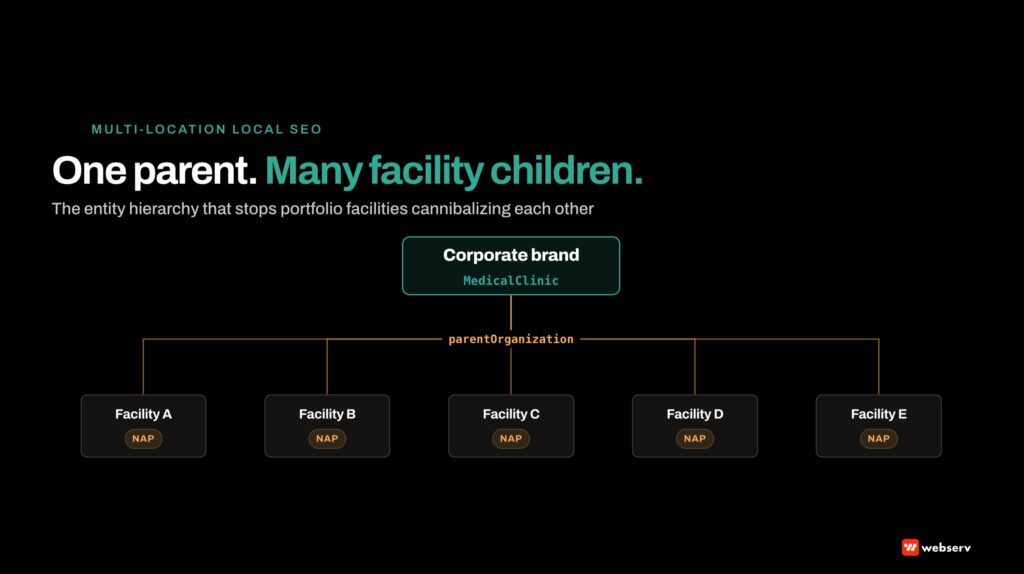
No. Single portfolio homepage with location routing to facility-specific pages. Portfolios that create separate homepages per market typically fragment the brand entity signal in the same way separate facility websites do.
The portfolio homepage handles the corporate brand entity signal, visitor-type routing to facility selection, and portfolio-wide trust signals. Facility-specific pages under /locations/ handle the facility entity signal, facility-specific programs, and facility-specific admissions workflow.
Our Local SEO guide covers the specific multi-location entity hierarchy that supports this architecture.
How does the homepage rubric interact with our landing page and service page frameworks?
Complementary. The homepage serves brand-search and direct-navigation traffic with multi-intent visitor routing. Service pages serve high-intent organic traffic with E-E-A-T signal and topical authority. Landing pages serve paid direct-response traffic with single-message single-conversion focus.
The specific traffic routing: brand and direct traffic to homepage, high-intent organic to service pages, paid direct-response to landing pages. Each traffic type gets the page framework optimized for its specific intent state.
Facilities that use the same page framework across all three traffic types typically produce underperformance somewhere in the funnel. The three separate frameworks together produce the strongest overall conversion economics. Our landing pages guide covers the paid direct-response side.
How do we know the homepage is working?
Three specific measurement signals. First: visitor-type routing selection rate. Strong homepages typically see 30 to 50 percent of visitors self-select into a specific path within the first 30 seconds.
Second: path-specific conversion rate. Families-in-crisis path converts phone calls at 15 to 25 percent. Researching-families path converts inquiries at 5 to 10 percent. Path-specific rates measurably better than homogeneous homepage rates.
Third: multi-intent attribution that shows the homepage carrying the specific visitor types it should carry. Brand-search visitors resolve to appropriate paths, paid brand-term visitors convert at paid-appropriate rates, and referral partner traffic finds the referral-specific content.
Trevor Gage is the Director of Marketing at Webserv, a digital marketing agency for treatment centers.