Referral marketing is the highest-yielding acquisition channel most behavioral health treatment centers run, and also the one most operators treat as “not really marketing.” Coordinators build relationships with therapists in the community. The Director of Business Development takes hospital discharge planners to lunch.
Sober living homes send patients who need residential step-up. An alumni network trickles referrals in from the year-plus-sober population. None of this shows up in the paid-media dashboard, but for many facilities it produces 40 to 70 percent of monthly admits.
The problem is that treating referral development as a relationship function outside the marketing discipline leaves real money on the table. The best referral pipelines are built with the same measurement discipline, the same reporting cadence, and the same channel strategy that the paid-media team applies to Google Ads and Meta.
And in behavioral health specifically, referral marketing operates inside a federal compliance layer, the Eliminating Kickbacks in Recovery Act (EKRA), that most operators underestimate until they get flagged.
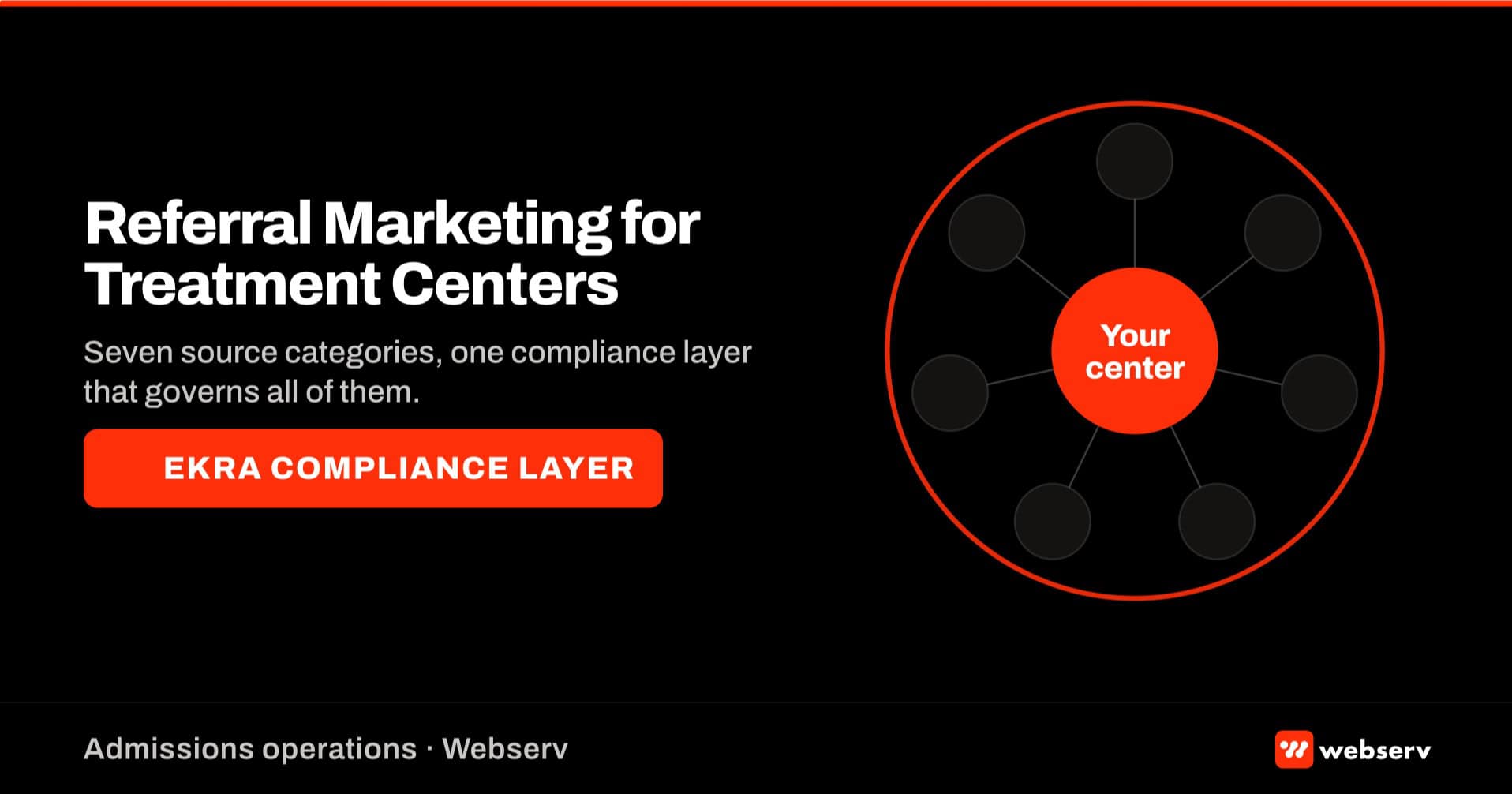
This piece walks the behavioral health referral marketing discipline in 2026. It covers the seven referral source categories every treatment center should be developing, the EKRA constraint layer that shapes how these relationships can be structured, and the specific tactics that build referral pipelines without violating federal law.
It also covers the measurement discipline that turns referral development into a managed marketing channel, and the common failure modes that surface when facilities try to scale referral marketing without the compliance and measurement layers. This sits inside the broader content and SEO operating model our client book runs on.
Key Takeaways
- Referral marketing is the highest-yielding acquisition channel at most behavioral health treatment centers, often producing 40 to 70 percent of monthly admits. The programs that outperform peers treat referral development as a managed marketing channel, not an ad-hoc relationship function.
- Seven referral source categories matter: clinical referrals, hospital and ED discharge planners, interventionists, sober living homes, Employee Assistance Programs, alumni networks, and step-down/step-up peer treatment centers. Each has its own development motion and its own compliance considerations.
- EKRA is the constraint layer that shapes behavioral health referral marketing more than any other regulation. Any compensation arrangement with a referral source, direct or indirect, has to survive EKRA scrutiny. The safest patterns are volume-independent compensation for genuine professional services at fair market value.
- Measurement discipline means tracking referral source attribution, rate-adjusted admit value per source, and the operational cost of maintaining each relationship. Facilities without this measurement typically overinvest in the sources that feel valuable and underinvest in the sources that actually produce profitable admits.
- The common failure modes are all preventable: paying for referrals in structures that violate EKRA, treating all referrals as equal in the CRM, running referral development as a solo function outside the marketing team, and skipping the measurement layer that surfaces which sources actually drive P&L improvement.
DEFINITION
Referral marketing (behavioral health). The discipline of building and maintaining relationships with third parties who direct patients to a treatment center. Sits alongside paid acquisition, organic search, content marketing, and direct inquiries as one of the primary marketing channels, and typically produces the highest-margin admits.
Distinct from business development (which usually refers to the enterprise-sales subset: employer contracts, EAP networks, insurance network relationships). Distinct from a relationship function outside marketing — the top-performing programs treat referral development as a managed marketing channel with measurement discipline, reporting cadence, and channel strategy discipline applied.
What Referral Marketing Means in Behavioral Health
Referral marketing is the discipline of building and maintaining relationships with third parties who direct patients to your treatment center. It sits alongside paid acquisition, organic search, content marketing, and direct admissions inquiries as one of the primary marketing channels a behavioral health treatment center runs.
The category is distinct from paid acquisition. Referral relationships produce admits at materially lower cost per admit than paid search or paid social, but they require ongoing relationship investment, longer time-to-productive-relationship, and a different compliance posture.
The category is also distinct from what most operators call “business development.” Business development often refers specifically to the enterprise sales motion (contracts with employers, EAPs, insurance networks, corporate wellness programs), while referral marketing covers the full spectrum of individual and institutional referral sources.
Our behavioral health marketing complete guide covers where referral marketing fits in the broader marketing operating model. This piece goes deeper on the referral discipline itself.
The right way to think about referral marketing is as the acquisition channel that generates the highest-margin admits, requires the most compliance discipline, and demands the most patient investment of any marketing motion the facility runs.
The Seven Referral Source Categories
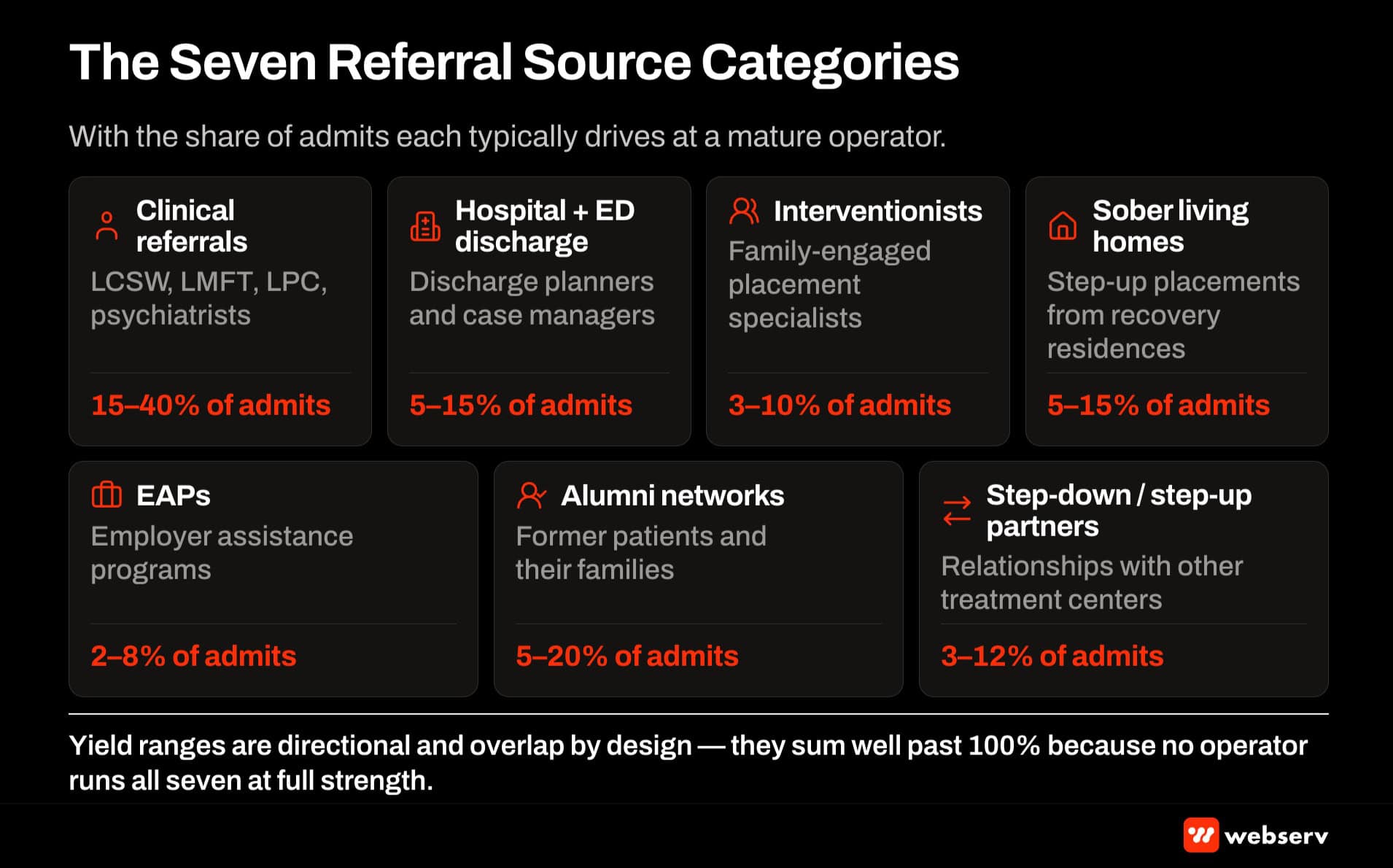
Behavioral health treatment centers acquire admits through seven distinct referral source categories, each with its own development motion.
1. Clinical referrals
Individual therapists, psychiatrists, psychologists, LMFTs, LCSWs, LPCCs, and other Licensed Practitioners of the Healing Arts (LPHAs) in the community who refer patients to higher levels of care when clinical need exceeds outpatient capacity.
The development motion is a combination of professional education (bringing clinical staff to CE events, presenting on treatment approach), consultative relationship building (case consultations with the clinical team), and post-discharge communication (updating the referring clinician on patient progress and step-down).
Volume per relationship is typically low (1 to 4 referrals per year per relationship) but conversion quality is very high because the referring clinician has already assessed clinical fit.
2. Hospital and ED discharge planners
Case managers and social workers at hospitals and emergency departments who need to place patients into residential SUD or mental health treatment after acute stabilization.
The development motion is a combination of hospital liaison presence, dedicated intake process for hospital-referred cases, and clear communication about admit availability and clinical program fit. Hospital referrals typically require faster admit response than other categories (24-72 hours from discharge planning conversation).
Volume per relationship can be very high (10 to 50 referrals per month per active hospital relationship), but competition is intense because every treatment center in the region is developing the same hospital.
3. Interventionists
Certified interventionists who work with families in crisis to convince a patient to enter treatment. Interventionist referrals typically convert at the highest admit rate of any referral category because the intervention process is specifically designed to produce a same-day or next-day admission.
The development motion is a combination of interventionist network relationships, clinical program fit alignment (some interventionists specialize in specific populations), and rapid admit response (interventions typically require admit within 24-72 hours).
Volume varies by interventionist relationship. Established interventionists can route 20 to 60 admits per year to preferred treatment centers.
4. Sober living homes
Residential recovery housing programs that provide transitional living for patients between residential treatment and independent recovery. Sober living homes refer patients into higher levels of care when relapse risk or clinical need exceeds what the sober living environment can support.
The development motion is a combination of clinical partnership (formal step-up protocols), transportation and logistics support, and financial-relationship transparency. This is where EKRA scrutiny is most intense because historical sober-living-to-treatment-center payment patterns have been the target of specific federal enforcement actions.
Volume per relationship is moderate. The compliance layer is the biggest constraint.
5. Employee Assistance Programs (EAPs)
Employer-sponsored programs that provide short-term counseling and referral services to employees and family members. EAPs refer employees with SUD or mental health treatment needs into contracted or preferred provider networks.
The development motion is a combination of EAP network contracting (getting listed in the EAP’s approved provider directory), EAP account management, and coverage-aware intake processes (EAP-referred patients often carry specific employer-sponsored health plans that require targeted verification).
Volume per relationship varies materially by employer size and industry. Large-employer EAPs can produce meaningful admit volume; smaller EAPs contribute at the margins.
6. Alumni networks
Former patients who have completed treatment and returned to the community. Alumni refer family members, friends, and acquaintances who develop treatment needs after the alumnus’s own recovery.
The development motion is a combination of alumni programming (reunions, alumni Facebook groups, ongoing outreach), post-treatment communication cadence, and easy referral mechanisms (alumni referral hotline, direct admissions team contact).
Volume per alumnus is typically low but the aggregate volume from a mature alumni network can be significant. A 500-alumnus network in year three typically produces 30 to 80 referrals per year across the cohort.
7. Step-down and step-up relationships with other treatment centers
Treatment centers that operate at different levels of care can refer patients laterally. A detox-only facility refers to residential providers. A residential facility refers step-down patients to PHP and IOP providers. An outpatient program refers step-up patients to residential when clinical acuity increases.
The development motion is a combination of clinical program complementarity, formal referral protocols, and clear communication about admit availability and clinical fit.
Volume per relationship depends heavily on operational fit. Facilities with clean clinical protocols and predictable admit availability tend to become preferred step-up or step-down partners.
Referral marketing benchmarks at established BH treatment centers
40-70%
Share of monthly admits from referral sources at established facilities
10-50/mo
Volume from an active hospital/ED discharge planner relationship
1-4/yr
Individual clinical-referral relationship volume (high conversion quality)
30-80/yr
Aggregate volume from a mature 500-alumnus alumni network
The EKRA Constraint Layer
EKRA is the load-bearing compliance framework that shapes how behavioral health referral marketing can be structured. Every operator running referral development needs to understand it before designing referral programs.
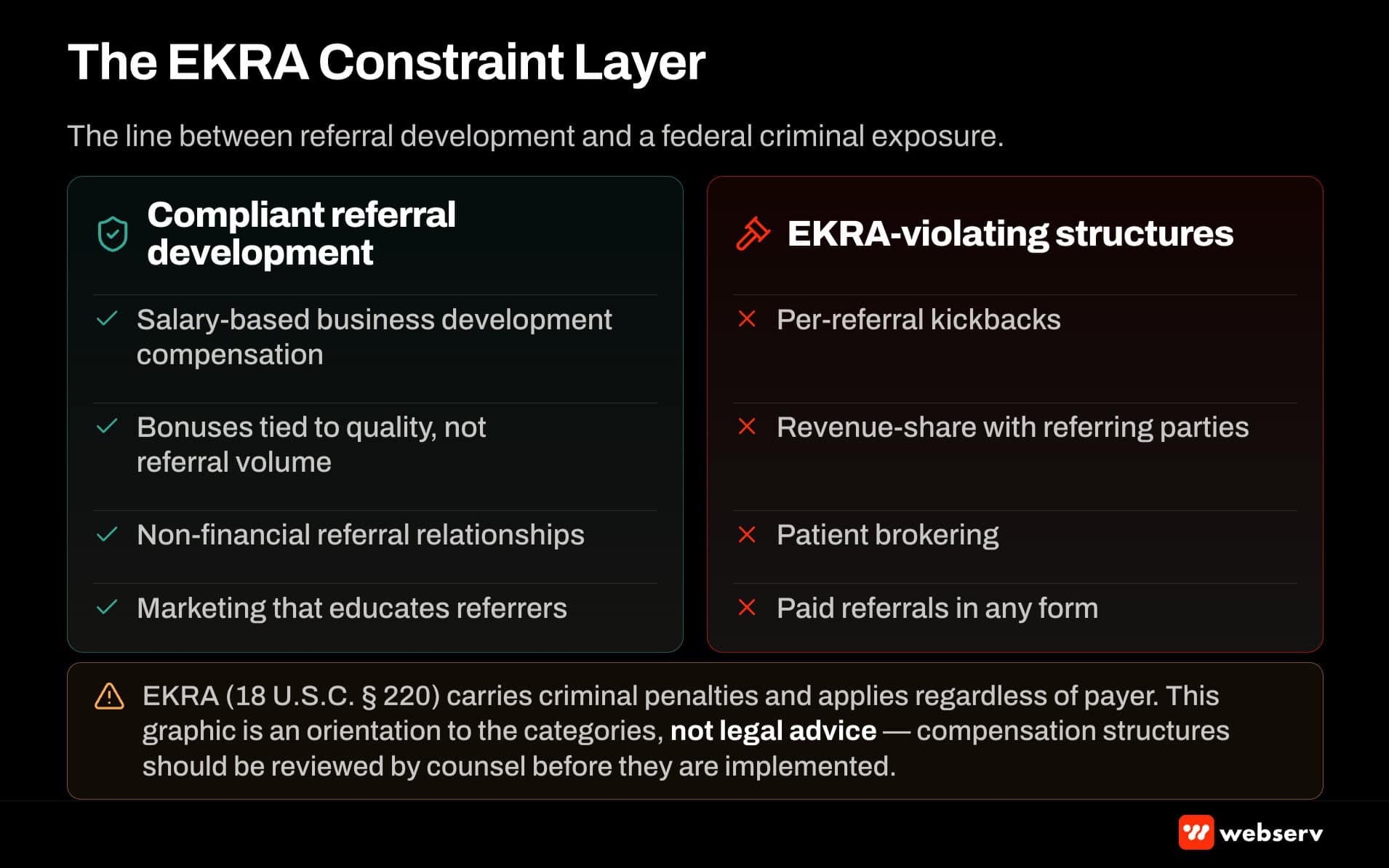
EKRA prohibits the payment of remuneration, direct or indirect, in cash or in kind, to induce a referral of a patient to a recovery home, clinical treatment facility, or clinical laboratory. The statute (18 U.S.C. § 220) applies to any healthcare service reimbursed by a federal or private payer, which effectively covers every behavioral health treatment scenario.
The specific patterns that violate EKRA include: paying a referral source per admit or per patient day, offering non-cash inducements (trips, meals beyond fair-market-value educational programming, gifts) tied to referral volume, or structuring “consulting agreements” where the underlying arrangement is a disguised referral payment.
The safest patterns include: volume-independent compensation for genuine professional services (medical direction, clinical consultation) at fair market value, educational programming at professional development pricing, and clearly documented professional relationships pre-cleared with healthcare regulatory counsel.
The pattern we recommend to every treatment center building referral development infrastructure: pre-clear every referral-source relationship with healthcare regulatory counsel before signing the arrangement, document the fair-market-value analysis, and audit the referral program annually against current EKRA enforcement patterns.
EKRA violations are prosecuted as federal crimes with substantial penalties. This is not a compliance layer where operators can move fast and fix later.
REGULATORY ALERT
EKRA prosecutes as a federal crime. The Eliminating Kickbacks in Recovery Act (18 U.S.C. § 220) prohibits payment of remuneration, direct or indirect, in cash or in kind, to induce a referral to a recovery home, clinical treatment facility, or clinical laboratory. Applies to any service reimbursed by a federal or private payer, which covers every behavioral health treatment scenario.
Patterns that violate EKRA: paying per admit or per patient day, non-cash inducements tied to volume, disguised “consulting agreements” where the underlying arrangement is a referral kickback. Safe patterns: volume-independent compensation for genuine professional services at fair market value, educational programming at professional development pricing, documented professional relationships pre-cleared with healthcare regulatory counsel.
EKRA SAFE
- Volume-independent compensation for genuine professional services (medical direction, clinical consultation) at fair market value.
- Educational programming and CE events priced at standard professional development rates.
- Documented professional relationships with clear scope-of-work and payment structures unrelated to referral volume.
- Pre-clearance of every referral-source arrangement with healthcare regulatory counsel before signing.
- Written fair-market-value analysis documented in the contract file.
EKRA VIOLATING
- Paying a referral source per admit or per patient day (direct kickback).
- Non-cash inducements (trips, expensive meals, gifts) tied to referral volume.
- “Consulting agreements” where the underlying arrangement is a disguised referral payment.
- Sober living rent subsidies conditioned on referral routing to specific treatment centers.
- Any compensation scaled by admit volume, patient days, or downstream reimbursement.
Measurement Discipline for Referral Marketing
Referral marketing that runs as a managed channel requires the same measurement discipline as paid channels, adapted to the different pattern of the referral pipeline.
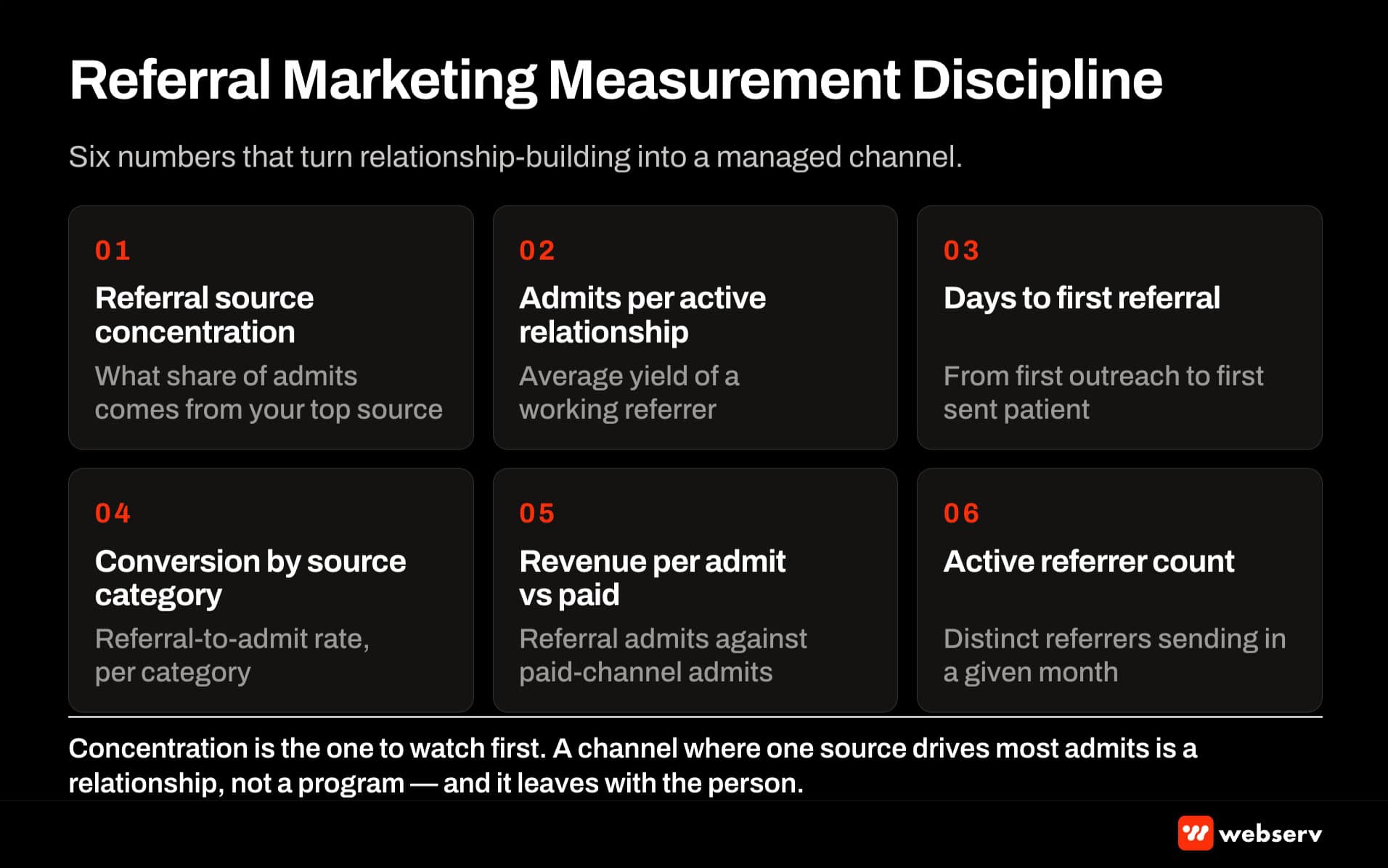
The five specific KPIs that matter for referral marketing at behavioral health treatment centers are: referrals produced per source per month, referral-to-admit conversion rate per source category, cost per referral (aggregating relationship investment and staff time), rate-adjusted admit value per source (weighted by the plan mix each source tends to refer), and time-to-productive-relationship for new referral sources.
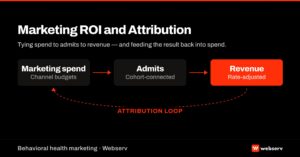
Our referral partner attribution piece covers the specific attribution mechanics that turn admit volume into revenue-adjusted admit value at the source level.
Rate-adjusted admit value is the KPI most operators skip and where the biggest measurement gains sit. Two referral sources delivering 20 admits per month each are not equivalent if one source routes patients on high-yielding OON plans while the other routes patients on lower-yielding in-network plans. The revenue-adjusted view is what determines where the next dollar of relationship investment should go.
Reporting cadence for referral marketing sits at the quarterly QBR review alongside the rest of the marketing performance conversation. The marketing and admissions QBR playbook covers how to fit referral source performance into the broader reporting structure.
Common Failure Modes
Four patterns show up repeatedly at treatment centers trying to scale referral marketing.
The first is compensation structures that violate EKRA. Paying a referral source per admit, offering non-cash inducements tied to volume, or structuring “consulting agreements” that are effectively referral payments. All three have been targets of federal enforcement actions.
The second is treating all referrals as equal in the CRM. Facilities that flag every inbound lead as “referral” without tracking the specific referral source lose the measurement layer that would surface which sources actually produce profitable admits. Source-level attribution is the prerequisite for the KPI stack that turns referral marketing into a managed channel.
The third is running referral development as a solo function outside the marketing team. When the Director of Business Development or a Community Liaison owns referral relationships without marketing team integration, the resulting referral pipeline typically underperforms because the measurement, reporting, and channel strategy layers do not get applied consistently.
The fourth is over-investing in high-visibility sources (large hospital systems, well-known interventionists) while under-investing in lower-visibility sources that produce better economics (community therapists, alumni networks). The measurement discipline is what surfaces this imbalance.
Referral Marketing Tools and Infrastructure
The specific tool stack for behavioral health referral marketing typically includes a CRM configured to track referral source attribution at the lead level, a business development tracking system for relationship activities and cadence, and integration with the admissions and billing systems for the outcome measurement layer.
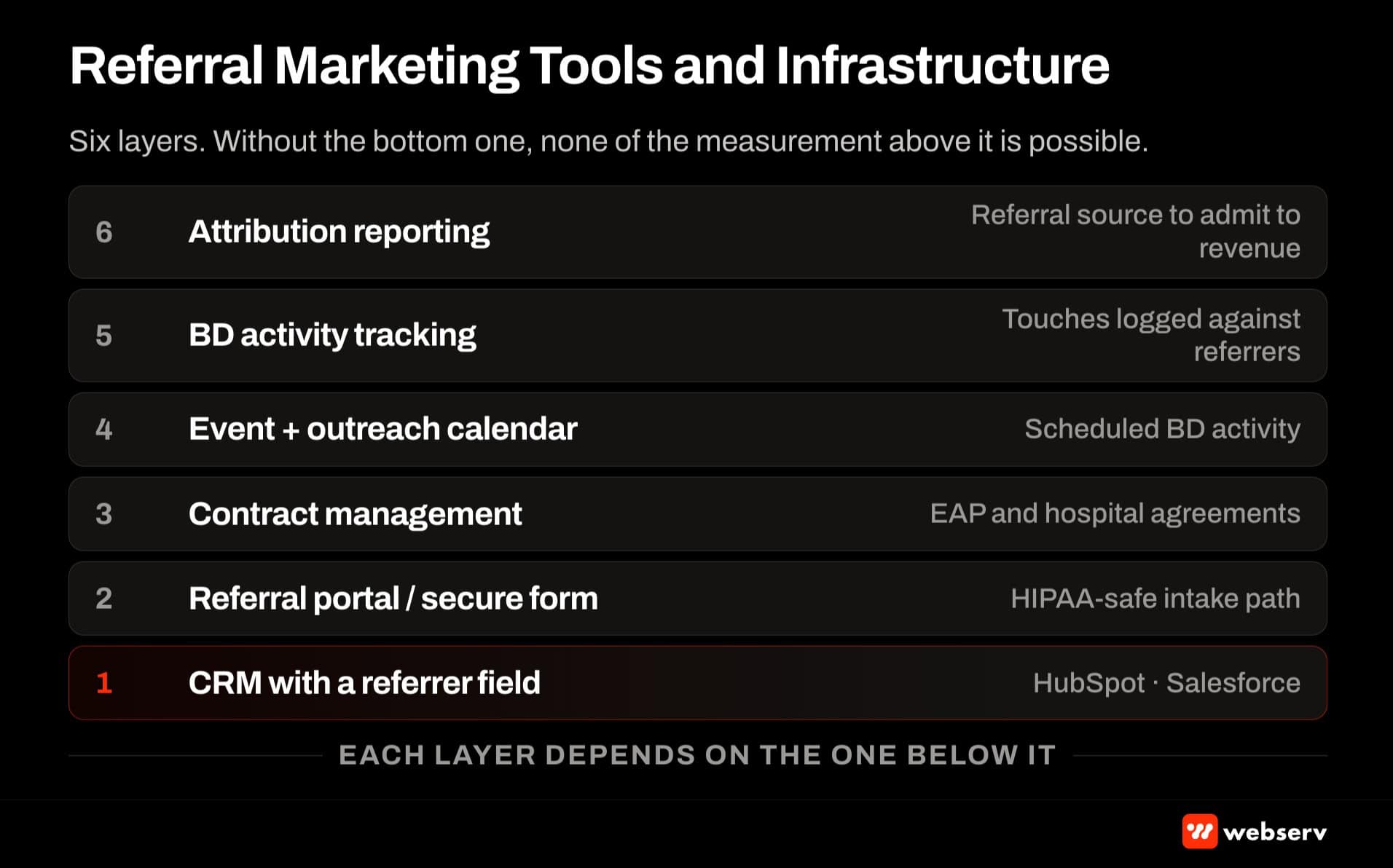
Some treatment centers add specialized referral marketing platforms (Bridgeway, Salesforce Health Cloud with referral extensions, custom-built solutions) that layer relationship management and reporting on top of the core CRM. Whether this specialized layer is worth the investment depends on facility scale.
At small treatment centers (single facility, 10-30 monthly admits), the primary CRM with referral source fields is usually sufficient. At mid-size operators (multi-location or 40-100 monthly admits), the specialized referral marketing infrastructure typically pays for itself in improved relationship management. At enterprise operators (multi-facility platforms), enterprise-grade CRM with dedicated referral management modules becomes essential because the volume and complexity of referral relationships outstrip what a standard CRM can support.
Frequently Asked Questions
How much does referral marketing typically contribute to a treatment center’s admit volume?
At most established behavioral health treatment centers, referral sources contribute 40 to 70 percent of monthly admits. The specific percentage varies by facility age (newer facilities typically rely more heavily on paid acquisition until referral networks mature), by service line (residential SUD referral share differs from outpatient mental health), and by geography (facilities in referral-network-dense metros run higher referral share than facilities in less-networked markets).
Facilities running referral share below 30 percent typically have either underinvested in referral development or have a strategic decision to focus on paid acquisition. Facilities running referral share above 70 percent typically have strong community relationships but face concentration risk if a key referral source shifts.
The right balance depends on facility strategy, but a rough rule is that a diversified pipeline with 40-60 percent referral share, 25-45 percent paid acquisition, and the remainder direct or organic tends to be operationally resilient.
What is EKRA and how does it affect referral marketing for treatment centers?
EKRA is the Eliminating Kickbacks in Recovery Act, a 2018 federal statute (18 U.S.C. § 220) that prohibits paying remuneration (direct or indirect, cash or in-kind) to induce a referral to a recovery home, clinical treatment facility, or clinical laboratory. It applies to any healthcare service reimbursed by a federal or private payer, which covers every behavioral health treatment scenario.
For referral marketing, EKRA means treatment centers cannot pay referral sources per admit, cannot structure disguised referral payments through consulting agreements, and cannot offer non-cash inducements tied to referral volume.
The safe patterns are volume-independent compensation for genuine professional services at fair market value, educational programming at professional development pricing, and clearly documented professional relationships. Every referral-source arrangement should be pre-cleared with healthcare regulatory counsel before signing.
Do we need a dedicated business development person to run referral marketing?
For treatment centers admitting fewer than 20 patients per month, referral development can typically be handled by the admissions director or a clinical liaison as part of their broader responsibilities. The volume does not justify a dedicated headcount, and splitting the function too early creates overhead without meaningful upside.
Above 20 monthly admits, the referral pipeline usually justifies a dedicated business development or community liaison role. The role owns relationship cadence, coordinates clinical program education, and produces the reporting that feeds back into marketing performance conversations.
At enterprise scale, dedicated business development teams with regional coverage and specialized roles (clinical liaison, hospital liaison, enterprise account manager for EAPs and corporate partnerships) typically emerge as the referral pipeline diversifies across the seven source categories.
How do we handle a therapist who wants to refer patients but does not carry the specific insurance we accept?
The clinical referral relationship is valuable independent of the specific patient’s insurance situation. A referring therapist who understands your program and refers patients whose insurance you cannot accept is still building the relationship for future referrals whose coverage does align.
The practical response is to develop a “referral out” protocol that routes patients your facility cannot admit to other treatment centers with clinical fit and payer network access. The referring therapist sees you maintaining the clinical priority even when the specific case does not convert for you, which strengthens the relationship for future referrals.
Some treatment centers formalize step-down or step-up relationships with peer treatment centers specifically to handle these cases. The referrals flow both ways over time.
What is the difference between referral marketing and business development?
Referral marketing is the broader discipline that covers all seven referral source categories, from individual clinical referrals through enterprise EAP relationships. It includes measurement, channel strategy, and integration with the broader marketing operating model.
Business development typically refers to the enterprise-sales-motion subset of referral marketing: contracts with employers, EAPs, insurance networks, and corporate wellness programs. It focuses on the higher-volume, longer-sales-cycle relationships that require sales infrastructure (contract negotiation, RFP response, enterprise account management).
The two functions overlap materially at treatment centers with mature referral programs. Smaller facilities often collapse both into a single role. Larger facilities typically separate them because the day-to-day motion for clinical referrals is different from the motion for enterprise sales.
How do we measure whether our referral development effort is actually working?
The five specific KPIs to track are referrals per source per month, referral-to-admit conversion rate by source category, cost per referral (including staff time and any compliant professional services investment), rate-adjusted admit value per source, and time-to-productive-relationship for new referral sources.
The most important of these is rate-adjusted admit value per source. Two referral sources delivering equivalent admit volume can produce materially different revenue if they route to different plan mixes. The revenue-adjusted view is what determines where the marketing dollar next goes.
Report these KPIs at the quarterly QBR alongside the rest of the marketing performance conversation. Our marketing and admissions QBR playbook covers how to fit referral source performance into the broader reporting structure.
Trevor Gage is Director of Marketing at Webserv, a behavioral health marketing agency and admissions operations platform working with residential, outpatient, and telehealth treatment providers across the United States. He leads the SEO, content, and paid-media disciplines for the Webserv client book and works directly with treatment center marketing and admissions teams on referral marketing infrastructure, EKRA-compliant relationship structures, and cross-channel measurement.