Many of the people who call a treatment center call on someone else’s behalf. A parent, a spouse, an adult child. Many have spent weeks reading, worrying, and holding questions they don’t want to post on their own timeline.
Paid social has a harder time reaching them than it used to. Meta limits health-related targeting, flags custom audiences that reference health conditions, and can restrict the conversion data health advertisers send back.
A well-run Facebook Group is one of the few places a treatment center can still build an ongoing relationship with families on Meta.
This piece covers when a family group is worth running, how to set it up for privacy, how to moderate it safely, and how it fits with your paid campaigns. It’s part of how we run paid social for treatment centers.
Key Takeaways
- Family involvement matters clinically. In trials of CRAFT, a family training approach, about two-thirds of loved ones entered treatment.
- Use a private group for family support. Only members can see posts and who belongs, but Meta can still review content.
- Turn on anonymous participation if it’s available, and tell members that admins can still see who posted.
- Never confirm that anyone is or was a patient. HHS has settled with providers over social media replies that disclosed patient information.
- Groups aren’t a custom audience source for ads. Treat the group as an owned community, not a retargeting pool.
- Write a crisis protocol before launch, including 988 and the SAMHSA National Helpline.
Why families, and why a group
Family support isn’t only a marketing idea. NIDA’s Principles of Drug Addiction Treatment says family and friends can play critical roles in motivating people to enter and stay in treatment.
Research on CRAFT, short for Community Reinforcement and Family Training, backs that up. Earlier trials reported 64% and 68% of loved ones entering treatment, compared with 17% and 29% in comparison groups.
Families also use online communities when they’re offered. In a study of parents whose teens were leaving residential treatment, 70% posted at least once in a private online forum, and most of their posts went to other parents, not the expert.
DEFINITION
Family community group. An online group run by a treatment provider where family members of people with substance use or mental health conditions can ask questions, share experiences, and find resources.
A group gives families something ads can’t: a place to come back to. They read for weeks before they ask a question, and they ask it where other parents can answer first.
Set it up for privacy
Private, and usually hidden
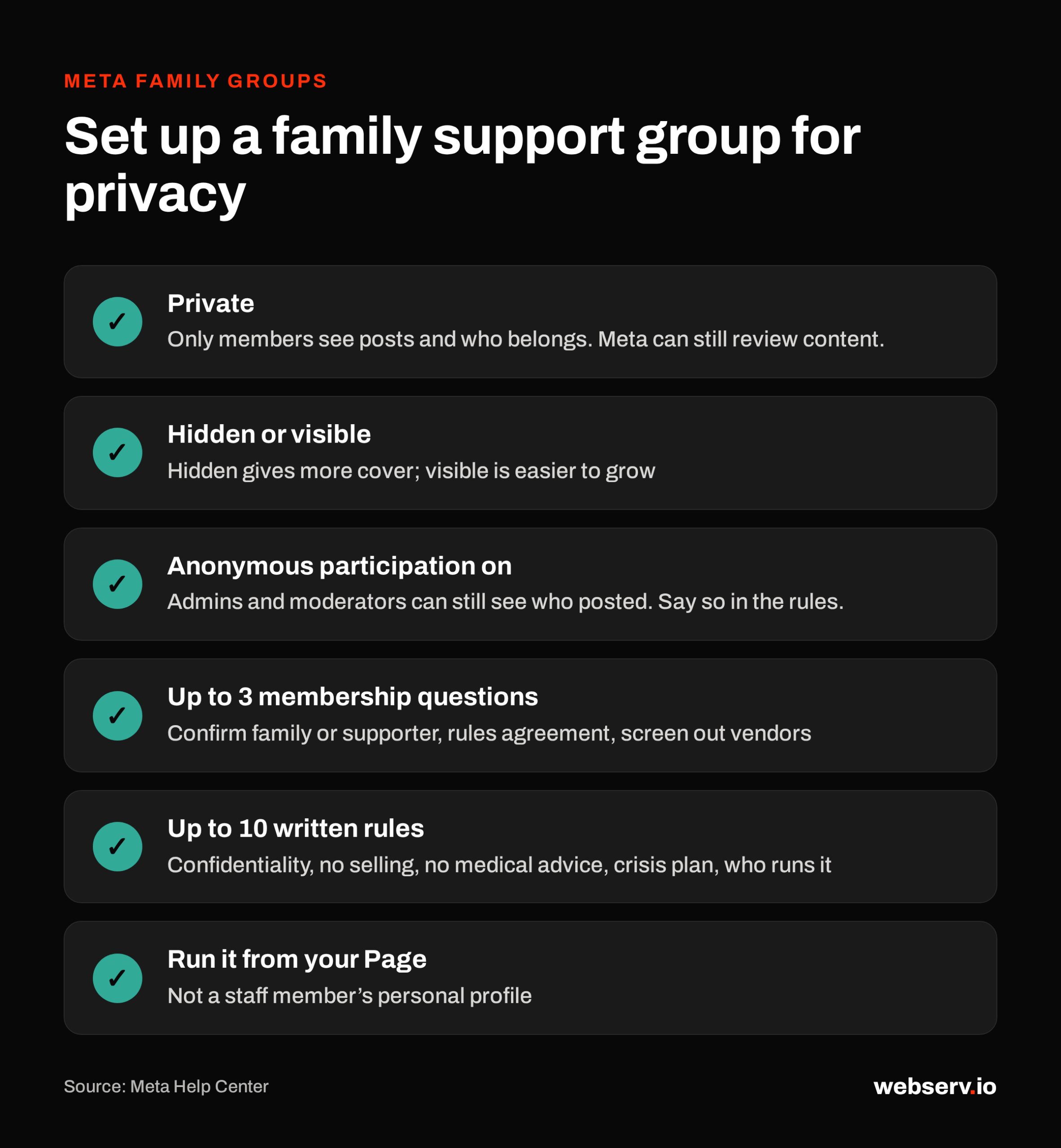
Facebook lets admins choose public or private groups. In a private group, only current members can see what’s shared and who the members are. Meta itself uses a health concern as its example of when to choose private.
Private groups can also be visible, so anyone can find them in search, or hidden, so only invited people can find them. A visible private group is easier to grow. A hidden one gives members more cover. Pick based on how you’ll recruit members.
Two caveats belong in your group description. Meta says it may review group content, including in private groups. And a private group can later be switched to public, so write a rule that you won’t do that.
Anonymous participation
Where it’s available, admins can turn on anonymous participation. Members can then post and comment without their name showing to other members.
Be clear about the limits. Meta says admins and moderators can still see who posted anonymously, and details in a post can reveal someone’s identity. Say both in your group rules.
Membership questions and rules
Facebook allows up to three membership questions. Use them to confirm a person is a family member or supporter, to get agreement to the rules, and to screen out vendors and spam.
Groups can have up to 10 written rules. At minimum, cover confidentiality, no selling or soliciting, no medical advice, what happens in a crisis, and who runs the group.
COMMON MISTAKE
Running the group from a staff member’s personal profile. A Page can create and admin a group, and its posts show as coming from the Page. That keeps the group tied to your organization when staff change.
Never confirm who’s a patient
This is the rule that matters most. A parent posts that their son is at your facility and asks how he’s doing. The instinct is to reply kindly with an update. Don’t.
HHS has settled with providers for exactly this kind of reply. A psychiatric practice, Manasa Health Center, paid $30,000 after it disclosed a patient’s information in a response to an online review. A dental practice paid $10,000 over social media disclosures of patient information.
Substance use treatment records carry extra protection under 42 CFR Part 2. Confirming that someone is in treatment, even in a private group, can be a disclosure.
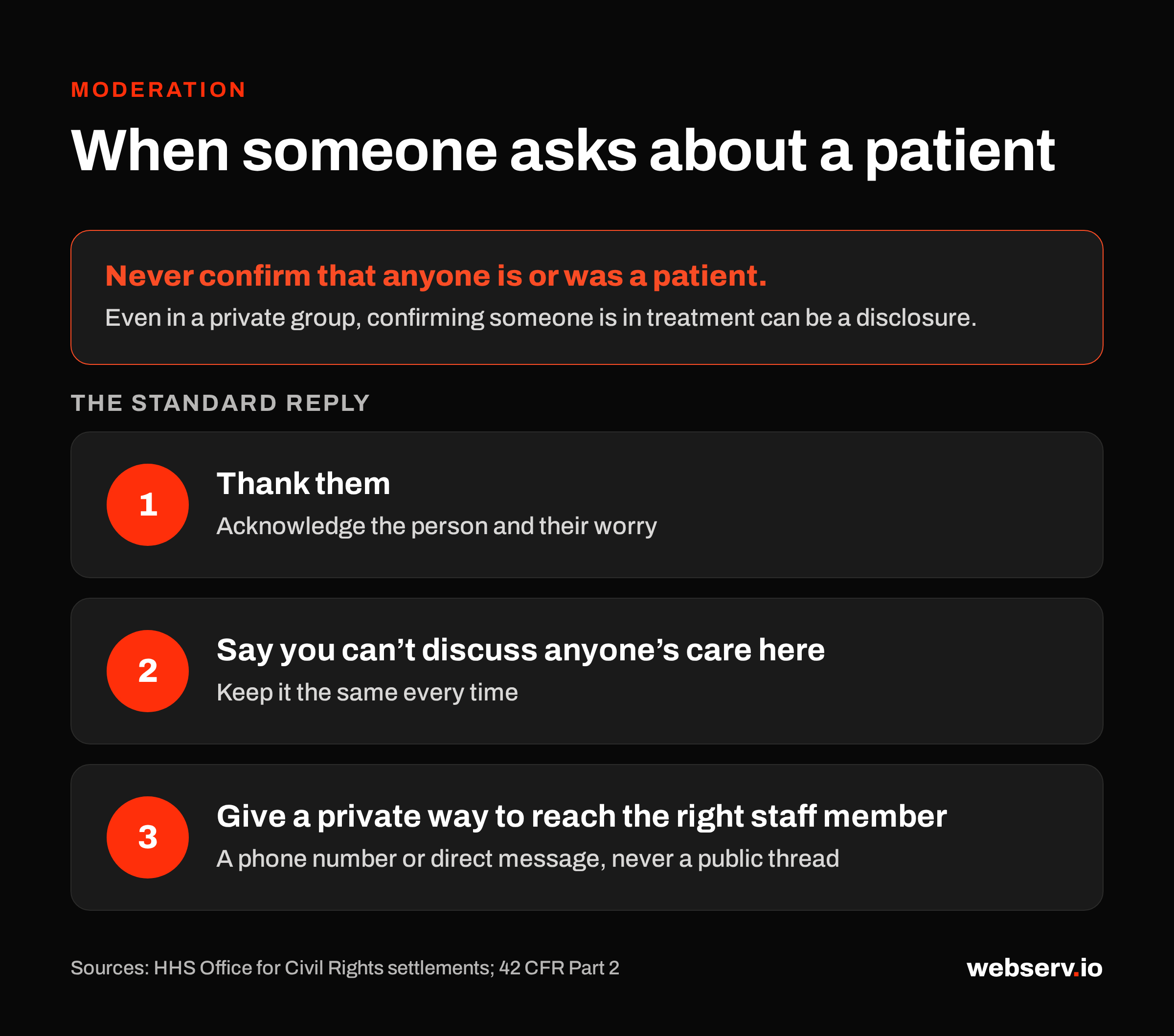
Train moderators on a standard reply: thank the person, say you can’t discuss anyone’s care in the group, and give them a private way to reach the right staff member.
OPERATOR INSIGHT
Write five reply templates before launch: patient questions, insurance questions, crisis posts, complaints, and vendors. Moderators under pressure reach for templates. Make sure the right ones exist.
Moderate for safety, not just spam
Family groups will see hard posts. Plan for them before you invite anyone.
Crisis posts. Meta’s guidance on suicide-related posts says to contact local emergency services first if someone is in immediate danger, and to report the content so Meta can reach out. Pin a post with the 988 Suicide & Crisis Lifeline, which people can call, text, or chat with, and SAMHSA’s National Helpline at 1-800-662-4357.
Drug sales and scams. Meta’s Community Standards don’t allow the sale of drugs. Family groups also attract people selling “guaranteed” programs and paid placements. Remove them fast.
Tools that help. Admin Assist can decline posts that link to specific sites and remove posts reported a certain number of times. Keyword alerts tell admins when members use words you choose, such as crisis terms.
Keep in mind that when members report to admins, the report doesn’t go to Facebook. Your team has to act on it.
Coverage. Decide who watches the group on nights and weekends. If you can’t cover those hours, say so in the rules and point people to 988 and the helpline.
Staff participation and disclosure
Staff should take part, but openly. The FTC’s Endorsement Guides say connections the audience wouldn’t expect must be clearly disclosed. One of the FTC’s own examples is an employee posting in an online community, who should disclose that relationship.
Use Facebook’s group experts badge where it’s available, so clinical staff are clearly marked. Keep their role to education and resources. Individual clinical advice belongs in a private, appropriate setting.
Where paid fits
Running a group doesn’t change Meta’s ad rules. Meta’s personal attributes policy says ads can’t assert or imply someone’s health condition. Addiction treatment advertisers in the U.S. need LegitScript certification and Meta’s permission.
Groups also aren’t a source for ad audiences. Meta’s engagement custom audiences can come from videos, lead forms, Instagram accounts, events, and Facebook Pages, but groups aren’t on the list.
Meta also doesn’t allow custom audiences that reference specific health conditions. And it can restrict the events health advertisers send back, pushing optimization toward upper-funnel actions.
That makes the group and your paid campaigns two separate jobs:
Paid builds awareness
Paid builds awareness with compliant, family-facing creative that doesn’t imply a condition. Our guide to family-focused landing page copy covers the message.
Your Page and site
Your Page and site carry the resources, and the group link sits there for people who want more.
The group earns trust
The group earns trust over weeks, with no targeting attached to membership.
Calls come through your normal tracked numbers
Calls come through your normal tracked numbers, so you can see whether family inquiries grow.
Our ultimate guide to social advertising for treatment centers covers the paid side in depth, and our guide to Meta Conversions API for treatment centers covers what data you can send.
Measure without tracking members
Don’t try to tie group members to admissions. You can’t do it on Meta, and trying would create privacy problems.
Measure the group on its own terms: member growth, share of posts answered within a day, and questions that come up repeatedly, which become content for your site. Then watch family-sourced calls in your call tracking over the following months.
Where this fits
For targeting families in paid campaigns without implying a condition, see our guide to ZIP exclusion and family targeting. For writing compliant ads, see our guide to compliant ad headlines.
For how paid social fits the rest of your marketing, see the complete guide to behavioral health marketing. If you want a second look at your family strategy on Meta, book an intro meeting.
This piece summarizes platform documentation and federal guidance. It isn’t legal advice.
Frequently Asked Questions
Should a treatment center run a Facebook Group for families?
It can, if you can staff it. Research on family involvement, including CRAFT, shows families can help loved ones enter treatment.
A private group gives families a place to ask questions and support each other over time.
Plan moderation, crisis coverage, and privacy rules before you invite anyone.
Are private Facebook Groups confidential?
Not fully. Only members can see posts and who belongs, but Meta says it may review content in private groups.
Admins can see who posted anonymously, and details in a post can identify someone.
Tell members both things in your group rules.
Can staff answer questions about a patient in the group?
No. Confirming that someone is or was a patient can be a disclosure of protected health information.
HHS has settled with providers over social media replies that disclosed patient information.
Use a standard reply that moves the conversation to a private, appropriate channel.
Can we target Facebook Group members with ads?
No. Groups aren’t a source for Meta’s engagement custom audiences.
Meta also doesn’t allow custom audiences that reference specific health conditions.
Run the group as an owned community and keep paid campaigns separate.
What should moderators do if someone posts about suicide?
If someone is in immediate danger, contact local emergency services first. Then report the post so Meta can reach out.
Pin the 988 Suicide & Crisis Lifeline and SAMHSA’s National Helpline at the top of the group.
Decide in advance who covers nights and weekends.
Keaton Nalle is the Director of Paid Admissions at Webserv, a digital marketing agency for treatment centers.