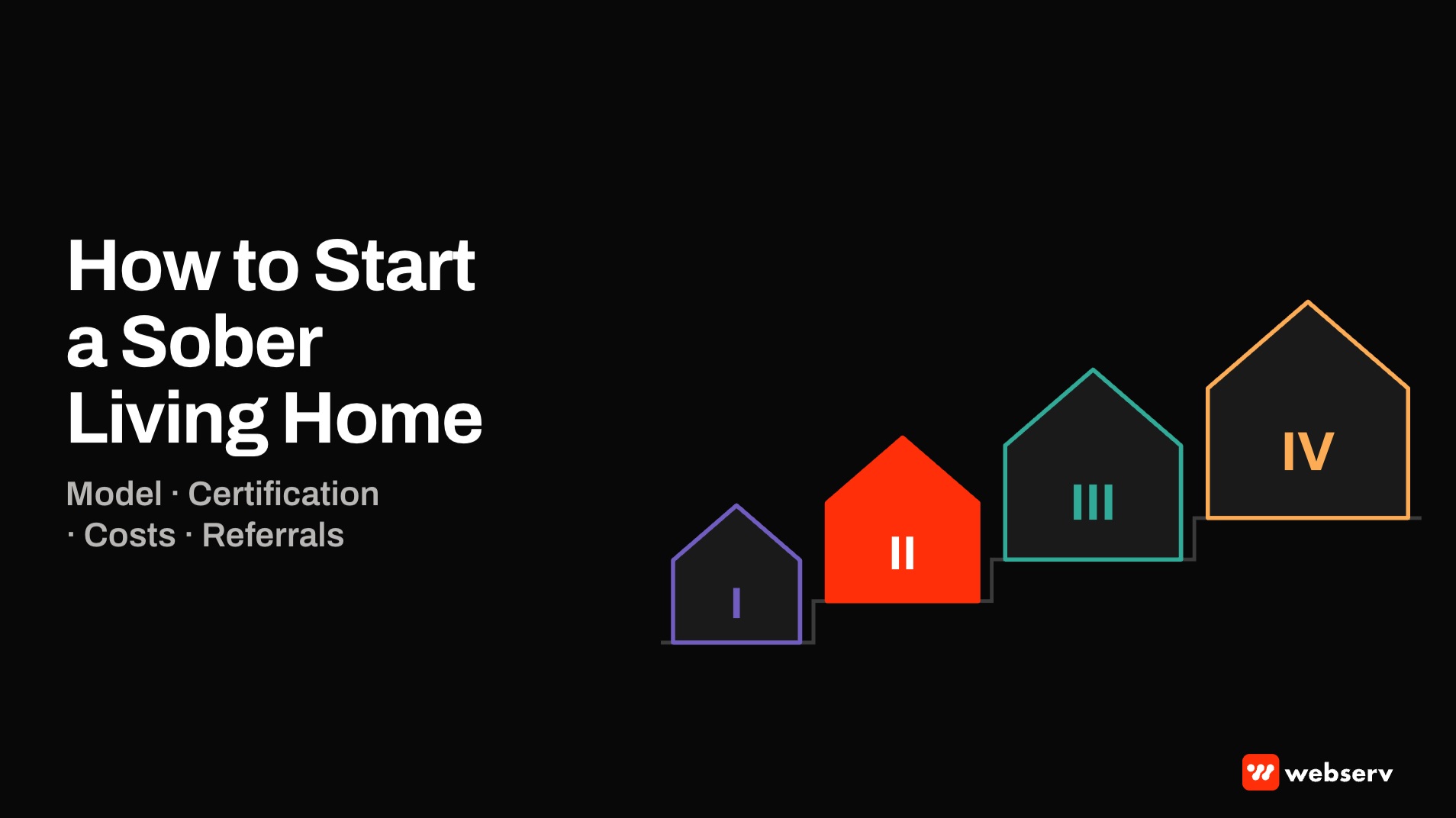
An operator buys a four-bedroom house, furnishes it, and writes house rules. Then the problems start. The local treatment center can’t refer residents because the home isn’t certified. Google won’t run the ads. The city asks about zoning.
None of these problems is unusual, and all of them are easier to solve before you buy the house.
This guide covers how to choose a sober living model, what certification and licensing involve, what it costs to run a home, and how residents and referral partners will find you. It’s part of how we approach SEO for behavioral health organizations, because for most sober living homes, search and referrals are the main ways new residents arrive.
Rules for sober living homes vary by state and change often. Verify every requirement with your state agency and local government. This guide isn’t legal advice.
Key Takeaways
- Pick your model first. The National Alliance for Recovery Residences (NARR) defines four levels, from peer-run homes to homes that offer clinical services. Your level sets your staffing, costs, and rules.
- Some states require a license, some offer voluntary certification, and some do neither. Arizona requires a license; Florida and Texas tie referrals or state funding to certification.
- The Fair Housing Act protects people in recovery, and local zoning rules can’t treat sober homes less favorably than similar homes.
- Federal law bans kickbacks for referrals to recovery homes and deceptive marketing of recovery housing.
- Non-clinical sober homes can’t get LegitScript certification, so they can’t run addiction-services ads on Google. Referrals, certification directories, and search are the main channels.
- Median annual operating cost was $155,000 per organization in a 2026 national study, and most operators didn’t collect every fee they charged.
Step 1: Decide your model
Sober living homes, also called recovery residences or recovery homes, aren’t all the same. Before you look at property, decide what kind of home you’re running and who it’s for.
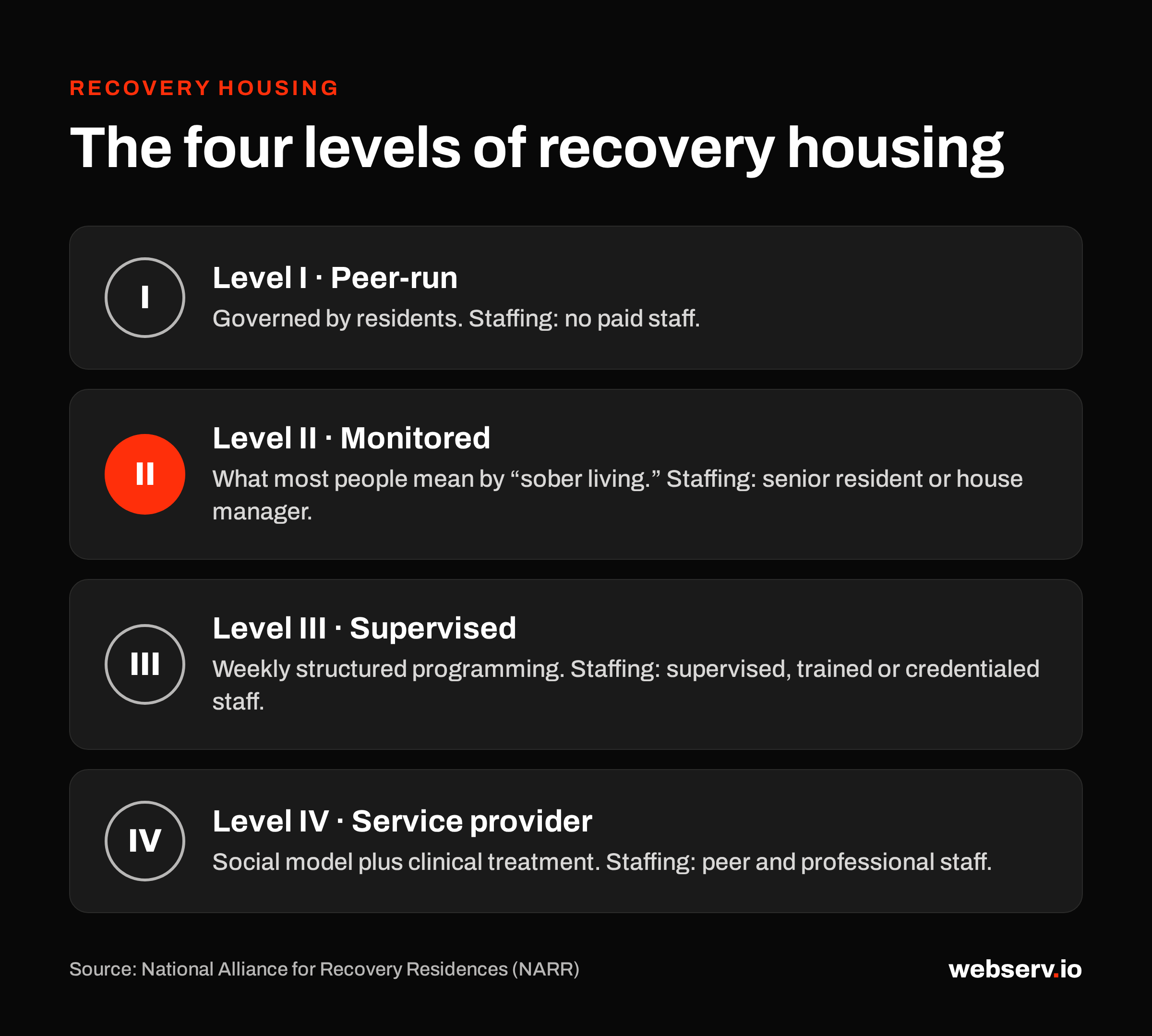
NARR’s Standard 3.0 is the most common reference. SAMHSA’s Best Practices for Recovery Housing uses the same four levels.
| NARR level | Also called | How it’s run | Typical staffing |
|---|---|---|---|
| Level I | Peer-run | Democratically governed by residents; Oxford House is the best-known example | No paid staff |
| Level II | Monitored | What most people mean by “sober living”; a house manager leads the household | Senior resident or house manager |
| Level III | Supervised | Weekly structured programming; licensed in a few states | Supervised, trained, or credentialed staff |
| Level IV | Service provider | Combines a social model with clinical addiction treatment | Peer and professional staff |
Source: NARR Standard 3.0, checked November 11, 2026.
DEFINITION
Recovery residence. A shared, substance-free home centered on peer support and connection to recovery services. Federal law uses the term “recovery home” for the same idea.
Most new operators start at Level II. If you plan to provide treatment on-site, you’re no longer only a sober home. You’ll likely need a treatment license from your state, which is a different project. Our guide to opening a rehab in California shows what that path looks like in one state.
Who you’ll serve. Decide early on gender, age range, and whether you’ll accept residents taking medications for opioid use disorder. SAMHSA’s best-practices guide covers how recovery housing can support residents who take them. Your choice affects referral partners, house rules, and how you describe the home.
Step 2: Check licensing, certification, and zoning
State licensing and certification
States take three broad approaches: required licensing, voluntary certification tied to referrals or funding, or no state oversight. Here are four examples.
| State | Approach | What it means for a new home |
|---|---|---|
| Arizona | License required | A state license is required to operate a sober living home, and licensed behavioral health providers may refer only to licensed homes |
| Florida | Voluntary certification | Licensed treatment providers may refer to, or accept referrals from, only certified recovery residences, with some exceptions |
| Texas | Voluntary accreditation | Under HB 299, recovery houses that aren’t accredited can’t receive state money as of September 1, 2025 |
| California | No state license for non-treatment homes | DHCS doesn’t license sober living homes, but a home providing treatment or recovery services needs a DHCS license |
Sources: Arizona Revised Statutes 36-2062 and 36-2065; Florida Statutes 397.487 and 397.4873; Texas HB 299 (2023); California DHCS. Checked November 11, 2026.
Even where certification is voluntary, it often decides whether treatment centers can refer to you. In Florida, a licensed provider generally can’t send a client to a home that isn’t certified. That’s most of your referral pipeline.
How certification works. In most states, a NARR affiliate certifies recovery residences against NARR’s standard, adapted for state rules. NARR says certification criteria can vary by state. We counted 33 affiliates on NARR’s affiliate page in November 2026.
SAMHSA’s best-practices guide says it plainly: “SAMHSA recommends recovery housing entities be certified.”
Fair housing and zoning
People in recovery from addiction are protected under the Fair Housing Act, unless they’re currently using illegal drugs. A HUD and Department of Justice joint statement on group homes says the term includes homes for people in recovery from alcohol or substance use.
The statement says local zoning rules that treat groups of unrelated people with disabilities less favorably than similar groups without disabilities violate the Fair Housing Act. Local governments must also make reasonable accommodations when needed.
That protection doesn’t remove local rules. Cities can still apply occupancy limits, building codes, and safety rules that apply to similar homes. Check with your city or county before you buy or lease, and talk to a fair housing attorney if you get pushback.
COMMON MISTAKE
Buying the house first. Zoning, occupancy limits, and certification requirements can all affect whether a property works. Confirm them before you commit to a property.
Step 3: Set up the property, house rules, and staffing
Property. Look for enough bedrooms and bathrooms for your target occupancy, shared space for house meetings, and access to transit, jobs, and outpatient care. Your certifying body’s standards set safety and property requirements, so get them before you renovate.
House rules. Write them down before the first resident moves in. Typical areas include sobriety expectations and testing, curfew, chores, meeting attendance, guests, and what happens after a relapse. Your certifying body will expect written policies.
Staffing. A Level II home usually has a house manager, often a resident in stable recovery. Decide who handles intake, rent collection, conflicts, and emergencies, and when the owner steps in.
Resident agreements. Spell out fees, what they cover, refund terms, and move-out conditions. Clear agreements protect residents and reduce disputes later.
Step 4: Budget for costs and revenue
Most sober living homes are funded by resident fees. Some also receive state or grant funding, especially certified homes.
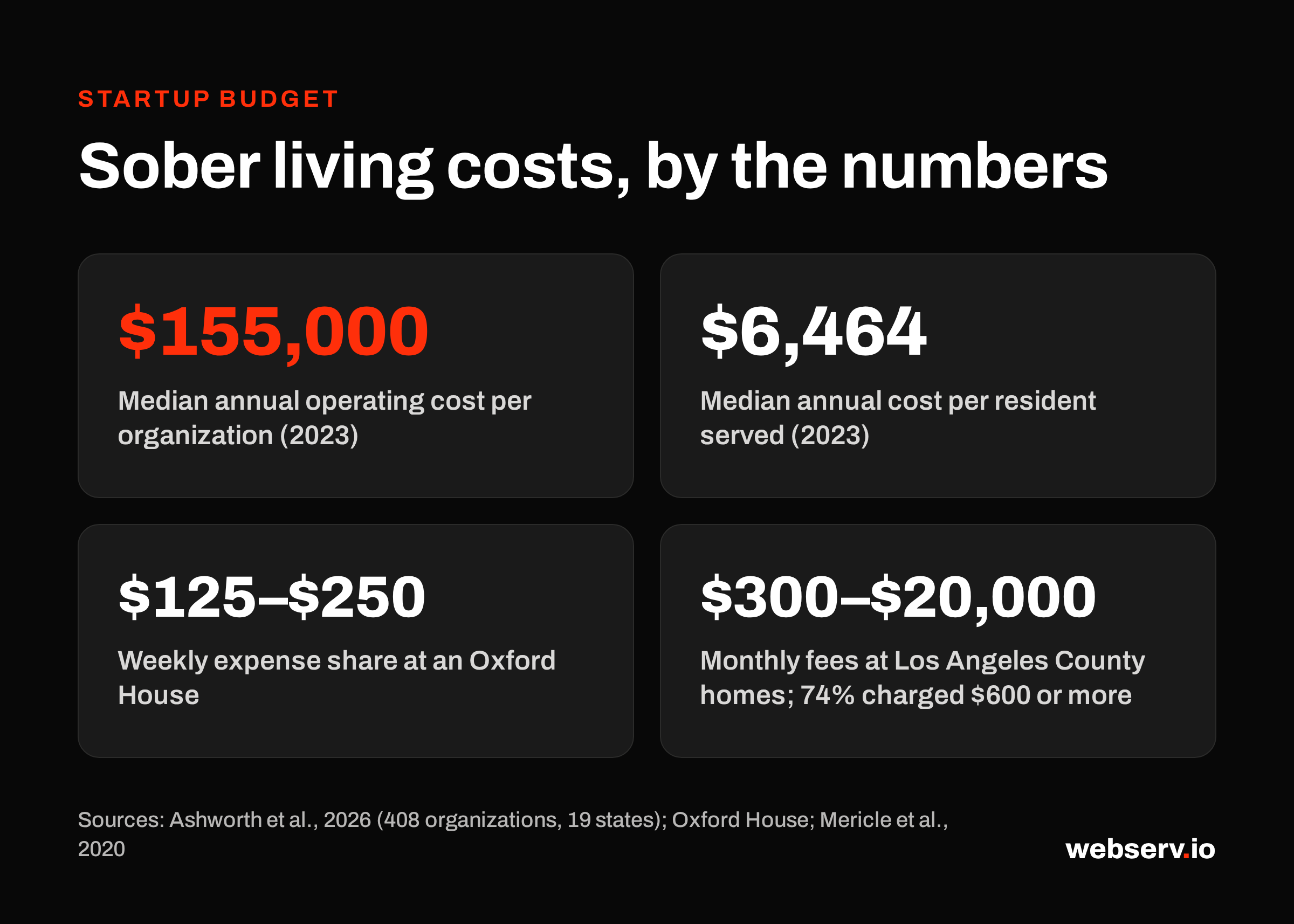
| Data point | Figure | Source |
|---|---|---|
| Median annual operating cost per organization (2023) | $155,000 | Ashworth et al., 2026, 408 organizations in 19 states |
| Median annual cost per resident served (2023) | $6,464 | Same study |
| Oxford House weekly expense share | $125 to $250 | Oxford House FAQ |
| Monthly fees at Los Angeles County sober living homes | $300 to $20,000; 74% charged $600 or more | Mericle et al., 2020 |
The 2026 study found that resident fees were the largest revenue source, and that most organizations didn’t collect all the fees they charged. Plan for vacancies and unpaid fees in your budget.
Startup costs. We didn’t find a reliable published figure for starting a single home. Your budget depends on whether you buy or lease, local rents, furnishing, insurance, certification fees, and how long it takes to fill beds. Build your own estimate with local quotes.
Oxford House loans. Federal law lets states run a revolving loan fund for group homes for people in recovery. Loans can’t exceed $4,000 per home and must be repaid within two years. Homes must have at least six residents, and residents set house policy by majority vote.
OPERATOR INSIGHT
Fill rate drives the budget more than anything else. Build relationships with referral partners before the home opens so beds aren’t empty for the first three months.
Step 5: Stay on the right side of federal law
Two federal laws apply directly to how sober living homes get residents.
No paying for referrals. The Eliminating Kickbacks in Recovery Act, 18 U.S.C. 220, makes it a crime to pay or receive kickbacks for referring people to a recovery home, when services are covered by a health care benefit program.
That includes paying “marketers” per resident, or offering free rent in exchange for a treatment center’s referrals.
No deceptive marketing. The Opioid Addiction Recovery Fraud Prevention Act, 15 U.S.C. 45d, makes unfair or deceptive practices unlawful for substance use disorder treatment services. The law’s definition explicitly includes recovery housing.
In practice, that means your website, listings, and referral materials must describe the home accurately: your level of support, what’s included, and what certification you hold. Our website compliance checklist covers the checks we run for treatment providers.
SAMHSA’s guidance calls out patient brokering directly, and lists rejecting it among its best practices for recovery housing.
Step 6: How residents and referral partners find you
This is where many new homes struggle, because the channels treatment centers rely on aren’t available to most sober living homes.
What’s off the table for most sober homes
Google and Meta addiction ads. Google’s addiction services policy lists sober living environments among restricted services. In the U.S., advertisers must hold LegitScript certification.
LegitScript says a sober living home without licensed clinical services doesn’t meet its certification requirements. In practice, a non-clinical sober home can’t run addiction-services ads on Google.
Meta’s addiction treatment ad policy also requires LegitScript certification for U.S. ads. Our guide to paid search compliance and LegitScript covers the rules for providers who do qualify.
FindTreatment.gov. SAMHSA’s directory lists facilities licensed to provide substance use treatment, with credentialed staff and authorization to bill payers. A non-clinical sober home can’t meet those criteria.
What works
Referral partners. Treatment centers, outpatient programs, therapists, drug courts, and recovery community organizations are the core pipeline for most homes. Certification often decides whether they can refer to you. Our guide to referral marketing for behavioral health covers how to build and track those relationships.
Certification directories. NARR affiliates and some states publish lists of certified homes. Massachusetts law, for example, requires a state list of certified alcohol- and drug-free housing. Getting listed is one of the practical benefits of certification.
Your website. Families and case managers check your site before they call. Show your level of support, certification, house rules, what’s included in fees, location, and how to apply. Our pre-launch SEO checklist covers the setup.
Local search. People search for sober living by city. A Google Business Profile requires that the business make in-person contact with customers during its stated hours. If you have a staffed office or intake location, that’s usually the address to list.
Think about resident privacy before you publish a house address. Our guides to local SEO for healthcare and Google Business Profile verification cover the setup and the common verification problems.
COMMON MISTAKE
A profile for an unstaffed house. Google requires in-person contact during stated hours, so a house with no staffed hours may not qualify. Build one strong website with a page for each home, and list profiles only where they meet the guidelines.
Step 7: Launch checklist
Work through these in order. Most of them take longer than operators expect.
Choose your model and level
Choose your model and level, and decide who you’ll serve.
Check state rules
Check state rules: licensing, certification, and how referrals and funding depend on them.
Confirm zoning and occupancy
Confirm zoning and occupancy with your city or county before you buy or lease.
Form your business entity
Form your business entity and get insurance, with advice from an attorney and accountant.
Write house rules, policies, and resident agreements
Write house rules, policies, and resident agreements to your certifying body’s standards.
Apply for certification
Apply for certification with your state’s NARR affiliate or approved credentialing body.
Build your website and local listings
Build your website and local listings, with accurate descriptions of your level and certification.
Meet referral partners
Meet referral partners before opening, and set up a way to track where each resident came from.
Why recovery housing is worth getting right
Research supports the model. In a randomized trial, Oxford House residents had lower substance use, higher income, and fewer incarcerations at 24 months than people in usual aftercare. A study of sober living houses in California found residents improved on substance use, employment, and arrests over 18 months.
Those outcomes depend on homes that are safe, honest, and well run. Certification, accurate marketing, and clean referral practices are how a new operator shows that.
Where this fits
If you’re opening a treatment program alongside your homes, see our guide to findable-first infrastructure for new treatment centers. For search beyond your local area, see our drug rehab SEO complete guide and our guide to local SEO for rehab centers.
For how SEO fits the rest of your marketing, see the complete guide to behavioral health marketing. If you want help planning your website and listings before opening day, book an intro meeting.
Frequently Asked Questions
Do you need a license to open a sober living home?
It depends on the state. Arizona requires a state license to operate a sober living home.
Florida and Texas offer voluntary certification, but tie referrals or state funding to it. California doesn’t license sober living homes unless they provide treatment or recovery services.
Check your state agency and local government before you open.
How do sober living homes get paid?
Mostly through resident fees. A 2026 national study found resident fees were the largest revenue source for recovery housing organizations.
Some homes also receive state funding or grants, which often require certification.
Most organizations in that study didn’t collect all the fees they charged, so budget for vacancies and unpaid fees.
Is a sober living home profitable?
It can be, but margins depend on fill rate, local rents, and collection. The same study found a median annual operating cost of $155,000 per organization.
Empty beds and unpaid fees are the most common budget problems.
Build relationships with referral partners before opening so beds fill quickly.
Can a sober living home advertise on Google?
Not for addiction services, in most cases. Google requires LegitScript certification for U.S. addiction services ads, and LegitScript says sober homes without licensed clinical services don’t qualify.
Most sober homes rely on referral partners, certification directories, their website, and local search instead.
Homes that also provide licensed clinical services may qualify.
What is the difference between sober living and a halfway house?
The terms overlap and aren’t defined the same way everywhere. “Halfway house” is often used for homes connected to the justice system or a treatment program.
NARR’s levels are a clearer way to describe a home, from peer-run Level I to clinical Level IV.
Describe your home by its level and certification, not just the label.
Preston Powell is the CEO of Webserv, a digital marketing agency for treatment centers.