The call I take most often from rehab executives lands somewhere around month four of an SEO engagement. The traffic chart is still mostly flat. The rankings dashboard shows movement on a handful of keywords, but no admissions have visibly moved.
The executive on the other end of that call is doing the math in their head: I’ve paid this agency $40,000 over four months. What am I getting.
That call is almost always too early. It’s also almost always preventable if the agency set the right expectations at the start.
We deal with this conversation every week inside Webserv’s SEO program for treatment centers. The answer to “how long does SEO take” is not a date. It’s a set of milestones, with different leading and lagging indicators at each one.
This guide walks through what you should actually see at the 30-day, 90-day, 180-day, and 365-day marks for a rehab website.
It also covers the variables that compress or stretch the timeline, the new AI Mode citation timeline that didn’t exist 18 months ago, and how to tell the difference between an agency that’s behind schedule and one that’s failing.
Key Takeaways
- Most rehab sites see early ranking movement and impression growth in months 3 to 6, meaningful organic traffic lift in months 6 to 9, and admissions impact in months 9 to 12. National-scale targets stretch all of that by 3 to 6 months.
- The 30-day mark is foundation work, not rankings. Technical audit, content gap analysis, schema implementation, and clinical-author bio rollout. If you’re seeing ranking changes in month one, something is mismeasured.
- The 90-day mark is when leading indicators move: impressions, indexed pages, ranking improvements on long-tail terms, GBP visibility. Most agencies under-communicate at this stage because the metrics don’t yet sound impressive.
- The 365-day mark is where compounding shows up. Topical authority is established, your site starts ranking for queries you never specifically targeted, and admissions attributed to organic become a predictable monthly number.
- Post-I/O 2026, AI Mode citations operate on a different curve. Pages structured for AI Overviews citation can show up in answers within 30 to 60 days of publishing, well before traditional rankings stabilize.
Why the Timeline Question Is Deceptive
When a rehab executive asks “how long does SEO take to work,” they’re usually asking a different question underneath: how long until this investment starts paying for itself.
That question depends on five things, and only one of them is “SEO.”
The first is what “working” means to you. If working means “ranking for our brand name,” that takes 30 days.
If it means “ranking on page one for a competitive national keyword like ‘drug rehab in California,'” that can take 18 to 24 months and several hundred thousand dollars of investment.
The second is your starting position. A rehab site with strong domain authority, clean technical foundations, and an existing content library compounds faster than a 6-month-old facility with a thin site and no backlinks.
The third is market competitiveness. A single-location facility competing in Bismarck, North Dakota, sees results in a fraction of the time it takes a luxury residential in Malibu to crack page one.
The fourth is content velocity. A program publishing two pages a month moves slower than one publishing eight. Both can work, but they produce different curves.
The fifth is whether your site converts the traffic SEO produces. If your conversion rate is 0.4 percent, doubling your traffic doubles a weak number. SEO can look like it isn’t working when the actual problem is downstream.
The timeline question isn’t useful as a deadline. It’s useful as a framework for what to measure at each milestone.
The 30-Day Mark: Foundation Work, Not Rankings
In the first 30 days of a credible rehab SEO engagement, you should expect almost no ranking movement. What you should see is foundation work that nobody measures with a rank tracker.
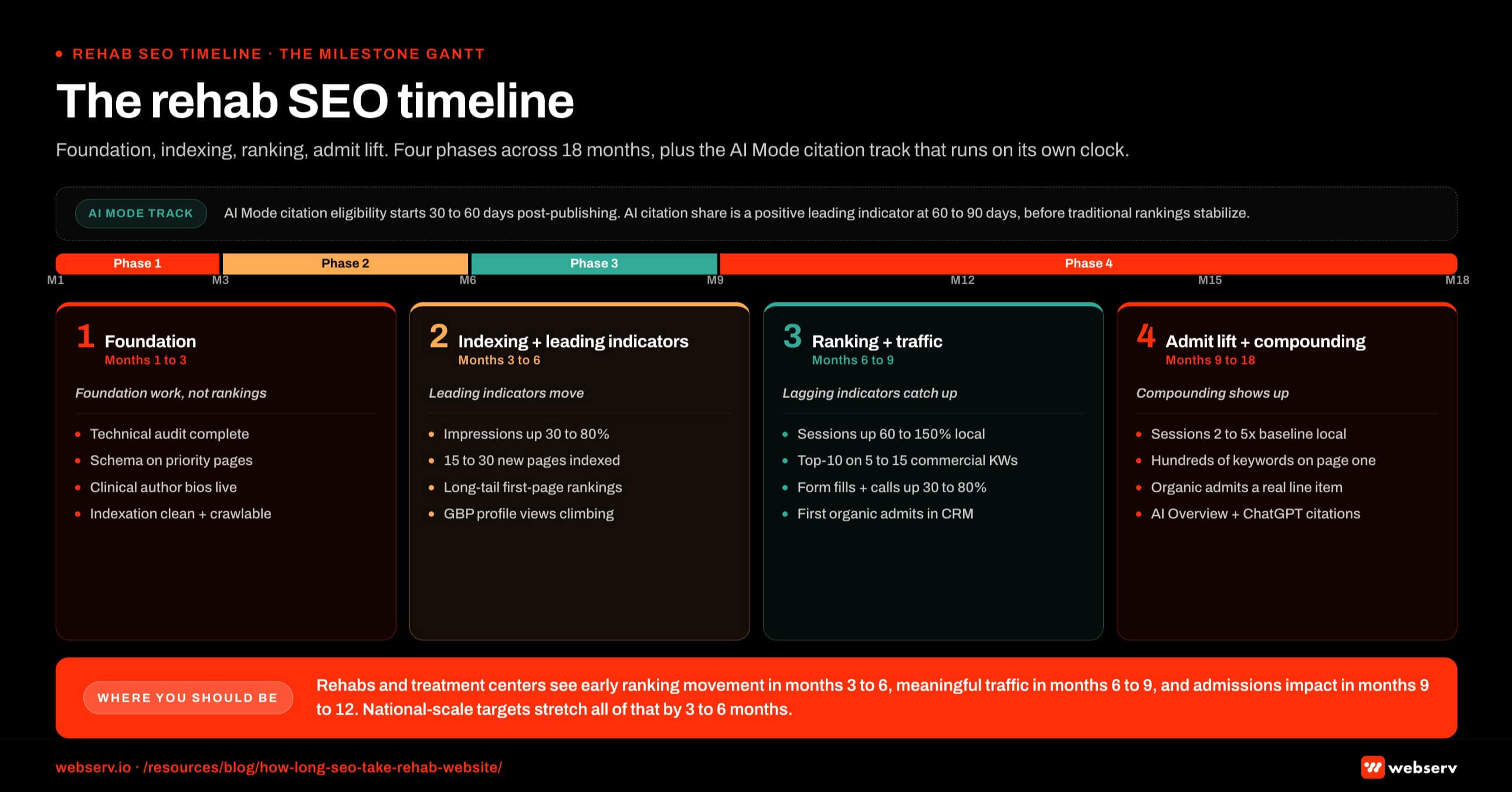 Infographic titled ‘The rehab SEO timeline’.
This includes a full technical audit (Core Web Vitals, crawl errors, indexation issues, redirect chains, broken internal links). A content gap analysis against your top three competitors.
Schema markup implementation on your priority pages. An author bio rollout for any clinical content. And a Google Business Profile audit if local visibility is part of the program.
Our pre-launch SEO checklist for behavioral health websites walks through the technical foundation in more detail, and it applies retroactively to any existing rehab site that hasn’t been audited recently.
The reason rankings don’t move in month one is mechanical. Google has to crawl your site, re-index pages with new schema and content, and reassess your overall topical authority before it adjusts your positions.
Per Google’s documentation on how Search works, this process happens continuously, but the visible ranking shifts lag the crawl by weeks.
If your agency is reporting “ranking improvements” in week three, you should ask which keywords moved and from what starting position. Movement from position 87 to position 62 is mathematically a ranking improvement but operationally meaningless.
Real movement in 30 days happens only on terms you were already ranking near page two.
The right deliverable to expect at the 30-day mark is a technical audit report, a content roadmap for the next 90 days, the first round of clinical author bios going live, and confirmation that your site is fully indexed and crawlable.
The 90-Day Mark: Leading Indicators Start to Move
Between days 30 and 90, the early leading indicators should start to move. Impressions in Google Search Console climb steadily, indexed page count grows, GBP profile actions increase, and you begin seeing ranking improvements on lower-competition long-tail keywords.
A few specific things you should see by month three:
- Impressions up 30 to 80 percent versus baseline. This means Google is showing your pages for more queries, even if the clicks haven’t followed yet.
- 15 to 30 new pages indexed, assuming a content cadence of 4 to 10 pages per month.
- First-page rankings on long-tail terms like “what to expect at IOP in [city]” or “does insurance cover detox at [facility name],” even if the head terms haven’t moved.
- GBP profile views up materially for local programs, with first-page rankings in the local pack on a handful of “rehab near me” variations.
What you shouldn’t see yet is dramatic traffic growth or admissions impact. That’s normal. The 90-day mark is when an agency that knows what they’re doing can show you that the machine is working, even if the machine hasn’t produced the revenue yet.
This is also the milestone where the order of work starts to matter. Programs that built service pages before blog content typically show earlier traffic-to-admissions correlation because the pages ranking are the pages that actually convert.
Programs that started with a blog-first strategy see traffic move first and conversions lag.
If you’re at month three with no impression growth, no new indexed pages, and no movement on long-tail terms, something is genuinely wrong. That’s the right time to push the agency for an explanation, not month four.
The 180-Day Mark: Lagging Indicators Show Up
Months four through six are when the lagging indicators start to catch up. Rankings on commercial-intent keywords (the terms that drive admissions) begin moving toward the top half of page one, organic sessions climb materially, and the conversion data starts to show real signal.
By the 180-day mark, a healthy rehab SEO program should show:
- Organic sessions up 60 to 150 percent versus baseline for local programs, and 40 to 90 percent for national programs.
- Top-10 rankings on at least 5 to 15 commercial-intent keywords like “IOP in [city],” “[modality] in [state],” “alcohol rehab [neighborhood].”
- Organic form fills and call volume climbing in a measurable way, ideally 30 to 80 percent above baseline.
- Initial admissions attributable to organic appearing in the CRM data, though usually still a small share of total.
The variance at month six is wide because facility conditions vary enormously. A site that started with strong foundations may already be tracking toward 200+ percent traffic growth. A site that needed 90 days of technical cleanup before any content investment could compound is just beginning to see ranking lift.
The honest truth at this stage is that you can see whether the program is working without yet seeing whether it’s worth the spend.
The leading indicators tell you the engine is running. The lagging indicators that matter for ROI (admissions, cost-per-admit, blended CAC) usually need another 90 to 180 days to express clearly.
This is also typically when topical authority starts to show up in search behavior. You begin ranking for queries you didn’t specifically target because Google has classified your site as authoritative within behavioral health. That’s the most reliable signal that the foundation work is paying off.
The 365-Day Mark: The Compounding Phase
The 365-day mark is where compounding becomes obvious. Rankings stabilize across hundreds of commercial keywords, organic traffic settles into a predictable monthly band, and admissions attributed to organic become a real line item in your monthly board report.
A mature 12-month rehab SEO program typically shows:
- Organic sessions 2 to 5x baseline for local programs, 2 to 4x for regional, 1.5 to 3x for national.
- Hundreds of keywords on page one, including a meaningful share on page-one positions 1 through 3.
- Organic-attributed admissions producing a quantifiable monthly contribution that justifies the retainer cost on a clean cost-per-admit basis.
- Conversion infrastructure refined through 12 months of CRO testing on the highest-traffic landing pages.
Compounding is the part that buyers don’t appreciate until they’ve lived through it. The pages that ranked at month nine continue earning traffic at month thirteen, fourteen, fifteen, and they don’t cost more to maintain.
The ROI curve gets steeper over time, not shallower, because each new ranked page is additive to an asset base that doesn’t depreciate the way ad spend does.
This is also when you should expect to see your pages cited in AI Overviews and ChatGPT answers for the high-intent queries that drive admissions, assuming the program was structured for citation eligibility from the start.
A rehab SEO program at month four looks identical to a failed one. So does a successful program at month nine. The difference shows up in the leading indicators, not the headline metrics. If your agency cannot explain what they’re seeing in impressions, indexed pages, and long-tail rankings at month four, the problem is communication, not SEO.
Trevor Gage, Director of SEO at Webserv
Variables That Compress or Stretch the Timeline
Two rehab websites starting SEO on the same day can have wildly different 12-month outcomes. Five variables explain almost all of the difference.
 Infographic titled ‘Five variables that compress or stretch the timeline’.
Domain age and existing authority. A facility that’s been live for five years with a clean backlink profile compounds faster than a one-year-old domain.
New domains often experience the so-called sandbox effect, where rankings move slowly for the first 6 to 9 months while Google evaluates trustworthiness.
Existing content depth. A site with 40 well-built service and condition pages already indexed has a head start on a site with 8 thin pages. The first 90 days of content investment on a thin site is catch-up work, not growth work.
Market competitiveness. A facility competing in Sacramento, Atlanta, or Bismarck sees results in a fraction of the time it takes a facility competing in Malibu, Phoenix, or West Palm Beach.
The SERP for “drug rehab Malibu” includes seven established luxury brands with combined link profiles in the thousands. Catching up takes time.
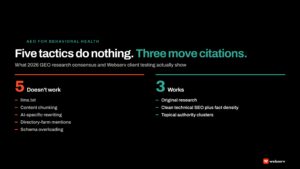
Content velocity and quality. A program publishing 4 to 8 well-built clinical pages per month moves materially faster than one publishing 2 thin pages.
There’s also a quality floor below which content velocity stops mattering. 12 AI-mill pages per month with no clinical review compounds slower than 2 high-quality pages reviewed by a credentialed clinician.
Technical foundation cleanliness. A site with a Core Web Vitals score in the green, no crawl errors, and clean indexation starts ranking faster than one with thousands of redirect chains, broken canonical tags, and 600 duplicate pages.
The mobile-first indexing reality means that mobile UX failures specifically delay timeline expression.
A facility that scores well on all five variables can see meaningful results in 4 to 6 months. A facility that scores poorly on all five can need 12 to 18 months just to reach the inflection point where compounding begins.
The AI Mode Citation Timeline (Post-I/O 2026)
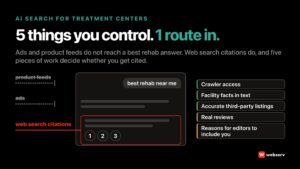
The Google I/O 2026 announcements introduced a second timeline that operates alongside traditional SEO. AI Mode and AI Overviews extract citations from pages structured to answer compound questions, and that extraction happens on a different curve than blue-link rankings.
The practical implication: pages built for fan-out query mechanics can show up as citations in AI Mode answers within 30 to 60 days of publishing, well before they crack page one of traditional search results.
What that means for your timeline expectations:
- AI citation share can become a positive leading indicator at 60 to 90 days, before traditional rankings show meaningful lift.
- Pages cited in AI Overviews drive a different traffic profile than blue-link clicks: lower volume, higher intent, and noticeably better admission-to-inquiry rates in early Webserv data.
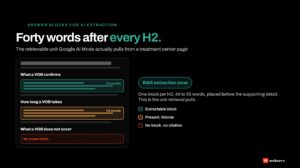
- The AI Mode timeline rewards structure as much as authority. A well-structured page on a moderately authoritative site can earn citations a senior page on a high-authority site misses because of poor compound-answer structure.
This changes how you should evaluate an SEO program at the 90-day and 180-day marks. If the agency is only tracking traditional rank metrics and not tracking AI citation share, they’re measuring last decade’s outputs and missing the earliest positive signal of program quality.
 Infographic titled ‘What to expect each quarter’.
When to Declare Failure
REAL FAILURE SIGNAL
There is a difference between an SEO program that is behind schedule and one that has actually failed. Month 3 with flat impressions and no growth in the indexed page count means the foundation work is not happening. Month 6 with leading indicators moving but zero movement on commercial keywords means the content strategy is targeting the wrong terms. Month 9 with no admissions attribution means the tracking is broken, the content does not match intent, or both. Any of these three signals is grounds for a formal program review, not another 90 days of patience.
There’s a difference between an SEO program that’s behind schedule and one that’s failing. The signs of an actually failing program are specific and identifiable.
Month 3 with no leading indicator movement. If impressions are flat, the indexed page count hasn’t grown, and there’s no movement on long-tail rankings, the foundation work isn’t happening. This is a real failure signal.
Month 6 with no commercial keyword movement. If you have leading indicator growth but no movement on commercial-intent keywords (the terms that actually drive admissions), the content strategy is targeting the wrong terms. This is recoverable but only if the agency can articulate a clear pivot.
Month 9 with no admissions impact and no clear attribution. If you can’t tell whether organic is producing admissions at month 9, the attribution stack was never built. This compounds: another six months of work without attribution doesn’t get you closer to ROI clarity.
Any month with no honest weekly reporting. An agency that defaults to monthly slide decks instead of weekly check-ins on what they’re seeing is operating in marketing mode, not operator mode. That’s a culture problem that doesn’t fix itself with more time.
The decision tree we use internally with clients who are at the four-to-six-month nervousness point breaks into three checks.
Review the leading indicators against benchmarks. Ask whether the agency has a clear and credible explanation for the variance. And assess whether the underlying SEO investment level matches the market competitiveness of the targets.
If two of those three are wrong, switch agencies. If only one is off, give it another 90 days with explicit milestone accountability.
Frequently Asked Questions
How long does SEO take to show results for a rehab website?
Most rehab websites see leading indicator movement (impressions, long-tail rankings, GBP visibility) in 3 to 6 months, meaningful organic traffic lift in 6 to 9 months, and admissions impact in 9 to 12 months. National-scale programs targeting more competitive keywords typically need 12 to 18 months for full expression.
The variance is driven by your site’s starting position, market competitiveness, content velocity, and the cleanliness of your technical foundation. Sites with strong existing authority and clean technical health see results faster than new domains or sites with significant cleanup work to do.
Programs that promise dramatic rankings or traffic shifts in 90 days are almost always selling either a one-time cleanup project (which can produce real short-term wins) or a content-mill operation that won’t compound.
Can SEO produce rehab admissions in the first 90 days?
Direct admissions from SEO in the first 90 days are rare but not impossible. They happen most often on facilities with strong existing brand awareness, a few high-converting service pages already ranking near page two, and an immediate Google Business Profile optimization push that surfaces the facility in local pack results.
For most rehab sites, the first 90 days are foundation work. Indexation, schema implementation, technical cleanup, content gap analysis, and the start of authority-building. Admissions attributed to organic typically show up between months 6 and 9, and the meaningful share of total admissions usually doesn’t materialize until months 9 to 12.
If your agency is forecasting admissions inside the first 90 days, ask for the specific mechanism: which page, which keyword, which conversion path. A credible answer is a sign of a well-structured program. A vague answer is a sales pitch.
Does SEO take longer for rehab sites than for other industries?
Yes. Behavioral health and addiction treatment sit inside Google’s Your Money or Your Life (YMYL) category, and Google’s Search Quality Rater Guidelines apply the highest content-quality bar to pages that could affect health, financial stability, or safety.
That single fact stretches the timeline by 30 to 60 percent versus generic local service business SEO. Content needs clinical review, author bios need credential signaling, and Google’s algorithms apply additional trust evaluation before content ranks.
A roofing company can see meaningful organic results in 4 to 6 months. A rehab typically needs 6 to 9 months for equivalent ranking lift on comparably competitive terms. This is part of why the cheapest tier of rehab SEO retainers (sub-$2,000 per month) almost never works. The content depth required to earn YMYL trust signals isn’t producible at that price point.
How do I know if my rehab SEO program is on track at month 4?
At month 4, the right metrics to evaluate are leading indicators, not headline traffic or admissions.
Specifically: impressions growth in Google Search Console (target: 30 to 80 percent above baseline), indexed page count growth (target: 15 to 30 new pages), ranking improvements on long-tail commercial keywords (target: 10 to 25 keywords moving into top 30), and Google Business Profile views and actions trending up.
If all four leading indicators are flat or down at month 4, the foundation work isn’t happening and the program is genuinely behind. If three of the four are moving but headline traffic is flat, the program is on track and just needs another 60 to 90 days for the lagging indicators to express. The biggest mistake executives make at month 4 is judging the program on rankings or traffic alone.
What’s the fastest way to compress my rehab SEO timeline?
Four moves compress the timeline more than anything else. First, fix the technical foundation before adding content. A site with crawl errors, slow Core Web Vitals, and broken internal links wastes the first 3 months of any content investment on catch-up work.
Second, build service pages before blog content. The service pages convert. The blog content drives top-of-funnel traffic that hands off to service pages. Building in the wrong order delays admissions impact by 60 to 90 days even on a strong content cadence. Third, invest in real link acquisition from month one, not month six.
Fourth, build the attribution stack before you need it. Sites that wait until month 9 to instrument CallRail, CRM tagging, and UTM tracking lose the early signal that would have proven the program was working. Our deep dive on landing page optimization for addiction treatment covers the conversion infrastructure side of the same equation.
Build a Predictable Organic Channel for Your Treatment Center
The right timeline for your rehab SEO program depends on your starting position, your competitive market, your content velocity, and the cleanliness of your technical foundation. None of those have a generic answer.
We work with treatment center groups across the country to build organic programs that connect directly to admissions, with milestone-based reporting that tells you what you should see at month three, month six, and month twelve before the work even starts.
Schedule a site audit and milestone review to get a real timeline forecast for your facility, with the leading and lagging indicators that should move at each stage and the variables that will compress or stretch your specific curve.
For the wider picture of how SEO fits inside a full treatment center marketing program, see our ultimate guide to behavioral health marketing.
Trevor Gage is Director of SEO at Webserv, where he leads organic strategy for behavioral health and addiction treatment centers across the U.S. He writes about treatment-center SEO economics, AI search citation, and the operational realities of marketing high-acuity healthcare.