The content model most treatment center marketing teams still run on is broken. One article, one primary keyword, ranking position tracked as the KPI. This model worked when Google returned ten blue links and a user picked one.
It does not work in a world where AI Mode handles roughly 40 percent of Google queries and Google AI Overviews appear in ~48 percent of searches.
The new model is compound-prompt content. Behavioral health prospects rarely search for one thing anymore. They enter a natural-language question, and Google’s AI Mode generates a fan-out of related sub-queries it runs internally before assembling an answer. That compound-prompt architecture is what our authority content program at Webserv is now built to serve.
The article that satisfies all of the sub-queries gets cited across the fan-out. The article that satisfies only the primary keyword gets skipped, even if it would have ranked position one under the old model.
This article walks the shift in how authority content should be structured for behavioral health treatment centers.
It covers what compound prompts are, why the single-keyword model broke, how to identify the compound prompt behind a search intent, the 5-step framework for writing content that satisfies compound prompts, and how citation share replaced rank position as the measurement that matters.
Key Takeaways
- Google I/O 2026 confirmed AI Mode as the default search surface, powered by Gemini 3.5 Flash. AI Mode generates a fan-out of sub-queries from a single user prompt, then assembles an answer that cites content satisfying those sub-queries. Content built for one keyword rarely satisfies the full fan-out.
- The old single-keyword content model rewarded rank position 1-5. The new compound-prompt model rewards citation share across AI-generated sub-queries. Rank position 2-5 has been reframed as AI citation eligibility rather than as click-through position.
- Compound prompts are the natural-language questions prospects actually ask. Not “opioid treatment,” but “what are the best treatment options for opioid addiction near me, and how do I know a facility is legitimate.” The old keyword was a component; the new compound prompt is the full question.
- Content that satisfies compound prompts has specific structural characteristics: H2 sections that each answer a discrete sub-query, data tables AI can extract, named clinical POV AI can cite, FAQ sections mirroring common sub-questions, and internal links to cluster siblings covering adjacent sub-queries.
- The measurement that matters is citation share across ChatGPT, Claude, Perplexity, and Google AI Mode, not rank position on individual keywords. The measurement is still manual (no fully automated tool exists as of mid-2026), which is why most treatment centers are not measuring it.
- Behavioral health is a category where compound-prompt content pays back disproportionately, because prospects and families researching treatment options ask compound questions more heavily than in most consumer categories.
What Compound Prompts Actually Are
DEFINITION
Compound Prompt
A natural-language question that contains multiple sub-questions the AI must answer to give a satisfactory response. Compound prompts became the default query type when Google I/O 2026 confirmed AI Mode as the primary search surface. Where a traditional Google search was often one to three words targeting a specific keyword, a compound prompt is a full sentence encoding multiple criteria simultaneously: intent, location, qualifier, comparison, decision factor. AI Mode’s response to a compound prompt is not a list of links; it is an assembled answer citing content across multiple sub-queries the AI ran internally.
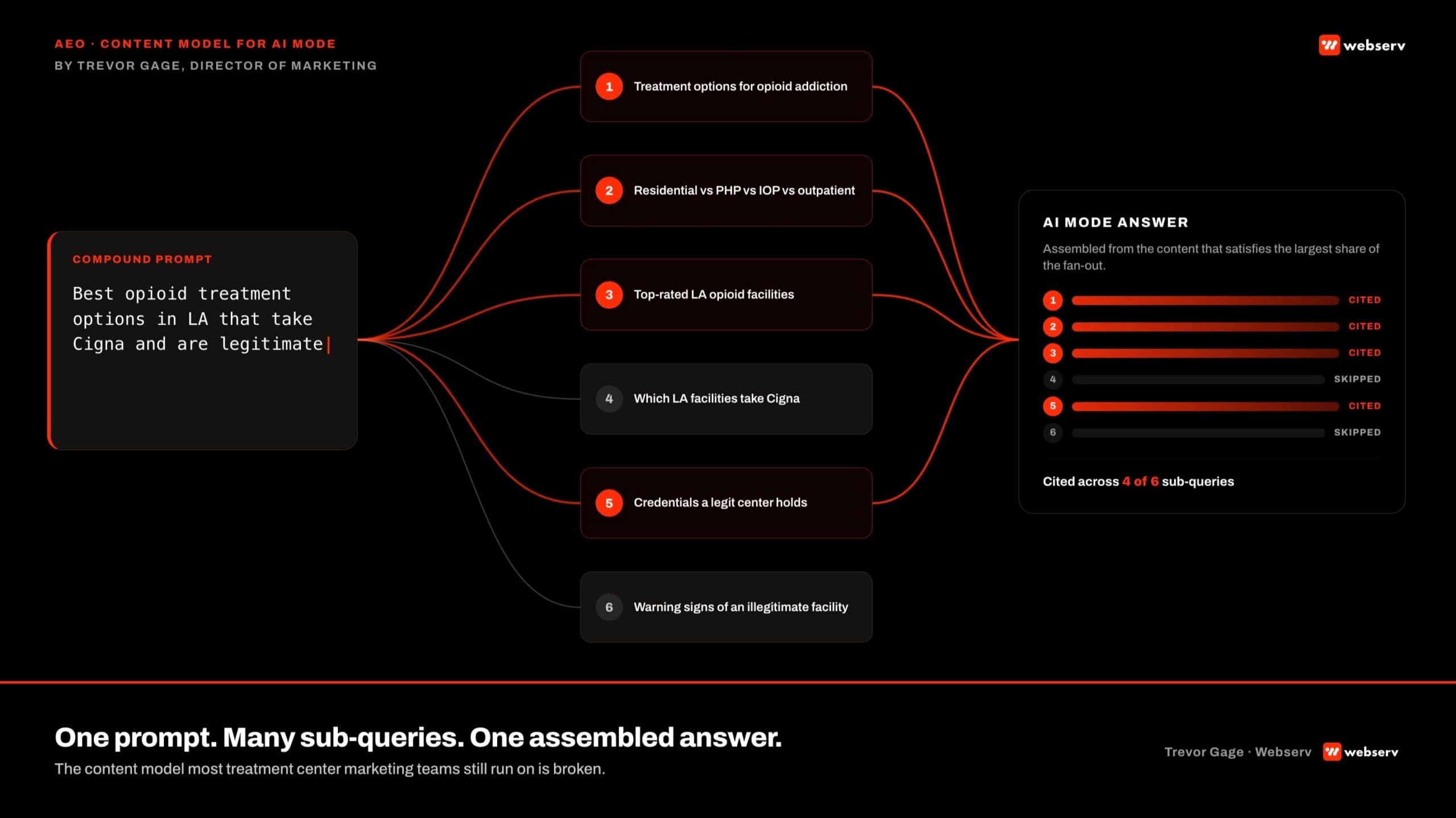
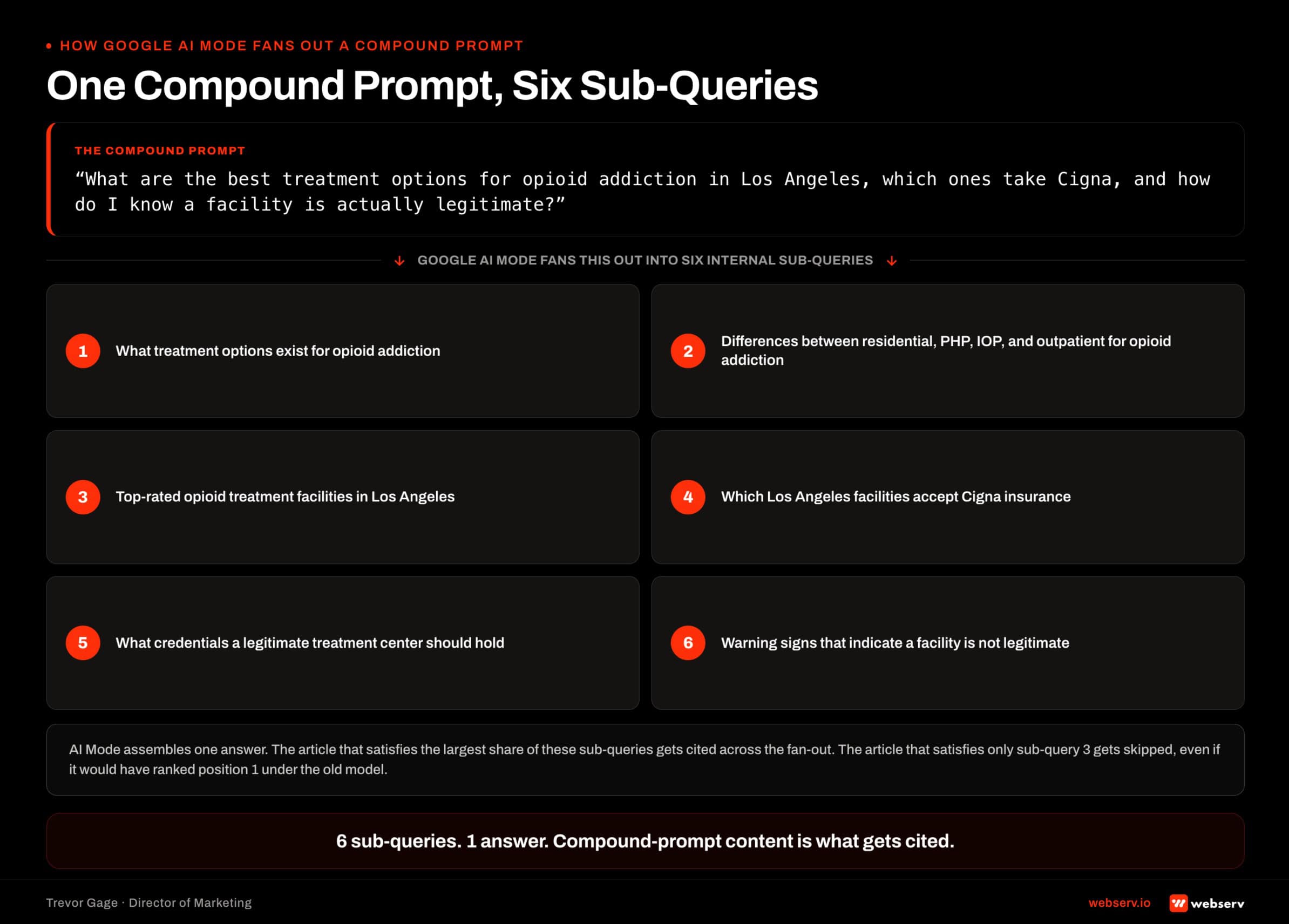 The canonical behavioral health compound prompt about opioid treatment options in Los Angeles that accept Cigna and are legitimate, fanning out into the six internal sub-queries Google AI Mode runs, showing how the article satisfying the largest share of the fan-out gets cited, not the article that ranks position one on the primary keyword alone.
The shift is easiest to see through an example. A prospect researching treatment options in 2024 might have searched “opioid rehab Los Angeles” and evaluated the ten blue links Google returned.
The same prospect in 2026 is likely to ask AI Mode: “what are the best treatment options for opioid addiction in Los Angeles, which ones take Cigna, and how do I know a facility is actually legitimate.”
Google AI Mode responds to that compound prompt by generating a fan-out of internal sub-queries:
- What treatment options exist for opioid addiction
- What are the differences between residential, PHP, IOP, and outpatient for opioid addiction
- What are the top-rated opioid treatment facilities in Los Angeles
- Which Los Angeles facilities accept Cigna insurance
- What credentials should a legitimate treatment center hold
- What warning signs indicate a facility is not legitimate
The response AI Mode assembles pulls from content that satisfies each of these sub-queries. If your treatment center has an article that ranks well for “opioid rehab Los Angeles” but does not address any of the other sub-queries, the article does not appear in the AI Mode response.
A less-well-ranking article that covers all six sub-queries substantively gets cited across the fan-out.
Why the Single-Keyword Model Broke
The old SEO content model was designed for a Google that returned ten blue links. Under that model, one article targeted one primary keyword, secondary keywords supported the primary, and success was measured by rank position on the primary keyword.
Position 1 got the click. Position 2-5 got a smaller click. Position 6-10 got very little. Position 11+ got nothing.
~48%
of Google searches now include AI Overviews (up from ~14% in Dec 2025)
~40%
of Google queries now handled by AI Mode (March 2026 update baseline)
up to 61%
organic CTR drop on pages beneath AI Overviews with prominent citations
The new model changes what “winning” looks like. Position 1 in the traditional listings still exists, but the CTR on that position has dropped materially because AI Overviews now sit above it.
Position 2-5, which used to be a smaller consolation prize, is now reframed as the AI citation zone.
Search Engine Land documented the specific changes in the May 2026 AI Overviews update, and Google’s own Search Central documentation on AI features in Search covers the underlying mechanics of how AI Mode composes responses from indexed sources. Pages that rank in positions 2-5 for a keyword are the pages AI Mode most often cites when generating answers to compound prompts that include that keyword.
The optimization target has moved. The goal is no longer to rank number one for one keyword. The goal is to be citable across the fan-out of sub-queries a compound prompt generates.
What Behavioral Health Compound Prompts Look Like
BEHAVIORAL HEALTH PROSPECTS USE COMPOUND PROMPTS MORE HEAVILY THAN MOST CATEGORIES
The decision to enter treatment is complex, family-mediated, and financially significant. Prospects and family members researching options ask multi-faceted questions that encode multiple decision criteria simultaneously. Treatment center content designed for single keywords misses the full research pattern these prospects use. Family-research prompts especially skew compound because family members are trying to answer multiple questions at once.
The compound prompts that surface most often in behavioral health searches:
- “Best rehab centers for [specific substance] near [location]”
- “Does [insurance carrier] cover [level of care] treatment”
- “How do I know if my son needs residential or outpatient treatment”
- “What is the difference between [treatment approach A] and [treatment approach B] for [condition]”
- “How much does treatment cost with [insurance] and how long does it take”
- “Is [facility name] legitimate and what do former patients say about it”
Each of these compound prompts spawns 4 to 8 sub-queries when AI Mode processes them. A treatment center article that covers all of the sub-queries substantively becomes the citable source across the fan-out. An article that covers only the primary intent gets skipped.
The 5-Step Framework for Compound-Prompt Content
- Identify the Compound Prompt. Not the keyword. The full natural-language question a prospect would actually ask. If the marketing team is still starting from a keyword research spreadsheet, that is the sign the process is still on the old model. Start from the compound prompt and derive the keywords, not the other way around.
- Run Query Fan-Out. For each compound prompt, list the 4-8 sub-queries AI Mode is likely to generate internally. This can be done manually (write out the sub-questions embedded in the compound prompt) or with a fan-out tool that simulates AI query expansion. The output is the map of what the article needs to cover.
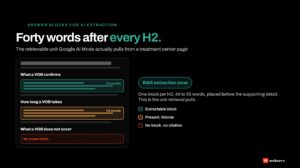
- Structure Content to Satisfy Each Sub-Query. H2 sections that each address a discrete sub-query. Do not blend multiple sub-queries into a single section; AI Mode’s citation logic prefers clearly-scoped sections. Each H2 gets 300-500 words of substantive content answering that specific sub-query.
- Include Citable Data and Named Clinical Authorship. AI assistants weight citable elements heavily: data tables, specific numbers, named clinicians with credentials, verified citations to authoritative sources. Every article should include at least one data table AI can extract and at least one named clinical POV AI can attribute.
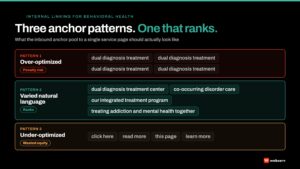
- Link Internally to Cluster Siblings. One article rarely covers a full compound prompt with the depth AI needs. Link to 3-5 cluster siblings that cover adjacent sub-queries. AI Mode weighs internal linking as part of topical authority signal, and the cluster becomes the citation-eligible unit rather than the individual article.
The 5-step framework produces articles that are typically 2,000 to 3,500 words, cover 5 to 8 discrete sub-queries in dedicated H2 sections, and include named clinical authorship plus at least one citable data element.
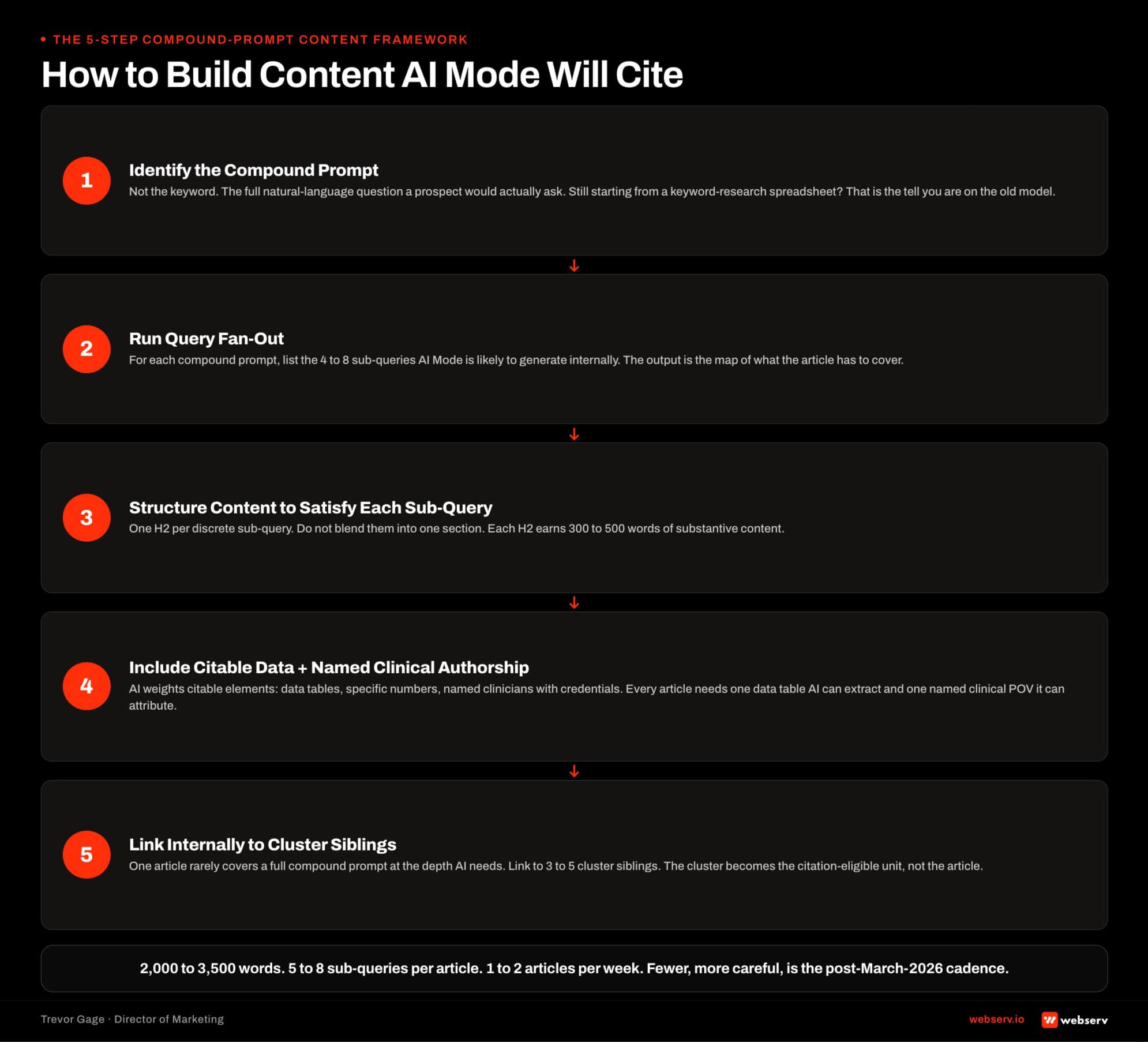 The five-step Webserv framework for compound-prompt content, identify the full natural-language compound prompt, run the query fan-out, structure H2 sections to satisfy each discrete sub-query, include citable data tables with named clinical POV, and link internally to cluster siblings covering adjacent sub-queries, with a 1-to-2-articles-per-week cadence banner.
This is more work per article than the old model. The trade-off is that each article does the work of what used to require three or four single-keyword articles under the old model.
What Compound-Prompt Content Looks Like Structurally
DEFINITION
Query Fan-Out
The process by which Google’s AI Mode (and other AI assistants) expand a single user prompt into multiple internal sub-queries that are executed against the search index to gather the source material for an assembled answer. A compound prompt of “best opioid treatment options in Los Angeles that take Cigna” might fan out into 6-8 internal sub-queries the AI runs, each retrieving relevant content. The article that satisfies the largest share of these sub-queries substantively gets cited most heavily in the final assembled answer.
The structural characteristics of content that satisfies compound prompts:
H2 sections mapped to sub-queries. Each major section answers a discrete sub-question. Section headings often mirror the exact language of the sub-query. “How to Verify a Treatment Center’s Legitimacy” as a section works better than “Trust Factors in Treatment Center Selection” because AI Mode matches semantic intent between the section heading and the internal sub-query.
Data tables AI can extract. Structured data (level-of-care cost ranges, insurance coverage percentages, treatment duration benchmarks) that AI assistants can pull into their responses directly. Tables get cited more than prose because they are extractable.
Named clinical POV. A named medical director or clinical director quoted or credited with specific clinical claims. Google’s Creating Helpful, Reliable, People-First Content guidance weights named-expert content heavily for YMYL topics. Anonymous or generic content does not carry the same signal.
FAQ sections that mirror sub-queries. The FAQ section is where you address the sub-queries that did not warrant a full H2 section but still matter to the compound prompt. Each FAQ Q&A is an atomic unit AI Mode can extract.
Internal links to cluster siblings. One article covers 5-8 sub-queries. The cluster covers 20-40. Link the cluster together so AI Mode reads the whole cluster as one topical authority.
How This Differs From Traditional SEO Content
COMPOUND-PROMPT CONTENT PATTERNS
- 2,000-3,500 word articles covering 5-8 sub-queries in dedicated H2 sections
- H2 headings that mirror the actual sub-questions prospects ask
- Data tables, benchmarks, and specific numbers that AI assistants can extract
- Named clinical POV credited to real named clinicians with visible credentials
- Cluster of 5-15 articles covering related sub-queries, cross-linked internally
SINGLE-KEYWORD CONTENT PATTERNS THAT NO LONGER COMPETE
- 1,500-word articles targeting one primary keyword with keyword density optimization
- H2 headings designed for keyword optimization rather than natural-language questions
- Prose-only content with no citable structured elements
- Anonymous ‘medical team reviewed’ credit with no named individual
- Standalone articles that do not link to related content on the same site
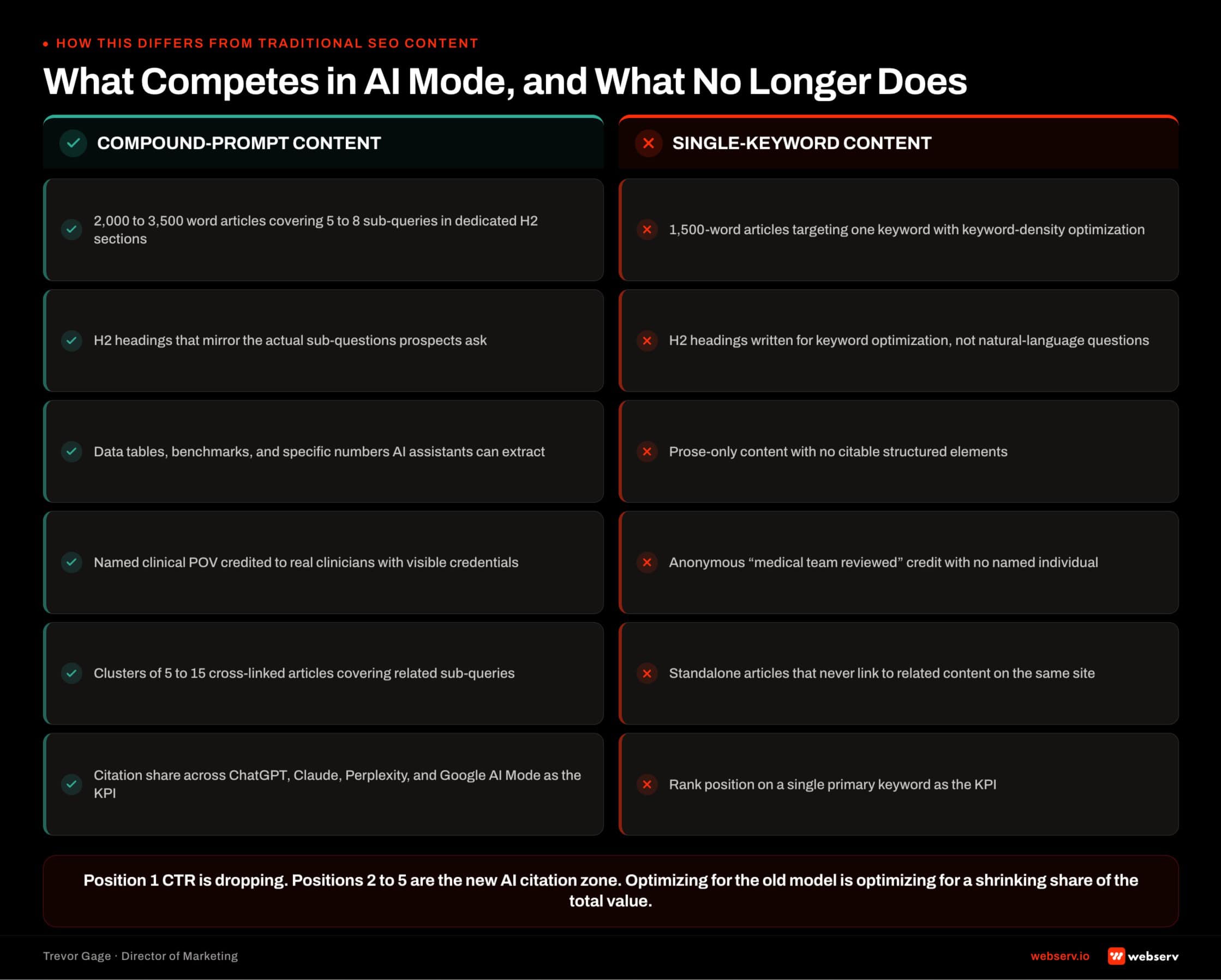 Side-by-side comparison of six behavioral health content patterns that compete in Google AI Mode’s compound-prompt world, 2,000-3,500 word articles covering 5-8 sub-queries in dedicated H2 sections, natural-language H2 headings, citable data tables, named clinical POV, cluster cross-linking, and citation-share KPIs, versus six single-keyword patterns that no longer compete.
The old model is not dead. Articles that follow the old model still rank on some keywords and produce some traffic.
The problem is that the rank position that matters most (position 1) has a materially lower CTR than it did two years ago, and the rank positions that used to be second-tier (2-5) are now the AI citation zone rather than the click zone.
Optimizing for the old model is optimizing for a shrinking share of the total value.
Citation Share Is the New KPI
RANK POSITION IS A PARTIAL METRIC NOW; CITATION SHARE IS THE METRIC THAT REFLECTS THE ACTUAL VALUE
Citation share means how often your content is cited when ChatGPT, Claude, Perplexity, and Google AI Mode answer queries relevant to your business. A treatment center whose content is cited in 40 percent of relevant AI-assistant queries is winning even if it does not hold position 1 on the traditional listings. A treatment center that holds position 1 but is never cited by AI assistants is losing traffic, credibility, and eventually admits, even though the rank-tracking tool says the site is winning.
Measuring citation share is currently manual work. No fully-productionized tool tracks AI citation share automatically as of mid-2026. Third-party tools are building this capability but nothing is complete. The manual approach:
Weekly manual query set. 15 to 25 compound prompts that matter for the treatment center’s business. Facility name + reputation queries, level-of-care queries in target markets, comparative queries with named competitors, condition-specific queries in the facility’s clinical scope.
Run each query in ChatGPT, Claude, Perplexity, and Google (for AI Mode/AI Overviews). Note whether the treatment center’s content is cited, which specific article or page, and where in the response.
Track over time. A week-over-week trend line on citation share tells you whether the content strategy is working. Individual query results are noisy; the trend is where the signal is.
This is the measurement Webserv now runs weekly for all AEO engagements. The manual overhead is 3 to 5 hours per week for a treatment center of moderate scale. It is not automation-ready yet, but it is defensible.
Getting Started With Compound-Prompt Content
Treatment centers migrating from the old single-keyword model to compound-prompt content should sequence the work in three phases.
Phase 1 (30 days). Identify the 20 to 40 compound prompts that matter most for the treatment center’s business. Not keywords. Full natural-language questions. Prioritize by prospect intent (family research, insurance verification, decision-stage, brand-name searches) and by traffic value.
Phase 2 (60-90 days). Rewrite or newly produce 5 to 10 flagship articles that satisfy the highest-priority compound prompts using the 5-step framework. Named clinical authorship, data tables, cluster linking, FAQ sections that mirror the sub-queries. These become the anchor content for the new model.
Phase 3 (90-180 days). Backfill existing content to add compound-prompt characteristics. Retitle sections, add data tables, add FAQ blocks, add internal cluster linking. Existing content that was ranking under the old model can often be retrofitted rather than replaced.
The compounding pattern shows up in months 4 through 12. Sites that commit to the compound-prompt model early establish citation share ahead of competitors still running the old model.
The gap widens as AI Mode’s share of query volume continues to grow. Book an intro meeting if you want to walk your current content model against the compound-prompt framework.
Frequently Asked Questions
For the broader content strategy this fits into, see keyword strategy for rehab providers and clinical content Google trusts.
Do we need to abandon our old keyword-focused content?
No. Content ranking under the old model is still producing some value. What changes is what you produce going forward and how you refresh existing content.
The right approach is a hybrid transition. New content follows the compound-prompt framework. Existing content gets audited for compound-prompt characteristics and retrofitted where it makes sense. High-traffic articles that are ranking but not being cited by AI assistants are the priority for retrofit.
The exception is content that Google’s March 2026 algorithm update devalued heavily. That content should typically be rewritten from scratch rather than retrofitted, because the underlying quality signals were what got it penalized and cosmetic changes will not restore them.
How do we identify compound prompts if we do not have direct customer research?
Three sources produce useful compound-prompt discovery. First, listen to the admissions team. What questions do prospects and families actually ask on the phone? The verbatim language they use is the compound prompt in its natural form.
Second, look at Reddit and other forums where behavioral health prospects post questions. Full-sentence questions on r/addiction, r/mentalhealth, r/AlAnon, and condition-specific subreddits are compound prompts by definition. Our Reddit-for-rehabs playbook walks the community mapping side of this.
Third, use AI assistants themselves. Ask ChatGPT or Claude “what are the most common compound questions someone would ask when researching addiction treatment for a family member” and evaluate the response as a starting point for your own compound-prompt list. Do not accept the AI’s output as final; use it as a research prompt.
How long does a compound-prompt article take to produce?
Between 20 and 40 hours per article for the full workflow. Longer than the old single-keyword article, which typically ran 12 to 20 hours.
The additional time covers: compound-prompt identification (2-3 hours), query fan-out mapping (1-2 hours), extended structural planning (2-3 hours), producing 2,000-3,500 words instead of 1,500 (additional 4-8 hours), and clinical review with data table and citation verification (3-5 additional hours per the Clinical Review Workflow standard).
The efficiency logic works because each compound-prompt article does the citation work of what used to require three or four single-keyword articles. Fewer articles, produced more carefully, is the sustainable post-March-2026 cadence.
The 4 to 6 articles per week volume that some treatment centers were producing before the algorithm updates is not viable at the compound-prompt level. The right cadence is 1 to 2 articles per week with full compound-prompt structure.
Consolidating to fewer higher-quality articles almost always produces better ranking and citation results within 90 to 180 days than the higher-volume approach ever did.
How does this fit with the Expert Advice block from AI Overviews?
The Expert Advice block (introduced in Google’s May 2026 AI Overviews update) is one of the several output surfaces where compound-prompt content gets cited.
When AI Mode assembles an answer to a compound prompt, part of that answer may pull from the treatment center’s site (compound-prompt content territory), part may pull from forums like Reddit (Expert Advice block territory), and part may pull from authoritative sources like Google Business Profile listings or accreditation directories.
Treatment centers optimizing for the full AI answer surface need to think about all three streams: their own compound-prompt content on the treatment center site, their named clinicians’ participation in relevant Reddit and forum communities, and their accurate presence in authority directories. No single stream is sufficient. All three compound.
Trevor Gage is the Director of Marketing at Webserv, a digital marketing agency for treatment centers.