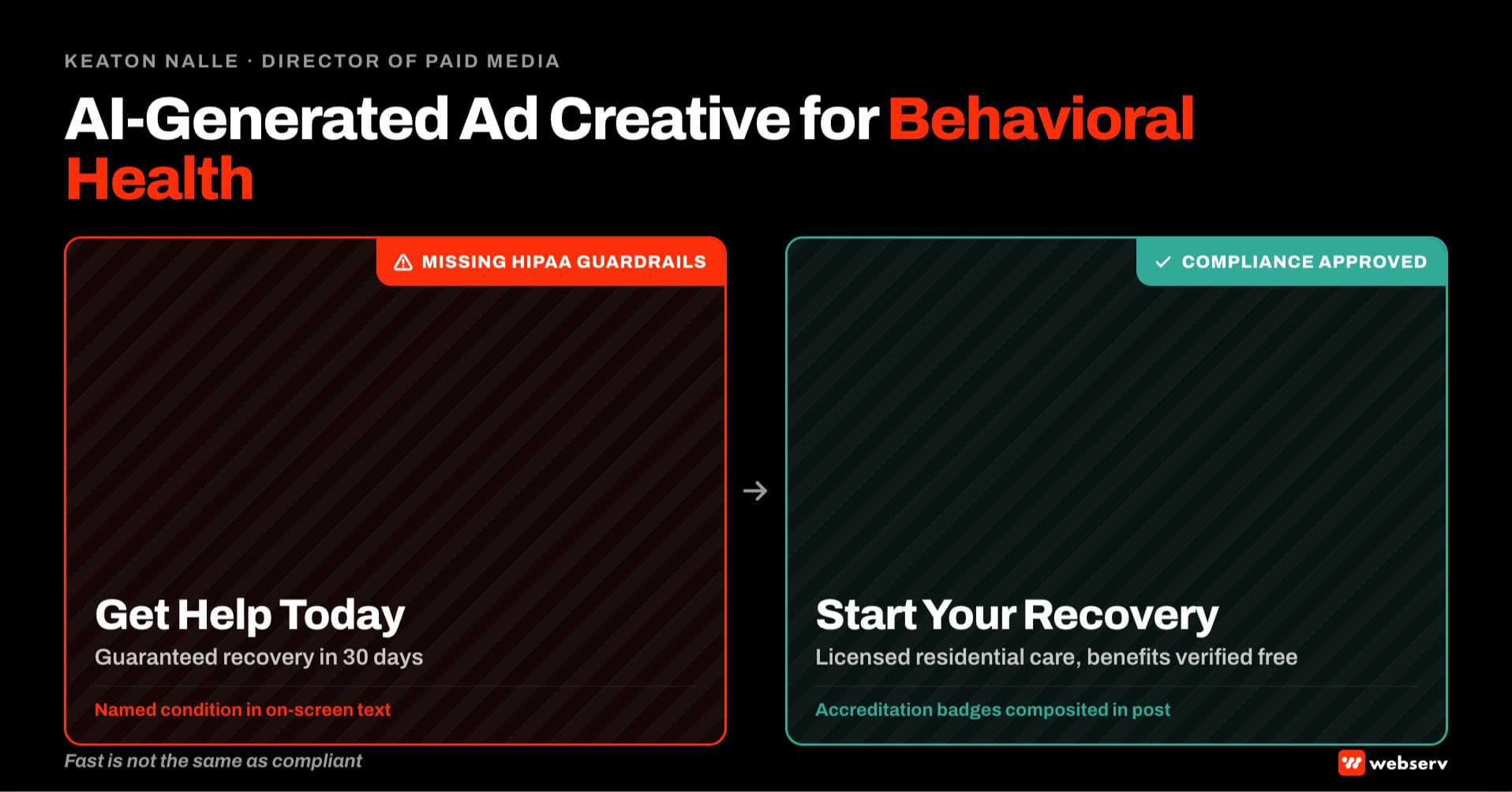
AI-generated ad creative moved from “novelty demo” to “production-ready” across the paid platforms we run in the second half of 2025. Meta Advantage+ Creative enhancements default-on for Sales and Leads campaigns.
Google’s Performance Max asset generation produces campaign-ready creative variants from a text brief. Third-party tools (Canva AI, Adobe Firefly, Runway, ElevenLabs) produce image, video, and audio ad assets that render at professional-agency quality.
Behavioral health is the compliance-heaviest paid vertical in advertising. LegitScript certification governs claim language. Google’s healthcare and behavioral health policies govern comparative claims. HHS OCR‘s tracking bulletin governs data flow. State-specific advertising regulations layer on top.
Combining production-ready AI creative with the compliance-heaviest vertical produces a specific set of gotchas most operators do not anticipate before the first disapproval or the first compliance escalation.
Individual assets pass review. Combinations fail. Fabricated clinician imagery survives internal QA but violates the trust signals AI answer surfaces reward. Voice-generated audio ads produce disclosure gaps most operators do not know they need to close.
This piece walks the four categories of AI creative operators are already deploying, the five compliance gotchas specific to behavioral health, and the quality floor that separates production-ready AI creative from AI slop.
It also covers the pre-generation prompt discipline and post-generation review workflow that keep AI creative deployable, and the specific decisions about when to use AI creative versus when human creative is the load-bearing option.
It sits inside our paid media practice and complements our ad creative strategy UG that covers the broader creative production discipline.
Key Takeaways
- AI-generated ad creative is production-ready for behavioral health as of 2026, but the vertical’s compliance requirements create a set of failure modes that generic AI creative tools do not surface. LegitScript claim standards, Google’s BH advertising policies, HHS OCR’s tracking bulletin, and state-specific advertising rules all constrain what AI-generated creative can say and show.
- The four categories of AI creative that matter for treatment centers are copy generation (headlines, descriptions, ad variants), image generation (stock replacement, scene imagery, thumbnail assets), video generation (short-form ad variants, cutdowns), and voice generation (audio ads, video narration). Each category has a different compliance profile and a different quality floor.
- Five compliance gotchas produce most of the disapprovals and compliance escalations we see in BH accounts running AI creative: guaranteed-outcome hallucinations, comparative-superiority language, insurance-network claims without verification, fabricated clinician imagery, and HIPAA-adjacent context leakage in patient-in-scene imagery.
- The quality floor is not what most operators expect. AI creative can produce competitive-quality headlines, description variants, background imagery, and short-form video cutdowns. It cannot produce defensible clinician-on-camera content, family testimonial content, or the specific clinical-authority visual signals that E-E-A-T requires.
- The compliance review workflow that works for BH AI creative: pre-generation prompt discipline (specific language rules, forbidden claims list, brand tone constraints), post-generation LegitScript review, post-generation Google policy check, and human quality review before deployment. Skipping any of the four steps produces disapprovals and compliance escalations that cost more time than the workflow would have.
DEFINITION
AI-generated ad creative for behavioral health. Ad assets (copy, image, video, voice) produced with generative AI tools (Meta Advantage+, Google Performance Max asset generation, ChatGPT, Claude, Adobe Firefly, Midjourney, Runway, ElevenLabs) for use in treatment center paid campaigns. Bound by four compliance layers: LegitScript addiction treatment advertising standards, Google’s healthcare and behavioral health ad policies, HHS OCR’s tracking bulletin, and state-specific advertising regulations.
Distinct from generic AI creative production (where compliance layer is minimal) and distinct from fully-human creative (where the load-bearing production discipline is human editorial rather than prompt engineering). Amplifies human creative capacity for volume and iteration; does not replace load-bearing human creative decisions (clinician-on-camera, family testimonial, authority-signal imagery).
COMPLIANCE REALITY
Individual AI assets pass review. Combinations fail. Fabricated clinician imagery survives internal QA but violates the trust signals AI answer surfaces reward. Voice-generated audio ads produce disclosure gaps most operators do not know they need to close. AI copy generators default toward strong claims because strong claims produced better engagement in the training data.
LegitScript’s advertising standards apply regardless of whether creative is human or AI-generated. Facilities running AI creative for LegitScript-restricted content need tighter pre-generation prompt constraints than facilities running AI creative for less-restricted verticals — the compliance failure mode is the same, but the AI tools generate non-compliant variants at 10x the rate a human would.
The four categories of AI ad creative
Copy generation
Headlines, descriptions, ad text variants, and full ad copy. Meta AI, Google AI, ChatGPT, Claude, and third-party copy tools all produce production-ready output when prompted with brand voice constraints and BH compliance rules. This is the most mature category and produces the largest volume of usable output. The specific use case that works: producing 30-100 headline variants for A/B testing at a rate no human copywriter could economically match.
Image generation
Background imagery, scene composition, thumbnail assets, and stock-replacement imagery. Adobe Firefly, Midjourney, DALL-E, and Canva AI produce competitive-quality output. This category has the highest compliance risk because BH-specific imagery choices (patient-in-scene, clinician representation, crisis framing) can violate policy without the operator noticing until disapproval.
Video generation
Short-form ad variants, static-to-motion conversions, and cutdowns from longer source content. Runway, Sora-adjacent tools, and Meta’s video ad tools produce output that runs on Meta and YouTube. The specific use case that works: cutting a 60-second clinician interview into 6-second, 15-second, and 30-second variants with different pacing, different text overlays, and different closing CTAs. Fully-generated video without source footage remains uneven for BH.
Voice generation
Audio ads (Spotify, Pandora, podcast preroll), voice-over narration for video ads, and translated audio versions. ElevenLabs and similar tools produce voices that sound human. The specific compliance consideration: audio ads in some states require voice disclosure that a real person is speaking, and voice-generated ads without disclosure violate the requirement.
The five compliance gotchas
Gotcha 1: Guaranteed-outcome hallucinations
AI copy generation tools default toward strong claims because strong claims produce better engagement in the training data the models learned from. In BH, guaranteed-outcome language (“get sober now,” “the fastest path to recovery,” “guaranteed results”) violates LegitScript standards and Google’s BH ad policy. The AI does not know the specific compliance boundaries; it produces claims that violate them by default unless the prompt forbids them.
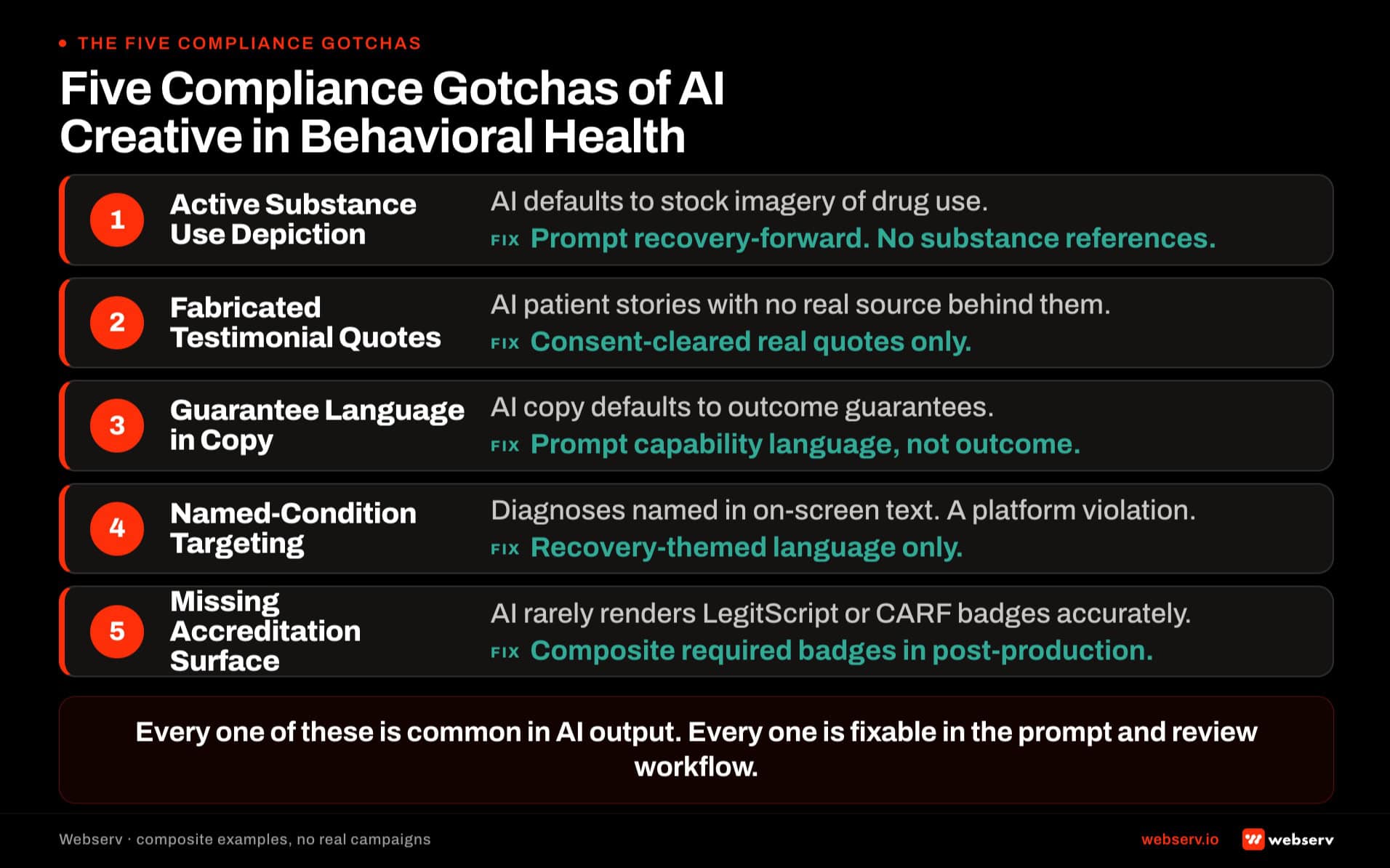
Prevention. Include an explicit forbidden claims list in every prompt. “Do not use guarantees, do not use comparative superlatives, do not use time-specific outcome claims, do not use insurance-network guarantees.” Our compliant ad headlines guide covers the specific language rules.
Detection. Post-generation review checks every asset for guarantee language. Any variant containing “guarantee,” “promise,” “fastest,” “best,” “leading,” or specific-outcome numeric claims gets flagged.
Gotcha 2: Comparative-superiority language
AI tools generate superlative claims by default (“best treatment center,” “leading rehab in [city],” “premier program”). Superlative claims without documented substantiation violate both LegitScript standards and general advertising standards. In BH specifically, unsupported superlative claims trigger LegitScript review and Google ad policy escalation.
Prevention. Forbidden claims list explicitly excludes comparative superlatives. Prompt should specify “avoid comparative claims, avoid market-position claims, avoid unqualified best language.”
Detection. Post-generation regex against “best,” “leading,” “premier,” “#1,” “top-rated” catches most instances.
Gotcha 3: Insurance-network claims without verification
AI copy generators often produce “we accept most insurance” or “in-network with [payer]” language because it correlates with high engagement in the training data. Publishing in-network claims without active contract verification is a misrepresentation risk that carries specific legal exposure in BH and violates Google’s healthcare advertising policy.
Prevention. Prompt should require insurance language to say “commonly accepts” rather than “in-network with,” and to name payers only when the facility has current contract verification.
Detection. Post-generation review checks every ad variant against the facility’s active payer contract list. Any variant naming a payer not on the current list gets flagged.
Gotcha 4: Fabricated clinician imagery
Image generation tools produce photorealistic clinician imagery on demand. Using AI-generated clinician imagery in BH advertising creates two specific problems. First, the imagery is not a real clinician, which violates E-E-A-T signal expectations and undermines the trust signal that separates a treatment center ad from a generic health ad. Second, using AI-generated clinicians without disclosure produces the specific misleading-content violation FTC guidance flags.
Prevention. Never use AI-generated clinician imagery in BH advertising. Real clinician photography is the load-bearing option. Fabricated imagery for anonymous supporting roles (crowd scenes, background family members) is acceptable when clearly stylized and not identifiable.
Detection. Image review workflow flags any ad variant featuring photorealistic human faces in clinician-role positioning.
Gotcha 5: HIPAA-adjacent context leakage in patient-in-scene imagery
AI image generation can produce patient-in-treatment scene imagery that appears to depict specific clinical contexts (group therapy, individual session, medication administration). Even when the patients are AI-generated, the specific clinical context can imply real-patient depiction, which crosses into HIPAA-adjacent risk. Our HIPAA-compliant Facebook ads piece covers the underlying framework.
Prevention. Patient-in-scene imagery should be stylized (illustration, silhouette, abstract composition) rather than photorealistic. Clinical settings should be depicted as generic care environments rather than specific treatment protocols.
Detection. Image review workflow flags any ad variant depicting identifiable clinical contexts or photorealistic patient imagery.
The AI creative decision surface at a glance
4
Categories: copy, image, video, voice generation
5
BH-specific compliance gotchas producing most disapprovals
4 steps
Review workflow: prompt discipline, LegitScript, Google policy, human QA
1.5-3x
Net production velocity with proper workflow — not 10x tool marketing claims
The quality floor
AI creative can produce competitive quality in specific categories and fails in others. Understanding the split is what separates operators using AI creative effectively from operators producing AI slop that underperforms human creative at scale.
Where AI creative meets the quality floor. Copy generation produces headlines and descriptions comparable to human agency output when prompted with proper brand voice and compliance constraints. The volume advantage matters: an operator can produce 40 variant headlines in an hour with AI where the same operator would produce 5-8 with fully-human production. Background and supporting imagery hits the quality floor for most BH use cases. Video cutdowns from real source footage produce competitive output.
Where AI creative fails the quality floor. Fully-generated video ads without source footage produce output that visibly reads as AI-generated and underperforms in engagement metrics. Fabricated clinician content violates E-E-A-T and compliance standards regardless of visual quality. Family testimonial content requires real family voices and real family stories; AI-generated testimonials both violate FTC guidance and read as inauthentic to the audience.
The load-bearing rule. Use AI creative for volume and iteration. Use human creative for authority and clinical framing. The specific split we run in our client accounts: 60-70 percent of copy variants come from AI generation with human editorial review. 40-50 percent of background and supporting imagery comes from AI generation. Zero percent of clinician-on-camera, family testimonial, or authority-signal imagery comes from AI generation.
The four-step compliance review workflow
The workflow that keeps AI creative deployable in behavioral health has four load-bearing steps.
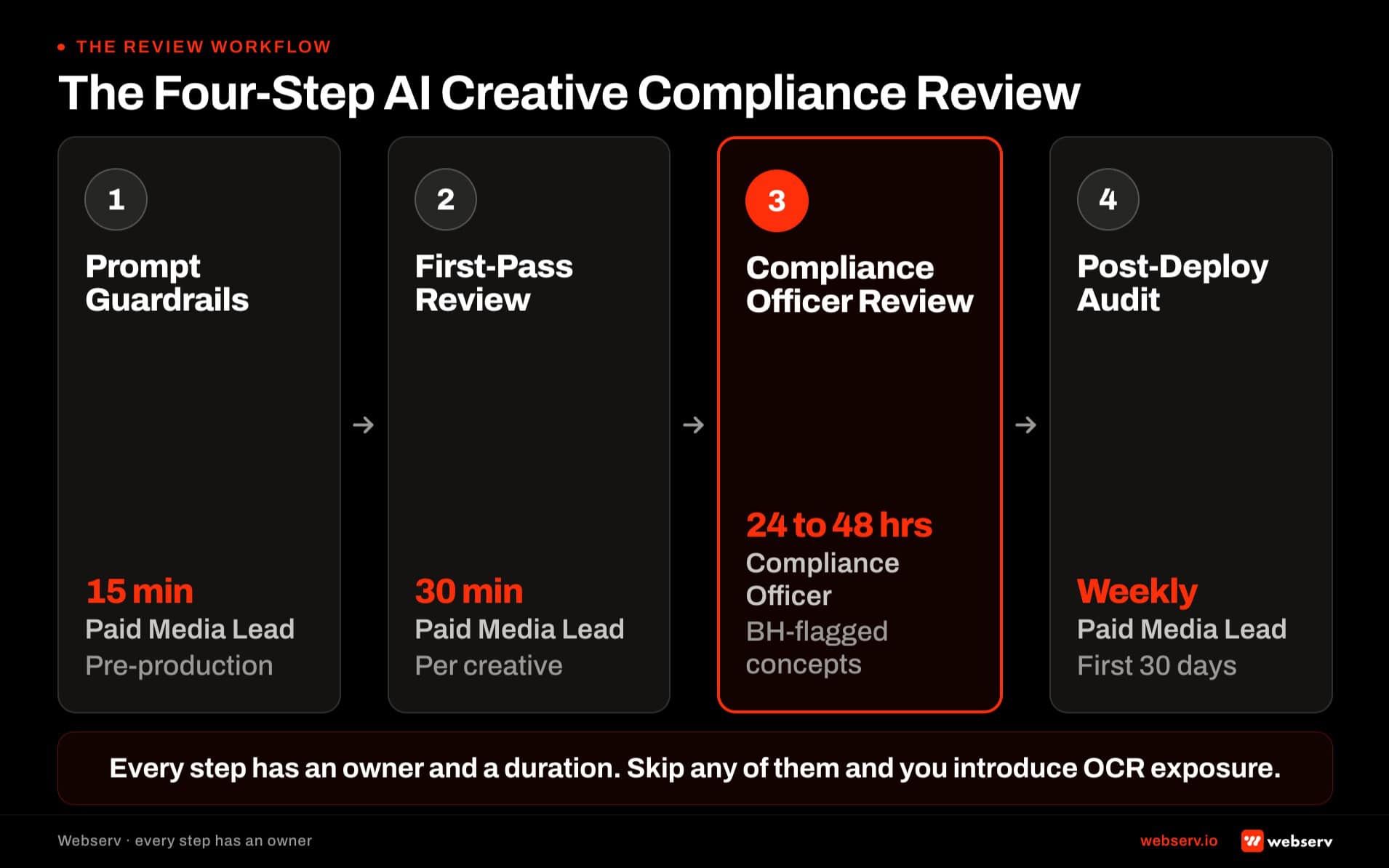
Step 1: Pre-generation prompt discipline. Every prompt used for BH ad creative generation includes the same three constraint blocks: brand voice specification (tone, register, sentence-length preference, banned words), forbidden claims list (guarantees, superlatives, unverified network claims, time-specific outcome promises), and target audience specification (family perspective, not patient perspective, unless the campaign explicitly targets patients).
Step 2: Post-generation LegitScript review. Every generated asset gets checked against LegitScript’s advertising standards before deployment. The check covers claim language, prohibited superlatives, and specific-outcome claims. Assets that fail the check either get rewritten or excluded.
Step 3: Post-generation Google policy check. Every generated asset gets checked against Google’s healthcare and behavioral health advertising policies. The check covers comparative claims, unverified insurance-network language, and crisis-language framing. Assets that fail the check either get rewritten or excluded.
Step 4: Human quality review. Every asset that passes Steps 2 and 3 gets a human quality review before deployment. The review checks for brand voice consistency, subtle compliance issues the regex checks miss, and quality-floor issues (does the asset actually look and read professional). Assets that fail the human review get sent back to Step 1 with prompt refinement.
Facilities that skip Steps 2, 3, or 4 to accelerate production velocity produce disapprovals and compliance escalations that cost more time than the workflow steps would have.
When to use AI creative versus when not to
Use AI creative when. Producing volume variants for testing (30-100 headline variants for A/B testing). Producing background and supporting imagery at scale. Cutting source footage into ad variants. Producing translated versions of existing creative. Producing quick-turn variants for time-sensitive campaigns.
Do not use AI creative when. Producing clinician-on-camera content. Producing family testimonial content. Producing authority-signal imagery (accreditation displays, clinical credentials, licensure references). Producing content that will run in states with voice-disclosure requirements. Producing content targeting audiences where AI-generated content disclosure would be required.
The general operating rule: AI creative amplifies human creative capacity. It does not replace the load-bearing human creative decisions.
Facilities that treat AI creative as a full replacement for human creative production see near-term velocity gains and medium-term quality degradation. Facilities that treat AI creative as a volume-and-iteration layer on top of human strategic direction see sustainable creative production capacity.
DO
- Use AI creative for volume and iteration — 30-100 headline variants, background imagery at scale, cutting source footage into variants.
- Include an explicit forbidden claims list in every prompt (no guarantees, no superlatives, no time-specific outcome claims, no unverified network claims).
- Run every asset through the 4-step workflow: prompt discipline, post-gen LegitScript review, post-gen Google policy check, human quality review.
- Refresh prompt constraint blocks quarterly — compliance rules drift and stored prompts go stale within 60-90 days.
- Reserve human creative for clinician-on-camera, family testimonial, authority-signal imagery, and any content that will run in voice-disclosure states.
DON’T
- Use AI-generated clinician imagery — real clinician photography is the load-bearing E-E-A-T signal, and fabricated imagery violates both signal expectations and compliance standards.
- Publish AI-generated patient-in-scene imagery photorealistically — stylize (illustration, silhouette, abstract) to avoid HIPAA-adjacent context leakage.
- Skip Step 2 (LegitScript check) or Step 3 (Google policy check) to accelerate production — disapprovals cost more time than the review does.
- Reuse a prompt that worked without refreshing the constraint blocks — compliance drift produces variants that pass an outdated list but fail current policy.
- Use AI voice generation for audio ads in California, Colorado, or other voice-disclosure states — compliance risk exceeds production velocity gain.
Common failure modes
Four patterns produce most of the AI creative failures we audit in BH accounts.
The first is prompt reuse without customization. Operators find a prompt that works, save it, and reuse it across dozens of variant generations without adjusting the compliance constraint blocks for the specific ad group or campaign context. The compliance constraints drift over time and eventually produce assets that pass the outdated constraint list but fail current LegitScript or Google policy.
The second is Step 4 review compression. As AI creative production velocity increases, operators compress the human review step to keep up. Review becomes cursory, subtle compliance issues get missed, and the disapproval rate climbs 60-90 days after the review compression starts.
The third is deploying AI creative in categories that fail the quality floor. Fully-generated clinician videos, AI family testimonials, AI voice-over on facility tour videos. These deploy without producing engagement, then the operator concludes AI creative does not work in BH.
The fourth is skipping the LegitScript pre-clearance for specific ad variants that “obviously” comply. Any variant containing insurance language, outcome language, or clinical claim language should go through Step 2 regardless of how obviously compliant the operator believes the variant is.
Frequently Asked Questions
Does Meta Advantage+ Creative use AI generation on my ad assets?
Yes. Advantage+ Creative enhancements have been default-on for new Sales and Leads campaigns since early 2025. The enhancements include AI-generated variations of your source assets: cropping, background replacement, text overlay adjustments, and in some cases fully-generated variant assets from your source library.
For behavioral health accounts, we recommend disabling Advantage+ Creative on brand-sensitive elements. The specific setting: in Meta Ads Manager, under the ad-level configuration, expand Advantage+ Creative and toggle off “Enhance creative” for the specific enhancements that carry compliance risk (text overlay changes on claim-language, background replacement on clinician imagery, video crop changes on approved creative).
Our Meta CAPI HIPAA piece covers the parallel platform-side configuration for BH advertisers.
Do we need to disclose that our ads use AI-generated creative?
Federal disclosure requirements around AI-generated advertising are still developing as of 2026. The current baseline: FTC guidance on AI-generated content requires disclosure when the AI generation could mislead consumers about a material fact. In BH advertising, the specific concerns are AI-generated testimonials (prohibited regardless of disclosure), AI-generated clinician imagery (we recommend against), and AI-generated outcome claims (prohibited regardless of AI origin).
State-specific requirements vary. California, New York, and Colorado have specific AI content disclosure requirements that apply to political and consumer advertising. Behavioral health advertising specifically has not been carved out from the general requirements in most states.
The safe operating posture: do not use AI creative in categories where disclosure would be required (testimonials, endorsements, expert opinions, clinical claims). Use AI creative in categories where disclosure is not required (background imagery, general brand imagery, headline variations, ad copy iterations).
Should we use AI voice generation for our audio ads?
Depends on your target markets. For audio ads running in California, several other states with voice-disclosure requirements, or on podcast preroll where the podcast’s own voice-disclosure standards apply, we recommend against AI voice generation. The compliance risk is not worth the production velocity gain.
For audio ads running in markets without specific voice-disclosure requirements, AI voice generation is a legitimate option for supporting narration (product descriptions, offer disclosures, closing CTAs). Even in unrestricted markets, we recommend against AI voice generation for content that carries clinical or authority claims , the trust signal of a real clinician voice matters more than the production velocity gain.
The general operating pattern: AI voice for functional narration, human voice for authority narration.
How much production velocity does AI creative actually add?
Meaningful, but less than the tool marketing suggests. In our accounts running AI creative under proper compliance workflow, we see roughly 3-5x velocity on copy generation, 2-3x velocity on background imagery, and 4-6x velocity on video cutdowns from source footage.
The velocity gain is offset partially by the compliance review workflow overhead. Steps 2 and 3 of the four-step review add roughly 15-25 minutes per ad variant. Step 4 human review adds 10-15 minutes. Total workflow overhead: 25-40 minutes per variant.
The net production velocity math: AI creative with proper workflow runs 1.5-3x faster than fully-human creative production, not the 10x tool marketing suggests. This is still a meaningful gain, particularly when the operator needs 30-100 variants for A/B testing that human production could not economically produce.
Can we use AI to generate ad creative for LegitScript-restricted content categories?
Yes, with the same compliance workflow that applies to human-generated creative. LegitScript’s advertising standards apply regardless of whether creative is human or AI-generated. AI creative that violates the standards fails LegitScript review the same way human creative would.
The specific gotcha: AI copy generators produce claim-heavy language by default because engagement metrics in the training data reward it. Facilities running AI creative for LegitScript-restricted content need tighter pre-generation prompt constraints than facilities running AI creative for less-restricted verticals. Our LegitScript certification guide covers the standards; the AI prompt has to encode those standards explicitly rather than assuming the model will infer them.
Our compliant ad headlines guide is the reference for the specific language rules that need to appear in every prompt.
How do we train our internal team on AI creative workflow?
The workflow training runs 4-6 hours across three sessions. Session one covers the four categories and where each fits (2 hours). Session two covers the five compliance gotchas and the pre-generation prompt discipline that prevents each (2 hours). Session three covers the post-generation review workflow (LegitScript check, Google policy check, human quality review) with hands-on practice on real ad variants (2 hours).
After the training, the team runs a 2-week supervised deployment where every AI-generated variant goes through the full review workflow with agency support. After the supervised period, the team runs independently with quarterly workflow audits to catch drift.
Facilities that skip the training and try to run AI creative on internal capacity without workflow discipline produce the specific failure modes documented above within 60-90 days.
Keaton Nalle is the Director of Paid Admissions at Webserv, a digital marketing agency for treatment centers.