Almost nobody in behavioral health admissions consulting publishes pricing. The operator budgeting for the engagement is left comparing invoices from two firms that will not name a number before a discovery call.
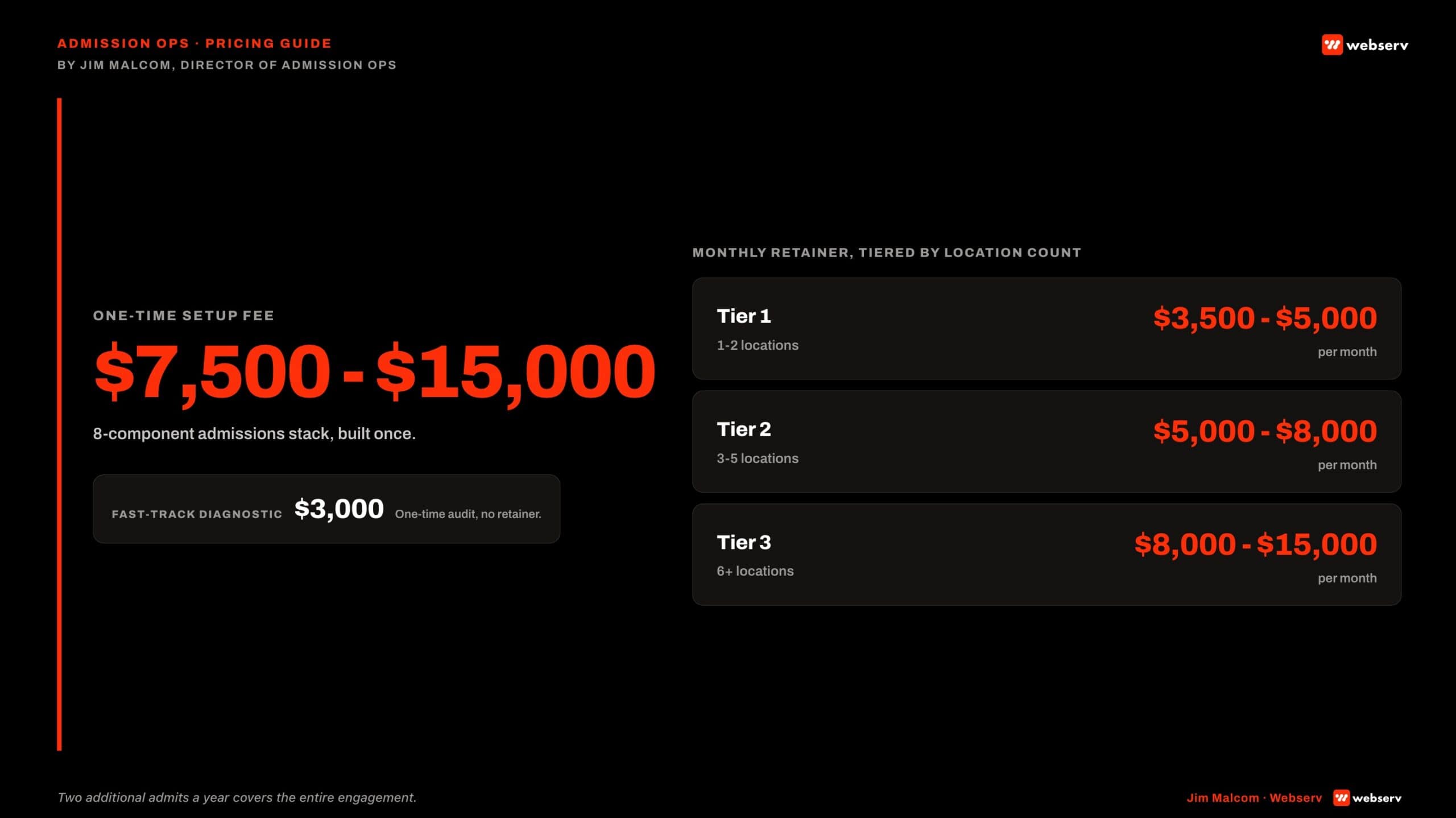
Webserv publishes the bands. $7,500 to $15,000 setup. $3,500 to $15,000 monthly retainer, tiered by location count. A $3,000 fast-track diagnostic that credits back 100 percent toward the first month if the facility moves forward.
This piece explains what each band buys, what moves the price inside it, and how the ROI math works before the first invoice lands.
It is the pricing transparency article the category refuses to write. The Admission Ops capability page is where the scope lives. This piece is the number underneath the scope.
Key Takeaways
- Admissions consulting for behavioral health treatment centers runs $7,500 to $15,000 for the one-time setup plus $3,500 to $15,000 per month for the ongoing retainer. Setup covers the 6-week launch sprint. Retainer is tiered by number of locations, not by team size.
- Ongoing retainer tiers. Tier 1 (1-2 locations) $3,500 to $5,000 per month. Tier 2 (3-5 locations) $5,000 to $8,000 per month. Tier 3 (6+ locations) $8,000 to $15,000 per month.
- A $3,000 fast-track diagnostic (normally $15,000) delivers a scoped audit, gap map, and firm proposal, and credits 100 percent back toward month one if the facility moves forward.
- Four inputs move the price inside those bands. CRM complexity, integration surface, number of locations, and existing tech debt. Any proposal that does not name those four inputs is quoting a template.
- ROI math is not close. A single behavioral health admit carries $20,000 to $40,000+ in lifetime value. One saved conversion per month across twelve months makes the engagement ROI-positive at every tier.
- The 5 pillars any real engagement covers. Lead Intake and Tracking. CRM and Workflow Optimization. VOB and Insurance Ops. Team Enablement and Training. Always-On Admissions. Consultants who scope less than all five are pricing a partial engagement.
- Not every facility is ready. Facilities under 5 admits per month or with no attributable marketing spend should solve for lead volume and attribution first, then revisit admissions consulting once the ROI math has room to work.
- Published pricing is the exception, not the rule, in this category. Most admissions consultants hide pricing behind a discovery call. Webserv publishes the bands and names the inputs that move them.
What Admissions Consulting Actually Includes
Admissions consulting for a treatment center is not marketing help. It is not clinical program design. It is the operational layer that turns leads into admits and admits into predictable revenue. Any real engagement covers five pillars.
Pillar 1: Lead Intake and Tracking. Know where every lead came from, how it performed, and what it is really worth. Attribution, scoring, capture, routing, QA.
Pillar 2: CRM and Workflow Optimization. Turn chaos into clarity with a clean admissions pipeline. Pipeline stages, automations, lead scoring, early reporting.
Pillar 3: VOB and Insurance Ops. VOB request process, status tracking, follow-up SOPs, payer mix visibility across the funnel.
Pillar 4: Team Enablement and Training. Call scripts, objection handling, QA feedback loops, live training with the admissions floor.
Pillar 5: Always-On Admissions. Ongoing performance reporting, conversion insights, monthly strategic reviews. The layer that keeps the engine tuned month over month.
Any consultant quoting less than all five pillars is quoting a partial scope. Any consultant quoting a flat number without walking the full admissions process spine against your CRM, integrations, and locations is quoting a template.
The Setup Fee: What $7,500-$15,000 Buys
The one-time setup fee funds the 6-week launch sprint. Every week has named deliverables.
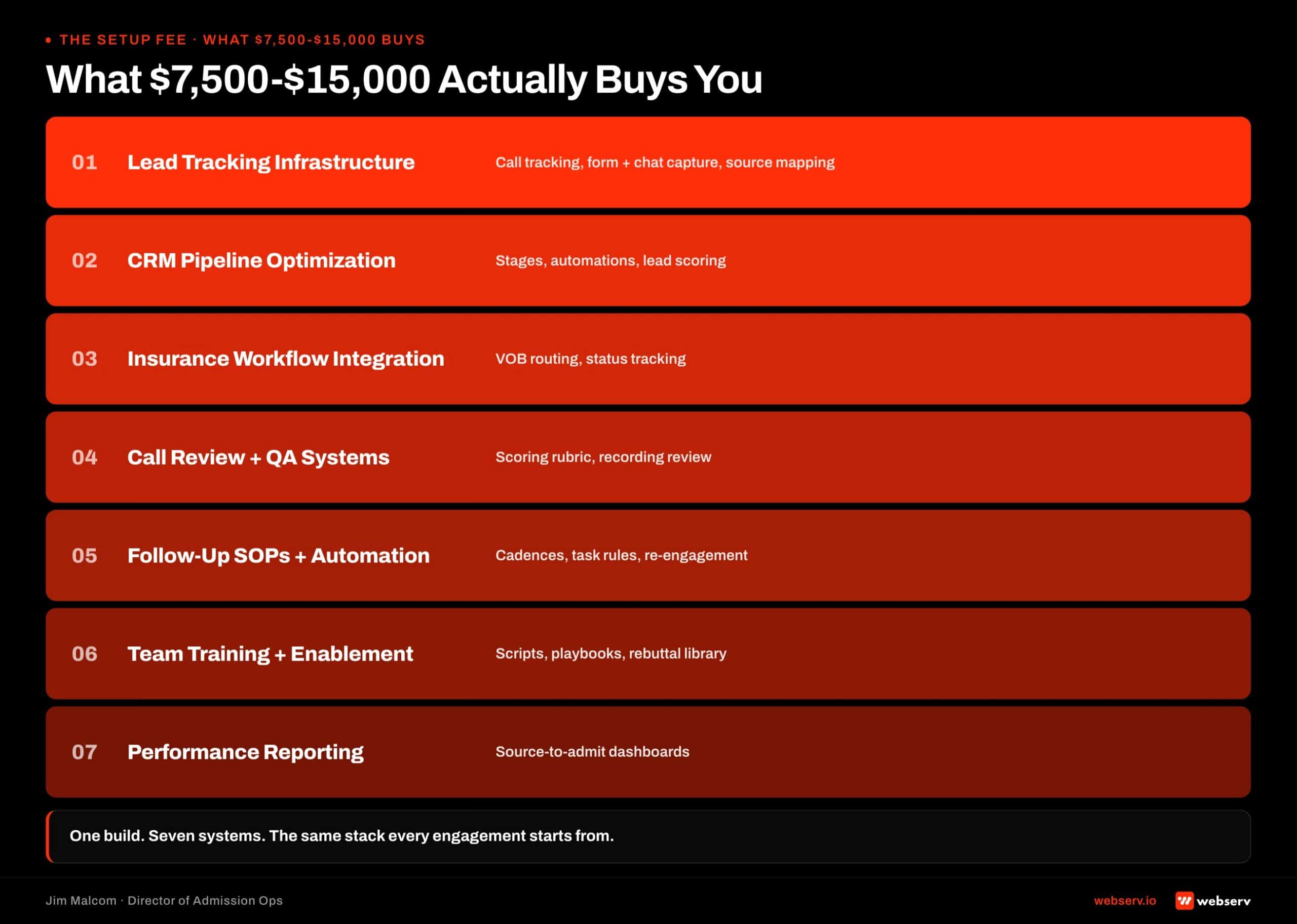
Week 1, Onboard and Audit. Kickoff workshop, intake assessment, gap map, audit findings, implementation roadmap.
Week 2, Lead Tracking. Call tracking numbers and routing, form and chat capture, source mapping into CRM, lead scoring framework drafted, call QA process stood up.
Week 3, CRM Pipeline. Pipeline stages built, automations for status changes and task assignments deployed, early reporting activated.
Week 4, VOB Workflow. VOB request process mapped and integrated into CRM, status tracking and notifications activated, follow-up SOPs finalized.
Weeks 5-6, Training and Launch. Scripts and qualification playbooks finalized, rebuttal and objection handling resources built, QA feedback loops activated, team training sessions run.
The $7,500 end of the band is a 1-location facility on a clean CRM with 2-3 integrations. The $15,000 end is a multi-location facility on a legacy CRM with heavy custom integrations and a call tracking migration.
Ongoing Retainer: Tiered by Location Count
The tiers are published. No obfuscation.
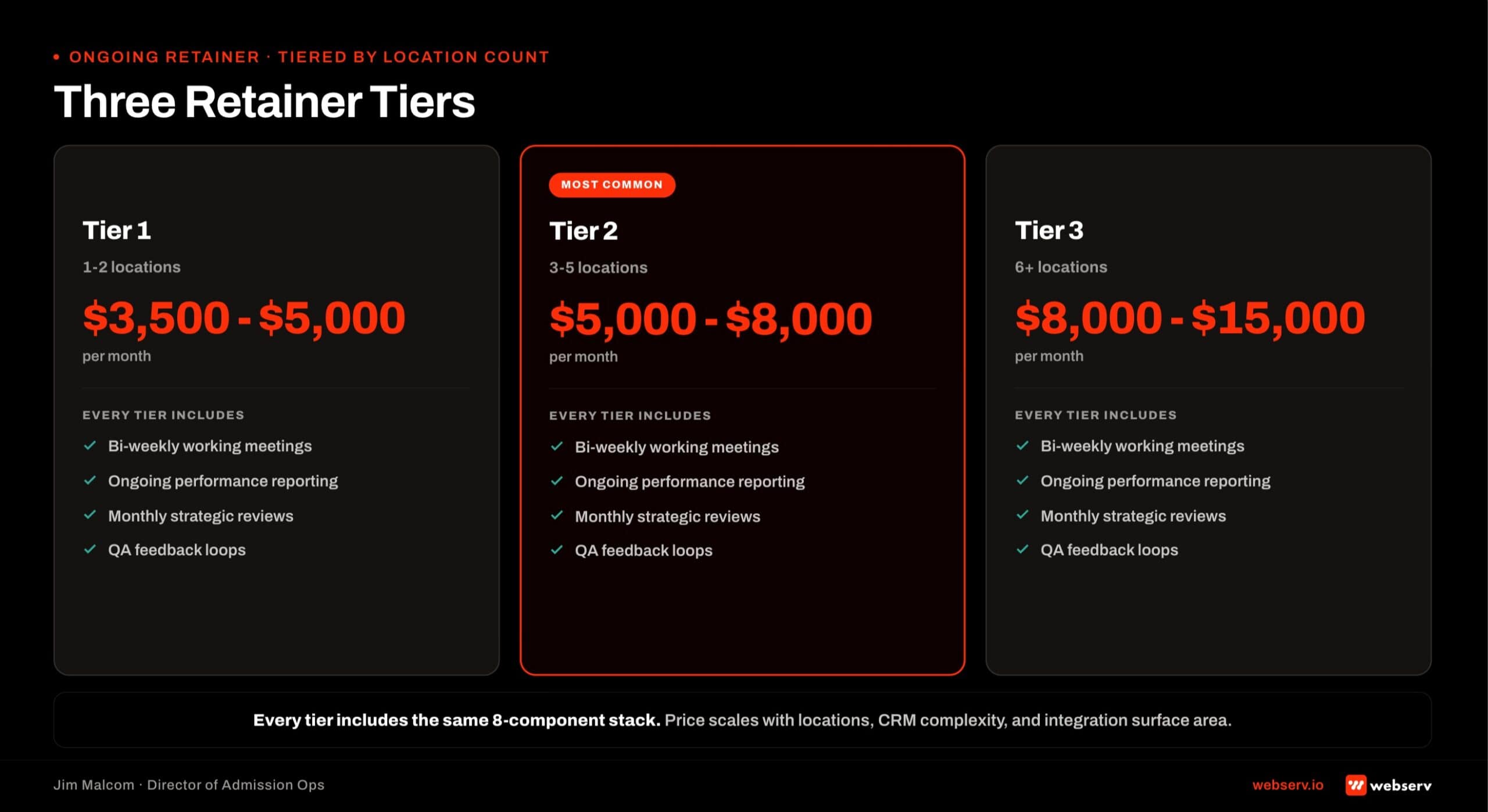
Tier 1 (1-2 Locations). $3,500 to $5,000 per month.
Tier 2 (3-5 Locations). $5,000 to $8,000 per month.
Tier 3 (6+ Locations). $8,000 to $15,000 per month.
Every tier includes the same core scope: Admissions Audit and Launch Sprint, Lead Tracking Infrastructure, CRM Pipeline Optimization, Insurance Workflow Integration, Call Review and QA Systems, Follow-Up SOPs and Automation, Performance Reporting, Team Training and Enablement, and Always-On Monitoring.
The tier structure is priced on operational surface area, not headcount or seat count. Two facilities with the same admissions team size can land in different tiers if one has three physical locations and the other has one.
The reason: each additional location doubles the number of routing rules, QA loops, and payer mix segmentations the ops team maintains.
What Drives Price Up vs Down
The four inputs that move the number inside the published bands.
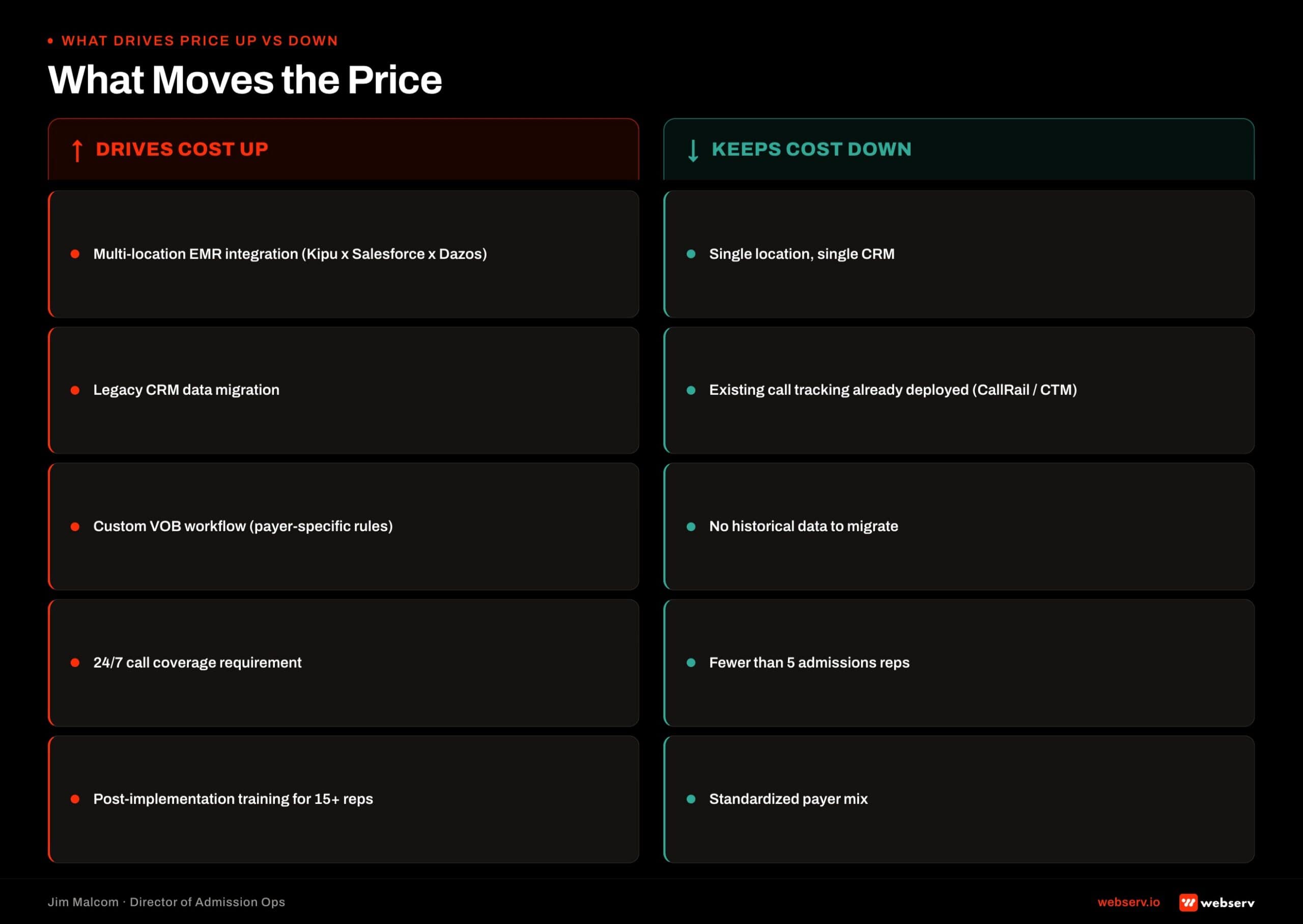
- CRM Complexity. A facility on a well-configured Salesforce or HubSpot Enterprise starts lower in the setup band than a facility on a heavily customized legacy CRM with five years of technical debt. Migration from an unsupported CRM to a supported one moves the number up. Rebuilding the KPI spine every admissions CRM should carry is where sprint hours land.
- Integration Surface. Every integration point (call tracking, EMR, VOB tool, billing system, marketing automation) adds sprint hours. Facilities on 2-3 integrations land at the low end. Facilities on 6+ integrations land at the high end. Legacy integrations without maintained APIs add the most hours.
- Number of Locations. Retainer tier is set by locations. Setup fee moves with locations too. Each new location adds routing rules, QA feedback loops, and reporting segmentations. Multi-state operators also carry state-by-state consent-to-record and payer mix variance.
- Existing Tech Debt. If the CRM was never properly configured to match how the admissions team actually works, the sprint spends more time rebuilding foundational plumbing before optimization work begins. Facilities with clean plumbing move faster and price lower.
Any consultant that quotes a flat number without scoping against these four inputs is quoting a template. Ask for the four inputs by name before signing.
The Fast-Track Diagnostic: $3,000, Credited Back on Month One
The lower-friction entry point. Normal fee is $15,000. Fast-track fee is $3,000 and credits 100 percent back toward the first month if the facility moves forward with a full Admission Ops engagement.
What operators get for $3,000:
- A scoped audit against the 5 pillars
- A gap map identifying the top 3-5 leaks in the current admissions funnel
- A firm proposal with a scoped setup fee and tier assignment (no more ranges, real numbers)
- A written implementation roadmap the operator can execute with any consultant, including us
The diagnostic is priced this way for a specific reason. It removes the “give me a real number” friction most operators name in first calls. It also filters out facilities that are not ready. To see what the engagement covers end to end, read our admissions operations complete guide.
A facility that will not commit $3,000 to scope the work will not commit $50,000 to execute it. That is not a judgment. That is a readiness signal both sides need to see clearly before the engagement begins.
ROI Math: LTV of a Single Admit vs the Engagement Cost
The load-bearing math. Anchor the whole calculation on one number: lifetime value per admit.
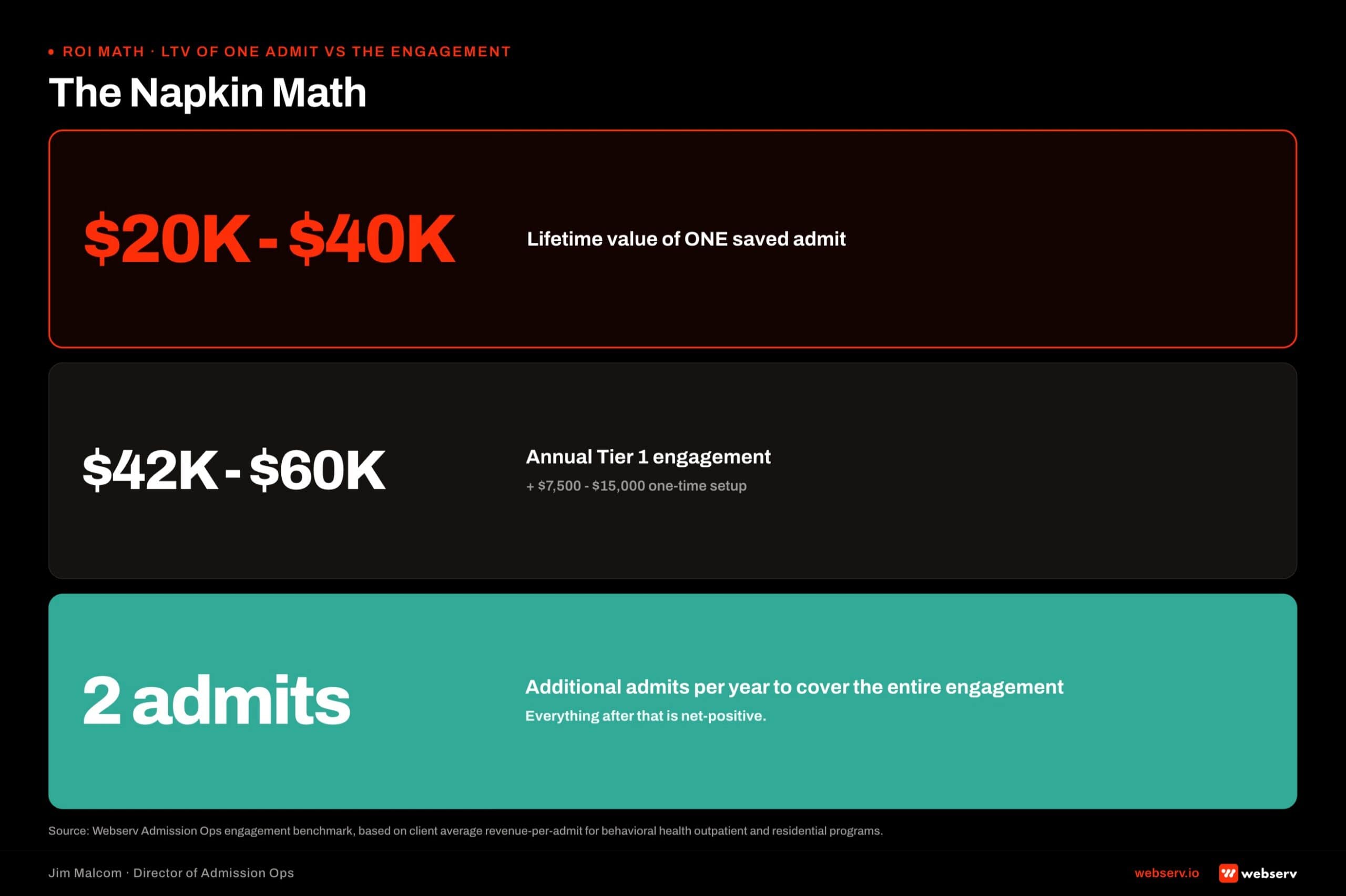
Single admit in behavioral health carries $20,000 to $40,000+ in lifetime value.
Tier 1 engagement (1-2 locations): $7,500 to $15,000 setup plus $3,500 to $5,000 per month over 12 months equals $49,500 to $75,000 per year.
Tier 2 engagement (3-5 locations): $10,000 to $15,000 setup plus $5,000 to $8,000 per month over 12 months equals $70,000 to $111,000 per year.
Tier 3 engagement (6+ locations): $12,000 to $15,000 setup plus $8,000 to $15,000 per month over 12 months equals $108,000 to $195,000 per year.
At the low end of admit LTV ($20K), one saved conversion per month across twelve months returns $240K on a Tier 1 engagement. At the high end ($40K), one saved conversion per month returns $480K. The scaling factor is admit volume, not deal size.
Revenue cycle leaders cite lead-to-admit conversion inefficiency and manual intake workflows as consistently in the top three drivers of avoidable margin loss for specialty providers (HFMA, Revenue Cycle Management). Admissions ops is a revenue cycle problem. It returns multiples of the engagement cost when the funnel underneath it is real.
Directional evidence from Webserv engagements. A Tennessee outpatient client running Dazos saw PPC close rate move from 17 to 64 percent in two months. Missed call rate dropped from 15 to 1 percent. The marketing did not change. The admissions engine did.
The operational reason facilities live inside broken funnels for years is usually the operational dysfunction that keeps funnels broken, not budget.
How to Evaluate an Admissions Consultant
Checklist. Ask any consultant these questions before signing.
Do they publish price ranges or hide them? If they will not name a range before a discovery call, they are quoting a template.
Do they scope against a named framework? Ask what their equivalent of the 5 pillars is. If they cannot name one, they are selling hours, not scope.
Do they charge for the diagnostic and credit it back? Free consults produce free work. A paid diagnostic that credits back filters for real fit on both sides.
Do they name what drives price up or down? If they cannot articulate the four inputs that move the number, they are not scoping the engagement. They are quoting the last one they closed.
What does their measurement stack look like on day 30, day 90, day 180? Ask for the exact dashboard, not the promise.
How do they handle CRM tech debt they inherit? Rebuild versus optimize is the biggest sprint-hour driver and the answer tells you whether the setup fee will hold.
External operational consulting at specialty providers typically runs a small share of annual net patient revenue, well inside the ROI-positive range for engagements that produce measurable throughput improvements (MGMA, Practice Management Benchmarks).
This cost tier is normal for the category. What separates real consultants from templated ones is the six questions above.
When You Should NOT Hire an Admissions Consultant
Not every facility is ready. Two clear disqualifiers.
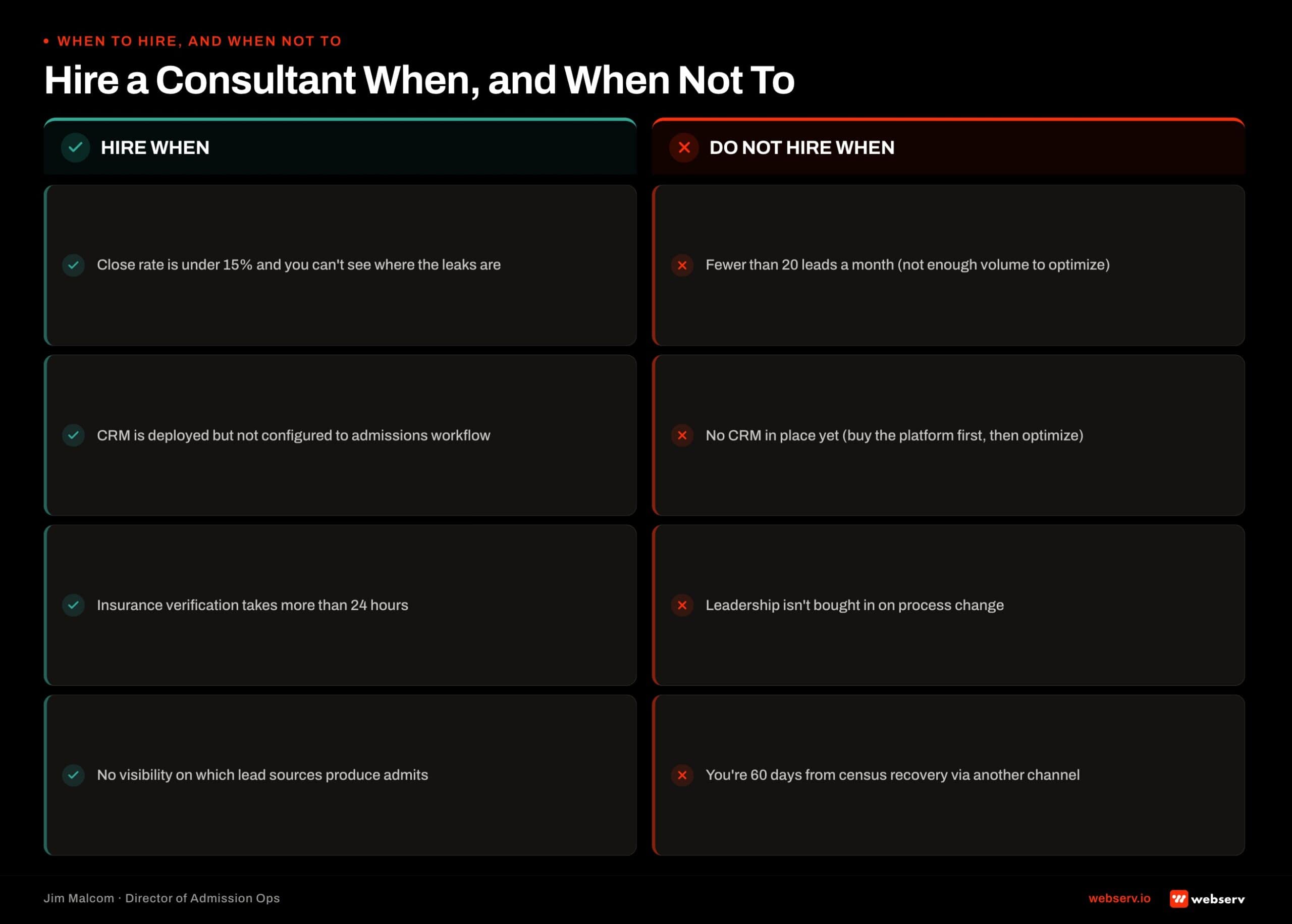
Facilities under 5 admits per month. The engagement’s ROI math depends on volume large enough that one saved conversion per month moves the P&L. Below 5 admits, the math gets thin.
Solve for lead volume and marketing spend first, then revisit admissions ops once the funnel has enough throughput to optimize. Admissions consulting cannot manufacture leads that do not exist. Our complete guide to behavioral health marketing covers how to build that funnel first.
Facilities with no attributable marketing spend. If lead source data is not captured in any form, the first three months of an admissions engagement will be spent building attribution instead of optimizing conversion.
Better to solve attribution independently, even at a basic level with call tracking and UTM parameters, before starting the engagement. The engagement starts stronger with a clean data layer to optimize against.
Optional third disqualifier: facilities in active regulatory or licensing crisis. The admissions engine is the wrong problem to solve while the license is at risk. Fix the compliance exposure first. The revenue cycle referral bench is where regulatory-first facilities should be looking anyway.
Frequently Asked Questions
How much does admissions consulting cost for a treatment center?
Admissions consulting for behavioral health treatment centers runs a one-time setup fee of $7,500 to $15,000 plus an ongoing monthly retainer of $3,500 to $15,000. Retainer is tiered by number of locations: $3,500-$5,000/mo at 1-2 locations, $5,000-$8,000/mo at 3-5, $8,000-$15,000/mo at 6+.
The setup fee funds a 6-week launch sprint that builds the admissions engine: lead tracking, CRM pipeline, VOB workflow integration, and team training. The ongoing retainer funds continuous optimization, bi-weekly meetings, monthly strategic reviews, and the ops team keeping the engine running.
Facilities that want a firm number before the full engagement can start with a $3,000 fast-track diagnostic (normally $15,000). The diagnostic delivers a scoped audit and firm proposal, and credits 100 percent back toward month one.
What is included in the setup fee vs the ongoing retainer?
The setup fee funds the 6-week launch sprint. Week 1 is onboarding and audit. Week 2 builds lead tracking. Week 3 configures the CRM pipeline. Week 4 stands up the VOB workflow. Weeks 5-6 finalize scripts, training, and launch the fully configured admissions engine.
The ongoing retainer funds the always-on layer: continuous performance reporting, conversion insights, call QA feedback loops, monthly strategic reviews, and bi-weekly working meetings with the admissions team. It also funds ongoing training and playbook updates as payer mix, campaigns, and coordinator team composition change.
Think of setup as the build and retainer as the operations layer. The setup gets you a working admissions engine. The retainer keeps it working and catches leaks before they compound into a quarter of missed admits.
What makes admissions consulting cost more or less at my facility?
Four inputs move the price inside the published bands: CRM complexity, integration surface, number of locations, and existing tech debt. A facility on a clean CRM with 2-3 integrations at one location lands at the low end. A multi-location facility on a legacy CRM with 6+ integrations lands at the high end.
The retainer is tiered by locations because each additional location doubles the routing rules, QA loops, and payer mix segmentations the ops team maintains. Setup fee moves with locations too, but the biggest single driver of setup variance is CRM tech debt.
Any admissions consultant that quotes a flat number without scoping against these four inputs is quoting a template. Ask for the four inputs by name before signing anything.
Is there a lower-cost way to test admissions consulting before committing to a full engagement?
Yes. The $3,000 fast-track diagnostic is the low-friction entry. Normal fee is $15,000. Facilities that move forward with a full Admission Ops engagement after the diagnostic get 100 percent of the $3,000 credited back on their first month.
What operators get for $3,000: a scoped audit against the 5 pillars, a gap map naming the top 3-5 leaks in the current admissions funnel, a firm proposal with a scoped setup fee and tier assignment (no more ranges, real numbers), and a written implementation roadmap the facility can execute with any consultant.
The diagnostic is deliberately paid, not free. Free consults produce free work, usually shallow. A paid diagnostic filters for real fit on both sides.
How do I calculate ROI on an admissions consulting engagement?
Anchor the math on a single number: lifetime value per admit. In behavioral health, single-admit LTV runs $20,000 to $40,000 or more. A Tier 1 engagement (1-2 locations) runs $49,500 to $75,000 in year one. Even at the low LTV assumption, one saved conversion per month across twelve months returns $240,000, roughly 3-5x the engagement cost.
The math is the same at every tier. Tier 2 engagements at $70,000 to $111,000 per year require one saved conversion per month to be ROI-positive at the low LTV assumption. Tier 3 engagements at $108,000 to $195,000 per year require the same one-per-month lift, spread across more admits.
Directional evidence: the Tennessee case study saw PPC close rate move from 17 to 64 percent in two months, same marketing spend. The broken-funnel vs optimized-funnel benchmark shows the same 3x lift is achievable at facilities running mid-to-upper five-figure monthly marketing spend.
When should a treatment center not hire an admissions consultant?
Two clear disqualifiers. First, facilities running fewer than 5 admits per month. The ROI math depends on enough volume that one saved conversion per month moves the P&L. Below that threshold, solve for lead volume and marketing spend first, then revisit admissions ops once the funnel has enough throughput to optimize.
Second, facilities with no attributable marketing spend. If lead source data is not being captured in any form, the first three months of an admissions engagement will be spent building attribution instead of optimizing conversion. Better to solve attribution independently before starting.
Optional third disqualifier: facilities in active regulatory, licensing, or accreditation crisis. The admissions engine is the wrong problem to solve while the license is at risk.
Closing Note From the Admission Ops Floor
Admissions consulting is priced the way most category incumbents price it because operators keep signing engagements without asking what the number covers. That is fixable at the buyer side.
Ask any consultant to publish a range, name the four inputs that move it, and scope the 5 pillars against your CRM before quoting. Consultants who cannot do those three things are selling hours. Consultants who can are selling scope.
If you want a scoped number for your facility instead of a range, the $3,000 fast-track diagnostic delivers a firm proposal, gap map, and implementation roadmap. It credits 100 percent back toward month one if you move forward.
Book an intro meeting with the Webserv admission ops team to get started.
Jim Malcom is Director of Admission Ops at Webserv. He has spent his career inside behavioral health admissions operations (call floors, VOBs, CRMs, and the reporting stack that ties them together) and now leads the Webserv admission ops practice for treatment center operators nationwide.