A treatment center gets two content quotes. One promises eight blog posts a month at a low flat rate. The other offers fewer pieces at a higher price, each reviewed by a clinician. The cheaper quote looks like more content. It’s usually less of what search engines and families trust.
This guide covers what drives the cost of content for a treatment center, what published rate data says, what a monthly budget realistically buys, and how to judge whether it’s working. It’s part of how we approach authority content for treatment centers.
Key Takeaways
- Treatment center content is health content. Google holds it to a higher standard, and some of it should come from or be reviewed by experts.
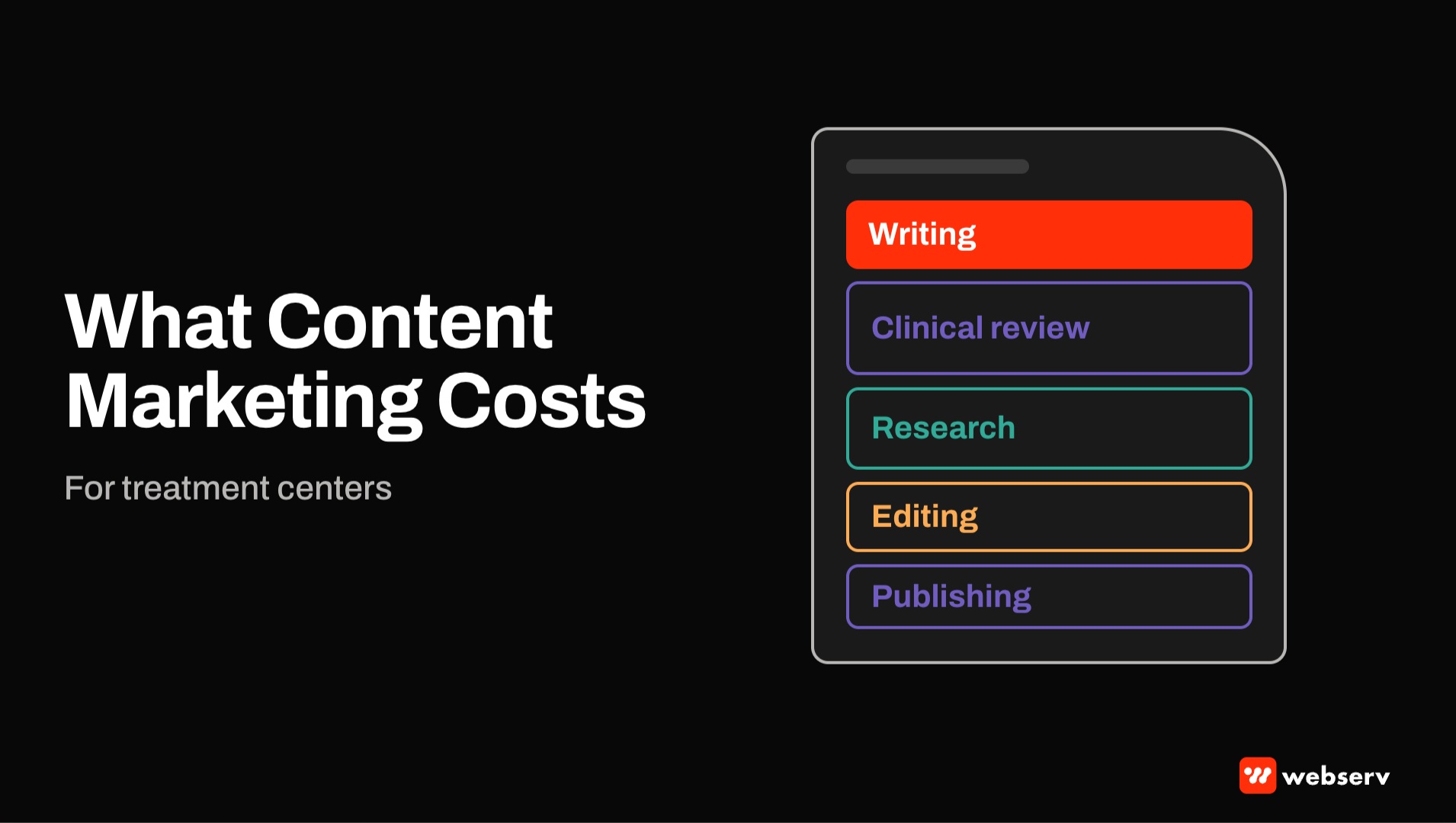
- The biggest cost drivers are clinical review, research, original material, and editing, not word count.
- Freelance writing rates vary widely. Editorial Freelancers Association survey data puts medical ghostwriting at about $1.00 to $1.50 a word.
- Bloggers spent an average of about 3 hours and 20 minutes writing a post in Orbit Media’s 2026 survey, before review and publishing.
- Fewer, stronger pieces usually beat a high monthly count. Budget for refreshes and promotion, not just new posts.
Why treatment center content costs more
Google’s quality rater guidelines treat health topics as “Your Money or Your Life” content, which they define as content that could significantly affect people’s health, financial stability, or safety. The guidelines also say some types of YMYL information must come from experts.
Google’s guidance on helpful, reliable, people-first content says its systems prioritize information created to benefit people. For a treatment center, that means content written or reviewed by people who know the clinical and admissions reality, with accurate claims and real sources.
That standard adds cost: clinical review, fact-checking, sourcing, and compliance review for advertising and privacy rules. Our guide to building clinical content Google trusts covers the process.
What drives the price
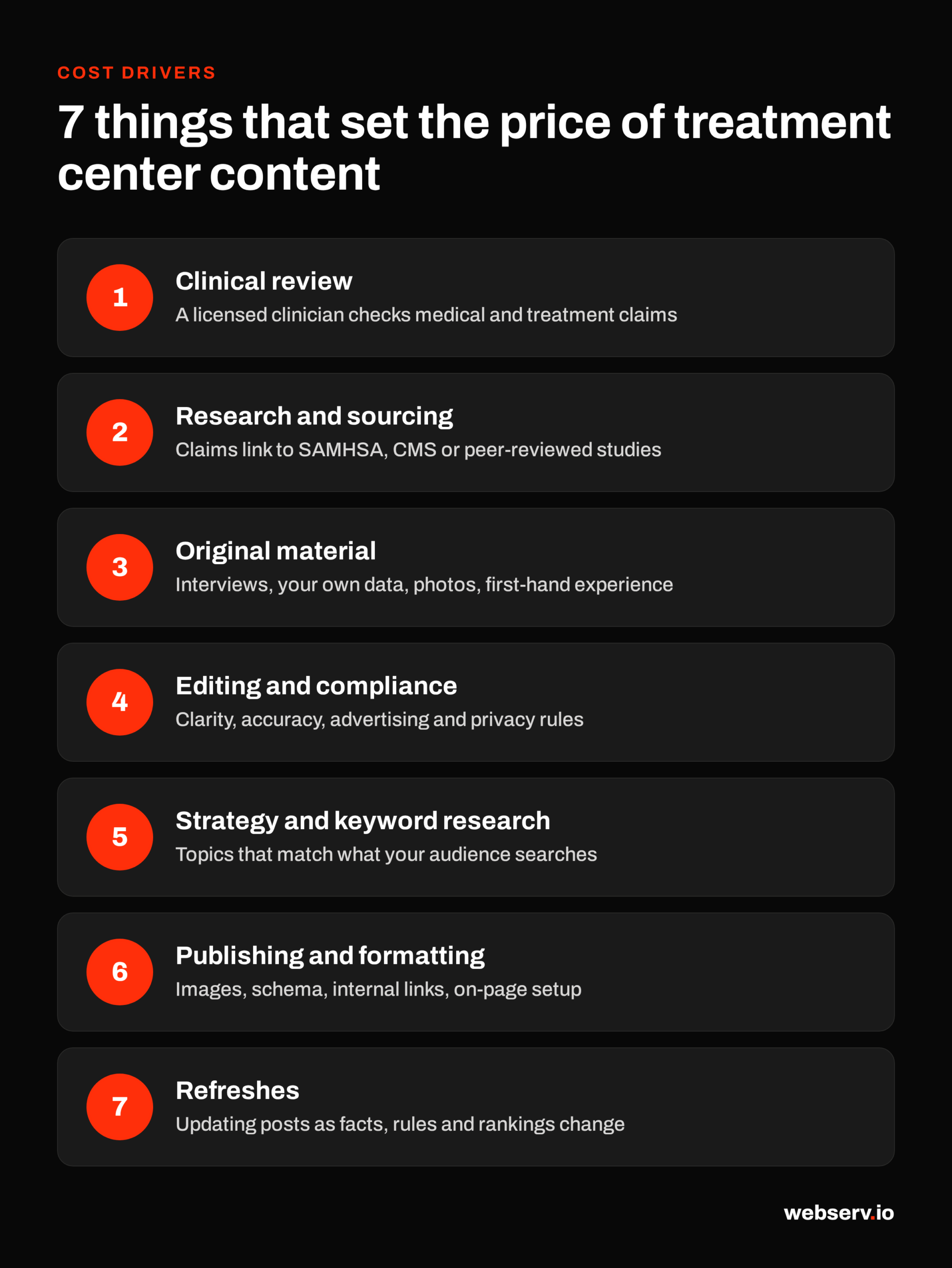
Two quotes for the same number of posts can include very different work. These are the items that move the price most:
| Cost driver | Why it matters |
|---|---|
| Clinical review | A licensed clinician reviews medical and treatment claims |
| Research and sourcing | Claims link to primary sources such as SAMHSA, CMS, or peer-reviewed studies |
| Original material | Interviews, your own data, photos, and first-hand experience |
| Editing and compliance | Edits for clarity, accuracy, and advertising and privacy rules |
| Strategy and keyword research | Choosing topics that match what your audience searches |
| Publishing and formatting | Images, schema, internal links, and on-page setup |
| Refreshes | Updating existing posts as facts, rules, and rankings change |
A writer can produce a draft. Most of the cost difference between quotes comes from everything around the draft.
What published rate data says
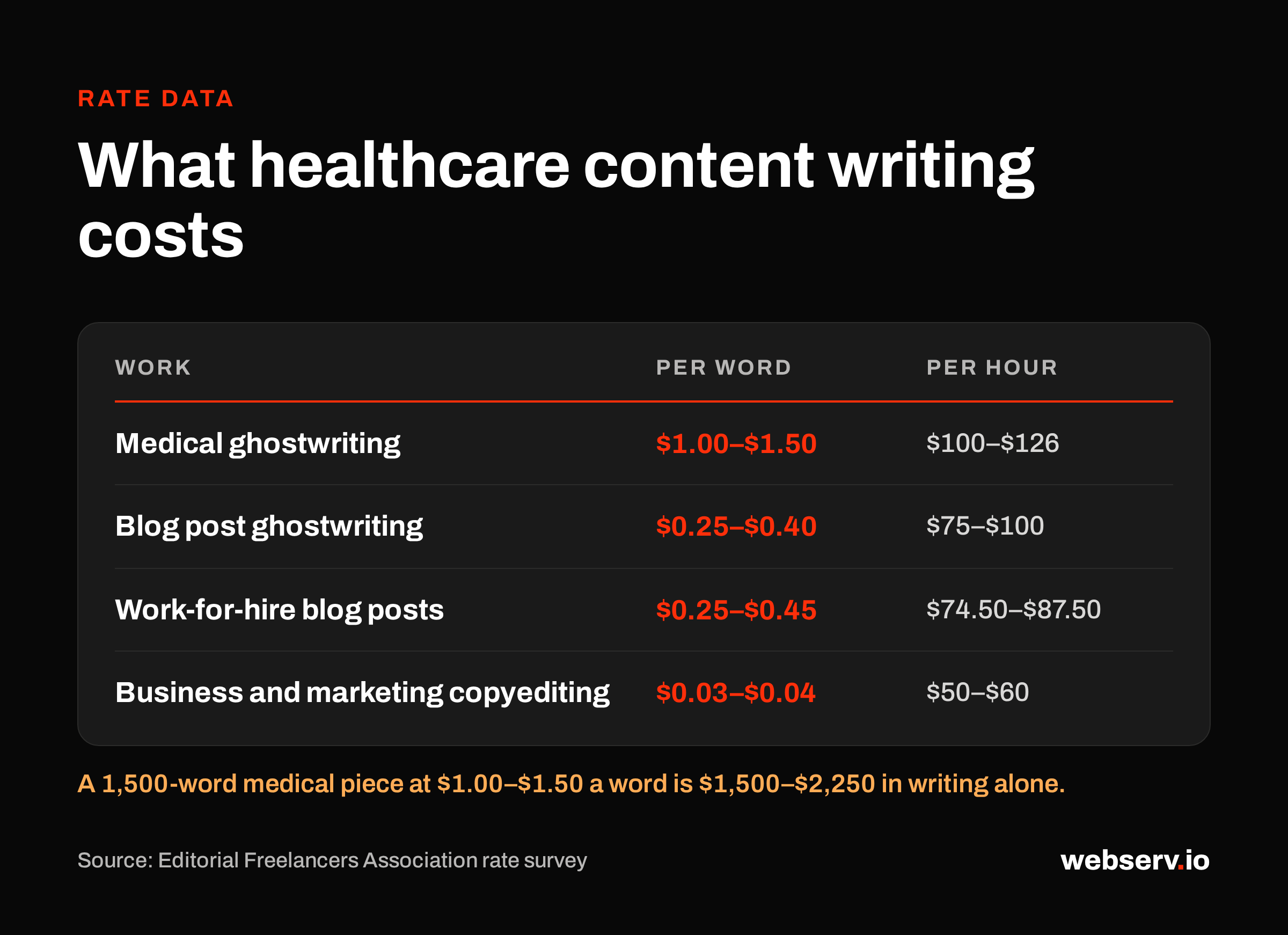
The Editorial Freelancers Association’s 2026 rate chart, based on a survey of more than 1,100 members, reports these median ranges:
| Work | Per word | Per hour |
|---|---|---|
| Ghostwriting, medical | $1.00 to $1.50 | $100 to $126 |
| Ghostwriting, blog posts | $0.25 to $0.40 | $75 to $100 |
| Work-for-hire blog posts | $0.25 to $0.45 | $74.50 to $87.50 |
| Business and marketing copyediting | $0.03 to $0.04 | $50 to $60 |
Source: Editorial Freelancers Association 2026 rate chart, survey run November 2025 to January 2026.
Orbit Media’s 2026 blogger survey found the average post took about 3 hours and 20 minutes to write and ran about 1,312 words. Writing time is only part of the work; research, review, and publishing add more.
These are writing rates, not the full cost of content. A 1,500-word medical piece at the EFA’s medical ghostwriting range costs $1,500 to $2,250 in writing alone, before clinical review, editing, images, and publishing.
What a monthly budget buys
Rather than a price list, think in terms of what each level of investment can support:
- A small budget supports a few well-researched pieces a month, focused on your highest-value services, with clinical review on each.
- A moderate budget adds regular refreshes of existing posts, original material such as clinician interviews, and promotion.
- A larger budget supports a full editorial calendar across services, levels of care, and family audiences, plus original research and digital PR.
At every level, put the most money into the pages closest to admissions: service pages, insurance pages, and level-of-care pages. Blog content supports them.
COMMON MISTAKE
Buying volume. A package of many low-cost posts a month often produces thin, similar pages that compete with each other. One strong page that answers a family’s real question usually does more than several that don’t.
In-house, freelance, or agency
Each model can work. The difference is who owns strategy, review, and quality:
| Approach | Strengths | Watch for |
|---|---|---|
| In-house writer | Knows your program; easy access to clinicians | One person can’t cover strategy, writing, SEO, and editing |
| Freelancers | Flexible; you pay per piece | You manage strategy, review, and quality |
| Agency | Strategy, writing, editing, and SEO together | Check who writes, who reviews, and what’s included |
Whichever you choose, keep a clinician in the review loop and own the strategy. Our list of content marketing agencies for treatment centers covers what to ask an agency.
OPERATOR INSIGHT
Ask any writer or agency to show you a published piece with its sources and reviewer named. If they can’t, assume your content won’t have them either.
How to tell if it’s working
Content works when it brings in people who become admissions. Track:
- Organic sessions and calls to the pages the content supports.
- Rankings for the service and level-of-care searches that matter most.
- Calls and forms that start on content pages, measured without sending health details to ad or analytics platforms.
Content takes time. Our guide to refreshing existing content covers how to get more from what you’ve already published, and our rehab SEO cost guide covers the wider SEO budget.
Where this fits
For how blog content supports admissions, see our guide to blog and resource architecture. For how content fits the rest of your marketing, see the complete guide to behavioral health marketing.
If you want a second look at a content quote, book an intro meeting.
Frequently Asked Questions
How much does content marketing cost for a treatment center?
It depends on volume, clinical review, research, and original material. Treatment center content usually costs more than general business content because it’s health content.
The Editorial Freelancers Association’s 2026 survey puts medical ghostwriting at about $1.00 to $1.50 a word.
Budget for review, editing, and publishing on top of writing.
How much should a blog post cost?
Writing rates vary widely. The Editorial Freelancers Association’s 2026 survey shows blog ghostwriting at about 25 to 40 cents a word and medical ghostwriting at $1.00 to $1.50.
A 1,500-word medical post at those rates costs $1,500 to $2,250 to write.
Clinical review, editing, and publishing add to that.
Why does treatment center content need clinical review?
Google treats health content as “Your Money or Your Life” content, and its rater guidelines say some health information must come from experts.
Clinical review checks treatment and medical claims for accuracy.
It also protects families who rely on what you publish.
Is it better to publish more content or better content?
Better content, in most cases. Many thin, similar posts can compete with each other and weaken trust.
Focus first on pages closest to admissions, such as service and insurance pages.
Then add blog content that supports them.
Should a treatment center hire a writer or an agency?
An in-house writer knows your program; freelancers are flexible; agencies combine strategy, writing, and SEO.
Whichever you choose, keep a clinician in the review process and own the strategy.
Ask to see published work with sources and reviewers named.
Trevor Gage is the Director of Marketing at Webserv, a digital marketing agency for treatment centers.