On May 7, 2026, Google stopped showing FAQ rich results in Search. The expandable question-and-answer dropdowns under a search result are gone for every site, and Google removed the FAQ rich result documentation the following month, according to its Search Central changelog.
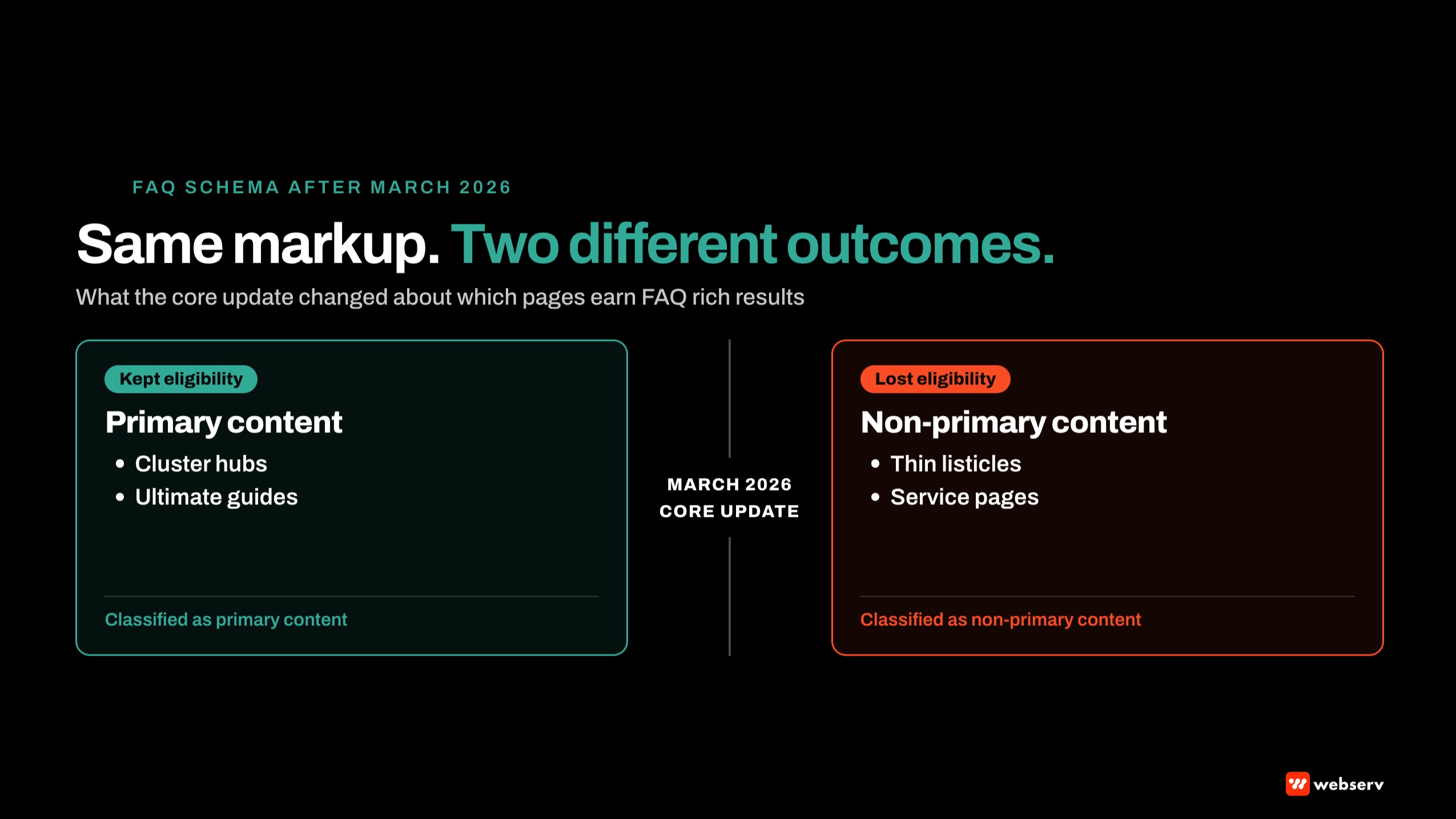
For most of the web the feature had been gone since August 2023, when Google limited FAQ rich results to well-known, authoritative government and health sites. Some treatment center sites fell inside that health exception, which is why their FAQ dropdowns kept showing into this year.
So marketing directors at treatment centers are asking us two questions. Should we strip the FAQ blocks off our pages? And does FAQ schema still help with visibility in ChatGPT, Google AI Overviews, and AI Mode?
Our answer: keep the visible FAQ sections that answer real questions, leave the markup alone, and stop treating FAQ schema as a ranking or citation lever. This piece covers what changed, what the AI citation research shows, and how we handle FAQ content inside our AEO program for treatment centers.
Key Takeaways
- Google stopped showing FAQ rich results on May 7, 2026, and removed the documentation in June. FAQPage markup is still valid Schema.org, but it no longer earns a search feature.
- Most AI-cited pages carry some structured data, but a controlled Ahrefs test of 1,885 pages found adding schema produced no clear citation lift in AI Overviews, AI Mode, or ChatGPT.
- The visible FAQ section is the part that matters. SE Ranking found pages with FAQ sections in their content averaged 4.9 AI Mode citations versus 4.4 without, while FAQ schema showed no ChatGPT advantage.
- Keep FAQ sections where they answer questions families actually ask, write each answer so it stands on its own, and update answers when facts change.
- Measure FAQ content with AI citation tracking and the generative AI performance report in Search Console, not FAQ rich result impressions.
What Google changed, and when
Google’s own documentation lays out the sequence in three steps.
- August 2023. FAQ rich results limited to well-known, authoritative government and health-focused sites. HowTo rich results were cut back at the same time (Google Search Central blog).
- May 7, 2026. FAQ rich results stop appearing in Google Search for every site.
- June 2026. Google removes the FAQ rich result documentation because the feature is no longer shown.
None of those steps was a penalty. If a treatment center’s FAQ dropdowns disappeared in May, the feature ended; the site did not lose standing.
DEFINITION
FAQ rich result, FAQPage schema, and a visible FAQ section. Three different things that get lumped together. The rich result was Google’s expandable display in search results, and it is gone. FAQPage schema is the JSON-LD markup that describes questions and answers, and it is still valid Schema.org.
The visible FAQ section is the questions and answers a reader sees on the page. On WordPress sites using the Rank Math FAQ block, the visible section and the markup ship together, so the real decision is about the content, not the code.
With the rich result gone, the only remaining case for FAQ schema is AI visibility. That is where the research gets more interesting than the posts claiming schema is the key to AI citations.
What the AI citation data says about FAQ schema
Three kinds of evidence are worth separating: how common structured data is on cited pages, what happens when pages add it, and how FAQ markup compares with visible FAQ content.
Structured data is common on cited pages
SE Ranking found about 65 percent of pages cited by Google AI Mode and 71 percent of pages cited by ChatGPT include structured data, per its structured data research. Ahrefs found AI-cited pages were almost three times more likely to have JSON-LD than pages that were not cited.
Those are correlations. Sites that add schema also tend to invest in technical SEO, content, and links, and those investments are what get pages cited.
Adding schema did not move citations in a controlled test
Ahrefs tracked 1,885 pages that added JSON-LD between August 2025 and March 2026 and compared them with matched control pages. In its schema and AI citations study, AI Mode and ChatGPT changes were statistically indistinguishable from zero.
AI Overview citations fell 4.6 percent relative to controls, a small decline Ahrefs could not attribute to schema. The caveat: every page in the study was already heavily cited, so the data cannot say whether schema helps pages AI systems have not found yet.
FAQ schema versus FAQ content
SE Ranking’s study of 216,524 pages found pages with FAQ schema averaged 3.6 ChatGPT citations versus 4.2 for pages without it, as Search Engine Journal reported. Its AI Mode research found pages with FAQ sections in their main content averaged 4.9 citations versus 4.4 without.
One likely reason for the split: searchVIU tested five AI systems (ChatGPT, Claude, Perplexity, Gemini, and Google AI Mode) and found none extracted JSON-LD when fetching a page live. They read the visible HTML. Results depend on the fetching tool, so treat it as a strong tendency rather than a rule.
FAQ schema and AI citations in the published research
4.9 vs 4.4
AI Mode citations, pages with vs without FAQ sections (SE Ranking)
3.6 vs 4.2
ChatGPT citations, pages with vs without FAQ schema (SE Ranking)
1,885
Pages tracked after adding schema, with no clear citation lift (Ahrefs)
Google’s position matches the data. Its guide to optimizing for generative AI features says structured data isn’t required for generative AI search and there’s no special schema.org markup to add, while still recommending structured data as part of overall SEO.
OPERATOR INSIGHT
The FAQ content is the asset, and the markup is a free byproduct of how Rank Math builds the block.
We keep FAQ blocks on our own posts because families and buyers ask the same questions over and over, and a clear answer on the page is useful whether or not an AI system cites it. We don’t pitch FAQ schema to clients as a citation lever.
What to do with FAQ blocks on a treatment center site
Four decisions cover most sites.
Leave the markup in place
Stripping FAQPage schema costs developer time and gains nothing measurable. The Ahrefs test found no clear benefit or harm on already-cited pages, and the Rank Math FAQ block outputs the markup alongside the visible section anyway.
The exception is hand-coded JSON-LD that no longer matches the visible text. Markup describing questions the page doesn’t show helps no one, so fix it or remove it.
Keep FAQ sections that answer real questions
The questions worth answering on a treatment center page are the ones admissions hears every day: whether a plan is accepted, what happens on admission day, whether family can visit, what to bring, and how a level of care is structured.
Pull them from admissions call notes and Search Console queries rather than a keyword tool. A question a real parent asked is worth more than a keyword variation.
Cut FAQ blocks that exist only for search
An FAQ block bolted onto a thin page does not make the page more citable. If the questions repeat the body copy, or the same five questions appear on every service and location page, rewrite them for that page or remove them.
Stop reporting FAQ rich results
Any report still tracking FAQ rich result impressions is tracking a feature that no longer exists. Replace it with AI citation tracking on the prompts that matter and Google’s generative AI performance report in Search Console.
How SoCal Sunrise generated 85 admissions and 2,297% ROI from SEO in 6 months
A ground-up SEO rebuild using the Pathfinder Parents Methodology turned an invisible online presence into a top-ranking admissions engine.
Read the case study →85 admits and 3,152 leads attributed to organic
How to write FAQ answers people and AI systems can use
Google’s AI guide says you don’t need to write in a special way for AI search or break content into tiny chunks. The habits that make an answer useful to a worried parent also make it easy to quote.
Answer in the first sentence. If a family asks whether you accept a specific plan, start with yes, no, or it depends on the plan, then explain. Our answer-first placement piece covers the same pattern for body sections.
Give the answer enough room. SE Ranking found sections of 120 to 180 words averaged 4.6 ChatGPT citations versus 2.7 for sections under 50 words. A two-line FAQ answer rarely carries enough to cite.
Keep body headings direct. In the same study, question-style H1s and H2s underperformed straightforward headings (3.4 versus 4.3 citations). Questions belong inside the FAQ block; body headings work better as plain labels.
Keep answers current. Pages updated within three months averaged 6 ChatGPT citations versus 3.6 for outdated pages. When a payer contract, program schedule, or visiting policy changes, update the FAQ that week.
DO
- Answer the question in the first sentence, then explain.
- Pull questions from admissions calls and Search Console queries.
- Write each page’s FAQ for that page’s program or topic.
- Update answers when payer, program, or policy details change.
- Leave FAQPage markup in place where the Rank Math block outputs it.
DON’T
- Add FAQ blocks to thin pages as a ranking tactic.
- Repeat the same questions across service and location pages.
- Report FAQ rich result impressions as a KPI.
- Promise outcomes, success rates, or the best treatment in an answer.
- Describe individual patients or their outcomes in an answer.
The rules in that list about claims and patients come from law, not style preference, which is the next section.
Compliance rules still apply to FAQ answers
FAQ answers are marketing claims like any other copy on the site, and the stakes are higher for addiction treatment. The Opioid Addiction Recovery Fraud Prevention Act of 2018 lets the FTC seek civil penalties for deceptive practices involving substance use disorder treatment services.
The FTC’s Health Products Compliance Guidance expects health claims to be backed by competent and reliable scientific evidence. In an FAQ, that rules out guaranteed recovery, unsupported success rates, and superlatives like the best rehab in the state.
Keep answers about how the program works, what insurance typically covers, and what families can expect. Leave individual patient stories out of FAQs; HIPAA generally requires written authorization before a covered entity uses patient information in marketing.
How to measure whether FAQ content is working
Three checks replace the old rich result report.
- Citation tracking. Run the prompts families actually use (for example, does a specific plan cover residential treatment in your city) in ChatGPT, Perplexity, and Google AI Mode each month, and record which pages get cited.
- Search Console. Use the generative AI performance report to see how your content performs in Google’s generative AI features.
- Admissions feedback. Ask admissions which questions callers still ask after reading the site. Those gaps are the next FAQ rewrites.
For the wider picture, our Full AI Search Stack for treatment centers shows where FAQ content sits among the other AI search surfaces, and structured data beyond Rank Math defaults covers the schema types worth maintaining. Our guide to author bios and E-E-A-T covers how to tie answers to credentialed authors and reviewers.
If FAQ questions map to multi-part prompts on your site, the compound prompt content model covers the structure, and our AI Information page guide covers the factual reference page AI systems draw on. For the full marketing picture, start with our behavioral health marketing guide.
If you want a second set of eyes on your FAQ content, book an intro meeting and we will review it with you.
Most in-house teams hit a wall not because they lack knowledge, but because they lack bandwidth.
When you are ready to hand it off, Webserv has spent 9 years executing exactly this for treatment centers nationwide.
Frequently Asked Questions
Should we remove FAQ schema now that Google dropped FAQ rich results?
No. FAQPage markup is still valid Schema.org, and removing it gains nothing measurable. Google’s guidance on generative AI features still treats structured data as part of normal SEO, and on WordPress sites using the Rank Math FAQ block the markup comes bundled with the visible section.
What should change is the reason you add FAQ sections. Add them because a page’s readers have questions the body copy doesn’t answer, not because the markup used to earn a dropdown in search results.
The one cleanup worth doing is hand-coded JSON-LD that has drifted from the visible text. Markup describing questions the page no longer shows helps no one, so fix it or take it out.
Does FAQ schema help a treatment center get cited in ChatGPT or AI Overviews?
The evidence says not by itself. Ahrefs tracked 1,885 pages that added schema and found no clear citation lift in AI Overviews, AI Mode, or ChatGPT, and SE Ranking found pages with FAQ schema averaged slightly fewer ChatGPT citations than pages without it.
What tracks with citations is the visible content. SE Ranking’s AI Mode data showed pages with FAQ sections in their main content averaged 4.9 citations versus 4.4 without, and searchVIU found AI systems fetching a page live read the visible HTML rather than the JSON-LD.
What most operators miss is that these are studies of the whole web. Before assuming the averages hold for your site, compare citations on a few pages before and after an FAQ rewrite.
Were behavioral health sites affected differently than other sites?
Some were. From August 2023 until May 2026, Google limited FAQ rich results to well-known, authoritative government and health-focused sites, so some treatment center sites kept FAQ dropdowns after most businesses lost them.
That means some behavioral health sites saw a visible change in May 2026 that most of the web had absorbed years earlier. A drop in FAQ appearances or clicks from search results that month reflects the feature ending, not a quality problem with the site.
The practical step is to annotate May 7, 2026 in your reporting so nobody reads the change as a penalty when comparing year-over-year search performance.
How many questions belong in an FAQ section?
As many as the page’s readers actually ask. On our own long-form posts we use four to six, and on a treatment center service page the right set usually comes straight from the questions admissions hears on calls about that program.
Each question should earn its place with an answer the body doesn’t already give. Restating body copy in question-and-answer form adds length without adding anything a reader or an AI system can use.
The mistake to avoid is copying one generic set of questions onto every service and location page. Write the set for each page, or leave the section off.
How do we track FAQ performance without the rich result report?
Track citations and questions instead of rich result impressions. Check which of your pages get cited for the prompts families actually use in ChatGPT, Perplexity, and Google AI Mode, and review the generative AI performance report in Search Console.
Pair that with admissions feedback. The questions callers still ask after visiting the site show which FAQ answers are missing or unclear, and that list is often more useful than any search tool.
Keep a simple log of the date each FAQ answer was updated. When citations move, you will know whether a content change or a platform change is the more likely cause.
Trevor Gage is the Director of Marketing at Webserv, a digital marketing agency for treatment centers.