Landing pages are the direct-response conversion asset paid campaigns depend on. Not the same as organic service pages. Not the same as the homepage. Purpose-built for single-conversion focus from paid traffic with specific message match to the ad that produced the click.
Most treatment center paid programs our performance creative team audits are running against landing pages built for organic ranking, not direct-response conversion. The paid CPA looks worse than it should because the landing page is doing organic-page work with paid-page traffic. The two contexts require materially different page architectures.
Running the wrong page type against paid campaigns compounds the cost of every ad click that hits it.
The specific pattern I see repeatedly: facility spends $30,000 to $80,000 per month on paid media across Meta and Google. The paid traffic lands on the same service pages that receive organic traffic.
Session-to-lead conversion sits at 1 to 2 percent because service pages are optimized for search intent and E-E-A-T signal rather than paid direct-response.
The paid team requests custom landing pages. Marketing leadership pushes back because “we already have landing pages for that.” What marketing has are service pages that Google indexes. What the paid team needs are landing pages that convert paid clicks.
This piece is the operator-facing guide we run every landing pages engagement against. It walks what a landing page actually is (distinct from service pages and homepages), the five-component framework that produces high-converting paid landing pages, and how many landing pages a treatment center actually needs.
It also covers the specific compliance considerations for LegitScript and Google BH advertising policy that apply differently to landing pages than to other page types.
It also covers the testing framework that produces measurable conversion lift over 60 to 120 days and the common failure modes that undermine landing page deployment even when the design work is done well.
It sits inside the paid media and performance creative clusters alongside our phone-first versus form-first landing pages piece that covers the primary CTA decision, our 10 elements every treatment center landing page needs piece that covers the component-level checklist, and our landing page design guide that walks the overall design discipline.
Key Takeaways
- Landing pages are direct-response paid conversion assets. They are not organic service pages. They are not the homepage. The distinction matters because service pages carry E-E-A-T signal and topical authority optimization for organic ranking, homepages serve multiple visitor types with multiple conversion paths, and landing pages exist to convert paid traffic on a single specific offer.
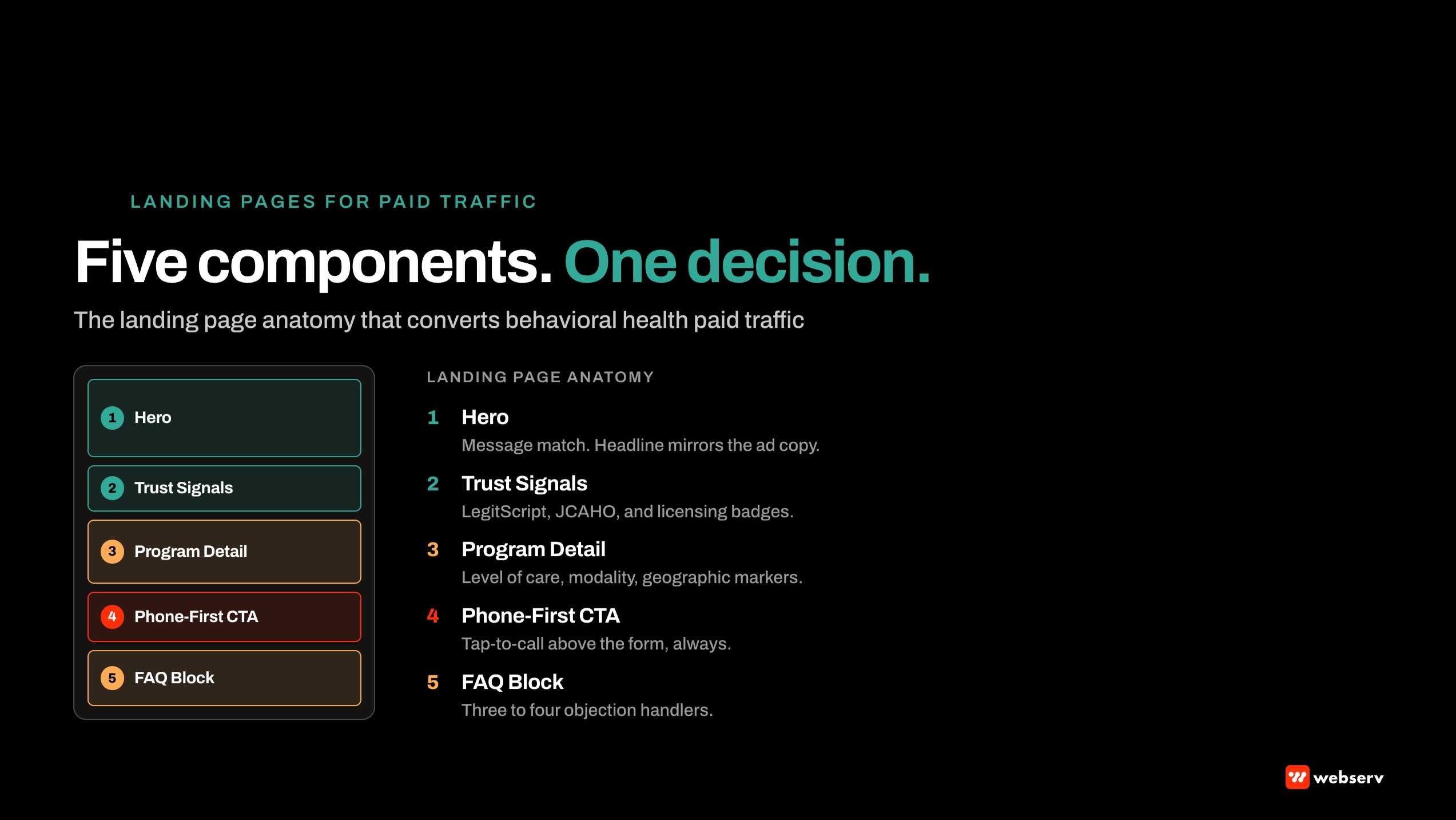
- The five-component landing page framework: above-the-fold hero with single-message value proposition matched to the ad copy that produced the click, trust signals block with accreditation and clinician credentials inline, program-specific detail covering what the specific offer includes, phone-first CTA hierarchy with form-second CTA, and FAQ block addressing paid decision points.
- Message match between ad copy and landing page hero is the single load-bearing variable in paid landing page performance. Ads promising residential rehab with in-network BCBS coverage that land on a generic start-your-recovery-journey landing page produce meaningful drop-off before the visitor scrolls.
- Most treatment centers need between 8 and 25 distinct landing pages. Not one per keyword. Not one per campaign. One per distinct offer positioning that appears in ad copy. Facilities running with fewer than 8 typically produce message-match failures. Facilities with more than 30 typically produce maintenance overhead that exceeds conversion benefit.
- Landing page compliance considerations apply differently than service page compliance. LegitScript reviews landing pages more aggressively than blog content because landing pages carry commercial claims. Google BH advertising policy applies to landing pages as if they were extensions of the ad copy itself.
DEFINITION
Treatment center landing page. A purpose-built page designed to convert paid traffic on a single specific offer with message match to the ad copy that produced the click. Five load-bearing components: message-match hero, trust signals inline, program-specific detail, phone-first CTA hierarchy with form-second CTA, and FAQ block addressing paid decision points. No navigation to other pages. No secondary conversion path to alternative CTAs. One offer, one path, one measurement signal.
Distinct from service pages (organic-optimized for E-E-A-T signal + topical authority + rank on commercial queries) and distinct from homepages (multi-visitor-type, multi-conversion-path, brand narrative). The three page types serve three different traffic contexts. Reusing service pages as landing pages is the specific pattern that produces the paid CPA problem most operators encounter. Purpose-built landing pages produce the paid conversion economics paid campaigns require.
OPERATOR INSIGHT
“We already have landing pages for that” means the marketing team has service pages that Google indexes.
What the paid team needs are landing pages that convert paid clicks. The two contexts require materially different page types, and running the wrong page type against paid campaigns compounds the cost of every ad click that hits it. Service pages carry E-E-A-T + topical authority for organic rank. Paid direct-response requires single-message single-conversion focus. Same underlying facility, entirely different page architecture.
What a landing page actually is
A landing page is a purpose-built page designed to convert paid traffic on a single specific offer. Understanding what a landing page is (and is not) is the prerequisite to designing landing pages that convert.
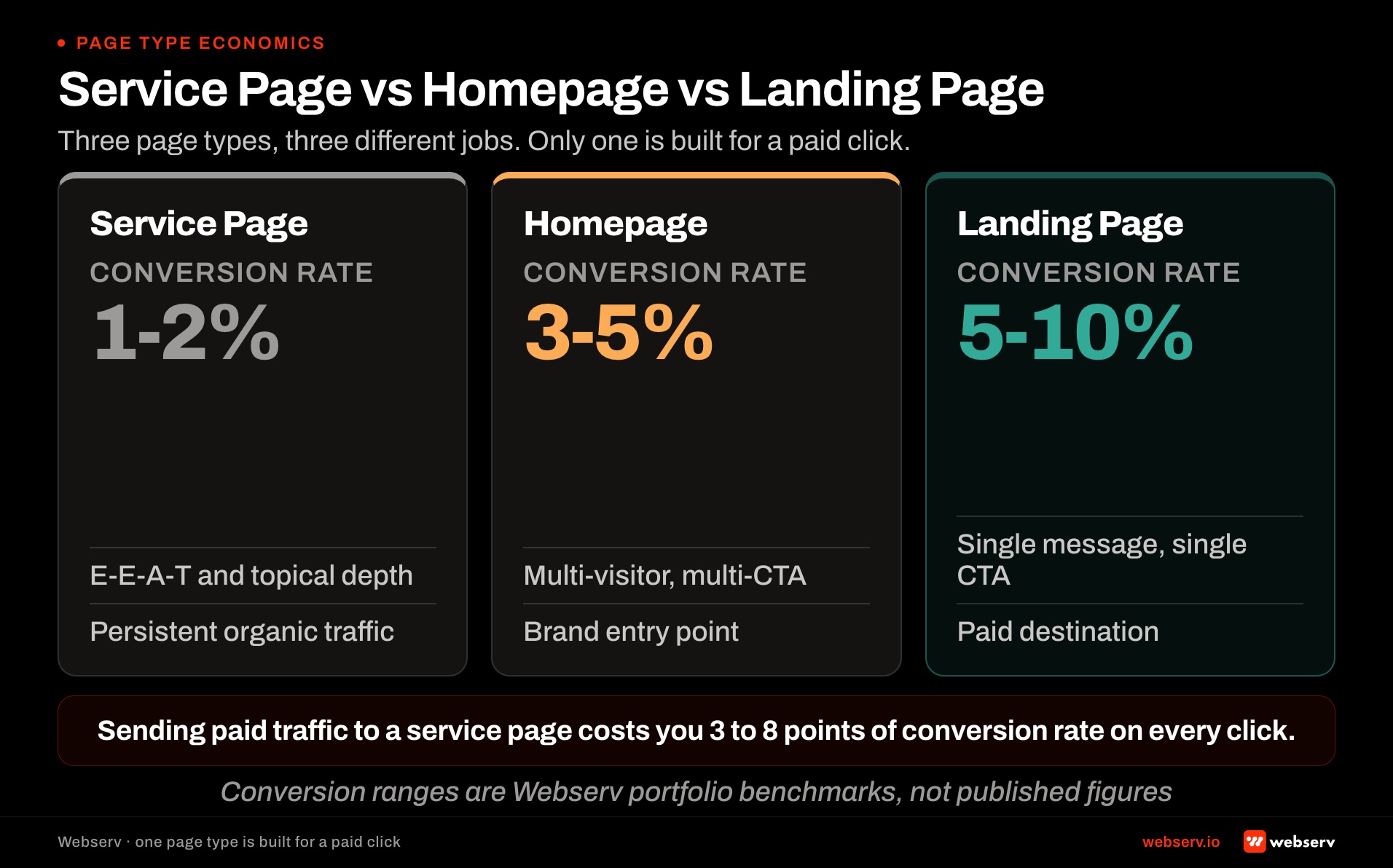
A landing page is not a service page. Service pages target organic search intent and get optimized for E-E-A-T signal, topical authority, and rank on specific commercial queries. Service pages typically carry the full clinical positioning, program depth, insurance visibility, and secondary conversion paths that serve organic traffic across a broader intent range.
A landing page is not a homepage. Homepages serve multiple visitor types simultaneously (acute-need families, research-mode families, referral partners, brand-search visitors) with multiple conversion paths matched to visitor intent. Homepages carry the full brand narrative, program navigation architecture, differentiated conversion paths, and location clarity.
A landing page is the paid direct-response conversion asset. Landing pages target a single specific offer that matches the ad copy that produced the click. Everything on the page reinforces that single offer. There is no navigation to other pages. There is no secondary conversion path to alternative CTAs. One offer, one path, one measurement signal.
The three page types serve three different traffic contexts. Reusing service pages as landing pages produces the paid CPA problem documented above. Reusing homepages as landing pages produces the same problem with additional navigation leakage. Purpose-built landing pages produce the paid conversion economics paid campaigns require.
The five-component landing page framework
The framework that produces high-converting paid landing pages has five load-bearing components. Each component has a specific job. Missing components or under-configured components collapse the conversion rate.
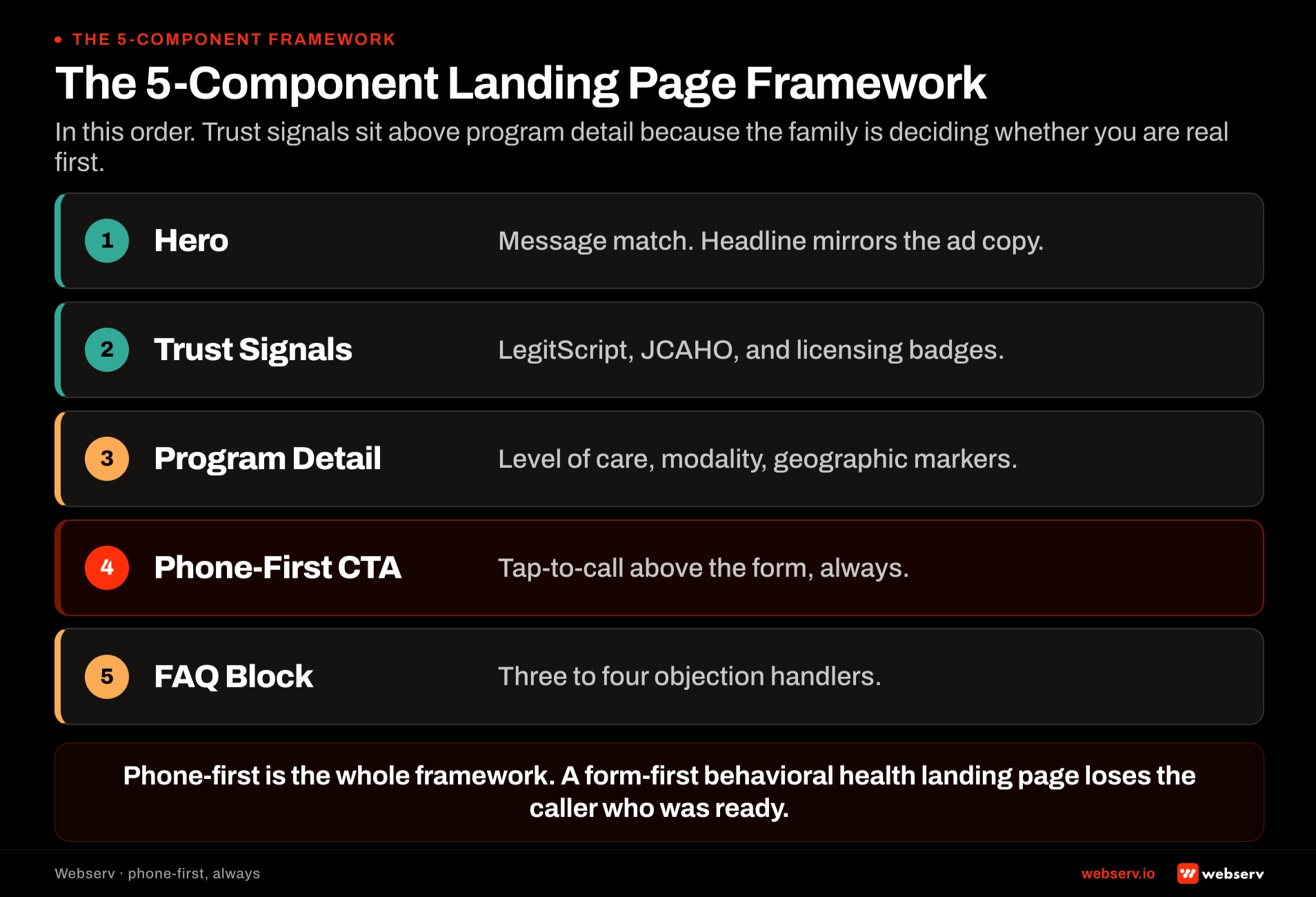
Component 1: Above-the-fold hero with single-message value proposition matched to ad copy
The hero is the first 40 to 80 words of body content above the fold. It has 4 to 8 seconds of visitor attention before the visitor either engages or leaves. The specific job of the hero is confirming that the visitor landed on the right page for the specific offer the ad promised.
The pattern that works: the hero copy references the specific offer or positioning from the ad. If the ad promised “residential dual diagnosis treatment with in-network BCBS coverage in Arizona,” the hero mirrors those exact elements: residential, dual diagnosis, BCBS network, Arizona geography.
Generic “start your recovery journey” hero copy against a specific ad produces the meaningful message-match failure that drops the session immediately.
Component 2: Trust signals block with accreditation and clinician credentials inline
Trust signals appear within the first screen of the page, ideally directly below the hero. Named clinical leadership with credentials, facility accreditation logos (JCAHO, CARF, LegitScript, state license number), and specific years-in-operation reference all belong in this block.
The specific job of the trust signal block: resolving the skepticism paid traffic carries about behavioral health advertising. Families arriving from paid clicks typically know the category has a documented history of predatory operators.
Trust signals that establish credibility within the first screen produce the second reading beat that keeps the visitor engaged. Buried trust signals in the footer only reach visitors who have already invested reading effort, which is late.
Component 3: Program-specific detail covering what the offer includes
Program-specific detail describes what the specific offer promised in the ad actually includes at this facility. Length of stay, clinical modalities offered, insurance coverage patterns, admission process. Not generic category description. Facility-specific programmatic content.
The specific job of the program detail: confirming the offer is real and grounded in specific facility operations. Generic program descriptions that duplicate what any facility would say produce the paid drop-off pattern.
Visitors scroll but do not convert because the page did not establish the facility as specifically the right choice.
Component 4: Phone-first CTA hierarchy with form-second CTA
Phone-first CTA hierarchy positions the phone number as the primary conversion path. Phone number in the sticky header. Phone number in the hero CTA. Phone number in the mid-page CTA. Every phone number on mobile is a tel: link with a tap target sized 44 pixels or larger.
Form-second CTA provides the secondary conversion path for visitors who prefer form submission. Form with 3 to 5 fields maximum. Our phone-first versus form-first landing pages piece covers the specific decision framework for which CTA type leads and how to configure the hierarchy.
Component 5: FAQ block addressing paid decision points
FAQ block at the bottom of the landing page covers the specific decision points paid traffic works through. Insurance coverage questions. Admission timing questions. Program length questions. Family involvement questions. Four to six FAQs with Rank Math FAQ block deployment for structured data.
The specific job of the FAQ block: resolving the specific objections that would produce exit without conversion. Paid traffic that reaches the FAQ block is engaged enough to consider conversion but working through specific concerns.
FAQ answers that address those concerns directly produce meaningful lift on conversion rate for the visitors who reach the FAQ section.
The landing page surface at a glance
5
Components: hero, trust signals, program detail, CTA hierarchy, FAQ
8-25
Distinct landing pages per facility — one per offer positioning, not per keyword
5-10%
Session-to-lead conversion rate for paid traffic on a well-executed LP
60-120 d
Testing cycle window (hero → CTA → form, sequential)
How many landing pages does a treatment center actually need?
Between 8 and 25 distinct landing pages for most single-facility operators. Facilities with fewer typically produce message-match failures. Facilities with more typically produce maintenance overhead that exceeds the conversion benefit.
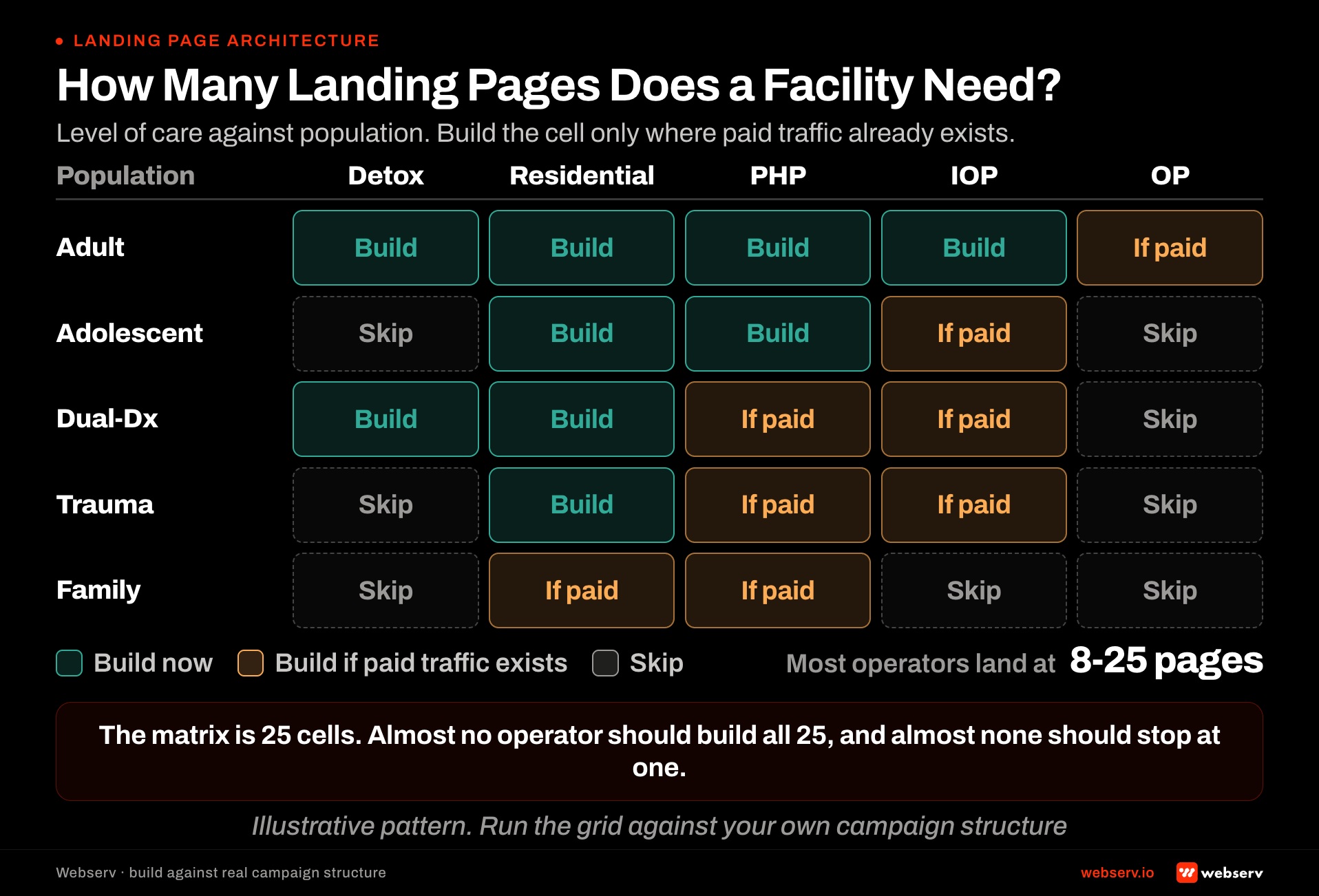
The right count depends on the specific offer positioning that appears in ad copy across the paid program. Not one landing page per keyword. Not one per campaign. One per distinct offer positioning.
The specific pattern that produces 8 to 25 landing pages. Each level of care that runs in paid campaigns produces one landing page (residential, PHP, IOP, detox). Each condition that runs in specific ad campaigns produces one landing page (dual diagnosis, SUD, alcohol use disorder, trauma-focused, adolescent). Each insurance-specific offer that appears in ad copy produces one landing page (in-network BCBS residential, in-network Aetna PHP, etc.).
A residential SUD facility offering dual diagnosis treatment with mixed payer mix in Arizona might produce a landing page count in the 12 to 18 range covering the LOC-condition-payer-geography combinations that appear in ads.
A portfolio operator with multiple facilities in multiple states produces meaningfully more, roughly 8 to 15 landing pages per facility.
The specific gotcha: facilities that build one landing page per keyword end up with 200+ landing pages that all say essentially the same thing with different keywords swapped in the hero.
This produces maintenance overhead without conversion benefit because AI-optimized paid campaigns (Meta Advantage+, Google AI Max) do not benefit from keyword-level landing page splitting the way older campaign types did.
Landing page compliance
Landing page compliance considerations apply differently than service page compliance because landing pages are extensions of paid advertising rather than organic content. Three specific compliance frameworks apply.
LegitScript standards for behavioral health advertising. LegitScript reviews landing pages more aggressively than blog content because landing pages carry commercial claims tied to specific paid campaigns. Guaranteed outcome language, comparative superlative claims, unverified insurance-network claims, and specific-outcome numeric claims all fail LegitScript standards on landing pages. Our compliant ad headlines guide covers the specific claim language rules that apply across paid platforms.
Google BH advertising policy. Google evaluates landing pages as part of the ad approval process. Landing pages that violate BH advertising policy trigger ad-level disapprovals that spread across the campaign. The specific triggers: crisis-language framing, targeting-implication imagery, specific-outcome promises, and comparative-superiority claims.
HIPAA-adjacent considerations on landing pages that capture PHI. Landing page forms that capture insurance information, health condition specifics, or medication history carry HIPAA-adjacent implications. The form data flow needs to route through the same server-side tracking infrastructure that keeps ad platform data flows compliant. Our HIPAA-safe conversion tracking piece covers the specific data-flow architecture.
Facilities that treat landing page compliance as an extension of organic content compliance typically discover the difference through Google ad disapprovals or LegitScript enforcement. Catching the difference during landing page design is meaningfully cheaper than remediating after enforcement.
Landing page testing framework
Landing page testing produces measurable conversion lift over 60 to 120 days when the testing framework is structured correctly. The framework runs three test types in specific sequence.
Test type 1: Hero message match. The hero copy is the highest-impact single variable in landing page conversion. Testing hero variations against specific ad campaign variations produces the fastest conversion rate improvement. Test frame: run two hero versions against the same ad campaign for 14 to 21 days. Measure conversion rate. Scale the winner.
Test type 2: CTA hierarchy. Phone-first versus form-first, sticky header versus no sticky header, single primary CTA versus dual CTA. Test frame: run two hierarchy configurations against traffic for 21 to 30 days. Measure conversion rate and specifically the phone-versus-form conversion split. Scale the winner.
Test type 3: Form field count and structure. Multi-step form versus single-step form, 3-field versus 5-field form, insurance question upfront versus later. Test frame: run two form configurations for 21 to 30 days. Measure completion rate on visitors who initiate the form. Scale the winner.
The specific sequence matters. Hero message match testing produces the largest single lift and should run first. CTA hierarchy testing produces the second-largest lift and should run second. Form field testing produces smaller lift and should run third once the higher-impact variables are stabilized.
Facilities running all three test types simultaneously produce noisy results because the interactions between variables cannot be isolated. Sequential testing produces cleaner signal and faster overall improvement.
DO
- Build purpose-built LPs for paid — hero mirrors the exact offer language from the ad copy (LOC + condition + payer + geography).
- Deploy 8-25 distinct LPs per facility — one per distinct offer positioning that appears in ad copy, not one per keyword.
- Run compliance review during design — LegitScript + Google BH policy review before production, not after enforcement.
- Test sequentially: hero (14-21 days) → CTA hierarchy (21-30 days) → form structure (21-30 days). Isolate variables.
- Route form submissions through the server-side conversion tracking stack — LPs that capture insurance or health context carry HIPAA-adjacent flows.
DON’T
- Run paid campaigns against organic service pages — 1-2% conversion vs 5-10% on a purpose-built LP, and every paid click compounds the CPA problem.
- Ship generic “start your recovery journey” hero copy against specific-offer ads — message-match failure loses the session inside 8 seconds.
- Build 100+ LPs targeting individual keywords — AI-optimized paid campaigns (Advantage+, AI Max) don’t reward keyword-level LP splitting.
- Test hero + CTA + form variants simultaneously — variable interaction noise cancels the signal; sequential testing wins.
- Treat LP compliance as organic content compliance — LegitScript reviews LPs more aggressively; Google treats LPs as extensions of the ad copy.
Common failure modes
Five patterns produce most of the landing page failures we audit.
Failure mode 1: Service pages used as landing pages. Paid campaigns run against service pages designed for organic traffic. Conversion rate stuck at 1 to 2 percent. Fix: build purpose-built landing pages for the specific paid offers.
Failure mode 2: Message match failure between ad and landing page. Ad promises specific offer. Landing page hero uses generic language. Visitor drop-off inside the first 8 seconds. Fix: hero copy that mirrors the specific offer language from the ad copy.
Failure mode 3: Too many landing pages. Facility builds 100+ landing pages targeting individual keywords. Maintenance overhead exceeds conversion benefit. Compliance risk multiplies across the landing page inventory. Fix: consolidate to 8 to 25 landing pages per facility organized by distinct offer positioning.
Failure mode 4: Landing page compliance treated as organic content compliance. Landing pages carry LegitScript-noncompliant claims that Google policy enforcement eventually catches. Fix: run landing page copy through LegitScript standards review and Google BH policy review during design, not after production.
Failure mode 5: Testing multiple variables simultaneously. Test frame produces noisy results because hero, CTA, and form variations run against the same traffic without isolation. Fix: sequential testing with hero first, CTA second, form third.
Frequently Asked Questions
Should our landing pages be indexed by Google?
Depends on the specific landing page and the campaign structure. Paid-only landing pages targeting specific ad copy typically should not be indexed because they duplicate content on service pages and can dilute organic ranking through the duplicate content signal.
The specific pattern that works: paid-only landing pages carry noindex, follow meta directives, which allows Google to crawl the page for policy review but excludes it from organic indexing.
Some landing pages support both paid and organic traffic. Facility landing pages positioned as the top-of-funnel entry point for a specific service area sometimes benefit from indexing because they can rank organically on branded plus service queries. Those pages typically follow the service page rubric rather than the paid landing page rubric. Facilities running both indexed and non-indexed landing pages should maintain clear separation in the CMS and in the URL structure to avoid confusion during audit and maintenance.
How much should we spend on landing page development?
Between $1,500 and $5,000 per custom landing page for most treatment center operators, depending on design complexity and copy sourcing. The specific breakdown: 8 to 16 hours on copywriting and message match against the ad campaign, 8 to 16 hours on design and development, 2 to 4 hours on compliance review, and 2 to 4 hours on testing setup and initial validation.
Portfolio operators typically produce landing pages more efficiently at scale because the design system, compliance framework, and testing infrastructure are shared across facilities. The per-page cost typically drops to $1,000 to $2,500 for the second and subsequent facilities in a portfolio.
Facilities using landing page builders (Unbounce, Instapage, Leadpages) can reduce the per-page cost meaningfully but typically produce landing pages with less design flexibility and less compliance-review integration than custom-built pages. Our landing page builders guide covers the platform decision framework.
How long should we keep a landing page live before testing changes?
Between 14 and 30 days minimum to accumulate enough conversion data for statistically defensible testing. Facilities that test changes at 7 days typically produce results that are within statistical noise rather than reflecting actual conversion difference.
The specific data requirement: enough conversions on both variants to detect the minimum meaningful conversion difference (typically 15 to 20 percent relative improvement). For a landing page converting at 5 percent, that requires roughly 400 to 600 sessions per variant, which typically takes 14 to 30 days at the traffic volumes most treatment center paid programs run.
Facilities that maintain landing pages without testing changes for more than 6 months typically produce declining conversion rates as ad platforms and creative patterns evolve and the landing page loses relevance. The right cadence: test the highest-impact variable every 30 to 60 days, scale winners, and revisit the full framework every 12 months.
Do we need separate landing pages for Google Ads and Meta Ads?
Sometimes. Google Ads landing pages typically emphasize specific query intent and match the search query language. Meta Ads landing pages typically emphasize the interruption context and match the specific interest-based targeting.
The specific pattern that works: shared landing pages for offers with equivalent messaging across Google and Meta (residential dual diagnosis with BCBS coverage plays similarly on both platforms). Platform-specific landing pages for offers where the platform context materially changes the visitor’s intent state.
A dedicated Google Ads versus Meta landing pages piece in this cluster covers the specific decision framework for when to split landing pages by platform.
What’s the difference between a landing page and a squeeze page?
A landing page is a broader category that includes multiple conversion pathways (phone-first CTA, form-second CTA, secondary information consumption). A squeeze page is a specific type of landing page focused exclusively on a single form-based conversion with minimal content beyond what is needed to produce the conversion.
For treatment center paid campaigns, squeeze pages typically underperform full landing pages because the single-form focus does not accommodate the phone-first conversion pattern that produces the highest conversion rates in acute-need behavioral health. Squeeze pages work in lower-intent contexts (top-of-funnel offer downloads, newsletter signups) but underperform in the primary paid admissions flow.
Facilities considering squeeze pages should confirm the specific conversion case before deploying. Squeeze pages that reduce conversion below the full landing page format produce lower conversion rates without corresponding cost savings.
How do we know our landing page framework is working?
Three specific measurement signals. First: session-to-lead conversion rate at 5 to 10 percent for paid traffic on the specific landing page. Below 3 percent signals one or more framework components are broken. Above 10 percent typically signals both strong framework compliance and favorable ad-to-landing-page message match.
Second: message match measurement through the specific ad-to-landing-page conversion rate variance. Landing pages with strong message match produce consistent conversion rates across ad variations targeting the same offer. Landing pages with weak message match produce highly variable conversion rates because different ads trigger different visitor expectations.
Third: cost per admit tracked through cohort attribution over 60 to 120 days. Landing page improvements should produce measurable cost-per-admit reduction at the cohort level, not just conversion rate improvement at the session level. Conversion rate that improves without cost-per-admit improvement typically signals the landing page is producing lower-quality inquiries at higher volume. Our HIPAA-safe conversion tracking guide covers the attribution architecture that surfaces this signal.
How does the landing page framework interact with our service page and homepage frameworks?
Complementary. The three page types serve three different traffic contexts and produce three different conversion economics.
Homepages convert brand-search and direct-navigation traffic at 3 to 5 percent through the nine-component homepage rubric with multiple conversion paths matched to visitor intent. Service pages convert high-intent organic traffic at 2 to 3 percent through the seven-component service page rubric with E-E-A-T signal and topical authority optimization. Landing pages convert paid direct-response traffic at 5 to 10 percent through the five-component landing page framework with single-message single-conversion focus.
Facilities running one framework across all three contexts produce underperformance somewhere in the funnel. The specific pattern that produces the strongest overall conversion economics: purpose-built pages for each context with clear separation between homepage, service pages, and landing pages in the site architecture.
Keaton Nalle is the Director of Paid Admissions at Webserv, a digital marketing agency for treatment centers. This piece pairs with our treatment center landing page design guide and our broader work on behavioral health marketing.