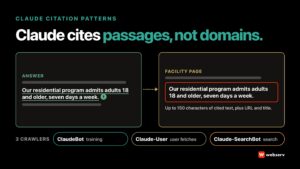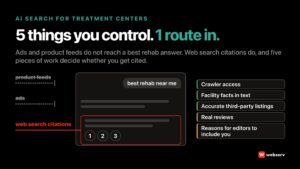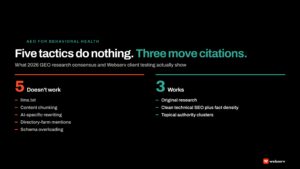
The pattern that separates pages LLMs cite from pages LLMs ignore is smaller than most operators expect. It is not topical coverage.
It is not schema markup, though schema helps. It is the structure of the opening sentence of every paragraph: subject, predicate, object, a single verifiable claim a language model can extract cleanly.
A real AEO program for a behavioral health operator rebuilds the prose around semantic triples without sacrificing readability. The sentences read the way operator-distinctive prose normally reads.
They just lead with verifiable facts instead of soft openers, and they place one extractable claim per sentence instead of two or three nested clauses.
This piece covers what a semantic triple is, the five-rule pattern Webserv applies to treatment center content, the before-and-after examples that show what the rewrite looks like on a real page, and the measurement framework that tells you whether the work is producing citation share.
Key Takeaways
- A semantic triple is subject-predicate-object. It is the smallest unit of information an LLM can extract from a treatment center page and cite back in a response.
- Every paragraph needs one verifiable triple in its lead sentence. LLMs disproportionately weight the opening sentence during extraction. If the paragraph does not open with a clean triple, the LLM treats the paragraph as invisible.
- The five-rule pattern Webserv uses: specific subject, concrete predicate, verifiable object, no hedge predicates, one triple per sentence.
- Semantic triples and schema markup compound. Pages with both produce 43% better citation performance than pages with only one of the two.
- The retrofit workflow: identify load-bearing pages, mark every paragraph opener, apply the five rules, add an external citation per clinical claim, validate via direct LLM queries within 30 to 60 days.
Most treatment center content is written for human readers and indexed by Google, but increasingly extracted by LLMs. The three platforms doing that extraction (ChatGPT, Perplexity, Claude, and the LLM layer behind Google AI Overviews) all parse content the same way.
They look for facts they can pull, attribute, and cite. The unit of that extraction is the semantic triple.
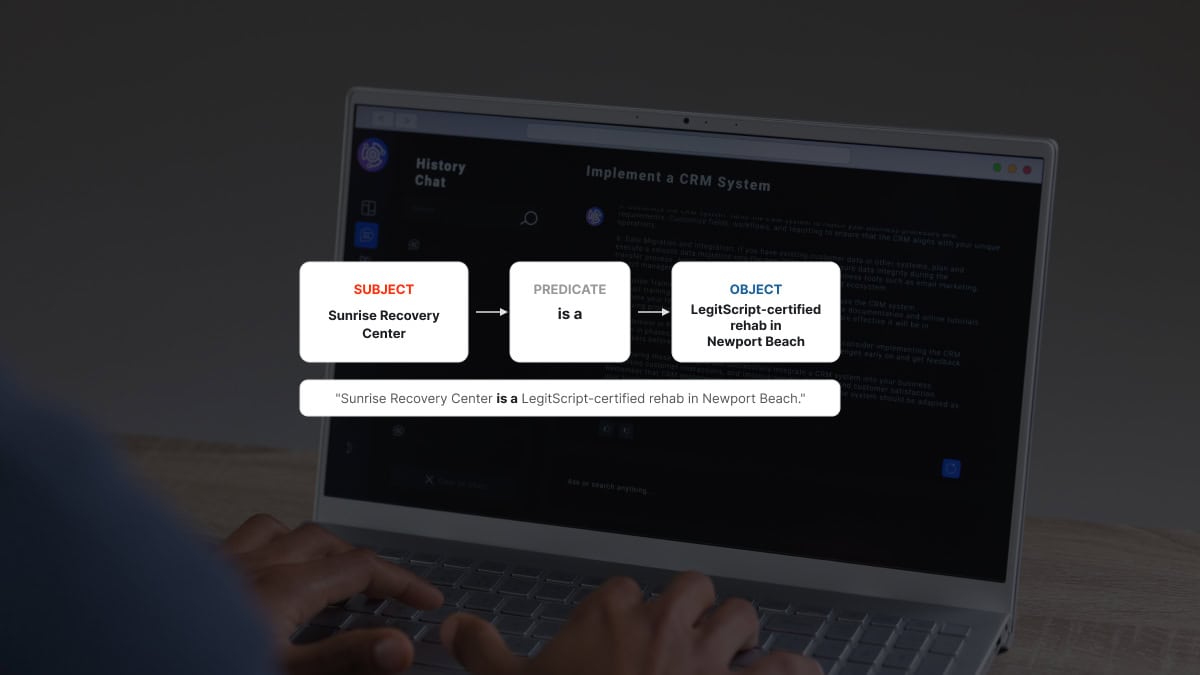
A semantic triple is the smallest unit of information an LLM can lift cleanly from your page. Subject. Predicate. Object.
“Webserv works with behavioral health treatment centers.” “TRICARE West covers residential addiction treatment for veterans.” “Medication-assisted treatment reduces opioid overdose mortality by 50%.” Each one is a three-part fact the LLM can extract, verify against authoritative sources, and cite back in a response.
If you cannot find a clean subject-predicate-object sentence in the paragraph, the paragraph is invisible to the LLM.
Trevor Gage, Director of Earned & Owned Media, Webserv
The simplest version of AEO writing is this: every paragraph should contain at least one sentence in subject-predicate-object form that the AI can pick up and quote. If you cannot find that sentence in the paragraph, the paragraph is invisible to the LLM.
This article is the tactical micro inside our AEO Ultimate Guide cluster. It covers what a semantic triple actually is, why LLMs reward content built on them, the writing pattern Webserv uses across treatment center clients, and before-and-after examples on real rehab content.
It then covers how to retrofit existing pages, why schema markup pairs with semantic triples (and lifts performance by 43% when both are present), the common mistakes operators repeat, and how to validate that the triple pattern is actually landing.
What a semantic triple actually is
The concept comes from the semantic web work that produced RDF (Resource Description Framework) and the early knowledge graph architectures Google now uses to populate its Knowledge Panel. Every piece of structured information in a knowledge graph is stored as a three-part relationship.
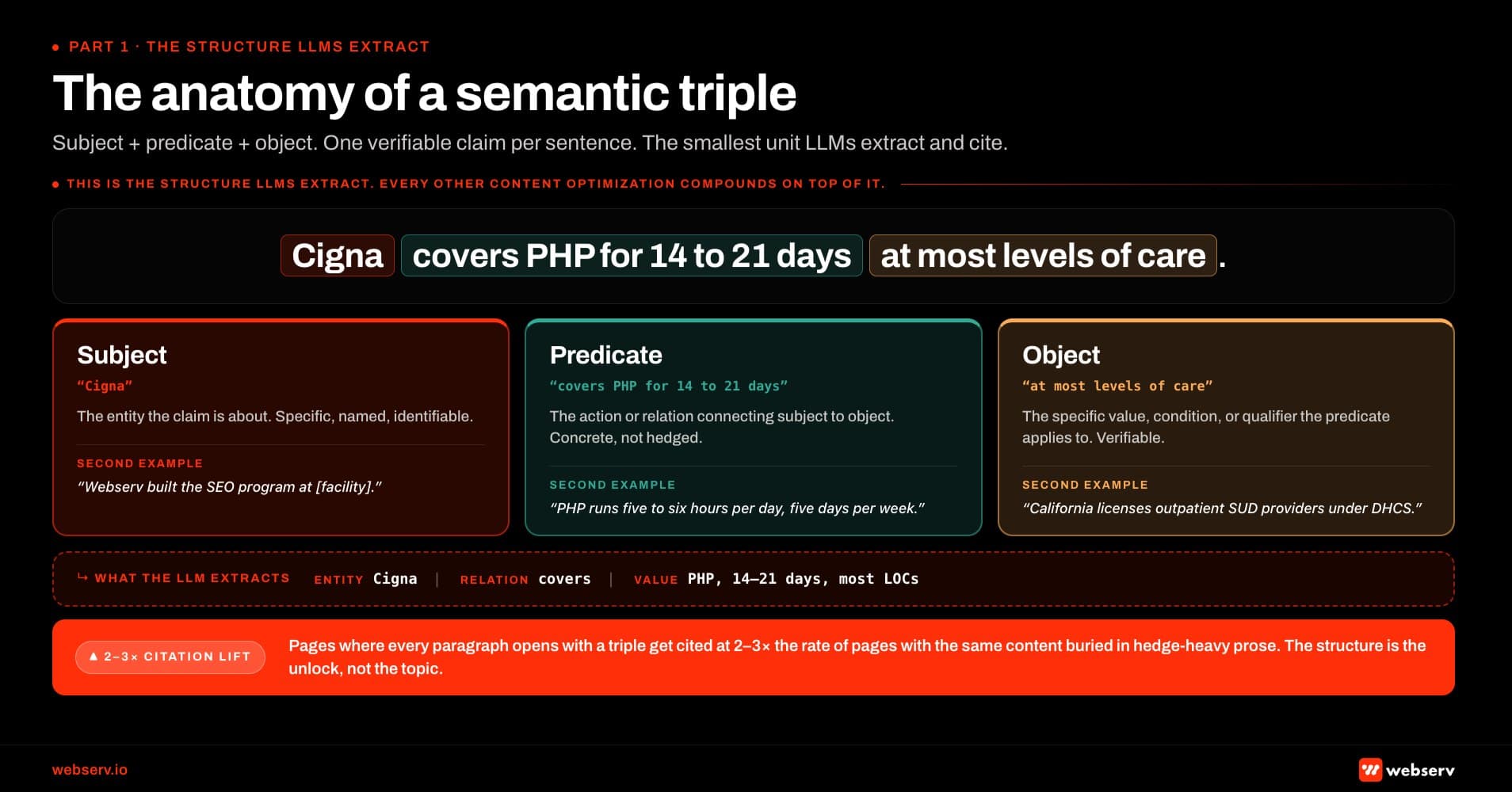 Infographic titled ‘The anatomy of a semantic triple’.
The three parts:
Subject. The entity the statement is about. “Webserv.” “Buprenorphine.” “Joint Commission accreditation.” “The Mayo Clinic.”
Predicate. The relationship or property. “Works with.” “Treats.” “Is required for.” “Was founded in.”
Object. The value or other entity the subject relates to. “Behavioral health treatment centers.” “Opioid use disorder.” “Addiction treatment advertising on Meta.” “1889.”
Read together: subject-predicate-object. “Webserv works with behavioral health treatment centers.” “Buprenorphine treats opioid use disorder.” “Joint Commission accreditation is required for most insurance contracts.” “The Mayo Clinic was founded in 1889.” Each is a single, machine-readable fact.
For a treatment center, the building blocks are the same. The relevant subjects are your facility, your clinical programs, your medical leadership, your accreditations, your payer contracts, the conditions you treat, the medications you use, the populations you serve.
The predicates connect those subjects to specific objects that LLMs can store as discrete facts.
Why LLMs reward content built on triples
LLMs do not read prose the way humans read prose. They tokenize text, build a probabilistic understanding of what is true, and reference that understanding when they generate responses. The cleaner the underlying facts on the page, the easier those facts are to extract, store, and re-emit during generation.
Three signals make a triple “cleanly extractable” to an LLM:
The sentence has a single, identifiable subject. Vague subjects (“our team,” “everyone,” “the program”) create attribution ambiguity. Specific subjects (“Webserv’s medical director Dr. Jane Smith,” “the residential program at our Bandera, Texas facility,” “TRICARE West coverage”) create entity-clear extractions.
The predicate is concrete and unambiguous. Hedge words (“might help,” “can sometimes,” “is generally”) create probabilistic statements LLMs cite less reliably. Direct predicates (“treats,” “covers,” “requires,” “produces”) create assertion-clear statements.
The object is specific and verifiable. Generic objects (“better outcomes,” “improved care”) cannot be checked against authoritative sources. Specific objects (“a 50% reduction in opioid overdose mortality,” “in-network status with Aetna, BCBS, and Cigna,” “the Joint Commission’s Gold Seal of Approval”) can.
Recent industry data backs the pattern. HubSpot reported a 642% increase in the number of times its pages were cited in AI answers after rewriting key content into subject-verb-object statements, alongside schema, backlinks, and its existing SEO foundation. Self-contained answer units built around clean triples are the pattern to copy.
The pages that earn citations are not the longest or the most visually polished. They are the ones an LLM can read without ambiguity.
The writing pattern Webserv uses
The pattern is simple to describe and harder to execute. Every paragraph on a treatment center page should contain at least one sentence that follows the subject-predicate-object format and states a specific, verifiable fact about the facility, the program, or the clinical landscape.
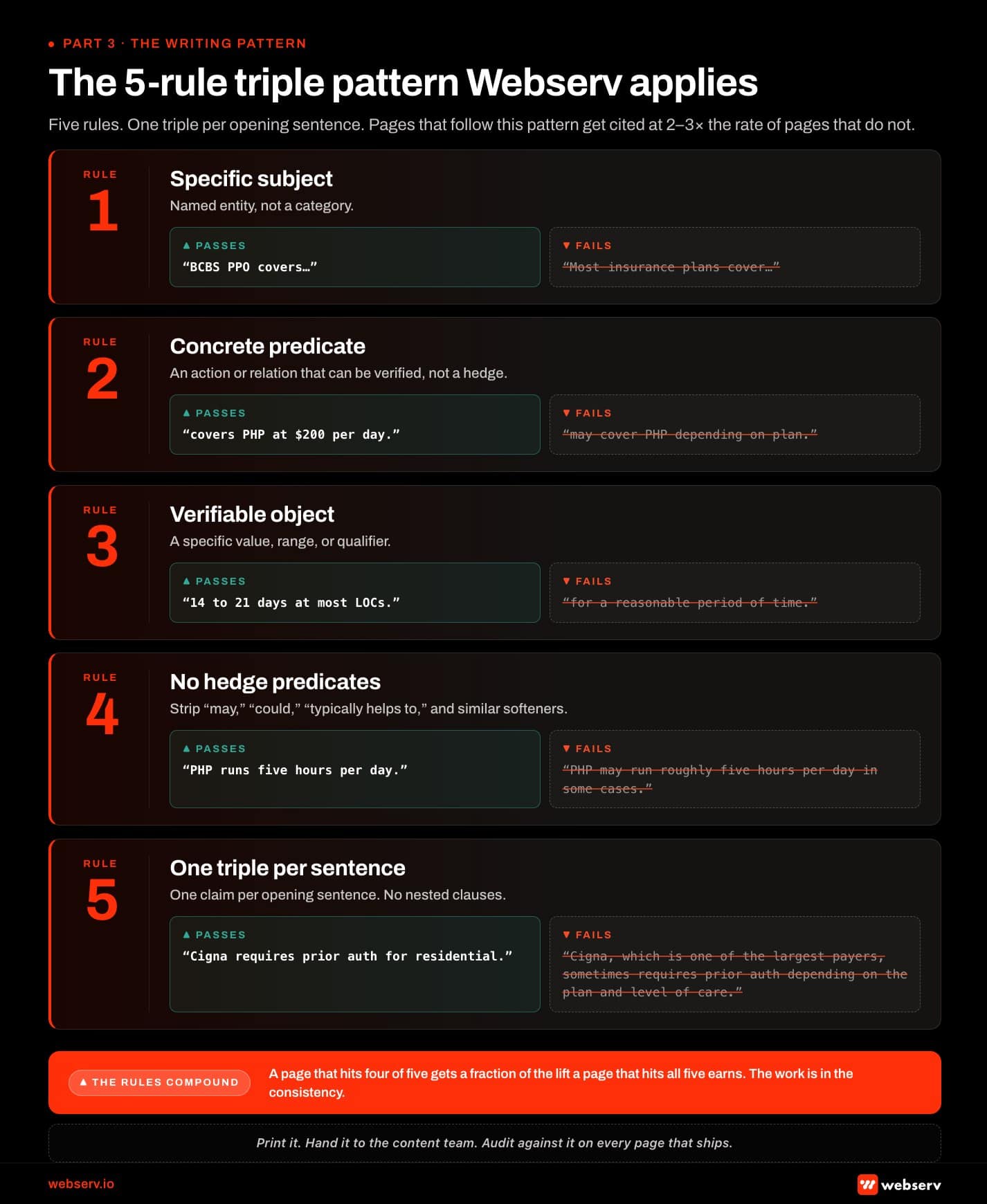 Infographic titled ‘The 5-rule triple pattern Webserv applies’.
The five rules we use across client content:
- Lead the paragraph with the triple. The first sentence of every paragraph should be the strongest triple in that paragraph. LLMs disproportionately weight the opening sentence of a paragraph during extraction.
- Make the subject specific. Avoid “we,” “our team,” “our program,” “the facility” as subjects. Use the named entity instead. “Webserv’s residential program.” “The Bandera campus.” “Dr. Jane Smith, our medical director.”
- Use a verifiable object. If the object cannot be checked against an external source (NIDA, SAMHSA, CDC, peer-reviewed research, or your own published outcomes), it produces a weaker citation. Pair every clinical claim with a citable source.
- Avoid hedge predicates. “May,” “can,” “sometimes,” “often” weaken the triple. Use direct predicates where the underlying claim supports them. Where it does not, restructure the sentence so the hedge is not the predicate.
- Limit one triple per sentence. Sentences that try to assert three facts at once become long, parse poorly, and reduce extraction quality. Split compound sentences into two or three clean ones.
The pattern compounds with the rest of the AEO stack. Semantic triples are Layer 1 of the seven-layer model from our AEO Ultimate Guide. The other six layers (code structure, digital PR, video, social, reviews, site structure) operate on top of the triple foundation.
Examples: bad vs. good on rehab content
The pattern is easier to see on real content. Each example below shows the kind of sentence treatment center sites currently publish and the rewrite that earns LLM citations.
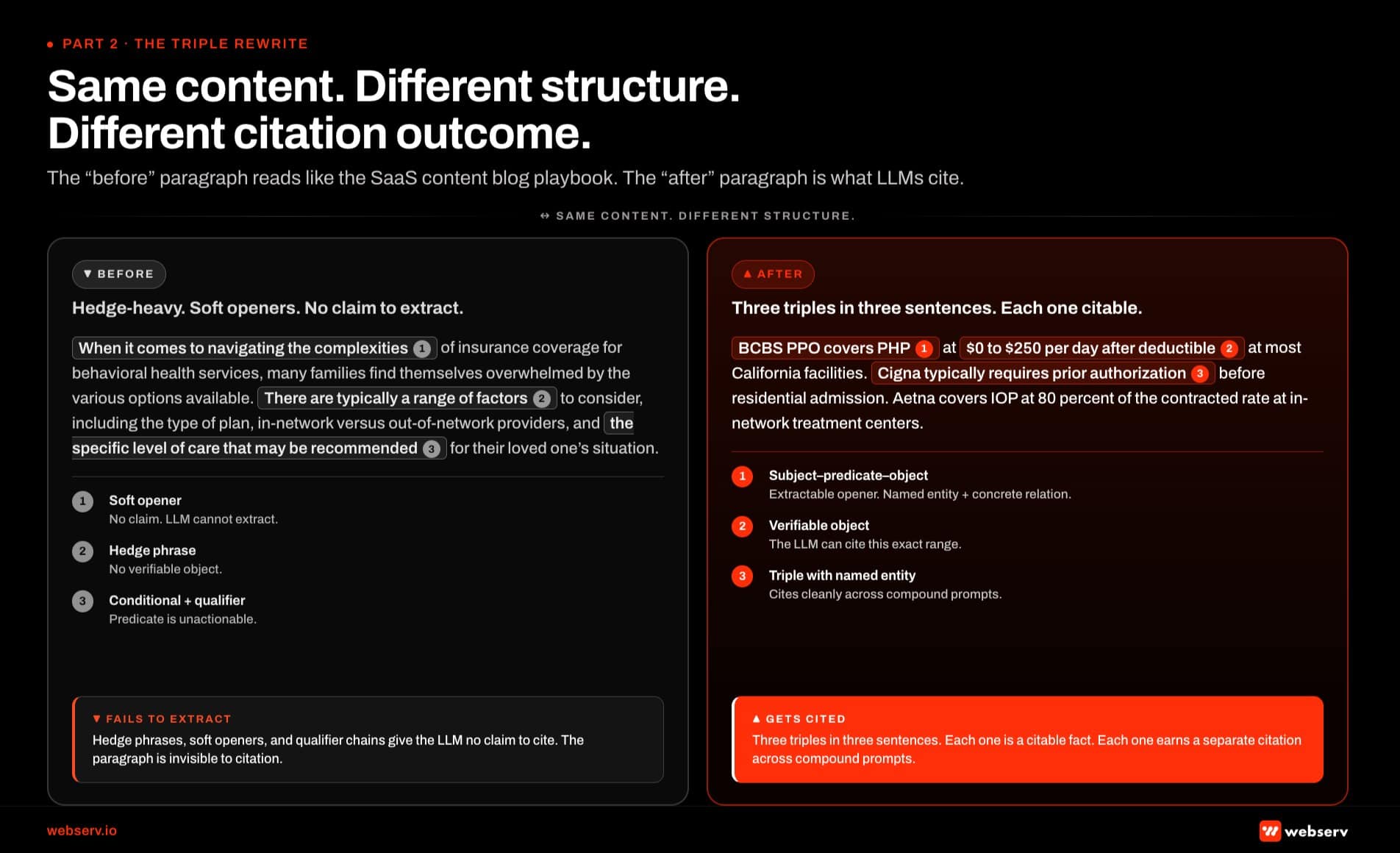 Infographic titled ‘Same content. Different structure. Different citation outcome.’
Example 1: facility description
Before: “Our experienced team is dedicated to providing compassionate, individualized care in a healing environment.”
After: “Webserv’s Bandera, Texas residential program is licensed by the Texas Department of State Health Services and accredited by the Joint Commission. The clinical team is led by Dr. Jane Smith, MD, a board-certified addiction medicine physician with 15 years of experience treating substance use disorder in veterans.”
The before sentence contains zero triples. “Our experienced team” is not a recognizable entity. “Dedicated to providing care” is not a verifiable claim. The after produces two extractable facts. The facility is licensed by a named regulator. The medical director is named, credentialed, and specialized.
Example 2: clinical claim
Before: “Medication-assisted treatment can help people recover from opioid addiction.”
After: “Medication-assisted treatment (MAT) reduces opioid overdose mortality by approximately 50% according to NIDA. Webserv’s MAT program uses buprenorphine and naltrexone under the supervision of board-certified addiction medicine physicians.”
The before sentence is a weak triple (“can help” is a hedge predicate, “people” is a vague object). The after produces a citable fact backed by NIDA and a second triple about the facility’s specific protocol.
Example 3: insurance and admissions
Before: “We work with most major insurance providers and can verify your coverage quickly.”
After: “Webserv’s residential program is in-network with Aetna, Blue Cross Blue Shield, Cigna, and United Healthcare. The admissions team verifies insurance coverage within 24 hours of the initial call.”
The before sentence contains zero extractable triples. The after produces two: the network status with named carriers, and the specific verification timeline.
Example 4: outcome language
Before: “Most of our clients see real improvement after completing our program.”
After: “Webserv reports a 78% completion rate for its 90-day residential program based on internal outcomes data collected from 327 patients between January and December 2025.”
The before is undefendable under FTC scrutiny and uncitable by LLMs. The after is a specific, sourced, defensible claim. Treatment centers that produce outcome content of this shape inherit both the AI citation benefit and the regulatory defensibility our Topical Authority for Treatment Centers explainer covers in the post-FDA-warning-letter context.
How to retrofit existing content
Most operators do not need to rewrite their sites from scratch. The triple pattern can be retrofitted onto existing pages with a focused audit-and-edit workflow.
- Identify the load-bearing pages. Service pages, level-of-care pages, population pages, and the top 10 to 15 most-trafficked blog posts. The triple-rewrite work is most valuable on pages Google indexes and LLMs cite. Pages with low indexing or thin traffic are not the priority.
- Mark the first sentence of every paragraph. For each priority page, copy the content into a document and highlight the first sentence of every paragraph. These are the candidate triples.
- Apply the five rules to each opener. For each marked sentence, check it against the five rules above. Specific subject? Verifiable object? Concrete predicate? No hedges? One triple per sentence? Rewrite any sentence that fails one or more rules.
- Add the underlying citation. Every clinical or outcome triple should link to or cite an authoritative source. NIDA, SAMHSA, CDC, peer-reviewed PubMed, or your own published outcomes data with a methodology footnote.
- Verify the rewrites with a manual LLM check. After publishing the rewrites, query ChatGPT and Perplexity directly with the related search queries. The pages that produced LLM citations within 30 to 60 days of the rewrite are the pattern-working pages. The pages that did not need either a deeper rewrite or schema reinforcement.
A typical 15-page retrofit takes 8 to 12 hours of focused editorial work. The conversion-rate lift on commercial pages and the AI citation lift on educational pages compounds over the following quarter.
How SoCal Sunrise generated 85 admissions and 2,297% ROI from SEO in 6 months
A ground-up SEO rebuild using the Pathfinder Parents Methodology turned an invisible online presence into a top-ranking admissions engine.
Read the case study →85 admits and 3,152 leads attributed to organic
Why schema markup amplifies the triple pattern
Schema markup is the structured-data layer that translates the triples on a page into the machine-readable format Google and LLM crawlers parse fastest. Pages that contain semantic-triple-shaped content AND the corresponding schema markup produce 43% better citation performance than pages with only one of the two.
For a treatment center, the schema types that matter most:
MedicalOrganization on the homepage and key facility pages. Properties include name, address, license numbers, accreditations, and parent organization. Each property is a semantic triple in structured form.
Physician schema on clinical leadership bios. Properties include credential, license number, school, specialty, and affiliations. Each one is a citation-ready triple about the named professional.
MedicalWebPage on level-of-care pages with specialty, condition treated, and primary audience properties filled in.
FAQPage on pages with question-and-answer content. The question is the predicate, the answer contains the object. LLMs disproportionately cite FAQPage content because the structure is unambiguous.
The schema does not replace the prose, and the same passage-level structure that wins fan-out citations applies inside the prose. The prose and the schema work together.
A page that asserts “Webserv’s residential program is in-network with Aetna” in the body AND lists Aetna as an acceptedPaymentMethod in the schema gives the LLM two confirming signals for the same fact. Both signals strengthen the citation likelihood.
Common mistakes operators repeat
TOP REJECTION TRIGGER
Generic subjects and stacked hedges in the same sentence. “Our team may help clients who generally struggle with…” contains no extractable triple — the LLM cannot resolve “our team” to a named entity and each hedge collapses the confidence of what remains. LLMs are also tuned to verify clinical claims against authoritative sources, so “studies show” without a citation reads as unsupported and gets skipped for citation. Replace generic subjects with named entities, remove stacked hedges, and cite specific studies with linked sources.
Five patterns we see across treatment center pages that fail the LLM-citation test.
- Generic subjects. “Our team,” “we believe,” “the program” as the opening of every paragraph. LLMs cannot resolve these to specific entities. Replace with named subjects.
- Stacked hedges. “May help, can sometimes, generally produces” inside the same sentence. Each hedge reduces the strength of the triple by an order of magnitude. Remove or restructure.
- Marketing tone as the dominant register. “Compassionate, individualized care in a healing environment.” Phrases of this kind contain zero extractable triples and signal to the LLM that the page is promotional rather than informational. Replace with facts.
- Unsourced clinical claims. “Studies show,” “research suggests,” “many experts agree” without an actual citation. LLMs are tuned to verify clinical claims against authoritative sources. Unsourced claims produce zero citation lift and increasing regulatory exposure post-FDA March 2026 warning letters.
- Long compound sentences with multiple triples. Sentences trying to assert three or four facts in one structure parse worse than three single-triple sentences. Split.
How to validate the pattern is landing
Three checks operators can run after a triple-rewrite engagement.
The manual LLM query test. Query ChatGPT, Perplexity, and Google AI Overviews directly with the queries the rewritten pages target.
Look for brand mention in the response, source citation in the linked references, and accuracy of the facts the LLM cites. Run the same queries weekly for 30 days to track citation lift.
The structured data validator. Run rewritten pages through Google’s Rich Results Test and Schema.org Validator. Confirm the schema parses, the properties are populated, and there are no errors. The schema layer either confirms the prose triples or contradicts them. Both need to be checked.
The citation-share dashboard. OtterlyAI, Profound, AI Rank Lab, and similar tools report citation share at the brand and page level across major LLMs. We cover the platform landscape in our Top 20 AI Optimization Agencies for Rehab review.
Compare baseline to post-rewrite. Pages where citation share increased materially are the pages where the triple pattern landed. Pages where it did not need a deeper editorial pass or schema reinforcement.
The combination of the three checks tells the operator whether the rewrite is working before the broader compounding citation lift becomes visible.
A page that scores well on the manual test, validates clean on schema, and trends up on the citation-share dashboard within 30 days is a page that will keep compounding through the following two quarters.
What this means for treatment center operators
Semantic triples are the simplest, highest-impact tactical move available to a treatment center investing in AEO right now.
The pattern is small enough that a single editor can hold the rules in their head, specific enough that the rewrite work is straightforward, and impactful enough that the citation lift shows up within 30 to 60 days on well-built pages.
The operators winning AEO citations in 2026 are not the ones publishing the most content. They are the ones whose content is built so that an LLM extracting facts can find a clean triple in every paragraph, verify it against an authoritative source, and cite the page back without ambiguity.
The pattern is invisible to most readers and unmistakable to the AI.
Trevor Gage, Director of Earned & Owned Media, Webserv
If you want help running a triple-rewrite on your highest-priority pages or a full AEO audit against the seven-layer framework, our AEO services team handles the work.
Book an intro call and we will run the manual LLM citation test on your top 10 pages as part of the diligence. Discovery is free. The honest assessment is the deliverable.
The perspective in this article comes from 9 years working exclusively inside behavioral health.
We are a team built by people in recovery who understand that behind every admission is someone asking for help. If that resonates, get to know us.
Frequently asked questions about semantic triples and AEO
How long until semantic-triple rewrites show up as AI citations?
Most treatment centers see the first LLM citations on rewritten pages within 30 to 60 days, with measurable citation-share lift between months 2 and 4. The timeline depends on the page’s existing authority, the depth of the rewrite, and whether the schema layer is in place alongside the prose updates.
Pages with stronger baseline organic visibility see citations faster because AI engines weight existing trust signals. Pages starting from low authority typically need a foundational quarter of supporting work before citation lift becomes visible. The retrofit is real work, not a hack, and it follows a real timeline.
The pages where citations do not appear within 90 days are usually the pages where one of the five rules was not applied cleanly. The recovery move is a deeper editorial pass on the paragraph openers, not a rebuild of the page.
Do semantic triples help traditional SEO rankings or only AI citations?
Semantic triples help both. The same clarity that makes content extractable for LLMs also strengthens topical relevance signals for traditional search ranking. Google’s ranking systems and the AI extraction layer rely on overlapping signals because both operate against the same underlying knowledge graph architecture.
In practice, pages rewritten under the triple pattern typically show organic ranking improvements within 60 to 90 days alongside the AI citation lift. The conversion rate on commercial pages also improves because specific, verifiable claims convert better than generic marketing language.
The work pays for itself across three surfaces at once: AI citations, organic rankings, and on-page conversion. That triple return is part of why the pattern compounds faster than other AEO tactics.
Which pages should treatment centers retrofit first?
Start with the load-bearing pages. Service pages (residential, PHP, IOP, detox), the homepage, level-of-care pages, condition pages, and the top 10 to 15 most-trafficked blog posts in your existing organic footprint. These are the pages where AI citation lift translates most directly to admissions impact.
Avoid spreading the rewrite work thin across the full site at the outset. A focused 15-page retrofit done well outperforms a 50-page retrofit done quickly. Most facilities can complete the priority set in 8 to 12 hours of focused editorial time.
Once the priority set is rewritten and citation lift is verified, the pattern can be templated and pushed across the rest of the site. The first 15 pages are where you build the muscle. The next 50 pages are where the work compounds.
Are semantic triples enough on their own, or do you need schema markup too?
Semantic triples alone produce real citation lift. Pages with semantic triples but no schema typically see meaningful improvement in AI citations within 60 days. Adding schema markup on top of the triple pattern produces approximately 43% better citation performance compared to either signal alone.
The right sequencing depends on resources. If your team can ship the prose rewrite but not the schema work in the same quarter, ship the prose first. The citation lift is large enough to be worth doing in isolation. The schema layer is the multiplier, not the prerequisite.
For treatment centers running a full AEO program, both layers are non-negotiable. The combination is the difference between competing for AI citations and owning the citation pool for your priority queries.
How does this work for telehealth-only treatment programs?
Telehealth-only programs apply the same pattern with different specifics. The subject becomes the clinical entity (the licensed group, the named clinicians, the technology platform) rather than a physical facility. The objects shift toward state-by-state licensing scope, HIPAA-compliant technology, and prescriber DEA registration.
The five rules are identical. Specific subject, concrete predicate, verifiable object, no hedges, one triple per sentence. The retrofit workflow is identical. The validation method is identical.
Telehealth programs often see faster citation lift than brick-and-mortar because the triple pattern produces less ambiguity in a category where most competitor content remains generic. Specificity wins disproportionately in surface areas where most operators are still writing in marketing voice.
Trevor Gage is the Director of Earned & Owned Media at Webserv. Webserv works with behavioral health and addiction treatment centers on SEO, paid media, and full-funnel admissions strategy.