Healthcare advertising rarely fails because the offer is wrong. It fails because the wrong people see it. A treatment center pushing a residential program to college students, or a cardiology group serving family caregivers as if they were the patient, spends the same media dollars as a competitor with sharp segmentation and gets a fraction of the qualified calls.
Targeting and audience segmentation is the discipline that fixes that. It splits a broad healthcare audience into groups defined by real behavior, real intent, and real ability to pay, then adjusts messaging, channel, and creative for each group. For paid programs specifically, this is the layer that determines cost per admit; for a wider view of how it fits, see the complete behavioral health marketing guide. The strategy work on this page is exactly what our paid media team deploys inside every treatment-center account.
Key Takeaways
- Segmentation is a media efficiency lever, not a branding exercise. The same budget targeting the right audience returns two to four times the qualified calls of an untargeted campaign.
- Healthcare segments differ from generic B2C in one critical way: the person seeing the ad is often not the patient. Family members, referral partners, and case managers are their own audiences with their own creative needs.
- The four working segmentation methods for healthcare paid media are demographic, behavioral, interest-based, and retargeting. Each earns budget when the offer is calibrated to that segment, not the whole market.
- HIPAA and platform policy narrow what you can target on. Google Ads restricts personalized advertising for healthcare, and Meta removed most sensitive interest categories in 2022. Design your segmentation around what is still legal to target, not what the 2019 playbook allowed.
- Buyer personas only pay off when they are built from real intake data (VOB records, admit source, call transcripts). Personas assembled from stock demographics produce generic creative that competes on price.
Strategies for Effective Audience Segmentation in Healthcare
Effective audience segmentation lets healthcare organizations understand and engage the specific people who move through their doors. That work involves developing patient-grounded buyer personas, using intake and behavioral data to define the segments worth targeting, and tailoring messaging so the ad, the landing page, and the intake conversation feel like one continuous experience for each group.
Understanding Your Patient Population
Before you target segments of your patient population, you need a clear picture of who is already converting and why. That means a real look at patient data: demographic information, health conditions, insurance mix, referral source, and behavioral patterns.
Surveys and focus groups surface trends that intake forms miss. You may find that patients with a specific condition rely on social channels to research treatment options, or that patients in a given age group prefer email over phone or text. For treatment centers, VOB data plus call transcripts from your admissions team are usually a richer source than any survey, because they capture the exact objections and priorities of the people who converted.
Developing Effective Buyer Personas
Once you have a firm grasp of your patient base, you can build buyer personas. A persona is a fictional composite of a real patient you already treat well, grounded in the intake data you already have, not a stock template.
Free tools like HubSpot’s Buyer Persona builder are a fast way to structure the exercise if you have not done it before.
Effective personas capture age, gender, income, health issues, lifestyle, and preferences, plus healthcare-specific fields: health literacy, preferred communication style, insurance status, and level of trust in the healthcare system. For behavioral health, add the referral source (self, family, referring clinician, EAP) because the ad copy that works on a self-referred adult in crisis is very different from the copy that works on a mother researching options for her adult child.
Rich personas let you match the message to the moment. A mid-forties patient with diabetes exploring integrative options wants different proof than a young adult with a mental health condition who prefers text-based intake, and both want different proof than the family member paying the bill.
Definition, psychographic segmentation
Segmenting an audience by attitudes, values, motivations, and lifestyle rather than by demographic labels. In healthcare paid media, psychographic segments answer the question demographics cannot: why a person is searching now. Two 38-year-olds with the same income and ZIP code can be a decade apart in readiness to enter treatment, and psychographic segmentation is what separates them so the higher-intent audience gets the higher-intent creative.
Using Data to Identify the Right Target Audience
Alongside personas, use data to decide which target segments deserve budget. This can mean applying predictive analytics to forecast patient behavior, or simply cross-referencing existing patient records to spot which segments over-index for conversion, retention, or clinical outcome.
Data segmentation is the strongest single method for picking the right target. Split your patient population by age, gender, medical condition, and behavioral pattern, and you can rank high-priority segments and build tailored campaigns for each. For treatment centers, layering payer mix on top of those splits is the difference between a persona and a media buy: the segment that closes is usually the intersection of clinical fit and payer viability.
Heidi Keller’s TEDx talk on audience segmentation is a useful primer on why the ranking step matters more than the sorting step:
Do (healthcare-vertical segmentation)
- Segment by referral source and payer, not just age and ZIP; those two fields predict admit likelihood better than any lifestyle bucket.
- Build a separate audience for family members and paying decision-makers, with their own creative and their own landing page.
- Design targeting inside HIPAA and platform policy first (no sensitive interest categories on Meta, restricted personalized ads on Google for health).
- Refresh personas quarterly against fresh intake and VOB data so the segments track what is actually converting.
Do not (generic B2C playbook)
- Do not target people directly by diagnosis, condition, or in-market symptoms; that is a policy violation on every major platform.
- Do not treat the patient and the paying family member as one audience; the offer, proof, and CTA differ.
- Do not build personas from stock demographics; if you cannot tie the persona to real intake records, you are guessing.
- Do not run one creative to a broad healthcare audience and call it segmentation; frequency without fit is just faster ad fatigue.
Targeting Methods in Healthcare Advertising
Advertising plays a growing role in reaching new patients and retaining current ones as the healthcare sector expands. Choosing the right technique for a given program is the hard part. Four methods carry the freight in healthcare paid media today: demographic, behavioral, interest-based, and retargeting. For treatment centers running Google Ads specifically, the platform-side mechanics live inside our Google Ads strategy guide for behavioral health providers.
Demographic Targeting
Demographic targeting focuses your advertising on specific groups by age, gender, income, or education. Used well, it is a fast way to reach patients most likely to benefit from your services; used poorly, it is a proxy for stereotyping that misses real intent.
The practice involves adjusting your marketing message to appeal to those demographic groups by tailoring headline, offer, and image. Targeting the right groups improves ROI because the same media dollar reaches people already inclined to convert.
For a deeper walkthrough, see our resource on healthcare demographic targeting.
Demographic Targeting in Healthcare Marketing
Demographic targeting focuses on key traits of a defined audience, such as age, gender, income, and education. In healthcare marketing it is a solid entry point for reaching different patient populations. Google’s own documentation on setting up demographic targeting in an ad group covers the platform mechanics.
A healthcare provider might use demographic targeting to deliver messages that speak to the needs and concerns of older adults, while a medical facility hoping to reach new parents can build campaigns that highlight pediatric services and specialization. Healthcare marketers who tailor content to specific patient populations build trust and rapport, which ultimately improves patient outcomes.
Behavioral Targeting
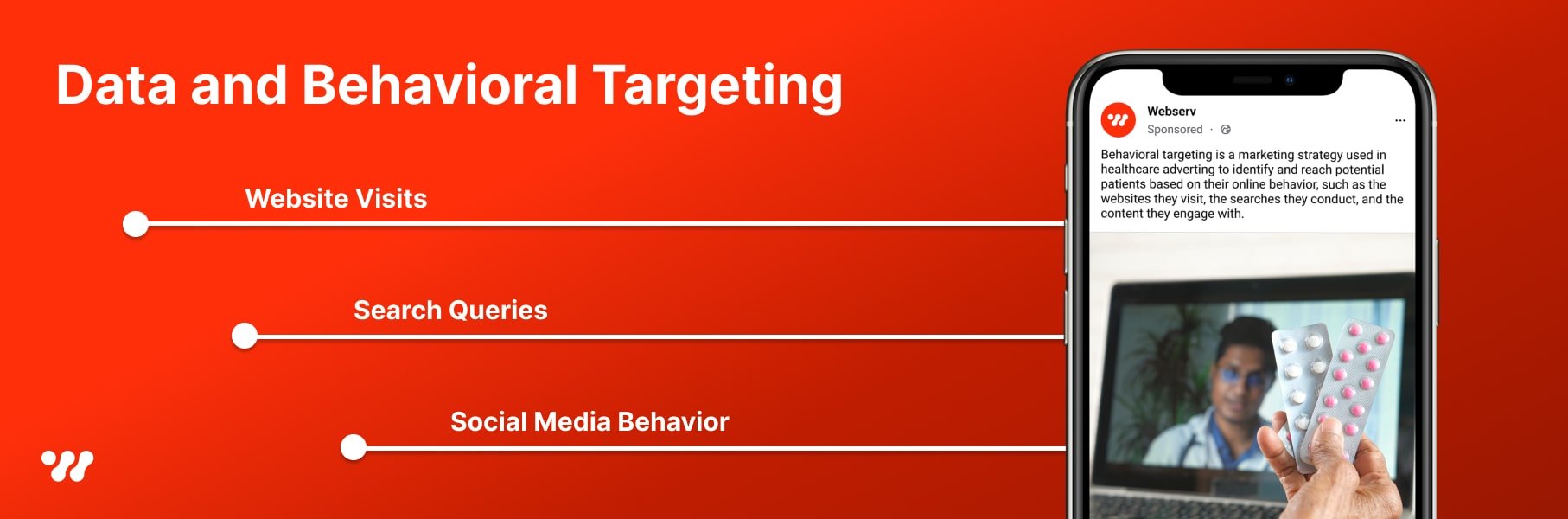
Behavioral targeting uses data analytics to track and analyze online behavior, such as website visits, search queries, and social media activity, to deliver personalized marketing messages to specific consumers. By understanding a person’s online behavior, healthcare marketers can align messaging with that person’s interests and needs.
Benefits of Behavioral Targeting in Healthcare Marketing
The benefits of behavioral targeting come down to relevance and personalization: higher engagement rates, improved conversion rates, and better return on investment. Behavioral signals also reduce ad fatigue and improve the user experience because the ads shown are more likely to interest the viewer. Advertisers gain a clearer read on the audience and can build campaigns that reach the right people with the right message at the right time.
Better ROI is the outcome that matters most. When budget flows to the right consumers with the right message, waste drops and every remaining dollar works harder.
Interest-Based Targeting
Interest-based targeting reaches potential patients based on their online preferences and areas of interest. The method builds a profile of a person’s interests and habits from browsing history, search queries, social media use, and other online activity, then serves content and advertising tuned to those interests. On sensitive verticals, Meta narrowed the available interest categories in 2022, so treatment centers should design interest-based programs around lifestyle, wellness, and family-and-relationship categories rather than the removed condition-specific ones. Our overview of HIPAA-compliant Facebook ads for addiction treatment covers the current constraints.
How Healthcare Organizations Can Use Interest-Based Targeting
Interest-based targeting helps healthcare organizations reach patients likely to be interested in their services. A dermatology practice, for example, might serve ads to people who have recently looked up skincare items or visited skin-health websites. Delivering customized advertising to an already-interested audience raises the odds that person chooses the practice over a competitor.
The same technique works for organic content, not only ads. A healthcare organization might publish articles or videos on stress management or nutrition, then use interest-based targeting to surface that content to people who have expressed interest in those topics.
Retargeting
Retargeting lets healthcare organizations re-engage people who have already interacted with their brand. A hospital might use retargeting to serve ads to people who previously visited its website, raising the probability that those already-interested visitors choose the hospital over a competitor.
Retargeting also works for content, not only ads. A healthcare organization might build social posts or email campaigns about managing chronic conditions or healthy living, then retarget those materials to people who have already shown interest in the topic. For behavioral health specifically, retargeting is often the single highest-ROI segment in a program because it re-touches people already deep in a treatment search.
Tips for Creating Effective Retargeting Campaigns
- Be Strategic: Prioritize who and when you target. Focus on people who have shown clear intent, such as those who visited multiple pages or spent real time on the site.
- Employ Compelling Content: Copy and creative should be engaging and relevant to the target audience. Write clearly, choose imagery that reads at ad size, and speak to the needs and priorities of the segment you are re-touching.
- Test and Optimize: Like any marketing initiative, retargeting improves through iteration. Use A/B testing to identify the ad styles, messaging, and targeting tactics that resonate with your audience.
Semrush’s 30 tips to optimize your retargeting campaign is a solid tactical reference. On the compliance side, our teardown of compliance mistakes in rehab Google Ads covers the specific policy traps healthcare marketers hit when they run remarketing on sensitive audiences.
Frequently Asked Questions
What is healthcare advertising targeting and audience segmentation?
Healthcare advertising targeting and audience segmentation is the process of identifying specific groups of people within a broader audience who are most likely to be interested in and benefit from a healthcare product or service. This can be done using a variety of demographic, psychographic, and behavioral factors to create more personalized and relevant messaging that resonates with the target audience.
What are some common methods for segmenting a healthcare audience?
There are many different ways to segment a healthcare audience, but some common methods include age, gender, geographic location, income level, health status, lifestyle factors, and past medical history. These factors can help advertisers create messaging that is tailored to the specific needs and preferences of each audience segment.
Why is audience segmentation important in healthcare advertising?
Audience segmentation is important in healthcare advertising because it allows advertisers to create more targeted and effective campaigns that resonate with specific groups of people. By identifying the unique needs and interests of each audience segment, advertisers can create messaging that is more likely to grab their attention, build trust, and ultimately drive conversions.
What are some best practices for healthcare advertising targeting and audience segmentation?
Some best practices for healthcare advertising targeting and audience segmentation include using data-driven insights to identify the most relevant audience segments, creating messaging that speaks directly to the needs and interests of each segment, using multiple channels to reach each segment where they are most likely to engage, and regularly monitoring and adjusting campaigns based on performance data.
What are some potential challenges of healthcare advertising targeting and audience segmentation?
Some potential challenges of healthcare advertising targeting and audience segmentation include privacy concerns, limited access to accurate data, and the risk of alienating certain segments of the audience. Additionally, some healthcare products and services may be relevant to a wide range of people, making it difficult to create highly specific audience segments without sacrificing reach or relevance.
Get More Patients and Boost Your Bottom Line with Webserv
Healthcare advertising is a critical tool for providers and businesses looking to reach the right patients efficiently. At Webserv, we build bespoke healthcare advertising campaigns tailored to the specific needs of our clients. Our team uses proven audience segmentation techniques to identify and reach the most relevant target audiences, driving increased engagement and more conversions. If you are ready to take your healthcare advertising to the next level, Webserv is the team.
Do not miss the opportunity to reshape your healthcare advertising strategy and drive meaningful results for your business. Book an intro meeting with Webserv today to discuss how our team can help move your advertising forward.