The average behavioral health website has 6 to 10 seconds to convince a family member their loved one is safe here. Not converted. Not enrolled. Just safe enough to keep scrolling.
Design decisions determine whether that six seconds ends in a phone call or a back-button. Most treatment centers get design wrong not because they hired the wrong designer, but because they never named the design job.
The job is not a pretty website. The job is a website that turns first-visit family and prospect traffic into called admissions.
This guide walks the full decision surface for treatment center website design. Trust signals that operators can actually place. Conversion elements that move admits. Content architecture that ranks.
Compliance layers that keep the site defensible. And the visual design decisions that separate a rehab website from a hospital website or a general healthcare site.
The audience is treatment center owners, COOs, and marketing directors evaluating a redesign, launching a new brand, or auditing a website that is not producing admits. Every section is written for the operator who has to sign off, not the designer building the wireframes.
Key Takeaways
- Treatment center website design is not a general healthcare design job. Family-mediated decision-making, LegitScript compliance, and clinical trust signals change the design brief in ways generalist designers do not see.
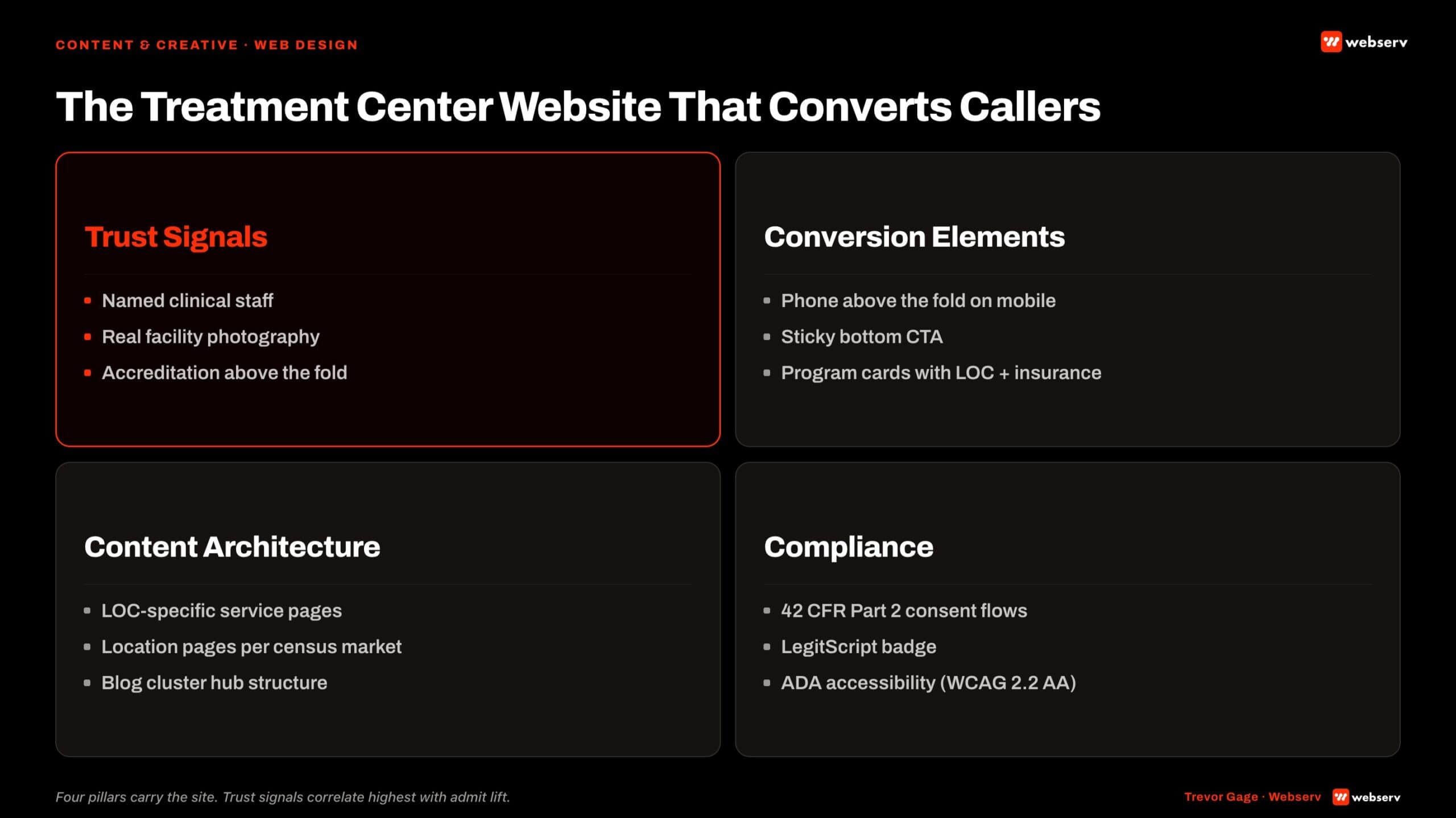
- The four design pillars: trust signals (credentials, reviews, clinical team), conversion elements (CTAs, phone placement, forms), content architecture (service pages, location pages, resource hub), and compliance (LegitScript, HIPAA, WCAG accessibility).
- Family audiences and prospect audiences read the same website differently. Family members want reassurance and credentials. Prospects want privacy and speed. Design should serve both without collapsing them.
- Mobile-first is not optional. 60 to 80 percent of treatment center traffic arrives on mobile, and the family research pattern often starts on a phone at midnight. Every design decision should be tested on mobile first.
- LegitScript-compliant design is a specific constraint on imagery, testimonials, and claims. A designer who has not worked in the vertical will accidentally build features that will not survive LegitScript audit.
- Photography is where most treatment center websites reveal they are copies of each other. Real facility photography beats stock imagery by every conversion measure worth tracking.
- The right redesign timeline is 8 to 16 weeks for a mid-size facility. Anything faster is a template. Anything longer usually means the discovery phase produced no real decisions.
Why Treatment Center Website Design Is Different From General Healthcare
Treatment center website design carries constraints general healthcare websites do not. Three structural differences change the design brief.
Family-mediated decision-making. The person searching your website is often a family member, not the prospective patient. Mothers, spouses, adult children, and siblings do the research. The design has to serve two audiences at once: the family member evaluating safety and credentials, and the person in treatment need who eventually calls.
Hospital websites and physician-group websites serve the patient directly. Behavioral health websites serve the family and the prospect in the same six-second first impression. Every design decision has to hold up for both audiences.
LegitScript compliance overlay. The compliance layer that governs behavioral health advertising also touches the website. Testimonials, before-and-after imagery, outcome claims, and specific clinical assertions all have LegitScript rules. A designer who does not know the vertical will build features that will not survive the certification audit.
Clinical trust signals matter more. Credentials, accreditations, clinical staff bios, and licensing information carry more weight on a treatment center website than on a general healthcare site.
The stakes are higher (the patient is trusting the facility with a life-altering treatment stay) and the market is more crowded with facilities of varying quality.
The result is a design brief with more constraints than general healthcare and a higher trust-signal density requirement. Facilities that hire generalist agencies routinely end up with websites that look polished but miss the vertical-specific design job.
Structured intake and admissions infrastructure is a documented driver of treatment access outcomes (SAMHSA, National Survey of Substance Abuse Treatment Services). The website is the entry point to that infrastructure. Design decisions have clinical stakes downstream.
Trust Signals
JCAHO/CARF/LegitScript badges, named clinical leadership, insurance logos. Above fold, not buried in footer.
Conversion Elements
CTA placement, phone-first vs form-first per your admissions answering pattern, sticky nav after scroll.
Content Architecture
Level-of-care pages with real clinical detail, location pages that reflect actual market realities, not templated swaps.
Compliance
HIPAA notice, 42 CFR Part 2 boundaries in intake copy, LegitScript-safe claims, licensing verification links.
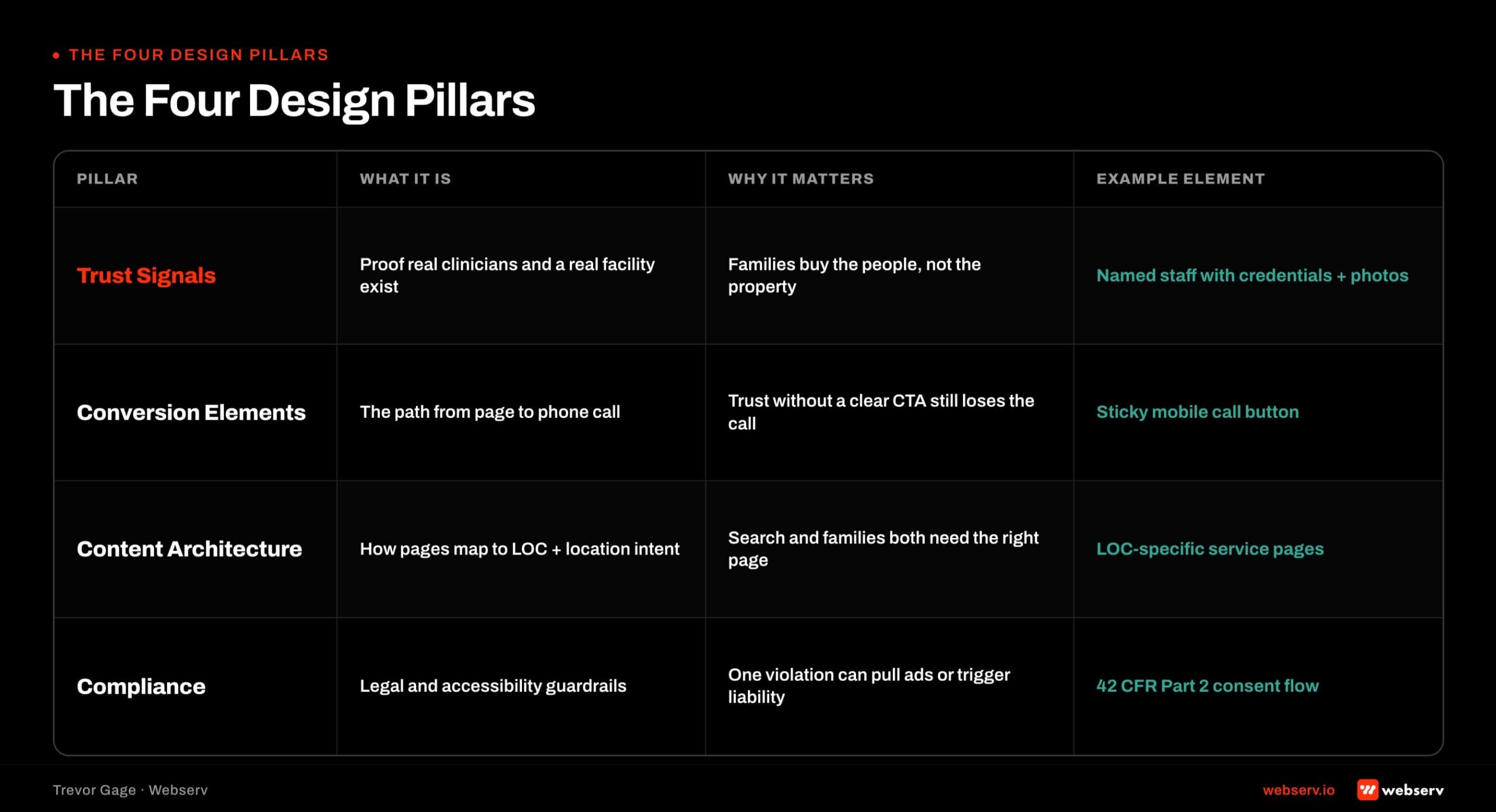
The Four Design Pillars
Every treatment center website that actually drives admits gets four pillars right. Missing any one caps the value of the other three.
Trust signals. Credentials, accreditations, clinical staff bios, reviews, and licensing information positioned to build family confidence in the six-second first impression.
Conversion elements. CTAs, phone number placement, contact forms, chat, and the specific interaction patterns that turn traffic into called admissions.
Content architecture. Site structure, service pages, location pages, resource hub, and internal linking that supports both SEO ranking and family research patterns.
Compliance. LegitScript rules, HIPAA safeguards on contact forms and analytics, and WCAG accessibility standards. Compliance is not a legal afterthought. It is a design constraint from day one.
Every pillar has failure modes we see repeatedly on audits. The rest of this guide walks each pillar operationally with specific design decisions and the reasoning behind them.
Pillar 1: Trust Signals
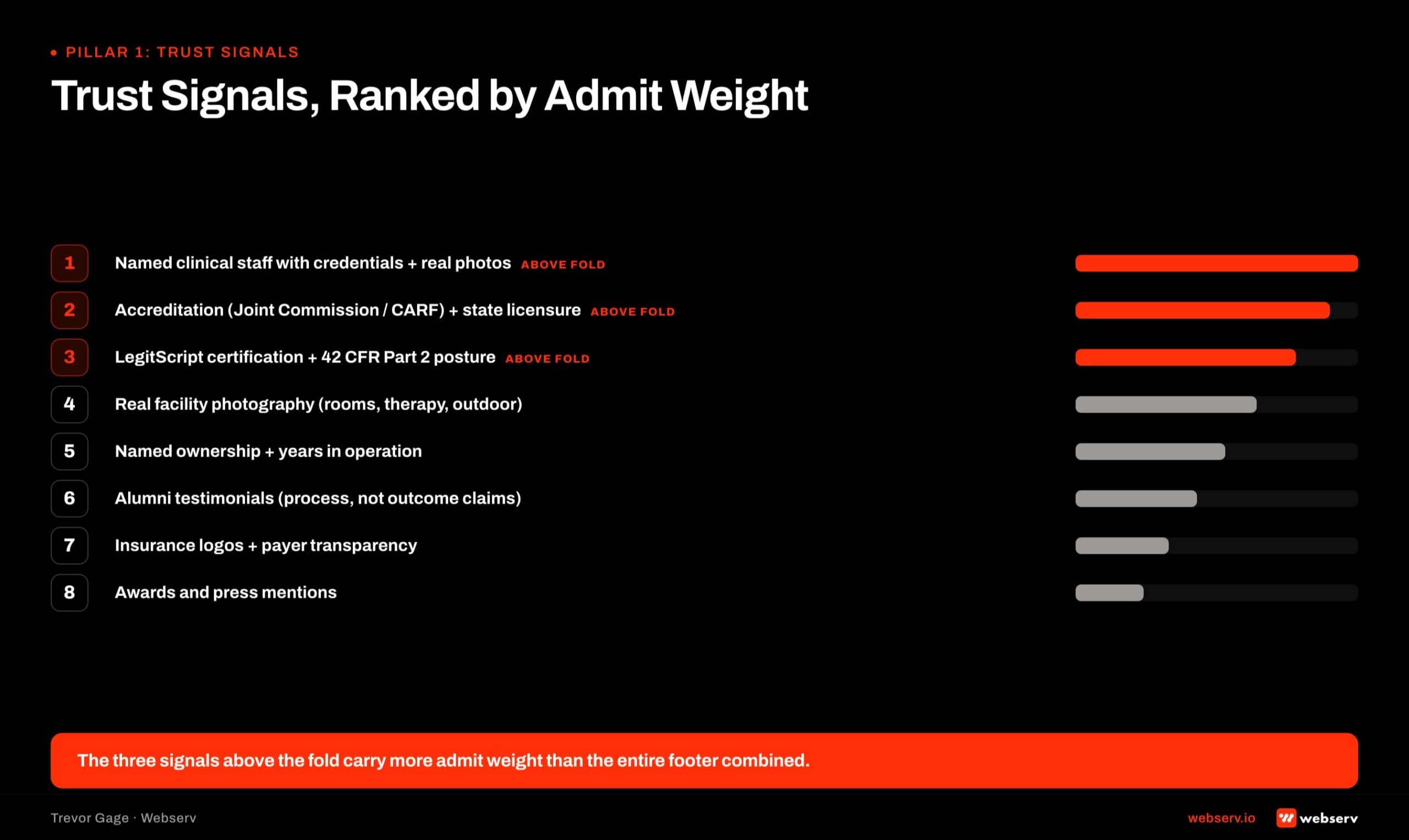
Trust signals are the design elements that answer the family member’s implicit six-second question. Is this facility safe. Are the clinicians real. Are the credentials real.
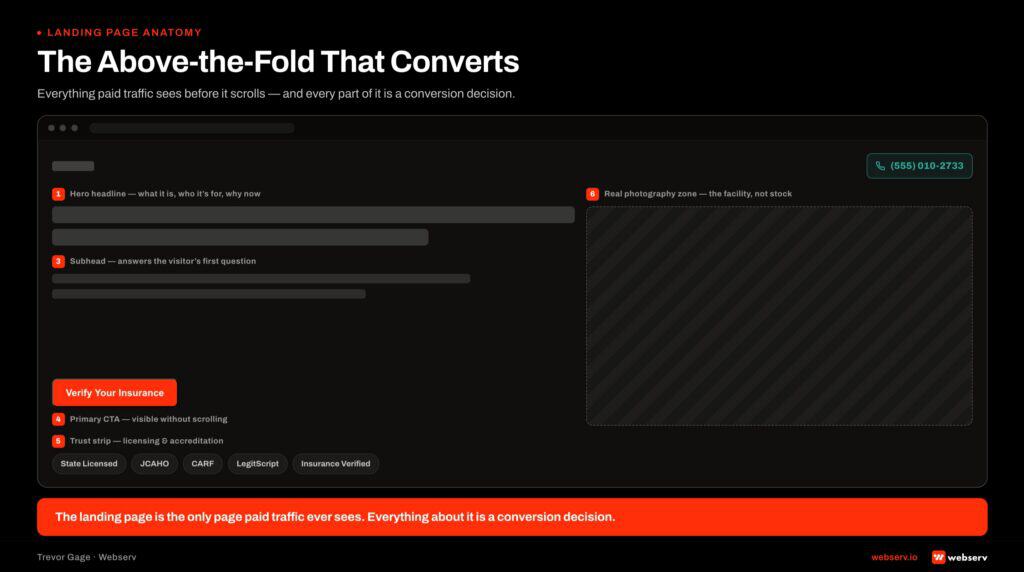
Accreditations placement. Joint Commission, CARF, LegitScript, and state licensing badges belong in the homepage hero or immediately below the fold, not in the footer. Facilities that hide accreditation badges in the footer treat them as legal disclosures. Family audiences read badges as safety signals.
Position accreditations where a family member scrolling on their phone will see them without having to search. Three to five badges in a horizontal row directly below the primary CTA is a common working pattern.
Clinical staff bios with credentials. The medical director, clinical director, and named clinicians need dedicated bio pages with credentials, education, and years of experience. Photos should be professional, warm, and consistent in style.
Facilities that leave clinical staff off the website or use generic stock photos of “doctors” surrender a substantial trust signal. Family members research the clinicians. Give them something to find.
Reviews and outcomes. Google reviews, patient testimonials (where compliant), and outcome data (where honestly measurable) all belong on the site. LegitScript restricts specific outcome claims and before-and-after imagery, but does not restrict general reviews or aggregated satisfaction data.
Third-party reviews (Google, Yelp) carry more weight than on-site testimonials. Family members trust reviews they can verify externally more than curated on-site quotes. Design should surface both.
Licensing and legal transparency. State licensing numbers, business registration, and insurance-verification transparency should be discoverable without effort. A dedicated “About” or “Credentials” page that consolidates this information into one scannable page beats scattered mentions across the site.
Pillar 2: Conversion Elements
Conversion elements are the design patterns that turn a scrolling visitor into a called admission. The design brief is not “beautiful.” The design brief is “calls the phone number or fills the form inside 90 seconds.”
Phone number placement. The phone number belongs in the top-right of the header on desktop and directly in the mobile navigation. Tap-to-call formatting on mobile is non-optional. Facilities running paid media should also feature a dedicated tracking phone number (via CallRail or CallTrackingMetrics) for attribution.
The phone number is the primary conversion action for most treatment center websites. Design decisions that hide, minimize, or de-emphasize the phone number are conversion sacrifices whatever aesthetic justification the designer offers.
Above-the-fold CTA. The primary CTA (usually “Verify Your Insurance” or “Speak With Admissions”) belongs above the fold on every landing page and the homepage. The CTA button should contrast the background clearly and use action language.
The treatment center homepage conversion patterns cover this in more detail, including the specific hero-section elements that consistently move admissions traffic to phone calls.
Contact forms with HIPAA-compliant handling. Insurance verification forms, contact forms, and any form that captures prospect information have to be built with HIPAA safeguards baked in. Not all form builders sign BAAs. Not all form data flows are compliant by default.
Facilities running contact forms without HIPAA safeguards carry real compliance exposure. HIPAA-compliant contact form patterns in WordPress is the tactical piece for facilities on WordPress specifically.
Chat and live-response elements. Chat widgets can lift conversion but require staffing to deliver on the promise. A chat widget with no one behind it damages trust more than no chat at all. Facilities running chat need real coordinator coverage during the hours the widget is live.
Mobile-first everything. 60 to 80 percent of treatment center traffic arrives on mobile. Every conversion element (CTA, phone, form, chat) has to work on mobile first, desktop second. Design that starts on desktop and gets adapted to mobile usually produces mobile experiences that suppress conversions.
Pillar 3: Content Architecture
Content architecture is the site structure that supports both SEO ranking and family research patterns. Both audiences need distinct information paths. The architecture decision matters.
Service pages. Each level of care (detox, residential, PHP, IOP, OP) needs a dedicated service page. Each specific treatment approach (medication-assisted treatment, dual-diagnosis, trauma-informed care) needs a dedicated page if the facility offers it as a distinct program.
Service pages should target commercial-intent keywords for that level of care and program combination. “Residential drug rehab [city],” “PHP for dual diagnosis [state],” and equivalent long-tail patterns are the search intents to serve.
Location pages. Multi-location facilities need a page per location with local trust signals (specific address, licensing, staff, photography), local SEO markup, and clear routing to the location’s admissions phone number. Single-location facilities benefit from a dedicated “Contact and Directions” page even without multi-location architecture.
Insurance and admissions pages. Family audiences research insurance coverage before they call. A dedicated insurance page with major carrier logos, an insurance verification form, and clear “we work with your insurance” language reduces phone friction. Facilities that hide insurance information behind a phone call lose family research traffic to competitors.
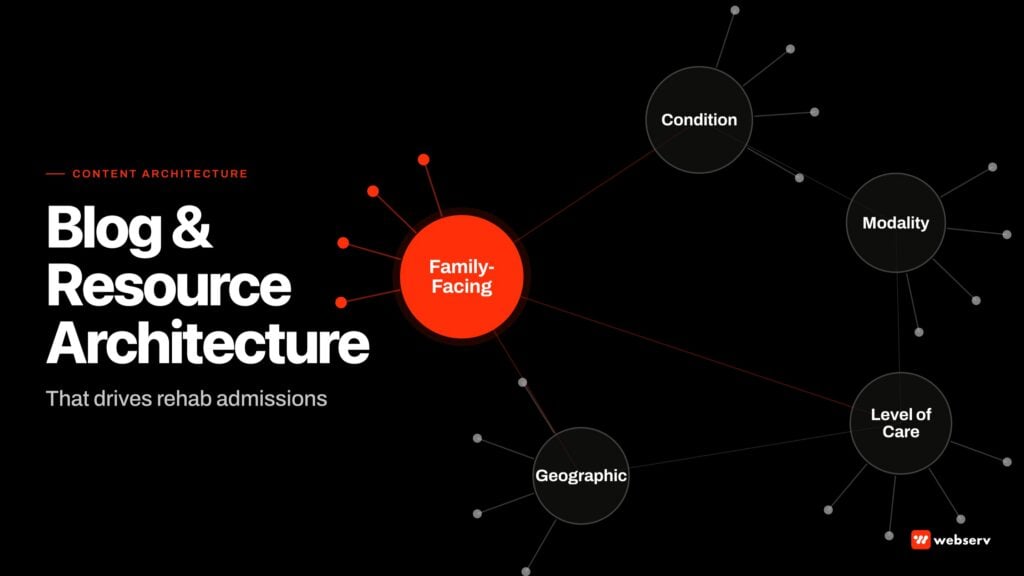
Resource hub. The blog and educational content library serves SEO ranking, E-E-A-T signaling, and family research needs simultaneously. Facilities with a well-maintained resource hub compound organic traffic over time in ways facilities without one do not.
The blog and resource architecture that drives rehab admissions walks the specific structure that supports both ranking and admissions attribution.
Navigation structure. The primary navigation should surface levels of care, insurance, admissions contact, and about-us prominently. Nested menus should be shallow (two levels max on mobile). Every major navigation item should have a purpose in the family research path or the prospect qualification path.
Pillar 4: Compliance
Compliance is not a legal afterthought. It is a design constraint that shapes every visual and interactive element on the site.
LegitScript design constraints. Treatment center websites advertising on Google, Meta, or Bing need LegitScript certification. LegitScript rules restrict specific website features.
Before-and-after imagery of patients. Specific outcome claims (“90 percent success rate”). Endorsements from named celebrities without documented consent. Testimonials that make specific medical claims. Deceptive design that hides the treatment center’s actual services.
Designers who have not worked in behavioral health will build features that will not survive LegitScript audit. The certification review is thorough, and features that get flagged after certification require site changes to maintain the certification. Design against the LegitScript ruleset from day one.
HIPAA safeguards on data collection. Every form that captures prospect information touches PHI when the prospect discusses their treatment need. Contact forms, insurance verification forms, and chat transcripts all need HIPAA-compliant handling.
That means BAA coverage across the tool stack, encryption in transit and at rest, and access controls scoped correctly.
The HHS Office for Civil Rights has issued specific guidance on HIPAA and online tracking, including tracking pixels and analytics tools (HHS OCR, HIPAA and Online Tracking Technologies). Treatment center websites running Meta Pixel, standard Google Analytics, or general tracking scripts without HIPAA-aware configuration carry exposure.
WCAG accessibility standards. Web Content Accessibility Guidelines (WCAG 2.2 as of 2026) set the standard for accessible web design. Behavioral health facilities are subject to ADA Title III accessibility requirements, and treatment center websites regularly face accessibility lawsuits when they miss the standard.
Core WCAG requirements: sufficient color contrast (4.5:1 for normal text), keyboard navigation for every interactive element, alt text on every image, screen reader compatibility, and no content that flashes or auto-plays without user control. These are design constraints, not remediation projects. Build to WCAG from day one.
Privacy policy and legal pages. Every treatment center website needs a privacy policy that references HIPAA and 42 CFR Part 2. Terms of service. Cookie policy. Accessibility statement. These pages are required and should be linkable from the footer.
Photography and Visual Design
Photography is where most treatment center websites reveal they are copies of each other. The category default is stock photography of diverse people in neutral clinical settings. Family audiences pattern-match these images to every other treatment center they have researched. The website loses trust before the family reads a word.
Real facility photography beats stock imagery. Photos of your actual facility, your actual clinical staff, your actual grounds, and your actual amenities differentiate the site from the category. Even imperfect real photography beats polished stock imagery on every conversion measure worth tracking.
Facilities that argue against real photography usually cite privacy concerns. Legitimate concern. The solution is to photograph the facility, the staff, the exterior, and the amenities without photographing patients. Facility photography does not require patient consent because patients are not in the photos.
Lifestyle and clinical imagery. Behavioral health treatment involves both clinical intervention and lifestyle recovery. Website imagery should show both. Clinical settings (therapy rooms, medical offices, staff at work) alongside lifestyle settings (dining areas, recreation, common spaces).
Family imagery with consent. Family reunification imagery is powerful but requires documented consent from every person in the photo. Alumni testimonial imagery requires consent. Facilities that use family or alumni imagery without consent carry legal exposure regardless of intent.
Photography style. Warm, natural lighting. Neutral color palettes. Professional composition without feeling staged. Real people in real settings, not models pretending to be patients.
Iconography and illustration. Custom icon sets and illustration systems reinforce brand consistency and reduce reliance on stock imagery. Icons for insurance carriers, treatment types, levels of care, and amenities all benefit from custom design that matches the brand identity.
Video content. Video walk-throughs of the facility, staff introductions, and (with consent) alumni testimonials build trust in ways still photography cannot. Video production is more expensive but the trust-signal density per minute of family attention is higher.
COMMON MISTAKE
Using stock imagery of couples on beaches, hands reaching upward, or generic group therapy circles. Every rehab website uses variations of the same handful of stock images, and templates converge on the market average. Convergence at the market average is invisibility.
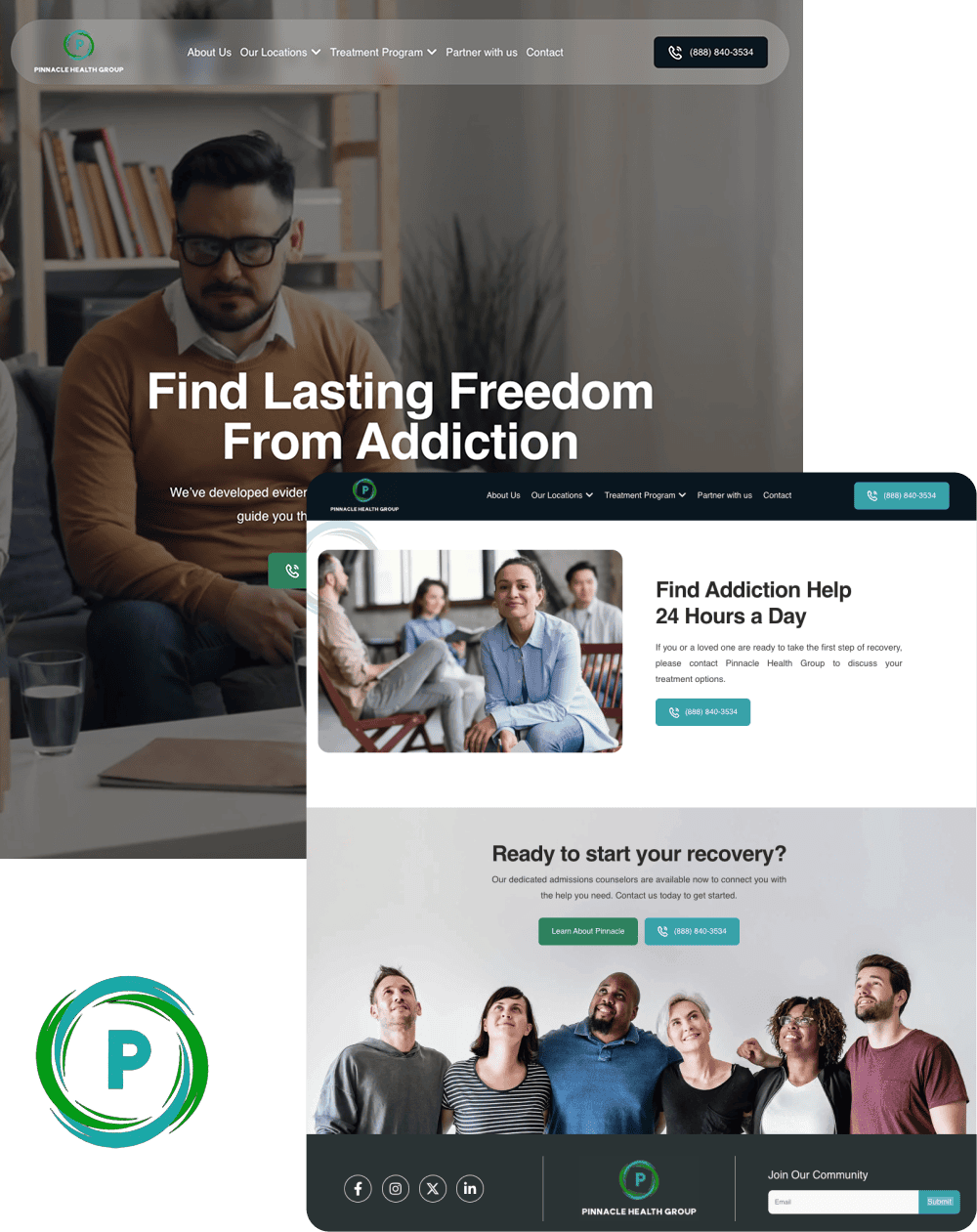
A unified platform built for multiple locations, programs, and audiences without feeling fragmented
- Reorganized multi-service site architecture
- ADA compliant responsive design system
- Future-ready CMS with modular templates
- Optimized for SEO and lead capture
Common Design Mistakes
Five design mistakes we see repeatedly on audits.
Stock imagery in the hero. The homepage hero is the first six seconds. Stock imagery in the hero signals “this is a generic treatment center” before the family reads a word. Real facility photography, even imperfect, beats polished stock every time.
Phone number buried below the fold. The phone number is the primary conversion action for treatment center websites. Design decisions that hide it in the footer, minimize it in the header, or bury it below the fold sacrifice conversion for aesthetics.
No clinical staff bios. Family audiences research clinicians. Facilities that leave staff off the website surrender a major trust signal. Named clinicians with credentials and photos beat generic “our team” language.
Aggressive testimonial claims. Testimonials that promise specific outcomes (“I got clean and never looked back”) are LegitScript exposure. Testimonial content should focus on experience quality, staff interactions, and facility environment rather than outcome claims.
Slow page load. Family research often happens on mobile with variable connections. Every second of page load time costs conversion. Core Web Vitals matter for admits, not just SEO. The Core Web Vitals benchmarks for healthcare websites is the tactical piece for facilities auditing their current performance.
OPERATOR INSIGHT
Full rebuilds destroy accumulated SEO equity. If the site is working from a ranking and conversion standpoint, a refresh (new imagery, updated trust signals, CTA repositioning) beats a rebuild every time. Reserve rebuilds for platforms that are structurally broken (no HIPAA-safe analytics, no responsive framework, no maintainable CMS).
When to Redesign vs Refresh
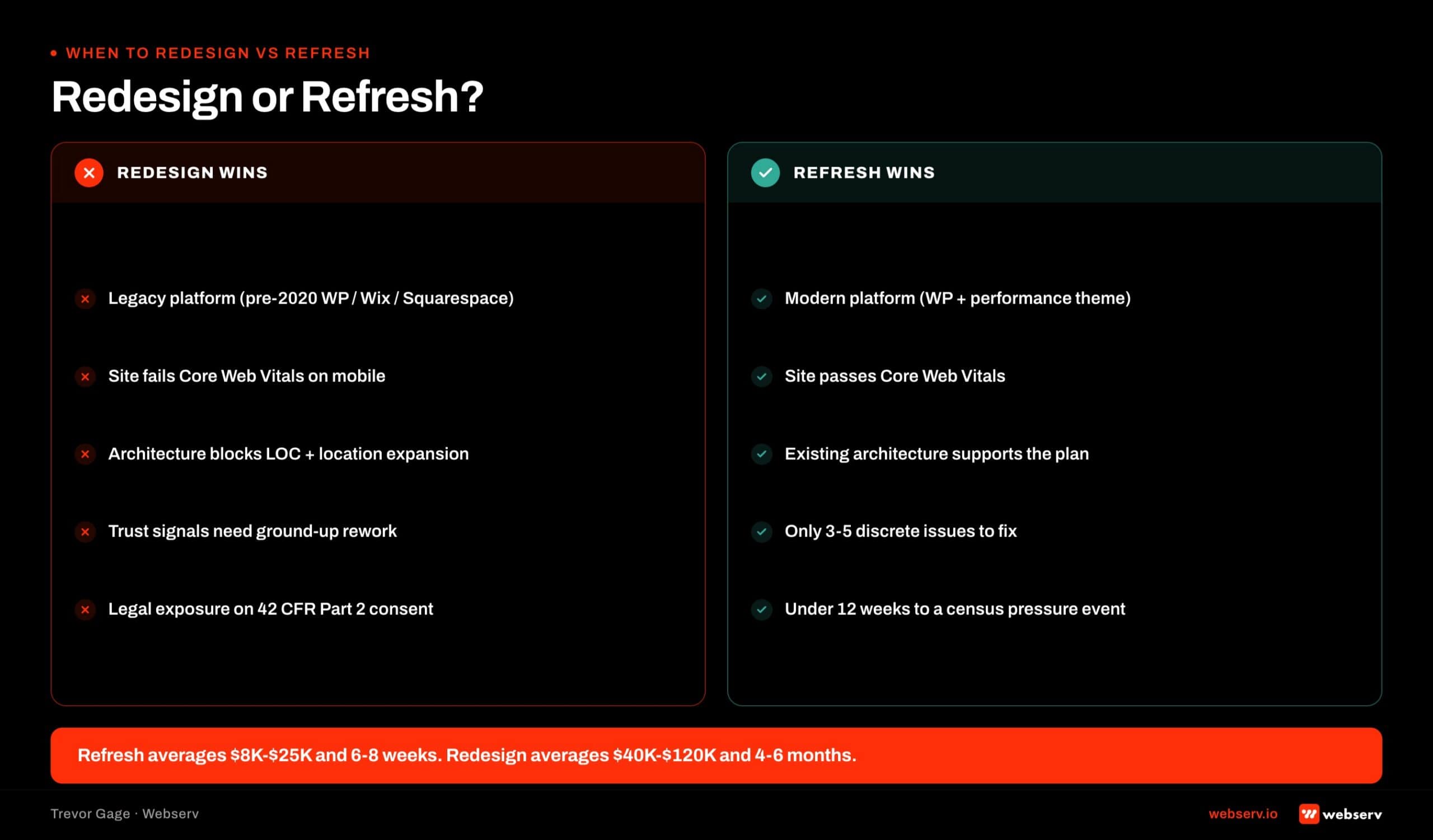
Full redesign is a 8-16 week project. Refresh is a 4-6 week project. The decision has real cost implications.
Refresh wins when. The site’s information architecture is fundamentally sound but the visual design feels dated. The content is largely correct but needs updating. The conversion elements exist but need optimization. The brand identity is intact.
Full redesign wins when. The site’s information architecture does not support the current business (multi-location added, new levels of care, major service line change). The visual design does not communicate the current brand. The technology stack is not maintainable. Compliance work would require rebuilding most templates anyway.
The treatment center website redesign decision framework walks the full decision surface. The pattern most facilities miss: the sites that most need a redesign are the sites that most benefit from a refresh, because the underlying architecture is often sound and the perceived problem is visual.
Facilities that pursue full redesigns should also read why rebuilding your treatment center website can hurt your rankings to understand the SEO risk profile before committing.
What a Webserv Engagement Looks Like
Webserv’s design work runs inside the Performance Creative capability. Web Design, Web Development, Landing Pages, and Ad Creative all live under the same practice.
Discovery phase (2-3 weeks). Current-state audit. Analytics review. Family and prospect journey mapping. Competitor teardown. Trust signal inventory. Compliance audit against LegitScript, HIPAA, and WCAG.
Design phase (3-5 weeks). Wireframes for key page templates. Visual design system. Photography direction. Content architecture map. Trust signal placement decisions.
Development phase (4-6 weeks). Front-end build. CMS configuration. Contact form and integration setup. HIPAA-compliant analytics stack. Accessibility QA against WCAG standards.
Launch and optimization (2-4 weeks). Content migration. Redirect mapping (this is where SEO gets protected or lost). Launch QA. Post-launch monitoring and optimization.
Pricing depends on scope. Refresh engagements run lower than full redesigns. Both include the Fast-Track Diagnostic ($3,000, credited toward the first month of engagement) as the low-friction entry.
The perspective in this article comes from 9 years working exclusively inside behavioral health.
We are a team built by people in recovery who understand that behind every admission is someone asking for help. If that resonates, get to know us.
Most in-house teams hit a wall not because they lack knowledge, but because they lack bandwidth.
When you are ready to hand it off, Webserv has spent 9 years executing exactly this for treatment centers nationwide.
Frequently Asked Questions
How much does a treatment center website cost?
Website design and development for a treatment center runs $15,000 to $75,000 for a mid-size facility depending on scope. Refresh engagements (updated visual design on existing architecture) run $15,000 to $30,000. Full redesigns run $30,000 to $75,000. Enterprise portfolios with multi-location complexity run higher.
The cost variance is driven by five inputs: number of pages, custom design work versus template adaptation, integration surface (CRM, EMR, call tracking, contact forms), photography and content production, and accessibility remediation depth.
Facilities budgeting website design should also model ongoing maintenance costs: hosting, plugin updates, content updates, and periodic optimization. A website is an operational asset, not a one-time project.
How long does a treatment center website design project take?
8 to 16 weeks end-to-end for a mid-size facility. Discovery phase runs 2-3 weeks. Design phase runs 3-5 weeks. Development phase runs 4-6 weeks. Launch and optimization runs 2-4 weeks.
Anyone quoting a 30-day website is quoting a template with the facility name inserted. Real design work at behavioral health requires photography direction, compliance review, family and prospect journey mapping, and trust signal architecture that does not compress into a month.
Anyone quoting six months usually has a discovery phase that produces no real decisions. Real engagements move from discovery to design decisions inside three weeks.
What are the most important design elements on a treatment center website?
Five elements. Above-the-fold phone number and primary CTA. Accreditation badges (Joint Commission, CARF, LegitScript, state licensing) visible in the hero or immediately below. Named clinical staff with credentials and photos. Real facility photography instead of stock imagery. Mobile-optimized conversion path.
If a treatment center website gets those five elements right, it will out-convert most competitor sites regardless of aesthetic polish. If any of the five is missing, aesthetic polish will not compensate.
Facilities that focus on brand identity, color palette, and typography before nailing the five conversion elements are optimizing the wrong layer. Get the conversion elements right first. The aesthetic layer is easier to iterate than the trust signal architecture.
Is WordPress a good platform for a treatment center website?
Yes for most facilities. WordPress runs the majority of behavioral health websites, handles the SEO and content management needs cleanly, and has a mature ecosystem of HIPAA-compliant plugins and hosting options.
WordPress alternatives (Webflow, Squarespace, custom CMS) work for specific scenarios but usually do not offer better outcomes at typical treatment center scale. The decision matrix walks in the Best Website Development Platforms for Addiction Treatment Centers.
The bigger decision than platform is configuration. A well-configured WordPress site beats a poorly-configured Webflow or custom site. A poorly-configured WordPress site loses to a well-configured alternative. Configuration is where the design and development work actually lives.
Do I need to worry about accessibility for a treatment center website?
Yes. Behavioral health facilities are subject to ADA Title III accessibility requirements. Treatment center websites regularly face accessibility lawsuits when they miss WCAG 2.2 standards. The legal exposure is real and the fix is not always cheap.
Building to WCAG from day one is materially cheaper than remediation after launch. Core WCAG requirements are design constraints, not add-on features: sufficient color contrast, keyboard navigation, alt text on images, screen reader compatibility, and no auto-playing content without user control.
Facilities running websites built before WCAG-first design became standard should audit accessibility as a discrete work stream. Small facilities can budget $5,000 to $15,000 for a real accessibility remediation. Larger facilities can budget more depending on template count and content volume.
Should our treatment center website include patient testimonials?
Testimonials are allowed under LegitScript with restrictions. Testimonials focused on experience quality, staff interactions, and facility environment are defensible. Testimonials that make specific outcome claims (percentages, success rates, guaranteed results) are LegitScript exposure and should be avoided.
Testimonials require documented consent from every person in the testimonial. Photo or video testimonials require model releases. Written testimonials require signed consent. Facilities that use testimonials without documented consent carry legal exposure independent of LegitScript.
Third-party reviews (Google, Yelp, health-specific review platforms) usually carry more trust weight than on-site testimonials. Family audiences trust reviews they can verify externally. Design should surface both third-party reviews and consented on-site testimonials.
How does website design connect to admissions performance?
The website is the primary conversion surface for most treatment center marketing. Paid media, organic search, referral partners, and direct traffic all funnel through the website before producing a called admission.
Design decisions that suppress conversion (buried phone number, missing trust signals, slow page load, poor mobile experience, unclear CTAs) reduce admits per marketing dollar spent. Design decisions that lift conversion (clear phone placement, accreditation badges visible, real facility photography, mobile-first speed, unambiguous CTAs) multiply the return on every dollar of marketing spend.
Facilities that treat the website as a static asset instead of a conversion system underinvest in the layer that determines whether their marketing spend produces admits. The design brief is not “beautiful.” The design brief is “turns marketing traffic into called admissions.”
Closing
Treatment center website design is not a general healthcare design job. Family-mediated decision-making, LegitScript compliance, clinical trust signals, and mobile-first behavior change the design brief in ways generalist agencies routinely miss.
The four pillars are knowable. Trust signals, conversion elements, content architecture, and compliance. Every one has operational best practices, common failure modes, and specific design decisions that separate a website that drives admits from a website that just looks good in a portfolio.
If you are evaluating a redesign, running a new brand launch, or auditing a website that is not producing admits, the audit is worth running before committing to a scope. Start with the $3,000 Fast-Track Diagnostic. Credited 100 percent toward the first month if you engage.
Trevor Gage is the Director of Marketing at Webserv, where he leads content and SEO for the agency’s behavioral health and addiction treatment clients. He writes about the operator lens on rehab marketing at the Webserv blog.