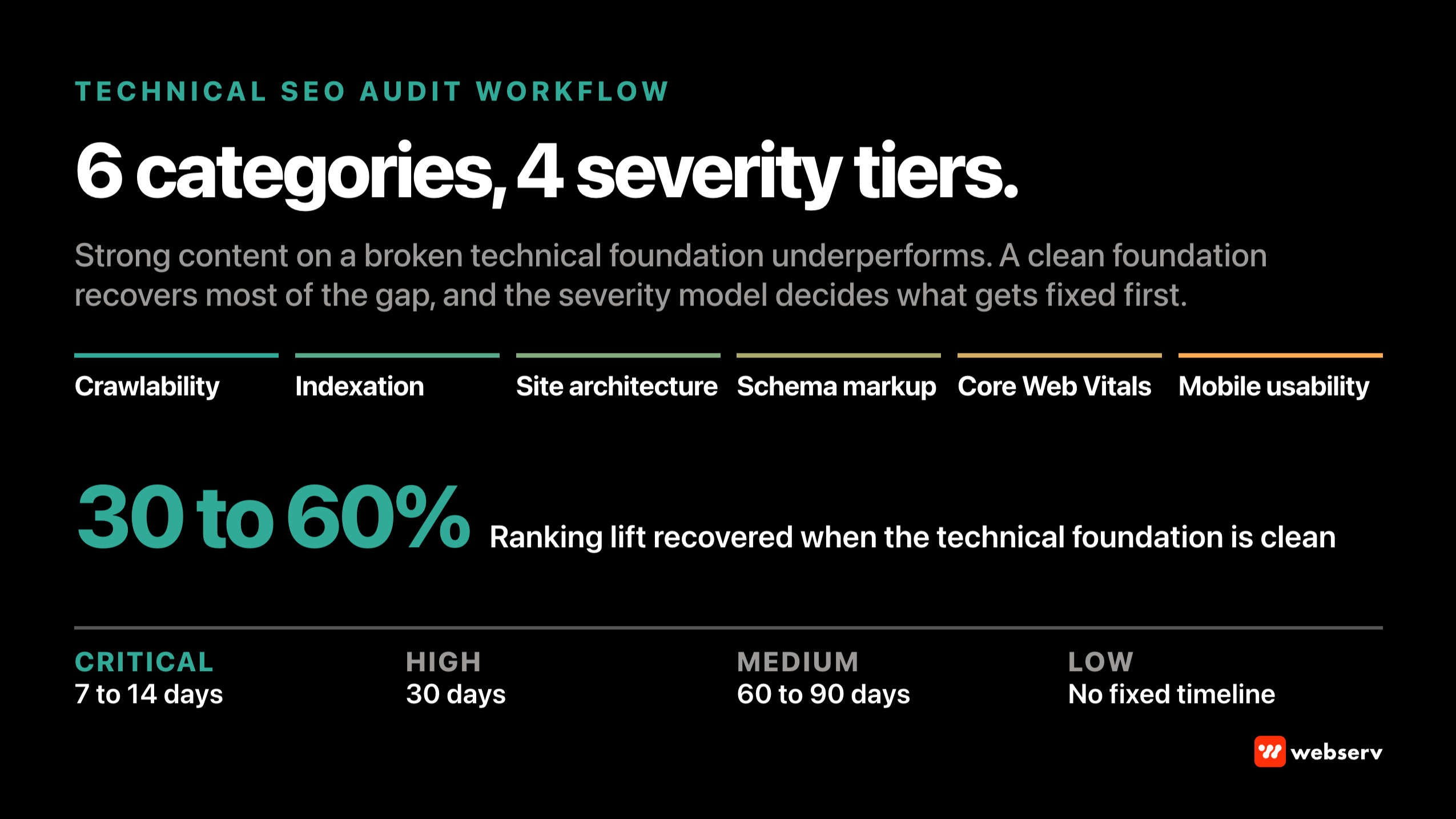
Technical SEO for behavioral health treatment centers is the specific foundation layer that determines whether content strategy and AI citation optimization produce measurable ranking and citation lift or fail silently against unresolved technical issues. It lives inside our SEO capability as the operational discipline that everything else depends on.
A facility site with strong content and a broken technical foundation ranks below what the content quality alone should earn, because crawl, index, and performance problems cap what the content can do.
The SEO capability at Webserv runs a specific technical audit workflow across the corpus of client sites plus the Webserv corpus itself. The pattern is consistent: sites with disciplined quarterly technical audits catch problems while they are small, and sites running only ad-hoc maintenance find them after rankings slip.
The pattern I see across treatment center technical audits: crawl errors accumulate for months without detection, redirect chains proliferate through content moves and URL restructures, schema markup gets deployed inconsistently across page types, and Core Web Vitals fail on specific page templates without the marketing team knowing.
Each issue compounds ranking impact. Facilities without systematic technical audit typically discover the accumulated issues only when a ranking incident forces investigation, by which point the accumulated fixes have become a remediation project rather than routine maintenance.
This piece walks the technical SEO audit workflow for treatment center sites. The specific audit categories that cover the technical foundation, the quarterly cadence that keeps technical issues from accumulating, and the tool stack that supports audit execution at scale.
It also covers the prioritization framework that separates critical issues from cosmetic issues, the remediation workflow that produces actual fixes rather than audit findings that sit in reports, and the measurement patterns that isolate technical audit impact from other SEO variables. Pairs with our content refresh framework piece as the two operational disciplines that maintain site performance, extends the diagnostic pattern in our why isn’t my rehab website ranking on Google piece, and supports the schema depth walked in our structured data beyond Rank Math defaults piece. Broader context in our ultimate guide to behavioral health marketing.
Key Takeaways
- Technical SEO audit is the specific foundation-layer discipline that determines whether content and AI citation strategy produce their intended ranking lift. Sites with strong content and a broken technical foundation rank below what the content should earn.
- The six audit categories that cover the technical foundation: crawlability (crawl errors, sitemap health, robots.txt), indexation (index coverage, duplicate content, canonical tags), site architecture (URL structure, internal linking depth, redirect chains), schema markup (deployment consistency, validation errors, coverage gaps), Core Web Vitals (LCP, INP, CLS across page templates), and mobile usability (mobile rendering, tap target sizing, viewport configuration).
- Quarterly audit cadence prevents technical issue accumulation. Quarterly audits catch issues within one quarter of appearing, so they get fixed in normal sprints. Annual or ad-hoc audits let issues pile up into a remediation project.
- Prioritization framework separates critical from cosmetic. Critical issues (indexation blockers, schema validation errors on primary content, Core Web Vitals failures on high-traffic pages) get remediation within 7 to 14 days. Cosmetic issues (minor crawl warnings, isolated redirect chains, non-critical schema warnings) get scheduled remediation in normal content sprints.
- Remediation workflow produces actual fixes rather than audit reports that sit unread. Each identified issue gets an owner, a deadline, and a completion verification step. Facilities without remediation workflow typically produce audit reports that identify issues without producing fixes.
DEFINITION
Technical SEO audit workflow for behavioral health treatment centers. The quarterly operational discipline that keeps a treatment center site’s technical foundation clean enough that content and AI citation strategy can actually earn their intended lift. Runs on six audit categories (crawlability, indexation, site architecture, schema markup, Core Web Vitals, mobile usability), a four-tier severity model (critical / high / medium / low with matching 7-14 / 30 / 60-90 / no-fixed timelines), a tool stack anchored on Google Search Console + Screaming Frog + Rich Results Test + PageSpeed Insights + Chrome UX Report, and a remediation workflow that turns findings into owned, deadline-bound fixes with verification.
Distinct from content refresh (which handles editorial freshness on published content), distinct from one-off SEO audits (which produce reports without ongoing cadence), and distinct from engineering-only site performance work (which typically covers Core Web Vitals without addressing schema, indexation, or the BH-specific patterns that separate healthcare sites from general commerce).
OPERATOR INSIGHT
Crawl errors accumulate for months without detection, redirect chains proliferate through content moves and URL restructures, schema markup gets deployed inconsistently across page types, and Core Web Vitals fail on specific page templates without the marketing team knowing.
Each issue compounds ranking impact. Facilities without systematic technical audit typically discover the accumulated issues only when a ranking incident forces investigation, by which point the accumulated fixes have become a remediation project rather than routine maintenance. Quarterly cadence catches the same issues in 90-day windows and remediates them in normal sprint capacity instead of triage mode.
The six audit categories that cover the technical foundation
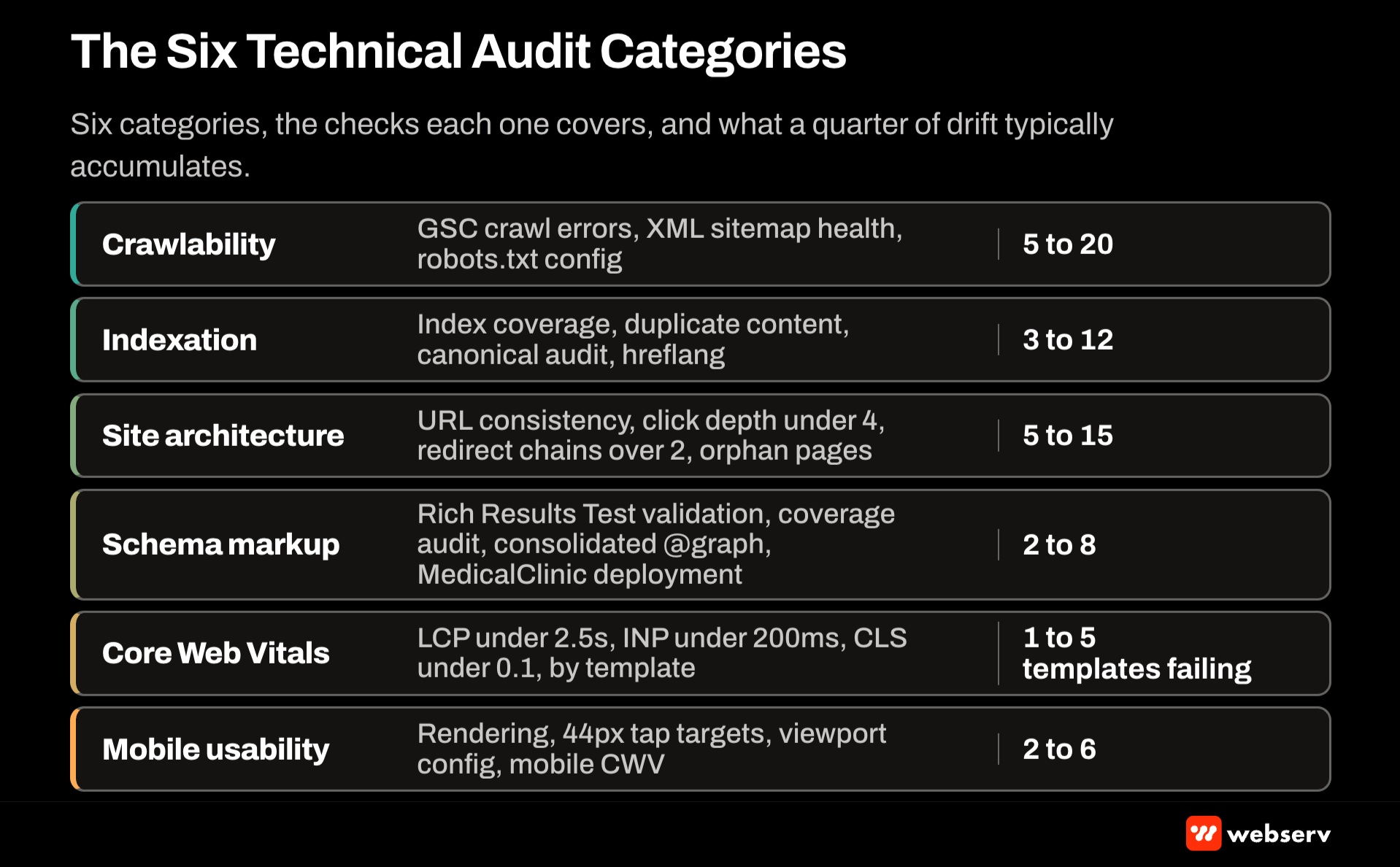
Six audit categories cover the technical SEO foundation for treatment center sites. Each category has specific check patterns and specific issue types.
Category 1: Crawlability
Whether Google’s crawler can access and traverse the site content. Specific checks: crawl error report in Google Search Console (soft 404s, server errors, DNS errors, blocked resources), XML sitemap health (all indexable URLs present, no non-canonical URLs, no 404 URLs, updated modification timestamps), and robots.txt configuration (no blocked resources needed for rendering, appropriate crawl directives).
Facility sites frequently develop crawl error accumulation through content moves, plugin changes, and CDN configuration drift. Quarterly crawl error review catches those issues before they compound.
Category 2: Indexation
Whether Google’s index reflects the intended site structure. Specific checks: index coverage report analysis (indexed vs excluded pages with excluded reasons), duplicate content identification (near-duplicate pages competing for the same queries), canonical tag audit (canonical URLs pointing to correct primary versions), and specific hreflang implementation for multi-region or multilingual sites.
Portfolio operators with multiple facilities frequently develop indexation issues because facility page templates get duplicated across facilities without appropriate canonical or differentiation. Our Local SEO cluster hub covers the entity-hierarchy pattern that resolves the underlying duplication issue.
Category 3: Site architecture
Whether the site structure supports efficient crawling and clear topical hierarchy. Specific checks: URL structure consistency (predictable patterns across page types), internal linking depth (all pages reachable within 3 to 4 clicks from homepage), redirect chain analysis (chains longer than 2 redirects flagged for consolidation), and orphan page identification (pages with no internal links pointing to them).
Category 4: Schema markup
Whether structured data deploys correctly and consistently across page types. Specific checks: schema validation through Google’s Rich Results Test (validation errors flagged for remediation), schema coverage audit (which page types carry which schema types), consolidated @graph pattern verification (Organization + Person + Article on primary content pages), and specific BH schema deployment (MedicalClinic, MedicalBusiness for facility pages). Our guide to author bios that build E-E-A-T and structured data beyond Rank Math defaults piece cover the specific schema patterns audit validates.
Category 5: Core Web Vitals
Whether page performance meets Google’s user experience thresholds. Specific checks: LCP (Largest Contentful Paint) of 2.5 seconds or less, INP (Interaction to Next Paint) of 200 milliseconds or less, and CLS (Cumulative Layout Shift) of 0.1 or less, each measured at the 75th percentile of real visits, per Google’s Web Vitals guidance.
Measurements taken across page templates rather than site-wide because template-specific performance varies meaningfully. High-traffic page templates get priority remediation.
Category 6: Mobile usability
Whether the site works appropriately on mobile devices. Specific checks: mobile rendering quality (content readable without horizontal scrolling), tap target sizing (at least 24 by 24 CSS pixels, the WCAG 2.2 AA minimum, and larger for primary buttons), viewport configuration (appropriate meta viewport tag), and mobile-specific Core Web Vitals, which often lag desktop and need to be read separately.
The technical SEO audit program at a glance
6
Audit categories: crawlability, indexation, architecture, schema, Core Web Vitals, mobile
4 tiers
Severity levels, from critical to low, each with its own remediation target
Quarterly
Full audit cadence, with monthly spot checks in between
7-14 d
Remediation SLA for critical-severity indexation, schema, and CWV issues
Quarterly cadence prevents issue accumulation
Quarterly audit cadence catches technical issues within 90-day windows and prevents the multi-year accumulation pattern that produces major remediation projects.
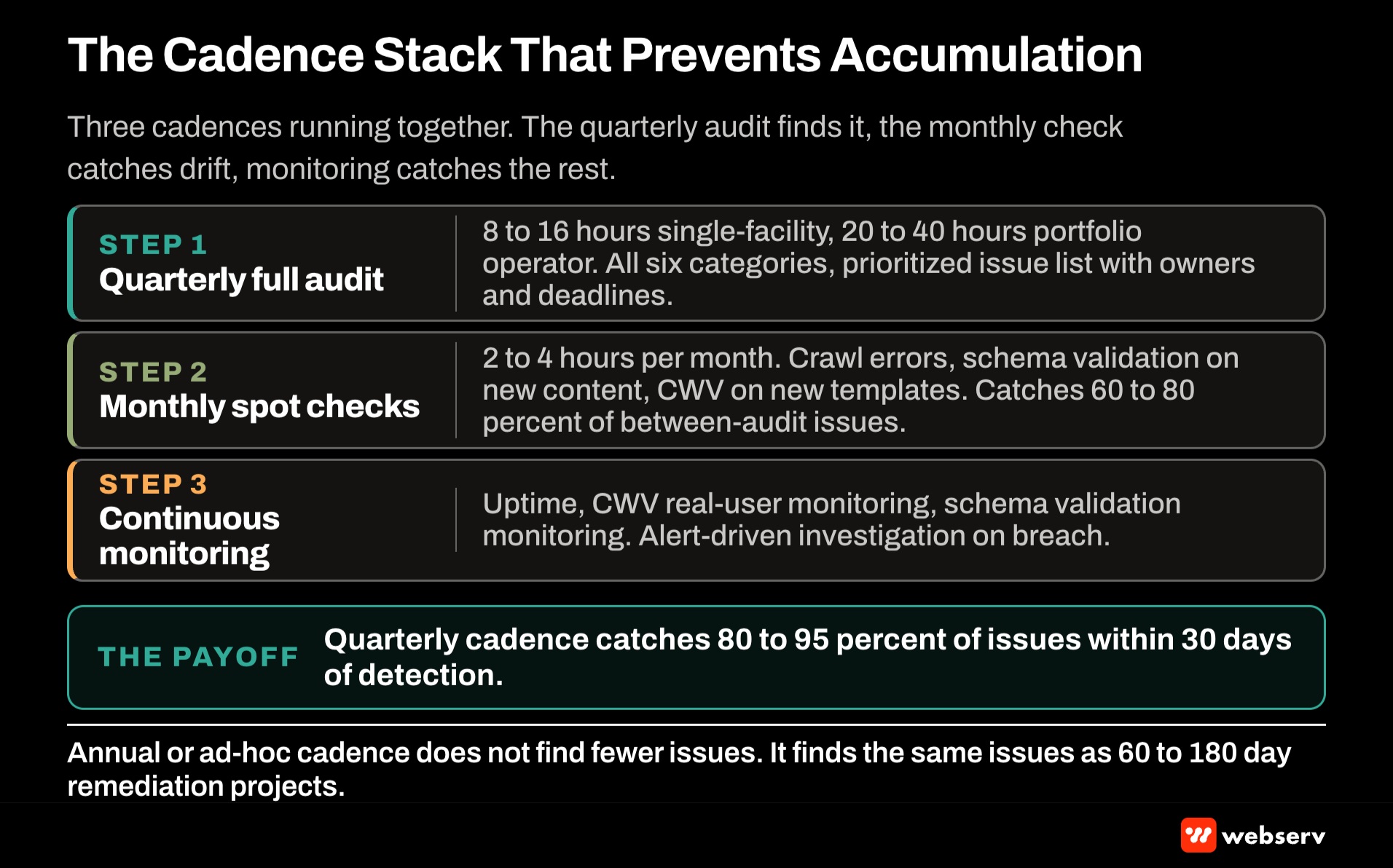
Quarterly execution pattern. One full technical audit per quarter across the six categories. Time scales with URL count and facility count, so budget it per site rather than per portfolio.
Audit outputs: prioritized issue list with severity classification, remediation owner assignment, and target completion timeline.
Monthly spot checks between quarterly audits. Between full audits, monthly spot checks on specific issue categories catch issues that emerge between audit cycles. Common monthly spot checks: crawl error report review, schema validation on newly-published content, Core Web Vitals on new page templates.
Monthly spot checks are shorter and focused on critical categories, so most urgent issues surface before the next full audit.
Continuous monitoring for critical categories. Uptime monitoring, Core Web Vitals real-user monitoring, and schema validation monitoring run continuously through dedicated tools. Alerts trigger investigation when critical thresholds get breached.
The specific pattern: quarterly full audit for comprehensive coverage, monthly spot checks for gap prevention, continuous monitoring for critical alert conditions.
How SoCal Sunrise generated 85 admissions and 2,297% ROI from SEO in 6 months
A ground-up SEO rebuild using the Pathfinder Parents Methodology turned an invisible online presence into a top-ranking admissions engine.
Read the case study →85 admits and 3,152 leads attributed to organic
Tool stack for audit execution
The specific tool stack that supports technical audit execution at scale.
Google Search Console for crawl and index data. GSC provides the specific data Google’s crawler produces about the site. Coverage report, sitemap report, Core Web Vitals report, mobile usability report, rich results report, and links report all feed audit workflow.
Free from Google. Required for any technical audit.
Screaming Frog for site crawl analysis. Screaming Frog SEO Spider crawls the site and produces structured data about URL patterns, internal linking, redirect chains, schema deployment, and page-level technical characteristics.
Free for crawls up to 500 URLs. The paid licence is $279 per year per user as of September 2026, and one licence can crawl any number of facility sites.
Ahrefs or Semrush for backlink and competitive analysis. SEO platforms that surface backlink profile changes, competitor movement, and keyword ranking patterns. Support technical audit through backlink audit (broken external links pointing to facility pages) and competitive gap analysis.
Paid subscriptions, priced by plan tier. Check current pricing before you budget.
Schema.org validator and Google Rich Results Test. Both validate schema markup deployment. Schema.org validator provides comprehensive validation. Google Rich Results Test provides Google-specific eligibility check. Both free.
PageSpeed Insights and Chrome UX Report. Google’s Core Web Vitals measurement tools. PageSpeed Insights for lab measurement on specific URLs. Chrome UX Report for real-user measurement across the domain. Both free.
Custom monitoring for BH-specific patterns. Custom scripts or monitoring tools for BH-specific patterns (LegitScript compliance check on landing pages, HIPAA-adjacent tracking verification, specific schema patterns like MedicalClinic deployment). Custom monitoring typically requires internal engineering support or specialized agency capability.
DO
- Run a full 6-category audit quarterly, plus monthly spot checks and continuous monitoring on critical categories.
- Assign every finding an owner + deadline + verification step. No entries land in the report without those three fields — that’s what turns audits into fixes.
- Enforce SLA by severity: critical 7-14 days, high 30 days, medium 60-90 days, low no fixed timeline but on the backlog.
- Measure remediation impact against pre-remediation baseline on ranking, CWV field data, index coverage, and Rich Results eligibility over the following quarter.
- Run retrospectives on recurring findings — issues that come back quarter after quarter signal a missing gate in publishing workflow or missing continuous monitoring.
DON’T
- Ship audit findings without ownership and deadlines — without that discipline, issues are still open at the next quarterly audit.
- Skip technical audit while investing in content or paid — the compound benefit of clean foundation is bigger than any single content or paid initiative.
- Measure site-wide Core Web Vitals instead of template-level — template-specific performance varies meaningfully and site-wide averages hide the failing templates.
- Duplicate facility page templates across a portfolio without differentiation — near-duplicate content across facilities is one of the top-5 recurring findings.
- Move content or restructure URLs without redirect maintenance — redirect chains pile up quietly on sites that skip the discipline.
Prioritization framework
Prioritization separates critical issues from cosmetic issues so remediation focuses on high-impact fixes.
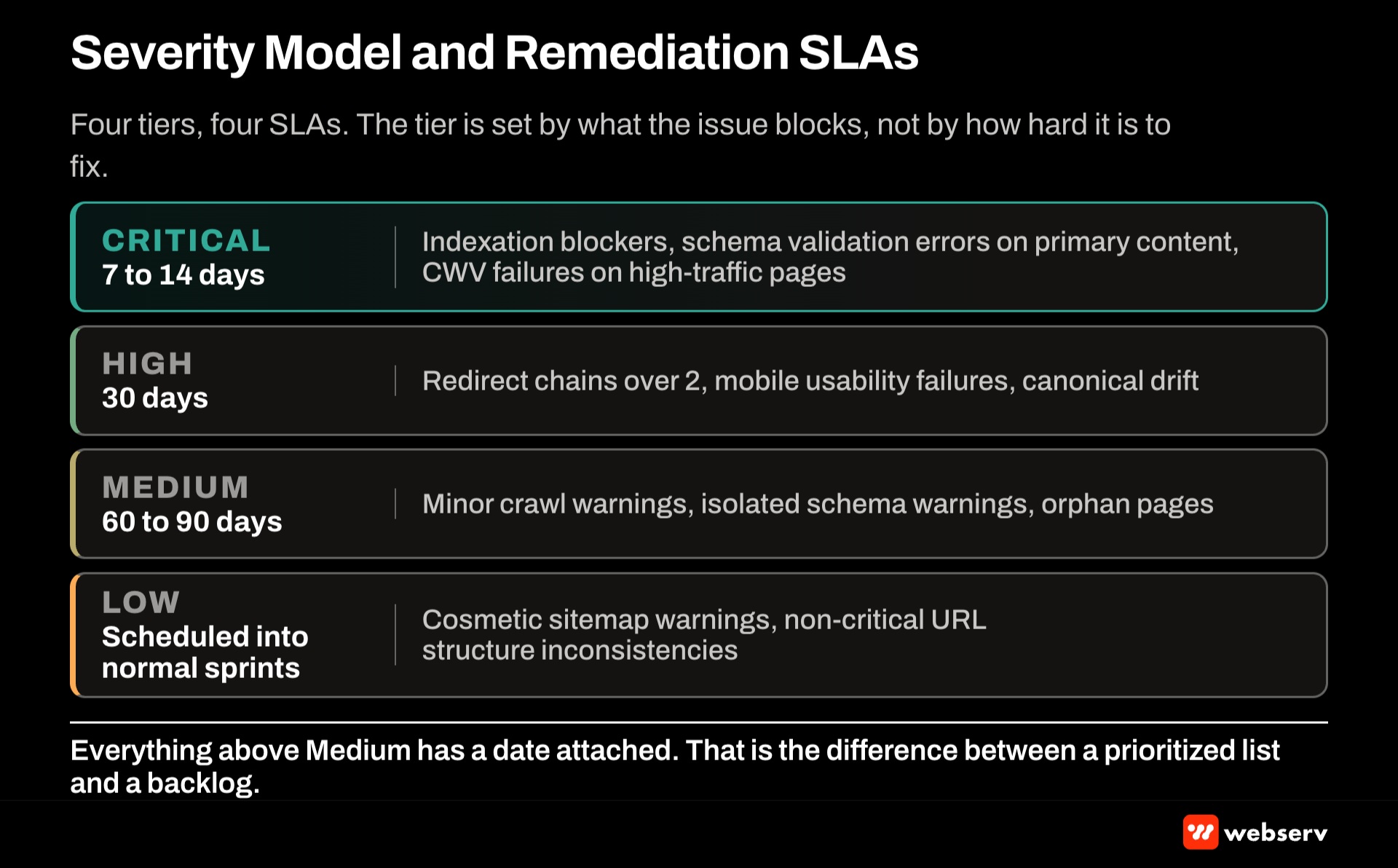
Critical severity (7 to 14 day remediation target). Indexation blockers preventing important pages from being indexed. Schema validation errors on primary content pages. Core Web Vitals failures on high-traffic templates. Mobile rendering issues on key conversion pages.
Critical issues affect ranking or user experience meaningfully. Remediation gets top priority regardless of other work.
High severity (30-day remediation target). Crawl errors on important content sections. Redirect chains longer than 2 redirects on trafficked URLs. Schema coverage gaps on primary content types. Site architecture issues affecting crawl efficiency.
High-severity issues affect performance without producing immediate ranking damage. Remediation scheduled in normal sprint cadence.
Medium severity (60 to 90 day remediation target). Isolated crawl warnings on low-traffic pages. Non-critical schema warnings. Site architecture issues affecting non-trafficked URLs. Cosmetic schema optimization opportunities.
Medium-severity issues have measurable but limited ranking impact. Remediation scheduled based on team capacity.
Low severity (no fixed timeline). Cosmetic warnings without clear ranking or user experience impact. Optimization opportunities that would produce marginal improvement.
Low-severity issues get addressed when higher-severity work completes or when a specific initiative addresses the area.
Remediation workflow
The specific workflow that produces actual fixes rather than audit reports that sit unread.
Step 1: Issue documentation with severity classification. Each audit finding documented with specific URL or template, specific issue description, severity classification, and evidence supporting the classification.
Step 2: Owner assignment and remediation timeline. Each issue gets a specific owner (marketing team member, engineering team member, agency team member) with a specific remediation deadline based on severity.
Step 3: Remediation execution. Owner completes the specific fix. Documentation updated to reflect the fix and any related changes.
Step 4: Completion verification. Fix verified through re-audit of the specific issue. Critical fixes get verified within 7 days of completion. High-severity fixes get verified within 30 days.
Step 5: Retrospective on recurring issues. Issues that recur across quarterly audits get retrospective analysis to identify workflow gaps that produce the recurrence. Recurring issues often signal missing continuous monitoring or missing gates in content publishing workflow.
Without a remediation workflow, audit reports turn into lists of known issues that are still open next quarter. With owners and deadlines, most issues close inside their severity window.
Measurement patterns for technical audit impact
The specific measurement patterns that isolate technical audit impact from other SEO variables.
Ranking recovery on remediated pages. Track ranking positions on pages where critical technical issues get remediated. Compare pre-remediation and post-remediation rankings over 30 to 90 day windows.
Crawl efficiency metrics. Google Search Console crawl stats report shows crawler behavior over time. Improved crawl efficiency (more pages crawled per crawler visit) typically follows successful technical remediation.
Index coverage improvement. Percentage of intended pages appearing in Google’s index over time. Expect index coverage to change gradually as Google recrawls the fixed pages.
Core Web Vitals field data trends. Chrome UX Report data shows real-user performance over time. The Chrome UX Report reports field data over a rolling 28-day window, so a fix takes about a month to show fully.
Schema rich result eligibility. Google Search Console rich results report shows schema deployment eligibility over time. Track eligibility after each schema fix, and remember that eligibility does not guarantee a rich result will show.
Most in-house teams hit a wall not because they lack knowledge, but because they lack bandwidth.
When you are ready to hand it off, Webserv has spent 9 years executing exactly this for treatment centers nationwide.
Frequently Asked Questions
How much does quarterly technical audit cost for a treatment center site?
It depends on site size, facility count, and whether the audit is run in-house or by an agency. The main cost is specialist time: running the six category checks, documenting findings, and verifying fixes.
Tool costs are modest. Google Search Console, the Rich Results Test, PageSpeed Insights, and the Chrome UX Report are free, and Screaming Frog’s paid licence is $279 per year per user as of September 2026. Remediation work, such as engineering changes, schema deployment, or Core Web Vitals fixes, is a separate cost that depends on what the audit finds.
Portfolio operators get economies of scale, because the second and later facilities reuse the same checklist, templates, and tooling.
How do we prioritize technical audit when we also have content and paid media budgets?
Technical audit is foundation-layer work that supports content and paid media performance. Skipping technical audit while investing in content and paid typically produces ranking outcomes below what the content and paid investment would otherwise produce.
The specific prioritization: technical audit gets consistent quarterly cadence funding regardless of content and paid budget cycles. It is a small line in the budget that protects the return on everything else.
Facilities that treat technical audit as optional typically produce measurable ranking underperformance versus facilities that treat it as required infrastructure.
How does technical audit interact with AI citation optimization?
Directly. Technical foundation determines whether AI answer surfaces can crawl, parse, and cite the site content. Technical issues (indexation blockers, schema errors, Core Web Vitals failures) affect AI citation eligibility the same way they affect Google ranking.
The specific integration pattern: technical audit runs quarterly and remediates issues that affect both ranking and AI citation. Schema audit specifically supports AI citation because schema deployment quality directly affects AI answer surface parsing. Our Full AI Search Stack for treatment centers covers the broader AEO framework technical audit supports; our structured data beyond Rank Math defaults piece covers the schema patterns technical audit validates.
Facilities investing in AI citation optimization without technical audit typically produce citation share below what the content optimization would otherwise produce because technical issues limit AI answer surface access.
What are the most common technical issues we see on treatment center sites?
Five specific issues appear frequently. First: redirect chains from content moves and URL restructures. Facilities that move content without redirect maintenance build up chains quietly, and nobody notices until a crawl surfaces them.
Second: schema markup inconsistency. Different page templates deploy different schema patterns without consolidated architecture. Portfolio operators frequently have facility-to-facility schema variation. Our guide to author bios that build E-E-A-T and Local SEO cluster hub both cover schema patterns that recur at portfolio scale. Third: Core Web Vitals failures on high-traffic templates. Service pages and location pages frequently fail LCP because of large hero images without appropriate optimization.
Fourth: index coverage issues from duplicate content. Portfolio operators with facility page templates frequently produce near-duplicate content across facilities that competes for the same queries. Fifth: crawl error accumulation from plugin changes and CDN drift. WordPress sites in particular develop crawl errors over time as plugins update and CDN configuration drifts.
How does technical audit fit with the content refresh framework?
Complementary but distinct. Content refresh maintains authority on published content through editorial changes. Technical audit maintains the technical foundation that supports content performance. Our content refresh framework piece covers the editorial side.
The specific integration: technical audit identifies technical issues affecting content pages. Content refresh addresses editorial and factual freshness. Both operate on quarterly cadence and both contribute to overall site performance.
Facilities running only content refresh without technical audit typically produce editorial improvements that get limited by unresolved technical issues. Facilities running only technical audit without content refresh typically produce technical improvements that get limited by aging content authority.
When should we bring in specialized engineering support for technical fixes?
For fixes requiring code changes (schema deployment through custom development, Core Web Vitals fixes requiring template changes, custom monitoring implementation), specialized engineering support typically produces better outcomes than marketing team implementation.
The specific tradeoff: marketing team implementation is faster for straightforward fixes (WordPress admin changes, plugin configuration, content updates). Engineering implementation is required for template-level changes, custom code, and infrastructure modifications.
Facilities without in-house engineering typically use specialized SEO development agencies for engineering-heavy technical fixes. The specialized agency approach typically produces better outcomes than general web development for SEO-specific technical work.
How do we measure whether our technical audit workflow is working?
Three specific measurement signals. First: percentage of identified issues remediated within severity-appropriate timeframes. Target: 80 percent for critical issues within 14 days, 70 percent for high-severity within 30 days.
Second: quarter-over-quarter issue counts by severity. A working audit workflow shows critical issue counts falling and high-severity counts holding steady or falling, quarter over quarter.
Third: ranking and traffic outcomes on remediated pages measured against pre-remediation baseline. Give each fix at least a full quarter before judging its ranking and traffic impact.
Trevor Gage is the Director of Marketing at Webserv, a digital marketing agency for treatment centers.