Search engine optimization (SEO) is the process of increasing your website’s visibility in organic search results by improving both what users see and what search engines evaluate.
Pay-per-click (PPC) advertising is the paid-media counterpart that buys placement at the top of the same search results. Treating the two as separate marketing programs is one of the most expensive habits marketing teams still have in 2026.
Modern SEO combines technical performance, user experience, content relevance, and (for regulated verticals) authorship credibility to help your site earn higher rankings and attract qualified traffic that converts. Modern PPC combines platform-native machine learning, precise audience targeting, and creative optimization to buy qualified visits at auction.
This guide walks the current state of SEO and PPC management, the trade-offs between them, and the specific integration patterns that produce compounding results across both channels. It closes with the behavioral health treatment center specifics that shift the play for that vertical inside the broader marketing strategy.
Key Takeaways
- SEO and PPC serve different roles at different points in the funnel, but they operate on the same intent signals and produce compounding results when the data flows between them.
- SEO builds sustainable authority and organic growth. It is the slower channel to activate and the cheaper channel to sustain at scale.
- PPC drives immediate traffic and precise audience targeting. It is the faster channel to activate and the more expensive channel to sustain.
- A blended strategy produces the best cost per acquisition and the fastest path to positive contribution margin. Behavioral health treatment centers see this pattern amplified because both channels sit inside regulated compliance frames.
- Data should flow between both strategies. Keyword conversion data from PPC informs SEO priority. Organic traffic patterns inform PPC audience building. Server-side conversion tracking makes both HIPAA-safe in regulated verticals.
What Is SEO? (Search Engine Optimization)
SEO is the process of increasing your website’s visibility in organic search results by improving both what users see and what search engines evaluate.
Modern SEO combines technical performance, user experience, and content relevance to help your site earn higher rankings and attract qualified traffic that converts. Here is a breakdown of the parts of SEO management.
Keyword Optimization
Keyword optimization is about matching your content to what real users are searching for.
This includes researching high-intent and long-tail keywords, optimizing page titles, meta descriptions, headings, and URLs to align with real search behavior, and structuring content around topics that answer the intent behind the search.
Post-Google-I/O 2026, the same discipline extends to compound-prompt queries that AI Mode generates as sub-queries from a single conversational input. Content that answers only the head term while ignoring the compound prompt structure gets skipped by AI-generated responses even when it ranks in the traditional 10 blue links.
Technical SEO
Technical SEO covers the parts of the site search engines evaluate that users rarely see directly. Core Web Vitals thresholds, structured data (Schema.org), crawl budget management, canonical handling, sitemap discipline, and internal link architecture all live in this layer.
Google’s own helpful content and ranking systems documentation covers the specific signals ranked pages need to demonstrate.
For treatment centers and other YMYL (Your Money or Your Life) categories, technical SEO also includes the E-E-A-T signal stack: clinical reviewer bylines, medical accuracy citations, and organizational authorship schema that Google explicitly requires for health-adjacent content.
Content Creation
Content creation is where SEO earns its ROI. Publishing content that answers real questions at real depth, updates on a regular cadence, and demonstrates topical authority is the input that produces organic ranking gains over time.
Treatment centers running content SEO have an added constraint layer. YMYL classification means Google demands clinical authorship, medical reviewer bylines, and evidence-based sourcing to rank at all.
A generic content push that would rank in ecommerce dies in behavioral health without that E-E-A-T signal stack. Our content types that drive treatment center admits piece walks the specific formats that clear both the ranking bar and the clinical trust bar.
Backlink Acquisition
Backlink acquisition is the process of earning links from other credible websites that point to your content.
Quality of the linking domain matters far more than volume in 2026, and the earned-media approaches (journalist coverage, industry data contributions, resource-page inclusions) outperform the transactional approaches (link exchanges, paid placements) both in ranking impact and in longevity of the link.
UX and Core Web Vitals
User experience signals feed both directly into Google’s ranking systems (Core Web Vitals thresholds) and indirectly through the engagement metrics that ranking systems infer from user behavior.
Load speed under 2.5 seconds, cumulative layout shift under 0.1, and interactive input delay under 200 milliseconds are the current thresholds Google publishes as passing marks.
Local SEO Optimization
local SEO is the discipline of ranking in geographically-scoped search results and in the Google Business Profile map pack. For treatment centers with physical facilities, local SEO produces some of the highest-intent traffic in the entire funnel.
Family members searching for “residential treatment near me” or “detox in San Diego” convert at rates several multiples above generic organic traffic.
What Is PPC? (Pay-Per-Click Advertising)
PPC is the paid-search discipline of buying placement at the top of search results and other digital surfaces. The advertiser bids on keywords or audiences, the platform (Google Ads, Microsoft Ads, Meta) auctions placement in real time, and the advertiser pays only when a user clicks.
Purpose of PPC
The purpose of PPC is immediate visibility and precision targeting. Where SEO earns visibility through authority signals over time, PPC buys it directly and can be launched, adjusted, and paused in real time. The channel produces measurable traffic within hours of campaign activation.
For behavioral health treatment centers, PPC operates inside an additional gating layer that generic advertisers do not face.
Google Ads requires LegitScript certification before addiction treatment or mental health facilities can run search ads targeting treatment-intent keywords. That certification runs $995 initially plus annual renewal fees, and only LegitScript-certified facilities can run treatment-intent search ads on Google.
Facilities that skip it can only run brand-defensive campaigns and lose the intent-heavy top-of-funnel search inventory entirely. Our Google Ads strategy piece for behavioral health providers walks the certification workflow and the campaign structure that survives the compliance layer.
Types of PPC Campaigns
Search Ads
Search ads are the text-based placements that appear above and alongside organic results on Google and Microsoft search pages. The advertiser bids on the query, the platform auctions placement in real time based on bid plus Quality Score, and the ad renders at the top of the SERP when the query intent matches the campaign targeting.
This is the highest-intent PPC surface because the user is actively searching for something specific at the moment the ad renders.
Display Network
Display ads are the image and video placements that render across the millions of sites in the Google Display Network and its equivalents. The intent signal is weaker than search because the user is not actively searching, so the campaign strategy shifts from bid-on-intent to audience-targeting and creative-driven engagement.
Shopping Ads
Shopping ads (Google Shopping, Microsoft Shopping) render product-specific placements at the top of commercial-intent queries. These are not applicable to service-business advertising like treatment center marketing.
YouTube Ads
YouTube ads are the video placements that render before, during, and alongside YouTube content. YouTube is a Google property, so campaign structure, bidding, and audience targeting all run through the same Google Ads platform that manages search ads.
Retargeting / Remarketing
Retargeting is the discipline of serving ads to users who have previously visited the site or engaged with the brand.
In behavioral health specifically, retargeting requires HIPAA-safe implementation (server-side tracking, no PHI in ad platforms, audience membership signals only) or the facility risks HIPAA violations that put the LegitScript certification at risk.
SEO vs PPC: Side-by-Side Comparison Chart
The side-by-side comparison of SEO and PPC as marketing channels typically covers four axes.
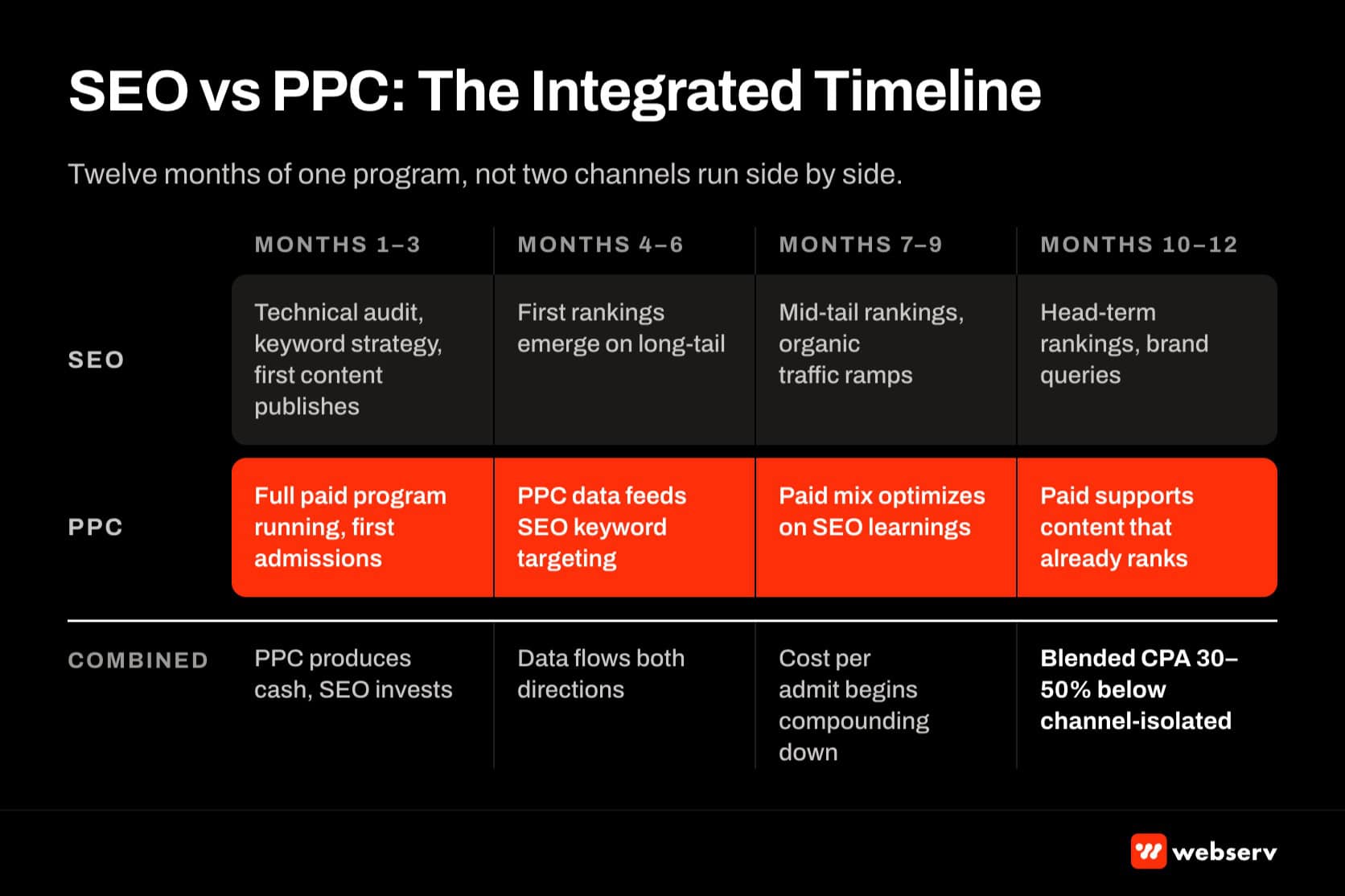
Cost trajectory (SEO front-loads work and back-loads cost while PPC does the opposite), speed to first result (PPC in hours, SEO in months), longevity of returns (SEO compounds, PPC stops the moment the budget stops), and audience precision (SEO targets by intent while PPC can target by intent plus demographics plus custom audiences).
For treatment centers specifically, the comparison also has to include the compliance constraint column. HIPAA applies to both channels. LegitScript applies specifically to PPC. YMYL editorial cost applies specifically to SEO.
42 CFR Part 2 restrictions on substance-use-disorder patient data apply to both channels but hit PPC audience segmentation harder than SEO content strategy. A facility running integrated SEO and PPC in behavioral health carries all of these constraints simultaneously and needs the campaign structure to respect each.
OPERATOR INSIGHT
In our client book, treatment centers running integrated organic and paid programs produce cost per admit ranges 30-50% below category average versus channel-isolated programs. The compounding effect is not marginal. It is the difference between a treatment center marketing program that scales cleanly and one that hits a ceiling at the compliance layer.
Should You Invest in SEO or PPC?
The honest answer for almost every service business at scale in 2026 is that this framing is the wrong question. Investing in one channel while ignoring the other is a legacy artifact of when the two channels lived in different agencies with different budgets.
The better framing: what percentage of your total search-funnel budget should sit in SEO versus PPC at the current stage of your marketing maturity?
A new facility with no organic authority should lean heavier on PPC in year one, invest in SEO in parallel, and shift the mix toward SEO as the organic authority compounds.
A facility with strong organic rankings can lean heavier on SEO for cost efficiency while running PPC as the brand-defense and top-of-funnel volume layer.
How to Integrate SEO and PPC Management for Maximum Results
Integration is where the compounding actually happens between organic search and paid media. The six specific patterns below are the ones we run across every client where both channels are active.
DEFINITION
Integrated SEO + PPC Management. The discipline of running organic search and paid search as one coordinated program with shared keyword strategy, shared conversion tracking, shared audience data, and shared executive reporting. In behavioral health specifically, integration also means shared compliance workflow (HIPAA on both, LegitScript on paid, YMYL editorial cost on organic) so the compliance overhead per channel drops instead of compounding.
Target Competitive Keywords with PPC While SEO Builds Authority
For keywords where the SEO opportunity is high but the domain does not yet rank, PPC buys the visibility while the organic authority compounds in the background. Once the organic rank clears position 3, the PPC spend on that specific keyword can be reduced or reallocated to the next target keyword in the SEO priority stack.
Retarget Organic Traffic with PPC
Users arriving from organic search have demonstrated topical intent. Retargeting them across display, YouTube, and Meta gives the brand a second and third impression that compounds the conversion probability.
In behavioral health, this retargeting must be HIPAA-safe (server-side, no PHI passed to ad platforms) or the compliance exposure eliminates the ROI.
Use PPC Ads to Test SEO Content Performance
New SEO content takes weeks to months to earn organic ranking, which is a slow feedback loop for content strategy.
Running PPC ads pointed at new content produces landing-page-level engagement data (bounce rate, scroll depth, time on page, conversion rate) within days. That data informs whether the content will earn organic traction once ranking builds and whether to invest additional content depth on the topic.
Establish SERP Dominance
For high-value queries where the domain ranks well organically, running PPC on the same query occupies additional real estate on the search results page.
Two placements (one organic, one paid) capture a larger share of clicks than either placement alone, especially on branded and semi-branded queries where the intent is high.
Build PPC Audiences Using SEO Traffic
Organic traffic patterns reveal audience segments that map to PPC targeting. Users who convert on the “residential treatment options” content cluster get built into a PPC audience for retargeting and lookalike expansion, feeding the PPC audience layer with data the platform cannot generate on its own.
Collect Keyword Conversion Intelligence
PPC produces immediate keyword-level conversion data. That data feeds directly into SEO priority: keywords that convert at high rates in PPC should be the SEO team’s top content targets, because the conversion signal is proven and the organic ranking cost per acquisition compounds down over time.
For behavioral health, this integration is amplified: SUD-specific and MH-specific keyword overlap between organic and paid is where the highest-intent audiences concentrate. Family-member queries (parent searching for adolescent treatment, spouse searching for opioid recovery) convert at rates several multiples above generic-vertical benchmarks in both channels.
6 Best Practices for Integrating SEO and PPC Management at Scale
Six discipline shifts differentiate treatment centers running integrated SEO and PPC from those running them as parallel channels. Three cover measurement (shared dashboards, unified reporting, shared keyword taxonomy); three cover campaign execution (HIPAA-safe tracking, weekly review cadence, landing page unification).
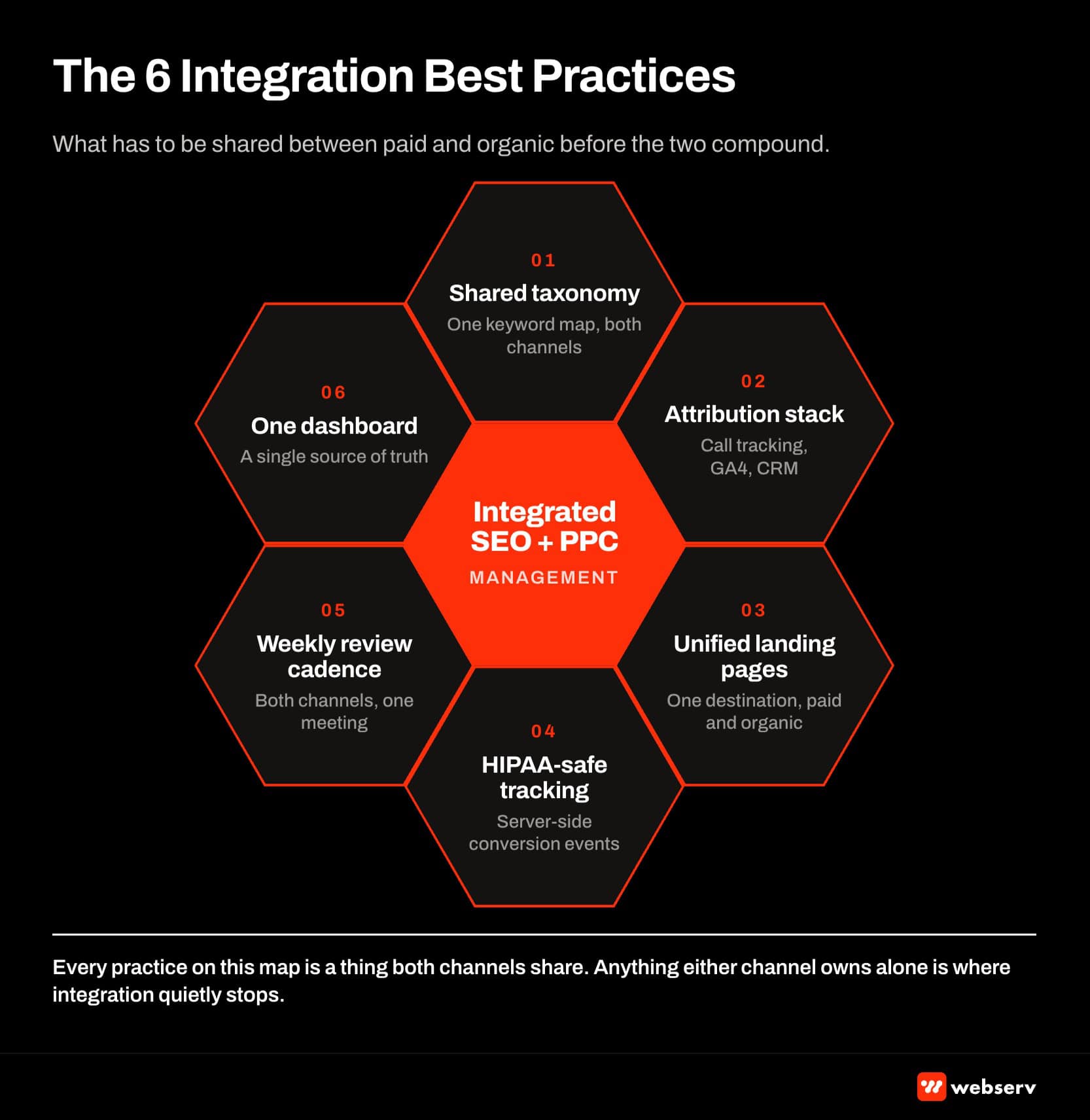
1. Use Shared Dashboards
Both SEO and PPC data belong in the same dashboard the marketing team reviews weekly. Splitting them across two separate reporting surfaces breaks the pattern-matching that produces the integration wins.
Looker Studio, Databox, or the treatment center’s own reporting stack all work as long as both channel data feeds render side by side.
2. Employ Unified Reporting
Unified reporting means the same conversion definition applies to both channels, the same attribution window applies to both channels, and the same performance metrics (cost per admit, cost per lead, revenue per user) are used across both.
Different definitions across channels produce reports that look like they contradict each other when they actually just measure different things.
3. Do Funnel Mapping
Funnel mapping means both channels contribute to a shared model of how users move from first touch through admit. SEO tends to dominate the early-funnel and comparison stages. PPC tends to dominate the decision and admit stages.
4. Use ROI-Based Keyword Prioritization
Keyword strategy for both channels should be ranked by expected ROI, not by search volume. High-volume keywords that do not convert are a waste of both budget and content investment. Low-volume keywords with high conversion rates deserve budget in both channels.
5. Think Conversion-First Design
Landing page design serves both channels. A page that converts well on organic traffic converts better on paid traffic too, because the intent signal is already stronger. Investing in conversion rate optimization on the landing page is one of the highest-value investments the marketing team can make.
6. Track HIPAA-Safe on Both Channels
For behavioral health specifically, all conversion tracking on both channels must be HIPAA-safe.
That means server-side conversion tracking (click-based Google Ads conversions sent server-to-server with enhanced conversions off, Meta’s Conversions API with the proper HIPAA safeguards), no PHI in ad platform events, and audience membership signals only rather than raw patient identifiers.
Google’s own Smart Bidding documentation covers how the platform’s machine-learning bidding actually uses the conversion data feeding it, which reinforces why the tracking discipline matters: garbage-in-garbage-out applies at the platform level.
Frequently Asked Questions
How do I find the right keywords to target for SEO and PPC?
Start with commercial-intent keywords where the search behavior signals a buying decision or high-value action. Tools like Google Keyword Planner, Ahrefs, and Semrush surface volume, competition, and cost-per-click estimates that inform prioritization for both channels.
For SEO, prioritize keywords where the domain has a realistic path to rank inside 6-12 months at the current authority level. For PPC, prioritize keywords where the conversion rate history (or projected conversion rate) justifies the cost-per-click on a cost-per-admit basis.
The integration play is to use PPC conversion data as the highest-quality signal for SEO priority. Keywords that convert at high rates in paid should be the SEO team’s top targets, because the conversion signal is proven and the organic acquisition compounds down over time.
Why isn’t my website ranking on Google even though I have content?
Publishing content is one input to organic ranking, not the whole equation. Ranking also depends on domain authority, technical SEO health, content quality and depth, on-page optimization, backlink profile, and (in YMYL categories) E-E-A-T signal strength.
A behavioral health site publishing content without clinical review bylines, medical reviewer verification, and evidence-based sourcing will rank poorly regardless of content volume. A generic-vertical site publishing content without technical SEO discipline (page speed, structured data, internal linking) will similarly underperform.
The fastest diagnostic is to audit the top 10 ranking pages for the target keyword and identify what they carry that your page does not. That gap analysis is usually more productive than publishing additional content into the same architectural weakness.
How do I know if my website content is actually working?
Track three signal layers. First, ranking position for the target keyword over time (rising ranks over 3-6 months mean the content is earning traction). Second, organic click-through rate and time-on-page (users are finding the content and engaging).
Third, downstream conversion (users who arrive from the content are converting on the primary action, meaning filling a form, booking an intro call, making an inquiry). Content that ranks and gets clicks but produces no conversions is a targeting problem, not a content problem.
For treatment centers specifically, admit attribution requires closing the loop between organic session and admit event via HIPAA-safe conversion tracking. Without that closing step, all upstream metrics are directional rather than definitive.
What does PPC management actually include?
PPC management includes keyword research and bid strategy, campaign structure design (search, display, video, shopping), audience segmentation, ad creative production and testing, landing page optimization, bid adjustment based on conversion data, negative keyword pruning, and ongoing performance reporting.
For behavioral health specifically, PPC management also includes LegitScript certification maintenance, HIPAA-safe conversion tracking implementation, 42 CFR Part 2 compliance across audience segmentation, and the additional creative review cycles that regulated verticals require.
The full-service PPC management engagement includes monthly (or weekly, at scale) executive reporting that ties spend to admit outcomes rather than just click and conversion metrics.
Should SEO and Google Ads work together or separately?
They should work together. Running them separately is a legacy artifact of when the two channels lived in different agencies with different budgets. When SEO and paid media operate inside a single marketing strategy, performance compounds across both.
Aligning market positioning with data alignment ensures campaigns reinforce each other rather than compete. Businesses in professional services see better lead quality and faster scalability when organic and paid visibility grow together on the same commercial-intent keywords.
For treatment centers, the compounding is amplified because both channels face the same compliance layers (HIPAA on both, LegitScript on paid, YMYL editorial cost on organic). Coordinated management reduces the compliance overhead per channel and produces a more defensible cost per admit.
Does SEO and PPC work differently for certain industries?
Yes. Regulated verticals like healthcare, legal, and financial services face additional compliance overhead on both channels that generic verticals do not. Behavioral health specifically adds LegitScript certification on the PPC side, HIPAA-safe conversion tracking on both sides, and YMYL editorial cost on the SEO side.
The core mechanics of both channels stay the same across industries. What changes is the compliance layer that sits on top and the cost structure that layer imposes. A treatment center running integrated SEO and PPC carries substantially higher operating cost per keyword than a generic-vertical advertiser, and the ROI framing has to account for the compliance-driven cost floor.
The compliance mistakes rehab Google Ads piece walks the specific traps behavioral health advertisers fall into on the PPC side.
How do I know if I need a specialist agency for integrated SEO and PPC?
Most treatment centers hit the specialist-agency threshold once monthly ad spend passes $10,000 or once organic ranking targets require competing against domains that have been investing in SEO for 3+ years. Below those thresholds, a generalist agency or an in-house marketing manager can often run both channels adequately.
Above those thresholds, the compliance overhead, the platform-specific expertise (Smart Bidding, HIPAA-safe conversion setup, LegitScript workflow), and the reporting integration usually justify the specialist premium. The right specialist agency also brings the pattern library from other treatment center clients, which shortens the learning curve compared to running both channels in isolation.
Scale Smarter with an Integrated SEO + PPC Management Strategy
Stop running paid ads and SEO in silos. Give us 15 minutes, and we’ll show you how search and paid media work together to produce predictable outcomes for your facility. Book an intro call with Webserv now.
Trevor Gage is Director of Marketing at Webserv, a behavioral health marketing agency and admissions ops platform working with residential, outpatient, and telehealth treatment providers across the United States. He leads Webserv’s integrated SEO and paid media strategy for treatment center clients running compliance-heavy admissions programs.