Most behavioral health operators are still optimizing local SEO for a search experience that already changed.
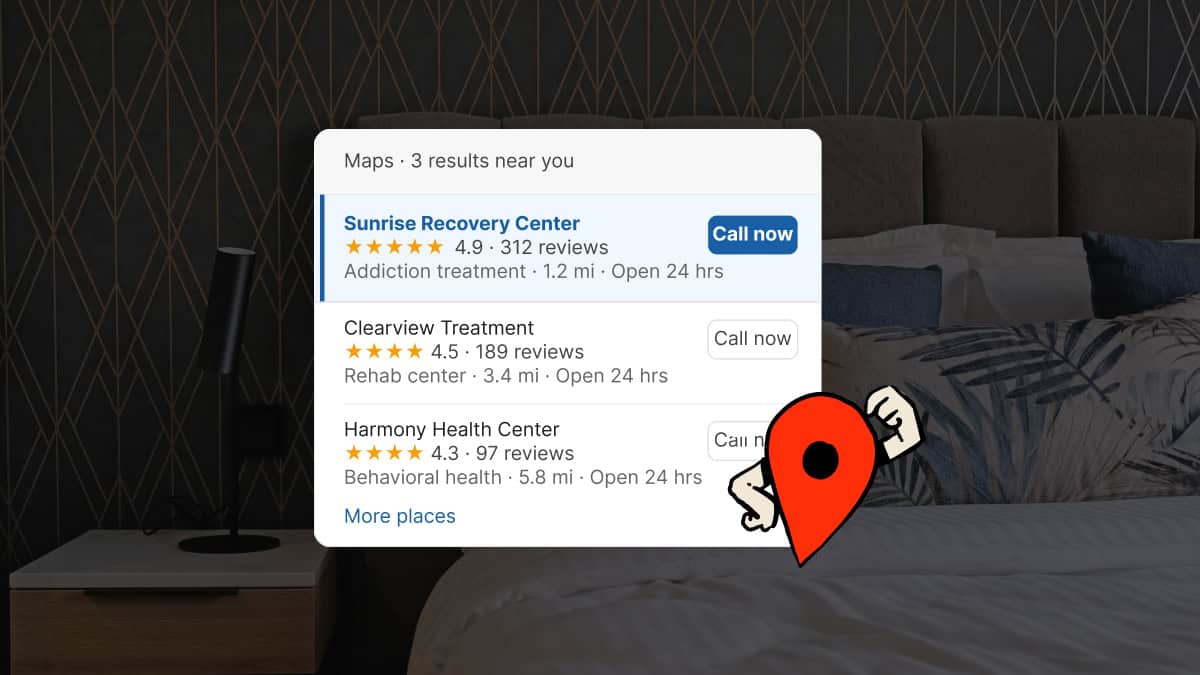
The local pack still exists. It still drives the bulk of bed-fill traffic for outpatient, detox, and any service where proximity matters. Patients searching “rehab near me” at 2am still see three listings, three star ratings, three call buttons.
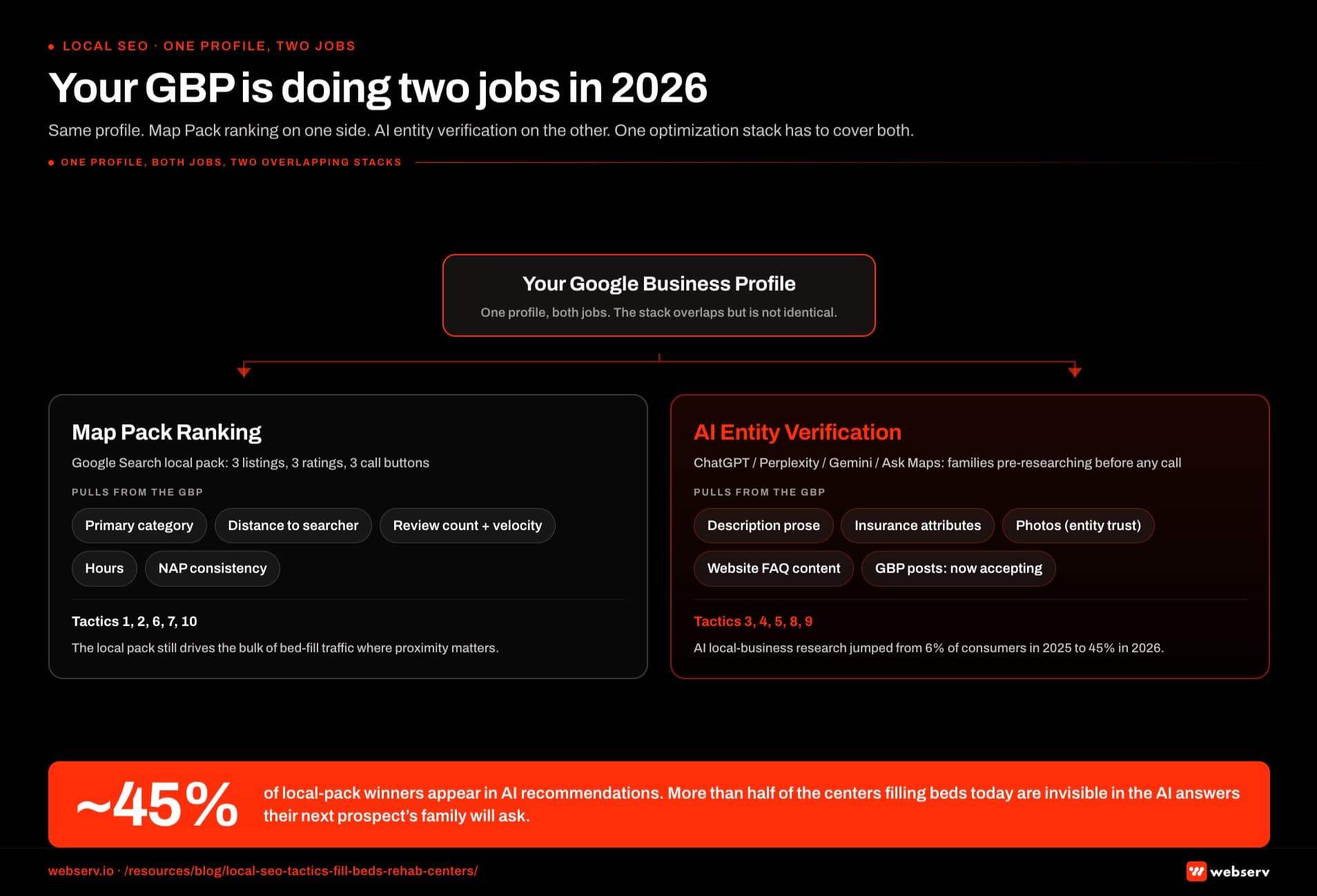
What’s different in 2026 is that the same GBP driving that map pack ranking is now doing a second job at the same time. It’s the primary entity-verification signal for ChatGPT, Perplexity, Google AI Overviews, Gemini, and Ask Maps. That dual role is also the reason SEO for treatment centers has stopped being a pure ranking exercise and started being a discovery-channel exercise.
Use of AI tools for local-business research jumped from 6% of consumers in 2025 to 45% in 2026. AI is now the third-most-used local discovery channel behind only Google and Facebook.
The split matters because the overlap isn’t tight. ChatGPT currently recommends about 1.2% of local businesses. Of the businesses ranking well in Google’s local pack today, only ~45% appear in AI recommendations.
More than half of the treatment centers filling beds today are invisible in the AI answers their next prospect’s family will ask.
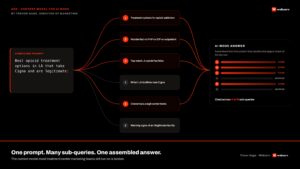
The math doesn’t work the way operators think it works. You can rank #1 in the map pack and still get cut out of the answer ChatGPT gives a parent at midnight when they ask “what’s the best rehab in [city] that takes Cigna.” The same GBP is doing both jobs. The optimization stack is slightly different. Most centers are doing about half of what they need to.
Trevor Gage, Director of Earned & Owned Media, Webserv
Key Takeaways
- In 2026 your GBP does two jobs at once: Map Pack ranking and entity verification for ChatGPT, Perplexity, Gemini, and Ask Maps. Only ~45% of local-pack winners appear in AI recommendations.
- The three 2026 shifts that drive most of this list: GBP Q&A is dead (replaced by Ask Maps), AI search is now a primary discovery channel for treatment-seekers, and Google added structured insurance attributes directly to GBP for healthcare categories.
- The first three tactics (primary category, hours that match admissions reality, and insurance-led description) are the highest-impact and lowest-cost. Most centers are still misconfigured at this layer.
- Review velocity overtook review volume as the dominant 2026 review signal. SMS review requests inside two hours of intake or discharge produce 3-4x higher response rates than 48-hour-delayed asks.
- The bed-fill arithmetic: a 10-bed gap at 60% vs. 85% occupancy on commercial payers averaging $45K/month is roughly $2.7M in annual revenue. Local search performance is one of the cleanest levers on that gap.
Why your Google Business Profile is doing two jobs in 2026
The 11 tactics below cover both jobs. Each one is calibrated for the bed-fill outcome, not the abstract “rank for everything” framing most local SEO content uses.
For the full technical framework that sits underneath these tactics, including algorithm pillars, citation tier strategy, and multi-location architecture, see our complete local SEO playbook for rehab centers. And if you’d rather have someone build and maintain this for you, see Webserv’s SEO service for treatment centers.
Three 2026 shifts drive most of what changed in this list.
GBP Q&A is dead. Google retired the public Q&A feature in late 2025 and replaced it with Ask Maps, a Gemini-powered conversational answer system that reads your website and reviews instead of submitted user questions.
AI search is now a primary discovery channel for treatment-seekers, not a secondary one. ChatGPT, Perplexity, and Gemini are how families pre-research facilities before any phone call.
Insurance is now displayed directly in Maps for healthcare categories. Google added structured insurance attributes to GBP in 2026. The data point patients care about most has its own field.
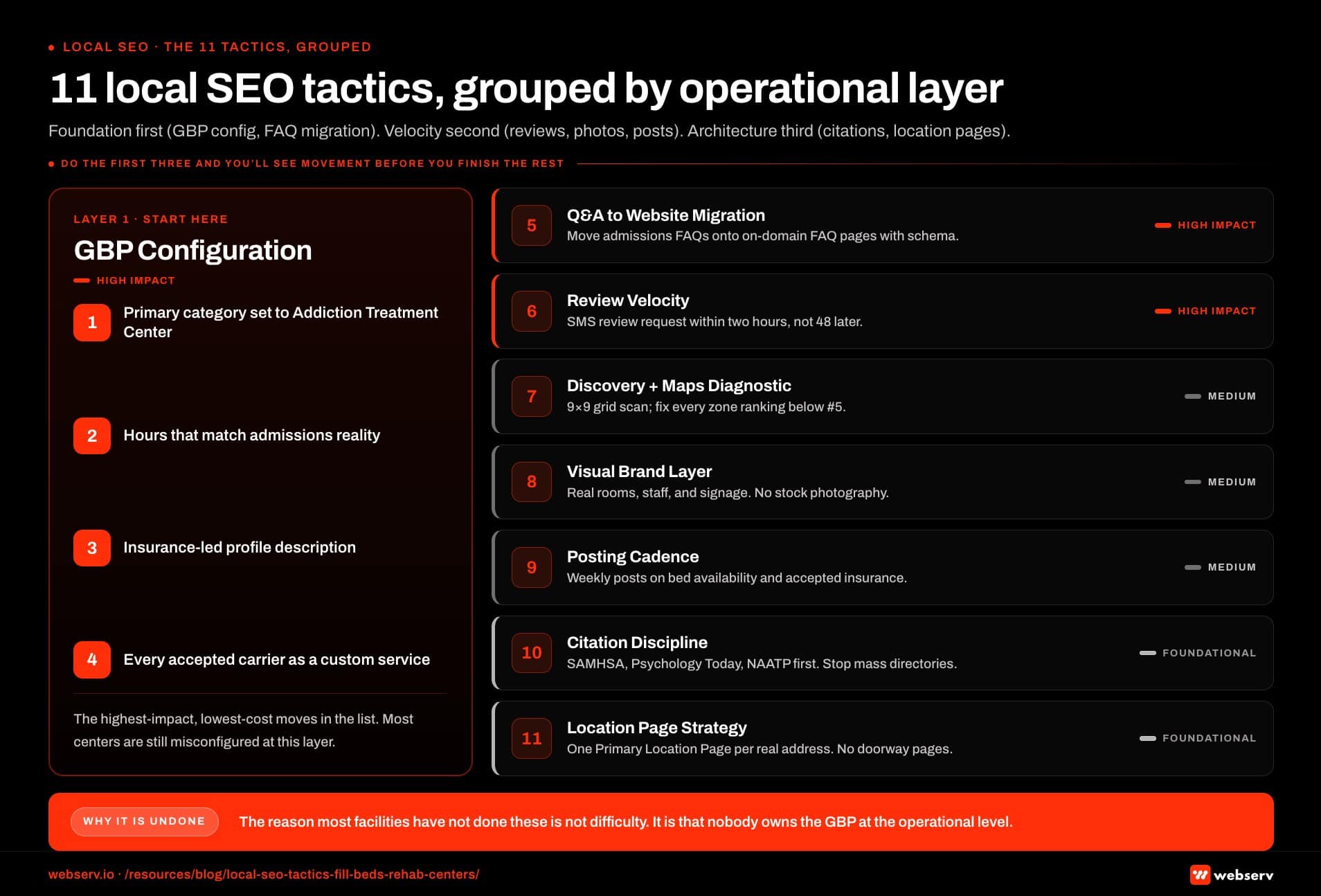
The tactics below run in priority order. Do the first three and you’ll see movement before you finish the rest.
1. Switch your primary category to “Addiction Treatment Center”
What we found: more than half of the BH facilities we audit have their primary GBP category set to something more general than “Addiction Treatment Center.” Common defaults are “Healthcare,” “Rehabilitation Center,” or “Mental Health Clinic” set as primary on a facility that does substance use treatment.
Why it matters: primary category is the single highest-impact GBP edit on Map Pack ranking. Google’s local ranking guidance names category relevance as one of the three core ranking factors alongside distance and prominence. It’s also how AI platforms classify your facility for recommendation. “Healthcare” tells Gemini you’re a generic medical provider. “Addiction Treatment Center” tells Gemini exactly what queries to surface you for.
Behavioral health-specific bed-fill outcome: patients searching “addiction treatment near me” don’t see facilities miscategorized as Healthcare in the pack at all. The category mismatch is filtering you out of the search before any other signal gets evaluated.
Fix: switch primary to “Addiction Treatment Center” if you provide substance use treatment, or “Mental Health Clinic” if you’re a pure mental health practice. Use up to 9 secondary categories to capture every accurate service (“Rehabilitation Center,” “Drug Addiction Treatment Center,” “Substance Abuse Treatment Center,” “Mental Health Clinic” if dual-diagnosis, “Medical Center” if you offer medically supervised detox).
Check: open your GBP in incognito mode, search for “addiction treatment near me” from your facility’s neighborhood, and confirm you appear. If you don’t, primary category is the most likely cause.
2. Match GBP business hours to your actual admissions hours
What we found: facilities advertising “24/7 admissions” on the website with GBP hours set to “Mon-Fri 9-5” or “Open: closed weekends.” The mismatch happens because the GBP was set up by an office manager working business hours, while admissions runs around the clock.
Why it matters: AI platforms penalize entities on conflicting data signals more aggressively than they used to. If your site says “24/7 admissions” and your GBP says you’re closed at 11pm, ChatGPT and Gemini either skip you in answers about late-night intake or surface you with a credibility caveat that drops conversion.
The patient-facing reality is worse than the AI signal. A family member calling at 11pm sees “closed” in your GBP and dials the next listing. The local pack itself filters you out for after-hours queries when your hours say you’re closed.
Fix: if you accept admissions calls 24/7, set GBP hours to “open 24 hours, all days.” If you have specific intake hours, list them honestly. Use the “More hours” feature to add separate hours for “Admissions” if your front desk closes earlier than your admissions line.
Check: GBP profile preview at 11pm and at 6am Sunday from a phone. The display should match the call coverage your admissions team actually provides.
3. Lead the GBP description with insurance accepted and admissions speed, not your mission
What we found: most treatment center GBP descriptions open with founding date, mission language, and clinical philosophy. “Founded in 2008, our compassionate team provides evidence-based treatment in a healing environment.” Then somewhere in paragraph two, eventually, payer information.
Why it matters: Ask Maps summarizes the description directly when generating answers. The first 250 characters are also what’s visible in the Maps listing without expanding. Patients in crisis don’t read mission statements. Their families read mission statements even less.
Insurance is the gating admissions question for 70%+ of inquiries. Lead with what answers it.
Fix: restructure the description to lead with admissions speed and insurance accepted. “Same-day intake. We accept Aetna, Cigna, Blue Cross Blue Shield, Optum, Humana, and most major commercial plans. Medical detox, residential, PHP, IOP, and outpatient care for substance use and co-occurring mental health conditions.” Then add mission and clinical philosophy in the remaining 500 characters.
Check: run the description through ChatGPT and ask “summarize this rehab in two sentences.” If the summary leads with mission and burying insurance, the description is misordered for AI consumption.
4. Add every accepted insurance carrier as a custom service entry
What we found: most facility GBPs list program-level services (Detox, Residential, PHP, IOP) and stop there. Insurance carriers get a buried mention in the description, if at all.
Why it matters: Google added structured insurance attributes to GBP in 2026 specifically for healthcare categories. Insurance accepted now displays directly in the Maps UI as a discrete data field, not buried in description copy. The structured-data shift mirrors how Google treats facility metadata in Schema.org’s MedicalBusiness vocabulary. Each attribute is its own queryable field, not free-text prose.
ChatGPT and Perplexity read these structured fields when answering “rehab that takes [insurance]” queries, which is one of the most common voice and AI search patterns in BH treatment-seeking. Voice queries especially trend toward payer-specific phrasing because parents and spouses know the insurance name before they know the facility name.
Fix: add each accepted carrier as a custom service entry. Aetna. Cigna. Blue Cross Blue Shield. Optum. Humana. UnitedHealthcare. Tricare if applicable. Each entry gets a 300-character description that names the levels of care covered for that payer where you have accurate detail.
Also populate Google’s structured insurance attribute fields if your dashboard surfaces them in your category.
Check: search “[your city] rehab that takes Cigna” or whichever payer is your highest-volume. If you’re not in the local pack and a competitor with worse general signals is, you’re missing the carrier-specific signal.
5. Move every admissions FAQ off GBP Q&A and onto your website
What we found: facilities that built years of curated GBP Q&A content under the old system are watching that content disappear, because Google retired the Q&A feature in late 2025. API support went away November 3. Public phase-out started December 3. The replacement, Ask Maps, ignores submitted questions and reads your website FAQ pages instead.
Many of the facilities we audit relied on GBP Q&A for the entry-level admissions content layer. Insurance, length of stay, what to bring, who answers the phone at 2am. That content layer is now invisible.
Why it matters: Ask Maps and the broader AI search ecosystem (ChatGPT, Perplexity, Gemini, Google AI Overviews) all pull from website FAQ content as a primary source. The Q&A authority you built on GBP is gone. The replacement signal lives on your own domain now.
Bed-fill outcome: every common admissions question that lives on a structured FAQ page on your site is a direct answer AI platforms can cite back to your facility. Every question you don’t answer on your site is one your competitor’s site does.
Fix: audit every common admissions question. Insurance accepted, levels of care, length of stay, what to bring, intake timeline, transportation, family visits, phone hours. Each question gets a clean answer on a website FAQ page or in service-page FAQ schema. Add FAQ schema markup so AI platforms parse the structure cleanly.
Check: run the most common admissions questions through ChatGPT, Perplexity, and Google AI Overviews using your facility name. If those AI tools don’t surface your answers, the FAQ work isn’t done.
How SoCal Sunrise generated 85 admissions and 2,297% ROI from SEO in 6 months
A ground-up SEO rebuild using the Pathfinder Parents Methodology turned an invisible online presence into a top-ranking admissions engine.
Read the case study →85 admits and 3,152 leads attributed to organic
6. Send the SMS review request within two hours of intake completion or discharge
What we found: most facilities that collect reviews send the request a week or two after intake or discharge, often through a clinical follow-up email. Response rates run 8-12% on that timing.
Why it matters: review velocity overtook review volume as the dominant 2026 review signal. A practice with 80 reviews getting 5 new ones per month outranks a practice with 300 reviews getting 1 per month.
Healthcare-specific research shows the two-hour SMS window produces 3-4x higher response rates than waiting 48 hours, and the gap widens past 48 hours. The patient or family member is most likely to respond when the experience is still immediate.
For BH specifically, HIPAA constraints make the review ask harder than retail. The compliant version asks for general feedback about the experience without referencing diagnosis, services received, or treatment specifics, and routes any clinical detail away from the public review channel.
Fix: trigger an SMS review request at the two-hour mark after intake completion or discharge. Use HIPAA-compliant copy that asks about the experience generally. For families, the request goes to the family contact, not the patient, with a softer cadence.
Check: total review velocity, not total count, in the GBP dashboard. Target five new reviews per month minimum. Track response rate by request timing if you can segment, and shift workflow toward whatever produces more responses.
7. Run a 9×9 grid scan and fix every zone where you rank below #5
What we found: facilities assume “ranking” for a local term is binary. They ask whether they’re in the pack and assume the answer is the same across their service area. It isn’t.
A 5-mile radius around any treatment facility breaks into an 81-square grid (9×9), and Map Pack visibility for the same query varies wildly across those squares. A facility might own the northern half of a city and be invisible in the southern half. The reverse is also common.
Why it matters: proximity to the searcher is approximately 55% of Map Pack ranking decisions. It’s the single biggest factor. Coverage gaps in your grid are bed-fill gaps in your service area.
The competitor filling the beds you should be filling is the one ranking #1 in the squares where you rank #6.
Fix: run a grid rank tracker (Local Falcon, BrightLocal, Whitespark) on your top 5 commercial keywords across a 9×9 grid centered on your facility. For any zone where you rank below #5, identify the strongest competitor in that zone and what they have that you don’t. Usually it’s review velocity, citation count, or a more specific category.
Check: quarterly grid scan. Coverage zones drift over time as competitors invest. The scan that’s right today is wrong in 90 days.
8. Replace stock photos with actual rooms, group spaces, clinical staff, and exterior signage
What we found: stock photography on treatment center GBPs is one of the most consistent issues we audit. Sterile generic medical settings, smiling actor families on porches, hands clasped around a coffee mug. None of which look like the facility.
Why it matters: AI platforms increasingly weight rich, specific imagery in entity-trust scoring. Google’s image AI detects generic stock photography and flags it as a low-trust signal. The same logic applies in ChatGPT and Gemini’s evaluation of which businesses to surface as trustworthy.
The patient-facing reality is the more important signal. Families deciding between three facilities click on the one whose photos look like a real treatment center, not a brochure. The room photo is the deciding moment more often than the description copy.
Fix: schedule a half-day photo session. Capture the exterior, the entrance and signage, common areas, group therapy rooms, dining space, outdoor areas, private rooms appropriate to share, and named clinical staff (with their permission and credentials displayed in captions). Upload at minimum 2-3 new photos monthly to maintain freshness signal.
For residential facilities especially, vertical short video (15-30 seconds) of a facility walkthrough or a clinician introduction generates higher engagement in GBP than photo carousels.
Check: open your GBP photos section. If anything in the first row looks like it could be on any other healthcare facility’s profile, replace it.
9. Post weekly to GBP about current bed availability or insurance updates
What we found: most treatment center GBPs have either no posts or posts focused on generic awareness content (recovery month, mental health awareness, holiday hours).
Why it matters: Ask Maps reads recent posts when generating “currently accepting” answers. Google rewards freshness more aggressively in healthcare YMYL than in retail because the underlying queries are time-sensitive (a patient deciding tonight whether to admit can’t use information from 18 months ago).
The bed-fill outcome is direct: posts about current availability and accepted insurance are exactly what answers the most common admissions decision questions. “PHP openings this week, accepting Cigna” outperforms generic recovery awareness content for the queries that close beds.
Fix: assign GBP posting to one person on the admissions or marketing team. Minimum cadence twice per month, target weekly. Mix post types: bed availability updates, accepted insurance changes, new program announcements, accreditation updates, named clinician introductions (“meet our new medical director”).
Keep posts under 1,500 characters with one image per post. Add a CTA button (Call, Learn More) tied to admissions intake.
Check: open your GBP and view the Posts section. If the most recent post is older than 60 days, you’re sending a “neglected listing” signal to both Google and the families clicking through.
10. Citation work on the trust trifecta first (SAMHSA, Psychology Today, Joint Commission), then stop
What we found: mass citation campaigns running on behavioral health sites with hundreds of generic directory submissions. Yelp, Yellow Pages, Manta, Foursquare, Hotfrog, the entire long tail of business directories.
Why it matters: three of the top five AI-visibility factors in 2026 are citation-based, but the weighting now strongly favors authoritative sources over directory volume. NAP consistency on SAMHSA, Psychology Today, the Joint Commission provider directory, and a small handful of other healthcare-authoritative directories matters more for AI citation than 200 generic submissions.
Mass citation campaigns actively dilute signal in YMYL verticals. They also create NAP inconsistency risk because every directory’s normalization rules are slightly different.
Fix: clean and verify your listings on the trust trifecta first. SAMHSA Treatment Locator, Psychology Today Therapy Directory, Joint Commission Quality Check for accredited facilities. Add a few high-authority secondary citations (Healthgrades, Vitals, FindHelp.org, your state DHS provider directory).
Stop the mass directory campaigns. If you’re paying for one, kill it. Audit existing directory listings for NAP inconsistencies and remove any that you can’t standardize.
Check: AI tools cite citations. Run “what is [your facility name] and where is it located” through ChatGPT, Perplexity, and Gemini. The sources cited should be authoritative healthcare directories and your own website. If they’re random citation aggregators, your citation portfolio is misweighted.
11. One Primary Location Page per real address. No exceptions
What we found: the “we’re 15 minutes from [neighboring city]” client request shows up at almost every multi-location operator we work with. Pages get spun up for cities the facility doesn’t have a physical address in. The pages rank for a quarter, then get classified as doorway pages and damage the entire domain.
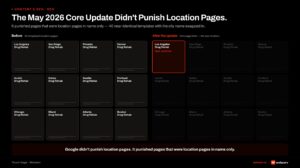
Why it matters: doorway-page classification risk under YMYL is at an all-time high in 2026. AI platforms specifically flag thin location pages targeting cities without real facilities as low-trust signals that hurt the entire domain. The same site that has one strong real-address location page and three “we serve [nearby city] too” pages gets penalized as a unit. It’s also the same dynamic that surfaces in our technical SEO fix list. Thin pages compound across the domain rather than failing in isolation.
Bed-fill outcome: losing the “we’re close to [city]” client request once protects every legitimate ranking the facility has. Holding the line on this rule is one of the most important things any agency can do for a multi-location BH operator.
Fix: one Primary Location Page per real, physical, treatment-delivering address. Period. When a client asks for a page targeting a nearby city, address proximity inside the real location page through copy (“located in [City A], serving clients from [City B] and surrounding areas”), driving directions, and admissions language about where clients commonly travel from.
The full workflow for handling this client request is in the Local SEO Playbook under multi-location architecture. The on-page assumptions also map to the keyword strategy framework we run on multi-location accounts.
Check: run a page-by-page audit. Any URL whose H1 or title targets a city you don’t have a physical address in goes on the kill list. Consolidate or 301 to the real-address parent.
The bed-fill arithmetic of doing this right
Let me end on a number.
Webserv’s admissions funnel benchmark across 200+ treatment center facilities runs roughly 250 impressions to 63 leads to 32 verified VOBs to 8 admits. Local search drives a meaningful share of those 250 impressions, especially for outpatient and detox.
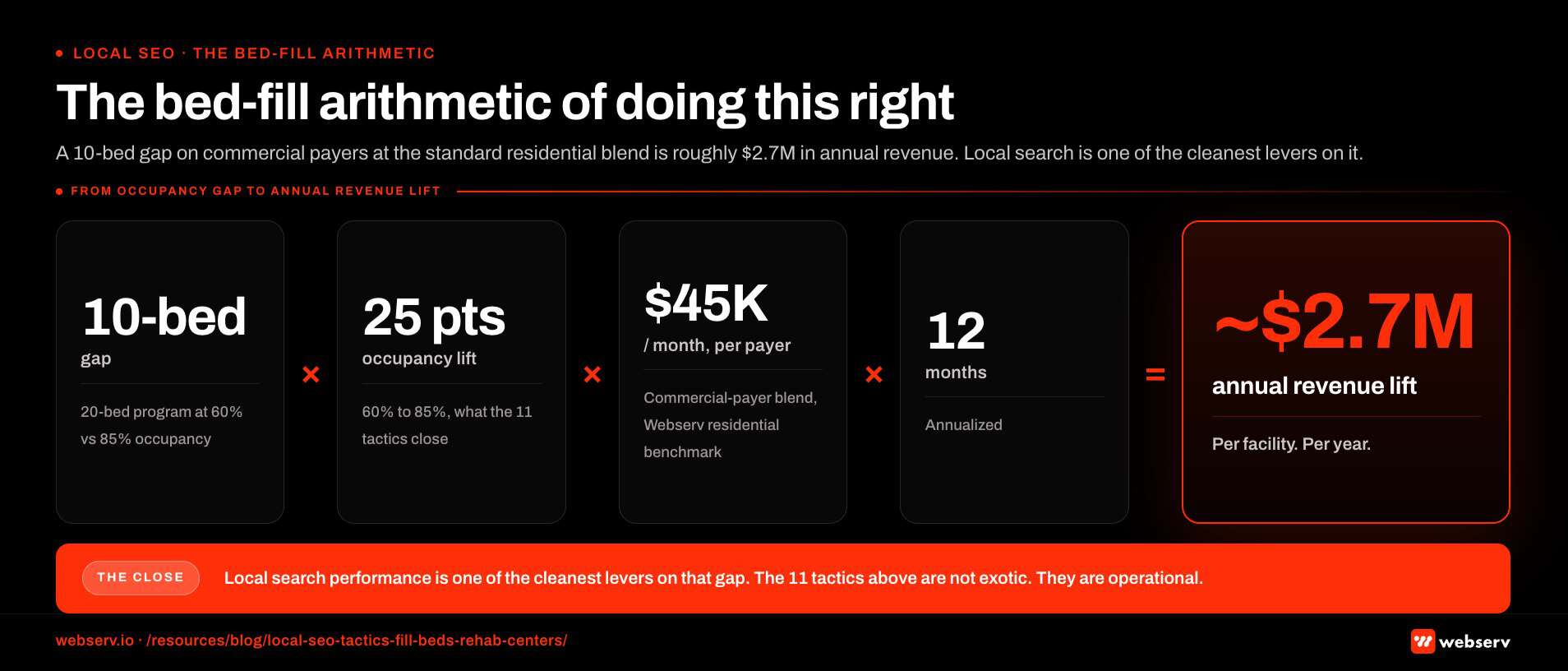
A 20-bed residential program at 85% occupancy on commercial payers averaging $45,000 per month does about $9M in expected annual net revenue. A 10-bed gap (occupancy at 60% versus 85%) is about $2.7M in annual revenue at the same blend.
Local search performance is one of the cleanest levers on that gap. The 11 tactics above are not exotic. They’re operational. The category switch is free. The hours fix takes thirty seconds. The description rewrite takes twenty minutes. The SMS workflow change takes a Tuesday afternoon.
The reason most facilities haven’t done them isn’t difficulty. It’s that nobody owns the GBP at the operational level. Marketing thinks it’s the agency’s job. The agency assumes someone in admissions is monitoring it. Nobody is.
The 1.2% AI recommendation rate and the 45% map-pack-to-AI overlap aren’t just stats. They’re a calendar. Every quarter where the GBP isn’t doing both jobs, the gap widens. The facility ranking #1 for “rehab in [city]” today and invisible in ChatGPT answers about [city] rehab is the facility that loses 5% of its bed-fill traffic to AI search next quarter, and 8% the quarter after.
If you want to know what’s specifically working against your facility’s local search performance, we run a local SEO audit as part of every new client engagement. Prioritized fix list returned before any retainer work begins, so you know what you’re working with before you commit a budget. Book an intro call and we’ll run yours.
Frequently asked questions about local SEO tactics for rehab centers
Which of the 11 tactics produces the fastest results?
GBP category alignment and business hours updates typically show map-pack movement within 7 to 14 days. The SMS-after-discharge review request produces the fastest sustainable lift because review velocity is one of the strongest local ranking signals and the tactic compounds month over month. The 9×9 grid scan with targeted fixes also produces fast results, usually within 30 days.
The slowest tactics are also often the highest-impact long-term. Insurance entries as custom services, location pages, and citation cleanup compound over 90 to 180 days but produce the most durable competitive moat. Programs that only chase the fast tactics miss the foundational work that makes the local position defensible.
The right sequence is foundation first (categories, hours, descriptions, citations), velocity second (reviews, photos, GBP posts), and architecture third (location pages, insurance entries, FAQ migration). Each phase builds on the previous one.
Do we need to do all 11 tactics to see meaningful local SEO improvement?
No, but the more you complete, the larger the cumulative lift. Most treatment centers see meaningful improvement from the first 4 to 6 tactics, with diminishing returns on the remaining tactics relative to the first ones. Programs starting from a baseline-poor local SEO position can move from outside the top 10 to top 3 in the map pack within 90 days by completing 5 to 7 of the tactics.
The compounding effect is real, though. Programs that complete all 11 tactics over 6 to 12 months produce a defensible local position that is hard for competitors to displace, even competitors who are well-funded and execute aggressively on a subset of tactics.
Prioritize by your current weakest signal. If your GBP is well-optimized but your review velocity is poor, focus on the review-driving tactics first. If your reviews are strong but your citations are inconsistent, focus on citation cleanup. The tactics that close your specific gaps produce more value than the tactics that reinforce your current strengths.
How long should we wait between deploying each tactic?
Most tactics can be deployed in parallel within the same week, with the exception of changes that affect Google Business Profile in ways that might trigger re-verification or suspension. For GBP-affecting changes (category, primary business name, business hours, primary address), deploy one change per week to avoid triggering Google’s automated review systems.
The waiting period for measurable signal is roughly 7 to 14 days per change for GBP-related tactics, 30 to 60 days for website-related tactics (location pages, FAQ migration), and 60 to 90 days for citation-related tactics (cleanup, new citations). The cumulative lift across all tactics typically shows in months 3 to 6 of the program.
Programs that deploy too aggressively on GBP-affecting changes sometimes trigger profile suspension. The recovery process is usually possible but takes weeks of evidence submission. We pace GBP changes deliberately for that reason.
Can these tactics work for a treatment center with no existing local presence?
Yes, with longer timelines. Programs starting from zero local presence (newly opened facility, never claimed GBP, no local citations, no reviews) typically need 6 to 12 months to build a competitive local position, versus the 90 to 180 days for programs starting from an established baseline.
The order of tactics is similar, but the foundation work takes longer. GBP creation and verification, initial citation building, and review program activation each take 30 to 60 days to start producing signal. The compounding effect kicks in around month 4 to 6 once those foundations are in place.
New programs should not skip the foundation work even when census pressure makes paid acquisition tempting. The local SEO foundation built in the first 6 months produces the lowest-cost admit channel for the program’s entire operating life. Skipping it means paying more for admits indefinitely.
How do we measure local SEO success beyond rankings?
The right local SEO success metrics are local-attributed admit volume, cost-per-admit from organic local sources, GBP-attributed phone calls and form submissions, and map-pack appearance share for primary target queries. Rankings are an intermediate metric; admits are the outcome.
Most treatment centers can build attribution from GBP source to admit using a combination of GBP Insights, call tracking with source attribution, form submission UTM tagging, and CRM tagging of inquiries by source. The infrastructure takes 2 to 4 weeks to set up and produces durable monthly reporting.
Programs that only track rankings often miss the local SEO value because rankings improve but admit attribution is unclear. Programs that build admit attribution from the start can defend local SEO budget against any operational scrutiny because the impact translates directly to census.
Should we run local SEO in-house or hire an agency?
The 11 tactics in this guide are operationally simple but cumulatively expensive on time. Most treatment centers under 50 beds can run them with a marketing manager who treats local SEO as a quarter of their full job. Programs above that size or programs in saturated competitive markets typically benefit from agency support, primarily for the photo refresh, citation audit, and grid scan workflows.
We publish our own ranking of the top addiction treatment SEO agencies with the methodology disclosed and Webserv at the top. The methodology can be re-weighted to emphasize local SEO depth specifically if that is the priority, which the article documents.
The risk with generalist local SEO agencies is the same risk we flag throughout this guide: they apply the local SEO playbook for any local business to a healthcare vertical that does not behave like one.
The perspective in this article comes from 9 years working exclusively inside behavioral health.
We are a team built by people in recovery who understand that behind every admission is someone asking for help. If that resonates, get to know us.
Trevor Gage is the Director of Earned & Owned Media at Webserv. Webserv works with behavioral health and addiction treatment centers on SEO, paid media, and full-funnel admissions strategy.