Chat is the conversion surface most treatment center sites quietly added over the last two years. A widget appeared on the homepage during a website refresh. A bot got activated as part of a Meta campaign. A messenger link got added to the footer.
Nobody audited the HIPAA implications because the tool marketed itself as easy to install and the compliance question never surfaced.
Chat widget HIPAA exposure is one of the least-audited compliance risks I see across treatment center sites. Our paid media team runs the audit as part of every paid engagement because chat sits inside the conversion pathway alongside paid landing pages and CRM handoff.
The pattern is consistent: roughly 70 percent of the treatment center sites we audit have chat widgets configured in ways that carry HIPAA exposure the operator has not documented.
The specific pattern that produces the exposure is that chat widget vendors do not lead their sales conversations with the HIPAA architecture. They lead with conversion improvement, response time, and integration ease. HIPAA becomes a footnote or an enterprise-tier upsell.
Operators install the widget on the marketing team’s approval, do not run the compliance audit, and find out about the exposure only when a HIPAA incident actually surfaces or when a legal review is triggered.
This piece walks the five categories of chat widgets treatment center sites run, the six specific HIPAA gotchas each category produces, the BAA requirements per platform tier, and the four-step implementation workflow that keeps chat widget deployment compliant.
It also covers the failure modes that undermine even well-intentioned chat implementations. It complements our HIPAA-compliant Facebook ads piece and our Meta Conversions API setup piece covering the server-side tracking layer.
Key Takeaways
- Chat widgets are the least-audited HIPAA exposure surface on most treatment center websites. Live chat platforms, AI chatbots, booking widgets, messenger integrations, and video chat embeds all carry BH-specific compliance considerations that generic chat widget marketing does not surface.
- The six HIPAA gotchas specific to chat widgets: PHI in transcripts stored by third-party platforms without a BAA, chat transcript emails routing PHI through non-BAA email systems, chat data enrichment via marketing tools without a BAA on the enrichment vendor, session recording tools capturing chat content, chat widget analytics leaking PHI to third-party analytics platforms, and AI chatbots trained on transcripts that include PHI.
- BAA availability varies dramatically across chat widget platforms. Some (Intercom, Drift, LiveChat) offer BAAs at their higher tiers. Others (Podium, Facebook Messenger, most WhatsApp implementations) do not offer BAAs at all for HIPAA-covered entities. Third-party chatbot builders (Ada, custom OpenAI implementations) require BAA verification on both the platform layer and the underlying model layer.
- The four-step implementation workflow keeps chat widgets deployable: platform selection with BAA verification before installation, data-flow restriction that keeps PHI out of surfaces without BAAs, chat script training that prevents PHI capture in the transcript, and quarterly audit of the full data flow against the BAA terms in effect.
- The single most common failure mode is a chat widget deployed by the marketing team without compliance review. The widget appears on the site, produces conversions, integrates with the CRM, and carries HIPAA exposure the compliance officer has never seen. Marketing-only deployment is the specific pattern that produces most of the chat widget HIPAA incidents we audit.
DEFINITION
HIPAA-compliant chat widget deployment. The set of platform, data-flow, training, and audit controls that keep chat surfaces on a treatment center website inside HIPAA coverage. Applies across five categories: live chat platforms (Intercom, Drift, LiveChat, HubSpot Chat), AI chatbots (Ada, Landbot, custom OpenAI/Anthropic), booking widgets with chat (Calendly, Chili Piper), messenger integrations (Facebook Messenger, WhatsApp Business, SMS via Twilio), and video chat embeds.
Distinct from generic chat widget deployment (where BAA is optional or absent) and distinct from HIPAA-covered EMR chat (which operates inside an already-covered clinical environment). The load-bearing controls are BAA verification before installation and data-flow restriction that keeps PHI out of any surface without BAA coverage. Marketing-only deployment without compliance review is the specific pattern that produces most BH chat widget incidents.
COMPLIANCE REALITY
BAA availability is almost always an enterprise-tier feature. Facilities running chat widgets at consumer or business tiers typically do not have BAA coverage even when the platform “supports HIPAA” at some tier. Intercom offers BAAs at Business plan. Drift at Enterprise. LiveChat at Enterprise. HubSpot Chat only via Enterprise Health Cloud. Podium, Facebook Messenger, and WhatsApp Business do not offer BAAs at any tier.
The specific gotcha we see most often: the facility believes it has coverage because the vendor’s website mentions HIPAA, but the BAA sits at a tier the facility does not subscribe to. Verify the specific plan tier before installation. If the platform does not offer a BAA at any tier the facility can deploy, select a different platform. Do not deploy first and audit later.
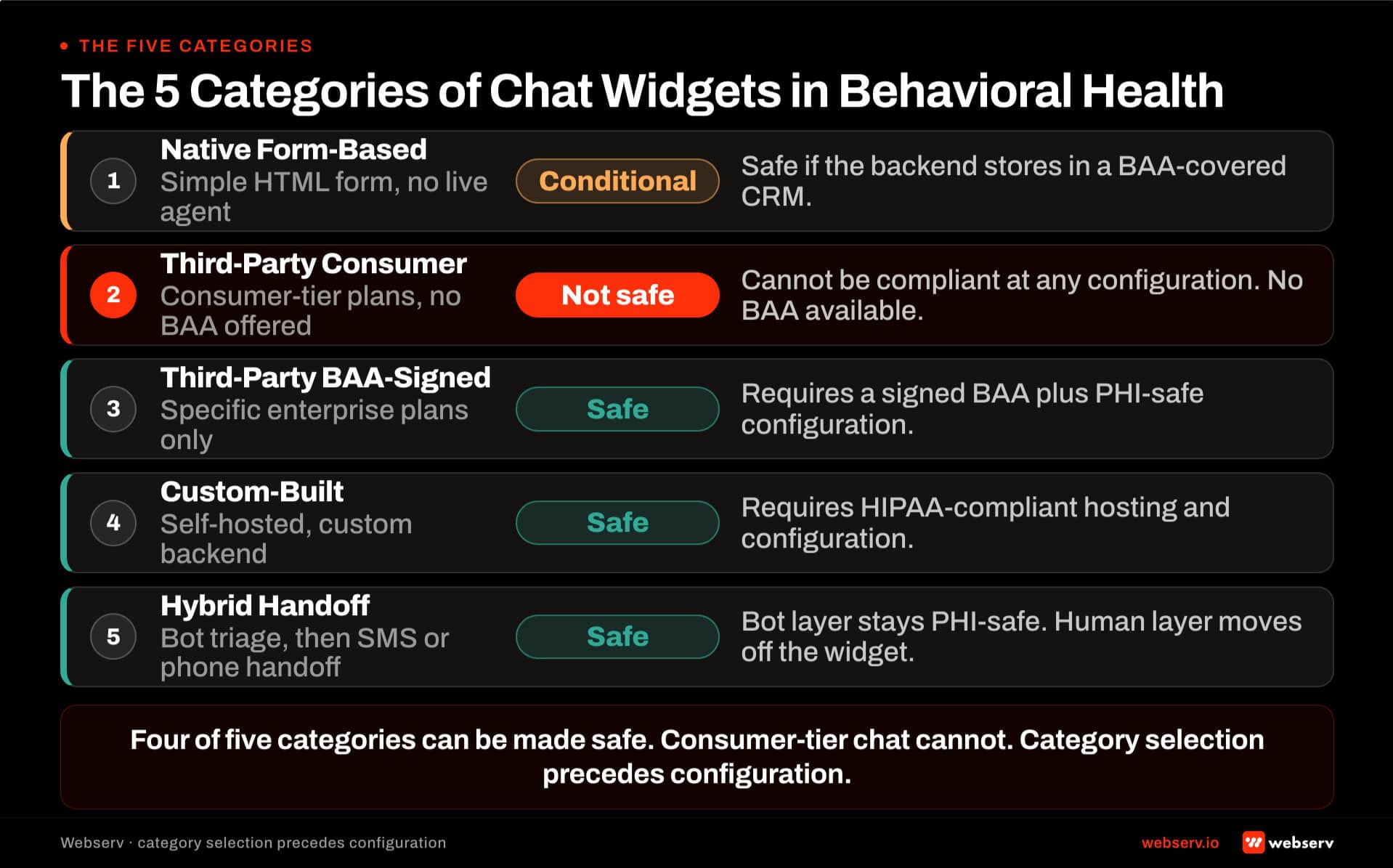
The five categories of chat widgets in behavioral health
Category 1: Live chat platforms
Intercom, Drift, LiveChat, HubSpot Chat, Tidio. A human agent (typically an admissions coordinator or marketing team member) responds in real time. Transcripts get stored on the platform. This is the highest-traffic chat category on treatment center sites and the category where PHI most commonly surfaces because families type freely.
Category 2: AI chatbots
Ada, Drift bots, Landbot, custom OpenAI or Anthropic implementations. An AI model generates responses without a human in the loop. Transcripts get stored on the platform and, depending on configuration, may feed model training. This is the fastest-growing chat category on BH sites and the category with the most complex HIPAA architecture because the platform layer and the underlying model layer both need coverage.
Category 3: Booking widgets
Calendly, Chili Piper, Nylas, custom scheduling embeds with inline chat capability. The primary purpose is scheduling, but the inline chat capability captures data during the booking flow. Booking widgets often carry PHI because families provide condition information during the scheduling step.
Category 4: Messenger integrations
Facebook Messenger, WhatsApp Business, SMS integrations (Twilio, MessageBird). The chat surface sits inside a third-party messaging platform rather than on the treatment center site directly. The site displays a “Message us” CTA that opens the third-party app. Data flows through the messaging platform outside the site’s HIPAA envelope.
Category 5: Video chat embeds
Zoom-embed widgets, Whereby integrations, custom WebRTC implementations. Less common on the entry point of the site but sometimes deployed for scheduled consultations. Video chat implementations carry the same recording and transcript exposure as voice chat plus the added complexity of PHI potentially visible in the video stream.
The six HIPAA gotchas specific to chat widgets
Gotcha 1: PHI in transcripts stored by third-party platforms without a BAA
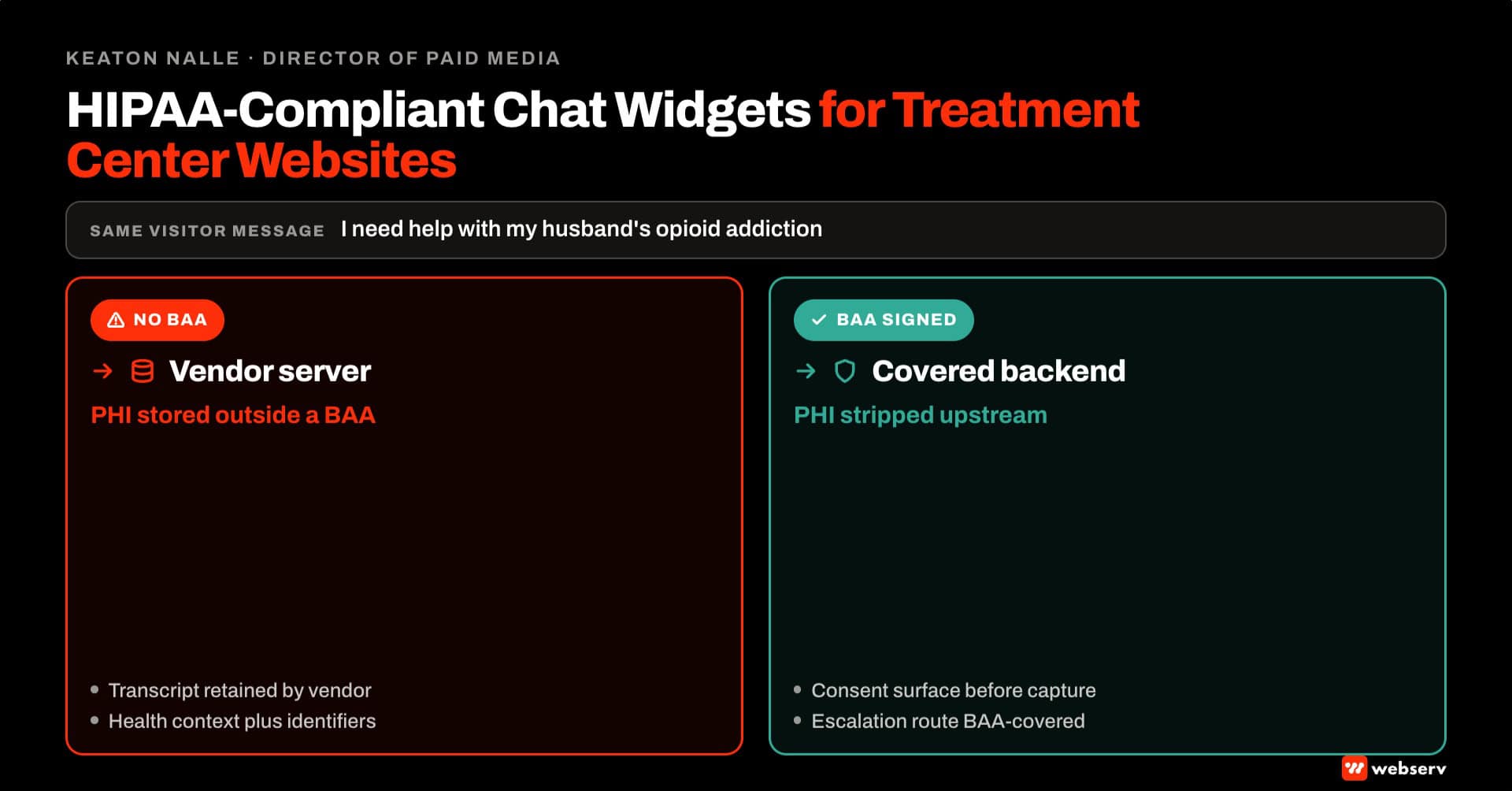
When a family types a message into a chat widget, the message flows through the platform’s servers before it reaches the treatment center’s team. The platform stores the transcript on its infrastructure. If the platform is not covered under a HIPAA BAA and the transcript contains PHI, the PHI is sitting on non-covered infrastructure.
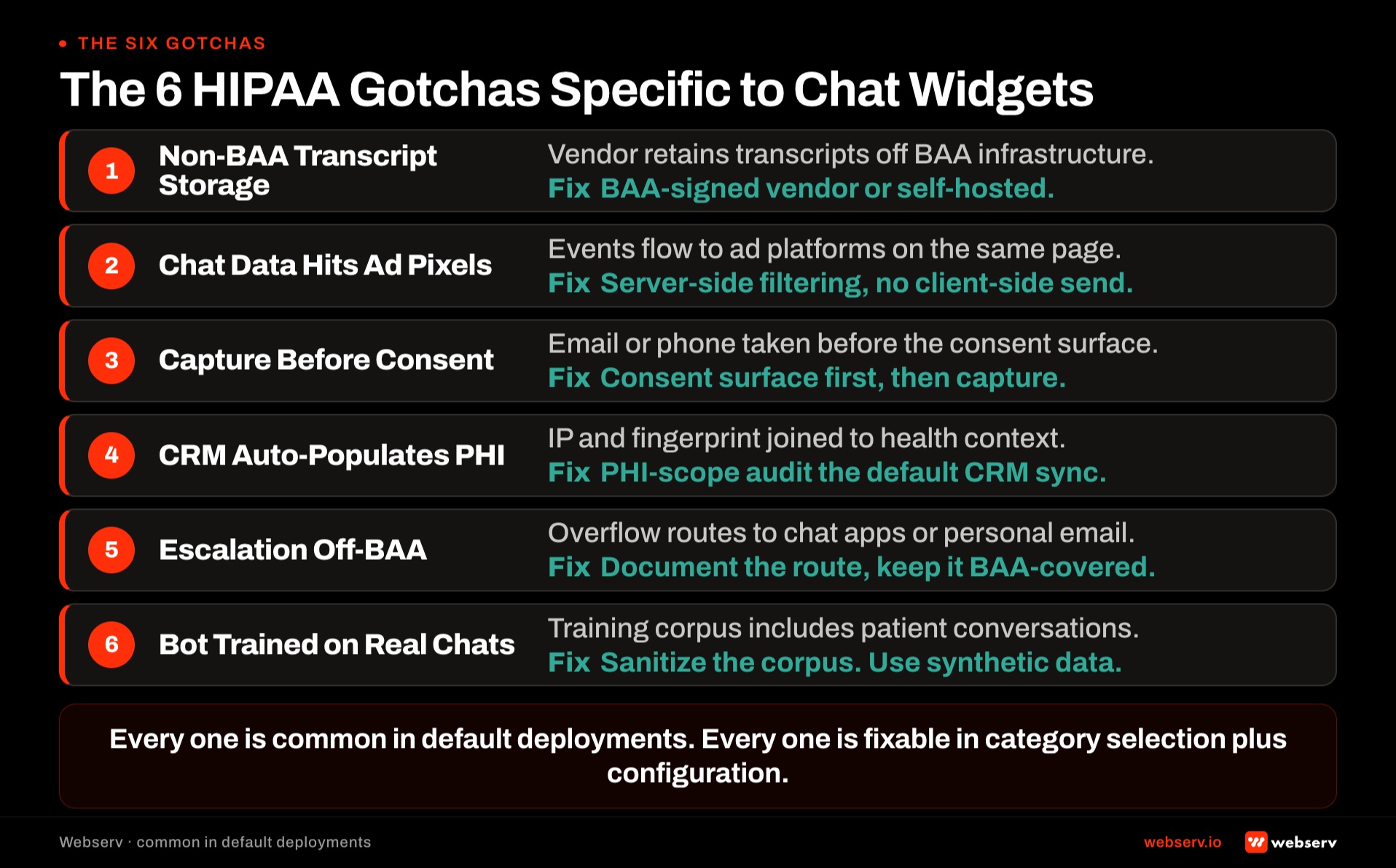
Prevention: BAA verification with the platform before installation. If the platform does not offer BAAs at the deployment tier being used, either upgrade to a BAA tier or replace the platform.
Gotcha 2: Chat transcript emails routing PHI through non-BAA email systems
Many chat platforms email transcripts to the treatment center admissions team automatically. If those transcripts contain PHI (which they usually do) and the receiving email system is a non-BAA general email (personal Gmail, non-BAA Google Workspace, non-BAA Microsoft 365), the transcript PHI is now sitting on non-covered email infrastructure.
Prevention: transcript delivery routing that keeps PHI inside BAA-covered email systems only. Enterprise Google Workspace and enterprise Microsoft 365 tiers offer BAAs. Standard consumer tiers do not.
Gotcha 3: Chat data enrichment via marketing tools without a BAA
Chat widgets often integrate with the CRM (HubSpot, Salesforce, Kipu CRM) to enrich the lead record with chat data. If the CRM does not have a BAA and the chat data being pushed to the CRM contains PHI, the enrichment is a compliance incident. HubSpot offers HIPAA coverage only at their Enterprise Health Cloud tier.
Prevention: CRM tier verification against BAA requirements before configuring chat-to-CRM integration. If the CRM is not BAA-covered, restrict the chat-to-CRM data flow to strip PHI before transmission.
Gotcha 4: Session recording tools capturing chat content
Hotjar, FullStory, Microsoft Clarity, and similar session recording tools capture visitor behavior including form fills and chat interactions. If the session recording captures PHI typed into the chat widget, that PHI sits on the session recording platform’s infrastructure alongside the primary chat transcript.
Prevention: exclude chat widget DOM elements from session recording capture. All major session recording platforms support DOM element exclusion via CSS selectors or data attributes. The parallel exclusion pattern applies to any HIPAA-adjacent form field on the site.
Gotcha 5: Chat widget analytics leaking PHI to third-party analytics platforms
Many chat widgets integrate with Google Analytics, Meta Pixel, and similar analytics platforms to track chat engagement events. If the analytics event payloads contain PHI (which happens when the chat message content is passed as an event parameter), the PHI flows to analytics platforms without BAA coverage.
Prevention: audit the chat widget’s analytics integration to confirm event payloads do not contain chat message content. Event parameters should include chat metadata (session ID, duration, outcome) only, never chat content. Our HIPAA-safe conversion tracking guide covers the parallel event-payload discipline for the broader analytics stack.
Gotcha 6: AI chatbots trained on transcripts that include PHI
AI chatbot platforms often use conversation transcripts to improve model performance. If the training data flow includes conversations that contain PHI and the training happens outside a BAA-covered environment, the PHI is entering training infrastructure that is not HIPAA-covered.
Prevention: audit the AI chatbot platform’s training data policy. Confirm that transcripts containing PHI are either excluded from training or that the training happens inside BAA-covered infrastructure. Some platforms offer HIPAA-tier configurations that exclude covered conversations from training pools.
The chat widget compliance surface at a glance
5
Categories: live chat, AI bot, booking, messenger, video
6
BH-specific HIPAA gotchas producing most chat widget incidents
~70%
Audited BH sites carrying chat widget HIPAA exposure the operator has not documented
4 steps
Workflow: BAA verify, data-flow restrict, script train, quarterly audit
BAA availability by platform
Chat widget platforms vary dramatically in their BAA availability for HIPAA-covered entities.
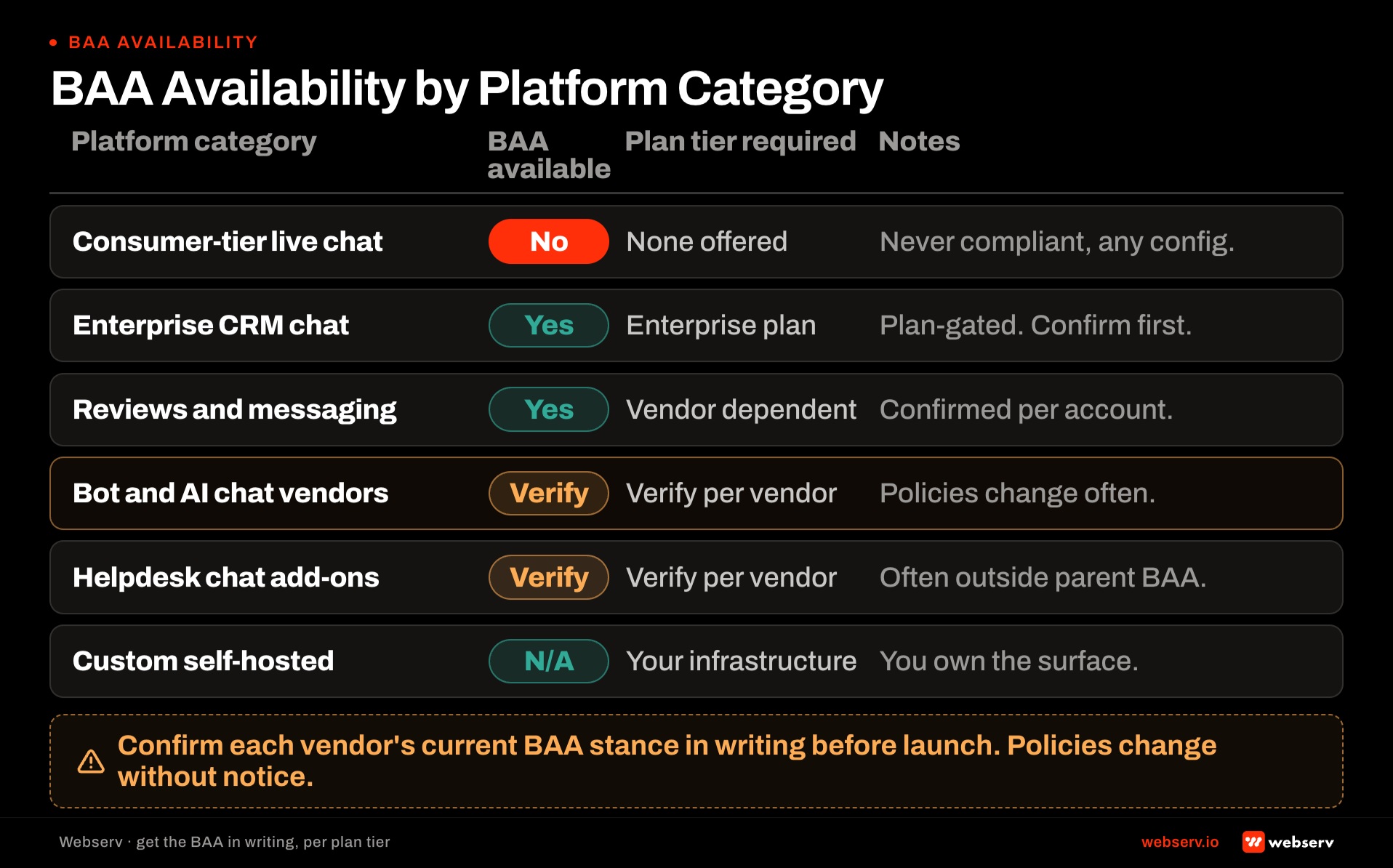
Platforms with BAA at higher tiers. Intercom offers HIPAA compliance and BAAs at their Business plan tier. Drift offers HIPAA compliance at their Enterprise tier. LiveChat offers HIPAA compliance at their Enterprise plan. HubSpot Chat offers HIPAA compliance only via HubSpot’s Enterprise Health Cloud configuration.
Platforms without BAA availability. Podium does not offer BAAs for HIPAA-covered entities as of current documentation. Facebook Messenger does not offer BAAs. WhatsApp Business does not offer BAAs for HIPAA-covered entities. Standard SMS integrations through Twilio require enterprise HIPAA configuration to be BAA-eligible.
AI chatbot layer. The chatbot builder platform (Ada, Landbot, custom implementations) may offer BAAs. The underlying AI model layer (OpenAI, Anthropic, Google Gemini) has its own BAA availability that has to be verified separately. OpenAI offers HIPAA compliance through their zero-retention API tier. Anthropic offers BAA coverage on their enterprise API. Google Gemini’s HIPAA coverage varies by deployment path.
Session recording layer. Hotjar offers HIPAA-compliant configuration at their Business tier with specific data flow restrictions. FullStory offers HIPAA compliance at their Enterprise tier. Microsoft Clarity does not currently offer BAAs for HIPAA-covered entities.
The general pattern: BAA availability is an enterprise-tier feature that adds meaningful cost. Facilities running chat widgets at consumer or business tiers typically do not have BAA coverage. Verifying BAA status before installation is the specific control that prevents downstream exposure.
The four-step implementation workflow
The workflow that keeps chat widget deployment HIPAA-compliant runs four steps.
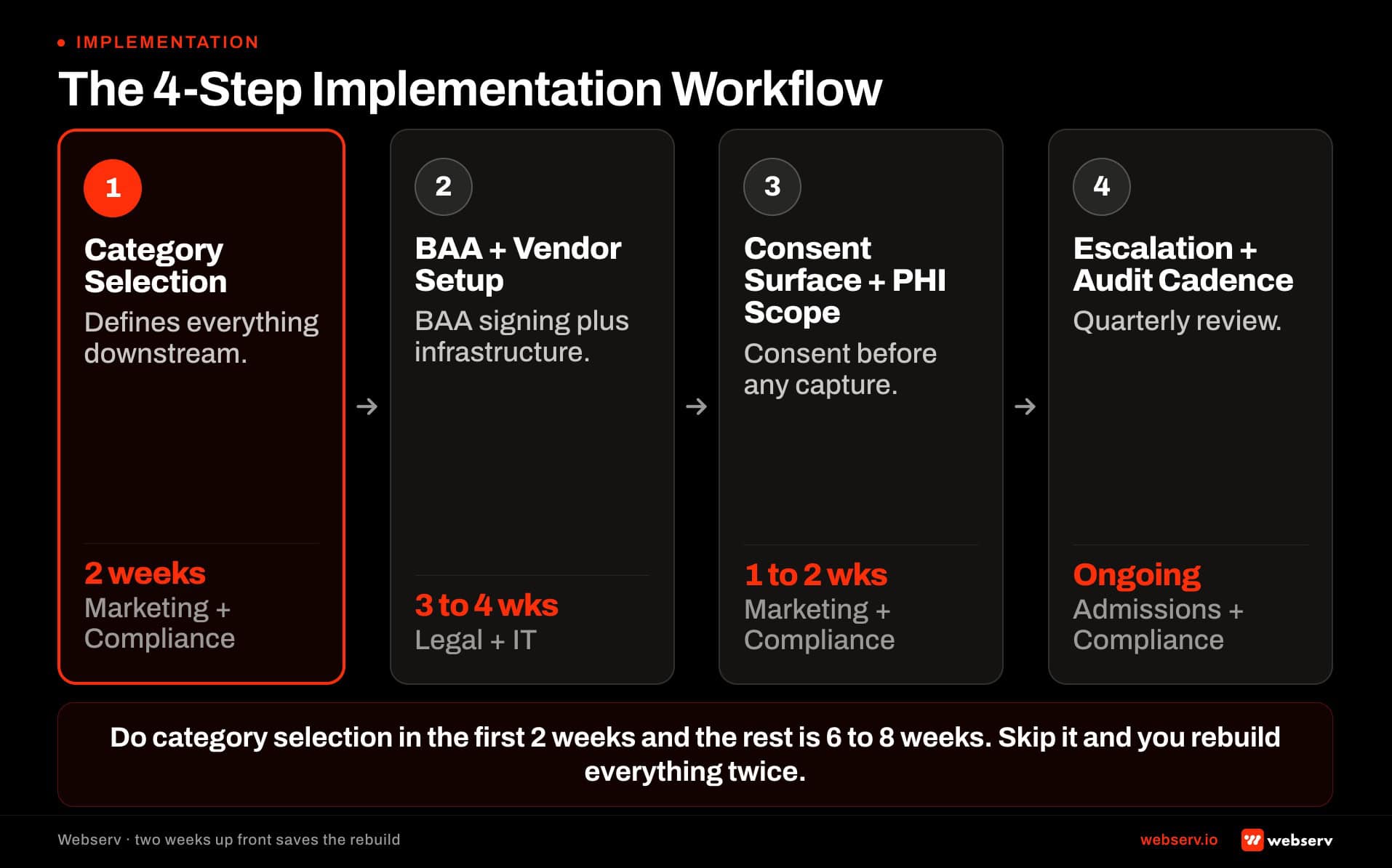
Step 1: Platform selection with BAA verification. Before any chat widget touches the site, verify the platform offers a BAA at the tier the facility can deploy. If the platform does not offer a BAA at any tier, or if the BAA tier exceeds the facility’s budget, select a different platform. Do not deploy first and audit later.
Step 2: Data-flow restriction. Map the specific data flows the chat widget produces: chat message content, transcript storage, email delivery, CRM enrichment, analytics events, session recording capture, AI training data. For each data flow, confirm the destination is BAA-covered. Where a destination is not BAA-covered, restrict the data flow to strip PHI before transmission or route the data to a BAA-covered destination.
Step 3: Chat script training. The admissions team or marketing team handling live chat needs specific training on what to type and what not to type. The pattern that works: do not type or ask for PHI in the chat itself. Route PHI-adjacent conversations to phone or to an authenticated intake form immediately. Train the team to recognize when a chat is heading into PHI territory and pivot to a covered channel. Our compliant ad headlines guide covers the parallel language discipline for ad copy.
Step 4: Quarterly audit of the full data flow. Chat widget platforms update integrations. Session recording tools change what they capture. AI chatbot vendors update training data policies. What was BAA-compliant at deployment may drift out of compliance over the next 12 months. A quarterly audit of the full data flow catches drift before it produces exposure.
DO
- Verify BAA at the specific plan tier the facility can deploy — not the platform’s marketing claim of HIPAA support. Enterprise-tier BAAs are common; consumer/business tiers rarely include them.
- Map every downstream data flow (transcript storage, transcript email, CRM enrichment, session recording, analytics events, AI training) and confirm each destination is BAA-covered.
- Exclude chat widget DOM elements from session recording capture via CSS selectors — Hotjar, FullStory, and Clarity all support this.
- Train the live chat team explicitly: do not type or ask for PHI in the chat window. Route PHI-adjacent conversations to phone or authenticated intake form immediately.
- Re-verify BAA status with every vendor annually — vendor terms change; a Business-tier BAA may move to Enterprise mid-contract.
DON’T
- Deploy chat widgets on marketing-team approval alone — this is the single most common pattern that produces undocumented HIPAA exposure.
- Use Facebook Messenger, WhatsApp Business, or Podium for PHI-covered conversations — none offer BAAs for HIPAA-covered entities.
- Pass chat message content as event parameters to Google Analytics, Meta Pixel, or other non-BAA analytics platforms.
- Assume the chatbot builder BAA covers the underlying model — the platform layer (Ada, Landbot) and model layer (OpenAI, Anthropic) require separate BAA verification.
- Route chat transcript emails to consumer Gmail or non-BAA Workspace — transcripts containing PHI must land in BAA-covered inboxes only.
Common failure modes
Failure mode 1: Marketing-only deployment. The chat widget gets installed on the marketing team’s approval without compliance review. The widget appears on the site, produces conversions, and carries HIPAA exposure the compliance officer has never seen. This is the specific pattern that produces most of the chat widget incidents we audit.
Failure mode 2: BAA at the wrong tier. The facility runs a chat widget on the platform’s standard tier assuming the standard tier is HIPAA-compliant. The BAA is available only at the enterprise tier. The facility believed it had coverage; it did not.
Failure mode 3: Chat-to-CRM integration without CRM BAA verification. The chat widget integrates with the CRM. The chat platform is BAA-covered. The CRM is not. PHI flows into the CRM without coverage. Common with HubSpot deployments running at non-Enterprise Health Cloud tiers.
Failure mode 4: Session recording capturing chat content. The facility runs both a chat widget and a session recording tool. Nobody audits whether the session recording captures chat content. It does. PHI typed into the chat flows into session recording infrastructure. Fix: exclude chat DOM elements from session recording via CSS selector.
Failure mode 5: Bot training on transcripts containing PHI. The facility runs an AI chatbot. The chatbot platform uses transcripts to improve its models. The training data flow was not audited. PHI enters model training infrastructure without HIPAA coverage.
Failure mode 6: Analytics event payloads containing chat content. The chat widget passes chat message content as an event parameter to Google Analytics or Meta Pixel. PHI flows to analytics platforms without BAA coverage. Fix: audit analytics event payloads to confirm chat content is not included.
Frequently Asked Questions
Do we need a chat widget at all on a treatment center website?
Depends on the conversion pattern. For residential and detox facilities where families arrive at the site in acute-need moments, phone-first conversion outperforms chat conversion. A well-configured phone-first CTA hierarchy typically produces 3 to 5 times the conversion rate of a chat widget on the same page.
For outpatient PHP and IOP facilities where families research over longer decision windows, chat conversion approaches phone conversion because the family is comfortable with asynchronous communication.
Facilities that deploy chat without a specific conversion hypothesis usually see chat as a leak surface rather than a conversion channel. Confirm the specific conversion case before deploying the widget, and be willing to remove the widget if the conversion pattern does not develop.
Which chat widget platform do you recommend for treatment centers?
Intercom Business tier or LiveChat Enterprise tier for facilities that want live chat with BAA coverage. Both platforms have mature HIPAA-compliant configurations, though both require the higher-tier subscription to access the BAA. Total cost typically runs $200 to $600 per month depending on seat count and volume.
For AI chatbot deployment, custom implementations built on OpenAI’s zero-retention API tier or Anthropic’s enterprise API produce the most defensible HIPAA architecture. Off-the-shelf AI chatbot platforms (Ada, Drift bots) require careful BAA verification because the platform layer and the model layer are separately covered.
For booking widgets, Calendly and Chili Piper both offer HIPAA-compliant tiers. Standard Calendly does not have a BAA; the Enterprise tier does.
Can we run a chat widget through Facebook Messenger?
Not for PHI-covered conversations. Facebook Messenger does not offer BAAs for HIPAA-covered entities. Any conversation on Messenger that includes PHI is happening outside HIPAA coverage. Our HIPAA-compliant Facebook ads piece covers the parallel Meta-platform framework.
The pattern some facilities run: use Facebook Messenger as an entry-point CTA that pivots to a secure channel immediately. “Message us on Facebook to start the conversation, then we will move to a secure phone call or verified email.” This works if the Messenger conversation itself never contains PHI, which requires discipline the team has to maintain.
The safer pattern: replace Facebook Messenger CTAs with phone-first CTAs on the treatment center site. Direct the Messenger traffic to your phone number rather than continuing the Messenger conversation.
What happens if we discover PHI has been sitting in a non-BAA chat platform?
Treat it as a HIPAA breach investigation. Document what data was exposed, when, and to what infrastructure. Notify legal counsel. Depending on scope (500 or more affected individuals triggers HHS OCR notification requirements), formal breach notification obligations may apply.
The remediation on the technical side: migrate to a BAA-covered platform, retrieve or delete the exposed data from the non-BAA platform (some platforms cooperate with retrieval requests, some do not), and document the remediation for future audits.
Facilities discovering historical chat platform exposure often find that the exposure runs back multiple years. The scope of the breach investigation can be significant. This is the specific reason to run the audit before deployment rather than after an incident surfaces.
How does the chat widget compliance workflow interact with our existing HIPAA training program?
The chat widget workflow adds a specific category to the existing HIPAA training. Admissions team members and marketing team members handling live chat need explicit training on what to type and what not to type in the chat window.
The training pattern that works: 30-minute session covering the six gotchas, the specific script patterns that keep PHI out of the chat, and the escalation pattern for conversations that start including PHI. Followed by monthly refresher check-ins for the first quarter, then quarterly refreshers ongoing.
Facilities that skip the training deploy technically-compliant chat platforms but produce PHI-in-transcript incidents because the team is not disciplined about what gets typed into the chat window.
How often do we need to re-verify BAA status with our chat platform?
Annually at minimum, though some vendors change their terms more frequently. Set a calendar reminder to pull the current BAA documentation from each chat platform, session recording platform, and analytics platform once per year and confirm the terms have not changed.
Vendor terms changes that affect HIPAA coverage happen regularly. A platform that offered a BAA at Business tier last year may have moved BAA availability to Enterprise tier. A platform that had a specific training data exclusion may have removed it. The annual re-verification catches these changes before they produce silent exposure.
Portfolio operators typically consolidate the annual re-verification into a single compliance calendar event alongside the other HIPAA vendor verifications (EMR BAA, billing vendor BAA, marketing platform BAA). The efficiency of the consolidated review typically produces better completion than facility-specific verification cycles.
Keaton Nalle is the Director of Paid Admissions at Webserv, a digital marketing agency for treatment centers.