A mid-size operator called our admission ops team six weeks into their EMR evaluation. They had demoed three platforms. Each vendor had told them the platform was purpose-built for behavioral health.
Each demo had looked polished. None of the demos had answered the operator’s actual question: which one fit their operation.
The question was not which EMR is best. The question was which EMR fit their clinical program, their coordinator team, their CRM stack downstream, and their integration budget. The three demos had never surfaced any of those variables.
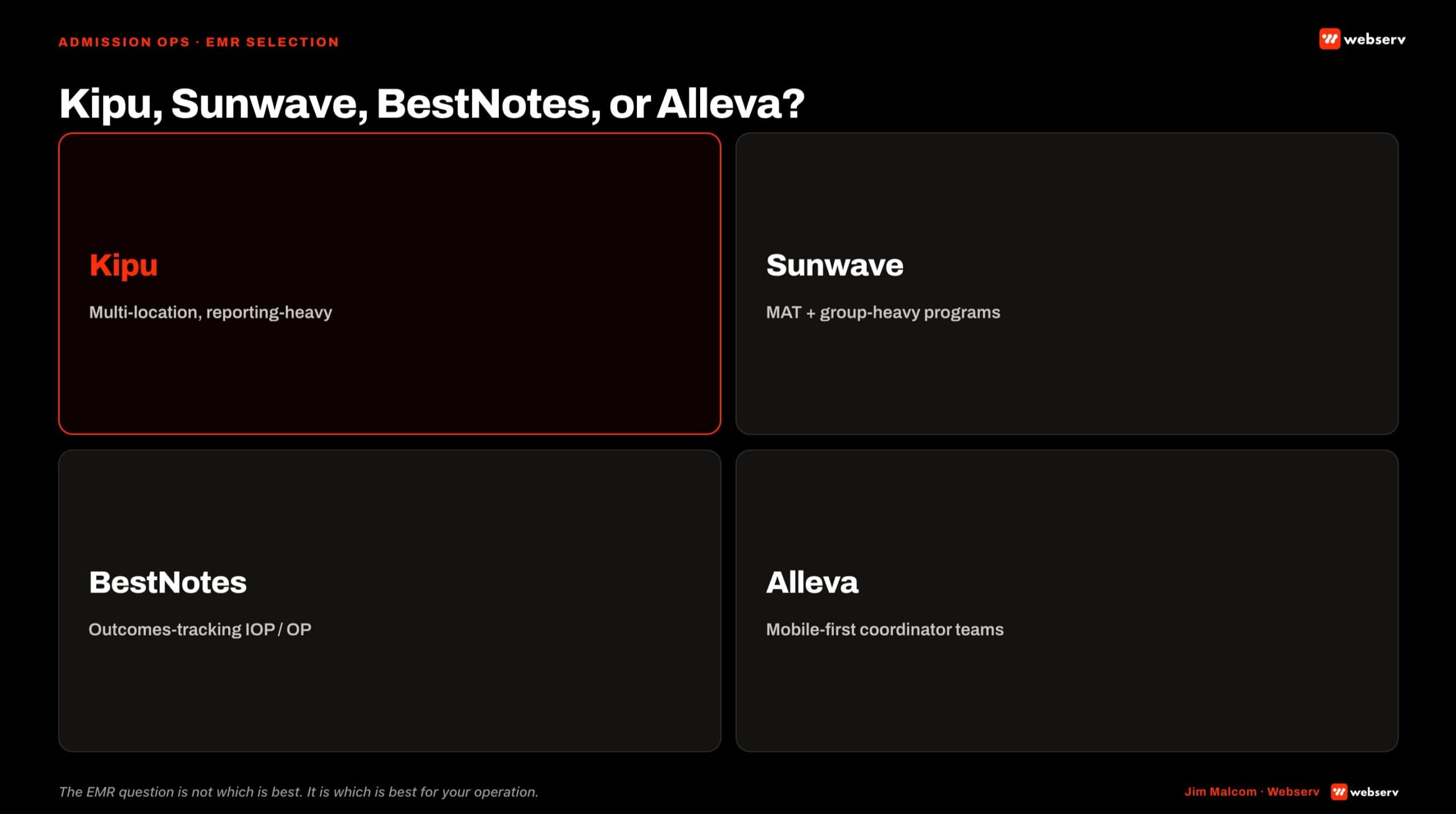
This piece is the decision framework we walked them through. Same framework applies to any behavioral health facility evaluating Kipu, Sunwave, BestNotes, or Alleva. Five questions that separate the platform-marketing pitch from the operational fit.
Disclosure: Webserv is a Dazos implementation partner. This article evaluates EMR selection independently. The same decision framework applies regardless of which CRM sits downstream. Kipu, Sunwave, BestNotes, Alleva, Dazos, Salesforce, and HubSpot are trademarks of their respective owners; use here is nominative and editorial only.
This piece is the EMR Integration sub-hub inside the broader Admissions Operations Complete Guide. The EMR decision sits under the four sub-disciplines the umbrella guide walks (Lead Management, EMR Integration, Billing/RCM, Attribution), and it is the choice that most directly shapes the operating layer around it.
Key Takeaways
- Behavioral health EMR selection is not a “which is best” question. It is a “which fits my operation” question. Kipu, Sunwave, BestNotes, and Alleva all work at different facility profiles. The vendor demos will not surface which one fits yours.
- Five questions decide it. Clinical focus. Coordinator workflow preference. CRM stack downstream. Outcomes-tracking depth. Integration budget. Answer honestly and the EMR choice usually narrows to one or two.
- Kipu fits broad-spectrum behavioral health with the deepest EMR feature set. Sunwave fits cloud-first outpatient operators with more built-in admissions functionality. BestNotes fits mental health and dual-diagnosis with outcomes measurement as core. Alleva fits mobile-first clinician teams and newer facilities.
- Integration architecture downstream is often more consequential than the EMR choice itself. Kipu integrates cleanest with Dazos through native connectors. BestNotes and Alleva lean middleware. Sunwave has a scoping decision (built-in intake versus downstream CRM) that Kipu and Alleva do not require.
- EMR migration is expensive. 60-120 days and $50,000 to $200,000+ fully loaded. Reconfiguring a well-fit EMR is usually the better decision than switching. The right selection at day one is where the compounding value lives.
- The specific migration failure mode to avoid. Picking an EMR based on the demo without walking the five-question framework. Every vendor demo looks polished. The demo is a marketing artifact. The operational fit surfaces during weeks 3-6 of implementation.
Why EMR Selection Is Different in Behavioral Health
General healthcare EMR selection is well-documented. Vendors like Epic and Cerner dominate the hospital and physician-group market with mature evaluation frameworks and RFP templates.
Behavioral health is different for three structural reasons.
Clinical workflow variance. SUD residential, mental health outpatient, dual-diagnosis IOP, and adolescent PHP all have materially different clinical workflows. An EMR that fits one program well can be a poor fit for another.
The BH EMR market has specialized into distinct platforms specifically because “one EMR for all BH” does not work.
Integration surface with admissions. BH treatment centers run heavier admissions and marketing operations than most healthcare providers. The EMR-CRM integration is load-bearing in a way it usually is not at a hospital or physician group.
EMR selection has to account for the CRM stack the facility runs or plans to run.
Compliance layer. Behavioral health data is subject to 42 CFR Part 2 in addition to HIPAA. Every EMR in the BH market handles this at varying depths. General healthcare EMRs often do not handle Part 2 well without heavy customization (SAMHSA, National Survey of Substance Abuse Treatment Services).
The result. Behavioral health has its own EMR ecosystem, its own selection framework, and its own set of failure modes that general healthcare evaluation frameworks do not surface. This piece is that framework.
The 5-Question Decision Framework
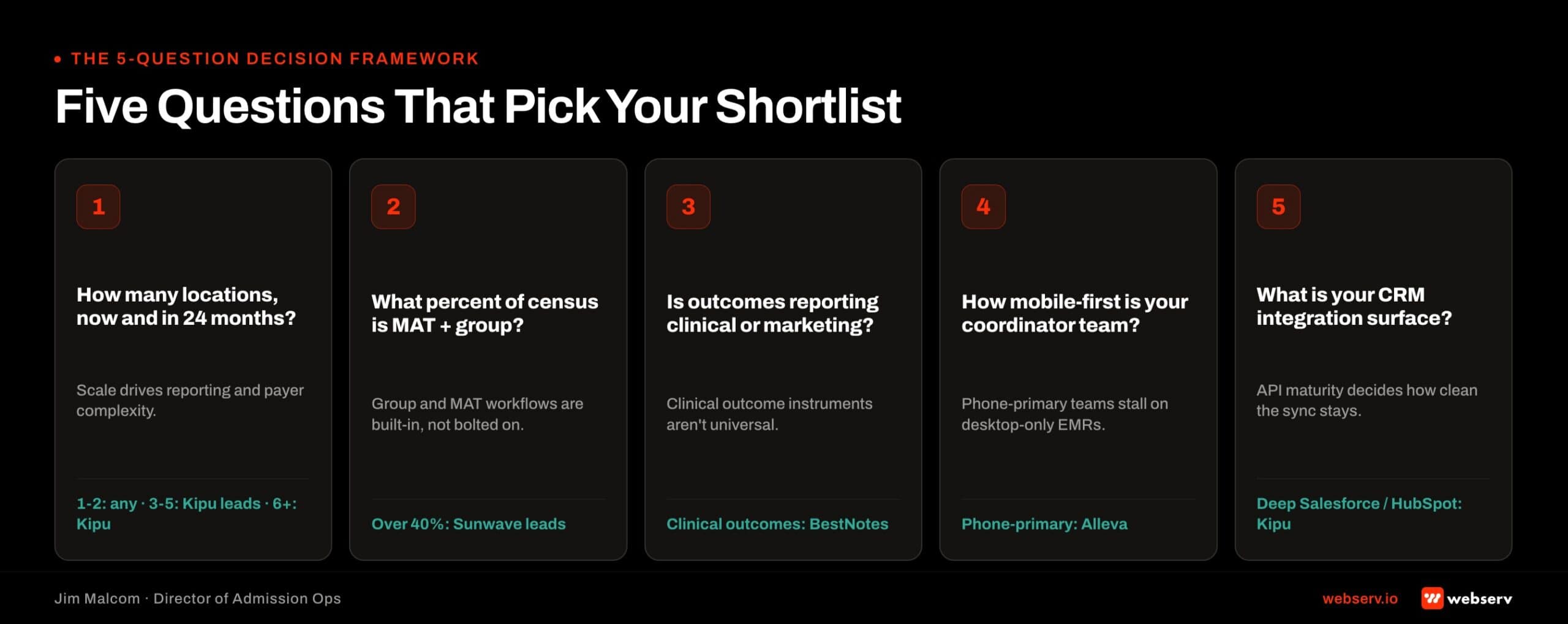
Five questions. Answer honestly. If three or more answers point clearly to one EMR, that is the platform to shortlist first.
Question 1: What is the clinical focus of your program? SUD residential. Mental health outpatient. Dual-diagnosis. Adolescent programs. Specialty populations. Each has a different EMR fit.
Broad-spectrum BH with SUD focus usually fits Kipu. Mental health and dual-diagnosis usually fits BestNotes. Cloud-first outpatient usually fits Sunwave. Mobile-first clinician teams usually fit Alleva. These are starting points, not prescriptions. Program specifics matter.
Question 2: What is your coordinator team’s workflow preference? Desktop-anchored function-dense workflows suit some teams. Mobile-first documentation suits others. Cleaner-UI cloud-native workflows suit teams starting fresh. Assessment-heavy workflows suit measurement-based-care programs.
Kipu is function-dense and desktop-anchored. Sunwave is cloud-native with a cleaner UI. BestNotes is assessment-heavy. Alleva is mobile-first. Match the workflow preference to the team you have or are building.
Question 3: What CRM sits downstream? Dazos integrates cleanest with Kipu through native connectors and reasonably well with the other three. Salesforce and HubSpot require middleware regardless of EMR. This changes the total cost of ownership calculation and the integration risk profile.
Facilities running Dazos have more EMR flexibility. Facilities running Salesforce or HubSpot with a middleware layer already in place should factor that middleware maturity into the EMR decision. Facilities greenfielding both EMR and CRM should evaluate the pair together.
Question 4: How important is outcomes tracking to your operating model? If measurement-based care and completed-treatment outcomes drive clinical decisions and marketing calibration, BestNotes has the deepest built-in outcomes layer.
If outcomes tracking is a nice-to-have or a compliance requirement rather than a core operating metric, Kipu, Sunwave, and Alleva all support outcomes tracking as configuration. The depth is genuinely different across the four EMRs, and this variable is the one facilities most often underweight in evaluation.
Question 5: What is your integration budget over three years? Every EMR-CRM integration has an ongoing cost. Native connectors are cheapest. Middleware is more expensive over time. Custom connectors are most expensive.
Kipu-Dazos native integration is the lowest-cost architecture available today. Middleware architectures (Sunwave, BestNotes, Alleva with any CRM; Kipu with Salesforce or HubSpot) run $500 to $2,000 per month in middleware fees plus maintenance overhead. Factor this into the three-year total cost of ownership.
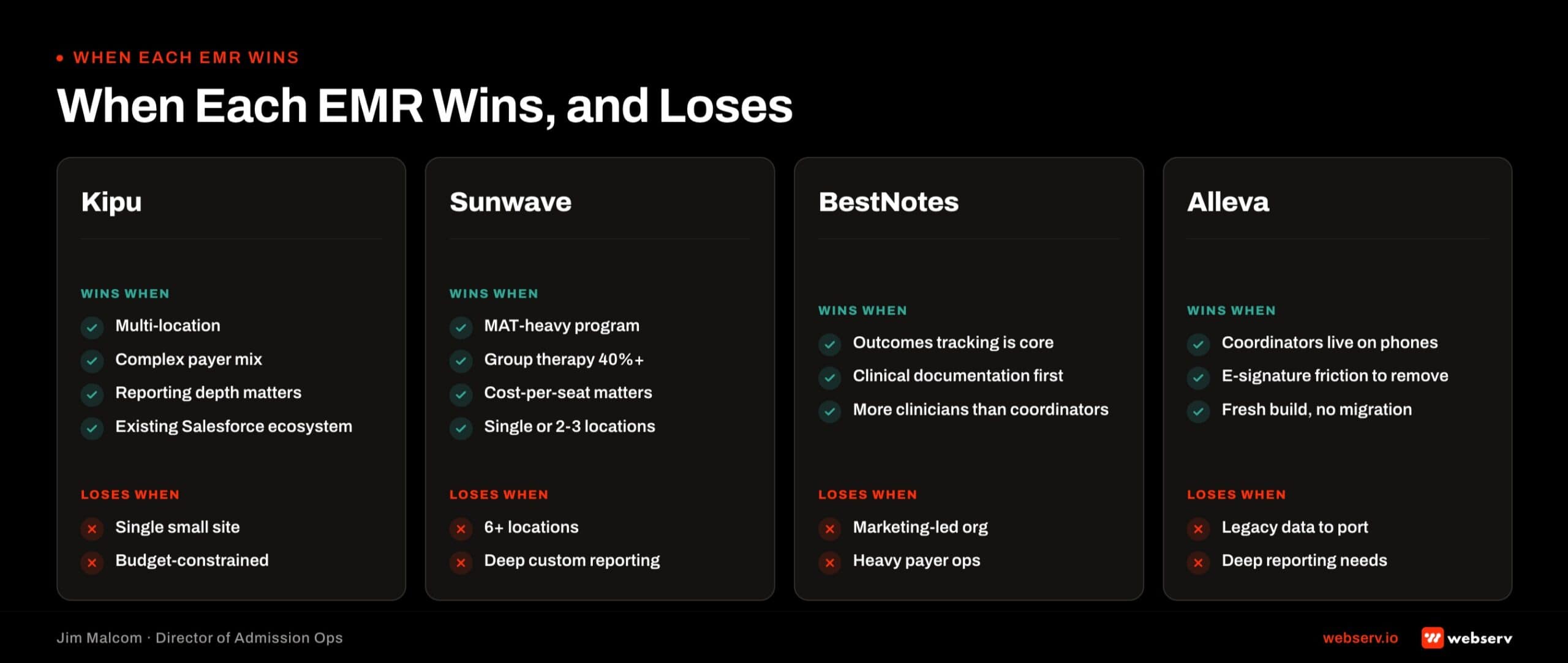
Kipu
Multi-location, complex payer mix, reporting-heavy. API depth + HL7 + custom report engine. Wrong pick for single-facility under 40 admits/mo.
Sunwave
MAT-heavy, group therapy, 2-3 locations. Native group scheduling + MAT dosing. Wrong pick for outcomes-tracking-first ops.
BestNotes
IOP + outpatient with outcomes measures. Clinician-facing UX + strong documentation. Wrong pick for admissions-workflow-first ops.
Alleva
Mobile-first coordinator teams. Native e-signature + faster onboarding. Wrong pick for multi-location with complex payer reporting.
When Each EMR Wins
Three or more yeses on any of the profiles below usually points at that EMR.
Kipu wins when. Clinical focus is broad-spectrum BH with SUD residential in the mix. Team prefers function-dense desktop workflows. Downstream CRM is Dazos or a well-integrated Salesforce. Outcomes tracking is nice-to-have rather than core. Integration budget prioritizes low-cost native connectors.
Sunwave wins when. Clinical focus is outpatient and cloud-first. Team prefers cleaner cloud-native UI over function density. Downstream CRM is Dazos or the facility wants to run Sunwave’s built-in intake as the system of record. Outcomes tracking is nice-to-have. Integration budget accepts middleware for non-Dazos CRMs.
BestNotes wins when. Clinical focus is mental health, dual-diagnosis, or measurement-based care programs. Team is comfortable with assessment-heavy workflows. Downstream CRM has middleware capacity. Outcomes tracking is a core operating metric that drives clinical decisions and marketing calibration. Integration budget accepts middleware layer for the outcomes-tracking advantage.
Alleva wins when. Clinical focus is a newer facility or program open to modern workflows. Team is mobile-first and documents on iPads or phones as primary interface. Downstream CRM has middleware capacity. Outcomes tracking is nice-to-have. Integration budget accepts middleware and slightly less mature ecosystem.
Facilities that come out of the framework with a clear one-EMR fit should go with that EMR. Facilities that come out with two viable candidates should demo both against the specific coordinator team who will use the platform daily, not against the executive who signs the contract.
Vendor Deep Dives: What Each EMR Is Actually Built For
The comparison matrix above tells you where each EMR sits relative to the others. What it does not tell you is what each vendor is actually built for at the DNA level.
That layer matters, because behavioral health EMRs are not general-purpose systems. Each one was designed around a specific operating shape, and picking the wrong shape for your program is more expensive than picking the wrong feature set.
Kipu: Multi-Location Reporting Depth and API Maturity
Kipu was built for multi-location behavioral health operations with complex payer mix and reporting-heavy workflows. If your operation runs three or more facilities, carries a wide payer mix, and produces a lot of custom reporting, Kipu is the platform most treatment center operators default to.
Strengths are the API depth, custom report engine, HL7 support, and multi-facility tenancy that keeps facility-level data separable while rolling up cleanly to a regional view.
Weaknesses are the heavier admin burden, higher per-seat cost at scale, and a UX that is often too dense for coordinator teams that live on mobile devices.
Where Kipu is the wrong pick: a single-facility program running under 40 admits per month, an MAT-primary program with heavy dosing workflow, or a coordinator team that lives on mobile devices.
Typical price range runs $150 to $300 per user per month depending on module selection and facility count. For the full CRM-to-Kipu integration walkthrough, see our Kipu Integration Guide.
Sunwave: MAT and Group Therapy at Scale
Sunwave was built for MAT-heavy programs, group therapy as primary modality, and 2 to 3 location facilities. If your program runs medication management as a core service or heavy group work, Sunwave is often the EMR the clinical team already recognizes.
Strengths are native group scheduling, MAT dosing tracking, and cleaner per-seat cost than the enterprise alternatives. Weaknesses are a thinner API surface, limited multi-location reporting depth, and less custom flexibility for operators who want the EMR to hold every operational data point.
Where Sunwave is the wrong pick: outcomes-tracking as your primary reporting need, multi-state operations at scale, or complex custom object needs that require API depth. Typical price range runs $120 to $220 per user per month. For the full CRM-to-Sunwave integration walkthrough, see our Sunwave Integration Guide.
BestNotes: Outcomes Tracking for IOP and Outpatient
BestNotes was built with outcomes tracking as a core capability, deeper clinical documentation, and IOP plus outpatient as the primary modality. If your program runs outpatient care and you need outcomes measures built into the workflow, BestNotes is often the clinical team’s preferred pick.
Strengths are built-in outcomes measures, clinician-facing UX, and strong documentation workflows. Weaknesses are a thinner marketing and admissions layer, less admissions ops flexibility, and weaker referral partner tracking compared to the enterprise alternatives.
Where BestNotes is the wrong pick: admissions-workflow-first operations, mobile-first coordinator teams, or programs that need admissions and CRM tightly coupled to the EMR. Typical price range runs $100 to $180 per user per month. For the full CRM-to-BestNotes integration walkthrough, see our BestNotes Integration Guide.
Alleva: Mobile-First Coordinator Teams
Alleva was built for mobile-first coordinator workflows, e-signature as a primary intake mechanism, and fresh builds without legacy EMR migration. If your program is standing up a new facility or your coordinator team lives on mobile devices, Alleva is often the fastest EMR to onboard.
Strengths are the mobile UX, native e-signature, and faster onboarding compared to the enterprise alternatives. Weaknesses are thinner reporting depth, less proven track record at multi-state scale, and an integration API that is still catching up to what the enterprise players offer.
Where Alleva is the wrong pick: multi-location with complex payer reporting, deep custom object needs, or operations that need the EMR to be the reporting authority. Typical price range runs $100 to $200 per user per month. For the full CRM-to-Alleva integration walkthrough, see our Alleva Integration Guide.
The Integration Layer Downstream
The CRM-EMR integration is often more consequential than the EMR choice itself.
Kipu has the most mature integration ecosystem across CRM platforms. Native Dazos integration. Mature middleware paths for Salesforce and HubSpot. Deep community of implementers who have configured every integration pattern operators are likely to need.
Sunwave has native Dazos integration and comparable middleware paths for Salesforce and HubSpot. Ecosystem is growing but less mature than Kipu.
BestNotes leans middleware. Some native Dazos configurations exist but the mature default is Zapier or Workato between BestNotes and any CRM. Facilities picking BestNotes should budget for ongoing middleware maintenance as part of the stack.
Alleva also leans middleware. Ecosystem is less mature than any of the other three. Native Dazos-Alleva configurations exist but middleware is the more common architecture.
The four EMR pieces walk each architecture in operational detail: Kipu integration architecture, Sunwave integration architecture, BestNotes integration architecture, and Alleva integration architecture.
The 12-field mapping is identical across all four. What varies is the middleware layer and the ongoing maintenance overhead. Factor that into the three-year cost model, not just the license fee.
90-Day Implementation Timeline
CFOs and COOs asking about EMR selection do not want to know what it costs. They want to know what it takes to do.
The implementation timeline is the answer, and it runs 90 days end to end for most treatment center migrations. Anyone quoting under 60 days on a complex migration is selling you a haircut, not a rebuild.
Weeks 1 to 4: Discovery and Data Audit
Stakeholder alignment across admissions, clinical, and billing leads. Current-state data audit to identify what lives in the old EMR that needs to migrate. Field-mapping decisions between old and new systems.
The most common failure at this phase is running discovery without the clinical team in the room. Field-mapping decisions made by an admissions ops lead alone consistently miss custom outcomes fields the clinicians rely on for accreditation reporting.
Weeks 5 to 8: Configuration and Integration Build
New EMR configuration across custom fields, workflow states, and user roles. CRM-to-EMR integration build. Staff training preparation. Dry-run migration in a staging environment before touching production data.
The most common failure at this phase is skipping the staging dry-run. Teams that go straight from configuration to production migration discover custom fields did not migrate cleanly during cutover week, which is when everyone is under stress and least equipped to diagnose.
Weeks 9 to 12: Migration, Cutover, and Stabilization
Production data migration. Dual-system verification period of at least two weeks with both EMRs live and being written to. Full cutover to the new EMR as authoritative source. Post-cutover stabilization for at least two weeks before the old EMR gets shut down.
The most common failure at this phase is skipping the parallel period or ending it too early.
Teams that cut over cold discover data-loss bugs six weeks later when they try to run a report and the numbers do not match what the old EMR would have shown. The parallel period is the insurance policy against that scenario.
Any implementation partner promising sub-60-day cutover on a complex migration is either underestimating scope or planning to skip the stabilization phase. Both cost more downstream than the extra 30 days would have.
COMMON MISTAKE
Any implementation partner promising sub-60-day cutover on a complex migration is either underestimating scope or planning to skip the stabilization phase. Both cost more downstream than the extra 30 days would have. A 90-day timeline is the honest floor for most treatment center migrations.
Common EMR Selection Failure Modes
Five failure modes on EMR selection audits.
Picking based on the demo. Every EMR demo looks polished. The demo is a marketing artifact designed to close the sale. The operational fit surfaces during weeks 3-6 of implementation when the coordinator team is inside the platform daily. Weight coordinator-team demos over executive demos.
Ignoring the CRM stack. The EMR gets evaluated in isolation from the CRM that will sit downstream. Integration cost surprises show up 60-90 days into implementation. Evaluate the EMR-CRM pair together, not sequentially.
Underweighting outcomes tracking. Facilities that need outcomes measurement as a core operating metric pick an EMR without checking outcomes-tracking depth. Six months later, the reporting layer cannot answer clinical or marketing questions leadership is asking. Retrofitting outcomes tracking onto an EMR that does not support it well is expensive.
Overweighting UI aesthetics. Cleaner UI wins demo scores. Function density loses demo scores but often wins the daily workflow contest with experienced coordinator teams. Weight both.
No exit consideration. EMR selection happens on the assumption that the choice is permanent. Migration between EMRs runs 60-120 days and $50,000 to $200,000 or more fully loaded. Selection should account for the exit cost if the fit turns out wrong at year two.
The fix. Walk the five-question framework before demos. Bring the coordinator team into every demo. Factor integration cost with the downstream CRM. Weight outcomes-tracking depth for facilities where it matters. Accept that no EMR is universally best.
Compliance Non-Negotiables: What Every EMR Must Handle
Behavioral health EMRs operate inside a compliance stack that other verticals do not carry. Four regulatory layers dictate what the EMR has to handle natively, and vendors that cannot answer these questions on the discovery call are not built for behavioral health.
42 CFR Part 2 Patient Consent and Disclosure Logging
Substance use disorder patient records carry a higher confidentiality standard than general HIPAA-covered PHI. The EMR needs to track patient consent for each disclosure, log every disclosure event, and enforce boundaries on referral partner communication.
Some EMRs handle this natively. Others handle it via add-on modules that add to the licensing cost. The 42 CFR Part 2 for behavioral health operators piece covers the regulation in depth.
HIPAA Encryption, BAAs, and Audit Trails
Encryption at rest and in transit is table stakes. Every EMR vendor should provide a Business Associate Agreement without negotiation friction.
Audit trail depth (who accessed which patient record and when) needs to be granular enough to satisfy a regulator asking about a specific data access event 18 months after the fact.
Access controls need to enforce role-based permissions at the field level, not just the record level. A coordinator viewing a patient chart should see only the fields their role permits, not the full clinical record.
JCAHO and CARF Documentation Requirements
Accreditation-ready templates for treatment plans, progress notes, discharge summaries, and utilization review documentation should ship with the EMR, not be built from scratch during implementation.
Ask each vendor for a list of JCAHO-ready and CARF-ready documentation templates included in the base license. If the answer is “we can build those for you as part of implementation,” that is a scope creep signal, not a feature.
State-Specific Behavioral Health Regulations
State licensing frameworks vary heavily. California, Florida, New York, Texas, and Arizona carry the most operator-facing complexity for behavioral health.
Utilization review documentation, level-of-care medical necessity documentation, and state licensing report exports need to be supported natively for the states you operate in. Ask the vendor to name the state-specific compliance layers they support before you sign.
If an EMR vendor cannot answer these four questions on the discovery call, they are not built for behavioral health. Move on to the next vendor before the sales process consumes more time.
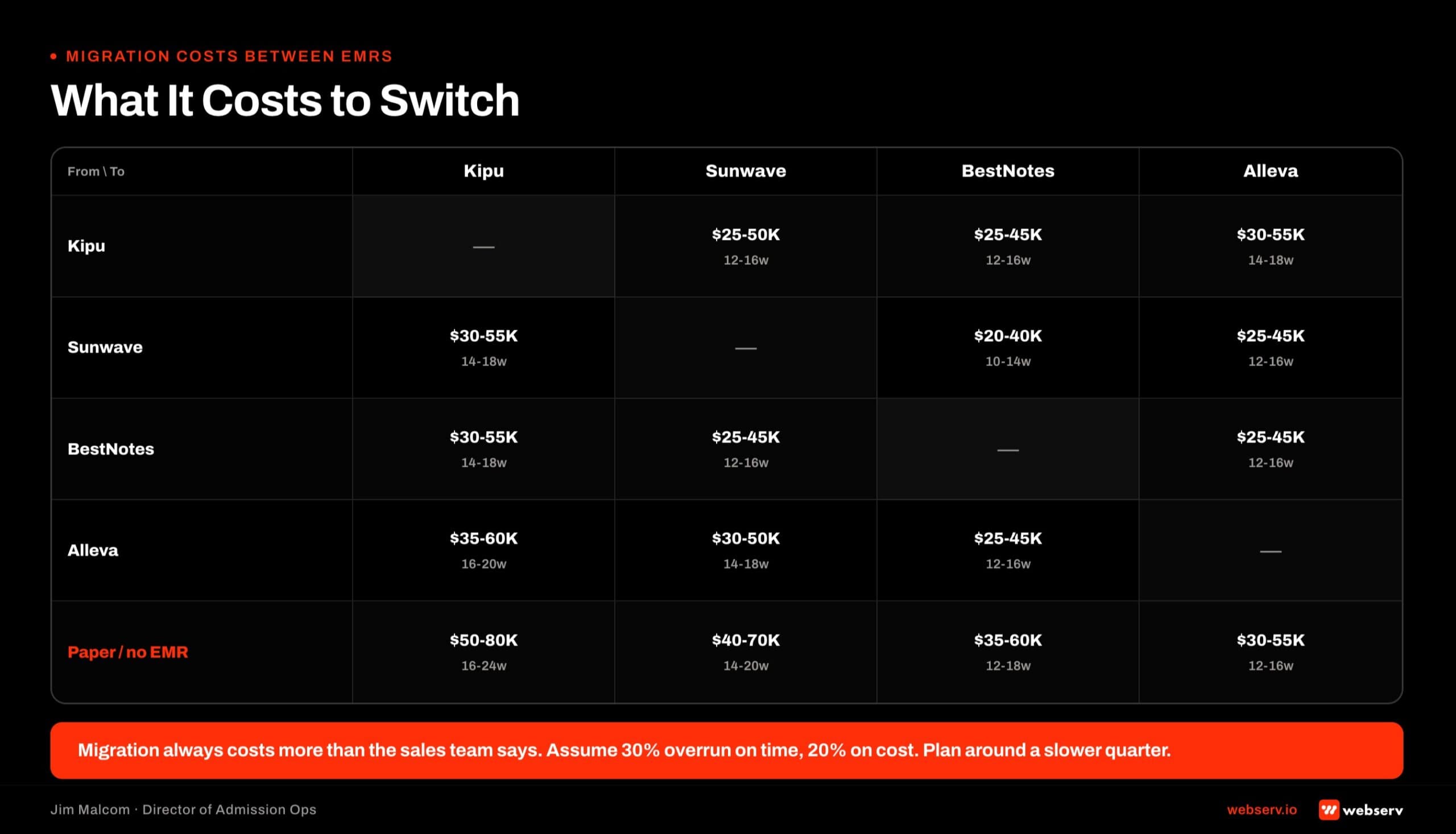
Migration Costs Between EMRs
If the current EMR is not fitting, migration is the option. It is not cheap.
Fully-loaded EMR migration cost runs $50,000 to $200,000 or more for a mid-size facility. Platform license fees on the destination. Implementation labor. Data prep. Team retraining. Productivity dip during cutover.
Timeline is 60-120 days end-to-end. Audit phase, design phase, migrate phase, cutover phase. Anyone quoting 30 days is quoting a template, not a scope. The same CRM migration playbook framework applies to EMR migration decisions.
The reconfiguration alternative. If the current EMR is 40 percent built (fields not configured, workflows not deployed, reporting not customized), reconfiguration usually beats migration. 6 weeks and $50,000 to $75,000 versus 60-120 days and $80,000 to $200,000 for migration.
The signal that migration is genuinely warranted. The current EMR cannot hold what your clinical program needs, integration to the downstream CRM cannot be built at any cost, or your coordinator team is materially failing to use the platform after real training investment.
Those three signals are structural. Everything else is usually configuration.
Facilities considering EMR migration should also read the CRM migration playbook since the same reconfigure-versus-migrate decision framework applies to both platform categories.
Total Cost of Ownership Over 3 Years
Migration cost is the number you defend to ownership when the contract is signed. Total cost of ownership is the number that actually determines which EMR is the right pick. Most operators budget for licensing plus implementation and get surprised by everything that lands in years 2 and 3.
Year 1 licensing typically runs $18,000 to $60,000 for a single-facility program on the four leading EMRs, depending on per-seat cost and typical seat count. Multi-location operations scale with facility count.
Year 1 implementation and migration typically runs $25,000 to $80,000 depending on legacy EMR complexity, data volume, and custom field surface area.
Year 1 training and change management typically runs 15 to 25% of implementation cost. This line item is where most operators under-budget. Clinical staff need training. Coordinator staff need training. Billing staff need training. The dual-entry period during migration is a productivity tax the operator absorbs.
Year 1 integration cost varies dramatically by choice of native versus middleware integration. A native connector between EMR and CRM may cost nothing beyond the license. A middleware integration through a third-party iPaaS platform can add $500 to $2,000 monthly.
Ongoing licensing (years 2 and 3) compounds at the per-seat rate. Add expected seat growth (typically 15 to 25% annually for growing operations).
Ongoing integration maintenance (years 2 and 3) covers patches, updates, and EMR API version bumps. Major EMR versions ship every 12 to 18 months, and each version release requires integration re-verification. Budget $2,000 to $8,000 annually for a single-integration surface, more for complex integration stacks.
Two hidden costs most operators miss. Change-management labor is the internal training time, dual-entry period, and coordinator productivity loss during ramp. It compounds across years 1 and 2 before the team is fully productive on the new system.
EMR version churn means the integration you built in year 1 does not stay static. Each major version bump requires integration validation and often minor rebuilds.
The EMR that looks cheapest at contract signing is rarely cheapest at 36 months. The reverse is also true. Build the 3-year TCO model before you sign, and use ranges rather than point estimates so the model survives contact with variance.
OPERATOR INSIGHT
Migration is disruptive. The bar to move is materially better economics plus a plan you can execute, not the sales team on the new platform being more responsive. If three or more of the five signals apply, the migration ROI is likely positive. If one or two apply, address the underlying issue (configuration, integration, or training) before initiating a migration.
When It’s Time to Migrate: A Decision Framework for Existing Users
Half of the audience reading a piece like this is not shopping for their first EMR. They are on Kipu wondering if it is time to move to Sunwave, or on BestNotes wondering if their outpatient program has outgrown the platform.
The migration decision looks different for existing users, and the framework needs to be more disciplined than “the new sales team is more responsive.”
Five signals it is time to consider migration:
Signal 1: You have outgrown your EMR. Either upward, meaning you have more locations than the EMR was designed for, or downward, meaning you are paying for enterprise features you do not use. Both are structural mismatches, and both compound as the operation grows.
Signal 2: Integration debt is compounding. Every new tool your operation adopts requires custom middleware because your EMR’s API is stale or thin. If the last three tool additions to your stack each required a custom integration build, the EMR is the constraint.
Signal 3: Coordinator productivity is measurably declining. Dual-entry across tools. Workflow states in the EMR that do not match how the team actually works. Coordinators building shadow spreadsheets to track what the EMR should be tracking. All three are productivity taxes that show up in speed-to-lead and VOB-to-admit conversion metrics.
Signal 4: A different EMR would materially change your unit economics. Cost per admit or LTV to CAC would shift by more than 10% if a different EMR were in place. This calculation requires actual numbers, not hopes about a different platform.
Signal 5: Your clinical team is losing time to documentation UX friction. Clinicians escaping to paper or Word documents is the tell. When clinical staff route around the EMR to get their work done, the EMR is failing at its primary job.
If three or more of the five signals apply, the migration ROI is likely positive and the decision framework should shift to timing and vendor selection. If one or two apply, address the underlying issue (configuration, integration, or training) before initiating a migration.
Migration is disruptive. The bar to move is materially better economics plus a plan you can execute, not the sales team on the new platform being more responsive.
How a Tennessee treatment center tripled its paid media close rate and cut missed calls to 1%
Full CRM configuration, system integrations, and call tracking metrics unified a fragmented admissions process into a single high-converting workflow in two months.
Read the case study →Up from 17% — missed calls cut from 15% to 1%
What a Webserv Engagement Looks Like
The Fast-Track Diagnostic is where EMR selection engagements typically start. Two-week audit of the current stack (EMR, CRM, integration), a five-question framework walkthrough, and a firm recommendation on whether to select a new EMR, reconfigure the current one, or leave both alone.
Pricing. Fast-Track Diagnostic $3,000, credited 100 percent toward month one if the facility moves forward with a full engagement. Full Admission Ops setup $7,500 to $15,000 depending on center size, CRM complexity, and integration scope.
Ongoing retainer tiers by location count: $3,500 to $5,000 per month for 1-2 locations, $5,000 to $8,000 per month for 3-5 locations, $8,000 to $15,000 per month for 6+ locations.
The bias in the recommendation is toward reconfiguration when reconfiguration is defensible. Migrations pay Webserv more in the short term. The client relationship pays back longer when the recommendation matches the operational reality, and the framework above is how we get to that recommendation honestly.
Facilities that come through the diagnostic with a clear EMR fit but a broken configuration usually reconfigure. Facilities that come through with a structural mismatch between EMR and program usually migrate. Both paths are supported inside the same engagement.
Most in-house teams hit a wall not because they lack knowledge, but because they lack bandwidth.
When you are ready to hand it off, Webserv has spent 9 years executing exactly this for treatment centers nationwide.
Frequently Asked Questions
How do I choose an EMR for a behavioral health treatment center?
Walk the five-question framework. Clinical focus of your program. Coordinator team workflow preference. CRM stack downstream. Outcomes-tracking importance. Integration budget over three years. Three or more yeses on any EMR profile usually points at that EMR.
Do not pick based on the demo. Every EMR demo is polished. The operational fit surfaces during weeks 3-6 of implementation. Bring your coordinator team into every demo you run, not just the executive who signs the contract.
Facilities that come out of the framework with two viable candidates should demo both against the specific coordinator team who will use the platform daily. The team that will document 200 clinical notes per week is a better evaluator than the executive who will see the platform in quarterly reports.
Which is the best EMR for behavioral health?
There is no single best EMR. Kipu, Sunwave, BestNotes, and Alleva all work at different facility profiles. The question is which one fits your operation, not which one is objectively best.
Kipu fits broad-spectrum BH with SUD residential focus. Sunwave fits cloud-first outpatient operators. BestNotes fits mental health and dual-diagnosis with outcomes measurement as core. Alleva fits mobile-first clinician teams and newer facilities.
The five-question framework surfaces which fit is right for your facility. Vendors will not surface that in a demo because every vendor pitches their platform as universally strong. The framework is the operator-side discipline that catches the mismatch before signing.
How much does an EMR cost for a treatment center?
Neither Kipu, Sunwave, BestNotes, nor Alleva publishes public pricing. All four price on facility size, user seats, and integration complexity. Facilities evaluating each should get quotes for the specific admit volume and coordinator headcount they will run.
Directional ranges from portfolio observations. Kipu tends to run higher on license fees but lower on integration ecosystem cost. Sunwave and BestNotes are middle-of-the-market. Alleva is often the most accessible license fee but the integration ecosystem is less mature.
Total cost of ownership over three years matters more than year-one license fee. Factor middleware costs, integration maintenance, and any workarounds the platform requires when a native feature does not exist. The cheapest EMR license fee can become the most expensive stack when middleware overhead accumulates.
Should I switch EMRs if my clinicians are frustrated?
Only if the frustration is a genuine operational constraint. Kipu, Sunwave, BestNotes, and Alleva all have workflow features that some coordinators love and others struggle with. Frustration alone is not a migration signal.
The migration signal is when the current EMR structurally cannot hold what your clinical program needs, when integration to the downstream CRM cannot be built at any cost, or when your coordinator team is materially failing to use the platform after real training investment. Those three signals are structural.
Everything else is usually configuration or training. A 6-week reconfiguration engagement typically resolves frustration that a $150,000 migration would not.
How does the EMR choice affect my admissions CRM?
The EMR-CRM integration is often more consequential than the EMR choice itself. Kipu integrates cleanest with Dazos through native connectors. Sunwave has native Dazos integration. BestNotes and Alleva both lean middleware.
Salesforce and HubSpot integrations to any of the four EMRs require middleware. That middleware is a real ongoing cost that changes the three-year total cost of ownership calculation.
Facilities greenfielding both EMR and CRM should evaluate the pair together. Facilities that already run Dazos have more EMR flexibility than facilities running Salesforce or HubSpot with an existing middleware layer to work around.
How long does it take to switch EMRs at a treatment center?
60 to 120 days end-to-end for a mid-size facility. Audit phase (2-3 weeks). Design phase (2-4 weeks). Migrate phase (4-8 weeks). Cutover phase (1-2 weeks including hypercare).
Anyone quoting 30 days is quoting a template. Behavioral health data models, clinical documentation workflows, and integration surfaces do not compress into a month regardless of platform. The 60-day floor is a realistic minimum for a clean facility. 120 days is realistic for a facility with data hygiene work.
Fully-loaded cost runs $50,000 to $200,000 or more. Platform license fees, implementation labor, data prep, team retraining, and productivity dip during cutover. That is why the selection framework matters upfront. Getting the choice right at day one avoids the cost.
What breaks most often on behavioral health EMR implementations?
Selection failures. The EMR was chosen based on the demo without walking the operational fit framework. Six weeks into implementation, the coordinator team is working around the platform instead of with it. The implementation team is doing custom configuration to make the EMR do things it was not designed for.
The other common failure mode is ignoring the CRM stack downstream. The EMR was evaluated in isolation. Integration cost surprises show up 60-90 days in. The middleware maintenance overhead accumulates as a hidden cost that was not in the original evaluation.
The fix for both is a rigorous selection framework at day one. Five questions. Coordinator team in the demos. CRM stack in the evaluation. Outcomes tracking weighted correctly for the operating model. Three-year total cost of ownership modeled, not just year-one license fee.
What’s the difference between HL7 and FHIR, and does my EMR need to support both?
HL7 v2 is the older messaging standard most behavioral health EMRs still use for lab results, ADT feeds, and payer eligibility checks. FHIR is the modern API-first standard replacing it, mandatory for federal interoperability compliance as of 2022.
Your EMR needs FHIR support if you plan to exchange clinical data with hospital systems, MAT pharmacies, or state health information exchanges. For most single-facility treatment centers, HL7 support is sufficient today. For multi-state operations, hospital-referral-heavy admissions, or any facility planning to participate in a state HIE, FHIR support is a hard requirement.
The tell is to ask each EMR vendor which FHIR resources they support and whether the support is read-only or read-write. “We are working on FHIR” means no.
How long does an EMR migration typically take for a mid-size treatment center?
90 to 120 days end-to-end for a facility running 40 to 100 admits per month. Discovery and data audit take 3 to 4 weeks. Configuration and integration build take 4 to 6 weeks. Production migration and stabilization take 4 to 6 weeks.
Two things reliably blow up the timeline. Undocumented custom fields in the old EMR that only one person understands, and an integration surface (CRM, phone system, billing platform) that turns out to be more brittle than anyone believed at the start.
Budget for at least a 30% timeline buffer. Any implementation partner promising a shorter timeline is either underestimating scope or planning to skip the stabilization phase, which is where most silent data-loss bugs surface.
Should we run our old EMR and new EMR in parallel during migration?
Yes, for a defined window, usually 2 to 4 weeks. Both systems live, both being written to by the team, with the new EMR gradually taking over authoritative status per patient cohort. New admits go to the new EMR first, then in-house existing patients, then discharged records.
The parallel window is expensive because it doubles licensing, doubles data entry, and doubles coordinator time. It is cheaper than the cost of finding out three months post-cutover that custom outcomes fields did not migrate cleanly and now you cannot produce the report your board wants.
Cap the parallel window with a hard end date. Open-ended parallel deployments become permanent parallel deployments, and the productivity tax accrues indefinitely.
Can we integrate our CRM with the new EMR before we cut over, or do we have to wait?
You can and should build the CRM to new EMR integration in a staging environment during the configuration phase (weeks 5 to 8), test it against migrated sample data in weeks 9 to 10, and go live with the integration on the same day the EMR cuts over.
Trying to build the integration after cutover is a common mistake. Coordinators end up dual-entering for weeks. Custom fields get built in the CRM that do not match the new EMR’s schema. The integration becomes a permanent afterthought that never gets the attention it needs.
Design the integration surface as part of the EMR selection process. If you cannot articulate how your CRM will sync to the new EMR on day one, you are not ready to sign the contract.
Closing Note From the Admission Ops Floor
EMR selection is not a “which is best” question. It is a “which fits my operation” question.
Every EMR vendor will tell you their platform is universally strong. Every operator I have walked through the five-question framework has ended up with one or two EMRs that clearly fit and two or three that clearly do not.
Walk the framework before demos. Bring the coordinator team into every demo. Factor integration with the downstream CRM. Weight outcomes tracking honestly. Model three-year total cost of ownership.
If you want the Webserv team to run the framework against your specific facility, start with the $3,000 Fast-Track Diagnostic. Credited 100 percent toward month one if you move forward with a full engagement.
Jim Malcom is the Director of Admission Ops at Webserv. He has spent his career inside behavioral health admissions operations (call floors, VOBs, CRMs, and the reporting stack that ties them together) and now leads the Webserv admission ops practice for treatment center operators nationwide.