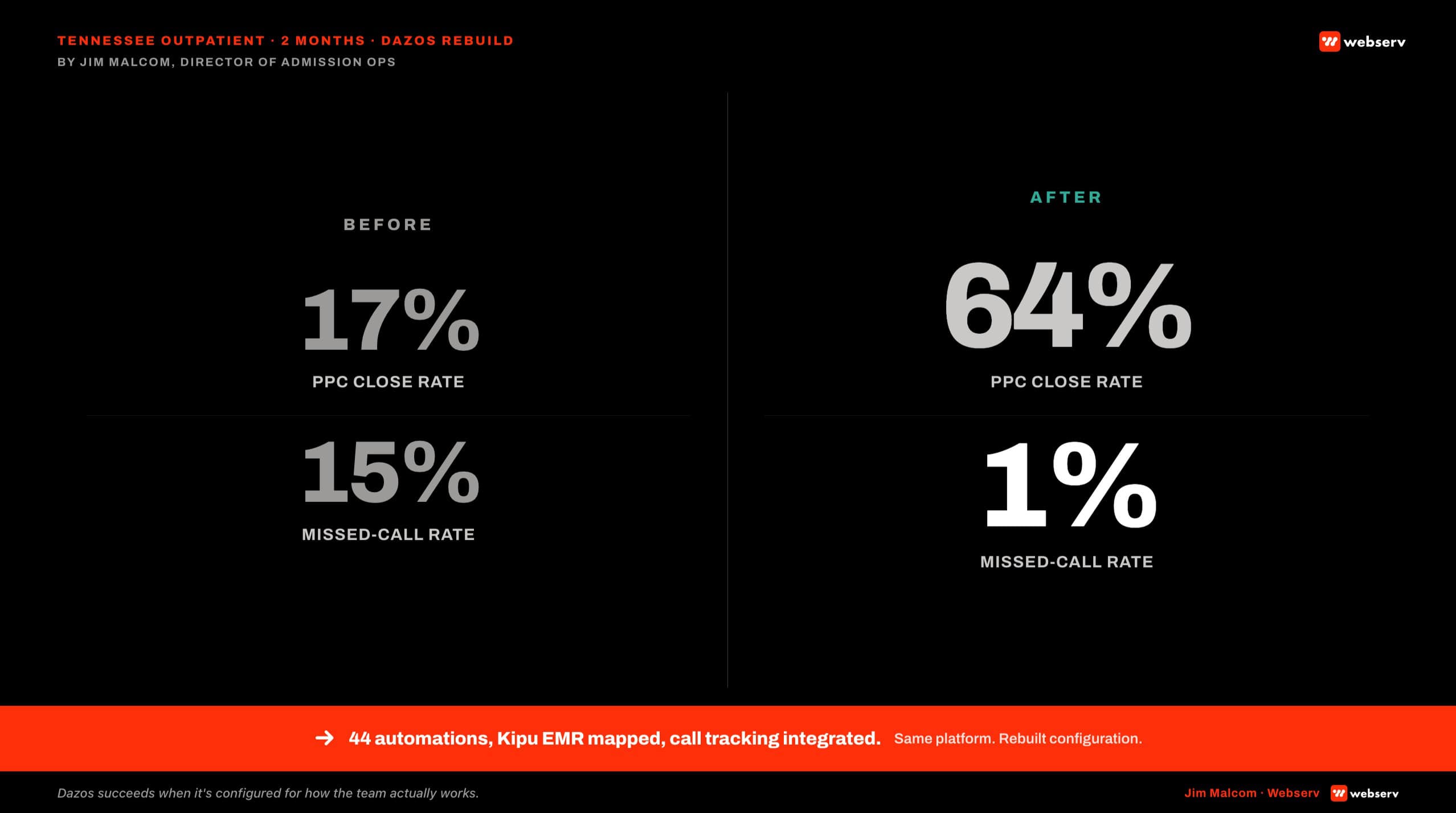
A Tennessee mental-health outpatient came to Webserv with Dazos already installed and a PPC close rate stuck at 17 percent. The operator’s assumption was that the platform was broken. The platform was not the problem. The configuration was.
Nothing about Dazos had been mapped to how the admissions team actually worked. Fields existed. Nobody used them. Automations were never deployed. Reporting was gut, not data.
Two months after Webserv’s admission ops team rebuilt the CRM from the ground up, the same team, the same platform, and the same marketing spend produced a 64 percent PPC close rate and dropped missed calls from 15 percent to 1 percent.
The marketing did not change. The admissions engine did.
Disclosure: Webserv is a Dazos implementation partner. That relationship is why we have deployed the platform inside enough behavioral health facilities to see the pattern this article describes, and why we are upfront about the cases where a different CRM is the right pick.
The partnership does not change how we evaluate a facility’s needs. Webserv does not receive commissions on Dazos license sales.
Key Takeaways
- A Tennessee behavioral health outpatient came to Webserv with Dazos already installed and a PPC close rate stuck at 17 percent. Two months of rebuild (same platform, same team, same marketing spend) moved that rate to 64 percent and dropped missed calls from 15 percent to 1 percent.
- Dazos is a behavioral-health-native CRM. That is a starting point, not a solution. Installing the platform is table stakes. Configuring it around a facility’s actual admissions workflow is the work that moves the numbers.
- The Tennessee rebuild deployed 44 automations across intake, VOB, and referral workflows, integrated CallRail for call tracking, and bidirectionally mapped Kipu EMR for patient sync. Every one of those was a configuration choice, not a platform feature.
- Dazos wins at small-to-mid facilities and 2-8 location portfolios where admissions is the operational bottleneck. It is not always the right pick for enterprise portfolios of 20+ facilities with dedicated Salesforce admins and heavy custom development budgets. Salesforce Health Cloud or a customized HubSpot can be defensible in those environments.
- Three failure modes account for most underperforming Dazos deployments: mistaking install for configuration, no automation deployment, and no reporting layer. All three show up on facilities that thought Dazos was the fix and skipped the configuration work.
- A Webserv Dazos implementation runs the 6-week Admission Ops sprint: onboard and audit, lead tracking, CRM pipeline, VOB workflow, training and launch. One-time setup is $7,500 to $15,000. Retainer runs $3,500 to $15,000 per month depending on portfolio size.
- Webserv is a Dazos implementation partner. We disclose that openly. The partnership is why we see the pattern this piece describes and why we are direct about the cases where Dazos is not the right CRM.
What Dazos Is Built For
DAZOS SHIPS WITH THE BEHAVIORAL HEALTH OBJECT MODEL OUT OF THE BOX
VOB with structured fields for expected reimbursement, prior-auth flags, and payer product type. Alpha prefix routing on member IDs. Level of care and referral partner attribution. Coordinator scorecards visible to the coordinator, not just the manager. Dazos IQ as the built-in analytics and reporting layer. A generic CRM has to be built to that specification. Dazos starts there.
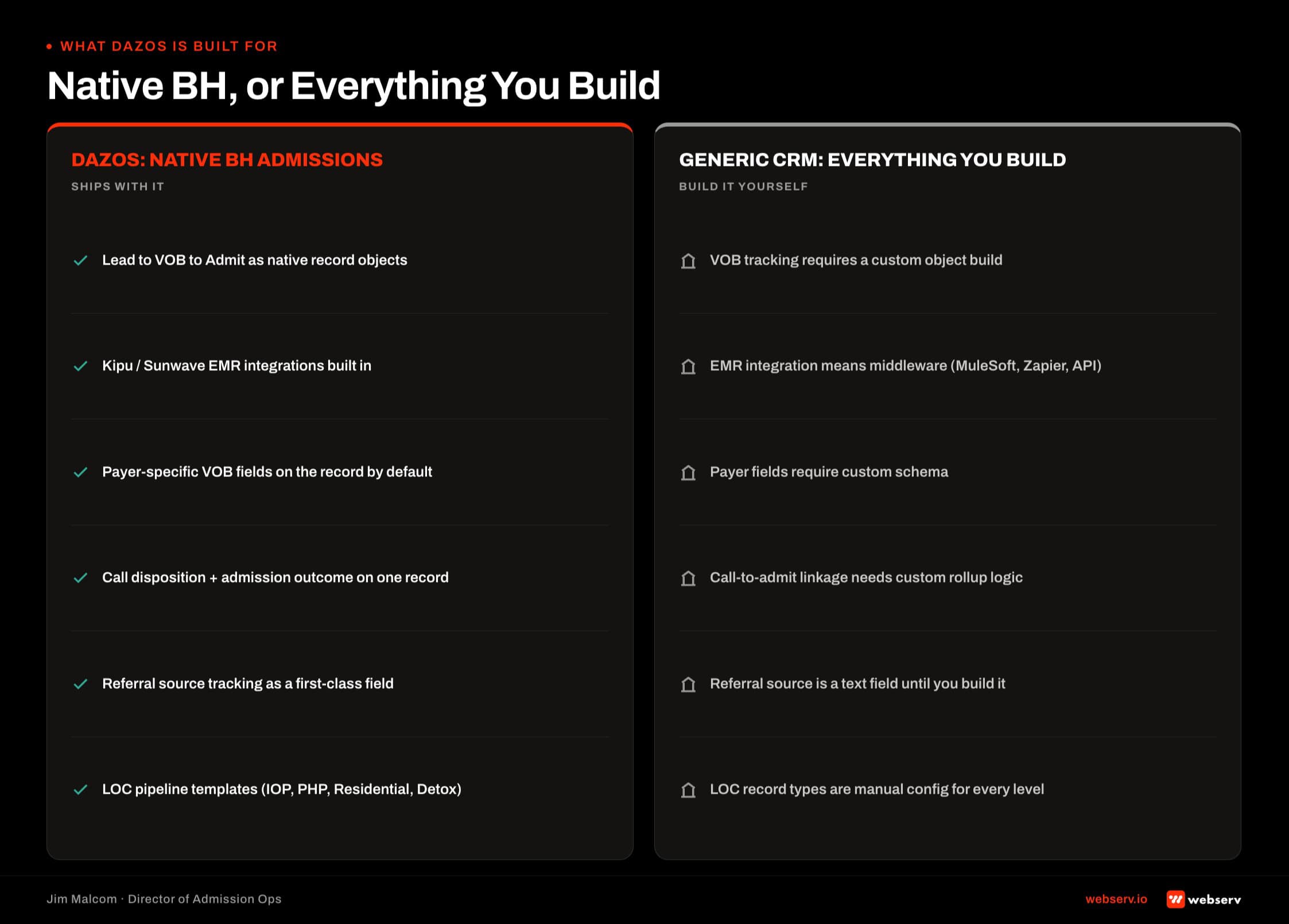
Dazos is a behavioral-health-native CRM. The field structure, VOB workflow, coordinator ergonomics, and admissions logic shipped with the platform already know what an alpha prefix, a level of care, a payer product type, and a coordinator scorecard are.
Generic CRMs like Salesforce and HubSpot can absolutely run a behavioral health facility. The difference is that every one of those objects has to be built as a custom object with a custom workflow, which is typically a four-to-six-month build before the platform produces value.
Behavioral health admissions volumes are concentrated at facilities with structured intake and referral workflows. Facilities without formalized admissions operations show materially lower conversion rates from referral to admit (SAMHSA, National Survey on Drug Use and Health).
Admissions infrastructure, not marketing spend, is what determines the conversion result at a treatment center. Dazos is admissions infrastructure by default.
When Dazos Wins vs When It Doesn’t
Dazos wins at small-to-mid single-brand facilities and 2-8 location portfolios where admissions is the operational bottleneck and the team wants a behavioral-health-native workflow without a 6-month Salesforce build.
Dazos is not always the right pick for enterprise portfolios of 20+ facilities with dedicated Salesforce admins, heavy custom development budgets, and existing enterprise data lakes. In those environments, Salesforce Health Cloud or a heavily-customized HubSpot instance can be the defensible pick.
Disclosure: Webserv is a Dazos partner. We have deployed Dazos across dozens of behavioral health facilities, which is why we have seen where the platform wins and where it doesn’t.
In the enterprise-portfolio scenarios above, we have recommended Salesforce Health Cloud or a heavily-customized HubSpot instead of Dazos. We will say so directly in the diagnostic phase of any engagement.
The honest cut is that most treatment centers are not enterprise portfolios. They are single-brand or small-portfolio operators where the four-to-six-month generic-CRM build is time and budget they do not have. Dazos exists to remove that build. That is the operational fit.
The Tennessee Implementation: 44 Automations That Rebuilt the Engine
The anchor case. A Tennessee mental-health outpatient came to Webserv running Dazos already, PPC close rate 17 percent, missed calls 15 percent, admissions team frustrated. The platform was in place. Nothing was mapped to how the team actually worked.
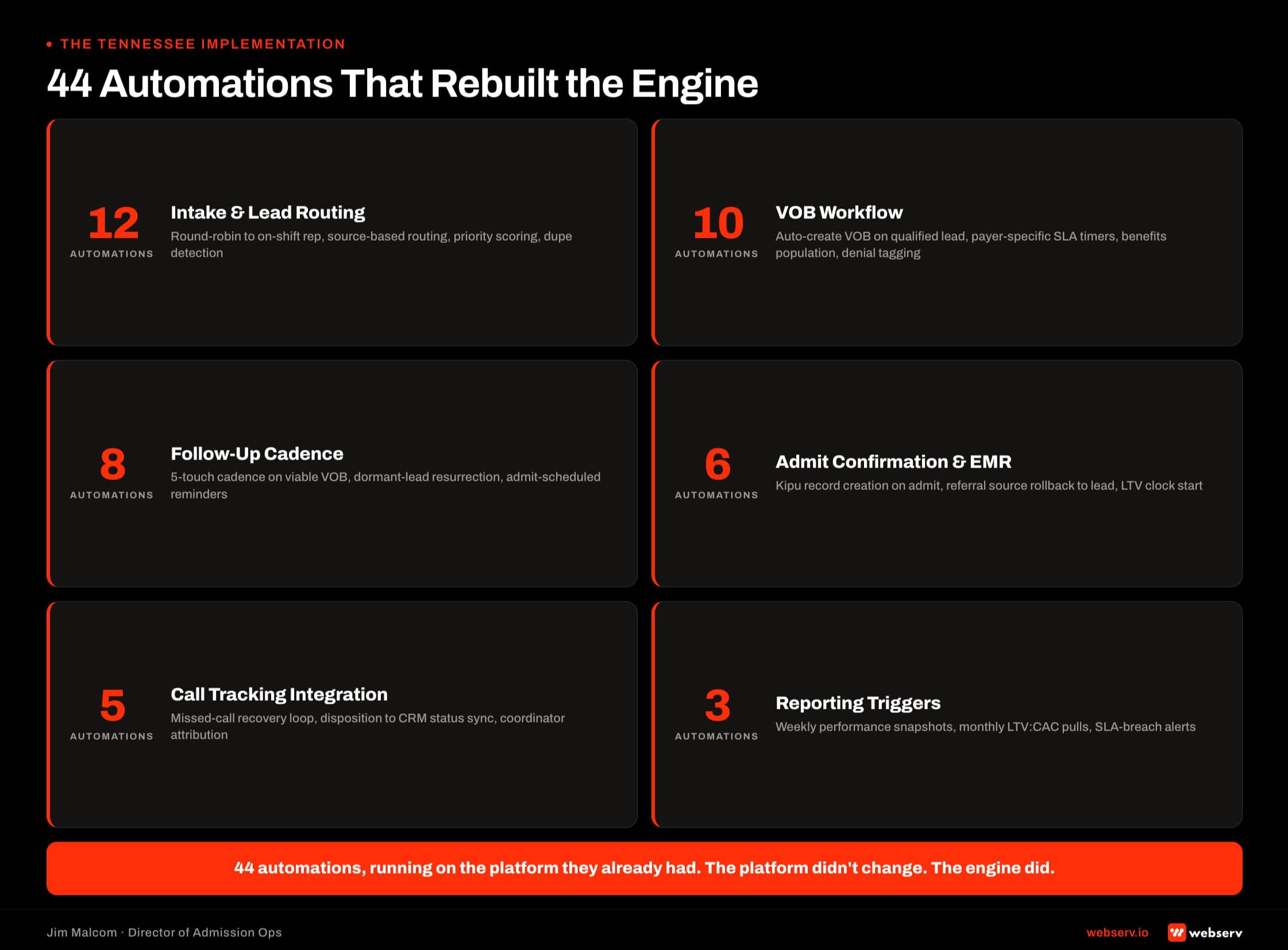
Webserv rebuilt the CRM from the ground up. Four workstreams inside a six-week sprint.
- Call Tracking Integration. CallRail routed and logged every inbound call, with campaign source metadata attached to the Dazos lead record on creation. Missed-call SMS follow-up triggered inside 60 seconds. Missed call rate moved from 15 percent to 1 percent inside the first month.
- Kipu EMR Bidirectional Mapping. Patient-level sync so admissions never re-entered discharge status and clinical never re-entered admit source. Both systems held one truth about the patient. The handoff between admissions and clinical stopped being manual data entry.
- 44 Workflow Automations. Intake auto-assignment by shift. VOB task creation on status change. Referral partner tag routing. Prior-auth flag surfacing at admission decision time. Coordinator scorecard population from live call data. Every automation removed a manual step the coordinators had been doing on top of the platform.
- Dazos IQ Reporting Layer. Custom dashboards for admissions director, coordinator lead, and CEO. Leadership decisions moved from gut to data the CRM already held. The KPI spine every admissions CRM should carry finally lived where the admissions team could see it.
The results. PPC close rate 17 percent to 64 percent in two months. Missed call rate 15 percent to 1 percent. Same coordinators. Same marketing spend. Same clinical program. Same Dazos license.
The marketing didn’t change. The admissions engine did.
Configuration Choices That Actually Move Admissions
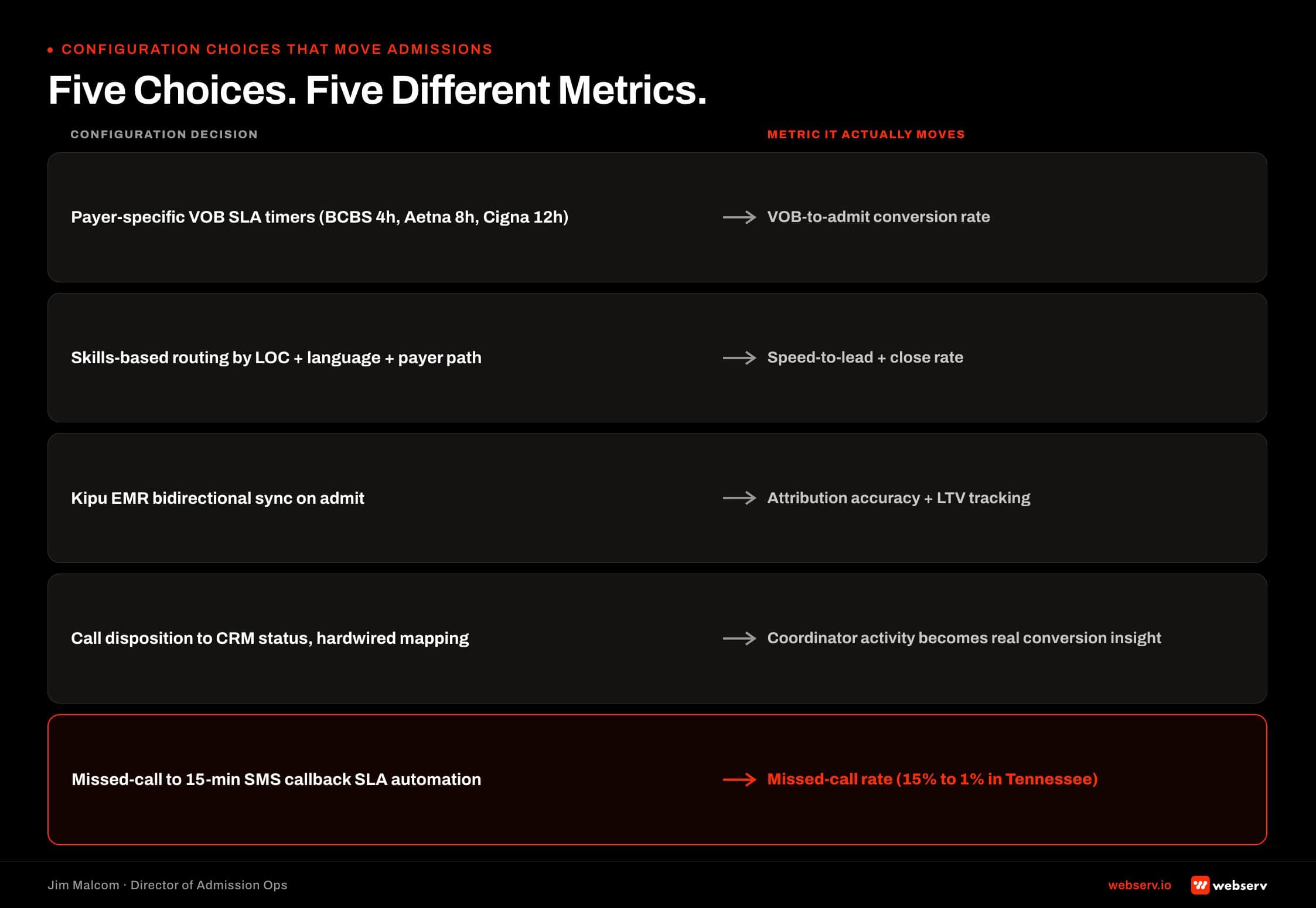
The Tennessee case is one instance of a pattern. Six configuration choices consistently move admissions when Dazos is deployed correctly, and consistently fail to move admissions when the choices go unmade.
Pipeline stages that match the actual admissions journey, not the vendor’s default template. Every facility has its own definition of what “hot,” “warm,” and “committed” mean. The template does not.
VOB object with structured fields for expected reimbursement, prior-auth flags, and payer product type. This is where the KPI spine every admissions CRM should carry starts producing coordinator-visible data.
Source attribution wired into call tracking and form capture, so every lead carries its source through admit. If admits by source is not accurate, marketing spend is guessing.
Coordinator scorecards visible to the coordinator, not just the manager. Scorecards used only for review become a compliance exercise. Scorecards the coordinator sees daily become a coaching tool.
Prior-auth and medical-necessity flags surfaced at admission decision time, not billing time. This is the flag that keeps admissions from accepting cases the payer will down-code 60 days later.
Missed-call escalation with SMS follow-up inside 60 seconds. This is the single largest and cheapest lift most facilities have available. The Tennessee move from 15 percent to 1 percent lived here. It also connects to the broader admissions process framework.
Evaluating Dazos Against a Generic CRM
DAZOS VS GENERIC CRM SCORECARD
Behavioral health field customization: Dazos out-of-the-box, generic requires custom object build. VOB workflow: Dazos native object, generic requires custom object plus workflow build. Dashboard flexibility: Dazos IQ ships tight-to-purpose, Salesforce Reports and HubSpot Reports are more flexible but require an admin. Coordinator ergonomics: Dazos single-pane admissions workflow, generic multi-tab enterprise UI. Time-to-value: Dazos 6-8 weeks configured, generic CRM 4-6 months of custom build. Total cost of ownership over three years: Dazos platform plus implementation, generic CRM license plus admin FTE plus implementation partner.
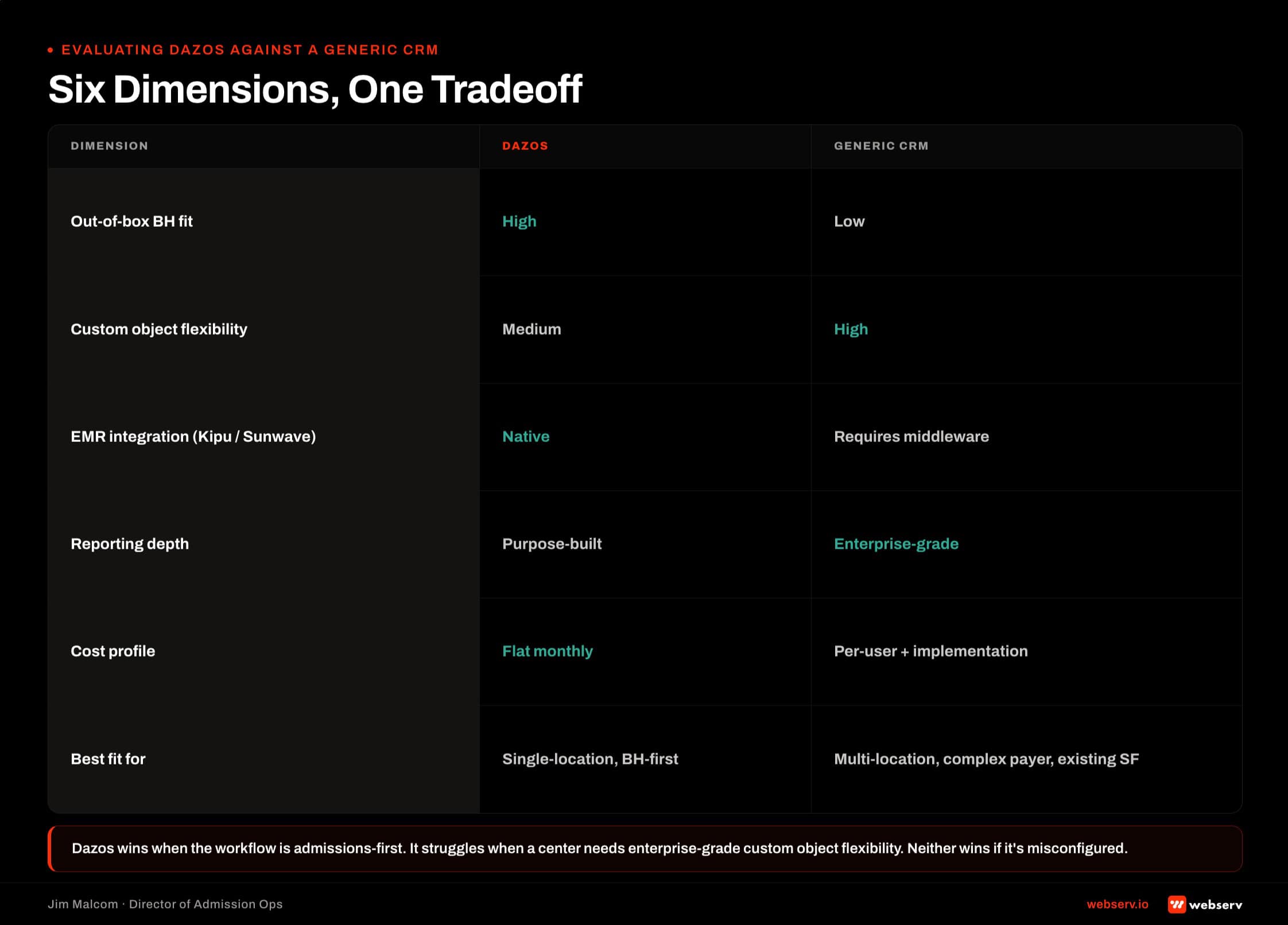
Facilities running a real evaluation should compare against the CRM shortlist for behavioral health with those six dimensions in mind.
The answer is almost always Dazos for small-to-mid operators and portfolios in the 2-8 location range. The answer is sometimes Salesforce Health Cloud for enterprise portfolios that already carry Salesforce infrastructure.
The tradeoff is not about which platform is better. It is about which platform fits the operational profile of the facility running the evaluation.
Common Dazos Implementation Failures
Three failure modes account for most underperforming Dazos deployments. All three show up on facilities that assumed the platform itself would move the numbers and skipped the workflow build underneath.
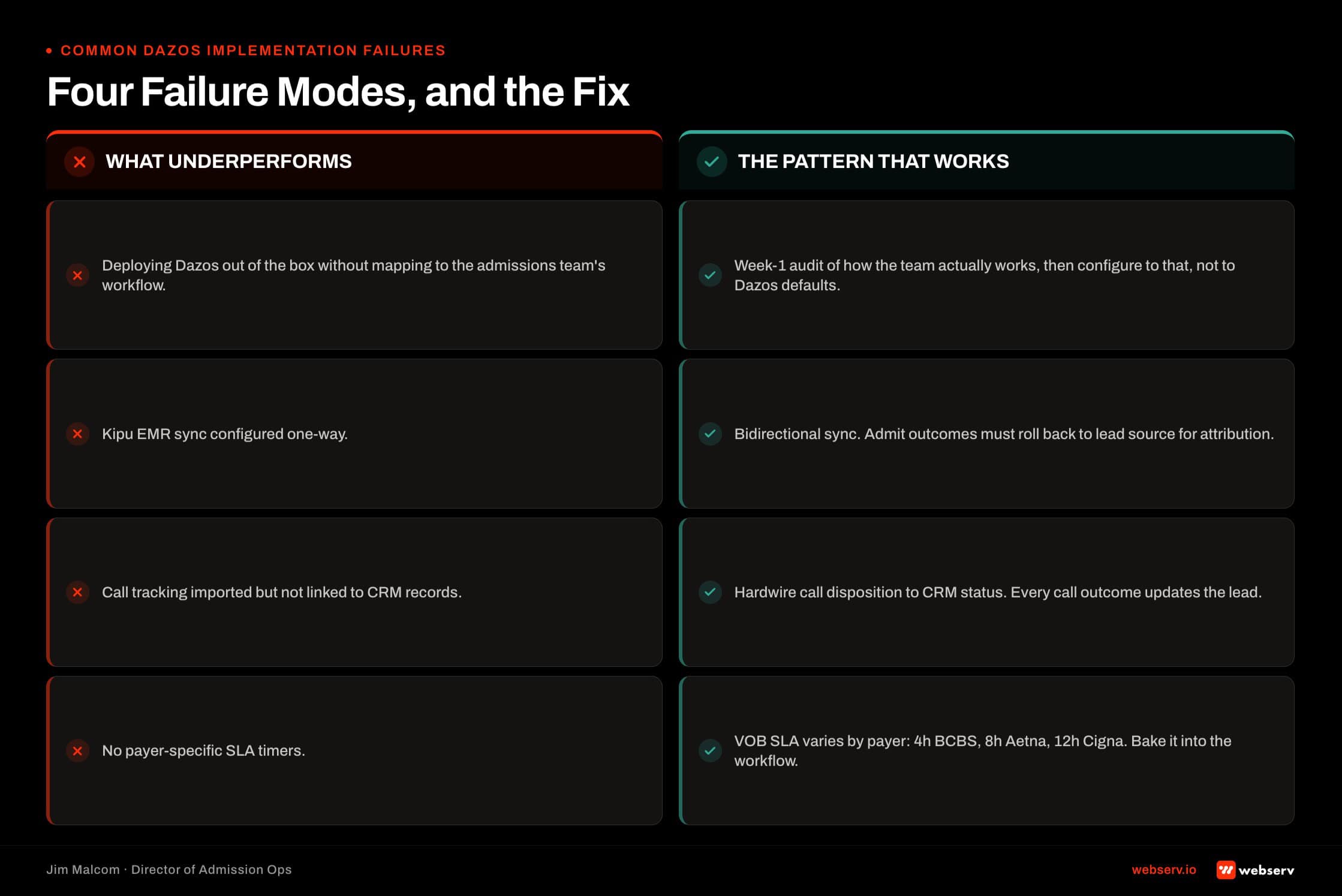
Mistaking install for configuration. Dazos was deployed, but nothing was mapped to the facility’s actual admissions workflow. Fields exist. Nobody is using them. The CRM becomes a contact database with a behavioral health skin.
Healthcare CRM implementations that include workflow configuration and automation deployment produce measurable admissions improvements. Install-only deployments produce minimal ROI (HFMA, Revenue Cycle Management).
No automation deployment. Coordinators are still doing manual task creation, manual follow-up, manual VOB status updates. The platform is a filing cabinet with a login.
This is the coordinator hostage dynamic that stalls admissions CRMs: the coordinators are doing work the CRM should be doing, and no reporting layer surfaces the gap.
No reporting layer. Dazos IQ was never turned on or was turned on with default dashboards nobody looks at. Leadership makes decisions on gut, not on data the CRM already holds. Turning Dazos IQ on is not the same as making it useful.
Integrating Dazos With Call Tracking, EMR, and Billing
Integration mechanics at operator depth. The three surfaces every treatment center has to wire.
Call tracking. CallRail is the default integration, but Twilio or vanity DID stacks also work. The pattern is the same: every call routes and logs into Dazos with source metadata attached to the lead record, so admits by source is accurate through the funnel.
EMR. Kipu is dominant in outpatient behavioral health, with Sunwave and a handful of others in play. The integration goal is bidirectional patient sync, so admissions doesn’t re-enter discharge status and clinical doesn’t re-enter admit source.
Both systems hold one truth about the patient. The admissions hub and its integration surface is where that handoff design happens.
Billing. External billing systems or in-house RCM. The admit-to-billing handoff carries structured payer and product-type metadata so RCM inherits the reimbursement expectation the VOB captured. Anything less and reimbursement expectation gets rebuilt inside billing from scratch.
What a Webserv Engagement Looks Like
The Webserv Dazos implementation runs a 6-week Admission Ops sprint.
Week 1, Onboard and Audit. Kickoff, intake assessment, gap map, roadmap.
Week 2, Lead Tracking. Call tracking configuration and source mapping into Dazos.
Week 3, CRM Pipeline. Pipeline stages, automations, early reporting.
Week 4, VOB Workflow. VOB object built out with prior-auth flags and status tracking.
Weeks 5-6, Training and Launch. Playbooks, QA feedback loops, live coordinator training.
Pricing: one-time setup $7,500 to $15,000 depending on center size, CRM complexity, and integration scope. Ongoing retainer $3,500 to $5,000 per month for 1-2 locations, $5,000 to $8,000 per month for 3-5 locations, $8,000 to $15,000 per month for 6+ locations.
The Fast-Track Diagnostic is the low-friction entry: $3,000, credited 100 percent toward month one if the facility moves forward. Three-day audit of the current CRM configuration, call tracking posture, and reporting layer. Delivers a gap map, prioritized punch list, and a clear stay-or-reconfigure recommendation.
For the fuller admissions technology stack, see behavioral health marketing guide and HubSpot for treatment center admissions.
Frequently Asked Questions
Who helps treatment centers implement Dazos?
Webserv implements Dazos for behavioral health treatment centers as a formal Dazos partner. Implementation runs a 6-week Admission Ops sprint that configures pipeline stages, deploys automations across intake and VOB workflows, integrates call tracking (typically CallRail) and EMR (typically Kipu), and stands up the Dazos IQ reporting layer.
The partnership matters because Dazos is a behavioral-health-native CRM, and behavioral health admissions operations have specific field structures, coordinator ergonomics, and payer workflows that a generalist Salesforce or HubSpot consultant will rebuild from scratch. Webserv has deployed Dazos across dozens of facilities and treats the implementation as one of four core admissions-attribution decisions.
A Tennessee mental-health outpatient came to Webserv with Dazos already installed and a PPC close rate of 17 percent. Webserv rebuilt the configuration (44 automations, CallRail integration, Kipu EMR mapping) and the close rate moved to 64 percent in two months on the same platform.
Is Dazos worth it for a behavioral health facility, or is a generic CRM better?
For most small-to-mid facilities and 2-8 location portfolios, Dazos is the better pick because the field structure, VOB workflow, and coordinator ergonomics ship out-of-the-box. Generic CRMs like Salesforce or HubSpot can absolutely run a behavioral health facility, but every custom object has to be built and every workflow has to be automated from scratch. That is typically a 4-to-6-month build before the platform produces value.
Dazos is not always the right pick for enterprise portfolios of 20+ facilities with existing Salesforce admins, heavy custom development budgets, and integrated enterprise data lakes. In those environments, Salesforce Health Cloud or a heavily-customized HubSpot instance can be the defensible pick.
Webserv is a Dazos partner and discloses that openly. The partnership is why the pattern is visible. It is also why the honest answer in the enterprise-portfolio case is that a different CRM is sometimes the right pick.
What does a Dazos implementation actually cover at a treatment center?
A real Dazos implementation covers pipeline configuration, automation deployment, VOB workflow, call tracking integration, EMR mapping, coordinator training, and a reporting layer built on Dazos IQ. Installation is a first day of week one. The rest of the six-week sprint is where the numbers actually move.
Webserv’s 6-week sprint runs onboard and audit (week 1), lead tracking configuration (week 2), CRM pipeline build (week 3), VOB workflow (week 4), and training and launch (weeks 5-6). The Tennessee engagement deployed 44 automations across intake, VOB, and referral workflows.
Facilities that skip the configuration phase and treat “install” as “implementation” produce the failure mode most operators recognize: the platform exists, nobody uses the fields, and admissions runs the way it did before. Configuration is the work.
What are the most common Dazos implementation failures?
The three most common failure modes are mistaking install for configuration, no automation deployment, and no reporting layer. All three show up on facilities that assumed the platform itself would move the numbers and skipped the workflow build underneath.
Install-only deployments look active on the surface. Leads land, records exist, coordinators log in. But the fields nobody configured stay empty, and the workflow nobody automated stays manual. The CRM becomes a contact database with a behavioral health skin.
Reporting is the failure mode leadership notices last. Dazos IQ ships with default dashboards, but a facility that never customizes them is making admissions decisions on gut instead of on data the CRM already holds.
How does Dazos compare to Salesforce or HubSpot for behavioral health admissions?
Dazos ships with a behavioral-health-native object model. VOB, alpha prefix, payer product type, level of care, coordinator scorecards, and referral partner routing all exist out-of-the-box. Salesforce and HubSpot require every one of those objects to be built as a custom object with a custom workflow. The full CRM buyer’s guide compares the shortlist side by side.
Time-to-value is the sharpest difference. Dazos is production-ready in 6-8 weeks with proper configuration. Salesforce Health Cloud or a heavily-customized HubSpot instance is a 4-6 month build followed by ongoing admin overhead. Total cost of ownership over three years favors Dazos for most small-to-mid facilities.
Dashboard flexibility and enterprise data-lake integration are the areas where Salesforce genuinely wins. For a 20+ facility portfolio with a dedicated Salesforce admin, that flexibility can outweigh the behavioral-health-native starting point Dazos offers.
What does a Webserv Dazos implementation cost?
The one-time setup fee for a Webserv Admission Ops engagement, which includes Dazos configuration, is $7,500 to $15,000 depending on center size, CRM complexity, and integration scope. Ongoing retainer runs $3,500 to $5,000 per month for 1-2 locations, $5,000 to $8,000 per month for 3-5 locations, and $8,000 to $15,000 per month for 6+ locations.
Facilities that want to see the diagnostic before committing to a full engagement can run Webserv’s Fast-Track Diagnostic for $3,000. If the facility moves forward with a full Admission Ops engagement, that $3,000 is credited 100 percent toward the first month.
The pricing scope covers CRM implementation, call tracking configuration, VOB workflow, training, and the ongoing performance reporting cadence that keeps the admissions engine running past week 6.
Closing Note From the CEO
Dazos is not a fix. It is a platform with more behavioral-health-native capability than any other CRM in the category. Like every platform, it produces the results the configuration underneath it deserves.
The Tennessee engagement is the case that made that clearest to me. Same platform, same team, same marketing spend, and the numbers moved because the configuration finally matched how the admissions team actually worked.
If you are evaluating Dazos, running Dazos and not seeing the numbers, or weighing Dazos against a generic CRM, book an intro meeting with the Webserv admission ops team.
We will tell you honestly whether Dazos is the right pick for your facility. If it is, we implement it. If it isn’t, we say so.
Preston Powell is the CEO of Webserv. Webserv is a Dazos implementation partner and serves 200+ behavioral health treatment centers through its Admission Ops, Paid Media, and SEO practices.