Every treatment center marketing budget I audit has the same structural bias. Media spend gets scrutinized to the campaign level. SEO gets tracked to the keyword.
Reporting cadence runs weekly, monthly, and quarterly. And creative production sits inside the budget somewhere between “agency retainer” and “misc,” under-audited, under-briefed, and under-invested against the job it actually has to do.
The best media buyer in the world cannot rescue starved creative. The best SEO team cannot compensate for a landing page that reads like a template. Our guide to behavioral health marketing covers the full program, and our creative strategy guide for rehab marketing covers the creative layer.
And in 2026, with Meta asking advertisers for genuinely diverse creative, AI Mode citations selecting for structurally distinctive content, and Google’s core updates favoring helpful, clearly authored content, the treatment centers still treating creative as an afterthought are compounding their own problem by the quarter.
This piece is the argument for why that pattern exists, what it costs, and what changes when a treatment center operator stops treating creative as an add-on and starts treating it as the highest-elasticity input in the paid media program.
Key Takeaways
- Treatment center marketing budgets systematically under-invest in creative because the industry vocabulary for creative ROI is missing, while media and SEO have well-defined KPIs.
- The under-investment produces four downstream failures: Meta algorithm starvation, brand indistinguishability against competitors, ad fatigue that gets misattributed to platform issues, and creative-to-landing-page mismatch that worsens with every algorithm update.
- The four incentive traps that reinforce the pattern are media buyer bonusing on ROAS not creative quality, agencies marketing SEO and paid as their sophisticated services, operators arriving from clinical or operations backgrounds rather than brand, and creative production feeling organizationally external.
- The variant win rate, hook engagement in the first three seconds, and AI Overview citation share on destination pages are the three KPIs that would give creative the reporting seat it needs but almost never gets in a rehab marketing dashboard.
- The 30-day fix is not more money into creative; it is naming a creative KPI dashboard, standing up a variant-level reporting discipline, writing a creative brief document that every variant has to justify itself against, and treating creative as a first-class line item rather than a support function.
The evidence that creative is an afterthought
Walk into any treatment center marketing meeting and ask three questions. What is the CPL trend on the top three campaigns. What is the organic session trend on the top three landing pages. What is the variant win rate on ad creative shipped in the past 90 days.
The first two questions get real answers with real numbers. The third question produces a pause, a look toward whoever manages the agency relationship, and eventually some version of “I don’t know, let me check with them.”
That pause is the whole argument. The absence of a ready answer to the creative question, in a room where the media and SEO answers were fluent, is the operational tell that creative is not being tracked the way the other lines are being tracked.
The evidence extends into org charts. Most mid-sized treatment centers have a director of marketing, an admissions marketing manager, and an agency relationship or two.
They rarely have a creative director. They rarely have a creative operations manager. They almost never have a variant-testing calendar or a creative brief document that governs what gets produced.
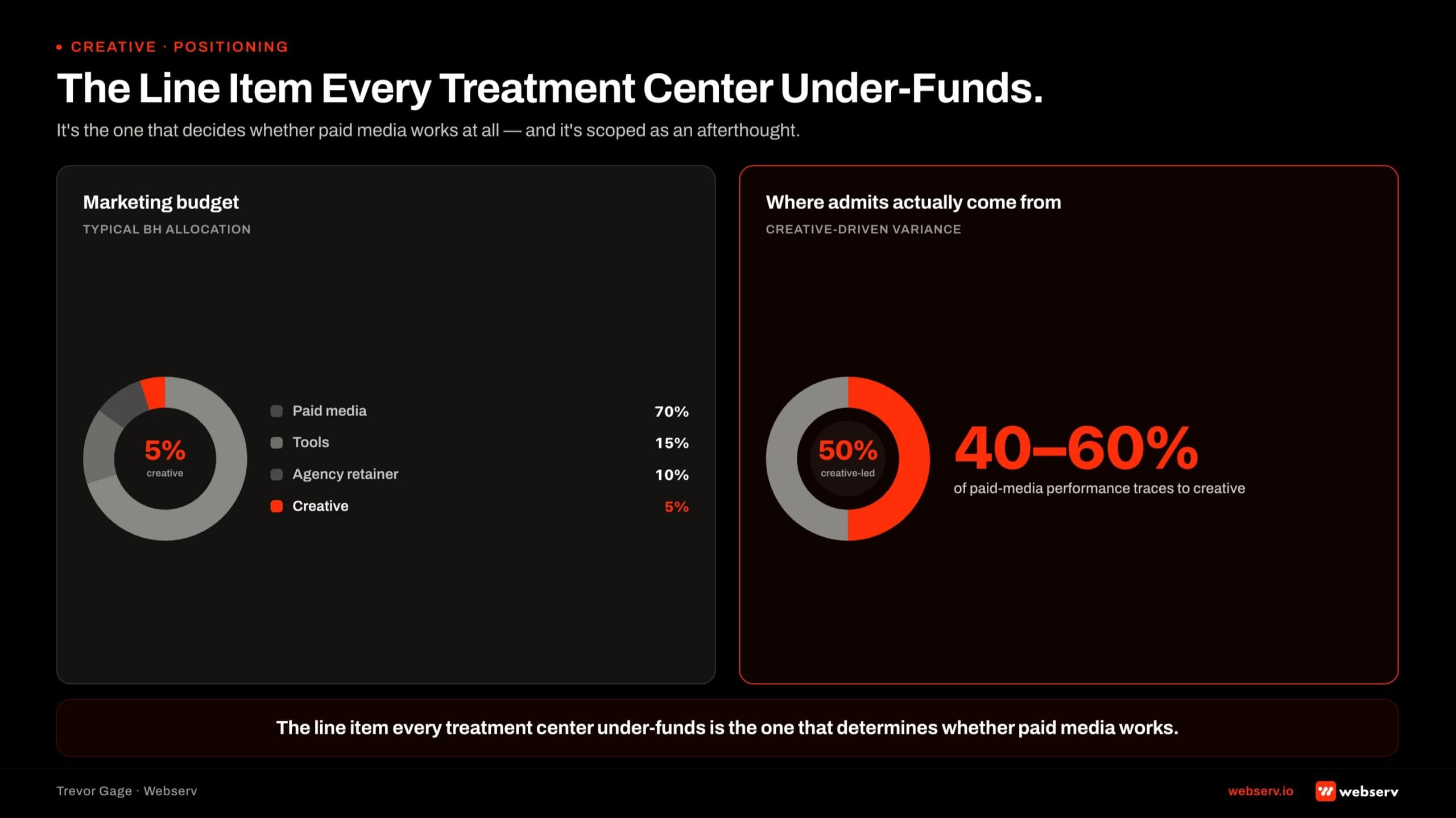
And the evidence extends into budgets. When I audit a treatment center’s marketing spend, media typically takes 55 to 70% of the budget, SEO and content take 15 to 25%, tools and attribution take 5 to 10%, and creative production takes whatever is left over, typically 5 to 12%.
That percentage on creative is the smallest line item, and it is producing the input that Nielsen’s catalyst analysis found drives roughly 47% of ad campaign sales contribution, and later Nielsen research published by Meta credited creative quality with 56% of campaign ROI.
The bias is not accidental. It is structural.
Why the vocabulary is missing
Media has CPL, CPA, ROAS, blended CAC. SEO has organic sessions, keyword rankings, position, click-through rate. Both disciplines have twenty years of accumulated vocabulary that lets a director of marketing look at a dashboard and know within thirty seconds whether things are going in the right direction.
Creative has… what? Impressions, technically. Engagement rate, sometimes. Video view rate, occasionally. None of those metrics tell an operator whether the creative is doing its job at the variant level.
And no widely adopted vocabulary exists for the questions that actually matter: how often does a new variant beat the account benchmark, how long does a winning variant stay winning, what percentage of production ends up in the active set versus the retired set.
The consequence is that creative work gets discussed in adjective form (this ad is “good,” that ad is “not landing,” this brand feels “off”) while media and SEO get discussed in metric form. Adjectives lose budget battles to metrics every time.
Until behavioral health marketers speak about creative in the same quantitative vocabulary they use for media and SEO, creative will keep losing the internal budget conversation. The problem is not that creative is inherently unmeasurable. It is that the industry has not built the shared language to measure it in.
The four downstream failures the under-investment produces
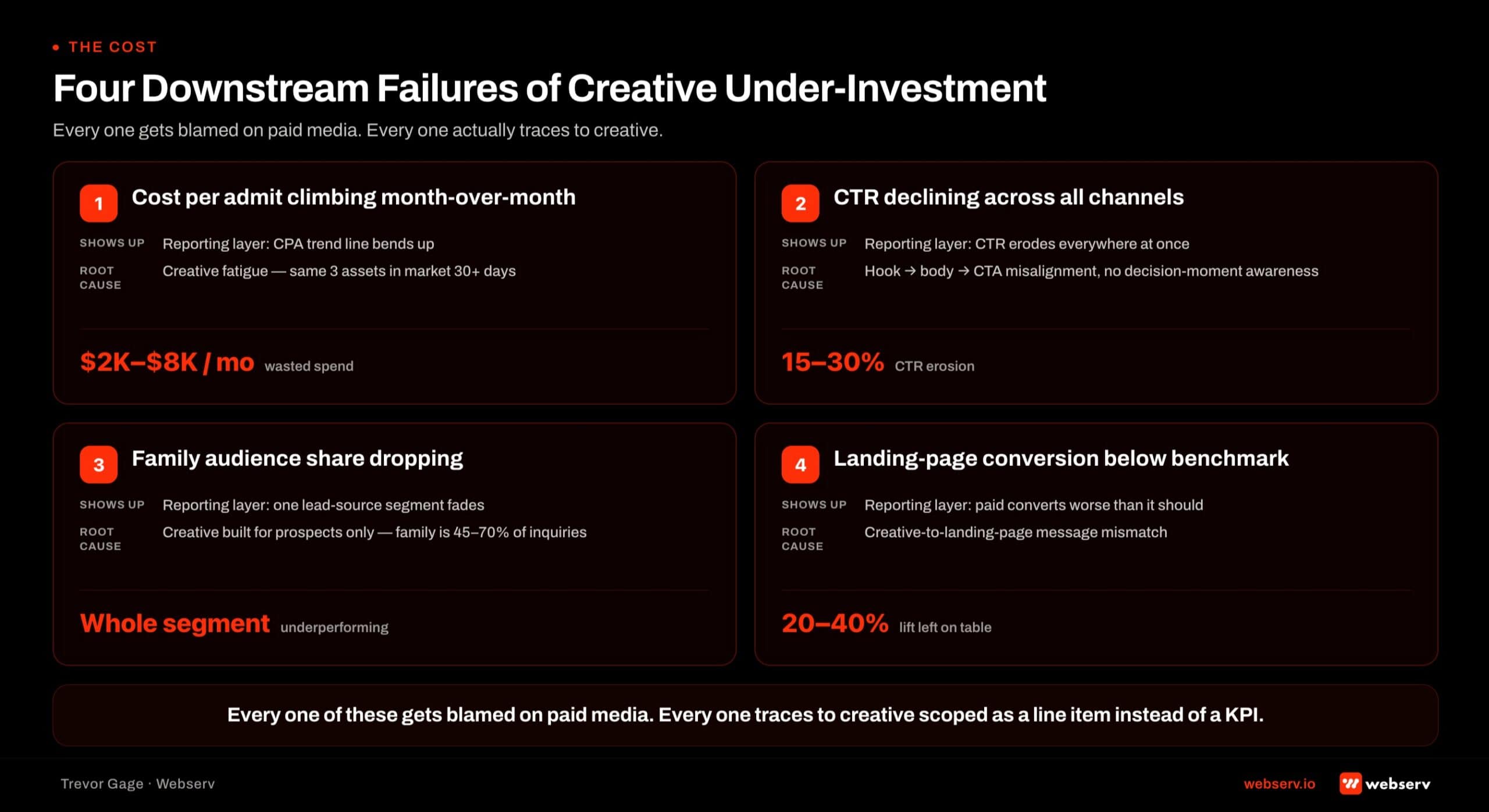
The systematic under-investment in creative produces a specific set of failure modes that show up predictably in rehab marketing programs. Each one gets misdiagnosed as a media problem, a targeting problem, or a platform problem, and each one is actually a creative problem masquerading as something else.
The first failure is Meta algorithm starvation. Meta’s own guidance on creative diversification says Advantage+ gets the best results from genuinely different ads, and accounts that ship a handful of near-identical creatives give it nothing to choose from.
Treatment centers producing four to six new variants per quarter are running an algorithm that is starving for signal, producing CPL drift that gets attributed to iOS 14 changes, audience saturation, or platform pricing when the actual cause is that the algorithm does not have enough creative to learn from.
The second failure is brand indistinguishability. Every rehab website in the country uses some combination of the same handful of stock images (couples on beaches, hands reaching upward, group therapy circles), the same headline structures (“Your recovery starts here”), and the same call-to-action patterns.
Under-invested creative operations default to templates, and templates converge on the market average. Convergence at the market average is invisibility.
The third failure is ad fatigue misattributed to platform issues. When creative volume is too low, the same variants run against the same audiences for weeks or months, and performance degrades.
The operator interprets the degradation as “Meta is broken” or “our targeting is off,” when the actual cause is that the algorithm has shown the same three ads to the same 40,000 people 25 times each. The Ad Fatigue for Treatment Centers piece unpacks this specific pattern in depth.
The fourth failure is creative-to-landing-page mismatch. Underinvested creative pipelines produce ads that point at whatever landing page happens to exist, rather than at pages specifically built to match the creative promise.
The May 2026 Google Core Update reweighted YMYL ranking against templated location pages and unnamed-author service content. Creative pointing at those pages is now producing spend that lands nowhere useful, and the mismatch gets worse with every algorithm cycle.
Each of these failures presents as a different marketing problem, and each one traces back to the same root cause: the marketing budget treated creative as the leftover line item.
COMMON MISTAKE
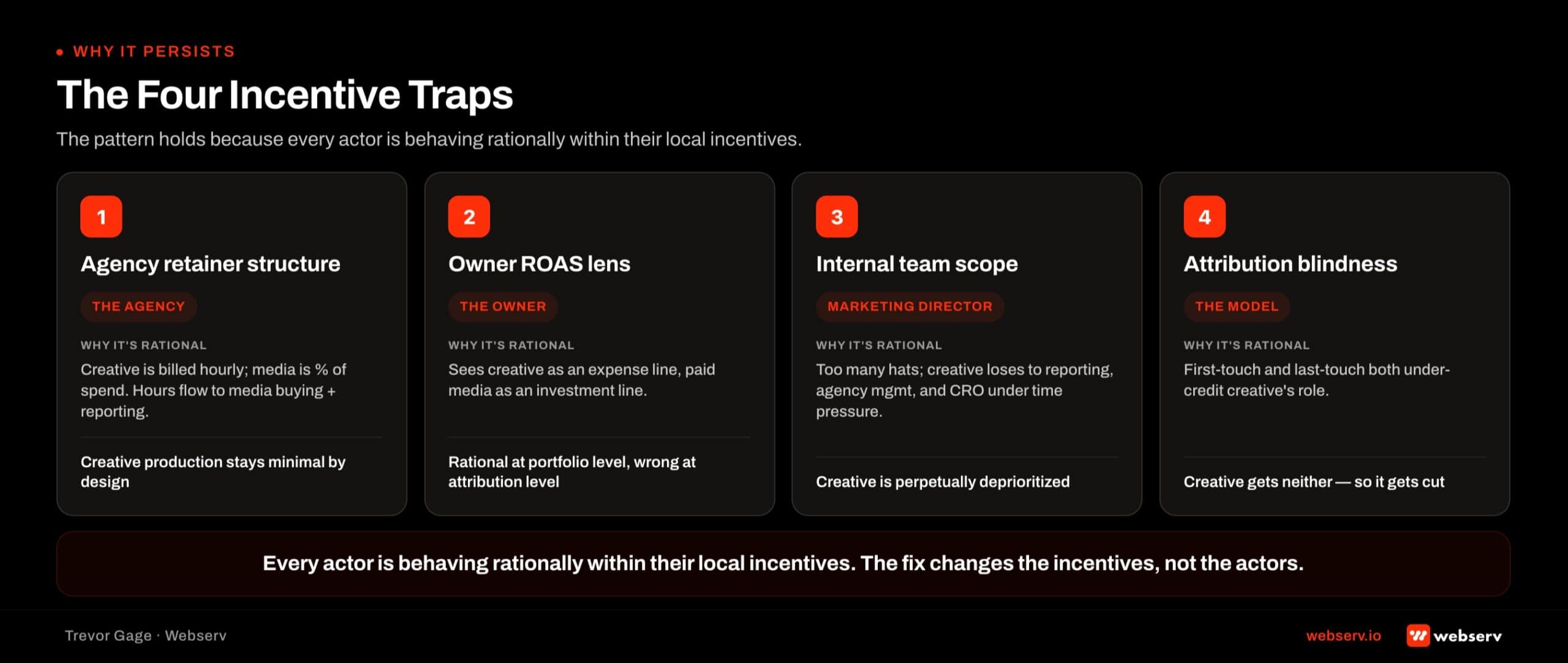
Media buyers get bonused on ROAS, not creative quality. Agencies price and position SEO and paid media as their sophisticated services, and creative as a value-add. Operators arrive from clinical or operations backgrounds, not brand. And creative production sits outside the marketing team’s daily operational routine. Together these four locally rational incentives produce the structural under-investment.
The four incentive traps that keep the pattern in place
The under-investment is not stupidity. It is a set of aligned incentives that make treating creative as an afterthought locally rational for most of the people making the decision. Naming the traps is the first step to fixing them.
The first trap is that media buyers get bonused on ROAS, not on creative quality.
A media buyer whose compensation depends on hitting a CPL target has every incentive to run whatever creative is available at whatever volume is available, and no incentive to advocate for more or better creative unless the account is actively on fire.
Media buyers become the invisible governors of creative volume, and their incentives are pointed away from advocating for more.
The second trap is that agencies market SEO and paid media as their sophisticated services and creative as a value-add.
Walk into any behavioral health marketing agency’s capabilities deck and the SEO section runs 12 slides deep, the paid media section runs 15 slides deep, and the creative section runs three slides showing a mood board.
Agencies price and position what they consider their differentiated work, and the market has decided that channel management is differentiated while creative is commodity.
Operators absorb that pricing and positioning as the truth about what matters.
The third trap is that most treatment center operators come from clinical or operations backgrounds, not brand or creative backgrounds. A COO who spent 15 years running admissions before becoming an operator has been trained to think about census, insurance mix, and clinical outcomes.
That operator’s intuition about creative is thin, and the natural response is to defer to whoever seems confident, which is usually the media buyer arguing for more spend on channels rather than more spend on creative.
The fourth trap is organizational. Creative production usually sits outside the marketing team’s daily operational routine. The team runs a Monday standup on campaign performance, a Wednesday check on lead volume, and a Friday review of the funnel.
Creative production runs on some other cadence, in some other Slack channel, or with some other agency, and it does not show up in the operational review until something breaks. What lives outside the routine gets treated as outside the priority stack.
None of these traps is a moral failure. Each one is a locally rational response to how the industry has organized itself. Together, they produce a structural under-investment that compounds every year.
OPERATOR INSIGHT
The moment creative shows up on the Monday standup dashboard alongside CPL and organic sessions, three second-order effects follow. The creative agency relationship gets professionalized. The internal creative brief becomes a real document. And the media buyer starts treating creative as an input they advocate for rather than a variable they receive. None of it requires new money.
What changes when creative gets a KPI seat
The specific change I have watched turn around treatment center marketing programs is when creative gets its own line on the Monday standup dashboard. Not as an agency deliverable check-in. As a first-class KPI review.
Three KPIs, tracked weekly. Variant win rate: of new variants shipped in the past 30 days, what percentage are still active and beating account baseline CPL. Hook engagement rate: on video creative, what percentage of viewers watch past the first three seconds relative to account benchmark.
AI Overview citation share on destination pages: for the top five landing pages the creative points at, are those pages appearing as AI-cited sources on the queries the campaigns target.
Once those three numbers are in the room every Monday, three second-order effects follow.
The first is that the creative agency relationship gets professionalized. When the creative director or agency counterpart has to walk into the Monday standup with variant-level performance data, the production cadence changes.
Shipping five unrelated variants a month becomes shipping five variants clustered around a hypothesis. Waiting three weeks between reviews becomes reviewing weekly. Discretionary output becomes disciplined output.
The second is that the internal creative brief becomes a real document.
When variants have to justify themselves against a KPI, the brief that produced them has to be specific enough that the variant’s performance is attributable to a specific hypothesis. Vague briefs produce vague creative. Specific briefs produce testable creative.
The third is that the media buyer starts treating creative as an input they advocate for rather than a variable they receive.
When the CPL trend is dropping and the variant win rate is dropping in parallel, the media buyer’s fastest path to hitting their target is to push for more and better creative, not to squeeze another 5% out of audience optimization. The incentive gradient realigns.
None of that requires new money. It requires that creative be visible in the operational dashboard the way media and SEO already are.
Creative as the highest-elasticity input
The strategic frame that reorients an operator’s relationship with creative is that creative has the highest elasticity of any input in the paid media stack. A 10% improvement in media buying discipline produces perhaps a 3 to 5% CPL improvement in a mid-tier rehab account.
A 10% improvement in creative quality produces a 20 to 40% CPL improvement, sometimes more, because creative sits earlier in the funnel and compounds through the click-through, the landing page match, and the conversion moment.
Elasticity means that the same dollar produces a bigger outcome depending on where it lands. Ad creative in behavioral health is the single most elastic input available. The dollar spent on creative production has more effect on admits than the dollar spent on audience refinement, ad-set optimization, or bid strategy.
That elasticity is why the systematic under-investment matters. Operators are not just under-investing in creative. They are under-investing in the input that produces the biggest downstream gain per dollar. The opportunity cost is not proportional. It is disproportionate.
The Ad Creative Strategy Ultimate Guide covers the tactical structure that unlocks that elasticity. What this piece adds is the argument for why doing that work matters in the first place, and why doing it produces returns nothing else in the paid stack can match.
The 30-day fix
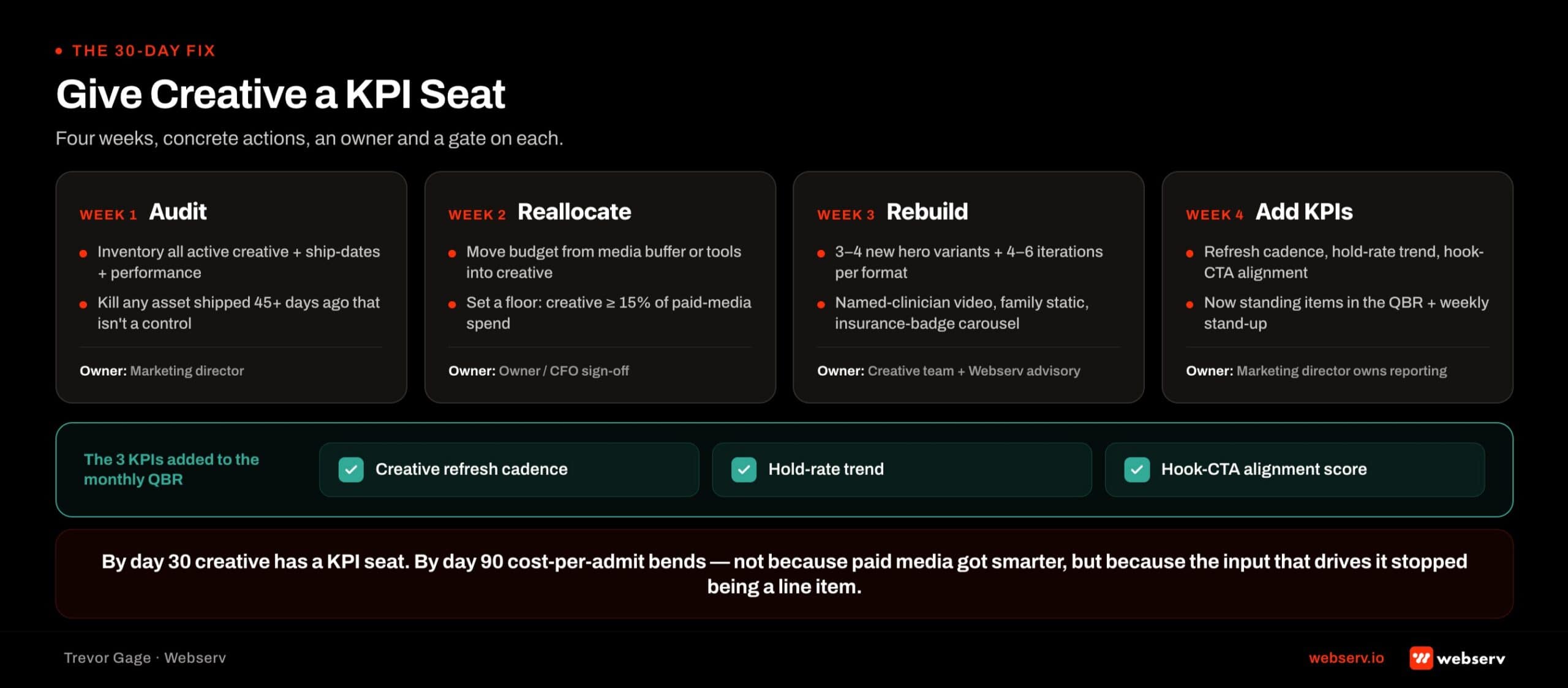
The specific work that shifts a treatment center from treating creative as an afterthought to treating it as a first-class discipline sequences into four moves inside 30 days.
Week 1 is the KPI dashboard. Add variant win rate, hook engagement, and AI Overview citation share to the marketing dashboard. Assign one person to own the numbers. Report them in the Monday standup the same way CPL and organic sessions get reported.
Week 2 is the creative brief document. Write the standing brief that every variant has to justify itself against. Include audience, voice, decision moment, compliance constraints, and the specific admissions outcome the creative connects to. One page, referenced by every production cycle.
Week 3 is variant-level reporting. Whether the creative work is in-house or agency, restructure the reporting cadence so that new variants get reviewed at the variant level, not the ad-set level.
This may require a conversation with the agency about how their reporting is set up, and that conversation is worth having.
Week 4 is the creative director or creative operations role. For most treatment centers, this is a fractional or contract role rather than a full-time hire in the first pass.
Someone whose job is specifically the creative pipeline, the brief discipline, and the production cadence, sitting either inside the team or embedded from the agency side. What matters is that the role exists and the person in it is accountable for the KPIs on the dashboard.
None of these four moves requires new media budget. Each one changes what happens inside the existing budget, and the compound effect over a quarter is typically a 20 to 40% CPL improvement without a single new campaign or targeting change.
The Creative Strategy for Behavioral Health Marketing umbrella walks the broader operating model this fix sits inside.
The uncomfortable conclusion
The hard part of this argument is not the diagnosis. Every operator I talk to nods when I describe the pattern.
The hard part is that the fix requires operators to give creative a status inside the marketing organization that most of them have never given it, and that status change is culturally uncomfortable.
Creative directors are not the norm in behavioral health marketing. Variant-level reporting is not the norm. Creative briefs that govern production are not the norm.
Making these things the norm means treating creative work with the same rigor an operator brings to admissions ops, insurance verification, or clinical protocol. That level of rigor applied to what an operator may have been treating as “marketing stuff” is a substantial cultural adjustment.
The operators who make the adjustment separate themselves from the ones who do not.
The gap widens every quarter that the industry keeps producing 15 to 30 tested creative variants at accounts that need 40 to 60 active, and the treatment centers that professionalize their creative discipline first will be running an operational advantage over the ones that leave creative as an afterthought.
The math is not close. The elasticity of creative dwarfs every other input available. The vocabulary gap is fixable in 30 days. And the industry has been treating this as a solved problem for a decade while shipping four variants per quarter.
Frequently Asked Questions
Why do treatment center operators under-invest in creative if the ROI is so high?
The pattern is structural, not personal. Media buyers get bonused on ROAS, not creative quality. Agencies price and position SEO and paid media as their differentiated services, and creative as a value-add.
Most operators arrive from clinical or operations backgrounds, not brand backgrounds, so creative intuition is thin. And creative production usually sits outside the marketing team’s daily operational routine, so it stays outside the daily priority stack.
None of these forces is a moral failure. Each one is a locally rational response to how the industry has organized itself. Together they produce a structural under-investment that compounds every year until the operator explicitly counter-balances the pattern.
What are the specific KPIs that would give creative a reporting seat?
Three metrics get creative to the level of measurement discipline that media and SEO already have. Variant win rate, meaning what percentage of new variants shipped in the last 30 days are still active and beating account baseline CPL.
Hook engagement rate, meaning what percentage of viewers watch past the first three seconds of video creative relative to account benchmark. AI Overview citation share on destination pages, meaning whether the landing pages the creative points at are appearing as AI-cited sources.
Once those three numbers are in the Monday standup, the whole conversation about creative changes shape. Vague quality debates convert into specific hypothesis-and-test cycles.
How much of a treatment center’s marketing budget should go to creative production?
Our working rule is 15 to 20% of Meta media spend going to creative production. Most treatment centers we audit put 5 to 12% of total marketing budget there, which is why creative starvation is so common.
The exact percentage varies by spend tier and channel mix. A Tier 1 program with $30,000 monthly total spend can run a working creative discipline at $4,000 to $6,000 monthly.
A Tier 3 program with $250,000 monthly needs to be spending $40,000 to $60,000 on creative production to keep the Meta pipeline fed at Advantage+ requirements. Under those thresholds, the operator is buying creative output rather than a creative program.
What is the fastest signal that a treatment center is under-invested in creative?
The simplest diagnostic is to open the Meta Ads Manager, filter to active ads across the past 30 days, and count. If the number of active variants is under 20 for a Tier 2 or Tier 3 program, the creative pipeline is starving the algorithm.
The second diagnostic is to ask the marketing team what the variant win rate is on ads shipped in the past 90 days. If nobody in the room can answer within 30 seconds, creative is not being tracked at the level required to produce forward progress.
Both diagnostics can be run in under ten minutes and both are load-bearing tells about whether creative is being treated as a first-class discipline or a leftover line item.
Trevor Gage is Director of Marketing at Webserv, a behavioral health marketing agency working with residential, outpatient, and telehealth treatment providers across the United States. He leads Webserv’s SEO, content, and AI search practice. If you want the operator read on where your creative discipline actually sits inside the current paid media logic, start with a Visibility Gap conversation.